Back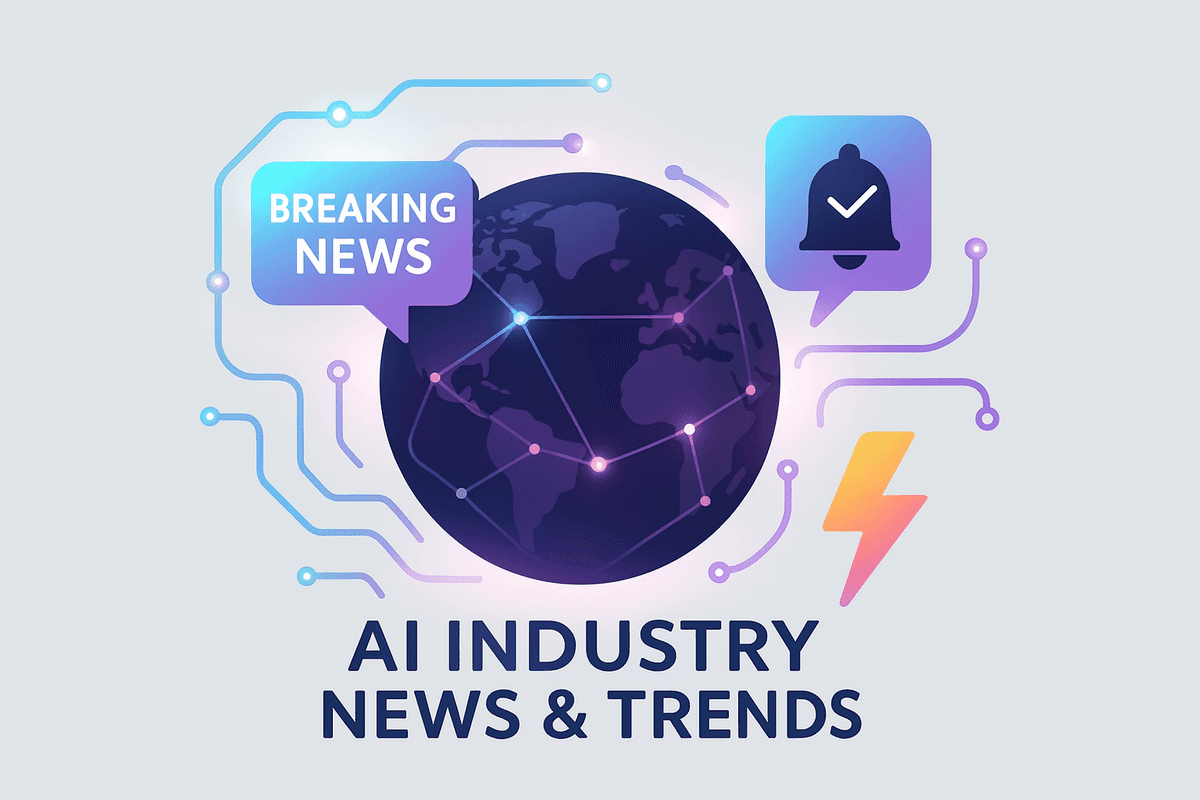
Collection93 articles
AI Industry News & Trends
Stay ahead of the curve with the latest AI breakthroughs, emerging models, and industry-shaping developments that are transforming technology and society
Curated Articles & Updates


AI News Today August 5 2026: 16 Biggest Stories
August 05, 2026

AI News Today August 4 2026: 16 Biggest Stories
August 04, 2026

Qwen3.8-Max Review: Specs, Pricing & Honest Take
August 03, 2026

AI News Today August 3 2026: 16 Biggest Stories
August 03, 2026

AI News Today August 2 2026: 16 Biggest Stories
August 01, 2026

AI News Today July 30 2026: 16 Biggest Stories
July 30, 2026

AI News Today July 29 2026: 16 Biggest Stories
July 29, 2026

AI News Today July 28 2026: 16 Biggest Stories
July 28, 2026

AI News Today July 27 2026: 16 Biggest Stories
July 27, 2026

AI News Today July 24 2026: 16 Biggest Stories
July 23, 2026

AI News Today July 23 2026: 16 Biggest Stories
July 22, 2026

Gemini 3.5 Flash Cyber: Google's AI Vulnerability Hunter
July 22, 2026

Gemini 3.6 Flash Review: Benchmarks, Price & API (2026)
July 22, 2026

Qwen-Audio-3.0-TTS: Pricing, Languages & Benchmarks
July 22, 2026

AI News Today July 22 2026: 16 Biggest Stories
July 21, 2026

Sakana Fugu-Cyber Review: Benchmarks & Access (2026)
July 21, 2026

NVIDIA Cosmos 3 Edge: Complete Guide (2026)
July 21, 2026

AI News Today July 21 2026: 16 Biggest Stories
July 20, 2026

NVIDIA NeMo vs Hugging Face vs Ollama (2026 Guide)
July 20, 2026

New AI Models July 2026: 5 Launches Compared
July 20, 2026

AI News Today July 20 2026: 16 Biggest Stories
July 19, 2026
Why Keeping Up with AI News Matters for Developers and Business Leaders
Artificial intelligence is the fastest-moving technology sector in history. In any given month of 2026, multiple frontier model releases, significant research breakthroughs, major regulatory developments, and transformative enterprise deployments reshape what is possible — and what is expected. Failing to keep up does not just mean missing interesting news: it means using a model that has been superseded, building on a framework that has been deprecated, or missing a capability that would have solved a problem you have been struggling with for weeks.
This collection curates the most important AI industry developments — model releases, benchmark results, policy changes, startup funding rounds, open-source releases, and research papers — so you can stay informed in 30 minutes a week rather than being overwhelmed by the firehose of AI content on the internet.
The Major Forces Shaping AI in 2026
The AI landscape in 2026 is defined by a handful of dominant themes. The model capability arms race continues to accelerate, with frontier labs shipping major model updates every few months and open-source models rapidly closing the gap with commercial APIs. Agentic AI has moved from demo to deployment — AI agents that autonomously browse the web, write code, manage files, and coordinate with each other are now running in production at thousands of companies. Multimodality is becoming table stakes: the leading models process text, images, audio, video, and code in a single context window. AI regulation and governance is intensifying globally, with the EU AI Act, US Executive Orders, and country-level AI safety frameworks all creating new compliance requirements for AI-powered products.
The Leading AI Labs to Watch
Anthropic continues to set the bar for safe, capable foundation models with the Claude family, with Claude Sonnet and Opus leading on reasoning-heavy tasks and long-context processing. OpenAI remains the market leader by deployment volume, with the GPT-4o family and the o-series reasoning models dominating enterprise adoption. Google DeepMind is pushing multimodal capabilities with the Gemini family, with particularly strong performance on scientific and mathematical reasoning benchmarks. Meta AI is the driving force behind the open-source ecosystem, with Llama models enabling a global community of researchers and developers to build, fine-tune, and deploy powerful models without API costs.
How to Stay Current Without Getting Overwhelmed
The key to sustainable AI education is curation over consumption. Rather than trying to read every paper and follow every announcement, focus on a handful of high-quality, signal-dense sources — curated newsletters, practitioner blogs, and communities where experts share what actually matters with context. This collection does exactly that: every piece of content here has been selected because it delivers genuine insight, not because it chases views. Bookmark it, come back weekly, and you will have a cleaner, clearer picture of where AI is heading than 95% of professionals in the industry.
Frequently Asked Questions
What are the biggest AI developments happening in 2026?
The most significant developments in 2026 include the mainstream deployment of AI agents for real-world tasks, rapid improvement of open-source models (especially Meta Llama) toward frontier capability, widespread adoption of multimodal AI across enterprise products, and the implementation of the EU AI Act creating new compliance requirements for AI systems operating in Europe.
Which AI lab is leading in 2026 — OpenAI, Anthropic, or Google?
Each lab leads in different areas. OpenAI leads on deployment scale and developer ecosystem. Anthropic leads on safety research and long-context reasoning with the Claude family. Google DeepMind leads on scientific AI and multimodal research. Meta leads the open-source ecosystem. The competitive landscape is more balanced than ever, with no single lab dominating all dimensions.
What is the EU AI Act and how does it affect AI developers?
The EU AI Act is the world's first comprehensive AI regulatory framework, classifying AI systems by risk level and imposing transparency, documentation, and safety requirements on high-risk applications. If you are building AI systems that affect employment, credit, education, or critical infrastructure — or if your users are in the EU — you need to understand its requirements and build compliance into your product from the start.
Are open-source AI models good enough for production use in 2026?
Yes, for many use cases. Meta's Llama 3 family, Mistral, Qwen, and Gemma models have reached a level of capability that rivals commercial APIs on a wide range of tasks. Open-source models offer significant advantages: no API costs at scale, full data privacy, and the ability to fine-tune on proprietary data. The trade-off is infrastructure management and the fact that frontier reasoning tasks still favor the leading commercial models.
How do I evaluate whether a new AI model is worth switching to?
Do not rely on benchmark scores alone — they are easy to game and often do not reflect real-world performance on your specific tasks. Instead, build a small evaluation dataset from your actual use cases, run the new model against your current model on that dataset, and measure quality, latency, and cost simultaneously. Upgrade only when the new model shows clear improvement on your specific workload.
What AI trends should developers focus on learning in 2026?
Prioritize: multi-agent systems (the most in-demand skill in enterprise AI), advanced RAG and retrieval techniques, LLMOps and evaluation (almost every company deploying AI needs these skills), fine-tuning open-source models on proprietary data, and multimodal AI (text + vision + audio workflows). These are the areas where demand is highest and the skills gap is largest.
Recommended
View all%25203%2520(2).png&w=96&q=75)
AI Agent Frameworks
52 articles
AI Applications & Use Cases
57 articles
AI Automation & No-Code
18 articles
AI Careers, Salary & Resume
13 articles
AI Coding Tools
46 articlesWaitlist Open
Agentic AI Launchpad
Will you be among the 1% who build AI Agents, or the 99% who just use them? Master AI app development.
- 6 Weeks Live Mentorship
- Build & Deploy 5+ Apps
- No Coding Required

Subscribe to updates
Get the latest insights directly in your inbox.