Back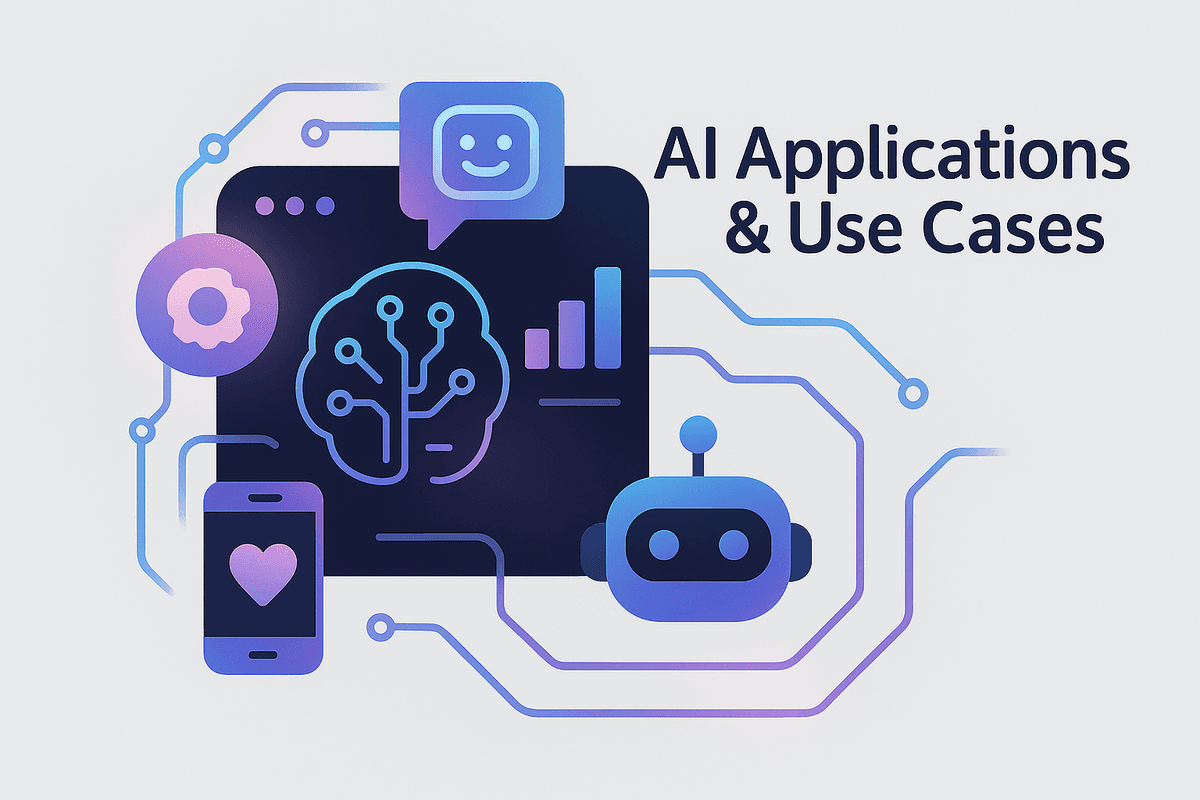
Collection57 articles
AI Applications & Use Cases
Learn practical ways to leverage AI for real-world problems, from career advancement and productivity to business solutions and creative projects.
Curated Articles & Updates


100 Best Nano Banana Prompts 2026 (Copy-Paste)
August 06, 2026

Anthropic Builds Its Own AI Chips: AI News August 6 2026
August 06, 2026

AI News Today August 5 2026: 16 Biggest Stories
August 05, 2026

DeepSeek V4 vs Kimi K3 vs GLM-5.2: Best Open Source Coding AI (2026)
August 04, 2026

AI News Today August 4 2026: 16 Biggest Stories
August 04, 2026

AI News Today August 3 2026: 16 Biggest Stories
August 03, 2026

AI Upskilling: How to Train 1,000 Employees
August 01, 2026

7 AI Tools That Changed Developer Workflow (Aug 2026)
August 01, 2026

100 Best AI Image Prompts 2026 (Nano Banana, Midjourney, Gemini)
August 01, 2026

200 Best AI Prompts for Work 2026 (Copy-Paste)
July 30, 2026

DeepSeek V4 Review: Benchmarks, Pricing & Verdict
July 30, 2026

Forward Deployed Engineer Salary India 2026 (Bands)
July 29, 2026

Corporate AI Training Cost in India: 2026 Pricing
July 28, 2026

AI News Today July 27 2026: 16 Biggest Stories
July 27, 2026

Fugu Ultra Review: Benchmarks, Pricing & Real Testing
July 24, 2026

Qwen-Image-3.0 Review: Features, Access & Honest Take
July 23, 2026

Gemini 3.5 Flash Cyber: Google's AI Vulnerability Hunter
July 22, 2026

Qwen-Audio-3.0-TTS: Pricing, Languages & Benchmarks
July 22, 2026

Corporate AI Training in India: 2026 Buyer's Guide
July 22, 2026

Sakana Fugu-Cyber Review: Benchmarks & Access (2026)
July 21, 2026

NVIDIA Cosmos 3 Edge: Complete Guide (2026)
July 21, 2026
From Theory to Practice: How AI Is Being Used in the Real World
The most important question about any technology is not what it can theoretically do, but what it is actually doing — in real companies, for real users, producing real results. Generative AI in 2026 has moved decisively out of the experimental phase and into the operational core of businesses across every industry. This collection covers the concrete use cases and applications where AI is delivering the most value today, along with the tutorials and tools that let you build similar capabilities yourself.
Understanding where AI works best — and where it still falls short — is essential for making good decisions about where to invest your time as a developer and where to invest resources as a business leader. The use cases below represent areas with proven ROI, mature tooling, and a clear implementation path in 2026.
High-Impact AI Use Cases for Businesses
Intelligent document processing is one of the highest-ROI AI applications in enterprise. Automating the extraction, classification, and routing of invoices, contracts, medical records, insurance claims, and regulatory filings — tasks that previously required large teams of data entry specialists — is now achievable with a few hundred lines of Python and a well-prompted vision model. AI-powered customer support is another area of massive adoption: first-response chatbots that resolve common issues instantly, agent assist tools that surface relevant knowledge base articles and draft responses for human agents, and escalation triaging systems that route complex cases to the right specialist.
Code generation and developer tooling has transformed software development. AI pair programmers, automated code review tools, test generation systems, and documentation generators are now part of the standard workflow at most tech companies, with studies consistently showing 20-40% productivity improvements among developers who use them effectively. Content creation and marketing pipelines — from SEO-optimized blog posts to personalized email sequences to product description generation at scale — are being rebuilt around AI, allowing small teams to produce content at a volume that previously required large editorial staffs.
AI Use Cases for Individual Productivity
AI is transforming individual work as much as organizational processes. Research and synthesis — using AI to rapidly digest and summarize reports, academic papers, market research, and competitive intelligence — is one of the highest-leverage applications for knowledge workers. Writing assistance goes beyond grammar checking: AI tools that help structure arguments, identify logical gaps, adapt tone for different audiences, and generate first drafts from bullet points are becoming core tools for anyone who writes professionally. Learning acceleration — using AI tutors that answer questions, generate practice problems, explain concepts at the right level, and track knowledge gaps — is reshaping how professionals upskill in fast-moving fields like AI itself.
How to Identify the Best AI Use Case for Your Situation
The best AI use cases share three characteristics: a high volume of repetitive, rule-following tasks where inconsistency is costly; clear success criteria that make it easy to evaluate quality; and access to examples (labeled data or ground truth) that can be used to evaluate and improve the system. If your candidate use case has all three, it is a strong candidate for AI automation. If it requires creative judgment, handles rare edge cases with high stakes, or operates in a domain where errors have serious consequences, plan for a human-in-the-loop architecture rather than full automation. The resources in this collection walk through both patterns with real implementation examples across dozens of industries and use cases.
Frequently Asked Questions
What are the most practical AI use cases for businesses in 2026?
The highest-ROI AI use cases in 2026 are: intelligent document processing (invoices, contracts, claims), AI-assisted customer support (first-response bots and agent assist tools), code generation and review for software teams, content creation and SEO at scale, internal knowledge assistants built on company documentation, and data extraction from unstructured sources. All of these have mature tooling, proven ROI, and a clear implementation path.
Can small businesses benefit from AI, or is it only for large enterprises?
Small businesses often see the largest proportional benefit from AI because they operate with fewer people relative to the amount of work they need to do. A 5-person team that automates customer support triage, content creation, and data entry with AI can operate at the scale of a 15-person team. The key is starting with one high-impact use case rather than trying to transform everything at once.
How can developers use AI to boost their own productivity?
The highest-leverage AI tools for developers are: GitHub Copilot or Cursor for code generation and completion, Claude or ChatGPT for debugging, architecture discussions, and explaining unfamiliar codebases, AI-assisted test generation to expand test coverage quickly, and documentation generators that produce accurate docs from code automatically. Studies show 20-40% productivity gains for developers who integrate these tools effectively.
How do I identify a good AI use case in my organization?
Look for tasks that are: high volume (done many times per day or week), rule-following (a skilled human could write down the steps), currently inconsistent (quality varies depending on who does it), and low-stakes if the AI occasionally makes an error (or easy to add a human review step). If your task meets these criteria, it is a strong candidate for AI automation.
What is AI-powered content creation and how do businesses use it?
AI-powered content creation uses LLMs to generate, edit, and optimize written content — blog posts, product descriptions, email campaigns, social media posts, and more. Businesses use it to produce more content with smaller teams, personalize content at scale (different versions for different audience segments), and accelerate the ideation and drafting phases of content production. The key is treating AI as a first-draft generator that skilled humans then edit, fact-check, and refine.
Is AI reliable enough to automate customer-facing workflows?
Yes, for well-defined, high-volume interactions. AI chatbots that handle FAQs, order status queries, and straightforward support issues can resolve 60-80% of tickets without human intervention — with customer satisfaction scores comparable to human agents for those interactions. The remaining 20-40% of complex, sensitive, or edge-case interactions should route to human agents. The key is building clear escalation paths and measuring containment rate, resolution rate, and CSAT continuously.
Recommended
View all%25203%2520(2).png&w=96&q=75)
AI Agent Frameworks
52 articles
AI Automation & No-Code
18 articles
AI Careers, Salary & Resume
13 articles
AI Coding Tools
46 articles
AI Image & Video Generation
32 articlesWaitlist Open
Agentic AI Launchpad
Will you be among the 1% who build AI Agents, or the 99% who just use them? Master AI app development.
- 6 Weeks Live Mentorship
- Build & Deploy 5+ Apps
- No Coding Required

Subscribe to updates
Get the latest insights directly in your inbox.