



Gemini 3.2 Flash: Everything We Know Before Google I/O 2026
Google didn't announce it. Users just found it. On May 5, 2026, Gemini 3.2 Flash quietly appeared inside the official iOS Gemini app and Google AI Studio — no press release, no keynote, no fanfare. Priced at $0.25 per million input tokens and reportedly faster than Gemini 3.1 Pro, it may be the most important quiet drop Google has made in years. Google I/O is two weeks away (May 19–20). Here's everything we know right now
1. What Is Gemini 3.2 Flash?
Gemini 3.2 Flash is Google's next unreleased Flash-tier AI model — spotted in leaked builds before any official announcement. It sits above Gemini 3.1 Flash-Lite in the model hierarchy and is positioned as a faster, cheaper alternative to Gemini 3.1 Pro, while delivering near-Pro performance on coding and creative tasks.
The Flash branding has always meant speed and efficiency. Gemini 3 Flash — the currently released model — delivers Pro-level intelligence at Flash-level latency and cost. Gemini 3.2 Flash appears to push that ratio even further. For a full picture of how Flash models have evolved this year, see our complete May 2026 AI model leaderboard.
Google has not officially confirmed the model. Everything below is based on leaks, user reports, and data extracted from AI Studio API logs as of May 5–6, 2026.
2. How It Was Discovered
Two discovery channels surfaced simultaneously on May 5, 2026.
First: a Reddit user on r/GeminiAI noticed their iOS Gemini app cycling through model versions in real time over 24 hours — shifting from Gemini 3 Flash to 3.1, then landing on 3.2 Flash. Alongside the model, they spotted a completely redesigned interface called 'Liquid Glass' — a pill-shaped prompt box, pulsating gradient background, and a model picker moved to a top-left dropdown.
Second: Gemini 3.2 Flash was found running silent benchmarks on the Eleuther AI Arena (also known as LM Arena), a third-party model evaluation platform. Google has historically used Arena for pre-launch stress testing, making this a strong signal of imminent release.
The leak also revealed a new Agents (Beta) tab in the Gemini sidebar — currently leading to a black screen, but clearly a placeholder for upcoming agentic features. This aligns with Google's broader push toward agentic AI across its product stack. For context on how that fits into the full Gemini API ecosystem, see our guide on using Gemini URL Context for real-time agentic workflows.
3. Pricing: What the Leaks Say
Leaked data from Google AI Studio puts Gemini 3.2 Flash at $0.25 per million input tokens and $2.00 per million output tokens. Here's how that stacks up against the current Gemini Flash family:
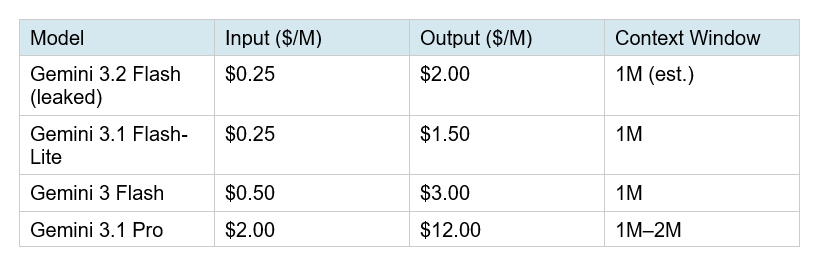
If accurate, Gemini 3.2 Flash would be priced identically to 3.1 Flash-Lite on input tokens but considerably more expensive on output — suggesting it's positioned as a mid-tier model, not a pure cost play. The output price of $2.00/M is actually below Gemini 3 Flash's $3.00/M, making it a compelling upgrade path for teams currently on that model.
For a complete breakdown of what these models actually cost at scale, our GPT-5.4 vs Gemini 3.1 Pro cost and benchmark comparison includes real dollar estimates for 10M+ monthly API calls — useful context before evaluating any new Flash release.
Important caveat: these numbers come from API Studio metadata in an unreleased build. Google has not confirmed them and pricing could change before launch.
4. Early Performance: What Testers Found
Gemini 3.2 Flash's unofficial debut on LM Arena produced the most concrete performance signal we have. Early testers ran it through a range of tasks — and the results were striking.
The most-shared test: an ASCII animation benchmark. One user asked the model to generate a full-screen HTML ASCII animation of a detailed city on a hill with moving elements. Gemini 3.2 Flash produced a working animated city skyline — complete with a functioning windmill and building lights — in under two minutes. For comparison:
- Gemini 3 Flash produced unusable code for the exact same prompt.
- Gemini 3.1 Pro struggled the most — taking up to five minutes and outputting broken, non-functional code.
On LM Arena's structured evaluations, Gemini 3.2 Flash showed particular strength in three areas:
- SVG generation — greater accuracy and fewer errors vs Gemini 3 Flash
- Coding proficiency — creation of interactive 3D environments previously unattainable with earlier models
- Animation processing — smoother transitions and dynamic outputs
My honest take: a Flash model outperforming 3.1 Pro on creative coding tasks is the real headline here. If those Arena results hold up at general availability, this won't just be a cost-efficient alternative to 3.1 Pro — it may be the better model for certain workloads.
To see how current Flash models perform in production agentic coding workflows, our April 2026 AI model benchmarks deep-dive covers SWE-bench, GPQA Diamond, and ARC-AGI-2 scores across all major models.
Don't just use ChatGPT. Learn to build custom LLM agents, RAG pipelines, and full-stack Agentic AI apps in our intensive 6-week program.
5. Gemini 3.2 Flash vs the Gemini 3 Family
Where does 3.2 Flash fit in Google's increasingly crowded model lineup? Here's a positioning summary:
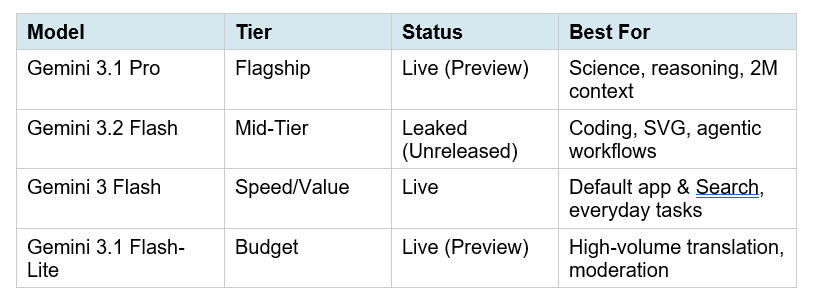
One noteworthy signal from the iOS leak: the new 3.1 Lite tier now replaces the dedicated Thinking option. Instead of a separate model, thinking is now a global toggle across all models. This mirrors what Google did with Gemini 3.1 Flash-Lite's expanded reasoning support — suggesting a broader platform shift toward thinking as a universal dial, not a model-level feature.
6. The Naming Strategy Shift: Why 3.2 Matters
The naming is actually the most strategically important part of this leak. Most observers expected Google to jump from Gemini 3.1 to Gemini 3.5 — following the pattern set by OpenAI and others. Instead, Google appears to be moving to incremental versioning: 3.0, 3.1, 3.2, and presumably beyond.
This is a deliberate signal. It suggests Google is shifting to a more software-like release cadence — smaller, more frequent model updates rather than infrequent major releases. For developers, that's actually good news: it means improvements ship faster, migration paths are more predictable, and you're less likely to get blindsided by a massive capability jump that breaks your prompts.
The contrarian read: incremental versioning can also mask stagnation. If the gap between 3.1 and 3.2 is smaller than the leap between 3.0 and 3.1, calling it '3.2' might be Google buying time while the real next-gen model (Gemini 4?) remains in development.
Either way, Google's track record of shipping meaningful Flash updates is strong. The jump from Gemini 2.5 Flash to Gemini 3 Flash — which we covered in our Gemini in Google Workspace 2026 feature guide — represented a generational leap in quality for everyday tasks. If 3.2 Flash does the same for coding and agentics, it will matter.
7. What to Expect at Google I/O 2026 (May 19–20)
Google I/O 2026 is shaping up to be one of the most AI-dense conferences in the company's history. Based on leaks, official teasers, and product roadmap signals, here's what we're expecting:
Gemini 3.2 Official Launch
Gemini 3.2 Flash is the most likely candidate for a formal announcement. Whether Google reveals additional 3.2 variants (Pro? Deep Think?) remains unclear, but the iOS leak strongly suggests 3.2 Flash will be the first out the door.
Android XR Smart Glasses
Google confirmed AI glasses with Warby Parker and Gentle Monster as eyewear partners, with Gemini AI and Project Astra handling the visual intelligence layer. A Q4 2026 consumer launch is expected, with I/O likely serving as the detailed reveal. The glasses run real-time object recognition, contextual memory, and live translation — powered by the same Gemini stack.
Project Astra Upgrades
Project Astra — Google's universal AI assistant with vision, memory, and tool use — is expected to get significant updates. It's the AI layer running inside the smart glasses and powering the most advanced Gemini Live features.
Gemini 4 Speculation
Google Cloud CEO Thomas Kurian teased 'a new version... very, very soon' on April 24. Whether that's Gemini 3.2, a broader 3.x rollout, or an early Gemini 4 preview is still unclear. The Gemini Embedding 2 multimodal model launch in March 2026 already suggested Google is building a tightly unified AI stack — I/O may be where that comes together publicly.
Aluminum OS and Android 17
Google is also expected to preview Aluminum OS (Android for PCs), Android 17, and agentic AI features across the Workspace suite. AI is the connective tissue across all of it.
Frequently Asked Questions
What is Gemini 3.2 Flash?
Gemini 3.2 Flash is Google's next unreleased Flash-tier AI model, spotted in leaked iOS app builds and AI Studio metadata on May 5, 2026. It reportedly delivers performance above Gemini 3 Flash and near or exceeding Gemini 3.1 Pro on coding tasks, at a significantly lower price point.
When is Gemini 3.2 Flash releasing?
No official date has been announced. Leaks list May 5, 2026 as the internal target date, though no public launch occurred. Google I/O 2026 (May 19–20) is the most likely window for an official reveal. Polymarket prediction markets had significant trading volume on a pre-I/O release.
How much does Gemini 3.2 Flash cost?
Based on leaked API Studio data: $0.25 per million input tokens and $2.00 per million output tokens. This would make it cheaper than Gemini 3 Flash ($0.50/$3.00) on output, and priced identically to Gemini 3.1 Flash-Lite on input. These figures are unconfirmed.
Is Gemini 3.2 Flash better than Gemini 3.1 Pro?
Based on early Arena results, Gemini 3.2 Flash outperforms Gemini 3.1 Pro on certain creative coding tasks — including the well-circulated ASCII animation benchmark where 3.1 Pro produced broken code while 3.2 Flash succeeded in under two minutes. Whether this advantage holds across broader benchmarks is unknown until Google releases official data.
How do I access Gemini 3.2 Flash?
It is not yet officially available. A small number of iOS users on version 1.2026.1710205 of the Gemini app have seen it appear via A/B testing. Developers can monitor Google AI Studio for early access. Our guide to the Gemini 3 developer API covers how to set up API access for when the model goes live.
What is the Liquid Glass redesign in the Gemini app?
Liquid Glass is a major visual overhaul spotted alongside the Gemini 3.2 Flash leak. It introduces a pill-shaped prompt input box, pulsating gradient background, and a top-left model picker dropdown. The rollout appears to be an A/B test, with only select users seeing it as of May 5, 2026.
What is Google's naming strategy with Gemini 3.2?
The appearance of Gemini 3.2 (rather than a hypothetical 3.5) suggests Google is shifting to incremental versioning — releasing smaller, more frequent model updates. This is a strategic departure from the large version jumps favored by competitors and may mean faster iteration cycles for developers building on the Gemini API.
Will Gemini 3.2 Flash support a 1 million token context window?
Based on the Gemini 3 series architecture, a 1M token context window is expected — consistent with Gemini 3 Flash and 3.1 Flash-Lite. This has not been officially confirmed for 3.2 Flash specifically.
The only comprehensive program designed to take you from basic prompting to building interactive Artifacts, custom integrations, and deploying production-ready code with Claude Code.
Recommended Blogs
- Best AI Models May 2026: Ranked Leaderboard (GPT-5.5, Claude Opus 4.7, DeepSeek V4)
- GPT-5.4 vs Gemini 3.1 Pro (2026): Full Benchmark and Cost Comparison
- Best AI Models April 2026: Every Major Release Compared
- Gemini 3.1 Flash TTS: Google's Most Controllable AI Voice (2026)
- Gemini Embedding 2: First Multimodal Embedding Model from Google
- Gemini in Google Workspace: Every Feature Explained (2026)
- Latest AI Models April 2026: Rankings and Features
References
- PiunikaWeb — Gemini 3.2 Flash and 3.1 Lite models spotted in iOS app with Liquid Glass update
- Geeky Gadgets — Google's Unreleased Gemini 3.2 Flash Just Surfaced Online: Here's What It Can Do
- NPowerUser — Gemini 3.2 Flash Spotted in Leaked iOS App Build
- Google Blog — Introducing Gemini 3 Flash: Benchmarks and Global Availability
- Google AI — Gemini 3 Developer Guide
- Google AI — Gemini Developer API Pricing
- MSN / Mashable — Google I/O 2026 to Spotlight AI, XR, and New OS
- Polymarket — Gemini 3.2 Released By...? Prediction Market
- Google Cloud Blog — Gemini 3.1 Flash-Lite: Our Most Cost-Effective AI Model Yet

