

Hermes Agent Is Now #1 on OpenRouter — Here's Why It Matters
On May 10, 2026, something quietly significant happened in the open-source AI world: Hermes Agent by Nous Research overtook OpenClaw to become the #1 most-used AI agent on OpenRouter's global daily rankings — processing 224 billion tokens in a single day. Three months ago, almost nobody outside AI Twitter had heard of it.
This is not a routine leaderboard update. It signals a genuine shift in how developers are thinking about AI agents — away from chat-first interfaces, toward persistent, self-learning systems that compound value over time. Here is what happened, why the architecture underneath matters, and what you should actually do with this information.
1. What Just Happened — The OpenRouter Rankings Explained
Hermes Agent is now the single most-used AI agent on OpenRouter by daily inference volume — 224 billion tokens per day against OpenClaw's 186 billion. OpenRouter's global app and agent rankings are a real-time leaderboard tracking token consumption across all apps and agents that route LLM calls through the platform, making it one of the cleanest proxies for actual developer usage in the open-source ecosystem.
The all-time cumulative picture still favors OpenClaw (9.17 trillion tokens vs. Hermes's 6.35 trillion), which makes sense given OpenClaw launched more than a year earlier. What the daily number tells you is velocity — how fast Hermes Agent is being adopted and used right now. That daily overtake is the meaningful signal.
Hermes was first published on GitHub on February 25, 2026. It has since grown to 114,000 stars, 295 contributors, and 13 major version releases in roughly 10 weeks. To understand where this fits in the broader landscape of open-source agent tooling, the best AI agent frameworks overview for 2026 provides useful context on what frameworks dominated before Hermes arrived.
2. What Is Hermes Agent? The Architecture Underneath the Milestone
Hermes Agent is not a chatbot wrapper. It is an open-source, MIT-licensed, self-hosted AI agent that runs persistently on your infrastructure — a laptop, a $5 VPS, or a serverless cloud environment — and is designed to get better at your workflows the more you use it.
Three architectural components make Hermes different from every stateless agent that came before it:
Persistent Memory with Cross-Session Recall
Hermes stores every conversation in SQLite with FTS5 full-text search and LLM-powered summarization. It can recall a conversation from three weeks ago, search its own history by topic, and build a progressively richer model of who you are and how you work. This is not a CLAUDE.md file you maintain yourself — the agent curates its own memory.
Autonomous Skill Creation and Self-Improvement
When Hermes completes a complex task successfully, it generates a reusable skill file — a markdown document that captures the exact procedure it used. The next time a similar task comes up, it loads that skill and refines it based on the outcome. The result is a task library that compounds. Users report the same task going from 20 minutes in week one to 8 minutes by week six.
Model Agnosticism and Multi-Platform Reach
Hermes supports 200+ LLMs through OpenRouter, plus direct integration with Nous Portal, OpenAI, Anthropic, Gemini, MiniMax, and local endpoints via Ollama or vLLM. It runs across 20 messaging platforms — Telegram, Discord, Slack, WhatsApp, Signal, Email, and more — from a single gateway process. If you want to understand how these pieces fit into a complete GenAI stack, the generative AI libraries and frameworks guide breaks down the full ecosystem layer by layer.
3. Why Hermes Is Winning: The Self-Improving Loop vs OpenClaw's Gateway Model
The OpenRouter #1 ranking is a symptom of a deeper architectural bet paying off. The open-source agent market is bifurcating around two fundamentally different philosophies: breadth of reach versus depth of learning.
OpenClaw's philosophy is gateway-centric. The agent connects to 50+ messaging channels and 44,000+ community-built skills. It is optimized for the user who wants maximum integration coverage — an AI that lives everywhere you do, right out of the box.
Hermes's philosophy is runtime-centric. It is optimized for the user who wants an agent that compounds. The learning loop — memory, autonomous skill creation, and user modeling — means the agent's performance on recurring tasks improves measurably over time. After 10 to 20 similar tasks, users report execution speed improving by 2 to 3x. That is not a feature. That is a fundamentally different value proposition.
The bet Hermes is making: the hard problem in AI agents is not routing and connectivity — it is memory and self-improvement. Early adoption data suggests a meaningful portion of the developer community is agreeing with that bet.
4. The OpenClaw Context: Leadership Change, Security CVEs, and Anthropic's Policy Shift
Hermes Agent did not win in a vacuum. Several structural shifts created tailwinds for any credible OpenClaw alternative in early 2026.
First: leadership. In February 2026, OpenClaw's founder Peter Steinberger announced he was joining OpenAI. OpenClaw moved to an independent open-source foundation with OpenAI as a sponsor. For many developers, this introduced meaningful uncertainty about the project's long-term direction.
Second: security. In a four-day window in March 2026, nine CVEs were disclosed against OpenClaw — one scoring 9.9 on the CVSS scale. A Koi Security audit of the ClawHub skill marketplace found 341 malicious entries. SecurityScorecard flagged tens of thousands of publicly exposed OpenClaw instances. Hermes, by contrast, has zero reported agent-specific CVEs across its comparable deployment footprint.
Third: Anthropic's policy on third-party Claude usage became materially less predictable. Paid Claude subscriptions shifted toward native Anthropic applications, with API keys framed as the clearest production path for third-party agent workflows — a change that disrupted OpenClaw's most common deployment pattern. The full scope of that change is documented in the OpenClaw 2026.5.2 release breakdown which covers how OpenClaw has been adapting to the new environment.
None of these events killed OpenClaw. But together they pushed developers who were already evaluating alternatives to move faster. Hermes was the most credible option available.
5. Hermes Agent vs Claude Code — Two Different Tools, Not Competitors
A common framing in the conversation around Hermes Agent is that it competes directly with Claude Code. This is mostly wrong.
Claude Code is a narrow, deep tool. It reads your entire codebase, makes multi-file changes, runs tests, and iterates on failures — all from natural language prompts. It is optimized for software engineering tasks and does them at a level nothing else currently matches. If you are writing, refactoring, or debugging code, Claude Code is the right answer.
Hermes Agent is broad and cross-domain. It is optimized for the persistent, recurring workflows that span your entire working life — research, scheduling, email, automation, cross-platform coordination. It is not designed to replace your IDE. It is designed to replace the cognitive overhead of re-explaining your preferences and procedures to an AI every single day.
The smarter comparison is Hermes Agent versus a stateless automation tool, not Hermes versus Claude Code. The community has largely converged on this: use Claude Code for coding work, and Hermes for everything else.
6. What Developers Are Actually Choosing in 2026
Based on analysis of 1,300+ Reddit comments across r/openclaw (103,000 members) and independent community surveys, the developer community in 2026 is splitting into four camps:
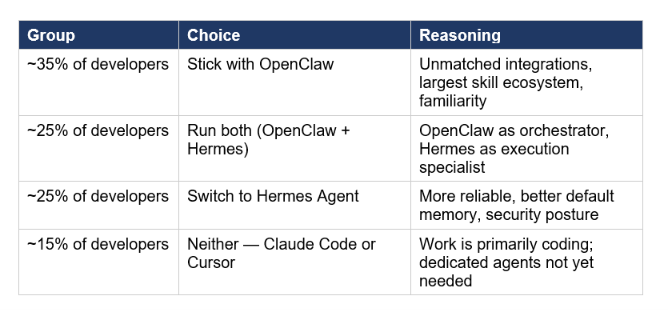
The most experienced users — those who have run both tools in production — are increasingly landing on the dual-use approach: OpenClaw for orchestration and multi-channel reach, Hermes as the execution specialist for recurring task loops. These tools complement each other more than they compete.
7. Should You Switch? A Practical Decision Framework
My honest take: Hermes Agent's architectural bet is the right one for most developers. The self-improving loop addresses the single most frustrating thing about AI agents — the context amnesia that forces you to re-explain yourself every session. If you work on recurring workflows, Hermes compounds in ways no static agent can match.
That said, switching has real costs. Hermes's community skill library (647 skills across four registries) is a fraction of OpenClaw's 44,000+. The ecosystem is newer, documentation gaps exist, and setup requires genuine technical engagement. If you are running sensitive, large-scale workflows, Hermes's shorter CVE history is not the same as battle-tested security.
Here is the framework I would apply:
- Start with Hermes if: You are running recurring research, scheduling, reporting, or cross-platform automation. You have been frustrated by context loss. You want model flexibility without lock-in. You are comfortable with a $5 VPS and a curl install command.
- Stay with OpenClaw if: You need 50+ channel integrations immediately, you depend on specific ClawHub skills, or your workflows are complex enough that you benefit from its more mature multi-agent orchestration.
- Run both if: You have complex workflows that benefit from OpenClaw's orchestration reach and Hermes's compounding execution. This is the direction experienced practitioners are moving.
- Use neither if: Your primary use case is software engineering. Use Claude Code or Cursor — they are purpose-built for this and do it better than any general agent framework.
One practical note on getting started: Hermes requires a model with at least 64,000 tokens of context. OpenRouter is the easiest onramp — it gives you access to 200+ models with a single API key and no lock-in. The install is a single curl command and a 5-minute setup wizard.
Frequently Asked Questions
What is Hermes Agent and who built it?
Hermes Agent is an open-source, MIT-licensed AI agent built by Nous Research — the team behind the Hermes, Nomos, and Psyche model families. It is designed to run persistently on your own infrastructure, remember across sessions, create reusable skills from experience, and improve the more you use it. It is not a chatbot or a coding copilot — it is an autonomous agent framework built around a closed learning loop.
Why did Hermes Agent become #1 on OpenRouter?
As of May 10, 2026, Hermes Agent is generating 224 billion daily tokens on OpenRouter versus OpenClaw's 186 billion, claiming the top daily ranking. The rapid rise reflects genuine architectural differentiation (the self-improving learning loop), strong community momentum (114,000 GitHub stars, 295 contributors in under 3 months), and structural tailwinds including OpenClaw leadership changes, a cluster of OpenClaw security CVEs in March 2026, and Anthropic's policy shift on third-party Claude usage.
How does Hermes Agent's self-improving learning loop work?
When Hermes completes a complex task, it generates a skill file — a markdown document capturing the exact procedure. The next time a similar task appears, it loads that skill and refines it based on the outcome. Combined with FTS5 SQLite cross-session memory and Honcho dialectic user modeling, the result is an agent that accumulates domain-specific expertise over time. Users report task execution speed improving 2–3x after 10–20 similar tasks.
Is Hermes Agent free?
Hermes Agent is free and open-source (MIT license). The real cost is LLM API usage, which varies by model. A solo developer running moderate daily tasks on a budget model (DeepSeek, MiniMax M2.7) can run Hermes for $1–$3 per day. Heavy usage with Claude Opus can run $50–$130 per day. Always-on hosting on a VPS adds $5–$10 per month.
Is Hermes Agent better than OpenClaw?
Neither is strictly better — they optimize for different things. OpenClaw leads on ecosystem maturity, with 44,000+ community skills and 50+ messaging channel integrations. Hermes leads on self-improvement, persistent memory, and security posture. The most common experienced user recommendation in 2026 is to run both: OpenClaw as the orchestrator for multi-channel reach, Hermes as the execution specialist for recurring tasks that benefit from accumulated learning.
Can I run Hermes Agent on my laptop?
Yes. Hermes installs via a single curl command on Linux and macOS (WSL2 on Windows). It requires Python 3.11+, a minimum of 64,000 context tokens from your chosen LLM, and any API key for your preferred model provider. You can also run it on a $5 VPS for always-on access, or serverless infrastructure that costs nearly nothing when idle.
How does Hermes Agent compare to Claude Code?
They are not competitors — they serve different use cases. Claude Code is a narrow, deep coding agent that reads your codebase and handles multi-file changes autonomously. Hermes is a broad, persistent general agent optimized for recurring cross-domain workflows. Most developers who use both treat them as complementary: Claude Code for software engineering tasks, Hermes for everything else.
How do I migrate from OpenClaw to Hermes Agent?
Hermes ships a built-in hermes claw migrate command that transfers configuration and settings from an existing OpenClaw directory. Skill libraries will need to be rebuilt — Hermes does not download community skills; it generates its own from your actual workflows. Most users who migrate report that the self-improving loop recreates their most-used skills faster than expected.
Recommended Blogs
- Best AI Agent Frameworks in 2026 — Build Autonomous AI Agents Fast
- OpenClaw 2026.5.2: Codex, Grok 4.3 & What's New
- Best Generative AI Libraries & Frameworks for Developers (2026)
References
- MarkTechPost — OpenClaw vs Hermes Agent: Why Nous Research's Self-Improving Agent Now Leads OpenRouter's Global Rankings
- Nous Research — Official X Announcement: Hermes Agent #1 on OpenRouter
- OpenRouter — App & Agent Rankings (Live)
- Hermes Agent — Official Documentation (Nous Research)
- GitHub — NousResearch/hermes-agent: The agent that grows with you
- The New Stack — OpenClaw vs. Hermes Agent: The race to build AI assistants that never forget
- Kilo AI — OpenClaw vs Hermes: 1,300 Reddit Comments Analyzed
- Utilo — Hermes Agent vs Claude Code vs OpenClaw (2026): Three AI Philosophies Head-to-Head

