



There is no single best open AI model in August 2026. The open model market has split into distinct tiers: enormous frontier models built for coding and long-horizon agents, cheaper models that make APIs unusually affordable, and practical 20B to 30B models that ordinary teams can actually deploy. Picking a winner without considering hardware, licensing and workflow is how you end up with a benchmark trophy you cannot use.
This collection ranks the models that matter most right now, including GLM-5.3, DeepSeek V4, Kimi K3, Qwen3.8, MiniMax M3, NVIDIA Nemotron 3.5 Lightning and Gemma 4. The ranking is deliberately broader than a coding leaderboard. It considers capability, context, multimodality, deployment freedom, licensing, price and how realistic the model is for an actual builder.
One terminology warning matters. Open source is commonly used for any model with downloadable weights, but weights and source code are not the same thing. The models in this article therefore use the more precise terms open-weight, downloadable and open-source where appropriate. DeepSeek V4 is open-weight with an MIT license, Kimi K3 uses its own K3 license, Qwen3.8 has different licensing across variants, Gemma 4 is Apache 2.0, and GLM-5.3's final weights and license remain pending as of August 26.
QUICK ANSWER
For most builders, DeepSeek V4-Pro is the safest overall open-weight recommendation because it combines strong reasoning and coding with already-available weights and unusually low API pricing. GLM-5.3 is the coding specialist to watch, with Z.ai reporting top-tier coding and cyber results, but its official weights are still pending. Kimi K3 is the strongest heavyweight choice for long-context multimodal agents. Qwen3.8 is the broadest family because it includes a 2.4T flagship and a much more practical 27B model. MiniMax M3 is the best open multimodal alternative for teams that want 1M context, coding and image/video input in one model. Nemotron 3.5 Lightning and Gemma 4 are the practical efficiency choices when the giant models are overkill.
My overall ranking for a normal AI builder is not the same as a pure benchmark ranking. DeepSeek V4-Pro wins the balance category, GLM-5.3 wins coding potential, Kimi K3 wins heavyweight multimodal work, Qwen3.8-27B wins practical local deployment, Nemotron 3.5 Lightning wins high-volume agent efficiency, and Gemma 4 wins the permissive small-model tier.
The August 2026 Open Model Rankings
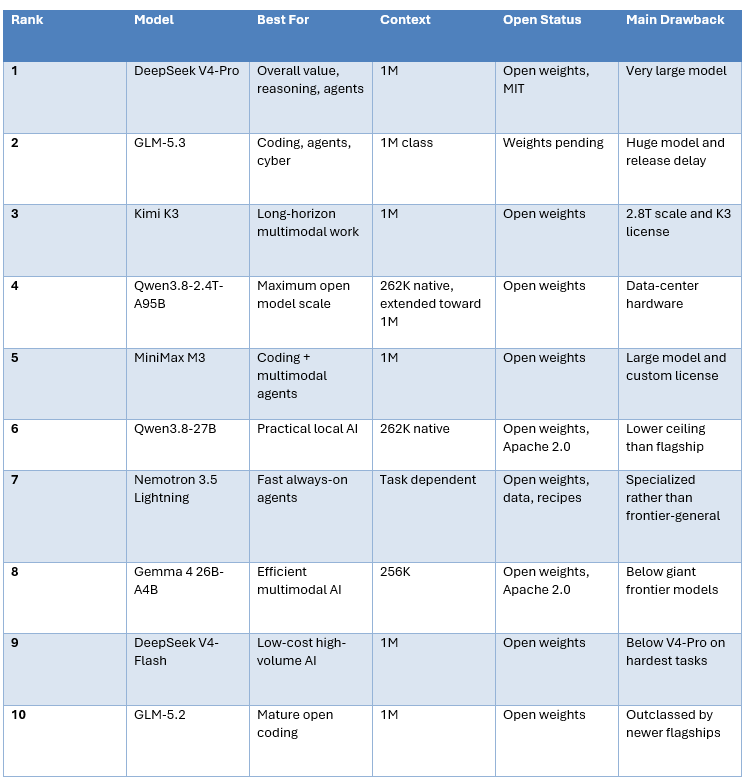
The important row is not always the model with the highest benchmark. A model you can afford, deploy and integrate can be more valuable than a slightly stronger model that requires a cluster.
1. DeepSeek V4-Pro: Best Overall Balance
DeepSeek V4-Pro is the cleanest recommendation for the largest number of builders. DeepSeek released V4 as open weights, gave V4-Pro a 1.6T total parameter MoE architecture with roughly 49B active parameters, and supports a 1M context window with tool calls and structured output.
What makes it the overall pick is not the 1.6T number. It is the combination of capability and economics. The current DeepSeek API pricing page lists V4-Pro at $0.435 per million cache-miss input tokens and $0.87 per million output tokens, with V4-Flash at $0.14 and $0.28 respectively. Product pricing can change, so treat those as current reference rates rather than a permanent guarantee.
For coding, reasoning and agents, V4-Pro is strong enough that it becomes the default open model I would test before paying premium closed-model prices. Its weakness is physical deployment. A 1.6T model is not a casual desktop download, so hosted access or a serious multi-GPU environment is the realistic route for most teams.
2. GLM-5.3: Best Open Coding Contender
GLM-5.3 is the most aggressive coding-focused open model in this collection. Z.ai says the model keeps the same base as GLM-5.2 and gets its gains from scaled post-training. On Z.ai's published comparison, GLM-5.3 scores 88.2 on Terminal-Bench 2.1, 28.3 on Terminal-Bench 3.0 and 66.9 on DeepSWE v1.1. Z.ai also reports major gains on CyberGym.
The catch is availability. Z.ai says the weights will follow after safety evaluation and hardening. As of August 26, the official model page still identifies the downloadable weights as coming soon. That makes GLM-5.3 simultaneously one of the most important open models and one of the least straightforward to self-host today.
You can still access the model through Z.ai's Coding Plan and coding-agent ecosystem. The current ZCode plans start at $12.60 per month for the Lite tier, making hosted experimentation practical while the weights are pending.
3. Kimi K3: Best Heavyweight Multimodal Open Model
Kimi K3 is the scale monster. Moonshot describes it as a 2.8T-parameter open model with a 1M-token context window, native vision and a focus on long-horizon coding, knowledge work and reasoning. The full weights are available, so unlike GLM-5.3, this is not merely a model you are waiting to download.
K3 is also one of the clearest examples of why open does not mean easy to run. A 2.8T model is a cluster-scale object for most teams, even with sparse activation. If your goal is private inference on an ordinary workstation, K3 is the wrong winner. If your goal is the strongest downloadable heavyweight for multimodal and long-context agent work, it deserves a top position.
The API is also far more expensive than DeepSeek. Kimi currently lists $3 per million uncached input tokens and $15 per million output tokens, with cache-hit input at $0.30. That is still useful for evaluation and production, but open weights do not eliminate operating economics.
4. Qwen3.8-2.4T-A95B: Biggest Open Flagship
Qwen3.8 is unusual because the family gives you two very different answers to the same question. The flagship Qwen3.8-2.4T-A95B brings a Qwen-Max-class model to open release, while Qwen3.8-27B gives ordinary developers a much smaller checkpoint.
The 2.4T flagship is built for coding, professional work, research and long-horizon agentic tasks. The official Qwen repository confirms that both the 2.4T model and the 27B model are available through Hugging Face and ModelScope. The smaller model has direct serving recipes for Transformers, SGLang and vLLM.
The important caveat is that the downloadable 2.4T checkpoint is not identical to every hosted Qwen3.8 experience. Hosted Qwen3.8 can add managed tools and multimodal behavior, while the open checkpoint needs to be evaluated based on what the specific downloadable model actually supports.
5. MiniMax M3: Best Open Multimodal Alternative
MiniMax M3 is one of the most interesting models outside the four headline Chinese labs. MiniMax describes it as a 428B-parameter native multimodal MoE with roughly 23B active parameters, a 1M-token context window and support for text, images and video. Its MiniMax Sparse Attention architecture is designed specifically for long-context efficiency.
M3 is particularly attractive for builders because its ecosystem already supports local deployment through vLLM, SGLang, Transformers, KTransformers and Unsloth, and the official model card provides an OpenAI-compatible vLLM route.
The tradeoff is size. At roughly 428B parameters, M3 is still nowhere near a single-GPU consumer model. Its open-weight availability is valuable for teams with infrastructure, while most individual developers will be better served through hosted access or smaller models.
6. Qwen3.8-27B: Best Practical Local Flagship
The 2.4T Qwen model gets the headline, but Qwen3.8-27B may be the more useful release for ordinary developers. It is a 27B checkpoint that can be downloaded today, and the official Qwen repository includes direct serving examples for Transformers, SGLang, vLLM and TokenSpeed.
That makes it a much better fit for a workstation, private assistant or on-prem prototype than a multi-trillion-parameter flagship. It does not have the same raw ceiling as Kimi K3, DeepSeek V4-Pro or Qwen3.8-2.4T, but it can actually participate in a normal team's hardware planning.
This is the model I would put on the shortlist for anyone who says, I want an open model I can actually own and operate. The answer is not always the largest model. Often the answer is the model whose memory footprint, throughput and maintenance requirements fit the organization.
7. NVIDIA Nemotron 3.5 Lightning: Best for Fast Always-On Agents
Nemotron 3.5 Lightning is the efficiency play. NVIDIA describes it as a 30B-parameter MoE model with about 3B active parameters, designed for high-volume, low-latency execution in long-running agents. The open release includes weights, data and training recipes under OpenMDW-1.1.
That is a different proposition from K3 or V4-Pro. Nemotron Lightning is not trying to win the largest-model race. It is trying to make a specialized worker cheap and fast enough to run continuously. NVIDIA also publishes aggressive quantization work for the model, including NVFP4 paths that can reduce model size while maintaining accuracy close to the BF16 baseline.
For routing architectures, this matters. A small, fast model can handle classification, extraction, routine tool use and repetitive agent loops, while a stronger model handles the hard reasoning. Nemotron Lightning is therefore more interesting as infrastructure than as a single universal assistant.
8. Gemma 4: Best Efficient Open Family
Gemma 4 remains one of the strongest practical open families because Google offers multiple sizes rather than one giant checkpoint. Gemma 4 includes small E2B and E4B models, a 26B MoE and a 31B dense model, with multimodal support across the family and an Apache 2.0 license. The family supports up to 256K context.
The 26B-A4B checkpoint is particularly interesting because it combines multimodality with a manageable active parameter count. Google also supports vLLM and SGLang for serving, while the Hugging Face model card shows a growing ecosystem of quantizations and local applications.
Gemma 4 is not the model I would use to chase the absolute best coding benchmark in August, but it is one of the safest practical choices when licensing, hardware and on-device deployment matter. Google's announcement also points to a massive community, with the Gemma family passing one billion downloads in August.
9. DeepSeek V4-Flash: Best Low-Cost Open Worker
DeepSeek V4-Flash is the smaller sibling to V4-Pro and is one of the most useful open models for high-volume workloads. DeepSeek lists 284B total parameters and about 13B active parameters, a 1M context window, tool calls and JSON output.
The economic difference is the point. The current DeepSeek pricing page lists $0.14 per million cache-miss input tokens and $0.28 per million output tokens for V4-Flash. That makes it an obvious routing tier for classification, summarization, extraction, coding assistance and agent steps that do not require the strongest model.
DeepSeek also supports OpenAI-compatible and Anthropic-compatible API access, and the Flash model is the current supported model for the Responses API and Codex integration.
10. GLM-5.2: The Mature Open Baseline
GLM-5.2 is no longer the most exciting model in the field, but it remains important because it is the baseline that GLM-5.3 builds on. Z.ai says GLM-5.3 uses the same base and derives its improvements mainly from post-training. That makes GLM-5.2 useful for teams that want a mature open checkpoint instead of waiting for the newer model.
It also gives you a useful benchmark reference. If a new model claims to be dramatically better, compare it against GLM-5.2 rather than only against closed frontier systems. The gap between a new flagship and a practical stable model is often more important than the gap between two frontier leaders.
Coding: Which Open Model Is Actually Best?
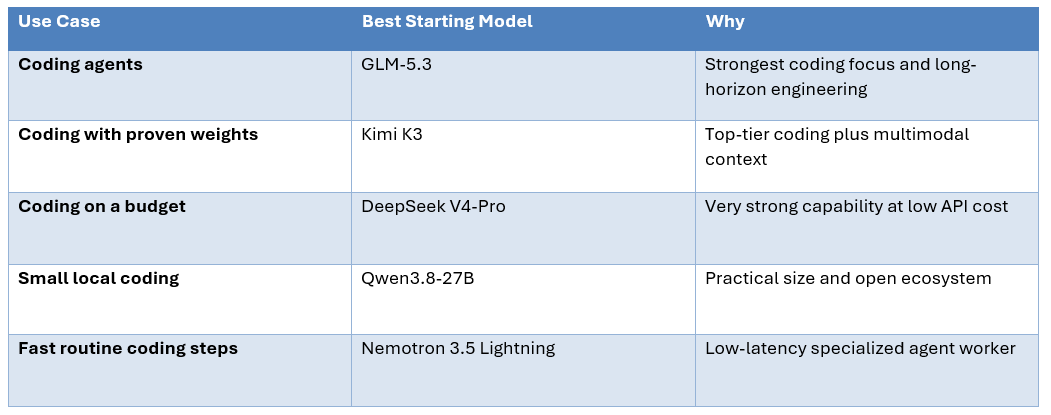
Coding is the easiest category to compare because several providers publish Terminal-Bench and software-engineering results. Z.ai's current table puts GLM-5.3 at 88.2 on Terminal-Bench 2.1, Kimi K3 at 88.3, DeepSeek V4-Pro at 87.9 and Qwen3.8-Max at 86.6. These are vendor-reported figures under a shared table, so they are useful directionally, not as a universal ranking.
Reasoning and Research: Who Wins?
Reasoning is harder to rank because the models are optimized differently. DeepSeek V4-Pro is positioned around reasoning, coding, math and world knowledge. Kimi K3 combines reasoning with native vision and a million-token context. GLM-5.3 concentrates on long-horizon engineering and agentic work. Qwen3.8 spans research, professional work and agent execution.
My practical choice is DeepSeek V4-Pro for general research, Kimi K3 when long visual context matters, and Qwen3.8 when you want a broad family with both a giant flagship and a practical 27B model. For software-engineering research, GLM-5.3 is the specialist to watch.
Multimodal: Kimi K3, MiniMax M3 or Gemma 4?
Kimi K3 and MiniMax M3 are the strongest heavyweight open choices when native vision and very long context are central. Kimi offers a 2.8T model with native vision and 1M context, while MiniMax M3 provides native text, image and video input with 1M context. Gemma 4 is the practical alternative because it brings multimodality to much smaller models and uses Apache 2.0 licensing.
For large-scale multimodal agent research, choose Kimi or M3. For a product that needs multimodality without a cluster, start with Gemma 4.
Local AI: What Can You Actually Run?
The phrase open source creates a dangerous illusion that everything on this list is a local model for your desktop. It is not. Kimi K3, DeepSeek V4-Pro, Qwen3.8-2.4T and MiniMax M3 are serious hardware projects. GLM-5.3 is still waiting for the official weights. The practical models in this collection are Qwen3.8-27B, Gemma 4 and Nemotron 3.5 Lightning, depending on the hardware and quantization you choose.
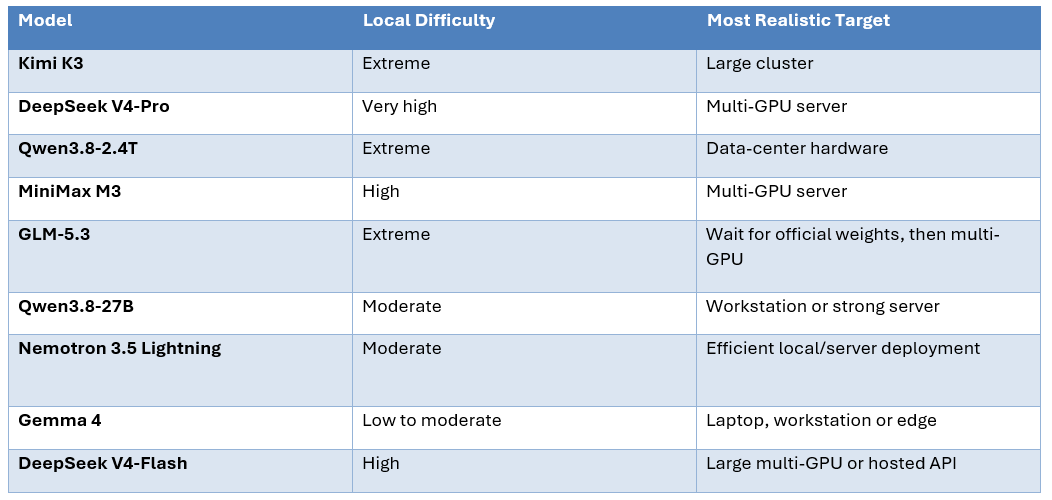
That is why the best model for local AI is often not the model at the top of the benchmark table. The useful model is the one that fits your memory, throughput and operational budget.
Price: Open Weights Do Not Mean Free
Open weights change the cost structure, but they do not erase cost. Self-hosting means paying for GPUs, electricity, cooling, storage, networking, engineering and maintenance. For low usage, a hosted API can be cheaper even when the underlying weights are free.
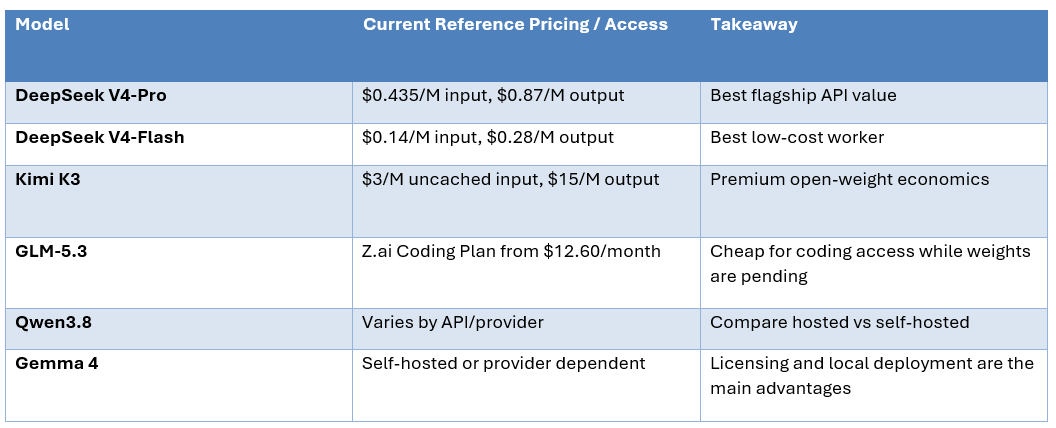
Reference prices can change quickly. The point is not to memorize today's exact token number. It is to recognize the current pattern: DeepSeek is competing aggressively on cost, Kimi monetizes a premium open flagship, and smaller local models compete by eliminating API dependence rather than winning the raw benchmark.
Licensing: The Detail You Cannot Ignore
This is where best open source model becomes technically messy. DeepSeek V4 uses an MIT license, Kimi K3 has a model-specific license, Qwen3.8 has different terms across variants, Gemma 4 uses Apache 2.0, Nemotron 3.5 Lightning uses OpenMDW-1.1, and GLM-5.3's final downloadable license is still pending with the weights.
Do not put commercially sensitive workloads into a model simply because an article calls it open source. Read the actual model license, usage restrictions, redistribution terms and any provider-specific requirements. Open weights, open source, free API access and permission to build a commercial hosted service are separate questions.
Which Model Should You Actually Choose?
- Choose DeepSeek V4-Pro when you want the strongest overall balance of capability, cost and verified open-weight access.
- Choose GLM-5.3 when coding and long-horizon engineering are the priority and you are comfortable using hosted access while the official weights are pending.
- Choose Kimi K3 when long context, vision and large-scale agent work are central to the product.
- Choose Qwen3.8-2.4T when you specifically need a giant open flagship and have the infrastructure to support it.
- Choose MiniMax M3 when you want native multimodality, long context and coding in one open model.
- Choose Qwen3.8-27B when realistic local deployment matters more than absolute frontier capability.
- Choose Nemotron 3.5 Lightning when you need a fast specialized worker for persistent agent work.
- Choose Gemma 4 when licensing, efficient hardware and multimodal local deployment matter most.
- Choose DeepSeek V4-Flash for cheap, high-volume tasks where V4-Pro quality is unnecessary.
Final Ranking for August 2026
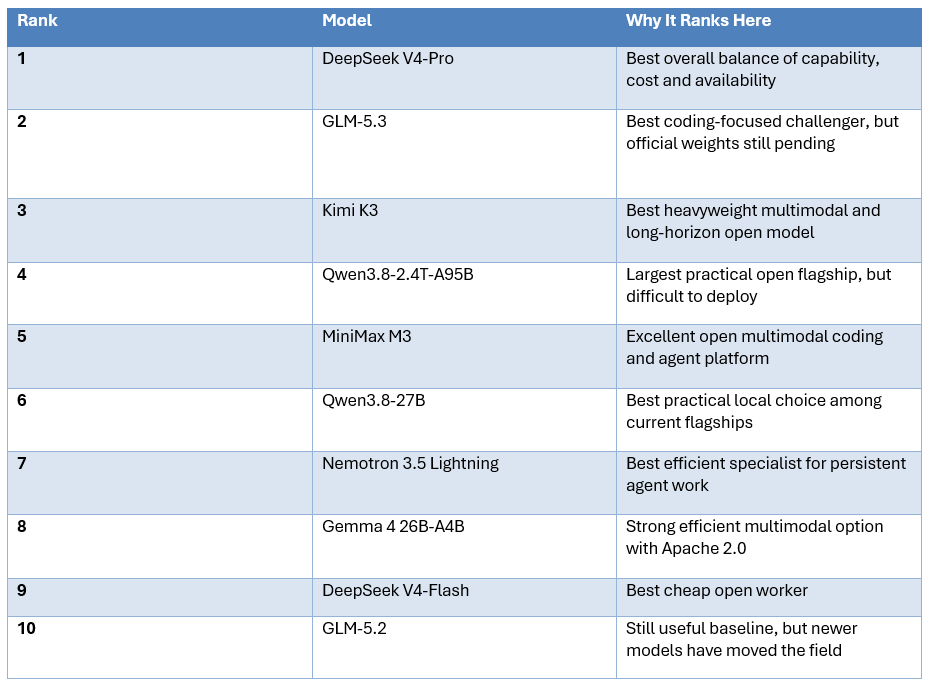
This ranking is deliberately not a pure benchmark list. If you optimize only for coding, GLM-5.3 and Kimi K3 can move to the top. If you optimize for multimodality, Kimi K3 and MiniMax M3 rise. If you optimize for local hardware, Qwen3.8-27B and Gemma 4 become much more important. If you optimize for cost, DeepSeek V4-Flash and V4-Pro dominate.
What Changed in August 2026?
August changed open AI more than the typical model-release cycle suggests. DeepSeek pushed V4-Pro into open release, Kimi K3 raised the open-model size ceiling to 2.8T, Alibaba opened the Qwen Max tier with Qwen3.8, Z.ai pushed GLM-5.3 toward the top of coding and cyber benchmarks, MiniMax M3 brought native multimodality and 1M context into another downloadable flagship, and NVIDIA pushed a highly efficient 30B-A3B Nemotron model for long-running agents.
The bigger change is that open AI is no longer one tier. There are giant frontier models, fast Flash-style workers, coding specialists, multimodal agents and small models designed for local hardware. The smart way to choose in late August 2026 is therefore to match the model to the workload, license and deployment budget rather than treating open source as a single performance class.
Frequently Asked Questions
What is the best open source AI model in August 2026?
DeepSeek V4-Pro is the best overall choice for most builders because it combines strong reasoning and coding with available open weights and unusually aggressive API pricing. GLM-5.3 is the strongest coding-focused challenger, while Kimi K3 and Qwen3.8 are stronger in specialized long-context and scale-heavy workloads.
Which open model is best for coding?
GLM-5.3 is the most compelling coding-first option, with Kimi K3 and DeepSeek V4-Pro close behind. For practical local coding, Qwen3.8-27B is more realistic than the giant frontier models.
Is Kimi K3 open source?
Kimi K3 is available as downloadable open weights and Moonshot provides its own K3 license. That is not the same thing as an MIT or Apache 2.0 license, so commercial users should read the terms.
Is DeepSeek V4 open source?
DeepSeek describes V4 as officially open-sourced and provides downloadable weights. DeepSeek V4 is released under an MIT license.
Which open model has the largest context window?
DeepSeek V4-Pro, Kimi K3 and GLM-5.3 all target 1M-class context. Qwen3.8's open 2.4T checkpoint has 262K native context with an extended configuration toward 1M, while hosted Qwen3.8 adds additional managed capabilities.
What is the best small open source AI model?
Gemma 4, Qwen3.8-27B and Nemotron 3.5 Lightning are among the strongest practical choices in this collection. Your best option depends on whether you prioritize multimodality, coding, speed or licensing.
What is the best open model for local AI?
For a realistic workstation, start with Qwen3.8-27B or an appropriate Gemma 4 variant. Larger models such as Kimi K3, DeepSeek V4-Pro and Qwen3.8-2.4T require serious multi-GPU infrastructure.
Which open model is cheapest?
DeepSeek V4-Flash has the lowest current flagship-tier API pricing in this comparison, while DeepSeek V4-Pro remains unusually inexpensive for its capability. Self-hosting may be cheaper at high utilization, but only after hardware and operations are included.
Is open source the same as open weights?
No. Open weights mean the model parameters are available. Open source can imply broader source, data and reproducibility rights. Always inspect the actual license and what the release includes.
Recommended Blogs
- GLM-5.3 vs DeepSeek V4-Pro vs Kimi K3: Best Open Coding AI (2026)
- 100 Best DeepSeek Prompts 2026 (Copy-Paste)
- DeepSeek V4 Flash Vision Exp Review: Benchmarks & Price
- Ox Alpha Review: The Mystery AI Model With 1M Context (2026)
- Qwen3.8-Flash-Next Preview: Release Date, Specs & Qwen4
- What Is Context Engineering? Complete Guide (2026)
- How to Use LangGraph for Multi-Agent Systems (2026)
Resources & Community
Join our community of 70,000+ AI enthusiasts and learn to build powerful AI applications. Whether you're a beginner or an experienced developer, Build Fast with AI helps you understand and implement AI in your projects.
- Website - buildfastwithai.com
- LinkedIn - Build Fast with AI
- Instagram - @buildfastwithai
- Founder Twitter - @satvikps
- Twitter - @BuildFastWithAI
Agentic AI Launchpad 2026
A structured 6-week cohort program that takes you from AI basics to building and deploying real-world agentic AI systems. Includes live sessions, expert mentorship, project reviews and a builder community network.
Ready to go from learning to building? Join the next cohort: Agentic AI Launchpad 2026
Free AI Resources
Access free tools, workshops and micro-learning to keep building.
References
- Z.ai - GLM-5.3: Frontier Coding with Emergent Cyber Capabilities
- DeepSeek API Docs - V4 Preview Release
- DeepSeek API Docs - Models & Pricing
- Kimi - K3 Open Frontier Intelligence
- Kimi - K3 Pricing
- QwenLM - Qwen3.8 official repository
- MiniMax - M3 official release
- MiniMaxAI - M3 model card
- NVIDIA - Nemotron 3.5 Lightning
- NVIDIA - Nemotron 3.5 Lightning training recipe
- Google - Gemma 4