



The open coding race just got its most dramatic week of the year. Z.ai launched GLM-5.3 claiming the open coding crown and topping a cybersecurity benchmark, DeepSeek raised the price of its updated V4-Pro with a peak-hour pricing scheme, and Kimi K3 continues to hold its ground as the balanced all-rounder. If you build with open models, three of the best just moved at once, and the obvious question is which one to actually use. This comparison breaks all three down on the things that matter: coding, agents, cybersecurity, price, and access.
The short version: GLM-5.3 is the new open coding and cybersecurity front-runner, leading defensive-security benchmarks and beating the updated DeepSeek V4-Pro on agentic coding, at very low pricing. DeepSeek V4-Pro is still strong and open, but its new peak and off-peak pricing raised its cost, softening its old value edge. Kimi K3 remains the reliable, balanced open model, strong on long-horizon agents. For most developers today, GLM-5.3 is the pick for value and cyber, DeepSeek for off-peak batch work, and Kimi K3 for steady all-round agent reliability.
QUICK ANSWER
For the best open coding AI in August 2026, GLM-5.3 leads. It is Z.ai's new model that tops the CyberGym cybersecurity benchmark and reportedly beats the updated DeepSeek V4-Pro on Terminal-Bench, at pricing from about $12.60 a month. DeepSeek V4-Pro is a strong open rival but just moved to costlier peak and off-peak pricing. Kimi K3 is the balanced all-rounder, strong on long-horizon agents. Pick GLM-5.3 for value and cybersecurity, DeepSeek for off-peak batch jobs, and Kimi K3 for steady agent reliability.
The Three Open Models at a Glance
All three are open-weights models built for serious coding and agent work, and all three are far cheaper than the closed leaders, which is the whole appeal of going open. Where they differ is in their specialty, their pricing model, and their momentum. GLM-5.3 from Z.ai is the newest, launched on a wave of coding and cybersecurity claims. DeepSeek V4-Pro is the value veteran that just changed its pricing. Kimi K3 from Moonshot is the balanced agent-focused all-rounder. Here is the fast side-by-side.
Table 1: GLM-5.3 vs DeepSeek V4-Pro vs Kimi K3
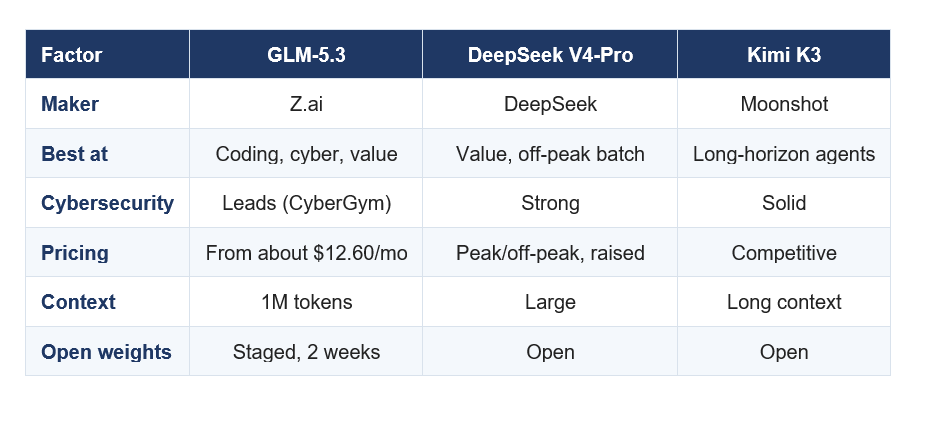
A general snapshot as of mid-August 2026. Benchmarks and pricing shift quickly; see the sections below for the detail behind each.
Benchmarks and Coding Performance
On coding, GLM-5.3 is the story of the week, and the timing is pointed: it launched a day after DeepSeek shipped its updated V4-Pro and reportedly beats it on Terminal-Bench 3.0, one of the hardest agentic coding benchmarks. GLM-5.3 scores 28.3 on that test, positioning it as the new open coding front-runner just as DeepSeek raised its prices. The remarkable part is that GLM-5.3 achieved this from the same 743 billion parameter base as GLM-5.2, purely through scaled-up post-training, and people are calling the efficiency an impossible miracle.
The honest nuance is that GLM-5.3's lead is real but not total. It leads the open field and beats DeepSeek V4-Pro on agentic coding, but against the closed leaders like Fable 5 it still trails on the very hardest raw coding, including on Z.ai's own private code benchmark. DeepSeek V4-Pro remains a genuinely strong coder that the update improved, and it is not far behind. Kimi K3 sits a little behind on peak coding benchmarks but shines specifically on long-horizon agent tasks, where its stability over many steps is a real advantage. So the coding order is roughly GLM-5.3 first among these three, DeepSeek V4-Pro close behind, and Kimi K3 competitive with an agent specialty.
The benchmark takeaway: GLM-5.3 is the new open coding leader of this trio, DeepSeek V4-Pro is a close and improved second, and Kimi K3 is the agent-reliable third that can lead on long multi-step work. The gaps are small enough that price and specialty should decide your choice as much as the raw scores.
For the full data behind GLM-5.3, see our GLM-5.3 review, and for the wider coding field, our best coding AI comparison.
Cybersecurity: GLM-5.3's Edge
Cybersecurity is where GLM-5.3 pulls clearly ahead of both rivals, and it is the most distinctive part of this comparison. GLM-5.3 tops the CyberGym defensive-security benchmark at 84.5%, ahead of even the closed leaders, and it has autonomously found thousands of real, often critical vulnerabilities across hundreds of open-source projects. Z.ai launched a free tool called Open-Source Shield to turn that capability toward helping maintainers audit their code. Neither DeepSeek V4-Pro nor Kimi K3 has a comparable, headline-leading cybersecurity story.
For anyone whose work touches security, code auditing, or vulnerability finding, this makes GLM-5.3 the standout choice among the three. Its strength is specifically defensive, finding and analysing vulnerabilities rather than weaponizing them, which is exactly the responsible capability a team wants. DeepSeek V4-Pro and Kimi K3 are perfectly capable general coders that can help with security tasks, but GLM-5.3 leads the field on this dimension, and it is a genuine reason to prefer it if cyber is part of your work.
THE CYBER FACTOR
If cybersecurity, code auditing, or vulnerability finding is part of your job, GLM-5.3 is the clear pick of these three, leading the CyberGym benchmark and shipping a free audit tool. That same emergent capability is why Z.ai is staging GLM-5.3's open weights behind a safety review, so plan for a short delay if you need the weights to self-host.
Pricing: The DeepSeek Price Hike Changes Everything
Pricing may be the factor that decides this comparison, because it just moved. DeepSeek was long the value king of open coding, but on August 16 it switched V4-Pro to dynamic peak and off-peak pricing, with peak rates around four to five times its old flat rate and off-peak roughly double. That change softens DeepSeek's biggest advantage right as GLM-5.3 arrives at very low, flat GLM-5.2 pricing, from about 12 to 13 dollars a month on the cheapest plan.
Table 2: Open coding AI pricing snapshot
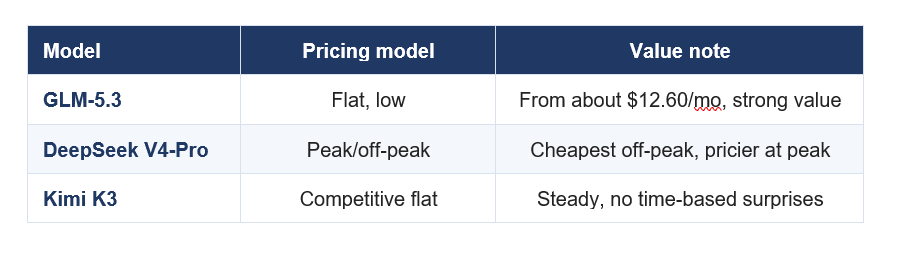
Pricing as of mid-August 2026. DeepSeek's peak/off-peak change took effect August 16, raising its effective cost versus its old flat rate.
The practical impact is a shift in the value ranking. GLM-5.3 now offers frontier-competitive coding at a flat, low price with no time-of-day complexity, which is a strong, simple value story. DeepSeek V4-Pro can still be the cheapest option, but only if you run your work during its off-peak hours and accept the higher peak rate otherwise, which turns cost control into a scheduling exercise. Kimi K3 sits at competitive flat pricing without the peak-hour catch. So for predictable low cost, GLM-5.3 and Kimi K3 are now the simpler picks, while DeepSeek rewards those who can time-shift to off-peak.
For the full detail on the DeepSeek change, see our DeepSeek V4-Pro pricing analysis.
GLM-5.3: Strengths and Weaknesses
GLM-5.3 is the momentum pick of this comparison, and for good reason.
- Strengths: leads open coding on agentic benchmarks, tops cybersecurity with a free audit tool, and offers frontier-competitive performance at low flat pricing from a 743B base.
- Weaknesses: trails the closed leaders and its own Code Bench on the very hardest raw coding, and its open weights are staged behind a safety review, so self-hosters wait about two weeks.
Best for: developers who want the best open coding value, and any team where cybersecurity or code auditing matters. It is the default recommendation of this trio for most users right now, with a closed leader reserved for the hardest coding.
DeepSeek V4-Pro: Strengths and Weaknesses
DeepSeek V4-Pro is the improved value veteran, still strong but repriced.
- Strengths: a genuinely capable open coder that the recent update improved, cheapest of the three during off-peak hours, with open weights and open agent software for self-hosting at scale.
- Weaknesses: the new peak and off-peak pricing raised its effective cost and added scheduling complexity, and GLM-5.3 now edges it on agentic coding benchmarks.
Best for: high-volume and batch workloads that can run during off-peak hours to get the lowest cost, and teams with the infrastructure to self-host the open weights and open agent software.
Kimi K3: Strengths and Weaknesses
Kimi K3 is the balanced all-rounder that quietly holds its ground.
- Strengths: strong, stable performance on long-horizon agent tasks, competitive flat pricing with no peak-hour catch, open weights, and a reliable, well-liked feel for everyday agent work.
- Weaknesses: sits a little behind GLM-5.3 and DeepSeek on peak raw coding benchmarks, and lacks GLM-5.3's standout cybersecurity story.
Best for: developers who want a dependable open model for long, multi-step agent workflows and predictable pricing, and anyone who values steady reliability over chasing the top benchmark of the week.
For the deep dive, see our Kimi K3 review.
Which Open Coding AI Should You Use?
There is no single winner for everyone, but the choice is clearer than it looks once you match the model to your priority. Here is the clean recommendation.
- Choose GLM-5.3 if you want the best open coding value right now or if cybersecurity matters. It leads the trio on agentic coding and cyber at low flat pricing, and it is the default pick for most.
- Choose DeepSeek V4-Pro if you run high-volume or batch work you can schedule into off-peak hours for the lowest cost, or you want to self-host with its open agent software.
- Choose Kimi K3 if you want a dependable all-rounder for long-horizon agents and simple, predictable pricing without peak-hour math.
- Use more than one. Many teams route by task: GLM-5.3 as the default, DeepSeek off-peak for cheap batch jobs, and Kimi K3 for steady agent runs.
Our overall pick: GLM-5.3 is the best open coding AI for most developers in August 2026. It took the open coding lead on agentic benchmarks, it leads clearly on cybersecurity, and its flat low pricing looks even better now that DeepSeek raised its rates. DeepSeek V4-Pro remains a strong, cheaper-off-peak alternative, and Kimi K3 is the reliable agent all-rounder. The best part of this three-way race is that open models are now genuinely competing with each other at the frontier of coding, which pushes quality up and prices down for every developer. Test GLM-5.3 first, and keep the other two in your toolkit for the jobs they win.
See all three against the full field in our best AI models of August 2026 ranking and our best open source AI models collection.
Frequently Asked Questions
Q: What is the best open source coding AI in 2026?
In August 2026, GLM-5.3 is the best open source coding AI for most developers. It leads the open field on agentic coding benchmarks like Terminal-Bench, tops the CyberGym cybersecurity benchmark, and offers frontier-competitive performance at low flat pricing. DeepSeek V4-Pro and Kimi K3 are strong alternatives, each with their own edge.
Q: Is GLM-5.3 better than DeepSeek V4-Pro?
On agentic coding, yes. GLM-5.3 launched a day after the updated DeepSeek V4-Pro and reportedly beats it on Terminal-Bench 3.0, and it leads clearly on cybersecurity. GLM-5.3 also has simpler, flat low pricing, while DeepSeek moved to costlier peak and off-peak rates. DeepSeek remains strong and can be cheaper off-peak, but GLM-5.3 edges it overall.
Q: How does Kimi K3 compare to GLM-5.3?
Kimi K3 is the balanced all-rounder, especially strong and stable on long-horizon agent tasks, with competitive flat pricing. GLM-5.3 leads on peak coding benchmarks and clearly on cybersecurity. Choose Kimi K3 for dependable multi-step agent work and predictable cost, and GLM-5.3 for the best coding value and security.
Q: Which open model is cheapest for coding?
It depends on timing. DeepSeek V4-Pro is the cheapest during its off-peak hours but pricier at peak after its August 16 change. GLM-5.3 offers low, flat pricing from about $12.60 a month with no time-of-day complexity, and Kimi K3 is competitively priced with no peak catch. For simple low cost, GLM-5.3 and Kimi K3 are easiest.
Q: Did DeepSeek raise its prices?
Yes. On August 16, 2026, DeepSeek switched V4-Pro to dynamic peak and off-peak pricing, with peak rates around four to five times the old flat rate and off-peak roughly double. It also shipped an improved V4-Pro and open-sourced its agent software. The change raised DeepSeek's effective cost and softened its long-standing value advantage.
Q: Which open model is best for cybersecurity?
GLM-5.3 is clearly the best of the three for cybersecurity. It tops the CyberGym defensive-security benchmark, has found thousands of real vulnerabilities across open-source projects, and ships a free Open-Source Shield audit tool. DeepSeek V4-Pro and Kimi K3 are capable general coders but do not lead on security the way GLM-5.3 does.
Q: Can I self-host GLM-5.3, DeepSeek, and Kimi K3?
Yes, all three are open-weights models you can self-host with sufficient hardware. DeepSeek and Kimi K3 weights are available, and DeepSeek also open-sourced its agent software. GLM-5.3's weights are staged behind a safety review, expected about two weeks after its August 14 launch, so self-hosters should plan for that short delay.
Q: Which open coding AI should I use?
Use GLM-5.3 as your default for the best open coding value and cybersecurity, DeepSeek V4-Pro for high-volume batch work you can run off-peak for the lowest cost, and Kimi K3 for dependable long-horizon agent tasks with predictable pricing. Many teams use all three, routing each task to the model that wins it.
Recommended Blogs
- GLM-5.3 review
- DeepSeek V4-Pro pricing change
- Kimi K3 review
- Best coding AI compared
- Best open source AI models
Resources and Community
Join our community of 70,000+ AI enthusiasts and learn to build powerful AI applications. Whether you are a beginner or an experienced developer, Build Fast with AI helps you understand and implement AI in your projects.
- Website (buildfastwithai.com)
- LinkedIn (Build Fast with AI)
- Instagram (@buildfastwithai)
- Founder Twitter (@satvikps)
- Twitter (@BuildFastWithAI)
Agentic AI Launchpad 2026
A structured 6-week cohort program that takes you from AI basics to building and deploying real-world agentic AI systems. Includes live sessions, expert mentorship, project reviews, and a builder community network.
Ready to go from learning to building? Join the next cohort: Agentic AI Launchpad 2026
Free AI Resources
Access free tools, workshops, and micro-learning to keep building:
Follow Build Fast with AI for honest, updated comparisons of every major open and closed model.

