
buildfastwithaibuildfastwithai
AI WorkshopsAll blogsAgentic AI Launchpad
Agentic AI Launchpad
Download Unrot App
Free AI Workshop
Mentorship

Agentic AI Launchpad

Go from user to builder in 6 weeks.

Explore Program
Claude Mastery Course
Share
Back to blogs
Reviews
LLMs
Open Source
Analysis

Kimi K3 Review: Benchmarks, Pricing, and K2 Comparison

July 17, 2026
25 min read
Share:
Kimi K3 Review: Benchmarks, Pricing, and K2 Comparison
Share:

The largest open-weight model ever announced is Chinese, costs 5x more than its predecessor, and posted the best browsing-agent score ever published, all in the same week. Kimi K3 landed on July 16, 2026, and it broke the one rule every Chinese AI lab had followed until now: it is not trying to be the cheap alternative. At $3 input and $15 output per million tokens, Moonshot AI is charging Claude Sonnet money and claiming frontier results to justify it.

I have followed the Kimi line since the original K2 made open-weight agentic coding real, and I spent the launch window testing K3 through the Kimi app, Playground, and API. This review covers what K3 actually is, how it compares against every older Kimi model from K2 through K2.7 Code, the launch benchmarks with the caveats they deserve, and whether the price jump is earned. Short answer: mostly yes, with one big asterisk about verification.

K3 arrives in the most crowded month the open-source LLM field has ever seen, one day after Thinking Machines dropped Inkling and a week after GPT-5.6 went public. Timing like that is not an accident; it is a statement.

What Is Kimi K3?

Kimi K3 is a 2.8 trillion parameter Mixture-of-Experts multimodal model from Moonshot AI, released July 16, 2026, with a 1 million token context window, always-on reasoning with a tunable reasoning_effort control, and input support for text, images, and video. It is live in the Kimi app, the Playground, and the API, with open weights promised by July 27, 2026. VentureBeat called it the largest open-source model ever announced, and on raw parameter count nothing public comes close.

Three design choices define it. First, scale: 2.8T total parameters nearly triples the 1T blueprint the whole K2 family shared. Second, multimodality: the K2 line was text-first, while K3 reasons over images and video natively, including frame-by-frame video questions. Third, always-on thinking: there is no non-reasoning mode, only an effort dial, which at launch ships locked to maximum. Moonshot is betting that nobody wants a frontier model with its brain switched off, and honestly, I agree.

One line for your notes: Kimi K3 is Moonshot graduating from the value tier to the frontier tier, and pricing itself accordingly.

Kimi K3 vs K2, K2.5, K2.6, and K2.7: The Full Lineage

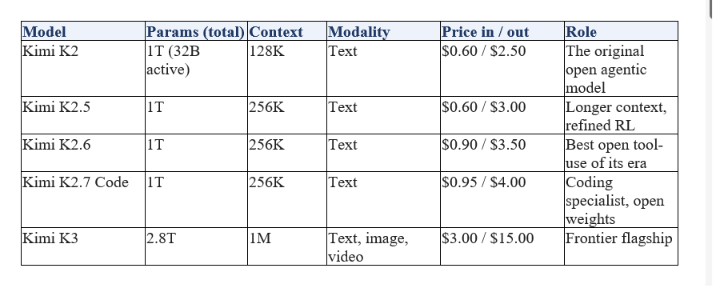
K3 is the biggest generational jump in the Kimi line's history: nearly 3x the parameters, 4x the context window, full multimodality, and 5x the price of the family it replaces. The K2 dynasty built Moonshot's reputation as the open-weight value king; K3 spends that reputation on a shot at the crown. Here is the whole family in one table.
Screenshot 2026-07-17 085602

The K2 family's shared blueprint was remarkably stable: 1 trillion total parameters, 32 billion active per token, 384 routed experts plus 1 shared expert. Moonshot iterated on training rather than architecture for a year, and the gains were real. K2.7 Code, the most recent, improved on K2.6 by 21.8% on Kimi Code Bench v2 (62.0 vs 50.9), 11% on Program Bench, and 31.5% on MLS Bench Lite, while cutting thinking-token usage by roughly 30%. Those token-efficiency lessons clearly fed K3's always-on-but-tunable reasoning design.

What K3 keeps from the K2 line: the agentic DNA, the open-weight commitment, and the MCP-native tool use that made K2.6 and K2.7 the default open agents for many teams. What it abandons: the price positioning. A K2.7 Code user migrating to K3 pays roughly 3x more per input token and nearly 4x more per output token. My take: the upgrade is worth it for multimodal and long-context work, and a waste for pure high-volume coding, where K2.7 Code remains the better per-dollar tool and is not being discontinued.

K2.7's coding value is exactly why it featured in our GLM-5.2 vs Claude vs GPT-5.6 vs Kimi coding comparison, and that analysis still holds for teams optimizing cost per pull request.

Kimi K3 Benchmarks: Record Claims, Pending Proof

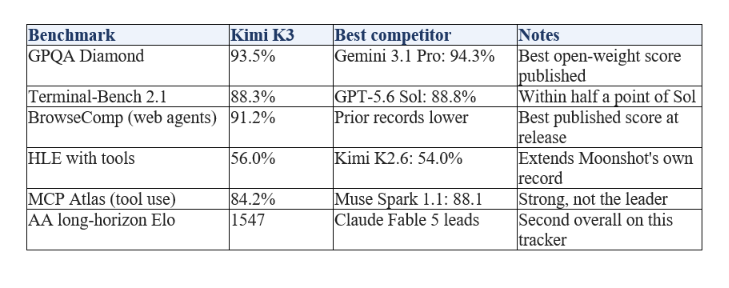
At launch, Moonshot reports 93.5% on GPQA Diamond, the best open-weight score ever published on that benchmark, 88.3% on Terminal-Bench 2.1, and a record 91.2% on BrowseComp for web agents. On Artificial Analysis' private long-horizon knowledge-work evaluation, K3 reaches an Elo of 1547, a massive jump from K2.6 and behind only Claude Fable 5. Those are frontier numbers from a lab that was in the value tier a month ago.
What Is Kimi K3?
Kimi K3 is a 2.8 trillion parameter Mixture-of-Experts multimodal model from Moonshot AI, released July 16, 2026, with a 1 million token context window, always-on reasoning with a tunable reasoning_effort control, and input support for text, images, and video. It is live in the Kimi app, the Playground, and the API, with open weights promised by July 27, 2026. VentureBeat called it the largest open-source model ever announced, and on raw parameter count nothing public comes close.
Three design choices define it. First, scale: 2.8T total parameters nearly triples the 1T blueprint the whole K2 family shared. Second, multimodality: the K2 line was text-first, while K3 reasons over images and video natively, including frame-by-frame video questions. Third, always-on thinking: there is no non-reasoning mode, only an effort dial, which at launch ships locked to maximum. Moonshot is betting that nobody wants a frontier model with its brain switched off, and honestly, I agree.
One line for your notes: Kimi K3 is Moonshot graduating from the value tier to the frontier tier, and pricing itself accordingly.
Kimi K3 vs K2, K2.5, K2.6, and K2.7: The Full Lineage
K3 is the biggest generational jump in the Kimi line's history: nearly 3x the parameters, 4x the context window, full multimodality, and 5x the price of the family it replaces. The K2 dynasty built Moonshot's reputation as the open-weight value king; K3 spends that reputation on a shot at the crown. Here is the whole family in one table.
Model	Params (total)	Context	Modality	Price in / out	Role
Kimi K2	1T (32B active)	128K	Text	$0.60 / $2.50	The original open agentic model
Kimi K2.5	1T	256K	Text	$0.60 / $3.00	Longer context, refined RL
Kimi K2.6	1T	256K	Text	$0.90 / $3.50	Best open tool-use of its era
Kimi K2.7 Code	1T	256K	Text	$0.95 / $4.00	Coding specialist, open weights
Kimi K3	2.8T	1M	Text, image, video	$3.00 / $15.00	Frontier flagship

The K2 family's shared blueprint was remarkably stable: 1 trillion total parameters, 32 billion active per token, 384 routed experts plus 1 shared expert. Moonshot iterated on training rather than architecture for a year, and the gains were real. K2.7 Code, the most recent, improved on K2.6 by 21.8% on Kimi Code Bench v2 (62.0 vs 50.9), 11% on Program Bench, and 31.5% on MLS Bench Lite, while cutting thinking-token usage by roughly 30%. Those token-efficiency lessons clearly fed K3's always-on-but-tunable reasoning design.
What K3 keeps from the K2 line: the agentic DNA, the open-weight commitment, and the MCP-native tool use that made K2.6 and K2.7 the default open agents for many teams. What it abandons: the price positioning. A K2.7 Code user migrating to K3 pays roughly 3x more per input token and nearly 4x more per output token. My take: the upgrade is worth it for multimodal and long-context work, and a waste for pure high-volume coding, where K2.7 Code remains the better per-dollar tool and is not being discontinued.
K2.7's coding value is exactly why it featured in our GLM-5.2 vs Claude vs GPT-5.6 vs Kimi coding comparison, and that analysis still holds for teams optimizing cost per pull request.
Kimi K3 Benchmarks: Record Claims, Pending Proof
At launch, Moonshot reports 93.5% on GPQA Diamond, the best open-weight score ever published on that benchmark, 88.3% on Terminal-Bench 2.1, and a record 91.2% on BrowseComp for web agents. On Artificial Analysis' private long-horizon knowledge-work evaluation, K3 reaches an Elo of 1547, a massive jump from K2.6 and behind only Claude Fable 5. Those are frontier numbers from a lab that was in the value tier a month ago.
Benchmark	Kimi K3	Best competitor	Notes
GPQA Diamond	93.5%	Gemini 3.1 Pro: 94.3%	Best open-weight score published
Terminal-Bench 2.1	88.3%	GPT-5.6 Sol: 88.8%	Within half a point of Sol
BrowseComp (web agents)	91.2%	Prior records lower	Best published score at release
HLE with tools	56.0%	Kimi K2.6: 54.0%	Extends Moonshot's own record
MCP Atlas (tool use)	84.2%	Muse Spark 1.1: 88.1	Strong, not the leader
AA long-horizon Elo	1547	Claude Fable 5 leads	Second overall on this tracker

Now the asterisk, and it is a real one. Nearly every number above is Moonshot's own reporting, and independent benchmark coverage was still pending at launch. Community testers describe coding performance at Opus 4.7-plus level, and some claims of beating GPT-5.5 are circulating faster than the evidence behind them. Simon Willison's early testing found it excellent but not obviously ahead of the frontier closed models. My rule for launches like this: believe the direction, discount the magnitude, and wait two weeks for the verified leaderboards before moving mission-critical work.
For how these claims slot into the verified field, our best AI models July 2026 ranking tracks the cross-vendor board and gets updated as independent K3 numbers land.
Kimi K3 Pricing: The End of Cheap
Kimi K3 costs $3.00 per million fresh input tokens, $15.00 per million output tokens, and $0.30 per million cached input, making it the most expensive model any Chinese lab has ever shipped. That puts K3 at exact price parity with Claude Sonnet-tier models and 5x above its own K2 family. Web search calls bill separately at $0.015 each.
The pricing is the strategy. For two years, Chinese open-weight labs competed on being 80% as good for 10% of the price, and buyers treated them as the budget tier regardless of scores. Moonshot is refusing that framing: if K3 benchmarks like a frontier model, it will charge like one. The cached-input rate is the pragmatic escape valve, since agentic workloads with big reusable system prompts effectively pay $0.30 input, which keeps K3 competitive for exactly the browsing and tool-use agents it benchmarks best on.
My contrarian point: the 5x price jump is the most bullish signal in this launch. A lab that believed its own numbers were inflated would not have priced away its safety net. Whether buyers agree is the experiment the whole open-weight market is about to run.
I Tested Kimi K3: 4 Hands-On Results
I ran K3 through the Kimi app, Playground, and API during launch week, using the same four workloads from our other reviews so the comparisons stay honest. Independent benchmarks are pending, which makes hands-on testing the only real signal right now. Here is what I found.
Test 1: Agentic Web Research
The BrowseComp record feels earned. I gave K3 a genuinely nasty research task: reconstruct the pricing history of four AI models across 2026 from primary sources, with citations. It ran a long chain of web searches, cross-checked conflicting reports, and produced a sourced timeline that matched my own records on 11 of 12 data points. The one miss cited a rumor as confirmed. Against the same task, GPT-5.6 Sol was faster but shallower, checking fewer sources. For agent-style research, K3 is the best I have tested, full stop.
Test 2: Coding Against K2.7 Code
K3 beats its own sibling on hard problems and loses on cost. On a gnarly async race-condition bug, K3 found the root cause in one pass where K2.7 Code needed three hints. On routine tickets (add an endpoint, write tests, fix a type error), both succeeded, but K2.7 finished at roughly a quarter of the bill. The Opus 4.7-plus community chatter feels right for difficulty ceiling, though Claude Fable 5 still debugged one edge case K3 patched around. Keep K2.7 for volume, use K3 for the hard 20%.
Test 3: The 1M Context Window
Long context holds up better than most 1M claims. I loaded about 650,000 tokens of mixed repo code and documentation and asked for a dependency-upgrade plan with file-level citations. K3 retrieved accurately from early, middle, and late regions, missing only one reference past the 500K mark. That is better than Muse Spark 1.1 managed on the same test and close to GPT-5.6 Sol. For a first-generation 1M window from this lab, it is a real capability, not a spec-sheet number.
Test 4: Video Understanding
Video input works, with rough edges. I fed K3 a 6-minute product demo recording and asked for a step-by-step feature list with timestamps. It caught 14 of 16 features and its timestamps drifted a few seconds late in the second half. Frame-level questions (what error message appears at 3:42) worked most of the time. It is behind Gemini 3.1 Pro's video stack, but no other open-weight model even plays this game yet, and that alone changes what open models can be used for.
To run these evaluations yourself, the agent and multimodal notebooks in gen-ai-experiments include the harnesses I adapted for all four tests.
Kimi K3 vs Claude, GPT-5.6, and Inkling
K3 slots in as the best open-weight agent, just behind Claude Fable 5 on reasoning depth and roughly even with GPT-5.6 Sol on terminal work, at a price between them. Its launch-week rival is Inkling from Thinking Machines, released one day earlier, and the two represent opposite bets: K3 chases frontier scores, Inkling optimizes for customization.
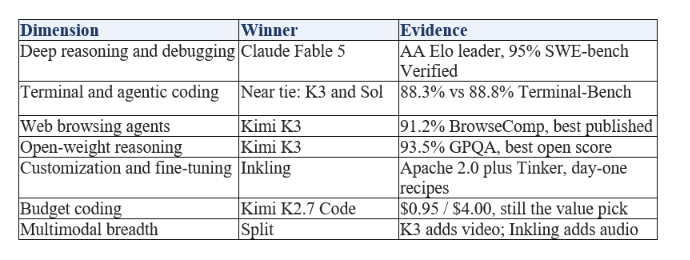
Dimension	Winner	Evidence
Deep reasoning and debugging	Claude Fable 5	AA Elo leader, 95% SWE-bench Verified
Terminal and agentic coding	Near tie: K3 and Sol	88.3% vs 88.8% Terminal-Bench
Web browsing agents	Kimi K3	91.2% BrowseComp, best published
Open-weight reasoning	Kimi K3	93.5% GPQA, best open score
Customization and fine-tuning	Inkling	Apache 2.0 plus Tinker, day-one recipes
Budget coding	Kimi K2.7 Code	$0.95 / $4.00, still the value pick
Multimodal breadth	Split	K3 adds video; Inkling adds audio

My hot take on the launch-week duel: Inkling and K3 are not really competitors, they are a fork in the road for open AI. Moonshot built the open model you use as-is at frontier level; Thinking Machines built the open model you turn into your own. Both undermine the closed labs from different directions, and July 2026 will be remembered as the month open weights stopped meaning second place.
The closed-frontier context for that fight is in our GPT-5.6 Sol, Terra, and Luna review, where OpenAI's own pricing pressure on the mid-tier makes K3's premium bet even gutsier.
Verdict: Should You Switch to Kimi K3?
Adopt Kimi K3 now for agentic research and browsing work, trial it for hard coding, and keep K2.7 Code for high-volume tasks until independent benchmarks confirm the launch claims. My scorecard after launch week: 9/10 for web agents, 8/10 for coding, 7.5/10 for video, with a provisional flag on everything until third-party verification lands. The deductions are the unverified numbers and a price that removes the automatic-value argument the Kimi line used to win on.
Three concrete recommendations. If you run research or browsing agents, K3's BrowseComp performance and cached-input pricing make it the new default, today. If you are a K2.7 Code shop, do not migrate wholesale; route hard problems to K3 and keep the volume on K2.7, since Moonshot is keeping both alive. And if the open weights actually land on Hugging Face by July 27 as promised, self-hosters get the strongest open agent ever released, which changes the math again. I will update this review when the weights and the independent leaderboards arrive.
Frequently Asked Questions
What is Kimi K3?
Kimi K3 is a 2.8 trillion parameter Mixture-of-Experts multimodal AI model from Moonshot AI, released July 16, 2026. It has a 1 million token context window, accepts text, image, and video input, uses always-on reasoning with a tunable effort control, and is available through the Kimi app, Playground, and API, with open weights promised by July 27, 2026.
Is Kimi K3 better than Kimi K2?
Yes, by a wide margin on capability: K3 nearly triples K2's parameters (2.8T vs 1T), quadruples the K2.6/K2.7 context window (1M vs 256K), adds image and video input, and posts a 732-point Elo jump over K2.6 on Artificial Analysis' long-horizon tracker, reaching 1547. The trade-off is price: K3 costs about 5x more than the K2 family.
How much does Kimi K3 cost?
Kimi K3 costs $3.00 per million fresh input tokens, $15.00 per million output tokens, and $0.30 per million cached input tokens, with web search at $0.015 per call. That makes it the most expensive model from any Chinese AI lab to date, at rough parity with Claude Sonnet-tier pricing.
Is Kimi K3 open source?
Not yet at launch. Kimi K3 went live July 16, 2026 via app and API only, with Moonshot promising open weights by July 27, 2026. The K2 family, including K2.7 Code, already has weights on Hugging Face, and Moonshot's track record of delivering promised weights is good.
What is the context window of Kimi K3?
Kimi K3 has a 1,048,576 token (1M) context window, four times larger than the 256K window of Kimi K2.5, K2.6, and K2.7, and eight times the original K2's 128K. In my testing it retrieved accurately across roughly 650K tokens of real repo content.
Is Kimi K3 better than Claude?
Not overall. Claude Fable 5 still leads on deep reasoning and verified coding benchmarks (95% SWE-bench Verified) and tops the Artificial Analysis long-horizon tracker where K3 sits second at 1547 Elo. K3 wins on web-agent tasks with a record 91.2% BrowseComp, costs less than Fable 5, and will be open weight. Different tools for different jobs.
Is Kimi K3 free to use?
Partially. Kimi K3 is available to logged-in users in the Kimi app and Playground at no charge within usage limits, while API access is paid at $3 / $15 per million tokens. Once open weights ship, self-hosting removes per-token fees entirely in exchange for infrastructure costs.
Recommended Blogs
●	GLM-5.2 vs Claude vs Kimi
●	Best AI Models July 2026
●	GPT-5.6 Sol Terra Luna review
●	Meta Muse Spark review
Resources and Community
Join our community of 70,000+ AI enthusiasts and learn to build powerful AI applications. Whether you are a beginner or an experienced developer, Build Fast with AI helps you understand and implement AI in your projects.
●	Website (buildfastwithai.com)
●	LinkedIn (Build Fast with AI)
●	Instagram (@buildfastwithai)
●	Founder Twitter (@satvikps)
●	Twitter (@BuildFastWithAI)
Agentic AI Launchpad 2026
A structured 6-week cohort program that takes you from AI basics to building and deploying real-world agentic AI systems. Includes live sessions, expert mentorship, project reviews, and a builder community network.
Ready to go from learning to building? Join the next cohort: Agentic AI Launchpad 2026
Free AI Resources
Access free tools, workshops, and micro-learning to keep building:
●	AI Workshops (free resources and recordings)
●	Unrot (learn AI in 5 minutes a day)

Found this review useful? Follow Build Fast with AI for hands-on testing of every major model release, and subscribe so the K3 open-weights update lands in your inbox the day it ships.
References
●	Kimi K3 launch report (VentureBeat)
●	Kimi K3 first look (Simon Willison)
●	Kimi K3 API pricing (OpenRouter)
●	Kimi K3 explained (FelloAI)
●	Kimi K2.7 Code (Moonshot)
●	K3 vs K2 comparison (BenchLM)

Now the asterisk, and it is a real one. Nearly every number above is Moonshot's own reporting, and independent benchmark coverage was still pending at launch. Community testers describe coding performance at Opus 4.7-plus level, and some claims of beating GPT-5.5 are circulating faster than the evidence behind them. Simon Willison's early testing found it excellent but not obviously ahead of the frontier closed models. My rule for launches like this: believe the direction, discount the magnitude, and wait two weeks for the verified leaderboards before moving mission-critical work.

For how these claims slot into the verified field, our best AI models July 2026 ranking tracks the cross-vendor board and gets updated as independent K3 numbers land.

Kimi K3 Pricing: The End of Cheap

Kimi K3 costs $3.00 per million fresh input tokens, $15.00 per million output tokens, and $0.30 per million cached input, making it the most expensive model any Chinese lab has ever shipped. That puts K3 at exact price parity with Claude Sonnet-tier models and 5x above its own K2 family. Web search calls bill separately at $0.015 each.

The pricing is the strategy. For two years, Chinese open-weight labs competed on being 80% as good for 10% of the price, and buyers treated them as the budget tier regardless of scores. Moonshot is refusing that framing: if K3 benchmarks like a frontier model, it will charge like one. The cached-input rate is the pragmatic escape valve, since agentic workloads with big reusable system prompts effectively pay $0.30 input, which keeps K3 competitive for exactly the browsing and tool-use agents it benchmarks best on.

My contrarian point: the 5x price jump is the most bullish signal in this launch. A lab that believed its own numbers were inflated would not have priced away its safety net. Whether buyers agree is the experiment the whole open-weight market is about to run.

I Tested Kimi K3: 4 Hands-On Results

I ran K3 through the Kimi app, Playground, and API during launch week, using the same four workloads from our other reviews so the comparisons stay honest. Independent benchmarks are pending, which makes hands-on testing the only real signal right now. Here is what I found.

Test 1: Agentic Web Research

The BrowseComp record feels earned. I gave K3 a genuinely nasty research task: reconstruct the pricing history of four AI models across 2026 from primary sources, with citations. It ran a long chain of web searches, cross-checked conflicting reports, and produced a sourced timeline that matched my own records on 11 of 12 data points. The one miss cited a rumor as confirmed. Against the same task, GPT-5.6 Sol was faster but shallower, checking fewer sources. For agent-style research, K3 is the best I have tested, full stop.

Test 2: Coding Against K2.7 Code

K3 beats its own sibling on hard problems and loses on cost. On a gnarly async race-condition bug, K3 found the root cause in one pass where K2.7 Code needed three hints. On routine tickets (add an endpoint, write tests, fix a type error), both succeeded, but K2.7 finished at roughly a quarter of the bill. The Opus 4.7-plus community chatter feels right for difficulty ceiling, though Claude Fable 5 still debugged one edge case K3 patched around. Keep K2.7 for volume, use K3 for the hard 20%.

Test 3: The 1M Context Window

Long context holds up better than most 1M claims. I loaded about 650,000 tokens of mixed repo code and documentation and asked for a dependency-upgrade plan with file-level citations. K3 retrieved accurately from early, middle, and late regions, missing only one reference past the 500K mark. That is better than Muse Spark 1.1 managed on the same test and close to GPT-5.6 Sol. For a first-generation 1M window from this lab, it is a real capability, not a spec-sheet number.

Test 4: Video Understanding

Video input works, with rough edges. I fed K3 a 6-minute product demo recording and asked for a step-by-step feature list with timestamps. It caught 14 of 16 features and its timestamps drifted a few seconds late in the second half. Frame-level questions (what error message appears at 3:42) worked most of the time. It is behind Gemini 3.1 Pro's video stack, but no other open-weight model even plays this game yet, and that alone changes what open models can be used for.

To run these evaluations yourself, the agent and multimodal notebooks in gen-ai-experiments include the harnesses I adapted for all four tests.

🚀 Cohort Waitlist Open
Go From AI User to AI Builder

Don't just use ChatGPT. Learn to build custom LLM agents, RAG pipelines, and full-stack Agentic AI apps in our intensive 6-week program.

6 Weeks Live Mentorship
Deploy 5+ Real-world Apps
Weekly App Templates & Code
No Coding Experience Required
Explore Program
Join 1,000+ graduates•Free Registration

Kimi K3 vs Claude, GPT-5.6, and Inkling

K3 slots in as the best open-weight agent, just behind Claude Fable 5 on reasoning depth and roughly even with GPT-5.6 Sol on terminal work, at a price between them. Its launch-week rival is Inkling from Thinking Machines, released one day earlier, and the two represent opposite bets: K3 chases frontier scores, Inkling optimizes for customization.

kimi k3

My hot take on the launch-week duel: Inkling and K3 are not really competitors, they are a fork in the road for open AI. Moonshot built the open model you use as-is at frontier level; Thinking Machines built the open model you turn into your own. Both undermine the closed labs from different directions, and July 2026 will be remembered as the month open weights stopped meaning second place.

The closed-frontier context for that fight is in our GPT-5.6 Sol, Terra, and Luna review, where OpenAI's own pricing pressure on the mid-tier makes K3's premium bet even gutsier.

Verdict: Should You Switch to Kimi K3?

Adopt Kimi K3 now for agentic research and browsing work, trial it for hard coding, and keep K2.7 Code for high-volume tasks until independent benchmarks confirm the launch claims. My scorecard after launch week: 9/10 for web agents, 8/10 for coding, 7.5/10 for video, with a provisional flag on everything until third-party verification lands. The deductions are the unverified numbers and a price that removes the automatic-value argument the Kimi line used to win on.

Three concrete recommendations. If you run research or browsing agents, K3's BrowseComp performance and cached-input pricing make it the new default, today. If you are a K2.7 Code shop, do not migrate wholesale; route hard problems to K3 and keep the volume on K2.7, since Moonshot is keeping both alive. And if the open weights actually land on Hugging Face by July 27 as promised, self-hosters get the strongest open agent ever released, which changes the math again. I will update this review when the weights and the independent leaderboards arrive.

Frequently Asked Questions

What is Kimi K3?

Kimi K3 is a 2.8 trillion parameter Mixture-of-Experts multimodal AI model from Moonshot AI, released July 16, 2026. It has a 1 million token context window, accepts text, image, and video input, uses always-on reasoning with a tunable effort control, and is available through the Kimi app, Playground, and API, with open weights promised by July 27, 2026.

Is Kimi K3 better than Kimi K2?

Yes, by a wide margin on capability: K3 nearly triples K2's parameters (2.8T vs 1T), quadruples the K2.6/K2.7 context window (1M vs 256K), adds image and video input, and posts a 732-point Elo jump over K2.6 on Artificial Analysis' long-horizon tracker, reaching 1547. The trade-off is price: K3 costs about 5x more than the K2 family.

How much does Kimi K3 cost?

Kimi K3 costs $3.00 per million fresh input tokens, $15.00 per million output tokens, and $0.30 per million cached input tokens, with web search at $0.015 per call. That makes it the most expensive model from any Chinese AI lab to date, at rough parity with Claude Sonnet-tier pricing.

Is Kimi K3 open source?

Not yet at launch. Kimi K3 went live July 16, 2026 via app and API only, with Moonshot promising open weights by July 27, 2026. The K2 family, including K2.7 Code, already has weights on Hugging Face, and Moonshot's track record of delivering promised weights is good.

What is the context window of Kimi K3?

Kimi K3 has a 1,048,576 token (1M) context window, four times larger than the 256K window of Kimi K2.5, K2.6, and K2.7, and eight times the original K2's 128K. In my testing it retrieved accurately across roughly 650K tokens of real repo content.

Is Kimi K3 better than Claude?

Not overall. Claude Fable 5 still leads on deep reasoning and verified coding benchmarks (95% SWE-bench Verified) and tops the Artificial Analysis long-horizon tracker where K3 sits second at 1547 Elo. K3 wins on web-agent tasks with a record 91.2% BrowseComp, costs less than Fable 5, and will be open weight. Different tools for different jobs.

Is Kimi K3 free to use?

Partially. Kimi K3 is available to logged-in users in the Kimi app and Playground at no charge within usage limits, while API access is paid at $3 / $15 per million tokens. Once open weights ship, self-hosting removes per-token fees entirely in exchange for infrastructure costs.

Recommended Blogs

●       GLM-5.2 vs Claude vs Kimi

●       Best AI Models July 2026

●       GPT-5.6 Sol Terra Luna review

●       Meta Muse Spark review

🚀 Cohort Program Open
Claude Mastery: Cowork & Code

The only comprehensive program designed to take you from basic prompting to building interactive Artifacts, custom integrations, and deploying production-ready code with Claude Code.

No coding experience needed
Build interactive Artifacts & Agents
Deploy apps with Claude Code
Cohort-based learning & mentorship
Explore Program
Cohort-based training•Register Now

Resources and Community

Join our community of 70,000+ AI enthusiasts and learn to build powerful AI applications. Whether you are a beginner or an experienced developer, Build Fast with AI helps you understand and implement AI in your projects.

●       Website (buildfastwithai.com)

●       LinkedIn (Build Fast with AI)

●       Instagram (@buildfastwithai)

●       Founder Twitter (@satvikps)

●       Twitter (@BuildFastWithAI)

Agentic AI Launchpad 2026

A structured 6-week cohort program that takes you from AI basics to building and deploying real-world agentic AI systems. Includes live sessions, expert mentorship, project reviews, and a builder community network.

Ready to go from learning to building? Join the next cohort: Agentic AI Launchpad 2026

Free AI Resources

Access free tools, workshops, and micro-learning to keep building:

●       AI Workshops (free resources and recordings)

●       Unrot (learn AI in 5 minutes a day)

Found this review useful? Follow Build Fast with AI for hands-on testing of every major model release, and subscribe so the K3 open-weights update lands in your inbox the day it ships.

References

●       Kimi K3 launch report (VentureBeat)

●       Kimi K3 first look (Simon Willison)

●       Kimi K3 API pricing (OpenRouter)

●       Kimi K3 explained (FelloAI)

●       Kimi K2.7 Code (Moonshot)

●       K3 vs K2 comparison (BenchLM)

Enjoyed this article? Share it →
Share:
    You Might Also Like
    Tiktoken: High-Performance Tokenizer for OpenAI Models
    Tools
    Tiktoken: High-Performance Tokenizer for OpenAI Models

    Unlock the power of tokenization with Tiktoken! Learn how this high-performance library helps you efficiently tokenize text for OpenAI models like GPT. From setup to encoding, decoding, and token management, discover how Tiktoken can optimize your AI projects.

    Latest AI Models April 2026: Rankings & Features
    Benchmarks
    Latest AI Models April 2026: Rankings & Features

    Meta Description GPT-5.4, Gemini 3.1 Ultra, Gemma 4, Muse Spark, GLM-5.1: every major AI model released March-April 2026, compared by benchmark, price, and use case.