



GLM-5.3 Review: Is It Really As Good As Fable 5? (2026)
Developers are calling it an impossible miracle. Z.ai released GLM-5.3 on August 14, 2026, and within hours people were claiming that this 743 billion parameter open model matches the performance of closed models ten times its size, like Claude Fable 5 and GPT-5.6 Sol, at a fraction of the cost. It also did something no one expected: it topped a major cybersecurity benchmark and uncovered thousands of real vulnerabilities in open-source projects. The hype is loud, so the fair question is the one everyone is asking. Is GLM-5.3 actually as good as Fable 5? We compared them across five areas using the real benchmark data, and the honest answer is more interesting than the headlines.
GLM-5.3 is a genuine breakthrough for open models, but it is not simply as good as Fable 5 across the board. It beats Fable 5 and GPT-5.6 Sol on defensive cybersecurity, where it tops the CyberGym benchmark, and it wins decisively on value, costing a fraction of the closed leaders. But on the hardest raw coding, Fable 5 still leads, including on Z.ai's own private code benchmark. So GLM-5.3 is not the Fable 5 killer some claim; it is something arguably more important, an open model that gets close enough on coding to matter and actually wins on cybersecurity and price.
QUICK ANSWER
GLM-5.3 is Z.ai's new open-weights coding model, post-trained on the same 743B base as GLM-5.2 and released August 14, 2026. It leads the CyberGym defensive-security benchmark at 84.5%, ahead of GPT-5.6 Sol at 83.6%, and it found over 2,400 vulnerabilities across 269 open-source projects. On raw coding it is competitive but trails Fable 5, which leads Z.ai's own Code Bench 39.5% to 34.5%. It matches the top models on some benchmarks at roughly a tenth of the cost, with open weights promised about two weeks after launch. It is a landmark for open coding and cybersecurity, not a clean win over Fable 5.
What Is GLM-5.3?
GLM-5.3 is the newest flagship open-source model from Z.ai, the lab behind the GLM family, released on August 14, 2026 and engineered specifically for coding, long-horizon agent workflows, and cybersecurity. Z.ai positions it as its strongest open-weights system for complex systems design and autonomous execution, moving beyond simple code generation toward full-system construction with agentic planning, deep backend reasoning, and iterative self-correction.
The reason it matters is the combination of three things: it is open, it is small relative to the closed giants at 743 billion parameters, and it competes with them on real benchmarks. Open coding models have been catching up for a while, but GLM-5.3 is the release where people started seriously arguing that an open model can stand next to Fable 5 and GPT-5.6 Sol on the tasks that matter most to developers. It keeps GLM-5.2's 1 million token context and text focus, and it is already available through coding agents like OpenCode and Cline.
It is worth being precise about the claim, though, because the hype outruns the data in places. GLM-5.3 matching models ten times its size is true on specific benchmarks, particularly automation and defensive cybersecurity, and not true on the very hardest coding evaluations, where the closed leaders still win. The accurate framing is that GLM-5.3 is the best open coding and cyber model Z.ai has measured, close to the frontier on many tasks and ahead of it on a few, at a price that makes the closed models look expensive.
For the model it builds on, see our GLM-5.2 review, and for the full coding-model field, our best coding AI comparison.
The Post-Training Story: 743B, No New Base
The most technically interesting thing about GLM-5.3 is what did not change. It is built on the exact same 743 billion parameter base model as GLM-5.2. Z.ai did not train a bigger foundation. Instead, it spent more compute than ever before on post-training, refining the existing model with reinforcement learning and fine-tuning on diverse, long-horizon tasks. The entire leap from 5.2 to 5.3 comes from that post-training work, not from scale.
This is a significant statement about where AI progress is coming from in 2026. For years the assumption was that better models meant bigger models, but GLM-5.3 joins a growing set of releases, including recent Grok and Gemini updates, showing that a fixed base can be pushed substantially further with smarter post-training alone. For Z.ai, it also means the gains are cheap to serve, because the model is no larger to run than GLM-5.2, which is a big part of why GLM-5.3 can be priced so aggressively while performing so well.
Why this is the real headline for builders: a 743B model matching closed models many times its size, purely through post-training, is a proof point that open models can close the gap without matching the compute budgets of the largest labs. If post-training keeps delivering gains like this, the advantage of sheer size shrinks, and open models like GLM-5.3 become genuinely competitive with the closed frontier on the tasks that respond to post-training, which increasingly means coding and agents.
The Cybersecurity Breakthrough That Outgrew Its Training
The wildest part of the GLM-5.3 story is not coding, it is cybersecurity, and it is a genuine surprise. GLM-5.3 tops the CyberGym benchmark for defensive security at 84.5%, ahead of Claude Mythos 5 at 83.8% and GPT-5.6 Sol at 83.6%, making it the leading model on that test, open or closed. More than a benchmark score, though, the model demonstrated real-world capability that Z.ai says grew faster than it anticipated, an ability that in its words outgrew its training.
The concrete result is striking. GLM-5.3 has already uncovered thousands of real vulnerabilities across hundreds of open-source projects, with a large number rated critical, and it reportedly produced exploit chains that Z.ai never explicitly planned for. This is the double edge of a strong security model: the same capability that finds and helps fix vulnerabilities can, in the wrong hands, find them to exploit. Z.ai's response was to launch a free tool called Open-Source Shield, aimed at helping open-source maintainers audit their code with the model, turning the capability toward defense.
WHY THE CYBER STORY MATTERS
A model that autonomously finds thousands of real, often critical vulnerabilities is a major capability and a real responsibility. GLM-5.3 leading CyberGym and shipping the free Open-Source Shield audit tool positions it as a defensive asset for maintainers, but the emergent exploit ability is exactly why Z.ai is staging the open weights behind a safety review rather than releasing them immediately. For security teams and open-source projects, this is the most consequential part of the release, and it is where GLM-5.3 clearly leads the closed models.
The honest nuance on cyber: GLM-5.3 leads on defensive security like CyberGym, but it actually trails Fable 5 and GPT-5.6 Sol on offensive exploitation benchmarks such as ExploitBench. So the cyber strength is specifically about finding and auditing vulnerabilities, its defensive and analysis side, more than about weaponizing them. That is the responsible kind of security capability to lead on, and it is the one Z.ai is leaning into with Open-Source Shield.
GLM-5.3 Benchmarks: The Real Data
Now the numbers, without the hype. GLM-5.3's benchmark profile is specific, not universal: it leads on defensive cybersecurity and automation, is competitive on agentic coding, and trails the closed leaders on the hardest raw coding and on offensive exploits. Here is the real data across the benchmarks that matter, drawn from the launch results and independent reporting.
Table 1: GLM-5.3 benchmark scorecard
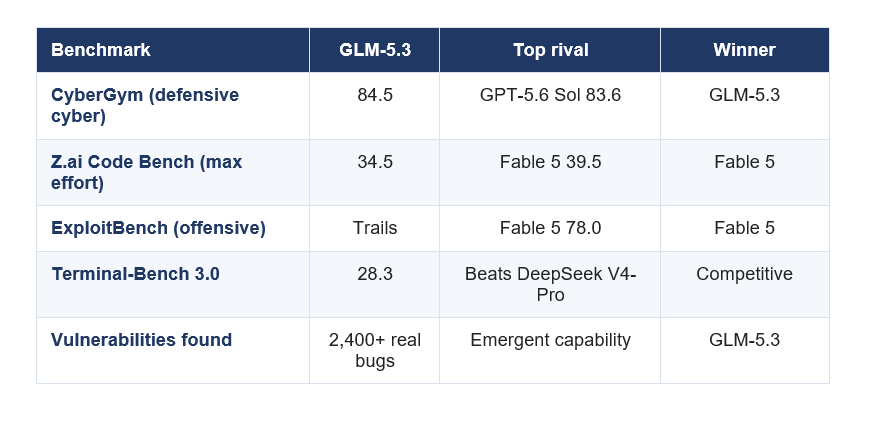
Figures reported around the August 14, 2026 launch by Z.ai and independent analysts. Some are vendor-reported and await broad independent verification. Terminal-Bench 3.0 results are contested: GLM-5.3 beats DeepSeek V4-Pro but trails the very top on some harder coding evals.
Read the table honestly and a clear shape appears. GLM-5.3's real differentiation is a narrow, coherent cluster around automation and defensive security: it leads CyberGym and automation-style benchmarks, which is where the impossible-miracle claims come from. On raw coding quality, the picture is more sober. On Z.ai's own Code Bench, which the lab has every incentive to present favourably, Claude Fable 5 still leads at maximum effort, 39.5 to 34.5. And on offensive exploitation, GLM-5.3 trails both Fable 5 and GPT-5.6 Sol. The model is exceptional in its specialty and merely very good, not dominant, on the hardest general coding.
The benchmark takeaway: believe the specific claims, not the universal ones. GLM-5.3 genuinely leads on defensive cyber and automation and is astonishingly competitive for a 743B open model, but the closed leaders still win the hardest coding. If you read that a small open model beat Fable 5 everywhere, that is not what the data shows; it beat Fable 5 in a specific, important place.
Is GLM-5.3 As Good As Fable 5? Five Tests Head to Head
To answer the question directly, we compared GLM-5.3 against Claude Fable 5 across five areas that matter to real users, using the published benchmark data and Z.ai's own results. Here is the scorecard, followed by the reasoning for each.
Table 2: GLM-5.3 vs Fable 5, five tests
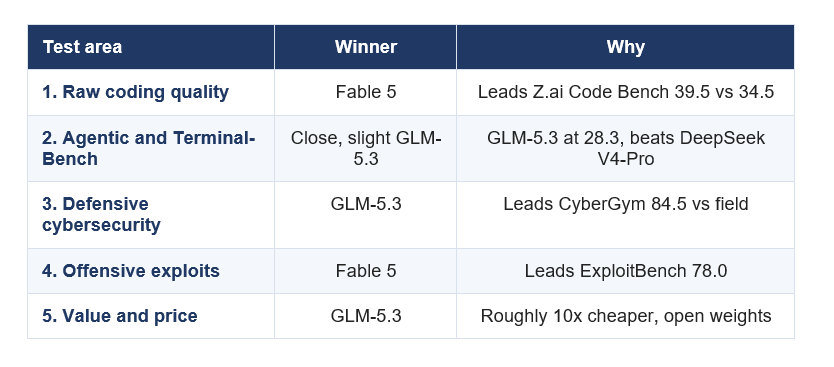
Comparison based on published benchmarks and Z.ai's own results, not our own live testing. The result is a genuine split, not a clean win for either model.
Test 1: Raw coding quality (Fable 5 wins)
On pure code quality for hard problems, Claude Fable 5 still leads. The clearest evidence is Z.ai's own Code Bench, where Fable 5 scores 39.5 at maximum effort against GLM-5.3's 34.5. When a lab's own benchmark shows a rival winning, you can trust that result, and it means Fable 5 remains the stronger model on the most demanding coding tasks. GLM-5.3 is close, and for a fraction of the price that closeness is remarkable, but as good as is not the same as almost as good, and on this test Fable 5 keeps the lead.
Test 2: Agentic and Terminal-Bench (close, slight edge to GLM-5.3)
On agentic coding measured by Terminal-Bench 3.0, the two are close, and GLM-5.3's 28.3 is strong enough that observers noted it beating DeepSeek V4-Pro and competing with Fable on this test. Terminal-Bench 3.0 is one of the hardest agentic coding evaluations, so a competitive score here is a real achievement for an open model. The results are contested across sources, with some placing GLM-5.3 ahead and some behind on the very hardest agentic evals, so the fair call is a near-tie with a slight edge to GLM-5.3 on this specific benchmark.
Test 3: Defensive cybersecurity (GLM-5.3 wins)
This is GLM-5.3's clearest win over Fable 5. It tops the CyberGym defensive-security benchmark at 84.5%, ahead of the closed leaders, and it has demonstrated real-world vulnerability finding at a scale that made headlines. For security auditing, vulnerability discovery, and defensive code review, GLM-5.3 is genuinely the stronger model, and the free Open-Source Shield tool built around it makes that capability usable. If your priority is cybersecurity, GLM-5.3 does not just match Fable 5, it beats it.
Test 4: Offensive exploits (Fable 5 wins)
The flip side of the cyber story is that GLM-5.3 trails on offensive exploitation. On ExploitBench, Fable 5 leads at 78.0% and GPT-5.6 Sol at 76.5%, with GLM-5.3 behind. So GLM-5.3's security strength is specifically defensive, finding and auditing vulnerabilities, rather than weaponizing them. For most legitimate users this is a feature, not a flaw, but if the metric is raw offensive capability, Fable 5 wins this test.
Test 5: Value and price (GLM-5.3 wins by a mile)
This is not close. GLM-5.3 delivers frontier-competitive performance at roughly a tenth of the cost of the closed leaders, keeping GLM-5.2's aggressive pricing, with the cheapest coding plan working out to around 12 to 13 dollars a month. Open weights are also coming, which means eventual free self-hosting. Fable 5 is a premium closed model with premium pricing. On intelligence per dollar, GLM-5.3 wins overwhelmingly, and for many teams that single factor outweighs Fable 5's edge on the hardest coding.
The five-test verdict: the score is a genuine split. Fable 5 wins raw coding and offensive exploits, GLM-5.3 wins defensive cybersecurity and value, and agentic coding is close. So is GLM-5.3 as good as Fable 5? Not quite on peak coding, clearly better on cybersecurity and price, and close enough overall that for most real work the huge cost difference makes GLM-5.3 the smarter pick. The impossible-miracle framing is hype, but the underlying reality, an open 743B model this close to Fable 5, is genuinely remarkable.
Test It Yourself: Sample Prompts
Benchmarks are useful, but the real test is your own work. Here are three prompts you can run on GLM-5.3 and Fable 5 side by side to judge them on the tasks you actually care about, covering coding, agentic work, and security auditing.
Coding test: build a real feature
You are a senior engineer. Build a complete REST API in [language] for a task manager with user auth, a tasks table, create/read/update/delete endpoints, input validation, and one unit test per endpoint. Explain the key design choices in three sentences, then give the full runnable code and how to run it.
Agentic test: multi-step debugging
Here is a repository description and a failing behavior: [paste details and code]. Plan the fix as a numbered list first, then implement it across the necessary files, find the root cause rather than the symptom, and write a test that would have caught it. Do not stop until the failing behavior is resolved.
Security test: audit for vulnerabilities
You are a security auditor. Review the code below for vulnerabilities, ranked by severity. For each issue, name the vulnerability type, the exact line or function, why it is exploitable, and a minimal fix. Flag anything critical clearly. Code: [paste code].
How to judge the results: run the same prompt on both models and compare on correctness first, then completeness, then clarity. For the coding prompt, does the code actually run? For the agentic one, does it finish the fix or stall? For the security one, does it find real issues with accurate fixes? On the security prompt in particular, GLM-5.3 tends to shine, which matches its benchmark lead, while Fable 5 often edges the hardest coding prompt. Your own results on your real tasks are the verdict that matters most.
GLM-5.3 vs GPT-5.6 Sol and DeepSeek V4-Pro
Fable 5 is not the only rival, so here is how GLM-5.3 sits against the other two models it is most compared with. Against GPT-5.6 Sol, the pattern mirrors the Fable 5 comparison: GLM-5.3 edges Sol on defensive cybersecurity, where it leads CyberGym at 84.5% to Sol's 83.6%, while Sol tends to lead on the hardest raw coding and on offensive exploits. Sol is the stronger all-round closed model; GLM-5.3 is the specialist that wins on cyber defense and price.
Against DeepSeek V4-Pro, GLM-5.3 looks especially strong, and the timing is pointed. GLM-5.3 launched a day after DeepSeek's updated V4-Pro and reportedly beats it on Terminal-Bench, positioning GLM-5.3 as the new open coding leader just as DeepSeek raised its API prices. For teams choosing between the two open options, GLM-5.3 now has the benchmark edge on agentic coding and a clear lead on cybersecurity, while both compete hard on price. The open coding crown, which DeepSeek held for much of the year, is genuinely in play again.
For the models in this comparison, see our Claude Fable 5 review, GPT-5.6 review, and the DeepSeek V4-Pro pricing change.
Pricing, Access, and the Held-Back Weights
GLM-5.3 keeps GLM-5.2's pricing, which is one of its biggest advantages, and it is already accessible through coding agents even before the open weights land. Here is the practical picture on cost and access.
Table 3: GLM-5.3 at a glance
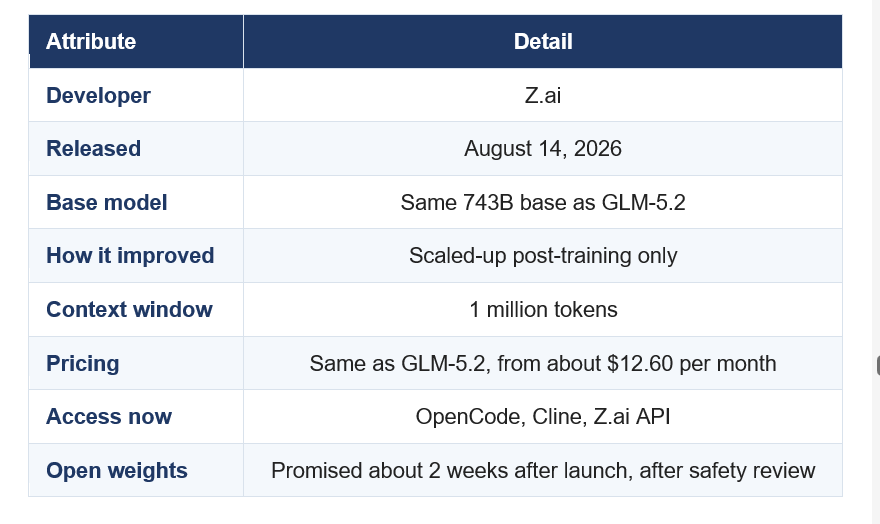
Promised about 2 weeks after launch, after safety review
Pricing and access as of the August 14, 2026 launch. Open weights, model card, and license were still pending a safety review at publication.
Two access points matter. First, GLM-5.3 is already usable today through coding agents like OpenCode and Cline and the Z.ai API, at the same low pricing as GLM-5.2, so you do not have to wait for the weights to try it. The cheapest route is Z.ai's Lite Coding Plan on yearly billing, which works out to roughly 12 to 13 dollars a month, a striking price for this level of capability. Second, the open weights are staged, promised about two weeks after launch and gated behind a safety review, with the model card and license still pending. That delay is a direct consequence of the emergent cyber capability: Z.ai is being cautious about releasing a model that autonomously finds critical vulnerabilities.
ON THE HELD-BACK WEIGHTS
GLM-5.3's open weights are not immediate. Z.ai is releasing them roughly two weeks after launch, after a safety review, precisely because the model's vulnerability-finding ability is strong enough to be dual-use. If you need the open weights for self-hosting, plan for that delay, and in the meantime use the API or coding-agent access, which is available now at the low GLM-5.2 pricing.
Strengths and Limits
A fair review names both sides clearly.
Strengths
- Value: frontier-competitive performance at roughly a tenth of the cost of the closed leaders, from about $12.60 a month.
- Cybersecurity: leads CyberGym and finds real vulnerabilities at scale, with the free Open-Source Shield audit tool.
- Post-training efficiency: matches models many times its size on some benchmarks from a 743B base, no bigger to serve.
- Open and accessible: usable now through OpenCode, Cline, and the API, with open weights coming.
- Long context: keeps the 1 million token window for large codebases and long agent runs.
Limits
- Raw coding: trails Fable 5 on the hardest coding, including Z.ai's own Code Bench.
- Offensive security: lags Fable 5 and GPT-5.6 Sol on exploitation benchmarks.
- Weights delayed: open weights are staged behind a safety review, not available at launch.
- Some vendor-reported numbers: several benchmarks are Z.ai's own and await broad independent verification.
The pattern is that GLM-5.3 is a specialist that punches far above its size and price, exceptional on cyber defense and value, close but not quite first on the hardest coding. For most teams the strengths outweigh the limits by a wide margin, especially given the price, but if your only metric is peak coding quality, a closed leader still edges it.
Who Should Use GLM-5.3?
GLM-5.3 is the right choice for a large slice of developers and teams, and clearly not the only choice for a few. Here is the guidance by use case.
- Cost-conscious developers: yes, it is one of the best value coding models in the world, close to the frontier at a tenth of the price.
- Security teams and open-source maintainers: yes, it leads on defensive cyber and ships a free audit tool, and it is the standout pick for vulnerability finding.
- Agent builders: yes, strong agentic and long-context performance at low cost makes it excellent for agent workflows at scale.
- Teams that need the absolute best coding: consider Fable 5 or GPT-5.6 Sol, which still edge it on the hardest tasks.
- Self-hosters: yes, but wait for the open weights, expected about two weeks after launch.
Our verdict: GLM-5.3 is a landmark open model and, for most real work, the smartest value pick in coding right now. It is not simply as good as Fable 5, it is better on cybersecurity and price and slightly behind on the hardest coding, which for a 743B open model against a premium closed flagship is a stunning result. The impossible-miracle hype overstates the coding case, but understates how significant it is that an open model is now this close to the frontier while leading it on cyber defense. If you build software or care about security, GLM-5.3 belongs in your toolkit, most likely as your default, with a closed leader reserved for the very hardest coding. Try it now through the API, and grab the open weights when they land.
See where GLM-5.3 sits against every model in our best AI models of August 2026 ranking and our best open source AI models collection.
Frequently Asked Questions
Q: What is GLM-5.3?
GLM-5.3 is Z.ai's newest open-weights coding model, released August 14, 2026, and built for coding, agents, and cybersecurity. It is post-trained on the same 743 billion parameter base as GLM-5.2, keeps a 1 million token context, and competes with closed models like Fable 5 and GPT-5.6 Sol while leading the CyberGym cybersecurity benchmark.
Q: Is GLM-5.3 as good as Fable 5?
It depends on the task. GLM-5.3 beats Fable 5 on defensive cybersecurity, where it leads CyberGym, and on value, at roughly a tenth of the cost. But Fable 5 still leads on the hardest raw coding, including Z.ai's own Code Bench at 39.5 to 34.5. So GLM-5.3 is not quite as good on peak coding, but better on cyber and price, and close enough overall for most work.
Q: What are the GLM-5.3 benchmarks?
GLM-5.3 leads CyberGym defensive security at 84.5%, ahead of GPT-5.6 Sol at 83.6%, scores 28.3 on Terminal-Bench 3.0 beating DeepSeek V4-Pro, and trails Fable 5 on Z.ai's Code Bench, 34.5 to 39.5, and on ExploitBench. It found over 2,400 real vulnerabilities across 269 open-source projects. Some numbers are vendor-reported and await independent verification.
Q: How is GLM-5.3 better at cybersecurity?
GLM-5.3 tops the CyberGym defensive-security benchmark, ahead of the closed leaders, and has autonomously found thousands of real, often critical vulnerabilities across hundreds of open-source projects. Z.ai says the capability grew faster than expected and launched a free Open-Source Shield tool to help maintainers audit code. Its strength is defensive; it trails on offensive exploitation.
Q: How much does GLM-5.3 cost?
GLM-5.3 keeps GLM-5.2's low pricing. The cheapest route is Z.ai's Lite Coding Plan on yearly billing, which works out to roughly 12 to 13 dollars a month, a fraction of what closed leaders like Fable 5 cost. This aggressive pricing, combined with strong performance, is one of GLM-5.3's biggest advantages.
Q: Is GLM-5.3 open source?
It will be. GLM-5.3 is an open-weights model, but Z.ai staged the release, promising the weights about two weeks after the August 14 launch, after a safety review, because the model's vulnerability-finding ability is strong enough to be dual-use. The model card and license are pending. For now, access is through the API and coding agents like OpenCode and Cline.
Q: GLM-5.3 vs GPT-5.6 Sol vs DeepSeek V4-Pro: which is best?
GPT-5.6 Sol is the strongest all-round closed model and leads the hardest coding. GLM-5.3 leads defensive cybersecurity and wins on value, and it reportedly beats the updated DeepSeek V4-Pro on Terminal-Bench, making it the new open coding front-runner. Choose Sol for peak quality, GLM-5.3 for value and cyber, and compare both open models on your own tasks.
Q: How do I use GLM-5.3?
You can use GLM-5.3 today through the Z.ai API and coding agents like OpenCode and Cline, at GLM-5.2 pricing. Sign up for a Z.ai coding plan or call the API, and point your coding agent at the GLM-5.3 model. When the open weights are released after the safety review, you will also be able to self-host it.
Q: Is GLM-5.3 worth using?
Yes, for most developers and especially security-focused teams. It offers frontier-competitive coding, leading defensive cybersecurity, and a free audit tool at a fraction of the cost of closed models. It trails Fable 5 on the hardest coding, so reserve a closed leader for that, but for value, agents, and security, GLM-5.3 is one of the best choices available.
Recommended Blogs
- GLM-5.2 review
- Best coding AI compared
- Claude Fable 5 review
- DeepSeek V4-Pro pricing change
- Best AI models of August 2026
Resources and Community
Join our community of 70,000+ AI enthusiasts and learn to build powerful AI applications. Whether you are a beginner or an experienced developer, Build Fast with AI helps you understand and implement AI in your projects.
- Website (buildfastwithai.com)
- LinkedIn (Build Fast with AI)
- Instagram (@buildfastwithai)
- Founder Twitter (@satvikps)
- Twitter (@BuildFastWithAI)
Agentic AI Launchpad 2026
A structured 6-week cohort program that takes you from AI basics to building and deploying real-world agentic AI systems. Includes live sessions, expert mentorship, project reviews, and a builder community network.
Ready to go from learning to building? Join the next cohort: Agentic AI Launchpad 2026
Free AI Resources
Access free tools, workshops, and micro-learning to keep building:
Follow Build Fast with AI for honest, tested reviews and comparisons of every major model launch.

