



DeepSeek V4 Review: Benchmarks, Pricing and Is It Worth It? (2026)
DeepSeek V4-Pro answers real GitHub issues as accurately as Gemini 3.1 Pro and charges 34 times less per output token than GPT-5.5. That single fact is why every major AI lab spent the summer of 2026 revisiting its prices. DeepSeek shipped an open-weight model that matches the frontier on coding and undercuts it so hard the comparison stops being about quality and starts being about the bill.
V4 comes in two sizes, V4-Pro and V4-Flash, both with a 1 million token context window and MIT-licensed open weights you can download and run yourself. It scores 80.6% on SWE-bench Verified, the highest open-weights result on record, and it is genuinely cheap rather than cheap-for-a-frontier-model. This review covers the two variants, the benchmarks, the pricing that broke the market, how it compares to Kimi K3 and GLM-5.2, and the honest answer to whether it is worth switching to.
The one-line verdict: DeepSeek V4 is the best price-to-performance model in AI right now, and for most coding and high-volume work it is the smart default. It is not the outright best on the hardest problems, where Claude Fable 5 still leads, but at these prices it does not need to be.
What Is DeepSeek V4?
DeepSeek V4 is a Mixture-of-Experts open-weight AI model from DeepSeek, released in two variants (V4-Pro and V4-Flash) with a 1 million token context window and MIT-licensed weights. It is built for efficient million-token-context intelligence, and it targets real-world software engineering, math and long-document work at a fraction of closed-model prices.
The architecture is the point. V4-Pro carries 1.6 trillion total parameters but activates only 49 billion per token, while V4-Flash carries 284 billion total with 13 billion active. That sparsity is how DeepSeek serves a frontier-class model cheaply enough to charge cents. After a preview earlier in 2026, the official V4 release firmed up pricing and benchmarks, and independent trackers like Artificial Analysis placed it back among the leading open-weights models.
Table 1: DeepSeek V4 at a glance
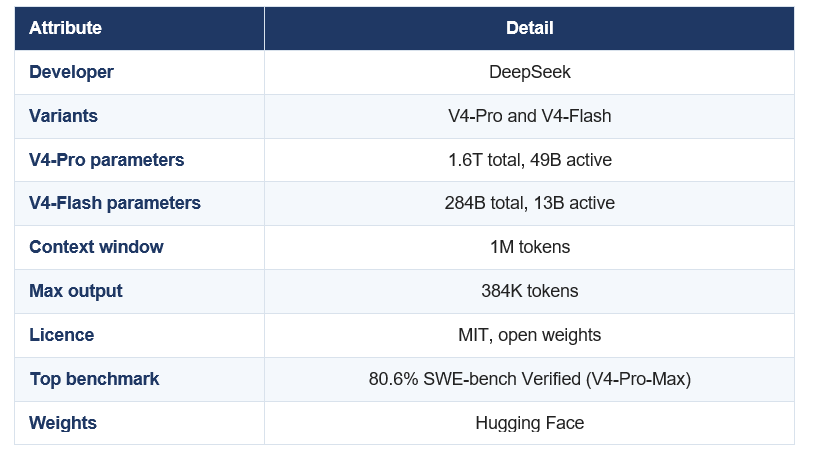
V4-Pro's 75% price cut became permanent on May 31, 2026, which is a large part of why V4 reset the market.
We reviewed each variant in depth at launch. Our DeepSeek V4-Pro review and DeepSeek V4-Flash review cover the architecture and first benchmarks, and this guide is the updated consolidated verdict.
DeepSeek V4-Pro vs V4-Flash
Choose V4-Pro for maximum accuracy on hard tasks and V4-Flash for cheap, high-volume work, because the two share an architecture and differ mainly in size and price. On coding they are surprisingly close, so the decision is usually about budget, not capability.
Table 2: V4-Pro vs V4-Flash
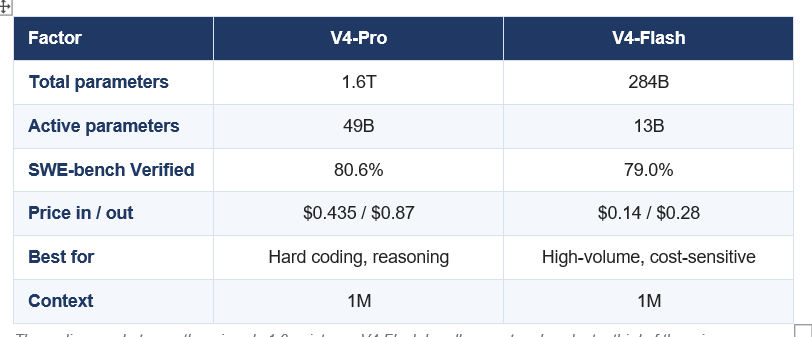
The coding gap between them is only 1.6 points, so V4-Flash handles most real work at a third of the price.
My take: the small gap between Pro and Flash is the interesting part. V4-Flash scores 79.0% on SWE-bench Verified at $0.14 input, which means for the large majority of coding tasks you can run the cheaper model and barely notice. Reserve V4-Pro for the genuinely hard problems where that last 1.6 points matters.
DeepSeek V4 Benchmarks
DeepSeek V4-Pro scores 80.6% on SWE-bench Verified, the highest open-weights result on record and tied with Gemini 3.1 Pro, with V4-Flash close behind at 79.0%. On the benchmark that best predicts real coding ability, V4 sits in the frontier conversation rather than the budget one.
Table 3: DeepSeek V4 key benchmarks
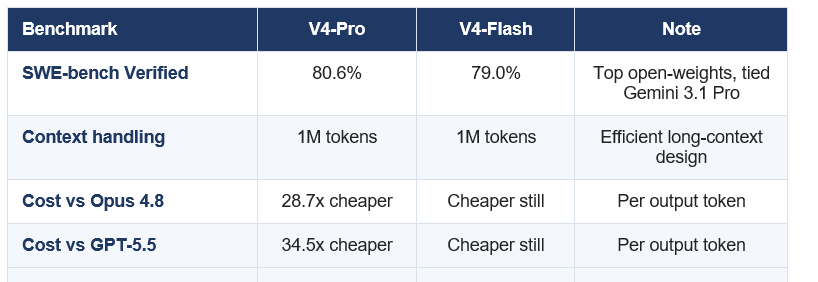
SWE-bench Verified numbers are corroborated by independent trackers. Treat cross-vendor comparisons as directional.
Two things put the 80.6% in context. First, Claude Fable 5 still leads the benchmark outright near 95%, so V4 is the best open model on coding, not the best model overall. Second, the closed leaders like GPT-5.6 Sol sit only a little above V4 on many software tasks, which means the practical quality gap for everyday coding is much smaller than the price gap. When a model this cheap is this close, the expensive model has to justify itself on the hardest 10% of work.
Quotable version: DeepSeek V4 did not win the benchmark, it won the argument. When the open model is within a few points and 30 times cheaper, price stops being a tiebreaker and becomes the whole decision.
DeepSeek V4 Pricing: The Number That Broke the Market
DeepSeek V4-Pro costs $0.435 per million input tokens and $0.87 per million output, while V4-Flash costs $0.14 input and $0.28 output. Those are not discounted-for-launch prices, the 75% cut on V4-Pro became permanent on May 31, 2026, which is what forced rival providers to respond.
Table 4: DeepSeek V4 pricing vs the field
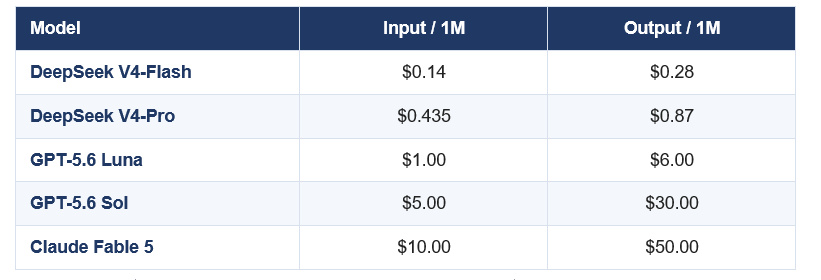
V4-Pro output at $0.87 is roughly 57 times cheaper than Claude Fable 5's $50. That is the market-breaking number.
WHAT THIS PRICING ENABLES
At $0.28 output per million tokens, V4-Flash makes always-on AI economically trivial. A pipeline that classifies, extracts or summarizes millions of documents a day costs tens of dollars, not thousands. Whole product categories that were too expensive to run on a frontier model become viable on V4.
My contrarian point: the real story of DeepSeek V4 is not that it is cheap, it is that it made everyone else look expensive. When a MIT-licensed model matches the frontier on coding at a thirtieth of the price, the burden of proof flips: now the premium models have to explain why they cost 30 times more, and for a lot of work they cannot.
V4 sits at the bottom of the value tier in our best open source AI models ranking, which maps the full open field by price and capability.
Don't just use ChatGPT. Learn to build custom LLM agents, RAG pipelines, and full-stack Agentic AI apps in our intensive 6-week program.
DeepSeek V4 vs Kimi K3, GLM-5.2 and Closed Models
Among open models, DeepSeek V4 wins on price and factual coding, Kimi K3 wins on agentic and web tasks, and GLM-5.2 wins on terminal work, so the best open pick depends on your job. Against closed models, V4 trades a small quality gap for an enormous price advantage.
Table 5: DeepSeek V4 vs the field
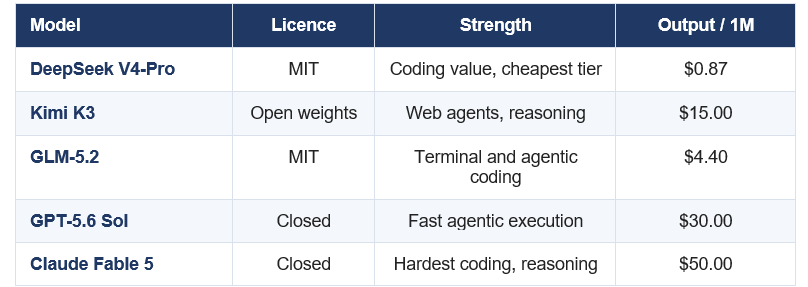
V4 is the value floor of the open tier. Kimi K3 and GLM-5.2 cost more but lead specific agentic tasks.
The practical framing for a builder: if your workload is coding, extraction, summarization or anything high-volume, DeepSeek V4 is likely the right default and the savings are dramatic. If your workload is web-browsing agents or complex multi-step tool use, Kimi K3 earns its higher price. If it is heavy terminal and repo work, GLM-5.2 is worth a look. And if you need the single best answer on the hardest problems regardless of cost, that is still Claude Fable 5 territory.
For a direct coding head-to-head across these models, our GLM-5.2 vs Claude vs GPT-5.6 vs Kimi comparison breaks down cost per merged pull request, and our Kimi K3 review covers the agentic side.
Is DeepSeek V4 Open Source?
Yes. DeepSeek V4 is released under the MIT license with open weights available on Hugging Face, one of the most permissive setups in AI. You can download, modify, fine-tune, self-host and commercialize it with almost no restrictions, which is a genuine advantage over the closed frontier models.
MIT matters more than most people realize. It is more permissive than the custom licenses on some other open releases, and it means a startup can build a product on V4 without a legal review that ends in a no. Combined with the pricing, that openness is why DeepSeek V4 became the default base for so many cost-sensitive AI products in 2026. The weights for V4-Pro live in the official DeepSeek repository on Hugging Face, and the technical report on efficient million-token context is public.
The practical benefit: with MIT weights you are never locked in. If DeepSeek changes pricing or access tomorrow, you can self-host the exact model you were using. That optionality is worth real money to teams that cannot afford to be at the mercy of one provider.
How to Access and Run DeepSeek V4
You can use DeepSeek V4 three ways: the DeepSeek API, hosted third-party providers, or self-hosting the open weights. For most teams the API is the fastest start, and because it is OpenAI-compatible, switching an existing app is usually a base-URL and model-name change.
- DeepSeek API: sign up at the DeepSeek platform, choose deepseek-v4-pro or deepseek-v4-flash, and call the OpenAI-compatible endpoint.
- Hosted providers: V4 is available through inference platforms and aggregators, useful if you already run on one.
- Self-host: download the MIT weights from Hugging Face and serve with vLLM or SGLang. Realistic only with serious GPU capacity given the model size, but it removes per-token costs entirely.
A practical tip on variant choice: start on V4-Flash for everything, measure quality on your actual tasks, and only escalate the hard cases to V4-Pro. Because the coding gap is small and the price gap is large, most teams end up running Flash for the bulk of traffic and Pro sparingly.
Is DeepSeek V4 Worth It?
For coding, high-volume pipelines and any cost-sensitive workload, DeepSeek V4 is worth it and then some, because it delivers near-frontier coding at a thirtieth of the price under an MIT license. It is less compelling only if your work is on the absolute hardest reasoning problems where Claude Fable 5 still leads, or if you specifically need web-agent strength where Kimi K3 is better.
Table 6: Should you use DeepSeek V4?
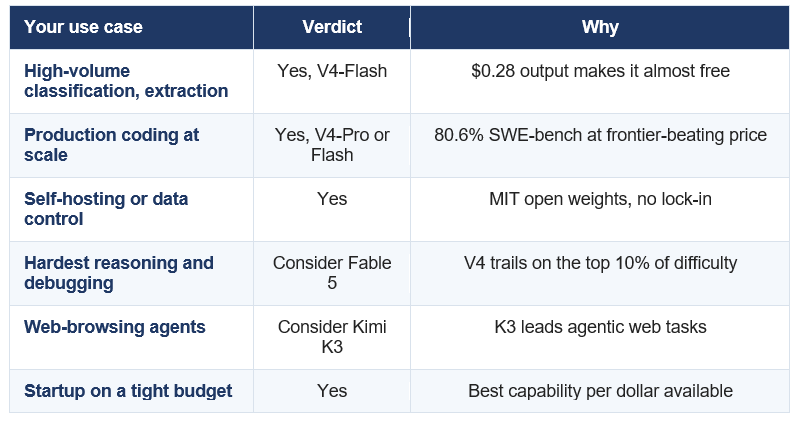
V4 is the value default. Move up to a premium model only for the specific tasks where it clearly leads.
Verdict, 9 out of 10: DeepSeek V4 is the most important open-weight release for cost-conscious builders in 2026, and the best price-to-performance model available. I dock one point only because the very hardest coding and reasoning still belong to closed flagships, and because self-reported benchmarks always deserve your own testing. For the large majority of real workloads, start here and route up only when you must.
For where V4 lands against the full 2026 field, closed and open, see our best AI models July 2026 ranking and the open-model focused GLM-5.2 review.
The only comprehensive program designed to take you from basic prompting to building interactive Artifacts, custom integrations, and deploying production-ready code with Claude Code.
Limitations
Three honest limitations are worth weighing before you commit.
- Not the top on hardest tasks. Claude Fable 5 leads SWE-bench Verified near 95%, so for the most difficult debugging and reasoning, V4 is very good but not the best.
- Self-hosting is heavy. A 1.6T-parameter model needs serious GPU infrastructure to run locally, so most teams will use the API despite the open weights.
- Benchmarks need your own validation. Headline scores flatter every model on clean tasks, so test V4 on your real audio, code or documents before a full migration.
My honest close: none of these are dealbreakers for the workloads V4 is built for. They are reasons to route the hardest 10% of tasks elsewhere, not reasons to skip a model that just made frontier-class coding cost cents.
Frequently Asked Questions
Q: What is DeepSeek V4?
DeepSeek V4 is an open-weight Mixture-of-Experts AI model from DeepSeek, released in V4-Pro and V4-Flash variants with a 1 million token context window and MIT-licensed weights. V4-Pro scores 80.6% on SWE-bench Verified, the top open-weights result, at pricing far below closed frontier models.
Q: What is the difference between DeepSeek V4-Pro and V4-Flash?
V4-Pro has 1.6 trillion total parameters (49 billion active) and scores 80.6% on SWE-bench Verified at $0.435 input and $0.87 output. V4-Flash has 284 billion total (13 billion active) and scores 79.0% at $0.14 input and $0.28 output. The coding gap is only 1.6 points, so Flash handles most work at a third of the price.
Q: How much does DeepSeek V4 cost?
V4-Pro costs $0.435 per million input tokens and $0.87 per million output. V4-Flash costs $0.14 input and $0.28 output. Per output token, V4-Pro is about 28.7 times cheaper than Claude Opus 4.8 and 34.5 times cheaper than GPT-5.5, and the 75% price cut became permanent in May 2026.
Q: How good is DeepSeek V4 at coding?
Very good. V4-Pro scores 80.6% on SWE-bench Verified, the highest open-weights result and tied with Gemini 3.1 Pro. Claude Fable 5 still leads the benchmark outright near 95%, so V4 is the best open model on coding rather than the best overall, but for most real coding work the quality gap is small and the price gap is huge.
Q: Is DeepSeek V4 open source?
Yes. DeepSeek V4 is released under the MIT license with open weights on Hugging Face, one of the most permissive setups available. You can download, fine-tune, self-host and commercialize it with almost no restrictions, which removes vendor lock-in that closed models carry.
Q: Is DeepSeek V4 better than GPT-5.6 or Claude?
On price, dramatically, at up to 34 times cheaper per token. On the hardest coding and reasoning, Claude Fable 5 and GPT-5.6 Sol still lead. For everyday coding and high-volume work, V4 is close enough that the price advantage usually wins, which is why it reshaped the market.
Q: What is the context window of DeepSeek V4?
Both DeepSeek V4-Pro and V4-Flash have a 1 million token context window with up to 384,000 tokens of output. The model is specifically designed for efficient million-token-context intelligence, so you can feed it entire codebases or long document sets in a single call.
Q: Is DeepSeek V4 worth using?
For coding, high-volume pipelines, self-hosting and cost-sensitive products, yes, it is the best price-to-performance model available. It is less compelling only for the absolute hardest reasoning, where Claude Fable 5 leads, or web-agent tasks, where Kimi K3 is stronger. For most workloads, V4 is the smart default.
Recommended Blogs
- DeepSeek V4-Pro review
- DeepSeek V4-Flash review
- Best open source AI models
- Kimi K3 review
- GLM-5.2 review
Resources and Community
Join our community of 70,000+ AI enthusiasts and learn to build powerful AI applications. Whether you are a beginner or an experienced developer, Build Fast with AI helps you understand and implement AI in your projects.
- Website (buildfastwithai.com)
- LinkedIn (Build Fast with AI)
- Instagram (@buildfastwithai)
- Founder Twitter (@satvikps)
- Twitter (@BuildFastWithAI)
Agentic AI Launchpad 2026
A structured 6-week cohort program that takes you from AI basics to building and deploying real-world agentic AI systems. Includes live sessions, expert mentorship, project reviews, and a builder community network.
Ready to go from learning to building? Join the next cohort: Agentic AI Launchpad 2026
Free AI Resources
Access free tools, workshops, and micro-learning to keep building:
Cheap, open, and frontier-adjacent is a rare combination. Test DeepSeek V4 on your own workload this week, and follow Build Fast with AI for honest coverage of every major model release.