



Best Open Source AI Models in 2026: The Complete Collection
In the space of 31 days, open-weight models matched the closed frontier on terminal coding, set the all-time record on web browsing agents, and shipped the largest model ever released to the public. June 16 to July 16, 2026 was the strongest month in open AI history, and if your mental model of open source still says cheaper but clearly worse, it is now simply wrong.
I have tested every major open release of the past quarter through APIs, playgrounds, and where possible self-hosted deployments. This collection ranks the 10 best open source AI models available right now, with real benchmarks, honest licenses, current prices, and a straight answer for every use case: overall, coding, agents, customization, budget, and local. Bookmark it; the open tier is moving fast enough that we update this list every month.
Every model here also lives in our open-source LLM hub with standalone reviews and comparisons, so you can go one level deeper on anything that makes your shortlist.
The State of Open Source AI in July 2026
Open-weight models closed most of the gap to the closed frontier in a single quarter, driven by three landmark releases. MiniMax M3 arrived June 1 with frontier-adjacent coding at 5-10% of closed prices. Thinking Machines dropped Inkling on July 15, a 975B Apache 2.0 multimodal base built for fine-tuning. And Moonshot answered one day later with Kimi K3, a 2.8 trillion parameter flagship that VentureBeat called the largest open-source model ever, with weights promised by July 27.
The pattern behind the headlines: Chinese labs (Moonshot, MiniMax, Z.ai, DeepSeek, Alibaba) now set the pace on raw open capability, while American open efforts split between NVIDIA's research-friendly Nemotron line and Thinking Machines' customization bet. Meta, the company that started the open-weights era with Llama, sat this quarter out entirely after pivoting proprietary with Muse Spark. The open crown changed continents, and almost nobody in the West noticed until K3's benchmark table forced the issue.
Quotable version: open source AI in 2026 is no longer the discount aisle. It is a second frontier, running one week behind the first and charging a tenth of the price.
Master Table: All 10 Models Compared
Here are the 10 best open source AI models available in July 2026, ranked by overall capability, with the license, context window, headline benchmark, and current API price for each. Self-hosting is free for all of them once weights are public; API prices are for hosted access.
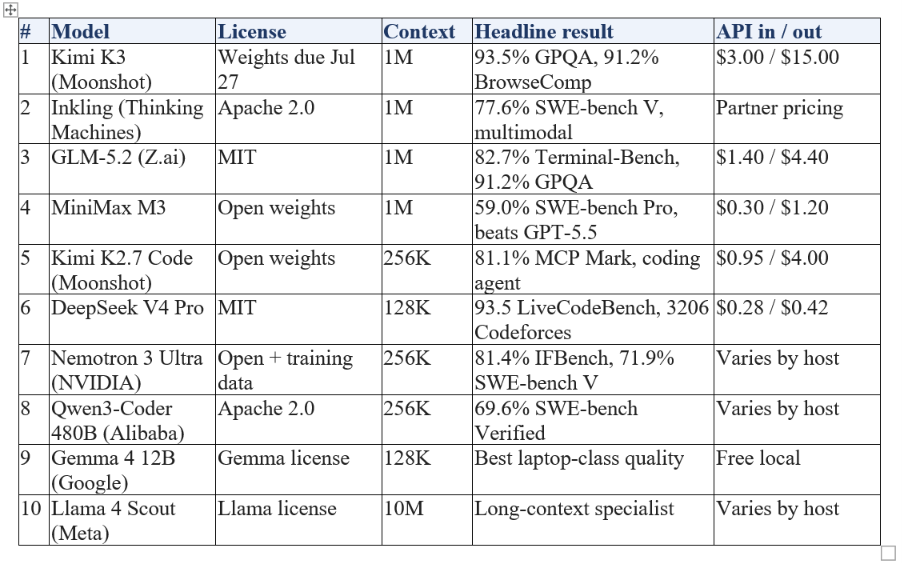
Ranking note for transparency: positions weigh verified benchmarks first, breadth of capability second, and deployment freedom third. Kimi K3 tops the list on capability despite its weights arriving later this month; if the July 27 release slips, Inkling and GLM-5.2 move up, and this page will say so.
Best Overall: Kimi K3
Kimi K3 is the best open source AI model overall in July 2026, posting 93.5% on GPQA Diamond (the best open score ever published), 88.3% on Terminal-Bench 2.1, and an all-time record 91.2% on BrowseComp for web agents. The 2.8T-parameter MoE reads text, images, and video, holds a 1M token context, and reached second place overall on Artificial Analysis' long-horizon tracker at 1547 Elo, behind only Claude Fable 5.
Two honest caveats keep this from being a coronation. Most launch numbers are Moonshot's own reporting, with independent verification still landing, and at $3 input / $15 output it is the most expensive Chinese-lab model ever, 5x its own K2 family. In my testing the agentic research capability is real and the best I have used, while routine coding is better value on cheaper siblings. Treat K3 as the open flagship it is priced as, not the budget pick the Kimi name used to mean.
Our full Kimi K3 review with hands-on tests covers the K2-to-K3 lineage, the four workloads I ran, and the verification caveats in detail.
Best for Customization: Inkling
Inkling from Thinking Machines Lab is the best open model to fine-tune into your own, released July 15, 2026 under a clean Apache 2.0 license with 975B total parameters, 41B active, native text, image, and audio reasoning, and a thinking-effort dial from 0.2 to 0.99. It scores 77.6% on SWE-bench Verified and holds the best open-weights adversarial safety score at 78.0% FORTRESS.
What sets it apart is the path from weights to product. Day-one fine-tuning on the Tinker platform, recipes in the Tinker Cookbook, an NVFP4 checkpoint for Blackwell GPUs, and support across vLLM, SGLang, and llama.cpp make it the smoothest customization pipeline in open AI. Thinking Machines says plainly that Inkling is not the strongest model available, and that honesty is the strategy: it is a base for a thousand specialized models, not one assistant. A 276B Inkling-Small preview with 12B active suggests the recipe scales down too.
The full Inkling review and benchmarks breaks down the architecture bets, the effort-dial cost curve, and my four hands-on tests.
Best for Coding: GLM-5.2, Kimi K2.7 Code, Qwen3-Coder
GLM-5.2 is the best open model for terminal and agentic coding at 82.7% on Terminal-Bench 2.1, Kimi K2.7 Code is the best budget coding agent, and Qwen3-Coder 480B is the safest license play. Coding is the deepest category in open AI, and the right pick depends on which constraint binds you.
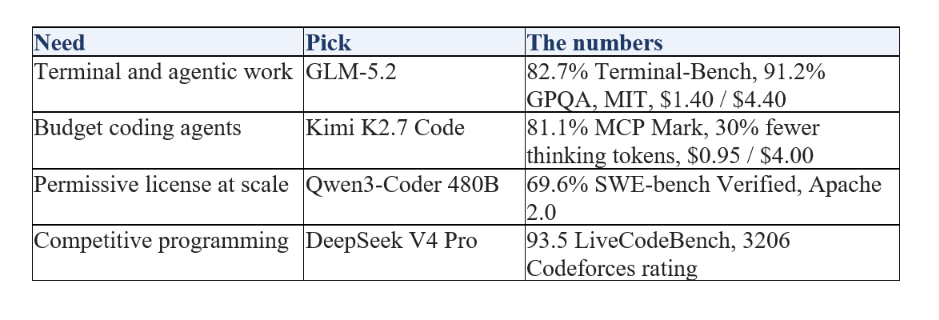
GLM-5.2's terminal score deserves a second look: 82.7% beats Inkling by 19 points, beats Muse Spark, and lands within 6 points of GPT-5.6 Sol, from an MIT-licensed model costing $1.40 input. My hot take stands from our earlier testing: for the average pull request, nobody can tell GLM-5.2 output from a closed flagship, and the closed labs know it, which is exactly why mid-tier closed pricing keeps falling.
We benchmarked these open coders directly against Claude and GPT-5.6 in our open vs closed coding comparison, including cost-per-merged-PR math that flips the leaderboard.
Best Price-Performance: MiniMax M3
MiniMax M3 delivers the best capability per dollar in open AI: 59.0% on SWE-bench Pro (above GPT-5.5 and Gemini 3.1 Pro), roughly 80.5% on SWE-bench Verified, a 1M token context, and native text, image, and video input, at $0.30 input / $1.20 output. VentureBeat's launch framing holds up: frontier-adjacent performance for 5-10% of closed-model cost.
The engineering behind the price is the story. MiniMax Sparse Attention (MSA) replaces full attention with KV-block selection, cutting long-context compute to roughly 1/20th of the previous generation at 1M tokens. That is why M3 can afford to be cheap at lengths where other models bleed money. In my testing it handled a full-repo review that would cost 15x more on a closed flagship, with quality I would grade a solid B+ rather than an A, which at this price is the correct trade for most volume work.
One-liner for your notes: MiniMax M3 is what happens when a lab optimizes the attention mechanism for your invoice instead of the leaderboard.
Best Budget and Factuality: DeepSeek V4
DeepSeek V4 is the cheapest serious model in AI at $0.14 input / $0.28 output, and its V4 Pro sibling leads open models on factual recall with 57.0% on SimpleQA Verified plus a 3206 Codeforces rating. Both ship under MIT, the most permissive license in the top tier.
The budget king role matters more than it sounds. Classification, extraction, summarization, and routing calls make up the silent majority of production AI traffic, and V4 does them at prices that make metering almost pointless. Its factuality lead is the underrated stat: on tasks where hallucination is the main risk, V4 Pro beats every open rival including models 20x its price. Pair it with a search tool and it becomes the most cost-effective RAG engine available. Every routing stack I build starts with a DeepSeek tier at the bottom.
Best of the Rest: Nemotron, Qwen, Gemma, Llama
Four more models earn their place for specific jobs, even if they miss the podium. Each solves a problem the leaders do not.
Nemotron 3 Ultra: the researcher's choice
NVIDIA's flagship leads open instruction following at 81.4% IFBench and posts 71.9% SWE-bench Verified, but its real differentiator is openness of process: training data, recipes, and intermediate checkpoints ship alongside weights. If you need to audit, reproduce, or build on the training itself, nothing else in the top tier offers this.
Qwen 3.5: the license-safe workhorse
Alibaba's Qwen family remains the safest all-round Apache 2.0 bet, with the widest size range from edge to 480B and the largest fine-tune ecosystem in open AI. Individual scores rarely top a category anymore, but the combination of license, sizes, tooling, and multilingual strength keeps Qwen the default recommendation for enterprises with cautious legal teams.
Gemma 4 12B: the laptop model
Google's small model is the best quality you can run on a consumer laptop today, and it is the honest answer to the most common question I get. If your constraint is a MacBook rather than a datacenter, Gemma 4 12B via llama.cpp or Ollama beats every larger model you cannot actually run.
Llama 4 Scout: the long-context relic
Meta's 10M-context specialist still owns extreme-length retrieval, and its ecosystem remains huge. But with Meta pivoted to proprietary Muse Spark and no Llama 5 announced, the line that created open-weights AI is now maintenance-mode history. Deploy it for its niche; do not build a 2027 roadmap on it.
Open vs Closed: How Big Is the Gap Now?
The open-to-closed gap in July 2026 is under six months on most benchmarks and effectively zero on some. Kimi K3 sits within half a point of GPT-5.6 Sol on Terminal-Bench (88.3% vs 88.8%). MiniMax M3 beats GPT-5.5 on SWE-bench Pro. GLM-5.2's GPQA score of 91.2% would have led the entire field, closed models included, at the start of this year.
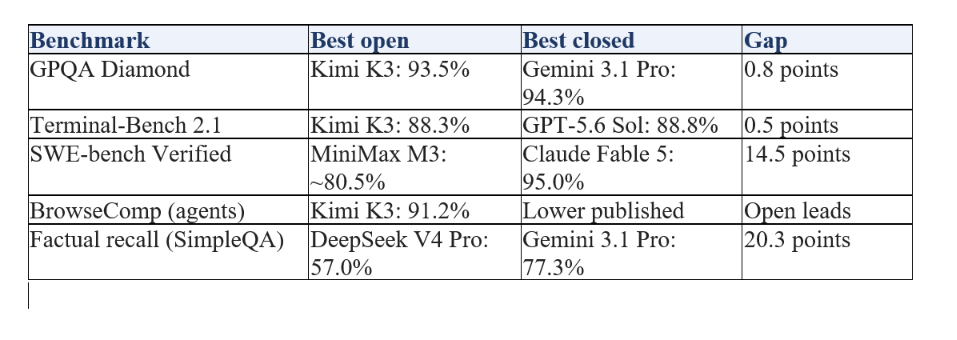
Read the gaps honestly. Where tasks are verifiable and trainable via RL (terminal work, browsing, competition math), open models have caught up or passed. Where quality depends on massive proprietary post-training and preference data (hardest software engineering, factual recall), closed leaders keep a real edge. Claude Fable 5's 14.5-point SWE-bench Verified lead is the single most defensible moat left in AI, and it is one benchmark, not a wall.
For the closed side of this ledger, our best AI models July 2026 ranking scores the full field, and the GPT-5.6 review shows what the open tier is chasing.
Licenses Explained: Apache, MIT, and Promised Weights
License determines what you can legally build, and the top 10 spans four meaningfully different tiers. Apache 2.0 (Inkling, Qwen) and MIT (GLM-5.2, DeepSeek) are true permissive licenses: download, modify, commercialize, no strings. Custom licenses (Gemma, Llama) permit most commercial use with restrictions you must actually read. Promised weights (Kimi K3 by July 27, MiniMax M3's rolling release) mean API-only until the upload lands.
My rule for teams: treat a promised release as vaporware until the Hugging Face repo exists, then verify the license file matches the announcement. Moonshot's track record here is good, and K2.7's weights shipped as stated, but roadmaps are not licenses. If legal certainty is your binding constraint today, the shortlist is Inkling, GLM-5.2, DeepSeek V4, and Qwen, full stop.
How to Choose: A Routing Stack That Works
Do not pick one open model; pick a stack of three and route by task. The price and specialization spread across this list makes a tiered setup strictly better than any single choice, and SDK compatibility makes it nearly free to implement.
Add Inkling as a fourth lane the moment you have a repeated task worth owning: fine-tune it once and your workhorse tier becomes your model, not a rented one. That is the real endgame of this list. Open source AI in 2026 is not about replacing one closed subscription with one open download; it is about assembling a stack you control at every price point.
The routing and fine-tuning notebooks in gen-ai-experiments include working examples for exactly this three-tier setup, from router logic to eval harnesses.
Frequently Asked Questions
What is the best open source AI model in 2026?
Kimi K3 from Moonshot AI is the best open source AI model overall in July 2026, with 93.5% on GPQA Diamond, a record 91.2% on BrowseComp, a 1M token context window, and multimodal input. For customization, Inkling (Apache 2.0) is the better base; for coding value, GLM-5.2 leads at $1.40 / $4.40.
Is Kimi K3 open source?
Kimi K3 launched July 16, 2026 via app and API, with open weights promised by July 27, 2026. Until the weights land on Hugging Face it is effectively a closed model with an open roadmap. Moonshot's earlier models, including Kimi K2.7 Code, already have public weights.
Which open source model is best for coding?
GLM-5.2 is the best open coding model for terminal and agentic work at 82.7% Terminal-Bench 2.1, with MIT licensing and $1.40 / $4.40 pricing. Kimi K2.7 Code is the best budget coding agent, Qwen3-Coder 480B is the strongest Apache 2.0 option, and DeepSeek V4 Pro leads competitive programming with a 3206 Codeforces rating.
What is the cheapest good open source AI model?
DeepSeek V4 at $0.14 input / $0.28 output per million tokens is the cheapest serious model available, and self-hosting any open-weight model removes per-token costs entirely. MiniMax M3 at $0.30 / $1.20 is the cheapest model with frontier-adjacent coding scores.
Can open source models match GPT and Claude?
On several benchmarks, yes: Kimi K3 is within 0.5 points of GPT-5.6 Sol on Terminal-Bench, and MiniMax M3 beats GPT-5.5 on SWE-bench Pro. Closed models keep real leads on the hardest software engineering (Claude Fable 5: 95% SWE-bench Verified vs ~80.5% open best) and factual recall. The gap is now months, not years.
Which open model can I run locally on a laptop?
Gemma 4 12B is the best laptop-class open model in 2026, running well through llama.cpp or Ollama on consumer hardware. Larger models like GLM-5.2 or Inkling need serious GPU infrastructure, though quantized checkpoints (including Inkling's NVFP4) keep lowering the bar.
What license should I look for in an open model?
Apache 2.0 and MIT are the safest: they allow download, modification, and commercial use without meaningful restrictions. Inkling, Qwen (Apache 2.0), GLM-5.2, and DeepSeek (MIT) qualify. Custom licenses like Llama's and Gemma's permit most uses but carry conditions, and promised weights are not a license until published.
Recommended Blogs
● GPT-5.6 Sol Terra Luna review
Resources and Community
Join our community of 70,000+ AI enthusiasts and learn to build powerful AI applications. Whether you are a beginner or an experienced developer, Build Fast with AI helps you understand and implement AI in your projects.
● Website (buildfastwithai.com)
● LinkedIn (Build Fast with AI)
● Instagram (@buildfastwithai)
Agentic AI Launchpad 2026
A structured 6-week cohort program that takes you from AI basics to building and deploying real-world agentic AI systems. Includes live sessions, expert mentorship, project reviews, and a builder community network.
Ready to go from learning to building? Join the next cohort: Agentic AI Launchpad 2026
Free AI Resources
Access free tools, workshops, and micro-learning to keep building:
● AI Workshops (free resources and recordings)
● Unrot (learn AI in 5 minutes a day)
Found this collection useful? Follow Build Fast with AI for monthly open-model rankings and hands-on reviews of every major release, and subscribe so the next update lands in your inbox.
References
● Kimi K3 launch (VentureBeat)
● MiniMax M3 announcement (MiniMax)
● MiniMax M3 pricing analysis (VentureBeat)
● Introducing Inkling (Thinking Machines)

