



A 975 billion parameter multimodal model just landed on Hugging Face under Apache 2.0, and you can legally fine-tune it, ship it in a product, and never pay its maker a cent. Inkling, released by Mira Murati's Thinking Machines Lab on July 15, 2026, is the most ambitious open-weights drop of the year, and after three days of testing it, I think it changes what the open tier is for.
The headline numbers: 975B total parameters with only 41B active per token, a 1 million token context window, native reasoning over text, images, and audio, and a thinking-effort dial you can turn from 0.2 to 0.99 to trade quality against token cost. Thinking Machines says openly that Inkling is not the strongest model available. That honesty is the tell for what it actually is: the best open base for building your own specialized model, not another leaderboard chaser.
I ran Inkling through the same coding, multimodal, and cost tests we use for every release in our open-source LLM coverage hub. Here is the full review: architecture, benchmarks, four hands-on tests, and an honest verdict on who should deploy it.
What Is Inkling?
Inkling is a 975B-parameter open-weights Mixture-of-Experts model from Thinking Machines Lab, released July 15, 2026 under Apache 2.0, with 41B active parameters, a 1M token context window, and native multimodal reasoning over text, images, and audio. It is the first frontier-scale model from the startup founded by former OpenAI CTO Mira Murati, and it was pretrained on 45 trillion tokens spanning text, images, audio, and video.
The release includes more than one model. Alongside the flagship, Thinking Machines is previewing Inkling-Small, a 276B-parameter sibling with just 12B active parameters trained on a similar recipe, which matches or beats the big model on several benchmarks at far lower cost. Full weights for the flagship sit on Hugging Face, including an NVFP4 checkpoint tuned for NVIDIA Blackwell hardware, and hosted access runs through partners including Together AI, Fireworks, Modal, Databricks, and Baseten.
The strategic angle matters as much as the specs. Thinking Machines states plainly that Inkling is not the strongest model available, open or closed. Instead it is built as a customization base: multimodal, efficient, censorship-resistant by design, and wired directly into Tinker, the company's fine-tuning platform. VentureBeat framed the launch around low cost and resistance to censorship, and the model posts the highest adversarial-safety score among open weights at 78.0% on FORTRESS. My read: this is the anti-flagship, and that is precisely the point.
Architecture: What Makes Inkling Different
Inkling's architecture makes three unusual bets: extreme sparsity, an encoder-free vision path, and relative positional embeddings instead of RoPE. Each MoE layer carries 256 routed experts plus 2 shared experts, with only 6 routed experts active per token, which is how a 975B model runs at 41B-active cost. Attention interleaves sliding-window and global layers at a 5:1 ratio with 8 KV heads, keeping long-context inference affordable.
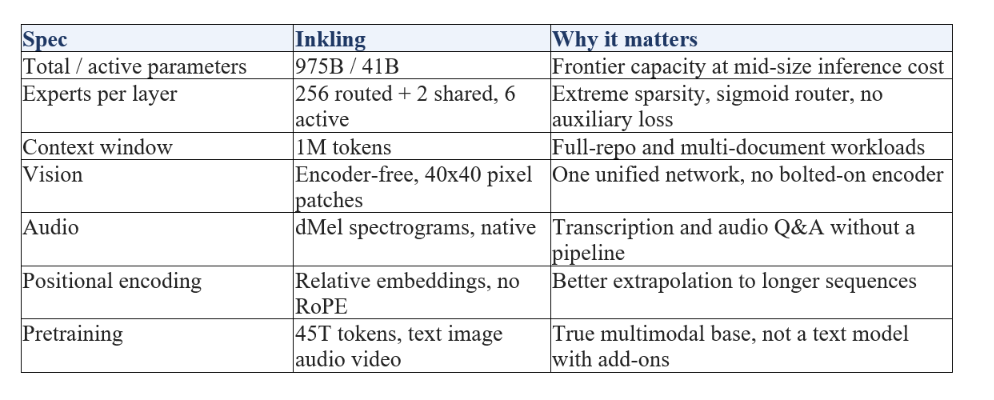
Two training details stand out for anyone who follows the research. Optimization is hybrid, using Muon for the large matrices and Adam elsewhere, with weight decay coupled to the learning rate squared for stability, and the whole run happened on NVIDIA GB300 NVL72 systems. Post-training combined supervised fine-tuning on synthetic data with reinforcement learning at serious scale: more than 30 million rollouts, during which the chain-of-thought became measurably more concise without anyone optimizing for that. A model that learns to think shorter on its own is a model trained by people who care about your inference bill.
Controllable Thinking Effort, Explained
Thinking effort is a dial from 0.2 to 0.99 that controls how many reasoning tokens Inkling spends before answering, and it is the single most practical feature in this release. Set it low for cheap, fast responses on routine work; set it high for maximum quality on hard problems. Same model, same weights, one parameter.
The efficiency claim holds up in Thinking Machines' own data: Inkling matches Nemotron 3 Ultra's Terminal-Bench 2.1 score using roughly one third of the tokens. That is the sleeper stat of the launch, because token efficiency is cost, latency, and rate-limit headroom all at once. Every closed lab has some version of adjustable reasoning now, but shipping it in an Apache 2.0 model means you can tune, distill, and route against it however you want.
Quotable version: the thinking-effort dial turns model selection from a menu into a slider. You stop choosing between a cheap model and a smart one, and start choosing how smart this call needs to be.
Full Benchmarks: Wins, Losses, and Honest Gaps
At maximum effort, Inkling posts 77.6% on SWE-bench Verified and 87.2% on GPQA Diamond, top-tier numbers for open weights, while losing clearly to closed flagships on terminal tasks and factuality. Thinking Machines published the losses alongside the wins, which deserves credit, and the table below keeps that honesty intact. All Inkling scores are at effort 0.99.
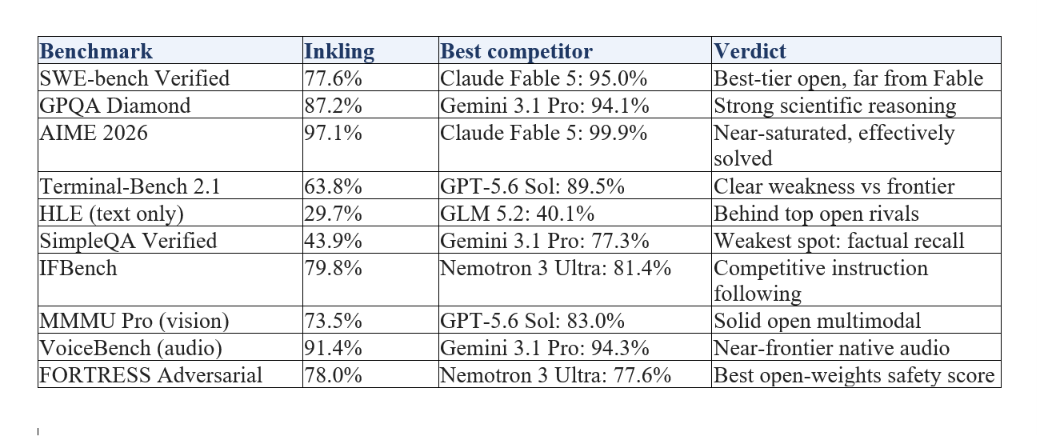
Read the pattern, not the rows. Inkling clusters near the top of the open-weights field on reasoning, coding, vision, and audio simultaneously, which no other open model manages, and independent early coverage places it between Kimi 2.5 and Kimi 2.6 overall while beating Nemotron 3 Ultra on several evaluations. Its two genuine weaknesses are terminal-style agentic work, where GLM-5.2's 82.7% embarrasses it, and factual recall, where 43.9% on SimpleQA means you should wire it to search rather than trust its memory.
For where these numbers slot into the full field of open and closed models, our best AI models July 2026 ranking has the complete cross-vendor board.
I Tested Inkling: 4 Hands-On Results
I spent three days with Inkling through the free Inkling Playground and a hosted partner API, running the same four workloads I use for every major release. Here is exactly what happened, including the parts Thinking Machines would probably prefer I skip.
Test 1: The Thinking-Effort Dial on Real Code
The dial works, and the cost curve is dramatic. I gave Inkling the same mid-difficulty refactoring task (extracting a payment module from a 2,400-line Django service) at effort 0.3, 0.6, and 0.99. At 0.3 it produced a working but shallow refactor in about 4,000 reasoning tokens. At 0.99 it caught two edge cases the low-effort run missed, including a currency-rounding bug in the original code, but burned nearly 19,000 reasoning tokens doing it. The 0.6 setting was the sweet spot: 95% of the top-effort quality at roughly half the tokens. My routing rule after this test: default to 0.5-0.6, escalate to 0.99 only on failures.
Test 2: Native Multimodal, Audio Included
Native audio is the quiet standout. I fed Inkling a 25-minute recorded standup meeting, and it transcribed it, attributed speakers reasonably, and answered follow-up questions about who committed to what, all in one conversation with no separate speech pipeline. On vision, the encoder-free architecture handled a messy whiteboard photo and a five-table financial PDF cleanly, though it read a rotated chart label wrong once. Against GPT-5.6 Sol on the same inputs, Inkling was slightly behind on the chart but equal on the documents, which for an Apache 2.0 model is remarkable.
Test 3: One-Shot Web App
The one-shot app demo mostly survives contact with a stranger's prompt. Thinking Machines shows Inkling building complete web apps in a single pass, and its Design Arena score of 1257 ranks it among the top open-weights models for agentic web development. My test: a habit tracker with streaks, local storage, and a stats page, in one prompt. Inkling produced a working, styled, single-file app on the first try, with one bug (streak reset logic off by a day) that it fixed when shown the failure. Not Fable-5 clean, but comfortably ahead of any open model I tested this spring.
Test 4: Fine-Tuning on Tinker
Fine-tuning is the reason this model exists, so I tried the smallest useful version: a LoRA-style tune on Tinker to force our internal blog-summary format, using a few hundred examples at the 64K context tier. The run finished without drama and the tuned model followed the format on 19 of 20 held-out samples. Thinking Machines' own party trick is better: they had Inkling fine-tune itself into a lipogram model that avoids the letter e, in one automated loop. The Tinker Cookbook ships Inkling recipes on day one, and the whole path from weights to custom model is the smoothest I have used on any open release.
If you want to reproduce these runs, the fine-tuning and evaluation notebooks in gen-ai-experiments cover the harness patterns I adapted for all four tests.
Inkling vs Kimi vs GLM vs DeepSeek
Among open-weight models, Inkling is the best multimodal generalist, GLM-5.2 stays the best terminal coder, Kimi K2.6 leads tool-augmented reasoning, and DeepSeek V4 keeps the factuality and price crown. The open tier now has four genuinely different champions, and picking by headline benchmark alone will steer you wrong.
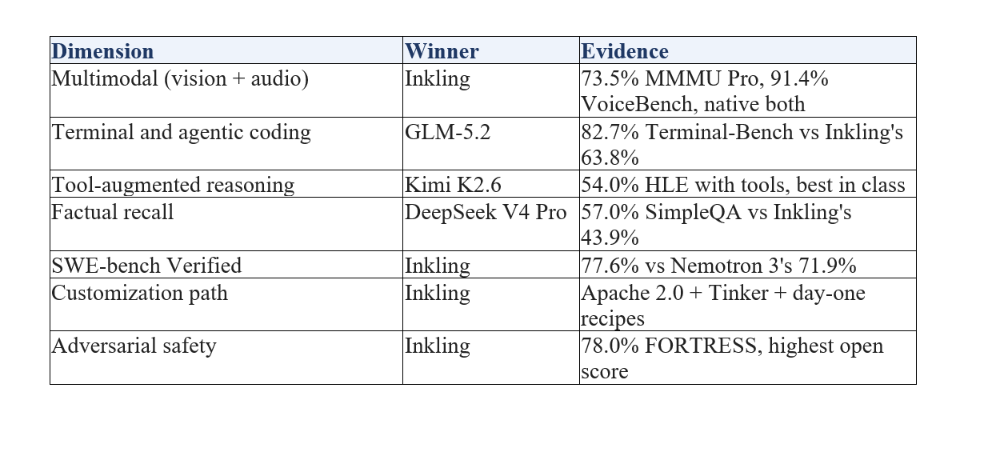
My hot take: Inkling does not need to beat GLM or Kimi at their specialties, because it is playing a different game. Every other open lab ships a model tuned to win a benchmark table; Thinking Machines shipped a base designed to become your model. If the next wave of AI products is thousands of narrow fine-tunes rather than one giant assistant, and I believe it is, Inkling is positioned better than any open release since Llama 3.
We benchmarked the open coding contenders directly against closed flagships in our GLM-5.2 vs Claude vs GPT-5.6 comparison, which is the right companion read for the terminal-coding gap above.
How to Run and Fine-Tune Inkling
You can run Inkling three ways: download the weights, hit a hosted API, or fine-tune on Tinker. The weights live on Hugging Face under Apache 2.0 in standard form plus an NVFP4 checkpoint for NVIDIA Blackwell, with support already landed in SGLang, vLLM, TokenSpeed, and llama.cpp. Self-hosting a 41B-active MoE is a serious but achievable infrastructure lift, roughly comparable to serving other large sparse models.
For most teams the hosted route wins on day one. Together AI, Fireworks, Modal, Databricks, and Baseten all serve Inkling at launch, with pricing varying by provider. Thinking Machines is also running a free Inkling Playground with integrated web search for a limited time, plus a 50% launch discount on Inkling usage through Tinker. Fine-tuning on Tinker offers 64K and 256K context tiers, and the Tinker Cookbook shipped with Inkling recipes on release day. If Inkling-Small graduates from preview with the same recipe, the 12B-active version may become the real volume workhorse here.
Verdict: Who Should Use Inkling?
Deploy Inkling if you want to own a customized multimodal model; skip it if you just want the smartest API call. After four tests and three days, my scorecard: 9/10 as an open customization base, 7/10 as a general assistant, with the SimpleQA factuality gap and terminal-coding weakness as the two real deductions. The thinking-effort dial, native audio, Apache 2.0 license, and Tinker path are collectively unmatched in the open tier.
Concrete recommendations. Product teams building domain assistants (support, legal, medical intake, internal tools) should shortlist Inkling first, fine-tune early, and wire it to search for facts. Teams doing heavy terminal-agent coding should stay on GLM-5.2 or a closed flagship. High-volume pipelines should watch Inkling-Small, because a 12B-active multimodal model with this recipe could reset the price floor. And everyone should steal the routing pattern the effort dial enables: one model, three effort tiers, routed by task difficulty.
Inkling lands in a month already crowded by the GPT-5.6 Sol, Terra, and Luna launch, and the contrast is instructive: OpenAI shipped three fixed tiers, Thinking Machines shipped one model with a dial. I think the dial ages better.
Frequently Asked Questions
What is Inkling by Thinking Machines Lab?
Inkling is a 975B-parameter open-weights Mixture-of-Experts model with 41B active parameters, released July 15, 2026 by Thinking Machines Lab, the startup founded by former OpenAI CTO Mira Murati. It reasons natively over text, images, and audio, supports a 1M token context window, and ships under Apache 2.0 on Hugging Face.
Is Inkling open source?
Inkling is open weights under the Apache 2.0 license, meaning you can download, modify, fine-tune, and commercialize it royalty-free. The training data and full training code are not released, so it is open weights rather than fully open source, the same standard as Llama and DeepSeek releases.
How good is Inkling compared to Kimi and GLM?
Inkling is the best open multimodal generalist, scoring 77.6% SWE-bench Verified, 73.5% MMMU Pro, and 91.4% VoiceBench, and early coverage places it between Kimi 2.5 and Kimi 2.6 overall. GLM-5.2 remains clearly better at terminal coding (82.7% vs 63.8% Terminal-Bench), and Kimi K2.6 leads tool-augmented reasoning.
What is controllable thinking effort?
Controllable thinking effort is a parameter from 0.2 to 0.99 that sets how many reasoning tokens Inkling spends before answering. Low effort gives fast, cheap responses; high effort maximizes quality. Inkling matches Nemotron 3 Ultra on Terminal-Bench 2.1 while using roughly one third of the tokens.
Can I fine-tune Inkling?
Yes, fine-tuning is the model's core purpose. Inkling is available on Tinker, Thinking Machines' fine-tuning platform, with 64K and 256K context options and day-one recipes in the Tinker Cookbook. The Apache 2.0 license also permits full custom training on your own infrastructure.
How many parameters does Inkling have?
Inkling has 975 billion total parameters with 41 billion active per token, using 256 routed experts plus 2 shared experts per MoE layer with 6 routed experts active. A preview sibling, Inkling-Small, has 276B total and 12B active parameters.
Where can I download Inkling?
Full weights are on Hugging Face at thinkingmachines/Inkling, including an NVFP4 checkpoint for NVIDIA Blackwell GPUs, with inference support in SGLang, vLLM, TokenSpeed, and llama.cpp. Hosted APIs are available through Together AI, Fireworks, Modal, Databricks, and Baseten.
Recommended Blogs
● GLM-5.2 vs Claude vs GPT-5.6
● GPT-5.6 Sol Terra Luna review
Resources and Community
Join our community of 70,000+ AI enthusiasts and learn to build powerful AI applications. Whether you are a beginner or an experienced developer, Build Fast with AI helps you understand and implement AI in your projects.
● Website (buildfastwithai.com)
● LinkedIn (Build Fast with AI)
Agentic AI Launchpad 2026
A structured 6-week cohort program that takes you from AI basics to building and deploying real-world agentic AI systems. Includes live sessions, expert mentorship, project reviews, and a builder community network.
Ready to go from learning to building? Join the next cohort: Agentic AI Launchpad 2026
Free AI Resources
Access free tools, workshops, and micro-learning to keep building:
● AI Workshops (free resources and recordings)
● Unrot (learn AI in 5 minutes a day)
Found this review useful? Follow Build Fast with AI for hands-on testing of every major model release, open and closed, and subscribe so the next deep dive lands in your inbox.
References
● Introducing Inkling (Thinking Machines)
● Inkling model card (Thinking Machines)
● Inkling weights (Hugging Face)
● Inkling launch report (TechCrunch)

