


Training 1,000 employees on AI is not a bigger version of training 10. It is a different problem. At 10 people you run a workshop. At 1,000 you run a change program, and the thing that breaks is never the teaching. It is the logistics, the manager layer, the licences, and the measurement.
India is the most aggressive AI adopter on the planet right now. More than 90% of Indian employees have already touched a generative AI tool, and 86% of employers say AI has changed job roles. Yet most of that usage is unstructured, unmeasured and unsafe. The companies pulling ahead are the ones turning that scattered curiosity into a governed, measured capability. That is what an AI upskilling program does.
What follows is a practical playbook for doing it at scale. It covers the four phase rollout, how to segment 1,000 people so you do not waste anyone's time, the champions model that makes large rollouts stick, budget and timeline benchmarks, the metrics that prove it worked, and the six mistakes that quietly kill these programs. It is written for the L&D head, CHRO, CTO or transformation lead who owns the number.
You do not train 1,000 people. You train 40 well, turn them into champions, and let the program spread through them.
1. What an AI Upskilling Program Actually Is
An AI upskilling program is a structured, organisation wide effort to teach employees to apply AI tools to their specific jobs, governed by a policy and measured against business outcomes. It is not a one off workshop, and it is not a stack of video courses nobody finishes. The defining feature is that it changes what people do on Monday morning, and it can prove it.
The distinction that trips people up is upskilling versus reskilling. Upskilling teaches your existing workforce new AI capabilities within their current roles, so a marketer becomes a marketer who uses AI. Reskilling moves people into new roles entirely, which is a much larger undertaking. For 1,000 employees, you are almost always upskilling, and that is good news, because it is faster, cheaper and less disruptive.
If you are still scoping the overall investment, our 2026 corporate AI training buyer's guide covers formats and providers, and the companion cost breakdown for corporate AI training in India gives you real per employee pricing to build a budget from.
2. Why Upskilling Matters More Than Hiring in 2026
Upskilling your existing workforce beats hiring AI talent for one blunt reason: you cannot hire your way out of an organisation wide skills gap, and the market will not let you afford to try. India commands 16% of the global AI talent pool, but demand is outpacing supply so fast that 63% of employers report year on year increases in AI hiring, which pushes salaries up and retention down.
There is a second, sharper reason. AI skills now carry a measurable salary premium over traditional qualifications, which means your best people already know their market value has jumped. If you do not build these skills internally, you will both fail to hire enough of them and watch your existing talent leave for companies that will.
The size of that premium is worth understanding before you set a budget. We analysed it in detail in the 56% salary gap between AI skills and degrees, and the broader 2026 AI jobs and salary landscape in India shows where demand is concentrated.
Hiring fills a seat. Upskilling changes the whole floor, and it keeps the people you already trust.
3. The Four Phase Rollout for 1,000 Employees
Roll out a large AI upskilling program in four phases over roughly 90 to 120 days: foundation, pilot, scale and embed. Trying to train everyone at once is the classic failure. Sequencing protects your budget and lets you fix the program on a small group before it touches the whole company.
Phase 1: Foundation
Before anyone is trained, get four things in place: a written AI usage policy, live tool licences, a metrics baseline, and executive sponsorship that is visible rather than nominal. Skipping the baseline here is the single most common reason companies later cannot prove the program worked. Take it in week one or argue from anecdote forever.
Phase 2: Pilot
Pick one function with repetitive, countable work, usually sales operations or customer support, and train a cohort of 40 to 60 people properly. This group does two jobs: it proves the curriculum on a small budget, and it surfaces the natural enthusiasts who will become your champions in phase three.
Phase 3: Scale
Roll out to the remaining functions in waves of 100 to 200, not all at once. Waves let facilitators stay hands on, let each cohort learn from the last, and spread the licence and support load. Each wave should be role specific rather than generic, which is the subject of section six.
Phase 4: Embed
Training ends and adoption begins. Office hours, a shared prompt library, internal champions and a monthly metric review are what convert a training event into a permanent capability. Budget for this phase explicitly, because it is the one finance always wants to cut and the one that determines whether any of the earlier spend pays back.
Planning a rollout at this scale? We will map the four phases to your org, size the cohorts and set the metric baseline in one working session. Book a free scoping call.
4. How to Segment 1,000 People Into Tiers
Segment your workforce into three tiers by how deeply each group needs to use AI, because training all 1,000 to the same depth wastes money on some and underserves others. A rough split that works for most organisations looks like this
Everyone gets the tier 1 foundation, which is short and can be delivered live virtual or self paced. The 200 to 300 power users get deeper, role specific training that changes their daily workflow. The 50 to 100 builders get advanced training to create automations and agents that the rest of the organisation then benefits from. This pyramid concentrates your budget where it produces the most return.
Your tier 3 builders are where outsized value comes from, because once a team understands what agentic AI actually is, they stop saving minutes on drafting and start removing entire manual processes. The difference matters, which we unpack in agentic AI versus generative AI.
5. The AI Champions Model That Makes It Stick
The single highest impact tactic for large AI rollouts is an AI champions program: a network of trained enthusiasts embedded in every team who provide peer support, answer daily questions and model good practice. Champions are what let a small central L&D team support 1,000 people without drowning.
The mechanics are simple. During the pilot, identify the 5% to 10% of participants who take to AI fastest and clearly enjoy it. Give them extra training, a title, recognition and a small time allocation, then place one or two in each team. When a colleague hits a wall on a Tuesday afternoon, they ask the champion two desks away rather than filing a ticket that gets answered next week. That immediacy is what sustains adoption after the formal training ends.
A champion two desks away beats a help desk two weeks away. That is the whole model.
Don't just use ChatGPT. Learn to build custom LLM agents, RAG pipelines, and full-stack Agentic AI apps in our intensive 6-week program.
6. Curriculum by Role, Not by Tool
Design the curriculum around what each role does, not around which tool you bought, because a finance controller and a field sales rep share almost nothing beyond a 45 minute foundation. Generic training fails at scale precisely because it treats 1,000 different jobs as one audience.
Sales usually shows return fastest because the work is repetitive and countable, and our 25 ChatGPT sales prompts that close deals gives that cohort a running start. For teams standardising on an assistant, the vendor neutral complete Claude AI guide and our library of 200 ChatGPT prompts for work reduce how much you teach from scratch.
Builders in tier 3 should leave with something running. Point them at our open generative AI experiments cookbook and the guide to automating work with no code AI agents so their capstone is a live automation, not a certificate.
One hard rule from the field: do not put engineers and non technical staff in the same room past the foundation session. The engineers disengage from boredom and the non technical staff shrink from intimidation. Splitting the cohorts costs a little more and roughly doubles completion.
7. Budget and Timeline Benchmarks
Budget INR 8,000 to INR 20,000 per employee for a serious tiered upskilling program, which puts a 1,000 person rollout in the range of INR 80 lakh to INR 2 crore depending on depth and delivery. That sounds large until you set it against the return, which section eight quantifies.
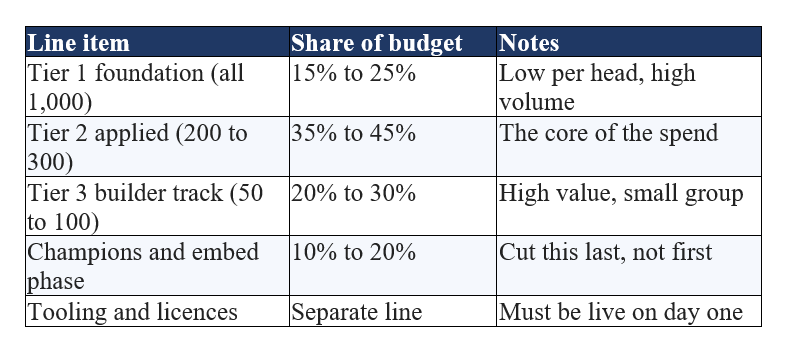
On timeline, plan 90 to 120 days from foundation to a fully embedded program, though the first measurable results usually appear during the pilot in weeks four to seven. Anyone promising a trained workforce of 1,000 in two weeks is selling attendance, not capability.
For a full per format and per team size cost breakdown you can hand to finance, use our 2026 pricing guide for corporate AI training.
8. Metrics That Prove the Program Worked
Measure an AI upskilling program on adoption, time saved and business outcomes, captured as a baseline before training and again at day 90. The reason most programs cannot prove value is that nobody recorded the starting point. These are the metrics that survive scrutiny in a budget review.
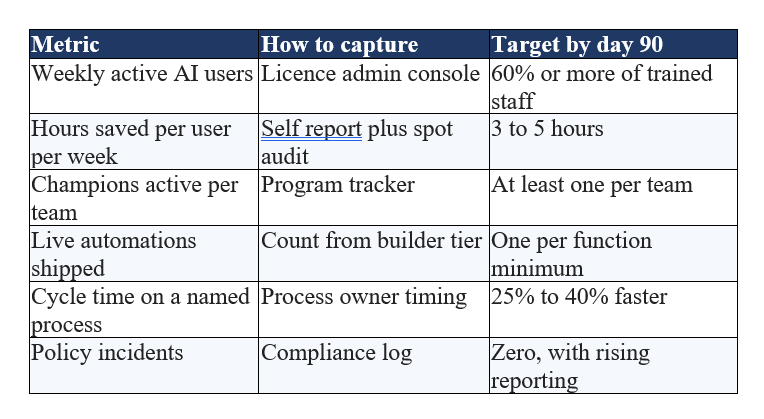
Turn hours saved into money with a simple formula: hours saved per week, times active users, times 48 working weeks, times fully loaded hourly cost, minus program cost. A 1,000 person program where 600 active users each save three hours a week at INR 500 per hour returns over INR 4 crore a year, which pays back a INR 1.5 crore program in roughly four months. Report it that way, because time saved is the language finance approves budgets in.
For a picture of what compounding automation looks like at the ceiling, our breakdown of how Amazon's AI automation saves billions is a useful direction of travel, and our roundup of the best AI agents for productivity shows the tools that get you partway there.
If you cannot name the process you expect to speed up, you are not ready to train 1,000 people to speed it up.
9. Six Mistakes That Kill Large Rollouts
Large AI upskilling programs fail for organisational reasons, not educational ones. Here are the six failure modes I see most often across enterprise rollouts, in rough order of damage caused.
Training everyone at once
Skipping the pilot and going straight to 1,000 people means any flaw in the curriculum, the tooling or the policy hits the entire company before you can fix it. Pilot first, always.
Ignoring the manager layer
If a team lead cannot use the tools, they will treat their team's AI time as time stolen from real work. Train managers one wave ahead of their teams. It is the highest return sequencing decision available and it costs nothing extra.
No policy before training
Without a clear written rule on what data goes into which tool, cautious staff freeze and incautious staff create compliance exposure. Under India's DPDP Act, that exposure is real. Publish the policy before the training, not after the incident.
Licences that lag the training
Teaching a tool people cannot access for six weeks wastes most of the learning. Licences live on day one, no exceptions. Teams violate this constantly because procurement and L&D run on different calendars.
No champions, so no support
A central L&D team of five cannot answer the daily questions of 1,000 learners. Without embedded champions, questions go unanswered, momentum dies, and people revert to old habits within a month.
Measuring attendance instead of outcomes
My most contrarian view: a program that trains 1,000 people and measures only completion has measured nothing that matters. Attendance is not capability. Define the business process you expect to improve before you start, or you will end the program unable to defend its budget.
Want a rollout plan that avoids all six? We will design the phases, the tiering, the champions model and the metric baseline with your team. Book a free scoping call.
The only comprehensive program designed to take you from basic prompting to building interactive Artifacts, custom integrations, and deploying production-ready code with Claude Code.
Frequently Asked Questions
How do you train employees on AI at scale?
Train employees on AI at scale using a four phase rollout: foundation, pilot, scale and embed, over 90 to 120 days. Segment the workforce into literacy, applied and builder tiers, pilot on one function first, then scale in waves supported by an embedded network of AI champions rather than a central team alone.
What is an AI upskilling program?
An AI upskilling program is a structured, organisation wide effort to teach existing employees to apply AI tools to their current jobs, governed by a usage policy and measured against business outcomes. It differs from a one off workshop by including role specific curriculum, ongoing support and measurement of adoption and time saved.
How long does it take to upskill a workforce in AI?
A full workforce AI upskilling program typically takes 90 to 120 days from foundation to embedded adoption, though individual live training is only days to weeks within that window. The first measurable results usually appear during the pilot phase in weeks four to seven.
What percentage of employees should be trained on AI?
Aim for 100% of employees at a basic literacy tier, 20% to 30% as power users with role specific training, and 5% to 10% as builders who create automations. This pyramid concentrates budget on the groups that produce the most return while giving everyone safe, baseline capability.
How do you measure the success of an AI upskilling program?
Measure success on weekly active users, hours saved per user, live automations shipped and cycle time on a named process, all against a baseline taken before training. Convert hours saved into money to prove ROI, and count only active users rather than everyone who attended.
What is the difference between reskilling and upskilling?
Upskilling teaches employees new AI capabilities within their current roles, so they do the same job better. Reskilling moves people into entirely new roles, usually because their old role is being automated. For a broad workforce of 1,000, upskilling is the faster, cheaper and less disruptive path.
How much does it cost to upskill 1,000 employees?
Budget INR 8,000 to INR 20,000 per employee for a serious tiered program, putting a 1,000 person rollout at roughly INR 80 lakh to INR 2 crore depending on depth and delivery. Most programs pay back within four to seven months on time savings alone when adoption is measured properly.
Do employees need coding skills for AI upskilling?
No. Around 80% of business value from AI comes from non technical use such as drafting, research and workflow automation, which need no code. Only your tier 3 builder cohort, usually 5% to 10% of staff, needs a deeper technical track, which is why mixed cohorts beyond the foundation session tend to fail.
Recommended Blogs
● Corporate AI Training in India: 2026 Buyer's Guide
● Corporate AI Training Cost in India: 2026 Pricing
● The 56% AI Skills Salary Gap
● Automate Work With AI Agents
● Best AI Agents For Productivity
Resources & Community
Join our community of 70,000+ AI enthusiasts and learn to build powerful AI applications! Whether you're a beginner or an experienced developer, Build Fast with AI helps you understand and implement AI in your projects.
● Website: buildfastwithai.com
● LinkedIn: Build Fast with AI
Agentic AI Launchpad 2026
A structured 6-week cohort program that takes you from AI basics to building and deploying real-world agentic AI systems. Includes live sessions, expert mentorship, project reviews, and a builder community network.
Ready to go from learning to building? Join the next cohort: Agentic AI Launchpad 2026
Free AI Resources
Access free tools, workshops, and micro-learning to keep building:
● AI Workshops: Free resources, upcoming events & past recordings
● Unrot: Learn AI in 5 minutes a day (free micro-learning app)
Ready to Upskill Your Workforce?
If you are planning an AI upskilling program for hundreds or thousands of employees, we will design the phased rollout, tiering and metrics with your team and quote a real number, with no obligation. Book a free scoping call with Build Fast with AI.
Want the strategy and budget context first? Read the 2026 corporate AI training buyer's guide or browse our AI applications and use cases hub.
References
● Deloitte: Indian Enterprises Lead At Scale AI Adoption
● Indeed and NASSCOM: Top Skills Employers Prioritise in 2026
● IndiaAI: NASSCOM AI Adoption Index 2.0 Findings

