



Ask ChatGPT to write an email and it writes one. Ask an agentic AI to "clear my inbox," and it reads your messages, drafts replies, checks your calendar, books the meetings, and tells you what it did. That gap, between a tool that answers and a system that acts, is the whole story of agentic AI in 2026.
This guide is written for beginners who keep hearing the phrase and want a clear, no-hype answer. By the end you will know exactly what agentic AI is, how it differs from the generative AI you already use, how an agent actually works under the hood, which frameworks and protocols matter, where it is being used in the real world, and how to build your first agent even if you have never written a line of code. Everything here is current as of July 2026.
1. What Is Agentic AI?
Agentic AI is artificial intelligence that can pursue a goal on its own by planning, taking actions, using tools, and adjusting based on results, with little or no human intervention at each step. Instead of producing a single output from a single prompt, an agentic system breaks a goal into steps, executes those steps, observes what happened, and decides what to do next until the job is done.
The word that matters is agency. A generative AI model like GPT-5.6 or Claude Opus is brilliant at one turn: you give it context, it gives you text, code, or an image. An agentic AI wraps that same model in a loop that lets it operate over many turns, call external tools, remember what it learned, and keep working toward an outcome. The model is the brain. The agent is the brain plus hands, memory, and a plan.
Here is a plain example. Suppose the goal is "research the top five project management tools and put them in a comparison sheet." A chatbot answers from memory in one shot. An agent searches the web for current options, opens each product page, extracts pricing and features, writes the rows into a spreadsheet, notices one page failed to load, retries it, and returns a finished file. Same underlying model, completely different behavior, because the agent can act and self-correct.
Three properties make a system truly agentic. First, autonomy: it decides the next step itself rather than waiting for you to prompt it. Second, tool use: it can reach outside its own text output to search, compute, or change data. Third, adaptivity: it reacts to what happened and changes course, rather than following a fixed script. Remove any one of these and you are back to either a plain chatbot or a rigid automation. Put all three together and you get behavior that feels less like a tool and more like a coworker.
If you want a deeper technical view of what makes these loops reliable at scale, our guide on loop engineering for AI agents breaks down the four parts every dependable agent loop needs: a trigger, a goal, a verifier, and a stop rule.
2. Agentic AI vs Generative AI: The Real Difference
Generative AI creates content in response to a prompt. Agentic AI takes actions to accomplish a goal. Generative AI is a capability. Agentic AI is a system that uses that capability, plus tools and autonomy, to get real work done. The two are not competitors. Almost every agent is powered by a generative model at its core.
The simplest way to feel the difference is the level of autonomy. With generative AI, you are the loop: you prompt, read the answer, prompt again, copy the result somewhere. With agentic AI, the software is the loop: it decides the next prompt, runs the next tool, and checks its own work. You set the destination. It handles the turns.
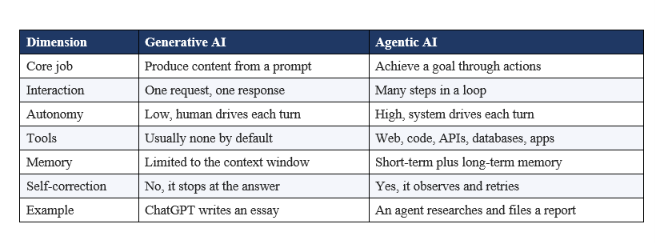
One honest caveat: the line blurs in practice. When ChatGPT browses the web or runs Python, it is already behaving agentically for those steps. Think of it as a spectrum from pure generation to full autonomy, not a hard wall. Most products in 2026 sit somewhere in the middle and are marching steadily toward the agentic end.
Why does this shift matter so much right now? Because value moves from answering to doing. A generative model that drafts a report saves you minutes. An agent that gathers the data, writes the report, and files it saves you the whole task. Analysts at Gartner have projected that agentic AI will be embedded in a rising share of enterprise software by 2028, and every major lab, from OpenAI to Anthropic to Google, reorganized its 2025 and 2026 roadmaps around agents. When the entire industry pivots in the same direction at once, it is worth understanding why.
3. How Agentic AI Works: The Agent Loop
Agentic AI works through a repeating cycle often called the agent loop: perceive, plan, act, observe, and repeat until the goal is met or a stop rule fires. This loop is what separates a one-shot model call from a system that can finish a multi-step task.
The five stages of the loop
Stage one is perceive. The agent takes in the goal and the current state: your instruction, the contents of a file, the result of the last action, or data from a tool. Stage two is plan. The model reasons about what to do next and often writes out its intended steps, a pattern popularized by frameworks that ask the model to think before acting.
Stage three is act. The agent calls a tool: it runs a web search, executes code, queries a database, sends an email, or updates a record. Stage four is observe. The agent reads the result of that action, success or failure, and feeds it back in. Stage five is repeat. With the new information, the agent plans the next move. The cycle continues until the task is complete or a stop condition halts it, such as a step limit, a budget cap, or a human approval gate.
The reliability of an agent lives in this loop, not in the raw intelligence of the model. A weaker model with a good verifier and clear stop rules will often beat a stronger model running an open-ended loop. If you want to see this pattern implemented in real code, the code-along AI agents tutorial with LangChain and CrewAI walks through building the loop step by step.
4. The Core Components of an AI Agent
Every AI agent is built from four building blocks: a model as the reasoning brain, tools for taking action, memory for retaining context, and an orchestration layer that runs the loop. Understanding these four parts is the fastest way to understand any agent product you meet.
The model (the brain)
The model is the large language model that does the reasoning and decision making, such as Claude Opus, GPT-5.6, or an open-source model like GLM or Qwen. It decides what step to take next and how to interpret results. A more capable model plans better and recovers from errors more gracefully, but as noted above, model quality is only one factor.
Tools (the hands)
Tools are the actions an agent can take in the outside world: searching the web, running code, calling an API, reading and writing files, querying a database, or controlling an app. Tools turn a text generator into something that can change the world. The set of tools you give an agent defines what it can actually do, so tool design is one of the highest-leverage parts of building an agent.
Memory (the notebook)
Memory lets an agent retain information across steps and sessions. Short-term memory holds the current task context. Long-term memory, often stored in a vector database, lets the agent recall facts, past decisions, and user preferences over time. Without memory, an agent forgets everything the moment its context window fills up. This is why retrieval-augmented generation, or RAG, sits right next to agents in most real systems: RAG is how an agent pulls the right facts into its working memory at the right moment, instead of relying on what the base model happened to memorize during training.
Orchestration (the manager)
Orchestration is the software that runs the loop: it decides when to call the model, when to call a tool, how to route between multiple agents, and when to stop. This is exactly where frameworks like LangGraph and CrewAI earn their keep, and it is the layer we explore across our AI agent frameworks collection, which covers orchestration patterns for real production systems.
5. Types of AI Agents: Single-Agent vs Multi-Agent
AI agents come in two broad shapes: a single agent that handles a whole task alone, and a multi-agent system where several specialized agents collaborate. Single agents are simpler and easier to debug. Multi-agent systems scale to complex work by dividing it among specialists, at the cost of more coordination.
A single-agent setup is one model in one loop with a set of tools. It is the right choice for most tasks: a research assistant, a coding helper, or a support bot. It is easier to reason about, cheaper to run, and less likely to spiral into confusion. Start here unless you have a clear reason not to.
A multi-agent system assigns roles. One agent researches, another writes, a third reviews, and a coordinator routes work between them. CrewAI popularized this crew metaphor, where each agent has a role, a goal, and tasks. Multi-agent designs shine when a job naturally splits into specialties or needs checks and balances, such as a writer agent paired with a critic agent that catches mistakes.
The honest trade-off: multi-agent systems add latency, cost, and new failure modes like agents talking past each other. Many teams over-engineer with five agents when one would do. Our review of the Cline SDK open-source agent runtime shows how a single well-built agent runtime can cover a surprising amount of ground before you reach for a crew.
6. Agentic AI Frameworks and Tools in 2026
The leading agentic AI frameworks in 2026 are LangGraph, CrewAI, the OpenAI Agents SDK, AutoGen, and no-code platforms like n8n. Each targets a different builder, from Python engineers who want fine control to non-coders who want to ship automations by dragging boxes.
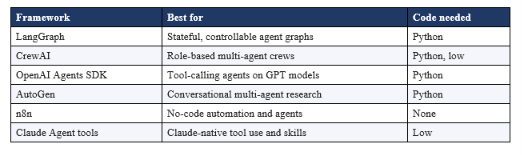
For beginners, CrewAI is one of the friendliest on-ramps because it maps cleanly to how humans think about teamwork. If you prefer building without code, n8n lets you wire up an agent with triggers and tool nodes visually. And if you live in the Claude ecosystem, our Claude Skills complete guide shows how reusable skills turn Claude into a capable, tool-using agent.
You do not need to master all of these. Pick one, build something small, and expand. When you are ready to write code, the open-source gen-ai-experiments cookbooks contain runnable notebooks for LangChain, CrewAI, and RAG that you can clone and adapt in an afternoon.
7. MCP and A2A: The Protocols Powering Agents
MCP (Model Context Protocol) is how an agent connects to tools and data. A2A (Agent2Agent) is how agents talk to each other. These two open standards are quietly becoming the plumbing of the entire agent ecosystem, and knowing the difference will save you a lot of confusion.
What is MCP?
MCP is an open protocol introduced by Anthropic in November 2024 that standardizes how AI models connect to external tools, databases, and services. Anthropic describes it as a USB-C port for AI: one connector that lets any compatible model plug into GitHub, a Postgres database, Google Drive, or a custom tool without rewriting the integration each time. Before MCP, every tool needed a bespoke connection. After MCP, tools and models speak a shared language.
MCP is genuinely worth learning because it is low competition and high leverage right now. Our Claude MCP setup guide shows how to connect a real tool to Claude in about ten minutes, which is the fastest way to feel what MCP unlocks.
What is A2A?
A2A, or Agent2Agent, is an open standard launched by Google in April 2025 with more than 50 industry partners that lets independent AI agents discover, communicate, and collaborate as peers, regardless of who built them or what framework they use. If MCP is how an agent reaches its tools, A2A is how a scheduling agent hands off to a booking agent that belongs to a different company entirely.
The easy way to remember it: MCP handles agent-to-tool, A2A handles agent-to-agent. In 2026 both were pulled under the Linux Foundation's Agentic AI effort, a strong signal that the industry expects agents to interoperate rather than live in walled gardens. Beginners do not need to implement these protocols on day one, but recognizing the names will make every agent article you read clearer.
8. Real-World Agentic AI Use Cases
Agentic AI is already in production across software development, customer support, sales, marketing, research, and operations. These are not demos. They are systems doing measurable work inside companies today.
Coding agents
Coding is the breakout use case. Agents like Claude Code and command-line tools read a codebase, plan a change, edit files, run tests, and fix what breaks. Our review of Grok Build, the xAI agent CLI, shows how a terminal-native agent runs an autonomous coding loop against your local project, planning and re-planning until the tests pass.
Customer support and operations
Support agents read a ticket, search the knowledge base, pull the customer's order history from a database, draft a resolution, and escalate to a human only when needed. Operations agents monitor systems, triage alerts, and file structured reports. The value is not just speed. It is handling the long tail of routine work so people focus on the hard cases.
Sales, marketing, and research
Sales agents research prospects, personalize outreach, and log activity in the CRM. Marketing agents draft content, run SEO checks, and schedule posts. Research agents gather sources, extract data, and synthesize findings into a brief. In each case the pattern is identical: a goal, a set of tools, a loop, and a stop rule. Once you see the pattern, every use case looks like a variation on the same theme.
Personal productivity agents
The use case closest to home is your own inbox and calendar. Personal agents triage email, schedule meetings across time zones, summarize long documents, and prepare a morning briefing before you wake up. This is where most beginners feel the first real payoff, because the task is familiar and the win is immediate. Build an agent that saves you thirty minutes a day and the concept stops being abstract. A useful rule of thumb: the best first agent automates something you personally do every single day and quietly resent.
9. Benefits and Honest Limitations
Agentic AI can automate multi-step work, operate around the clock, and scale expertise, but it also fails in ways that demand guardrails, verification, and human oversight. A balanced view matters, because the hype cuts both ways.
The real benefits
Agents compress work that used to take hours into minutes by chaining steps without a human in the middle. They run continuously, do not tire, and can be duplicated instantly to handle volume. They also lower the skill floor: a well-built agent lets a non-expert accomplish expert-level tasks, from writing SQL to shipping a small app. For businesses, that is leverage on a scale that is hard to ignore.
The honest limitations
Agents hallucinate, take wrong actions confidently, and can loop or rack up cost if the stop rules are weak. Giving an agent real permissions, to send email, spend money, or change data, introduces real risk, which is why approval gates and sandboxes exist. They also struggle with genuinely novel problems that were not in their training or tools. The mature approach is to treat an agent like a fast, tireless junior teammate: valuable, but reviewed. Gartner has projected that a large share of agentic AI projects will be scaled back or scrapped if teams skip this discipline, and that warning is worth heeding.
10. How to Build Your First AI Agent
You can build a working AI agent in an afternoon by picking one narrow task, choosing a model, giving it one or two tools, wrapping it in a loop, and adding a stop rule. The mistake beginners make is starting too big. Start embarrassingly small.
A five-step starter path
Step one: choose a tiny goal, such as "summarize the top three Hacker News posts each morning." Step two: pick a model you can access, such as Claude or GPT. Step three: give it the minimum tools, in this case a web fetch and maybe a Slack message. Step four: wrap it in a loop so it fetches, summarizes, and posts. Step five: add a stop rule so it runs once and halts instead of looping forever.
Do the no-code version first if you are not a programmer. In n8n or a similar platform, you can assemble that same morning-summary agent by connecting a schedule trigger, an AI node, and a Slack node, with zero code. Seeing it work end to end is worth more than reading ten articles, because the agent loop finally becomes concrete.
When you are ready for the coded version, clone a notebook from the gen-ai-experiments cookbook repository and change the goal to your own. Building on a working example beats staring at a blank file, and it teaches you the loop by doing rather than reading.
Five beginner mistakes to avoid
First, giving the agent too many tools. Ten tools confuse the model and multiply the ways it can go wrong. Start with one or two. Second, no stop rule, which lets an agent loop forever and burn through your budget. Always cap the steps. Third, no verification, so the agent reports success it never checked. Add a step that confirms the result. Fourth, chasing a multi-agent system before a single agent works, which is like hiring a team before you can do the job yourself. Fifth, granting real permissions too early. Let the agent draft the email before you let it send the email. Every one of these mistakes traces back to the same instinct, which is starting too ambitious, and every one is fixed by starting smaller than feels satisfying.
11. How to Learn Agentic AI: A 90-Day Roadmap
A realistic path to competence in agentic AI is about 90 days: one month on foundations, one month building agents, and one month shipping a real project. You do not need a computer science degree.
In month one, learn how models behave, write good prompts, and build one agent with one tool in the framework of your choice. In month two, add tools, wire up memory with a vector database, connect a real tool through MCP, and try a simple two-agent setup. In month three, focus on what makes agents reliable: verifiers, stop rules, error handling, and putting your agent somewhere it can run on a schedule.
Learning by building beats learning by watching, but a guided cohort compresses the timeline dramatically. That is exactly the gap our Agentic AI Launchpad is designed to close: six weeks of live mentorship where you build real agents instead of only reading about them.
12. Frequently Asked Questions
What is agentic AI in simple terms?
Agentic AI is software that pursues a goal on its own by planning steps, using tools, and correcting itself along the way. Instead of answering one question, it takes a series of actions until a task is finished, like an assistant that both decides what to do and does it.
What is the difference between agentic AI and generative AI?
Generative AI creates content from a prompt, such as text or images, while agentic AI takes actions to achieve a goal. Generative AI is the underlying capability. Agentic AI is a system that uses that capability, plus tools and autonomy, to complete multi-step work with little human input.
Is agentic AI the same as AI agents?
They are closely related. Agentic AI is the broad field and property of acting autonomously, while an AI agent is a specific system that exhibits it. In everyday use the terms overlap, and most people use agentic AI for the concept and AI agent for the actual product.
What is an example of agentic AI?
A coding agent like Claude Code is a clear example. Given a goal, it reads your codebase, plans a change, edits files, runs the tests, and fixes failures without a human driving each step. Research assistants and automated support agents follow the same loop.
Do you need coding to build AI agents?
No. No-code platforms like n8n let you build capable agents by connecting triggers, AI nodes, and tools visually. Coding with frameworks like LangGraph or CrewAI gives you more control, but many useful agents ship with zero code.
What is MCP in agentic AI?
MCP, the Model Context Protocol, is an open standard from Anthropic introduced in November 2024 that lets AI models connect to tools and data through one shared interface. It is often described as a USB-C port for AI, replacing custom integrations with a single common connector.
Is agentic AI worth learning in 2026?
Yes, if you want to build or lead AI projects. Agentic AI is where most of the new value and job demand is concentrated, and the emerging skills like MCP and multi-agent design still have low competition. Starting now puts you ahead of the curve.
Recommended Blogs
● Loop Engineering for AI Agents
● Master AI Agents Code-Along Tutorial
● Cline SDK Agent Runtime Review
● Claude Skills Complete Guide
Resources & Community
Join our community of 70,000+ AI enthusiasts and learn to build powerful AI applications. Whether you are a beginner or an experienced developer, Build Fast with AI helps you understand and implement AI in your projects.
● Website: buildfastwithai.com
● LinkedIn: Build Fast with AI
Agentic AI Launchpad 2026
A structured 6-week cohort program that takes you from AI basics to building and deploying real-world agentic AI systems. Includes live sessions, expert mentorship, project reviews, and a builder community network.
Ready to go from learning to building? Join the next cohort: Agentic AI Launchpad 2026
Free AI Resources
Access free tools, workshops, and micro-learning to keep building:
● AI Workshops: free events and recordings
● Unrot: learn AI in 5 minutes a day
Keep Building
If this guide helped, follow Build Fast with AI for weekly, no-hype breakdowns of the tools and techniques shaping agentic AI. The best way to understand agents is to build one, so pick a tiny goal today and ship it.
References
● Building Effective AI Agents (Anthropic)
● Model Context Protocol (MCP official)
● A2A: Agent Interoperability (Google)
● AI Agents Course (Hugging Face)

