



Grok Build: xAI's New Agent CLI, Reviewed for Developers (2026)
Grok used to be a chatbot you opened on X to ask snarky questions. As of May 14, 2026, that framing is over. xAI shipped Grok Build — a terminal-native, agentic command-line tool with up to 8 parallel sub-agents, a plan-first execution loop, MCP compatibility, and an underlying coding model (grok-build-0.1) priced at $0.20 per million input tokens. Elon Musk personally tested it on X. The wider beta opened to all SuperGrok and X Premium+ subscribers on May 25.
The product matters more than the moment. Anthropic's Claude Code arrived in early 2025. OpenAI's Codex CLI followed weeks later. Google's Antigravity is gathering momentum. xAI just turned itself into the third — arguably fourth — major lab with a terminal-based agent that can plan, code, run shell commands, and orchestrate sub-agents inside a real engineering workflow. That isn't a chatbot pivot. It's a platform play.
This is the developer-grade explainer. What Grok Build actually does. How it compares to Claude Code and Codex. The full Grok model lineup that backs it up. How AI agents differ from chatbots and where the hype outruns reality. And the brutally honest answer to whether the $99–$299/month price tag is worth your team's evaluation cycle right now.
1. What is Grok Build?
Grok Build is xAI's first agentic coding CLI — a terminal-native command-line tool that runs an autonomous coding agent against your local codebase. It launched in early beta on May 14, 2026 for SuperGrok Heavy subscribers ($299/month) and expanded on May 25, 2026 to all SuperGrok and X Premium+ subscribers. xAI bundled it with a SuperHeavy promotional tier at $99/month for the first six months.
The product page is xAI's first explicit statement that Grok is no longer just a chat product. The launch description reads: 'a powerful new coding agent and CLI for professional software engineering and complex coding work.' That phrasing is doing real work. xAI is staking a position in the same market segment as Claude Code and OpenAI's Codex CLI — three labs, three terminal-native coding agents, one shared bet that the next decade of developer tooling lives in the terminal, not the chat window.
Underneath the CLI sits a new model: grok-build-0.1. xAI's documentation confirms that API requests previously routed to grok-code-fast-1 now route to grok-build-0.1 after May 15, 2026 — meaning xAI is consolidating its coding work around this new model rather than keeping multiple variants. The underlying model scores 70.8% on SWE-Bench Verified with a 256,000-token context window, priced at $0.20 per million input tokens and $1.50 per million output tokens on the API.
If you've been tracking xAI's broader product line, this slots in alongside Grok 4.3, the company's frontier reasoning model, and the multi-agent architecture introduced in Grok 4.20 Beta. Grok Build is the coding-specialized agent layer on top of that stack — not a chat product wearing a CLI mask.
2. Plan mode, sub-agents, and what makes the CLI different
Three architectural choices separate Grok Build from being a thin wrapper around a chat model.
Plan mode is the default for non-trivial work
Open Grok Build for anything beyond a one-line fix and it doesn't start editing files. It writes a structured plan first. You see every step the agent intends to take — file edits, shell commands, dependency updates, test runs — before any of it executes. You can approve the entire plan, comment on individual steps, or rewrite the plan entirely. Every approved change shows up as a clean diff you review before commit.
This sounds basic. It is not. The standard failure mode of agentic coding tools is the model confidently doing the wrong thing for forty minutes inside your codebase, then asking you to confirm at step 23. Plan mode reverses that: the model commits to a structure first, you intervene cheaply at the planning layer, and execution becomes deterministic instead of exploratory.
Up to 8 parallel sub-agents in Git worktrees
This is the headline architectural bet. Grok Build can spawn up to 8 concurrent sub-agents, each running in its own Git worktree on a separate branch of your codebase. They work in parallel — one rewrites the auth flow, another updates tests, a third refactors the schema migration — and the orchestrator agent reconciles their outputs at the end.
It's the same idea xAI introduced in Grok 4.20 Beta's multi-agent architecture, applied to coding. For large refactors and codebase-wide migrations, the parallel execution is genuinely faster than sequential agent loops. For small, focused tasks, it's overkill and adds coordination noise. The community feedback so far suggests the 8-agent ceiling is most useful for migrations, test backfills, and codebases above 50K lines.
MCP compatibility means it plugs into your existing stack
Grok Build supports the Model Context Protocol natively. That means any MCP server you've already wired up for Claude Code — GitHub, Linear, Slack, your internal database, your CI system — works with Grok Build with zero reconfiguration. xAI didn't try to invent a competing protocol. That was the right call: MCP is becoming the lingua franca of the agent ecosystem, and proprietary alternatives would have been dead on arrival.
3. The full Grok and xAI model lineup in 2026
Grok Build doesn't exist in isolation. To understand what xAI is actually building, you need to see the full product surface. There are seven distinct Grok-family models or capabilities live in May 2026:
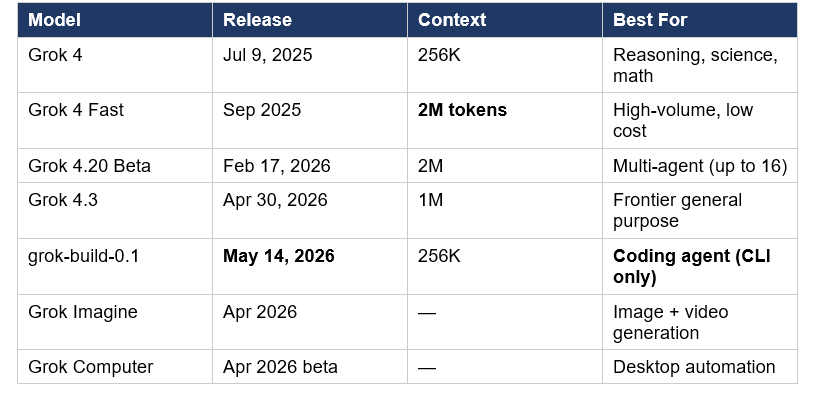
Two of these deserve a longer look. Grok 4.3, released April 30, 2026, is xAI's flagship reasoning model — 53 on the Artificial Analysis Intelligence Index, 1M-token context, strong on agentic benchmarks (a 321-point ELO jump on GDPval-AA over Grok 4.20). Our Grok 4.3 review breaks down the benchmarks and the $300/month paywall economics in detail.
The other is Grok 4.20 Beta's multi-agent architecture, which is the conceptual ancestor of what Grok Build inherits. Our Grok 4.20 deep-dive explains how the 4-agent and 16-agent Heavy configurations actually work — useful context for understanding why 8 parallel sub-agents in Grok Build is not a marketing number but a real engineering primitive.
Beyond the coding stack, xAI also operates a video and image generation system (Grok Imagine, running on the Aurora engine trained on 110,000 NVIDIA GB200 GPUs) and a voice cloning API. Our deep-dives on SuperGrok video and image generation and the xAI voice cloning API and custom voices tutorial cover those layers if you want the full picture.
My honest read: xAI is no longer 'the company with the meme chatbot.' They are running a six-product agent stack — language, vision, video, voice, desktop automation, and now terminal coding — and that breadth is closer to OpenAI's surface area than to a typical second-tier lab. Whether the depth on any one product matches Anthropic or OpenAI is still an open question. The coding CLI is the test that matters most for developer adoption.
4. AI agents vs AI chatbots — the actual difference
This distinction has been muddled by every marketing team in AI, so let's clean it up.
An AI chatbot responds to a single prompt with a single output. You ask, it answers. The interaction ends. State is local to the conversation window. Tool use, if it exists, is limited to a single round of function calls before returning text. Examples: ChatGPT on the free tier, Claude.ai's web interface for short questions, Gemini's standard chat mode.
An AI agent is given a goal — not a question — and decides on its own how to achieve it. It plans multi-step actions, executes them in sequence, observes results, and replans when the world doesn't match expectations. It can spawn other agents, call tools, edit files, run code, and decide on its own when it's done. It is, functionally, software that writes and runs its own next step. Examples: Claude Code, Grok Build, OpenAI Codex CLI, Cursor in Agent Mode, Cowork.
Three practical differences for builders:
- Latency vs durability — chatbots optimize for sub-second responses; agents optimize for multi-minute or multi-hour task completion.
- Side effects — chatbots return text; agents change the world (edit files, send messages, deploy code). The blast radius is fundamentally different.
- Observability — chatbots produce one output you can read; agents produce execution traces you have to monitor across dozens or hundreds of steps.
Grok Build is unambiguously an agent. The same is true for Claude Code, Codex CLI, and any 'autonomous' developer tool shipping in 2026. The shift from chatbot to agent is the underlying reason every major lab is now shipping CLI products — chat is a poor interface for software that runs for 35 hours unattended. For the broader competitive picture across every frontier model and agent stack, the April 2026 AI model leaderboard at Build Fast with AI tracks how each provider's agent surface is evolving release by release.
5. How to install and run Grok Build (step by step)
Setup is intentionally minimal. xAI ships a single-command installer, similar to how Anthropic distributes Claude Code. You need a SuperGrok or X Premium+ subscription before you start.
Step 1: Install
Open a terminal and run the official installer:
curl -fsSL https://x.ai/cli/install.sh | bashThis downloads the Grok Build binary, places it on your PATH, and registers the auth callback. The installer also sets up the default config directory at ~/.grok-build/.
Step 2: Authenticate
Run the CLI for the first time and it will open a browser window prompting you to sign in with your SuperGrok or X Premium+ account:
grok-build login
The auth token is stored locally. You won't need to re-authenticate unless you switch accounts or rotate keys.
Step 3: Start a session in plan mode
Navigate to the project you want Grok Build to work on, then start the agent:
cd ~/Documents/GitHub/your-project
grok-build --plan
The --plan flag forces plan-first execution. The agent will index your repository, ask what you want done, and write out a step-by-step plan before touching anything. From here you can approve, comment, or rewrite.
Step 4: Spawn parallel sub-agents
For larger tasks, you can ask Grok Build to delegate to specialized sub-agents running in parallel Git worktrees:
grok-build --parallel=8 "Migrate the auth system from JWT to PASETO across all services"Each sub-agent works on its own branch. The orchestrator reconciles changes when they complete. You review the merged diff before anything ships.
For production patterns — multi-agent orchestration, RAG-backed code review, agent evaluation harnesses — the 130+ open-source GenAI cookbooks at Build Fast with AI cover the LangChain, CrewAI, and orchestration scaffolding that compose into real agent systems on top of any provider, Grok Build included.
6. Grok Build vs Claude Code vs Codex CLI
Here's the honest head-to-head across the three terminal-native coding agents that matter in 2026:
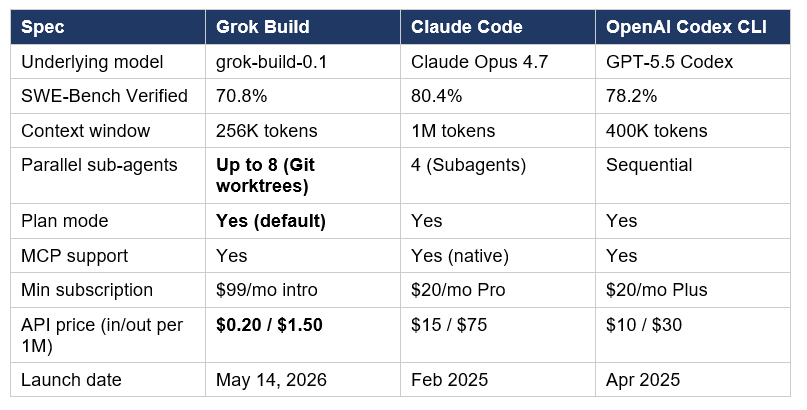
Read that table carefully. Grok Build's strongest specs are parallel sub-agents (8 vs 4) and API price ($0.20/$1.50 per million tokens — a tenth of what Claude Opus 4.7 charges). Its weakest are the underlying model's SWE-Bench score (70.8% vs Opus's 80.4%) and the 256K context window (vs 1M on Claude Code).
Practical translation. Claude Code is still the better choice for production engineering on a budget you can justify — the model is more reliable, the context window swallows entire monorepos, and the agent's tool-use traces are more legible to debug. Codex CLI is the safer pick for OpenAI-shop teams that already have GPT-5.5 keys and don't want to add another vendor. Grok Build is the right pick for three specific cases: parallel-heavy workloads (large migrations, test backfills) where 8 worktrees actually compound, cost-sensitive teams that need a sub-Anthropic-tier API price, and teams already paying for SuperGrok or X Premium+ who want incremental value out of that subscription.
If you're evaluating where xAI fits into a broader agent toolchain that already includes Claude or Codex, the OpenClaw 2026.5.2 release coverage shows how teams are mixing Grok 4.3, OpenAI Codex, and Claude inside the same orchestration layer — the multi-vendor future is here and the tooling is starting to catch up.
7. Best AI agent platforms in 2026
Grok Build is one of perhaps six platforms a developer in 2026 should know cold. Here's the short version of each:
- Claude Code (Anthropic) — Terminal-native, Opus 4.7-backed, the production default for serious coding work. Best ecosystem, deepest tool-use, highest SWE-Bench scores.
- OpenAI Codex CLI — GPT-5.5 Codex-backed, 400K context, ChatGPT Pro subscription model. The safest pick for OpenAI shops. Reportedly crossed 1M developers in its first month.
- Grok Build (xAI) — Terminal-native, grok-build-0.1 backed, 8 parallel sub-agents, lowest API price among the three. Best for parallel-heavy migrations.
- Cursor — IDE-native rather than terminal-native. Agent Mode runs inside the editor. Reportedly being acquired by SpaceX for $60B in 2026 — the longest-range play in coding agents.
- Cowork (Anthropic) — Desktop agent for non-developers. Folder-based context, multi-step workflows, no coding required. Best for ops and analyst workflows.
- Grok Computer (xAI) — Operates your actual desktop applications by reading pixels. Currently in wider beta. Adjacent to Grok Build — same lab, different layer of the stack.
If you're picking one, the rule of thumb that holds in 2026: pick Claude Code for engineering depth, Grok Build for parallel workloads at lower API cost, Cursor for IDE-bound teams, and Cowork for non-developer ops automation. The chatbot era did not end because chatbots got bad. It ended because the surface area of work that needs an agent grew faster than the surface area chat could cover.
8. Pricing, access tiers, and the honest verdict
Grok Build's pricing structure is unusually aggressive for an xAI launch. Three paths to access:
- SuperGrok Heavy — $299/month. Original launch tier on May 14. Includes Grok 4.3, Grok Imagine, and Grok Build.
- SuperHeavy (promo) — $99/month for the first six months, then $299/month. A 67% intro discount aimed at pulling Claude Code and Codex CLI users into the xAI ecosystem.
- SuperGrok + X Premium+ — Standard tiers ($30/month and $40/month respectively). Both received Grok Build access in the May 25 wider beta rollout.
- API access — $0.20 / $1.50 per million input/output tokens via grok-build-0.1. Available to anyone with an xAI API key, no subscription needed.
The API price is the genuine surprise. At $0.20 input / $1.50 output, grok-build-0.1 is roughly 1/75th the cost of running Claude Opus 4.7. If you're building an agent product and your margins live on token cost, Grok Build's underlying model becomes the rational backbone — even if you'd rather use Claude Code as your day-to-day driver. This is the same playbook DeepSeek and Qwen ran successfully in late 2025: undercut on tokens, capture the developers who actually build products.
Verdict: Grok Build is worth installing if you're already paying for SuperGrok or X Premium+ — it's a no-cost incremental add. It's worth evaluating if you have a parallel-heavy migration or test backfill coming up. It's not yet worth replacing Claude Code as your default if reliability and depth matter more than cost. The beta is early and xAI's track record on safety and rollout discipline is uneven — so production migration is a watch-and-evaluate call, not an adopt-now decision.
Six months from now, the calculus will look different. xAI iterates fast — Grok 4.20's Rapid Learning Architecture updates the model weekly based on production usage, and Grok Build will get the same treatment. The 70.8% SWE-Bench number is a floor, not a ceiling. The competitive question for Anthropic and OpenAI is not whether Grok Build can match them today but whether xAI can close the gap before the market consolidates around two or three default agent platforms.
9. Frequently Asked Questions
What is Grok Build?
Grok Build is xAI's agentic command-line coding tool, launched on May 14, 2026 and expanded to all SuperGrok and X Premium+ subscribers on May 25, 2026. It runs an autonomous coding agent in your terminal, with plan-first execution, up to 8 parallel sub-agents working in Git worktrees, and native Model Context Protocol (MCP) support. The underlying model is grok-build-0.1, with a 256K-token context window and a 70.8% SWE-Bench Verified score.
How do I install Grok Build?
Run the official installer in your terminal: curl -fsSL https://x.ai/cli/install.sh | bash. The installer places the grok-build binary on your PATH and sets up the config directory at ~/.grok-build/. After install, run grok-build login to authenticate with your SuperGrok or X Premium+ account.
Is Grok Build free?
No. Grok Build requires a SuperGrok subscription ($30/month), X Premium+ subscription ($40/month), SuperGrok Heavy ($299/month), or the promotional SuperHeavy tier ($99/month for the first six months). Direct API access to grok-build-0.1 is available separately at $0.20 per million input tokens and $1.50 per million output tokens.
Grok Build vs Claude Code — which is better?
Claude Code is currently better for production engineering depth: Opus 4.7 scores 80.4% on SWE-Bench Verified vs Grok Build's 70.8%, the context window is 1M tokens vs 256K, and the tool-use traces are more reliable. Grok Build wins on parallel sub-agents (8 vs 4), API cost (roughly 1/75th of Opus 4.7's per-token price), and integration with the broader xAI stack including Grok Imagine and Grok Computer. The right choice depends on whether you optimize for engineering depth (Claude Code) or parallel throughput and cost (Grok Build).
What is an AI agent vs an AI chatbot?
An AI chatbot responds to a single prompt with a single output — you ask, it answers, the interaction ends. An AI agent is given a goal rather than a prompt, plans multi-step actions to achieve it, executes those actions (file edits, code runs, tool calls), observes results, and replans when reality diverges from the plan. Grok Build, Claude Code, OpenAI Codex CLI, and Cursor's Agent Mode are agents. ChatGPT's basic chat interface and Grok's chat product on grok.com are chatbots.
What models power Grok in 2026?
xAI runs a seven-product family as of May 2026: Grok 4 (the July 2025 reasoning flagship), Grok 4 Fast (2M-token context, low-cost variant), Grok 4.20 Beta (the February 2026 multi-agent architecture), Grok 4.3 (the current flagship at 53 on the AA Intelligence Index), grok-build-0.1 (the coding agent backbone, May 2026), Grok Imagine (image/video generation on the Aurora engine), and Grok Computer (desktop automation in wider beta).
How do I use Grok CLI to build AI agents?
Grok Build is itself an agent — but it can also orchestrate sub-agents you define. Use the --parallel flag to spawn up to 8 concurrent sub-agents, each running in its own Git worktree on a separate branch. Combine this with MCP-connected tools (GitHub, Linear, Slack, your database) for full agent workflows. For programmatic agent building, hit the grok-build-0.1 model directly via the xAI API and orchestrate using frameworks like LangChain, CrewAI, or LangGraph.
Is Grok Build available outside the US?
Yes. Grok Build is available everywhere SuperGrok and X Premium+ are available, which includes most countries with X access. The wider beta opened on May 25, 2026 to all SuperGrok and X Premium+ subscribers globally. Direct API access to grok-build-0.1 is available through the xAI API in all supported regions.
Recommended Blogs
- Grok 4.3 Beta Is Live: Features, Review & Is $300 Worth It?
- Grok 4.20 Beta Explained: Non-Reasoning vs Reasoning vs Multi-Agent (2026)
- SuperGrok Video & Image Generation (2026): Speed, Pricing Math & Comparison
- xAI Voice Cloning API: Custom Voices Tutorial + Pricing (2026)
- Best AI Models Leaderboard: April 2026 Update
- OpenClaw 2026.5.2: Codex, Grok 4.3 & What's New
- Best AI Models April 2026: Ranked by Benchmarks
References
- xAI — Introducing Grok Build (official launch post)
- Pulse 2.0 — xAI: Grok Build Launches Early Beta Coding Agent CLI
- DevOps.com — xAI Enters the Coding Agent Race With Grok Build
- Grey Journal — xAI Launches Grok Build to Challenge Claude Code
- TECHi — Grok Build turns xAI into an AI coding-agent contender
- DigitalApplied — xAI Grok Build CLI: Parallel Coding Agents
- Artificial Analysis — xAI Grok 4.3 with improved agentic performance
- ChatForest — Grok Build review: SWE-Bench, MCP, plan mode
- Basenor — xAI Launches Grok Build Beta: Agentic Coding CLI Explained
- eWeek — Elon Musk's xAI Launches Grok Build, a coding agent

