



Grok 4.3 Beta Is Live: New Features, Full Review & Is $300 Worth It?
Today at 9 AM UTC, xAI did what xAI always does — dropped something big with zero announcement and zero fanfare. Grok 4.3 beta just went live on grok.com, iOS, and Android. No blog post. No press release. Just a new entry in the model selector that most people can't actually use.
I'm going to be direct: this is a genuinely interesting release, buried behind the most aggressive AI paywall I've seen in 2026. At $300 per month for SuperGrok Heavy, xAI is betting that its highest-paying users will serve as the lab rats while everyone else waits. The feature list — PDF creation, PowerPoint slides, spreadsheets, video input, sharper reasoning — is real. But so is the price tag. Let's get into what actually changed.
What Is Grok 4.3 Beta?
Grok 4.3 beta is xAI's newest iteration of its flagship AI model, released on April 17, 2026, exclusively for SuperGrok Heavy subscribers at $300 per month. It sits inside the Heavy mode on grok.com alongside the Expert and Fast options — so it's not a separate product, but a new version within an existing tier.
The model appears in the model selector with an 'Early Access' label, and regular SuperGrok subscribers at $30/month can see it listed but cannot activate it. The gap between seeing it and using it is exactly the point. xAI wants its highest-paying users to stress-test the model before any broader rollout.
This follows the exact same beta playbook xAI used with Grok 4.20 — launch to a narrow group, iterate fast, expand access over weeks. If you want the full architecture context on what xAI built with 4.20's multi-agent system, the Grok 4.20 beta deep-dive on Build Fast with AI covers the four-agent system (Grok, Harper, Benjamin, Lucas) that forms the backbone 4.3 is now building on.
Early reports from testers on X suggest Grok 4.3 is potentially twice the parameter size of Grok 4.20, with longer training runs. That aligns with xAI's trajectory toward Grok 5, which Elon Musk has described as targeting 6 trillion parameters on the Colossus 2 supercluster. Grok 4.3, if the size claims hold, sits somewhere between the current flagship and what's coming.
"Grok 4.3 beta is xAI's most capable consumer-facing model yet — locked behind a $300/month paywall, with PDF, slide, and spreadsheet creation that no previous Grok version could do natively."
New Features in Grok 4.3: What Actually Changed
Six confirmed new capabilities separate Grok 4.3 from its predecessor, and most of them are practical productivity upgrades rather than benchmark numbers.
1. PDF Generation
Grok 4.3 can create fully formatted PDF files from a conversation. You can ask it to summarize a research thread, compile findings, or generate a structured report — and it outputs an actual downloadable PDF. This is not a rendered screenshot. It's a real document. The implications for research workflows are significant, and it's something Claude and GPT-5.4 handle only through workarounds or plugins, not natively.
2. Spreadsheet Creation
The model can generate populated spreadsheets — tables, data sets, structured outputs in spreadsheet format. For anyone doing market research, data comparisons, or structured analysis inside Grok, this removes the copy-paste step into Excel or Google Sheets.
3. PowerPoint Slide Generation
The @techdevnotes account on X confirmed this within the first two hours of launch: Grok 4.3 can build PowerPoint slides. Input a topic or a document, and it structures the content into a slide deck. This is the kind of feature that makes enterprise users pay attention — and it's exactly the use case xAI is targeting with the $300/month tier.
4. Video Input
Grok 4.20 could handle images. Grok 4.3 adds video input, allowing you to upload or feed video content and interact with it conversationally. Ask questions about a video, extract information from footage, summarize what happens at a specific timestamp. This is multimodal AI becoming genuinely multimodal, not just text-with-an-image-button.
5. Sharper Reasoning
Beyond the document features, early testers note improved reasoning depth. This aligns with the claim that 4.3 carries longer training runs than 4.20. If the multi-agent architecture from 4.20 (16 agents in Heavy mode) is the engine, 4.3 appears to have more compute per agent, not just more agents.
6. Grok Computer Automation (Rolling Out Alongside)
Launching in parallel, Grok Computer — xAI's autonomous PC agent that can operate applications, fill forms, and chain multi-step desktop tasks — is entering wider beta access for select SuperGrok accounts. This is separate from Grok 4.3 but deeply connected: Grok 4.3 is the reasoning engine, Grok Computer is the action layer. The Build Fast with AI gen-ai-experiments cookbooks already cover multi-agent automation patterns that pair well with this kind of agentic AI architecture — worth exploring if you're building on top of Grok's API.
Who Can Access Grok 4.3 (And Who Gets Locked Out)
Right now, Grok 4.3 beta is exclusive to one tier, and only one tier. Here's how the access ladder breaks down as of April 17, 2026:
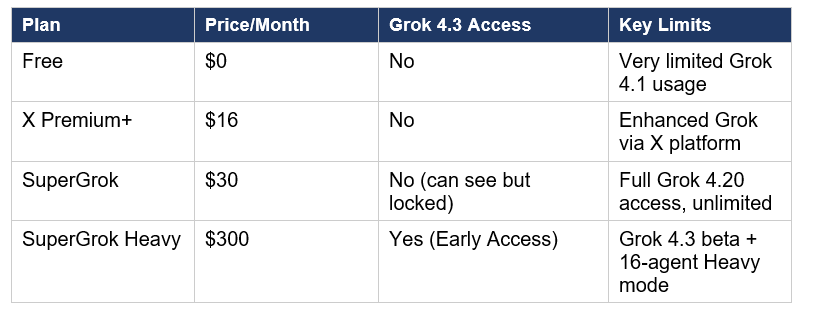
The frustration from the community is legitimate. One X user pointed out that Grok still lacks a basic memory feature — meaning you're paying $300/month for a model that forgets you between sessions. That's a fair criticism. ChatGPT Plus has had persistent memory since 2023. Claude's Projects feature stores context across conversations. For $300, not having memory is a meaningful gap, and xAI hasn't addressed it.
My take: the paywall is a feature, not a bug, from xAI's perspective. They get real-world stress testing from users who are invested enough to pay premium prices, and they use that feedback to iterate before the broader rollout. Whether that's worth it for you depends entirely on how much you use the specific new features — PDFs, slides, video input — that 4.3 brings.
Grok 4.3 vs Grok 4.20: What Actually Improved
Comparing 4.3 to 4.20 is the most useful frame for existing Grok users deciding whether to upgrade. Here's what the data and early reports tell us:
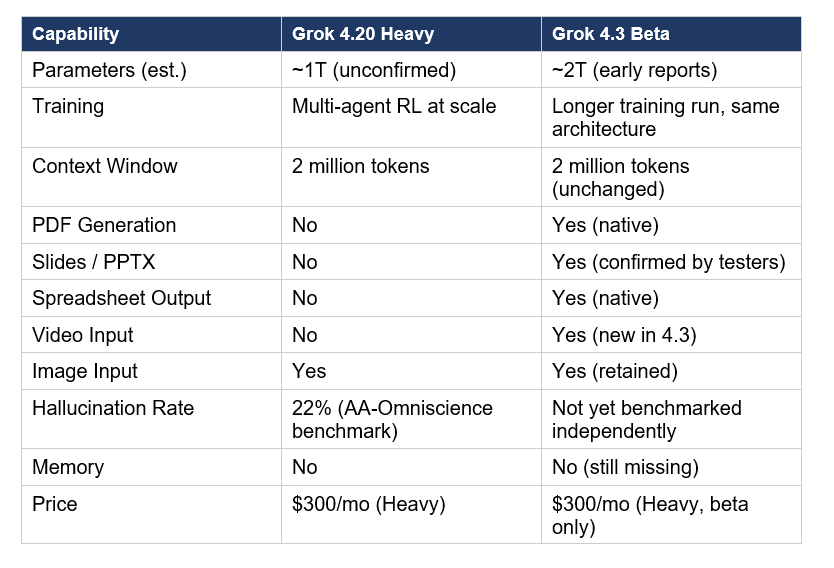
The headline difference is document creation. Grok 4.20 was a powerful reasoning and research engine. Grok 4.3 adds an output layer — it doesn't just analyze, it produces finished deliverables in standard formats. That's a meaningful shift from 'AI assistant' to 'AI co-worker.'
What hasn't changed is equally important. The 2 million token context window — the largest among Western closed models, beating Claude Opus 4.6's 200K limit and GPT-5.4's 128K — remains intact. The 16-agent Heavy architecture stays. And the memory problem stays too.
Grok 4.3 vs Claude Opus 4.7, GPT-5.4, and Gemini 3.1 Pro
The timing of this launch is impossible to ignore. Claude Opus 4.7 went live yesterday. Grok 4.3 dropped today. xAI is counter-programming deliberately, and it raises a real question: which model should you actually be using?
For the full benchmark landscape across all current frontier models, the April 2026 AI model rankings on Build Fast with AI gives a composite view across SWE-bench, ARC-AGI-2, and reasoning benchmarks. Here's how Grok 4.3 stacks up based on what we know today:
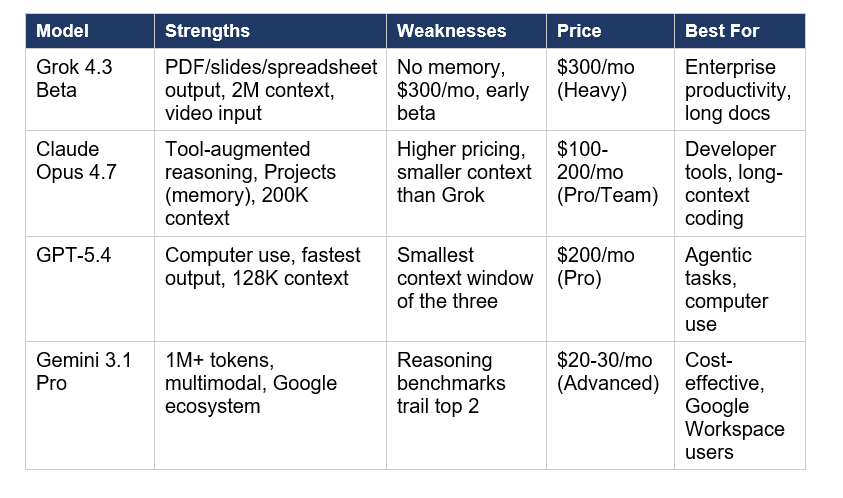
Honest take: Claude Opus 4.7 is still the better choice for most developers right now. Anthropic's Projects feature gives you persistent memory — something Grok 4.3 still doesn't have — and the tool-augmented reasoning pipeline is mature and production-tested. Grok 4.3's edge is the 2 million token context window and now, native document creation. If those two things are your bottlenecks, the $300 becomes more defensible.
GPT-5.4 is the strongest option for computer use tasks. Grok Computer is catching up, but OpenAI's computer-use feature shipped in March 2026 and has a real head start. For autonomous workflow execution, GPT-5.4 Pro is still the benchmark.
Gemini 3.1 Pro remains the cost-efficiency king. At $20-30/month with a 1 million token context, it's the obvious choice for anyone who needs large-context AI without paying frontier prices. It won't out-reason Grok 4.3 or Claude Opus 4.7 on hard benchmarks, but for most real-world use cases, the difference is marginal.
The Grok Computer Connection: xAI's Bigger Play
Grok 4.3 didn't launch in isolation. It landed the same week Grok Computer — xAI's autonomous desktop AI agent — began rolling out to wider SuperGrok access. That's not a coincidence.
Grok Computer can open applications, navigate UIs, fill forms, execute multi-step workflows, and chain actions across software without requiring API access. It works by reading pixels, which means it can operate any software, including legacy programs from a decade ago. The private beta went live April 13, 2026 — four days before Grok 4.3 dropped.
The architecture here is clear: Grok 4.3 is the brain (reasoning, document generation, analysis), and Grok Computer is the hands (execution, automation, desktop control). Together they're xAI's version of an AI that doesn't just answer questions — it does work. That's a fundamentally different product vision than what OpenAI is building with GPT-5.4, or what Anthropic is building with Claude Code.
For developers curious about building on top of agentic AI architectures, the multi-agent and automation patterns in the Build Fast with AI gen-ai-experiments repository are a good starting point for understanding how agent orchestration works in practice — which maps directly onto what xAI is assembling with Grok 4.3 plus Grok Computer.
One thing xAI has going for it that no other AI lab does: real-time access to the X firehose. Grok processes 68 million tweets daily. For tasks that require current social sentiment, breaking developments, or trend analysis, Grok 4.3 operating through Grok Computer has a data edge that Claude and GPT-5.4 simply can't replicate through web search alone.
My Honest Take: Is SuperGrok Heavy Worth $300 Per Month?
The honest answer is: probably not for most people right now. And that's fine — it's not designed for most people.
For the specific use case of someone who regularly needs to produce PDFs, slide decks, and spreadsheets directly from AI-assisted research — without exporting to another tool — Grok 4.3 starts to justify $300. The 2 million token context means you can feed it an entire document library, not a 128K snippet. And if you're already on SuperGrok for the 16-agent reasoning, the upgrade cost is $270/month for these new output formats.
But let me be the contrarian here: the memory problem is a dealbreaker for daily use. I don't care how good your reasoning is at $300/month if I have to re-introduce myself every session. ChatGPT has had this for years. Claude's Projects have it. Notion AI has it. Grok's roadmap hasn't even confirmed when it's coming. For $300, that omission is hard to rationalize.
If you're weighing whether to commit to Grok or a competitor for serious AI workflows, the Grok safety history from January 2026 is also worth reading — xAI's track record on responsible deployment matters when you're considering $300/month enterprise-level use.
My actual recommendation: wait two to four weeks. xAI's release cadence means Grok 4.3 will get meaningful improvements fast. If independent benchmarks in early May 2026 confirm the reasoning gains and the document features hold up in real workflows, the $300 becomes a much cleaner decision. Buying day-one beta access at $300/month is paying xAI to do their QA for them.
Frequently Asked Questions
What is Grok 4.3 beta?
Grok 4.3 beta is xAI's latest AI model, released April 17, 2026, exclusively for SuperGrok Heavy subscribers at $300/month. It introduces native PDF creation, PowerPoint slide generation, spreadsheet output, and video input — new capabilities that no previous Grok version offered. Early testers suggest it is potentially twice the size of Grok 4.20 with longer training.
How do I get access to Grok 4.3 beta?
You need a SuperGrok Heavy subscription at $300 per month. Standard SuperGrok at $30/month can see the model listed in the selector on grok.com, iOS, and Android but cannot activate it. xAI has not given a timeline for when Grok 4.3 will reach the standard $30/month tier.
What are the new features in Grok 4.3?
Grok 4.3 adds six major capabilities over Grok 4.20: native PDF generation, PowerPoint slide creation, spreadsheet output, video input, sharper reasoning from longer training, and access alongside the ongoing Grok Computer automation rollout. The 2 million token context window and 16-agent Heavy architecture from 4.20 are retained.
How does Grok 4.3 compare to Claude Opus 4.7?
Grok 4.3 leads on context window (2 million tokens vs. Claude Opus 4.7's 200K) and offers native document creation (PDF, slides, spreadsheets) that Claude doesn't match natively. Claude Opus 4.7 leads on persistent memory via Projects, mature tool-augmented reasoning pipelines, and production stability. Claude is $100-200/month; Grok 4.3 is $300/month in Heavy beta.
Is SuperGrok Heavy worth $300 per month?
For enterprise users who regularly produce PDFs, slide decks, or spreadsheets from AI research — and who need a 2 million token context window — Grok 4.3 has a real case at $300/month. For most individual users, the missing memory feature and early-beta stability make the standard SuperGrok at $30/month the better value. Independent benchmarks expected in May 2026 will clarify the performance gap.
What is Grok Computer and how does it relate to Grok 4.3?
Grok Computer is xAI's autonomous desktop AI agent, which entered private beta on April 13, 2026. It can open applications, navigate UIs, and chain multi-step workflows without API access by reading screen pixels. Grok 4.3 serves as the reasoning and generation layer; Grok Computer is the execution and automation layer. Together they represent xAI's vision of an AI that doesn't just answer questions but actively does computer-based work.
When will Grok 4.3 be available to regular SuperGrok users at $30/month?
xAI has not published a timeline. Based on the Grok 4.20 beta pattern — which moved from SuperGrok Heavy exclusivity to broader access over approximately four weeks — a reasonable estimate is mid-to-late May 2026. The beta tag typically drops when xAI publishes official benchmark data, which follows the conclusion of the Heavy-tier testing period.
Does Grok 4.3 have memory or persistent context?
No. As of April 17, 2026, Grok 4.3 does not have persistent memory between sessions — a feature that competitors including ChatGPT and Claude (via Projects) have offered for over a year. This remains one of the most cited user complaints about the Grok platform and has not appeared on xAI's published roadmap.
Recommended Blogs
These articles from Build Fast with AI connect directly to what's covered above:
- Grok 4.20 Beta Explained: Non-Reasoning vs Reasoning vs Multi-Agent (2026)
- Best AI Models April 2026: Ranked by Benchmarks
- Grok AI Image Tool Sparks Global Safety Crisis (Jan 2026)
- Build Fast with AI Gen-AI Experiments & Cookbooks (GitHub)
If you found this useful, subscribe to the Build Fast with AI newsletter — we cover every major AI release the day it drops, with the same no-fluff breakdown.
References
PiunikaWeb — xAI rolls out Grok 4.3 beta for SuperGrok Heavy subscribers (April 17, 2026):
xAI Official News — Grok 4 announcement and SuperGrok Heavy tier:
IBTimes Australia — Grok 4.20 Beta 2 Powers xAI Advances (April 2026):
DEXTools News — Grok Computer beta confirmed live (April 2026):
Artificial Analysis — Grok 4.20 0309 v2 Intelligence Index:
OpenRouter — Grok 4.20 API pricing and specs:
Build Fast with AI — Grok 4.20 Beta Explained 2026:

