



Generative AI writes the email. Agentic AI reads your inbox, writes the replies, checks your calendar, books the meetings, and tells you what it did. Both run on the same kind of large language model, yet they behave nothing alike. One produces content when you ask. The other pursues a goal on its own. Understanding that difference is the single most useful thing you can learn about AI in 2026.
This guide compares agentic AI vs generative AI in plain language, with side-by-side tables, real examples, and a clear decision framework for when to use each. It is written for beginners, product teams, and business leaders who keep hearing both terms and want to know exactly how they differ, how they work together, and where each one shines. Everything here reflects the state of AI as of July 2026.
1. Agentic AI vs Generative AI: The Short Answer
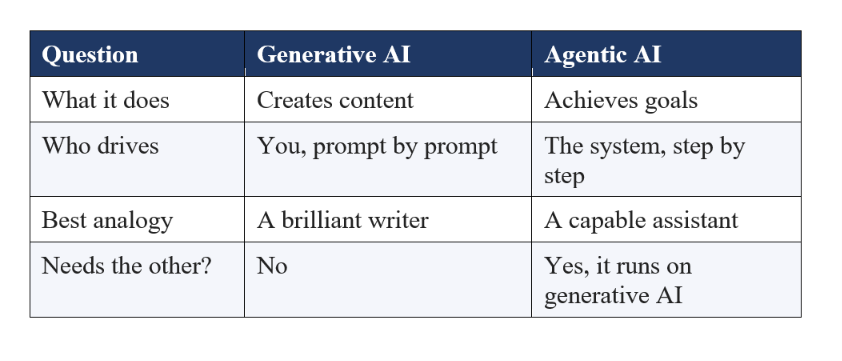
Generative AI creates content in response to a prompt. Agentic AI takes actions to accomplish a goal. Generative AI is a capability that produces text, images, code, or audio from an instruction. Agentic AI is a system that uses that capability, plus tools, memory, and autonomy, to complete multi-step work with little or no human input at each step.
Put simply, generative AI answers and agentic AI acts. When you prompt ChatGPT to draft a proposal, that is generative AI: one request, one response, and you drive every next step. When a system takes the goal "win back churned customers," then pulls the list, writes personalized offers, sends them, tracks replies, and reports results, that is agentic AI. The model at the center might be identical. The difference is the loop of autonomy wrapped around it.
Here is the relationship that trips people up. Agentic AI is not a replacement for generative AI. It is built on top of it. Nearly every agent uses a generative model as its reasoning engine. So the real question is rarely "which one," it is "how much autonomy does this task need." The rest of this guide makes that decision easy.
2. What Is Generative AI?
Generative AI is artificial intelligence that produces new content, such as text, images, code, audio, or video, based on patterns learned from training data. You give it a prompt, and it generates an output that matches the request. It is the technology behind ChatGPT, Claude, Gemini, Midjourney, and most of the AI tools people used first.
Under the hood, a generative model like GPT-5.6 or Claude Opus predicts the most likely next piece of content one token at a time. Trained on enormous datasets, it learns the statistical patterns of language, code, or images, then reproduces and recombines those patterns to create something new. The result can feel remarkably creative, but the mechanism is prediction, not intention. The model does not have a goal beyond producing a good response to the prompt in front of it.
What generative AI is great at
Generative AI excels at single-turn creation. Drafting an article, summarizing a document, translating a paragraph, writing a function, brainstorming names, generating an image, or explaining a concept. Anywhere the job is "turn this input into that output," generative AI is fast, cheap, and often excellent. McKinsey has estimated that generative AI could add trillions of dollars of annual value across business functions, and most of that value starts with exactly these content tasks.
The main types of generative AI
Generative AI is not one thing. It spans several modalities, and knowing them helps you see where the technology ends and agents begin. Text generation, led by models like GPT-5.6 and Claude Opus, writes articles, code, and answers. Image generation, from tools like Midjourney and the latest diffusion models, creates art and product visuals from a description. Code generation powers assistants that autocomplete and write functions. Audio and voice generation clone speech and compose music, while video generation, from models like Sora and Veo, produces clips from a prompt.
Every one of these modalities shares the same core behavior: input goes in, generated content comes out, and the interaction ends there. A text model does not decide to go verify a fact. An image model does not choose to upload its output to your store. They generate, then wait. That waiting is the seam where agentic AI attaches itself, by adding the decisions and actions that connect one generation to the next. Once you see generative AI as a set of powerful but passive generators, the value of wrapping them in an agent becomes obvious.
Where generative AI stops
Generative AI stops at the output. It does not check whether the answer is correct, it does not take the next step, and it does not act in the world unless something else tells it to. If you want it to do more, you become the glue: you read the output, copy it somewhere, prompt again, and repeat. That manual loop is fine for one task. It becomes the bottleneck the moment the work has many steps. That gap is precisely what agentic AI was built to close.
3. What Is Agentic AI?
Agentic AI is artificial intelligence that pursues a goal autonomously by planning steps, using tools, observing results, and adjusting until the task is done. Instead of producing one output, it runs a loop: perceive, plan, act, observe, repeat. The generative model is the brain. The agent adds hands, memory, and a plan.
An agent can search the web, run code, call an API, query a database, and update records, then react to what happened and decide the next move. For the full breakdown of how agents plan and self-correct, see our complete guide on what agentic AI is and how it works, which walks through the agent loop and its core components in depth.
The four parts of an AI agent
Every agent is built from four pieces, and each one is what a plain generative model lacks. The model is the brain that reasons and decides. Tools are the hands that let it act: web search, code execution, API calls, file edits. Memory is the notebook that holds context across steps, often backed by a vector database for long-term recall. Orchestration is the manager that runs the loop, decides when to call the model versus a tool, and knows when to stop. Strip these four back to just the brain and you are left with generative AI. Add them and you get a system that can finish a job rather than just describe one.
What agentic AI is great at
Agentic AI shines on multi-step work that has a clear goal but a messy path. Researching a topic across many sources and compiling a report. Fixing a bug by reading code, editing files, and running tests. Handling a support ticket end to end. Monitoring a system and responding to alerts. The common thread is that no single prompt could do the job, because the work requires several actions, checks, and course corrections along the way.
The reliability of an agent lives in that loop, not in raw model intelligence. A modest model with good stop rules and a verifier often beats a stronger model running an open-ended loop, a principle we explore in our guide to loop engineering for reliable AI agents.
4. The 7 Key Differences (With Table)
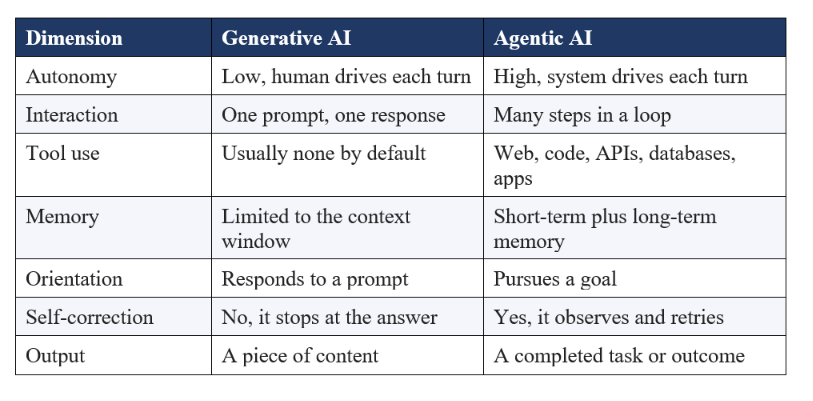
Agentic AI and generative AI differ across seven dimensions: autonomy, interaction pattern, tool use, memory, goal orientation, self-correction, and output type. Master these seven and you can classify any AI product you meet in seconds.
1. Autonomy: who decides the next step
This is the deepest difference. With generative AI, you decide every next move. With agentic AI, the software decides. That single shift, from you driving to the system driving, is what turns a tool into an assistant. It is also what makes agents feel qualitatively different to use, because you set a destination rather than steering every turn.
2. Interaction: one turn versus a loop
Generative AI is a single exchange. You prompt, it responds, the interaction ends. Agentic AI is a continuous loop that can run for dozens of steps, each one informed by the last. This is why an agent can handle a task that would take you fifteen separate prompts, while you handle none of them manually.
3. Tool use: reach beyond text
A generative model, by default, only produces text or media. An agent can act in the outside world through tools: searching, executing code, sending messages, editing files. Tools are what let an agent change reality rather than just describe it. The set of tools you give an agent defines what it can actually accomplish.
4. Memory: remembering across steps
Generative AI remembers only what fits in its context window for the current conversation. Agentic AI adds persistent memory, often backed by a vector database, so it can recall facts, decisions, and preferences across steps and sessions. Memory is what lets an agent stay coherent across a long task instead of forgetting its own plan halfway through.
5, 6, and 7: goals, self-correction, and output
Generative AI is oriented around responding, agentic AI around achieving. Generative AI does not check its own work, while an agent observes each result and retries when something fails. And the output differs in kind: generative AI hands you a piece of content, agentic AI hands you a finished outcome. A generative model gives you a drafted report. An agent gives you the report researched, written, formatted, and filed in the right folder.
How to classify any AI tool in ten seconds
Once you know the seven differences, you can label almost any product instantly by asking two questions. First, after you give it an instruction, does it do one thing and stop, or does it keep going on its own? One-and-stop is generative. Keeps-going is agentic. Second, can it touch the outside world, by searching, running code, or changing data, or does it only produce text and images? If it can act, it has crossed into agentic territory. A plain writing assistant is generative. A tool that researches, drafts, and posts is agentic. A model that answers questions is generative. A model that answers, then books the meeting it just recommended, is agentic.
Watch for the middle of the spectrum, because that is where most 2026 products actually live. A chatbot that can browse the web is mostly generative with a single agentic step bolted on. A coding assistant that reads your repo and runs tests is deeply agentic. Marketing that calls a product agentic does not always mean it is fully autonomous, so the two questions above cut through the labels and tell you what a tool really does. Judge the behavior, not the branding.
5. How Agentic AI and Generative AI Work Together
Agentic AI and generative AI are not rivals. Agentic systems use generative models as their reasoning engine. Think of generative AI as the engine and agentic AI as the whole car: steering, wheels, and a driver that knows the destination.
Every time an agent decides what to do next, it does so by calling a generative model. The model reads the current state, reasons about the goal, and proposes the next action. The agent framework then executes that action with a tool, feeds the result back, and asks the model again. Remove the generative model and the agent has no brain. Remove the agent and the generative model has no hands. The two are layers of the same stack, not competitors on the same shelf.
Three common myths, cleared up
The first myth is that agentic AI will replace generative AI. It will not, because it depends on it. Agents make generative models more useful, not obsolete. The second myth is that agentic AI is just a fancier chatbot. A chatbot answers in one turn, while an agent runs a loop, uses tools, and takes real actions, which is a difference in kind, not degree. The third myth is that more agents always means better results. In practice, a single well-designed agent usually beats a sprawling multi-agent system, which adds cost, latency, and new ways to fail.
There is a fourth misconception worth naming: that agentic AI is fully autonomous and needs no human. Serious deployments keep humans in the loop for anything high-stakes, using approval gates before an agent sends money, emails, or irreversible changes. Autonomy is a dial you turn up carefully, not a switch you flip. The best systems in 2026 are not the ones with the least human oversight. They are the ones that automate the routine and escalate the rest.
This is why the most capable AI products in 2026 blur the line. When ChatGPT browses the web or runs Python, it is acting agentically for those steps. When a coding agent like the ones covered in our Grok Build agent CLI review plans and edits code, a generative model is making every decision inside the loop. The useful mental model is a spectrum from pure generation to full autonomy, and most tools are marching steadily toward the agentic end.
6. Side-by-Side Examples You Will Recognize
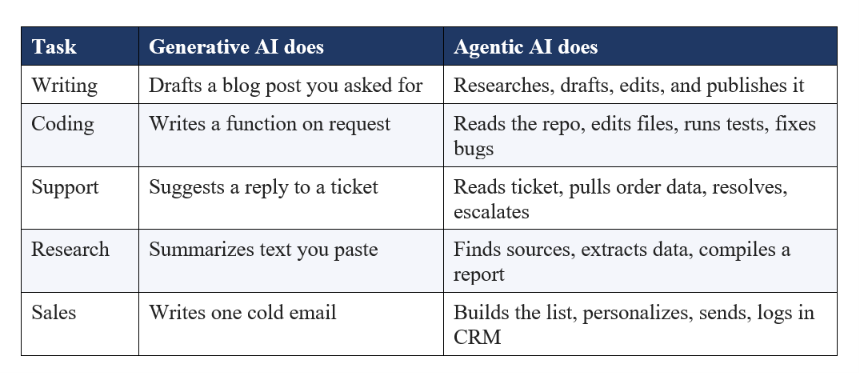
The clearest way to feel the difference is to watch the same task done by generative AI, then by agentic AI. In each pair, the model is similar. The autonomy is not.
Coding: the clearest contrast
Ask a generative model to write a login function and it returns clean code you then paste, test, and debug yourself. An agentic coding tool takes the goal "add login," reads the codebase, writes the function, wires it into the app, runs the tests, and fixes what breaks. Our Cline SDK agent runtime review shows how a single well-built agent runtime handles that full loop, and our code-along AI agents tutorial walks through building one yourself.
Customer support: the business contrast
Generative AI drafts a friendly reply, but a human still has to read the ticket, look up the order, decide the resolution, and hit send. An agentic support system does all of that: it reads the ticket, queries the order database, checks the refund policy, drafts and sends the resolution, and escalates only the hard cases to a person. The generative version saves a few minutes per ticket. The agentic version can close routine tickets without a human at all, which is a different order of leverage.
Research: the everyday contrast
Suppose you need a competitive analysis of five tools. With generative AI, you paste in text you already gathered and it summarizes it neatly, which means you still did the searching, the reading, and the copying. With agentic AI, you give the goal and the system searches the web, opens each product page, extracts pricing and features, notices a page that failed to load and retries it, then compiles a clean comparison table and saves it. Same summarizing skill at the core, wrapped in the autonomy to gather the inputs and deliver the finished artifact. This is the pattern you will see over and over: generative AI handles the thinking step, agentic AI handles the whole errand around it.
7. When to Use Generative AI vs Agentic AI
Use generative AI for single-step creative tasks and agentic AI for multi-step goals that require tools, checks, and autonomy. The decision comes down to one question: does the job need several actions and course corrections, or just one good output?
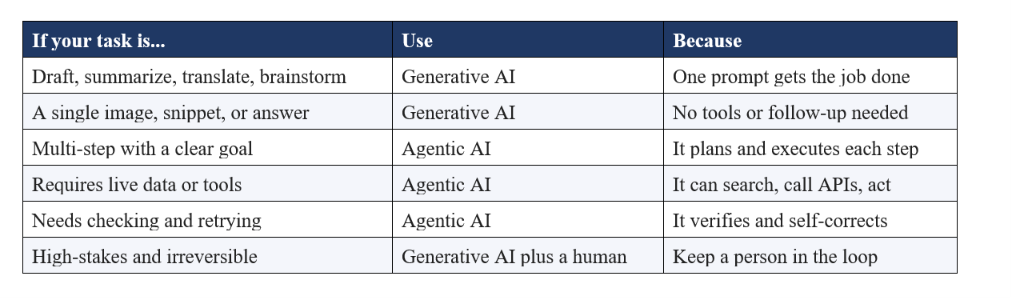
A practical rule of thumb: reach for generative AI first, because it is simpler, cheaper, and easier to control. Escalate to agentic AI only when the manual loop of prompting and copying becomes the bottleneck. Many teams over-engineer with a five-agent system when a single well-prompted generative call would have done the job. Start simple, and add autonomy only where it earns its keep.
Ask yourself three questions to decide. First, does the task have more than one step that depends on the previous one? If no, generative AI is enough. Second, does it need live data or an action in the real world, like sending a message or updating a record? If yes, you need an agent. Third, does the result need to be checked and possibly retried before it is trustworthy? If yes, an agent with a verifier earns its cost. If you answer no to all three, you are looking at a generative task, and adding an agent would only add complexity for no benefit.
When you do need agents, the framework you pick shapes everything. Our AI agent frameworks collection compares the leading options, and beginner-friendly tools like CrewAI or the graph-based approach in our Mastering LangGraph guide are good first stops.
8. Cost, Risk, and Reliability Compared
Generative AI is cheaper, faster, and lower risk per use, while agentic AI costs more and carries more risk but delivers finished outcomes. Honest trade-offs matter here, because the hype often skips the downsides.
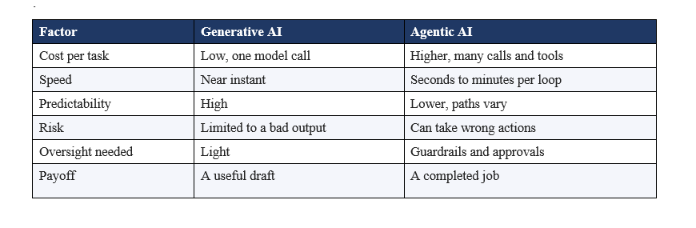
Generative AI carries a bounded risk: the worst case is a wrong or low-quality answer that you catch before using it. Agentic AI raises the stakes, because an agent with real permissions can send the wrong email, spend money, or change data. That is why serious deployments use approval gates, sandboxes, spending caps, and step limits. Gartner has cautioned that a large share of agentic AI projects will stall or be scrapped when teams skip this discipline, and that warning is worth taking seriously.
Reliability is the other honest gap. Generative AI is stateless and predictable: the same prompt gives similar output. Agentic AI is dynamic, so the same goal can take different paths, and small errors early in a loop can compound. The mature approach treats an agent like a fast, tireless junior teammate whose work you review, not an oracle you trust blindly. Build the verification in, and the reliability follows.
9. Why the Industry Is Shifting to Agentic AI in 2026
The industry is moving from generative to agentic AI because value shifts from answering to doing, and every major lab has reorganized around agents. 2025 and 2026 were the years agents moved from demos to production.
The economic logic is simple. A generative model that drafts a report saves minutes. An agent that gathers the data, writes the report, and files it saves the whole task. As models grew reliable enough to chain many steps without derailing, the ceiling on value moved from content to completed work. That is why OpenAI, Anthropic, and Google all shipped agent platforms and standards, and why Gartner projects agentic AI will be embedded in a rising share of enterprise software by 2028.
For learners and professionals, this shift changes what is worth studying. Knowing how to prompt a generative model is now table stakes, a skill almost everyone will have. The scarcer, higher-value skill is designing agents: choosing tools, wiring memory, writing verifiers, and setting stop rules so a system runs reliably without a human at every step. The people who can build the loop, not just write the prompt, are the ones the market is competing for. That is the practical reason the generative-to-agentic shift matters to your career, not just to enterprise software budgets.
Two open standards accelerated the shift. The Model Context Protocol, introduced by Anthropic in November 2024, lets agents connect to tools through one shared interface, as shown in our Claude MCP setup guide. Google's Agent2Agent protocol, launched in April 2025 with more than fifty partners, lets agents from different vendors talk to each other. Together they turned agents from isolated demos into an interoperable ecosystem, which is exactly what a technology needs to cross into the mainstream.
10. How to Get Started With Each
Start with generative AI to build intuition, then graduate to agentic AI by automating one small, repetitive task end to end. You do not have to choose. You climb from one to the other.
For generative AI, the on-ramp is free and immediate: use ChatGPT, Claude, or Gemini daily, and practice prompting until you can reliably get the output you want. Learn what the models are good at and where they hallucinate. This intuition is not wasted when you move to agents, because prompting the model well is still the core skill inside every agent loop.
For agentic AI, pick one tiny task you do every day and automate it end to end. Do the no-code version first in a tool like n8n, then try the coded version by cloning a notebook from the open-source gen-ai-experiments cookbook repository and changing the goal to your own. Building one working agent teaches you more than reading ten articles, because the loop finally becomes concrete.
A simple 30-day path works well. Spend the first week using a generative model daily and learning to prompt it precisely. In the second week, pick one repetitive task and build a no-code agent that completes it end to end. In the third week, rebuild that same agent in code so you understand the loop, the tools, and the memory underneath. In the fourth week, add a verifier and a stop rule, then put it somewhere it can run on a schedule. By the end you will have felt both technologies from the inside, and the difference between them will be muscle memory rather than theory.
If you want a guided path from generative basics to shipping real agents, the Agentic AI Launchpad compresses the journey into a six-week cohort with live mentorship and real projects, which is the fastest way to cross from using AI to building with it.
11. Frequently Asked Questions
Is agentic AI the same as generative AI?
No. Generative AI creates content from a prompt, while agentic AI takes actions to achieve a goal. Agentic AI is built on top of generative AI, using a generative model as its reasoning engine, then adding tools, memory, and autonomy to complete multi-step tasks.
What is the main difference between generative AI and agentic AI?
The main difference is autonomy. Generative AI responds to a single prompt and stops at the output, while agentic AI runs a loop that plans, acts with tools, observes results, and self-corrects until a goal is met. Generative AI answers, agentic AI acts.
Is ChatGPT generative or agentic AI?
ChatGPT is primarily generative AI, but it behaves agentically when it browses the web, runs code, or uses tools. Most modern AI products sit on a spectrum between pure generation and full autonomy rather than being purely one or the other.
Is agentic AI better than generative AI?
Neither is universally better. Generative AI is cheaper, faster, and simpler for single-step content tasks, while agentic AI is stronger for multi-step goals that need tools and self-correction. The right choice depends on whether the job needs one output or many coordinated actions.
Can agentic AI work without generative AI?
In practice, no. Agentic systems rely on a generative model to reason about what to do at each step. Without that model, an agent has no way to interpret the goal, plan actions, or decide its next move, so generative AI is the engine inside every agent.
What are examples of agentic AI vs generative AI?
A generative AI example is ChatGPT writing an essay from a prompt. An agentic AI example is a coding assistant that reads a codebase, edits files, runs tests, and fixes bugs on its own. Same underlying model, very different autonomy.
What comes after generative AI?
Agentic AI is widely seen as the next phase. As models became reliable enough to chain many steps, the focus moved from generating content to completing tasks. Analysts expect agentic AI to be embedded in a growing share of enterprise software through 2028.
Recommended Blogs
● What is Agentic AI, Beginner Guide
● Loop Engineering for AI Agents
● Master AI Agents Code-Along Tutorial
● Mastering LangGraph Multi-Agent Swarm
Resources & Community
Join our community of 70,000+ AI enthusiasts and learn to build powerful AI applications. Whether you are a beginner or an experienced developer, Build Fast with AI helps you understand and implement AI in your projects.
● Website: buildfastwithai.com
● LinkedIn: Build Fast with AI
Agentic AI Launchpad 2026
A structured 6-week cohort program that takes you from AI basics to building and deploying real-world agentic AI systems. Includes live sessions, expert mentorship, project reviews, and a builder community network.
Ready to go from learning to building? Join the next cohort: Agentic AI Launchpad 2026
Free AI Resources
Access free tools, workshops, and micro-learning to keep building:
● AI Workshops: free events and recordings
● Unrot: learn AI in 5 minutes a day
Keep Building
If this comparison helped, follow Build Fast with AI for weekly, no-hype breakdowns of the tools and ideas shaping agentic AI. The best way to understand the difference is to build with both, so generate something today and automate something tomorrow.
References
● Building Effective AI Agents (Anthropic)
● Economic Potential of Generative AI (McKinsey)
● Model Context Protocol (Official)

