


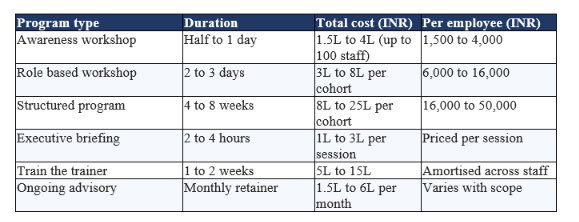
Corporate AI training in India costs between INR 1,200 and INR 12,000 per employee in 2026. A one day workshop for 100 people runs INR 1.5 lakh to INR 4 lakh. A multi week role based program for the same team runs INR 8 lakh to INR 25 lakh. Those numbers are the whole reason you clicked, so I put them first.
Now the part the price tables leave out. Almost no serious provider in India publishes a fixed rate card, because the real cost is driven by three things: how customised the content is to your workflows, how it is delivered, and how many people you train at once. This guide breaks down every one of those variables with real market ranges, so you can build a defensible budget and spot when a quote is padded.
It is written for the person who has to justify the spend: the HR or L&D head, the CFO, the founder. Every figure below is a market range observed across Indian enterprise deals in 2026, not a published list price. Use them to sanity check the quotes you receive.
If a vendor gives you a per seat price before asking what your team does all day, they are selling a product, not solving your problem.
1. Corporate AI Training Cost at a Glance
Here is the fast answer in one table. Every range below assumes India based delivery in 2026 and is explained in detail through the rest of this guide.
If you want the full strategic picture around these numbers, our 2026 corporate AI training buyer's guide covers formats, providers and the full evaluation checklist. This post stays focused on the money.
Skip the guesswork. Tell us your team size and functions and we will send a costed proposal in two working days, no obligation. Get a custom quote.
2. Cost Per Employee, Explained
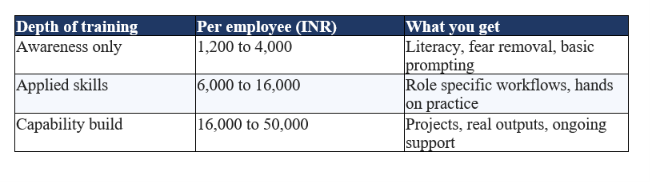
Cost per employee for corporate AI training in India ranges from INR 1,200 for basic group awareness sessions to INR 50,000 for intensive, project based programs. The number falls sharply as cohort size rises, because facilitator time is largely fixed whether you train 30 people or 200.
Per employee pricing is the metric finance teams anchor on, but it is also the most misleading, because a cheap per head number often hides a shallow program. A INR 1,200 per head awareness session that nobody applies is more expensive than a INR 20,000 per head program that changes how a team works, once you count the salary hours consumed either way.
Worth knowing before you set the budget: AI skills carry a real salary premium in India, which is why underinvesting costs you twice, once on weak training and again on attrition. We covered the data in our breakdown of the 56% salary gap between AI skills and degrees, and the 2026 AI jobs and salary picture in India fills in the market context.
3. Pricing by Delivery Format
Delivery format is the second biggest cost lever after customisation. The same content costs very different amounts depending on whether it is delivered live on site, live online, or self paced. Here is how the five common formats compare on price and value.
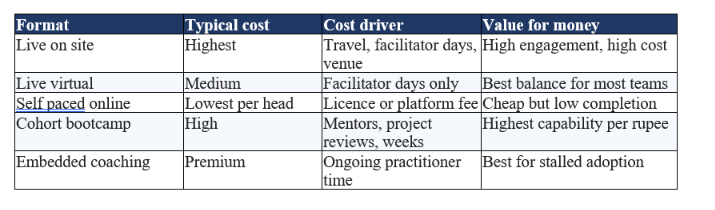
My honest view: live virtual is where most Indian companies should start. It removes the travel premium of on site delivery, keeps the live engagement that self paced video lacks, and scales across cities. Self paced online looks cheapest on the invoice, but corporate completion rates routinely sit under 20%, so the true cost per person who actually finishes is far higher than the sticker price suggests.
The cheapest format on paper is usually the most expensive per employee who actually learns something.
4. Pricing by Team Size
Team size changes per head cost more than any other single factor, because most of a program's cost is facilitator and design time that does not grow one for one with headcount. Doubling the cohort rarely doubles the price.
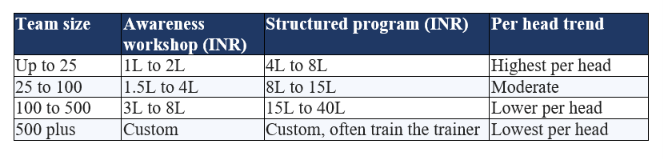
Once you cross roughly 500 employees, the economics usually flip toward a train the trainer model, where a provider trains a small internal cohort who then roll the program out company wide. This carries a higher upfront cost but the lowest long run per head cost, and it builds a permanent internal capability instead of a one time event.
5. What Actually Drives the Price Up
Five variables explain almost all of the spread between a cheap quote and an expensive one. Understanding them lets you tell the difference between a premium worth paying and padding you should negotiate out.
Customisation depth
This is the single biggest driver. A generic deck delivered to any company is cheap. A curriculum rebuilt around your actual CRM, your real documents and your approval workflows costs materially more, and it is also the only version that reliably changes behaviour. When you compare quotes, customisation is the premium worth paying for.
Delivery mode and location
On site delivery in Mumbai, Bengaluru or Delhi carries travel, accommodation and facilitator day rates that virtual delivery does not. If budget is tight, moving to live virtual is the fastest way to cut cost without cutting quality.
Facilitator seniority
A practitioner who ships production AI systems commands a higher rate than a trainer who presents slides, and the gap is justified. The senior facilitator answers the hard question in the room instead of promising to follow up. Treat that gap as a premium worth paying, not padding.
Hands on ratio and outputs
Programs that require each participant to build something real, such as a working automation or a prompt library, cost more than lecture style sessions because they need smaller groups and more facilitator attention. They also produce most of the actual return.
Post training support
Office hours, prompt libraries, adoption tracking and follow up coaching are often quoted as a separate line item. It is the line most buyers cut first and should cut last, because it is what turns a training event into sustained adoption.
Cut the travel and the venue if you must. Never cut the follow through. That is the part that pays you back.
Don't just use ChatGPT. Learn to build custom LLM agents, RAG pipelines, and full-stack Agentic AI apps in our intensive 6-week program.
6. Provider Pricing Tiers in India
Providers in the Indian market fall into rough pricing tiers, and each tier is priced the way it is for a reason. Here is what you typically pay and what you typically get.
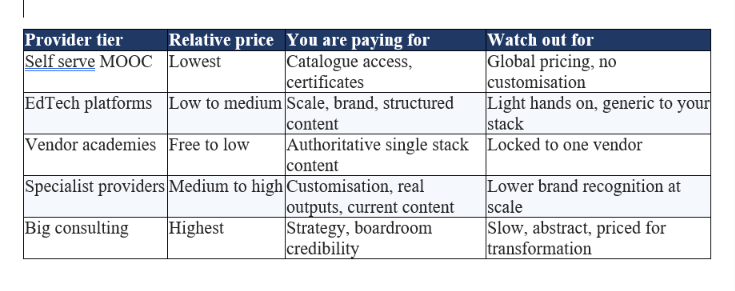
A practical rule: match the tier to the job. If you need 5,000 people credentialed at the lowest unit cost, an EdTech platform or MOOC wins. If you need a specific function to build working AI into their daily workflow, a specialist provider delivers more per rupee. If AI training is one workstream inside a board level transformation, consulting is the natural fit and is priced accordingly.
If your teams are also choosing between AI assistants during the program, our vendor neutral complete Claude AI guide for 2026 and our library of 200 ChatGPT prompts for work are useful free starting points that reduce how much you need to teach from scratch.
7. Free and Low Cost Options
Yes, there are genuinely free corporate AI training options, and a smart budget uses them as a baseline layer underneath paid, customised training rather than as a replacement for it. Here are the ones worth using.
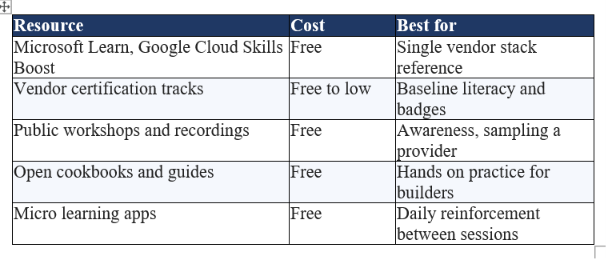
Teams that want free hands on practice can work through our open generative AI experiments cookbook, and non technical staff can start automating real tasks using our guide to no code AI agents. Both cost nothing and reduce the paid training you need.
The honest limit of free resources: they teach tools, not your workflows, and they include zero adoption support. They are excellent for building baseline literacy and terrible at driving behaviour change in a specific team. Use them to raise the floor, then pay for customised training to lift the ceiling.
8. How to Calculate ROI and Payback
Calculate AI training ROI on time saved: multiply hours saved per employee per week by the number of active users, then by 48 working weeks, then by fully loaded hourly cost, and subtract the total program cost. Most credible programs pay back within four to seven months on time savings alone.
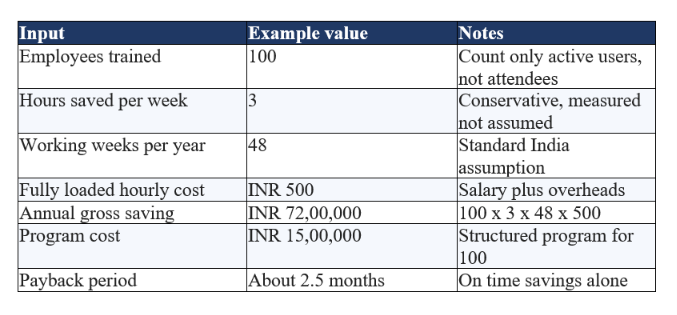
Two honesty checks on that math. First, it only works if you actually measure hours saved rather than assume them, which means taking a baseline before training starts. Second, the number is only real for active users, so a program where half the trained staff never adopt the tools has half the return. Anything claiming payback in under 30 days is being measured optimistically.
For a sense of what compounding automation looks like at the high end, our breakdown of how Amazon's AI automation saves billions is a useful direction of travel, though not a year one target.
Budget the training against the process you expect to speed up. If you cannot name that process, you are not ready to spend yet.
9. How to Budget Without Overspending
The most reliable way to avoid overspending is to buy a pilot before a rollout. Prove the number on one function, then use that internal result to fund the wider program. Here is the sequence I recommend to every buyer.
Start with one high volume, countable function such as sales or support, and run a structured pilot for a single cohort of 25 to 40 people. Expect to spend INR 4 lakh to INR 8 lakh. Measure the time saved against a baseline you took before it started.
If the pilot pays back, scale to adjacent functions using the internal case study to win over sceptical department heads. If it does not, you have risked one cohort's budget instead of the whole company's. This staged approach caps your downside and gives finance a real number to approve the next phase against.
Sales operations is often the fastest function to show payback because the work is repetitive and countable. Our library of 25 ChatGPT sales prompts that close deals is a practical, free head start for that pilot, and understanding what agentic AI can automate helps you spot the highest value processes to target.
Want a pilot scoped and costed for your team? We will design the cohort, set the metric baseline and quote a real number in one working session. Book a free scoping call.
The only comprehensive program designed to take you from basic prompting to building interactive Artifacts, custom integrations, and deploying production-ready code with Claude Code.
Frequently Asked Questions
How much does corporate AI training cost in India?
Corporate AI training in India costs between INR 1,200 and INR 12,000 per employee in 2026. A one day workshop for 100 staff runs INR 1.5 lakh to INR 4 lakh, and a multi week role based program for the same group runs INR 8 lakh to INR 25 lakh. Customisation depth and delivery format drive most of the variation.
What is the cost of AI training per employee?
Per employee cost ranges from INR 1,200 for basic group awareness sessions to INR 50,000 for intensive project based programs. The number drops sharply as cohort size increases, because facilitator time is largely fixed whether you train 30 people or 200.
How much does a one day AI workshop cost?
A one day corporate AI workshop in India typically costs INR 1.5 lakh to INR 4 lakh for up to 100 employees. On site delivery in metros carries a travel premium, while live virtual delivery of the same workshop usually costs less and scales across cities.
Is corporate AI training worth the money?
Yes, when it is measured. A structured program for 100 employees saving three hours per person per week returns roughly INR 72 lakh a year against a cost near INR 15 lakh, paying back in about two to three months. The return is only real for employees who actually adopt the tools, which is why adoption support matters more than headline price.
What factors affect AI training pricing?
Five factors drive price: how customised the content is to your workflows, whether delivery is on site or virtual, facilitator seniority, the hands on ratio, and how much post training support is included. Customisation and support are the two premiums worth paying for, since they are what change behaviour.
How much should a company budget for AI upskilling?
A practical starting budget is INR 4 lakh to INR 8 lakh for a single function pilot of 25 to 40 people, scaling to INR 15 lakh to INR 40 lakh for a company wide program of a few hundred employees. Budget against a named process you expect to speed up, not against headcount alone.
Are there free AI training options for companies?
Yes. Microsoft Learn, Google Cloud Skills Boost, vendor certification tracks, public workshop recordings and open cookbooks are all free. They build baseline literacy well but include no customisation to your workflows and no adoption support, so they work best as a foundation layer beneath paid, tailored training.
How do you calculate AI training ROI?
Multiply hours saved per employee per week by the number of active users, then by 48 working weeks, then by fully loaded hourly cost, and subtract total program cost. Take a baseline before training so the hours saved are measured rather than assumed, and count only active users, not everyone who attended.
Recommended Blogs
● Corporate AI Training in India: 2026 Buyer's Guide
● The 56% AI Skills Salary Gap
● Prompt Engineering Salary 2026
● Automate Work With AI Agents
● Best AI Agents For Productivity
Resources & Community
Join our community of 70,000+ AI enthusiasts and learn to build powerful AI applications! Whether you're a beginner or an experienced developer, Build Fast with AI helps you understand and implement AI in your projects.
● Website: buildfastwithai.com
● LinkedIn: Build Fast with AI
Agentic AI Launchpad 2026
A structured 6-week cohort program that takes you from AI basics to building and deploying real-world agentic AI systems. Includes live sessions, expert mentorship, project reviews, and a builder community network.
Ready to go from learning to building? Join the next cohort: Agentic AI Launchpad 2026
Free AI Resources
Access free tools, workshops, and micro-learning to keep building:
● AI Workshops: Free resources, upcoming events & past recordings
● Unrot: Learn AI in 5 minutes a day (free micro-learning app)
Ready to Budget Your AI Training?
Stop estimating from ranges. Share your team size and functions and we will send a real, costed proposal with clear deliverables and no obligation. Get a custom corporate AI training quote.
Want the strategy behind the spend first? Read the full 2026 corporate AI training buyer's guide or browse our AI applications and use cases hub.
References
● Deloitte: Indian Enterprises Lead At Scale AI Adoption
● Indeed and NASSCOM: Top Skills Employers Prioritise in 2026
● IndiaAI: NASSCOM AI Adoption Index 2.0 Findings