
buildfastwithaibuildfastwithai
AI WorkshopsAll blogsAgentic AI Launchpad
Agentic AI Launchpad
Download Unrot App
Free AI Workshop
Mentorship

Agentic AI Launchpad

Go from user to builder in 6 weeks.

Explore Program
Claude Mastery Course
Share
Back to blogs
Founder
Productivity
Optimization
Tools
AI Business

Corporate AI Training in India: 2026 Buyer's Guide

July 22, 2026
58 min read
Share:
Corporate AI Training in India: 2026 Buyer's Guide
Share:

Corporate AI Training in India: The 2026 Buyer's Guide

62% of Indian firms already use generative AI tools, the highest adoption rate of any major economy surveyed. Almost none of them can tell you what it earned. That gap, between adoption and measurable return, is the single most expensive problem in Indian enterprise AI right now.

I have watched this pattern repeat across dozens of buying conversations. A company buys 500 ChatGPT Enterprise seats, runs a two hour vendor demo, declares the rollout complete, and six months later logs in to find that 40 people use it daily and the rest quietly went back to their old workflow. The software was never the problem. The training was.

This guide is written for the person who has to sign the purchase order: the HR or L&D head, the CTO, the founder, the operations lead. It covers what corporate AI training actually costs in India in 2026, the five delivery formats and who each one suits, an honest review of the provider landscape including where we fit and where we do not, a 12 point scorecard for evaluating vendors, role by role curriculum, and a 90 day plan to measure whether any of it worked.

Buying AI tools is a procurement decision. Getting people to use them is a training decision. Most companies confuse the two.

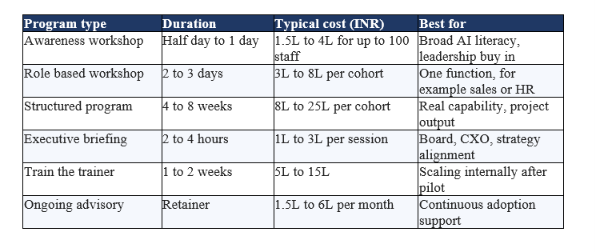
1. What Corporate AI Training Costs in India in 2026

Corporate AI training in India typically runs from INR 1,200 to INR 12,000 per employee, depending on format, depth and whether the content is customised to your workflows. A one day awareness workshop for 100 people usually lands between INR 1.5 lakh and INR 4 lakh total. A multi week, role specific program with hands on projects for the same group typically runs INR 8 lakh to INR 25 lakh.

Those are market ranges observed across Indian enterprise deals, not published rate cards. Almost no serious provider publishes fixed pricing, because cost is driven by cohort size, customisation depth and delivery mode rather than by a per seat list price. Treat any provider quoting a flat number before asking about your workflows with suspicion.
What Corporate AI Training Costs in India in 2026

What actually moves the price

Five variables account for most of the spread. Customisation is the biggest: rebuilding a curriculum around your actual CRM, your actual documents and your actual approval workflows costs materially more than delivering a generic deck, and it is also the only version that changes behaviour. Delivery mode is second, with on site sessions in Mumbai or Bengaluru carrying travel and facilitator premiums that virtual delivery does not.

Cohort size works in your favour, since per head cost typically drops 30% to 50% between a 25 person and a 200 person rollout. Facilitator seniority matters, as practitioners who ship production AI systems command more than trainers who present slides. Finally, post training support, meaning office hours, prompt libraries and adoption tracking, is often quoted separately and is the line item most buyers wrongly cut first.

The cheapest training is the one nobody uses. It costs you the fee plus the salary hours plus the credibility of the next initiative.

Worth understanding before you negotiate: AI skills carry a measurable salary premium in the Indian market, which is exactly why your best people will leave if you do not invest. We broke the numbers down in our analysis of the 56% salary gap between AI skills and degrees.

Want a real number instead of a range? Share your team size and functions and we will send a costed proposal within two working days. Book a free scoping call.

2. The Five Delivery Formats, and Who Each One Is For

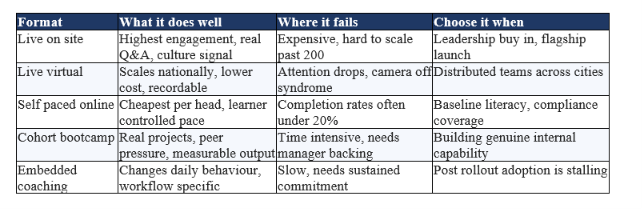
There are five formats worth considering in 2026, and choosing wrong is the most common early mistake. The format should follow the outcome you need, not the budget you have. A company that needs 800 people to stop fearing AI needs something completely different from a company that needs 30 analysts to build working automations.
What actually moves the price
Five variables account for most of the spread. Customisation is the biggest: rebuilding a curriculum around your actual CRM, your actual documents and your actual approval workflows costs materially more than delivering a generic deck, and it is also the only version that changes behaviour. Delivery mode is second, with on site sessions in Mumbai or Bengaluru carrying travel and facilitator premiums that virtual delivery does not.
Cohort size works in your favour, since per head cost typically drops 30% to 50% between a 25 person and a 200 person rollout. Facilitator seniority matters, as practitioners who ship production AI systems command more than trainers who present slides. Finally, post training support, meaning office hours, prompt libraries and adoption tracking, is often quoted separately and is the line item most buyers wrongly cut first.
The cheapest training is the one nobody uses. It costs you the fee plus the salary hours plus the credibility of the next initiative.
Worth understanding before you negotiate: AI skills carry a measurable salary premium in the Indian market, which is exactly why your best people will leave if you do not invest. We broke the numbers down in our analysis of the 56% salary gap between AI skills and degrees.
Want a real number instead of a range? Share your team size and functions and we will send a costed proposal within two working days. Book a free scoping call.
2. The Five Delivery Formats, and Who Each One Is For
There are five formats worth considering in 2026, and choosing wrong is the most common early mistake. The format should follow the outcome you need, not the budget you have. A company that needs 800 people to stop fearing AI needs something completely different from a company that needs 30 analysts to build working automations.
Format	What it does well	Where it fails	Choose it when
Live on site	Highest engagement, real Q&A, culture signal	Expensive, hard to scale past 200	Leadership buy in, flagship launch
Live virtual	Scales nationally, lower cost, recordable	Attention drops, camera off syndrome	Distributed teams across cities
Self paced online	Cheapest per head, learner controlled pace	Completion rates often under 20%	Baseline literacy, compliance coverage
Cohort bootcamp	Real projects, peer pressure, measurable output	Time intensive, needs manager backing	Building genuine internal capability
Embedded coaching	Changes daily behaviour, workflow specific	Slow, needs sustained commitment	Post rollout adoption is stalling

My honest view after seeing all five in the field: self paced online is the format most often bought and least often effective. It looks responsible on a budget line and it satisfies a compliance checkbox, but completion rates in corporate deployments routinely sit under 20%, and completion is not the same as competence. It has a place as a baseline layer underneath live training. It is a poor substitute for one.
The blend that works most reliably is a short live kickoff to create shared context, a cohort based build phase where people produce something real, and then embedded coaching for the teams that will actually operationalise it. That sequence costs more up front and saves considerably more in year one.
3. Provider Landscape: An Honest Review
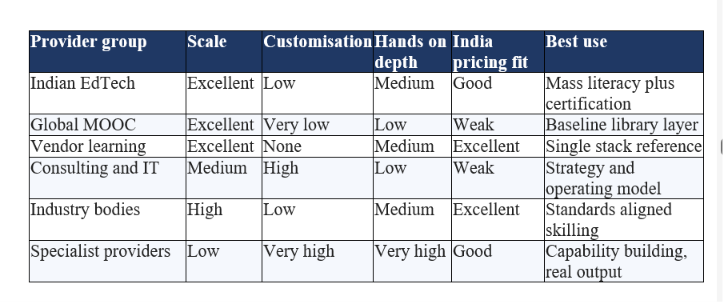
The Indian corporate AI training market splits into five distinct groups, and each is genuinely good at something and genuinely weak at something else. I am going to be direct about the trade offs, including our own, because a buyer's guide that pretends one vendor wins every category is a brochure.
Indian EdTech at scale: Simplilearn, Great Learning, upGrad
Strength: reach, brand recognition with HR teams, structured curricula, certificates that employees value on LinkedIn, and the operational muscle to onboard thousands of learners without breaking. If your primary goal is broad AI literacy across a very large workforce and a credential people can display, this group delivers reliably.
Weakness: the content is built for individual learners and career switchers first, enterprises second. You typically get a strong catalogue rather than a curriculum designed around your workflows, and the hands on component is usually lighter than the marketing suggests. Verdict: strong for scale and credentialing, weaker for behaviour change in a specific function.
Global MOOC platforms: Coursera, Coursera for Business
Strength: outstanding production quality, university and vendor partnerships, enormous catalogue breadth, and a subscription model that is easy to justify to finance. For a globally distributed workforce that needs consistent baseline content, it is hard to beat.
Weakness: almost nothing is India specific, pricing is set globally rather than for Indian budgets, and there is no meaningful customisation to your stack. It is a library, not a program. Verdict: excellent as a supporting layer, insufficient as your primary intervention.
Vendor learning: Microsoft Learn, Google Cloud Skills Boost, IBM SkillsBuild
Strength: authoritative, current, free or near free, and unbeatable if you have already standardised on that vendor's stack. If your organisation runs Microsoft 365 Copilot everywhere, Microsoft Learn is the canonical reference and you should absolutely use it.
Weakness: single vendor by design. None of them will teach your team when Claude beats Copilot for a drafting task, or when an open model running on your own infrastructure is the cheaper answer. Documentation is also not a training funnel, so adoption support is largely absent. Verdict: essential reference material, not a substitute for vendor neutral judgement.
If your teams are choosing between assistants, our complete Claude AI guide for 2026 is a useful vendor neutral starting point for that comparison.
Consulting and IT services: PwC, Deloitte, Accenture, TCS, Infosys
Strength: boardroom credibility, genuine transformation experience, and the ability to connect training to a broader operating model change. When AI training is one workstream inside a large transformation, this group is the natural fit and nobody else can match the strategic framing.
Weakness: cost, speed and abstraction. Engagements are expensive, timelines are long, and the output often skews toward frameworks and readiness assessments rather than employees who can independently build something by Friday. Verdict: right for strategy, frequently overpriced for skills delivery.
Industry bodies: NASSCOM FutureSkills Prime
Strength: credibility with government and industry, alignment to national skilling priorities under the MeitY partnership, and cost effectiveness. For organisations that need recognised, standards aligned skilling, it is a sensible anchor.
Weakness: it is a platform and directory rather than a delivery partner, so customisation to your organisation is limited. Verdict: strong for standards and scale economics, thin on bespoke delivery.
Specialist hands on providers, including us
Strength: depth, currency and customisation. Specialists build the program around your actual tools and ship working outputs rather than certificates. Because they are practitioners, the content reflects what changed last month rather than last year, which matters enormously in a field moving this fast.
Weakness, and I will name ours plainly: specialists cannot match the brand recognition of Simplilearn with a conservative board, cannot match Coursera's catalogue breadth, and are the wrong choice if you need 10,000 people credentialed next quarter at the lowest possible unit cost. We are built for depth over volume. If your requirement is genuinely volume, one of the platforms above will serve you better and I would rather tell you that now.
Provider group	Scale	Customisation	Hands on depth	India pricing fit	Best use
Indian EdTech	Excellent	Low	Medium	Good	Mass literacy plus certification
Global MOOC	Excellent	Very low	Low	Weak	Baseline library layer
Vendor learning	Excellent	None	Medium	Excellent	Single stack reference
Consulting and IT	Medium	High	Low	Weak	Strategy and operating model
Industry bodies	High	Low	Medium	Excellent	Standards aligned skilling
Specialist providers	Low	Very high	Very high	Good	Capability building, real output

Pick the provider whose weakness you can tolerate, not the one whose strength sounds best in a pitch.
4. The 12 Point Provider Scorecard
Score every shortlisted vendor from 1 to 5 on each point below. Anything under 40 out of 60 should not reach contract stage. I have watched this checklist save companies from seven figure mistakes, mostly because it forces vendors to answer questions their sales decks are designed to avoid.
1. Will they rebuild the curriculum around our actual tools and workflows, or adapt a standard deck?
2. Who exactly facilitates, and have they shipped production AI systems themselves?
3. Can they show a named client in our industry, at our scale, with a contactable reference?
4. What is the hands on ratio, meaning minutes building versus minutes listening?
5. What tangible artefact does each participant leave with, such as a working automation or prompt library?
6. How do they handle our data privacy and DPDP Act obligations during training?
7. Are they vendor neutral, or contractually incentivised to recommend one platform?
8. What post training support is included, and for how long, at no extra cost?
9. How do they measure success, and will they contract to those metrics?
10. How current is the content, and when was it last materially revised?
11. Can they deliver in the languages and cities our workforce actually needs?
12. What happens if adoption stalls at week six, and who pays for the remediation?

Point six deserves emphasis. Under India's Digital Personal Data Protection Act, 2023, any training exercise where employees paste customer records into a public AI tool creates a real compliance exposure. A serious provider raises this before you do. If a vendor has no answer, that tells you how they will handle your data when the contract is signed.
Use this scorecard on us too. We will answer all twelve in writing before you commit to anything. Request a corporate AI training proposal.
5. What Each Team Actually Needs to Learn
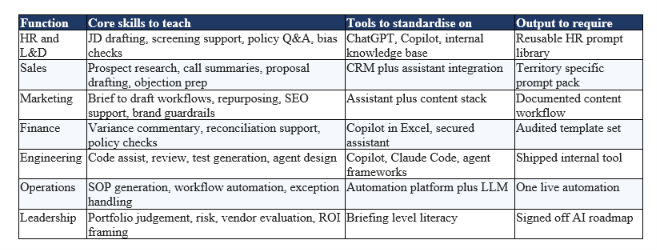
Generic AI training fails because a finance controller and a field sales rep need almost nothing in common beyond a 45 minute foundation. The most reliable structure is a short shared base layer, then sharply divergent role tracks. Deloitte research shows Indian enterprises deploying AI most heavily in product development at 62%, strategy and operations at 56%, and marketing and sales at 55%, which is a reasonable guide to where to start.
Function	Core skills to teach	Tools to standardise on	Output to require
HR and L&D	JD drafting, screening support, policy Q&A, bias checks	ChatGPT, Copilot, internal knowledge base	Reusable HR prompt library
Sales	Prospect research, call summaries, proposal drafting, objection prep	CRM plus assistant integration	Territory specific prompt pack
Marketing	Brief to draft workflows, repurposing, SEO support, brand guardrails	Assistant plus content stack	Documented content workflow
Finance	Variance commentary, reconciliation support, policy checks	Copilot in Excel, secured assistant	Audited template set
Engineering	Code assist, review, test generation, agent design	Copilot, Claude Code, agent frameworks	Shipped internal tool
Operations	SOP generation, workflow automation, exception handling	Automation platform plus LLM	One live automation
Leadership	Portfolio judgement, risk, vendor evaluation, ROI framing	Briefing level literacy	Signed off AI roadmap

Sales teams are usually the fastest to show measurable return, because the workflows are repetitive and the outcome is countable. Our library of 25 ChatGPT sales prompts that close deals is a practical starting point for that track.
For operations and engineering, the ceiling is far higher than assistants. Once a team understands what agentic AI actually is, the conversation shifts from saving minutes on drafting to removing entire manual handoffs.
A caveat I give every client: do not put engineers and non technical staff in the same room for anything beyond the foundation session. The engineers get bored, the non technical staff get intimidated, and both groups disengage. Splitting the cohorts costs slightly more and roughly doubles completion.
Teams that want to build rather than just prompt can work through our open generative AI experiments cookbook, which walks through agent and RAG implementations end to end.
6. How to Measure ROI in 90 Days
Measure ROI on time saved, quality lifted and cycle time reduced, captured as a baseline before training and again at day 90. The single biggest reason companies cannot prove AI training worked is that nobody recorded what things looked like beforehand. Take the baseline in week zero or accept that you will be arguing from anecdote forever.
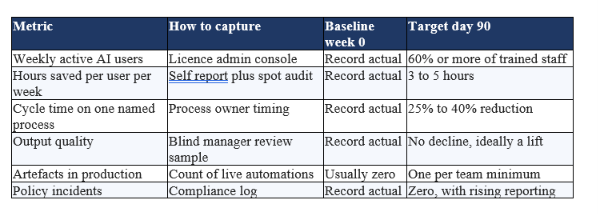
Metric	How to capture	Baseline week 0	Target day 90
Weekly active AI users	Licence admin console	Record actual	60% or more of trained staff
Hours saved per user per week	Self report plus spot audit	Record actual	3 to 5 hours
Cycle time on one named process	Process owner timing	Record actual	25% to 40% reduction
Output quality	Blind manager review sample	Record actual	No decline, ideally a lift
Artefacts in production	Count of live automations	Usually zero	One per team minimum
Policy incidents	Compliance log	Record actual	Zero, with rising reporting

A workable formula: multiply hours saved per week by the number of active users, then by 48 working weeks, then by fully loaded hourly cost, and subtract total program cost including salary hours consumed by the training itself. Most credible programs pay back within four to seven months on time savings alone. Anything claiming payback in under 30 days is being measured optimistically.
If you cannot name the process you expect to get faster, you are not ready to buy training yet.
For a sense of what compounding automation looks like at the top end, our breakdown of how Amazon's AI automation saves billions is a useful reference point, though I would treat it as a direction of travel rather than a year one target.
7. Why Most Corporate AI Training Fails
Most corporate AI training fails for organisational reasons, not educational ones. The content is rarely the problem. Here are the six failure modes I see repeatedly, in rough order of how much damage they cause.
It was a single event, not a program
A one off workshop produces a spike of enthusiasm that decays within about three weeks. Without reinforcement, office hours or a manager who asks about it in the next one to one, people revert. Budget for the follow through or expect to repeat the workshop annually with the same people.
Managers were not trained first
If a team lead cannot use the tool, they will not ask their team to use it, and they will quietly treat time spent on AI as time stolen from real work. Train the management layer one cycle ahead of their teams. Sequencing it that way is the highest impact decision available to you, and it costs nothing extra.
No policy, so nobody felt safe
In the absence of a clear written policy on what data may be entered into which tool, cautious employees do nothing and incautious employees create the exposure. Publish the policy before the training, not after the incident.
Tool access lagged the training
Teaching people a tool they cannot access for another six weeks wastes most of the learning. Licences should be live on day one of training. This sounds obvious and it is violated constantly, usually because procurement and L&D are running on different calendars.
Success was never defined
Programs bought as headcount coverage, meaning 500 people trained, get measured as attendance rather than capability. Attendance is not an outcome. Define the process you expect to improve before you sign.
The content was generic
Here is my most contrarian position in this guide: a mediocre trainer working with your real documents and your real CRM will outperform a brilliant trainer working with generic examples, almost every time. Relevance beats polish. When you evaluate providers, weight customisation far more heavily than production quality, because polish is what sells and relevance is what works.
8. Compliance and Governance Under the DPDP Act
Any AI training program run in India in 2026 must account for the Digital Personal Data Protection Act, 2023, which governs how personal data is processed and places obligations on organisations acting as data fiduciaries. Training is where exposure most often begins, because that is the moment employees first paste real records into an unfamiliar tool.
Three practical safeguards belong in every program. First, use synthetic or anonymised data in all exercises, never live customer records, and make that rule explicit in the joining instructions rather than assuming it. Second, teach the distinction between enterprise tiers with contractual data protections and consumer tiers that may use inputs for model improvement, because most employees do not know this difference exists. Third, publish a one page acceptable use policy naming approved tools, prohibited data categories and the escalation path.
Sector specifics matter too. Financial services teams carry additional obligations under RBI guidance, and healthcare organisations handle categories of data that warrant stricter controls than a general policy provides. Ask any prospective vendor how they have handled a regulated client before, and treat a vague answer as disqualifying.
For organisations with data residency constraints or multilingual requirements, Indian open models are increasingly viable. Our review of Sarvam 105B and Indian language LLMs covers where that option now stands.
The compliance conversation is not a delay to the training. It is the thing that makes the training safe to act on.
9. A 90 Day Rollout Plan
Run the program in four phases. This sequence assumes a mid sized organisation of roughly 200 to 1,000 employees and compresses or extends proportionally.
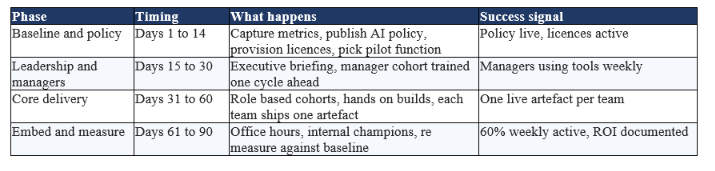
Phase	Timing	What happens	Success signal
Baseline and policy	Days 1 to 14	Capture metrics, publish AI policy, provision licences, pick pilot function	Policy live, licences active
Leadership and managers	Days 15 to 30	Executive briefing, manager cohort trained one cycle ahead	Managers using tools weekly
Core delivery	Days 31 to 60	Role based cohorts, hands on builds, each team ships one artefact	One live artefact per team
Embed and measure	Days 61 to 90	Office hours, internal champions, re measure against baseline	60% weekly active, ROI documented

Start with one function rather than the whole organisation. Pick the team with the most repetitive, countable workflow, usually sales operations or customer support, prove the number, then use that internal result to fund and sell the wider rollout. An internal case study from your own company persuades sceptical department heads in a way no vendor deck ever will.
Teams looking to build their first working automation during phase three can start from our guide to automating work with no code AI agents, which is deliberately accessible to non engineers.
Want this 90 day plan mapped to your organisation? We will build the phase plan, metric baseline and cohort structure with your team in a single working session. Book a free scoping call.
Frequently Asked Questions
How much does corporate AI training cost in India?
Corporate AI training in India typically costs between INR 1,200 and INR 12,000 per employee. A one day workshop for 100 staff generally runs INR 1.5 lakh to INR 4 lakh, while a multi week role based program for the same group runs INR 8 lakh to INR 25 lakh. Customisation depth and delivery mode drive most of the variation.
What is corporate AI training?
Corporate AI training is structured, organisation wide upskilling that teaches employees to apply AI tools to their specific job functions, rather than teaching AI theory. Effective programs combine a short shared foundation with role specific tracks for functions like HR, sales, finance and engineering, and require each participant to produce a working artefact.
How long should an AI training program for employees be?
Plan for 90 days end to end, even though live instruction is usually 2 to 15 days within that window. The instruction is the smaller part. Baseline measurement, policy publication, manager enablement and post training reinforcement occupy the rest, and skipping them is the most common cause of failed rollouts.
Do employees need coding skills for AI training?
No. Roughly 80% of business value from AI in a typical enterprise comes from non technical use such as drafting, summarising, research and workflow automation, none of which require code. Engineering teams need a separate, deeper technical track, which is why mixed cohorts beyond the foundation session tend to fail.
How do you measure the ROI of AI training?
Capture a baseline in week zero across weekly active users, hours saved per user, cycle time on one named process and output quality, then re measure at day 90. Multiply hours saved by active users by 48 weeks by fully loaded hourly cost, then subtract total program cost. Credible programs usually pay back in four to seven months.
Is AI certification worth it for employees?
Certification helps with employee motivation and retention signalling, but it correlates weakly with actual capability. A certificate proves attendance and assessment completion, not that someone can rebuild a workflow. Prioritise programs that require a working artefact, and treat the certificate as a useful secondary benefit rather than the goal.
Which company is best for AI training in India?
There is no single best provider, because the groups optimise for different things. Indian EdTech platforms lead on scale and credentialing, vendor academies lead on single stack depth, consulting firms lead on strategy, and specialist providers lead on customisation and hands on output. Score shortlisted vendors against the 12 point checklist in section four rather than on brand.
What should HR teams learn about AI first?
HR teams should start with job description drafting, candidate screening support, policy question answering and bias checking, in that order, because those four cover the highest volume repetitive work in most HR functions. Pair the training with clear DPDP Act guidance, since HR handles some of the most sensitive personal data in the organisation.
Recommended Blogs
●	What Is Agentic AI
●	Agentic AI vs Generative AI
●	AI Jobs India Salary 2026
●	Prompt Engineering Salary 2026
●	Best ChatGPT Prompts 2026
●	Automate Work With AI Agents
●	Best AI Agents For Productivity
Resources & Community
Join our community of 70,000+ AI enthusiasts and learn to build powerful AI applications! Whether you're a beginner or an experienced developer, Build Fast with AI helps you understand and implement AI in your projects.
●	Website: buildfastwithai.com
●	LinkedIn: Build Fast with AI
●	Instagram: @buildfastwithai
●	Founder Twitter: @satvikps
●	Twitter: @BuildFastWithAI
Agentic AI Launchpad 2026
A structured 6-week cohort program that takes you from AI basics to building and deploying real-world agentic AI systems. Includes live sessions, expert mentorship, project reviews, and a builder community network.
Ready to go from learning to building? Join the next cohort: Agentic AI Launchpad 2026
Free AI Resources
Access free tools, workshops, and micro-learning to keep building:
●	AI Workshops: Free resources, upcoming events & past recordings
●	Unrot: Learn AI in 5 minutes a day (free micro-learning app)
Ready to Train Your Team?
If you are evaluating corporate AI training for 2026, we will scope the program, baseline the metrics and quote a real number, with no obligation. Book a free scoping call with Build Fast with AI.
Prefer to explore first? Browse our AI applications and use cases hub for practical enterprise examples, or subscribe for weekly enterprise AI breakdowns.
References
●	NASSCOM: AI Adoption Index
●	NASSCOM: AI Enterprise Adoption Index 2.0
●	Deloitte: Indian Enterprises Lead At Scale AI Adoption
●	IndiaAI: NASSCOM AI Adoption Index 2.0 Findings
●	Indeed and NASSCOM: Top Skills Employers Prioritise in 2026
●	MeitY: Digital Personal Data Protection Act 2023
●	IndiaAI Mission: Official Portal
NASSCOM FutureSkills Prime

My honest view after seeing all five in the field: self paced online is the format most often bought and least often effective. It looks responsible on a budget line and it satisfies a compliance checkbox, but completion rates in corporate deployments routinely sit under 20%, and completion is not the same as competence. It has a place as a baseline layer underneath live training. It is a poor substitute for one.

The blend that works most reliably is a short live kickoff to create shared context, a cohort based build phase where people produce something real, and then embedded coaching for the teams that will actually operationalise it. That sequence costs more up front and saves considerably more in year one.

3. Provider Landscape: An Honest Review

The Indian corporate AI training market splits into five distinct groups, and each is genuinely good at something and genuinely weak at something else. I am going to be direct about the trade offs, including our own, because a buyer's guide that pretends one vendor wins every category is a brochure.

Indian EdTech at scale: Simplilearn, Great Learning, upGrad

Strength: reach, brand recognition with HR teams, structured curricula, certificates that employees value on LinkedIn, and the operational muscle to onboard thousands of learners without breaking. If your primary goal is broad AI literacy across a very large workforce and a credential people can display, this group delivers reliably.

Weakness: the content is built for individual learners and career switchers first, enterprises second. You typically get a strong catalogue rather than a curriculum designed around your workflows, and the hands on component is usually lighter than the marketing suggests. Verdict: strong for scale and credentialing, weaker for behaviour change in a specific function.

Global MOOC platforms: Coursera, Coursera for Business

Strength: outstanding production quality, university and vendor partnerships, enormous catalogue breadth, and a subscription model that is easy to justify to finance. For a globally distributed workforce that needs consistent baseline content, it is hard to beat.

Weakness: almost nothing is India specific, pricing is set globally rather than for Indian budgets, and there is no meaningful customisation to your stack. It is a library, not a program. Verdict: excellent as a supporting layer, insufficient as your primary intervention.

Vendor learning: Microsoft Learn, Google Cloud Skills Boost, IBM SkillsBuild

Strength: authoritative, current, free or near free, and unbeatable if you have already standardised on that vendor's stack. If your organisation runs Microsoft 365 Copilot everywhere, Microsoft Learn is the canonical reference and you should absolutely use it.

Weakness: single vendor by design. None of them will teach your team when Claude beats Copilot for a drafting task, or when an open model running on your own infrastructure is the cheaper answer. Documentation is also not a training funnel, so adoption support is largely absent. Verdict: essential reference material, not a substitute for vendor neutral judgement.

If your teams are choosing between assistants, our complete Claude AI guide for 2026 is a useful vendor neutral starting point for that comparison.

Consulting and IT services: PwC, Deloitte, Accenture, TCS, Infosys

Strength: boardroom credibility, genuine transformation experience, and the ability to connect training to a broader operating model change. When AI training is one workstream inside a large transformation, this group is the natural fit and nobody else can match the strategic framing.

Weakness: cost, speed and abstraction. Engagements are expensive, timelines are long, and the output often skews toward frameworks and readiness assessments rather than employees who can independently build something by Friday. Verdict: right for strategy, frequently overpriced for skills delivery.

Industry bodies: NASSCOM FutureSkills Prime

Strength: credibility with government and industry, alignment to national skilling priorities under the MeitY partnership, and cost effectiveness. For organisations that need recognised, standards aligned skilling, it is a sensible anchor.

Weakness: it is a platform and directory rather than a delivery partner, so customisation to your organisation is limited. Verdict: strong for standards and scale economics, thin on bespoke delivery.

Specialist hands on providers, including us

Strength: depth, currency and customisation. Specialists build the program around your actual tools and ship working outputs rather than certificates. Because they are practitioners, the content reflects what changed last month rather than last year, which matters enormously in a field moving this fast.

Weakness, and I will name ours plainly: specialists cannot match the brand recognition of Simplilearn with a conservative board, cannot match Coursera's catalogue breadth, and are the wrong choice if you need 10,000 people credentialed next quarter at the lowest possible unit cost. We are built for depth over volume. If your requirement is genuinely volume, one of the platforms above will serve you better and I would rather tell you that now.

What actually moves the price
Five variables account for most of the spread. Customisation is the biggest: rebuilding a curriculum around your actual CRM, your actual documents and your actual approval workflows costs materially more than delivering a generic deck, and it is also the only version that changes behaviour. Delivery mode is second, with on site sessions in Mumbai or Bengaluru carrying travel and facilitator premiums that virtual delivery does not.
Cohort size works in your favour, since per head cost typically drops 30% to 50% between a 25 person and a 200 person rollout. Facilitator seniority matters, as practitioners who ship production AI systems command more than trainers who present slides. Finally, post training support, meaning office hours, prompt libraries and adoption tracking, is often quoted separately and is the line item most buyers wrongly cut first.
The cheapest training is the one nobody uses. It costs you the fee plus the salary hours plus the credibility of the next initiative.
Worth understanding before you negotiate: AI skills carry a measurable salary premium in the Indian market, which is exactly why your best people will leave if you do not invest. We broke the numbers down in our analysis of the 56% salary gap between AI skills and degrees.
Want a real number instead of a range? Share your team size and functions and we will send a costed proposal within two working days. Book a free scoping call.
2. The Five Delivery Formats, and Who Each One Is For
There are five formats worth considering in 2026, and choosing wrong is the most common early mistake. The format should follow the outcome you need, not the budget you have. A company that needs 800 people to stop fearing AI needs something completely different from a company that needs 30 analysts to build working automations.
Format	What it does well	Where it fails	Choose it when
Live on site	Highest engagement, real Q&A, culture signal	Expensive, hard to scale past 200	Leadership buy in, flagship launch
Live virtual	Scales nationally, lower cost, recordable	Attention drops, camera off syndrome	Distributed teams across cities
Self paced online	Cheapest per head, learner controlled pace	Completion rates often under 20%	Baseline literacy, compliance coverage
Cohort bootcamp	Real projects, peer pressure, measurable output	Time intensive, needs manager backing	Building genuine internal capability
Embedded coaching	Changes daily behaviour, workflow specific	Slow, needs sustained commitment	Post rollout adoption is stalling

My honest view after seeing all five in the field: self paced online is the format most often bought and least often effective. It looks responsible on a budget line and it satisfies a compliance checkbox, but completion rates in corporate deployments routinely sit under 20%, and completion is not the same as competence. It has a place as a baseline layer underneath live training. It is a poor substitute for one.
The blend that works most reliably is a short live kickoff to create shared context, a cohort based build phase where people produce something real, and then embedded coaching for the teams that will actually operationalise it. That sequence costs more up front and saves considerably more in year one.
3. Provider Landscape: An Honest Review
The Indian corporate AI training market splits into five distinct groups, and each is genuinely good at something and genuinely weak at something else. I am going to be direct about the trade offs, including our own, because a buyer's guide that pretends one vendor wins every category is a brochure.
Indian EdTech at scale: Simplilearn, Great Learning, upGrad
Strength: reach, brand recognition with HR teams, structured curricula, certificates that employees value on LinkedIn, and the operational muscle to onboard thousands of learners without breaking. If your primary goal is broad AI literacy across a very large workforce and a credential people can display, this group delivers reliably.
Weakness: the content is built for individual learners and career switchers first, enterprises second. You typically get a strong catalogue rather than a curriculum designed around your workflows, and the hands on component is usually lighter than the marketing suggests. Verdict: strong for scale and credentialing, weaker for behaviour change in a specific function.
Global MOOC platforms: Coursera, Coursera for Business
Strength: outstanding production quality, university and vendor partnerships, enormous catalogue breadth, and a subscription model that is easy to justify to finance. For a globally distributed workforce that needs consistent baseline content, it is hard to beat.
Weakness: almost nothing is India specific, pricing is set globally rather than for Indian budgets, and there is no meaningful customisation to your stack. It is a library, not a program. Verdict: excellent as a supporting layer, insufficient as your primary intervention.
Vendor learning: Microsoft Learn, Google Cloud Skills Boost, IBM SkillsBuild
Strength: authoritative, current, free or near free, and unbeatable if you have already standardised on that vendor's stack. If your organisation runs Microsoft 365 Copilot everywhere, Microsoft Learn is the canonical reference and you should absolutely use it.
Weakness: single vendor by design. None of them will teach your team when Claude beats Copilot for a drafting task, or when an open model running on your own infrastructure is the cheaper answer. Documentation is also not a training funnel, so adoption support is largely absent. Verdict: essential reference material, not a substitute for vendor neutral judgement.
If your teams are choosing between assistants, our complete Claude AI guide for 2026 is a useful vendor neutral starting point for that comparison.
Consulting and IT services: PwC, Deloitte, Accenture, TCS, Infosys
Strength: boardroom credibility, genuine transformation experience, and the ability to connect training to a broader operating model change. When AI training is one workstream inside a large transformation, this group is the natural fit and nobody else can match the strategic framing.
Weakness: cost, speed and abstraction. Engagements are expensive, timelines are long, and the output often skews toward frameworks and readiness assessments rather than employees who can independently build something by Friday. Verdict: right for strategy, frequently overpriced for skills delivery.
Industry bodies: NASSCOM FutureSkills Prime
Strength: credibility with government and industry, alignment to national skilling priorities under the MeitY partnership, and cost effectiveness. For organisations that need recognised, standards aligned skilling, it is a sensible anchor.
Weakness: it is a platform and directory rather than a delivery partner, so customisation to your organisation is limited. Verdict: strong for standards and scale economics, thin on bespoke delivery.
Specialist hands on providers, including us
Strength: depth, currency and customisation. Specialists build the program around your actual tools and ship working outputs rather than certificates. Because they are practitioners, the content reflects what changed last month rather than last year, which matters enormously in a field moving this fast.
Weakness, and I will name ours plainly: specialists cannot match the brand recognition of Simplilearn with a conservative board, cannot match Coursera's catalogue breadth, and are the wrong choice if you need 10,000 people credentialed next quarter at the lowest possible unit cost. We are built for depth over volume. If your requirement is genuinely volume, one of the platforms above will serve you better and I would rather tell you that now.
Provider group	Scale	Customisation	Hands on depth	India pricing fit	Best use
Indian EdTech	Excellent	Low	Medium	Good	Mass literacy plus certification
Global MOOC	Excellent	Very low	Low	Weak	Baseline library layer
Vendor learning	Excellent	None	Medium	Excellent	Single stack reference
Consulting and IT	Medium	High	Low	Weak	Strategy and operating model
Industry bodies	High	Low	Medium	Excellent	Standards aligned skilling
Specialist providers	Low	Very high	Very high	Good	Capability building, real output

Pick the provider whose weakness you can tolerate, not the one whose strength sounds best in a pitch.
4. The 12 Point Provider Scorecard
Score every shortlisted vendor from 1 to 5 on each point below. Anything under 40 out of 60 should not reach contract stage. I have watched this checklist save companies from seven figure mistakes, mostly because it forces vendors to answer questions their sales decks are designed to avoid.
1. Will they rebuild the curriculum around our actual tools and workflows, or adapt a standard deck?
2. Who exactly facilitates, and have they shipped production AI systems themselves?
3. Can they show a named client in our industry, at our scale, with a contactable reference?
4. What is the hands on ratio, meaning minutes building versus minutes listening?
5. What tangible artefact does each participant leave with, such as a working automation or prompt library?
6. How do they handle our data privacy and DPDP Act obligations during training?
7. Are they vendor neutral, or contractually incentivised to recommend one platform?
8. What post training support is included, and for how long, at no extra cost?
9. How do they measure success, and will they contract to those metrics?
10. How current is the content, and when was it last materially revised?
11. Can they deliver in the languages and cities our workforce actually needs?
12. What happens if adoption stalls at week six, and who pays for the remediation?

Point six deserves emphasis. Under India's Digital Personal Data Protection Act, 2023, any training exercise where employees paste customer records into a public AI tool creates a real compliance exposure. A serious provider raises this before you do. If a vendor has no answer, that tells you how they will handle your data when the contract is signed.
Use this scorecard on us too. We will answer all twelve in writing before you commit to anything. Request a corporate AI training proposal.
5. What Each Team Actually Needs to Learn
Generic AI training fails because a finance controller and a field sales rep need almost nothing in common beyond a 45 minute foundation. The most reliable structure is a short shared base layer, then sharply divergent role tracks. Deloitte research shows Indian enterprises deploying AI most heavily in product development at 62%, strategy and operations at 56%, and marketing and sales at 55%, which is a reasonable guide to where to start.
Function	Core skills to teach	Tools to standardise on	Output to require
HR and L&D	JD drafting, screening support, policy Q&A, bias checks	ChatGPT, Copilot, internal knowledge base	Reusable HR prompt library
Sales	Prospect research, call summaries, proposal drafting, objection prep	CRM plus assistant integration	Territory specific prompt pack
Marketing	Brief to draft workflows, repurposing, SEO support, brand guardrails	Assistant plus content stack	Documented content workflow
Finance	Variance commentary, reconciliation support, policy checks	Copilot in Excel, secured assistant	Audited template set
Engineering	Code assist, review, test generation, agent design	Copilot, Claude Code, agent frameworks	Shipped internal tool
Operations	SOP generation, workflow automation, exception handling	Automation platform plus LLM	One live automation
Leadership	Portfolio judgement, risk, vendor evaluation, ROI framing	Briefing level literacy	Signed off AI roadmap

Sales teams are usually the fastest to show measurable return, because the workflows are repetitive and the outcome is countable. Our library of 25 ChatGPT sales prompts that close deals is a practical starting point for that track.
For operations and engineering, the ceiling is far higher than assistants. Once a team understands what agentic AI actually is, the conversation shifts from saving minutes on drafting to removing entire manual handoffs.
A caveat I give every client: do not put engineers and non technical staff in the same room for anything beyond the foundation session. The engineers get bored, the non technical staff get intimidated, and both groups disengage. Splitting the cohorts costs slightly more and roughly doubles completion.
Teams that want to build rather than just prompt can work through our open generative AI experiments cookbook, which walks through agent and RAG implementations end to end.
6. How to Measure ROI in 90 Days
Measure ROI on time saved, quality lifted and cycle time reduced, captured as a baseline before training and again at day 90. The single biggest reason companies cannot prove AI training worked is that nobody recorded what things looked like beforehand. Take the baseline in week zero or accept that you will be arguing from anecdote forever.
Metric	How to capture	Baseline week 0	Target day 90
Weekly active AI users	Licence admin console	Record actual	60% or more of trained staff
Hours saved per user per week	Self report plus spot audit	Record actual	3 to 5 hours
Cycle time on one named process	Process owner timing	Record actual	25% to 40% reduction
Output quality	Blind manager review sample	Record actual	No decline, ideally a lift
Artefacts in production	Count of live automations	Usually zero	One per team minimum
Policy incidents	Compliance log	Record actual	Zero, with rising reporting

A workable formula: multiply hours saved per week by the number of active users, then by 48 working weeks, then by fully loaded hourly cost, and subtract total program cost including salary hours consumed by the training itself. Most credible programs pay back within four to seven months on time savings alone. Anything claiming payback in under 30 days is being measured optimistically.
If you cannot name the process you expect to get faster, you are not ready to buy training yet.
For a sense of what compounding automation looks like at the top end, our breakdown of how Amazon's AI automation saves billions is a useful reference point, though I would treat it as a direction of travel rather than a year one target.
7. Why Most Corporate AI Training Fails
Most corporate AI training fails for organisational reasons, not educational ones. The content is rarely the problem. Here are the six failure modes I see repeatedly, in rough order of how much damage they cause.
It was a single event, not a program
A one off workshop produces a spike of enthusiasm that decays within about three weeks. Without reinforcement, office hours or a manager who asks about it in the next one to one, people revert. Budget for the follow through or expect to repeat the workshop annually with the same people.
Managers were not trained first
If a team lead cannot use the tool, they will not ask their team to use it, and they will quietly treat time spent on AI as time stolen from real work. Train the management layer one cycle ahead of their teams. Sequencing it that way is the highest impact decision available to you, and it costs nothing extra.
No policy, so nobody felt safe
In the absence of a clear written policy on what data may be entered into which tool, cautious employees do nothing and incautious employees create the exposure. Publish the policy before the training, not after the incident.
Tool access lagged the training
Teaching people a tool they cannot access for another six weeks wastes most of the learning. Licences should be live on day one of training. This sounds obvious and it is violated constantly, usually because procurement and L&D are running on different calendars.
Success was never defined
Programs bought as headcount coverage, meaning 500 people trained, get measured as attendance rather than capability. Attendance is not an outcome. Define the process you expect to improve before you sign.
The content was generic
Here is my most contrarian position in this guide: a mediocre trainer working with your real documents and your real CRM will outperform a brilliant trainer working with generic examples, almost every time. Relevance beats polish. When you evaluate providers, weight customisation far more heavily than production quality, because polish is what sells and relevance is what works.
8. Compliance and Governance Under the DPDP Act
Any AI training program run in India in 2026 must account for the Digital Personal Data Protection Act, 2023, which governs how personal data is processed and places obligations on organisations acting as data fiduciaries. Training is where exposure most often begins, because that is the moment employees first paste real records into an unfamiliar tool.
Three practical safeguards belong in every program. First, use synthetic or anonymised data in all exercises, never live customer records, and make that rule explicit in the joining instructions rather than assuming it. Second, teach the distinction between enterprise tiers with contractual data protections and consumer tiers that may use inputs for model improvement, because most employees do not know this difference exists. Third, publish a one page acceptable use policy naming approved tools, prohibited data categories and the escalation path.
Sector specifics matter too. Financial services teams carry additional obligations under RBI guidance, and healthcare organisations handle categories of data that warrant stricter controls than a general policy provides. Ask any prospective vendor how they have handled a regulated client before, and treat a vague answer as disqualifying.
For organisations with data residency constraints or multilingual requirements, Indian open models are increasingly viable. Our review of Sarvam 105B and Indian language LLMs covers where that option now stands.
The compliance conversation is not a delay to the training. It is the thing that makes the training safe to act on.
9. A 90 Day Rollout Plan
Run the program in four phases. This sequence assumes a mid sized organisation of roughly 200 to 1,000 employees and compresses or extends proportionally.
Phase	Timing	What happens	Success signal
Baseline and policy	Days 1 to 14	Capture metrics, publish AI policy, provision licences, pick pilot function	Policy live, licences active
Leadership and managers	Days 15 to 30	Executive briefing, manager cohort trained one cycle ahead	Managers using tools weekly
Core delivery	Days 31 to 60	Role based cohorts, hands on builds, each team ships one artefact	One live artefact per team
Embed and measure	Days 61 to 90	Office hours, internal champions, re measure against baseline	60% weekly active, ROI documented

Start with one function rather than the whole organisation. Pick the team with the most repetitive, countable workflow, usually sales operations or customer support, prove the number, then use that internal result to fund and sell the wider rollout. An internal case study from your own company persuades sceptical department heads in a way no vendor deck ever will.
Teams looking to build their first working automation during phase three can start from our guide to automating work with no code AI agents, which is deliberately accessible to non engineers.
Want this 90 day plan mapped to your organisation? We will build the phase plan, metric baseline and cohort structure with your team in a single working session. Book a free scoping call.
Frequently Asked Questions
How much does corporate AI training cost in India?
Corporate AI training in India typically costs between INR 1,200 and INR 12,000 per employee. A one day workshop for 100 staff generally runs INR 1.5 lakh to INR 4 lakh, while a multi week role based program for the same group runs INR 8 lakh to INR 25 lakh. Customisation depth and delivery mode drive most of the variation.
What is corporate AI training?
Corporate AI training is structured, organisation wide upskilling that teaches employees to apply AI tools to their specific job functions, rather than teaching AI theory. Effective programs combine a short shared foundation with role specific tracks for functions like HR, sales, finance and engineering, and require each participant to produce a working artefact.
How long should an AI training program for employees be?
Plan for 90 days end to end, even though live instruction is usually 2 to 15 days within that window. The instruction is the smaller part. Baseline measurement, policy publication, manager enablement and post training reinforcement occupy the rest, and skipping them is the most common cause of failed rollouts.
Do employees need coding skills for AI training?
No. Roughly 80% of business value from AI in a typical enterprise comes from non technical use such as drafting, summarising, research and workflow automation, none of which require code. Engineering teams need a separate, deeper technical track, which is why mixed cohorts beyond the foundation session tend to fail.
How do you measure the ROI of AI training?
Capture a baseline in week zero across weekly active users, hours saved per user, cycle time on one named process and output quality, then re measure at day 90. Multiply hours saved by active users by 48 weeks by fully loaded hourly cost, then subtract total program cost. Credible programs usually pay back in four to seven months.
Is AI certification worth it for employees?
Certification helps with employee motivation and retention signalling, but it correlates weakly with actual capability. A certificate proves attendance and assessment completion, not that someone can rebuild a workflow. Prioritise programs that require a working artefact, and treat the certificate as a useful secondary benefit rather than the goal.
Which company is best for AI training in India?
There is no single best provider, because the groups optimise for different things. Indian EdTech platforms lead on scale and credentialing, vendor academies lead on single stack depth, consulting firms lead on strategy, and specialist providers lead on customisation and hands on output. Score shortlisted vendors against the 12 point checklist in section four rather than on brand.
What should HR teams learn about AI first?
HR teams should start with job description drafting, candidate screening support, policy question answering and bias checking, in that order, because those four cover the highest volume repetitive work in most HR functions. Pair the training with clear DPDP Act guidance, since HR handles some of the most sensitive personal data in the organisation.
Recommended Blogs
●	What Is Agentic AI
●	Agentic AI vs Generative AI
●	AI Jobs India Salary 2026
●	Prompt Engineering Salary 2026
●	Best ChatGPT Prompts 2026
●	Automate Work With AI Agents
●	Best AI Agents For Productivity
Resources & Community
Join our community of 70,000+ AI enthusiasts and learn to build powerful AI applications! Whether you're a beginner or an experienced developer, Build Fast with AI helps you understand and implement AI in your projects.
●	Website: buildfastwithai.com
●	LinkedIn: Build Fast with AI
●	Instagram: @buildfastwithai
●	Founder Twitter: @satvikps
●	Twitter: @BuildFastWithAI
Agentic AI Launchpad 2026
A structured 6-week cohort program that takes you from AI basics to building and deploying real-world agentic AI systems. Includes live sessions, expert mentorship, project reviews, and a builder community network.
Ready to go from learning to building? Join the next cohort: Agentic AI Launchpad 2026
Free AI Resources
Access free tools, workshops, and micro-learning to keep building:
●	AI Workshops: Free resources, upcoming events & past recordings
●	Unrot: Learn AI in 5 minutes a day (free micro-learning app)
Ready to Train Your Team?
If you are evaluating corporate AI training for 2026, we will scope the program, baseline the metrics and quote a real number, with no obligation. Book a free scoping call with Build Fast with AI.
Prefer to explore first? Browse our AI applications and use cases hub for practical enterprise examples, or subscribe for weekly enterprise AI breakdowns.
References
●	NASSCOM: AI Adoption Index
●	NASSCOM: AI Enterprise Adoption Index 2.0
●	Deloitte: Indian Enterprises Lead At Scale AI Adoption
●	IndiaAI: NASSCOM AI Adoption Index 2.0 Findings
●	Indeed and NASSCOM: Top Skills Employers Prioritise in 2026
●	MeitY: Digital Personal Data Protection Act 2023
●	IndiaAI Mission: Official Portal
NASSCOM FutureSkills Prime

Pick the provider whose weakness you can tolerate, not the one whose strength sounds best in a pitch.

4. The 12 Point Provider Scorecard

Score every shortlisted vendor from 1 to 5 on each point below. Anything under 40 out of 60 should not reach contract stage. I have watched this checklist save companies from seven figure mistakes, mostly because it forces vendors to answer questions their sales decks are designed to avoid.

  1. Will they rebuild the curriculum around our actual tools and workflows, or adapt a standard deck?
  2. Who exactly facilitates, and have they shipped production AI systems themselves?
  3. Can they show a named client in our industry, at our scale, with a contactable reference?
  4. What is the hands on ratio, meaning minutes building versus minutes listening?
  5. What tangible artefact does each participant leave with, such as a working automation or prompt library?
  6. How do they handle our data privacy and DPDP Act obligations during training?
  7. Are they vendor neutral, or contractually incentivised to recommend one platform?
  8. What post training support is included, and for how long, at no extra cost?
  9. How do they measure success, and will they contract to those metrics?
  10. How current is the content, and when was it last materially revised?
  11. Can they deliver in the languages and cities our workforce actually needs?
  12. What happens if adoption stalls at week six, and who pays for the remediation?

Point six deserves emphasis. Under India's Digital Personal Data Protection Act, 2023, any training exercise where employees paste customer records into a public AI tool creates a real compliance exposure. A serious provider raises this before you do. If a vendor has no answer, that tells you how they will handle your data when the contract is signed.

Use this scorecard on us too. We will answer all twelve in writing before you commit to anything. Request a corporate AI training proposal.

🚀 Cohort Waitlist Open
Go From AI User to AI Builder

Don't just use ChatGPT. Learn to build custom LLM agents, RAG pipelines, and full-stack Agentic AI apps in our intensive 6-week program.

6 Weeks Live Mentorship
Deploy 5+ Real-world Apps
Weekly App Templates & Code
No Coding Experience Required
Explore Program
Join 1,000+ graduates•Free Registration

5. What Each Team Actually Needs to Learn

Generic AI training fails because a finance controller and a field sales rep need almost nothing in common beyond a 45 minute foundation. The most reliable structure is a short shared base layer, then sharply divergent role tracks. Deloitte research shows Indian enterprises deploying AI most heavily in product development at 62%, strategy and operations at 56%, and marketing and sales at 55%, which is a reasonable guide to where to start.

Screenshot 2026-07-22 103815

Sales teams are usually the fastest to show measurable return, because the workflows are repetitive and the outcome is countable. Our library of 25 ChatGPT sales prompts that close deals is a practical starting point for that track.

For operations and engineering, the ceiling is far higher than assistants. Once a team understands what agentic AI actually is, the conversation shifts from saving minutes on drafting to removing entire manual handoffs.

A caveat I give every client: do not put engineers and non technical staff in the same room for anything beyond the foundation session. The engineers get bored, the non technical staff get intimidated, and both groups disengage. Splitting the cohorts costs slightly more and roughly doubles completion.

Teams that want to build rather than just prompt can work through our open generative AI experiments cookbook, which walks through agent and RAG implementations end to end.

6. How to Measure ROI in 90 Days

Measure ROI on time saved, quality lifted and cycle time reduced, captured as a baseline before training and again at day 90. The single biggest reason companies cannot prove AI training worked is that nobody recorded what things looked like beforehand. Take the baseline in week zero or accept that you will be arguing from anecdote forever.

 How to Measure ROI in 90 Days

A workable formula: multiply hours saved per week by the number of active users, then by 48 working weeks, then by fully loaded hourly cost, and subtract total program cost including salary hours consumed by the training itself. Most credible programs pay back within four to seven months on time savings alone. Anything claiming payback in under 30 days is being measured optimistically.

If you cannot name the process you expect to get faster, you are not ready to buy training yet.

For a sense of what compounding automation looks like at the top end, our breakdown of how Amazon's AI automation saves billions is a useful reference point, though I would treat it as a direction of travel rather than a year one target.

7. Why Most Corporate AI Training Fails

Most corporate AI training fails for organisational reasons, not educational ones. The content is rarely the problem. Here are the six failure modes I see repeatedly, in rough order of how much damage they cause.

It was a single event, not a program

A one off workshop produces a spike of enthusiasm that decays within about three weeks. Without reinforcement, office hours or a manager who asks about it in the next one to one, people revert. Budget for the follow through or expect to repeat the workshop annually with the same people.

Managers were not trained first

If a team lead cannot use the tool, they will not ask their team to use it, and they will quietly treat time spent on AI as time stolen from real work. Train the management layer one cycle ahead of their teams. Sequencing it that way is the highest impact decision available to you, and it costs nothing extra.

No policy, so nobody felt safe

In the absence of a clear written policy on what data may be entered into which tool, cautious employees do nothing and incautious employees create the exposure. Publish the policy before the training, not after the incident.

Tool access lagged the training

Teaching people a tool they cannot access for another six weeks wastes most of the learning. Licences should be live on day one of training. This sounds obvious and it is violated constantly, usually because procurement and L&D are running on different calendars.

Success was never defined

Programs bought as headcount coverage, meaning 500 people trained, get measured as attendance rather than capability. Attendance is not an outcome. Define the process you expect to improve before you sign.

The content was generic

Here is my most contrarian position in this guide: a mediocre trainer working with your real documents and your real CRM will outperform a brilliant trainer working with generic examples, almost every time. Relevance beats polish. When you evaluate providers, weight customisation far more heavily than production quality, because polish is what sells and relevance is what works.

8. Compliance and Governance Under the DPDP Act

Any AI training program run in India in 2026 must account for the Digital Personal Data Protection Act, 2023, which governs how personal data is processed and places obligations on organisations acting as data fiduciaries. Training is where exposure most often begins, because that is the moment employees first paste real records into an unfamiliar tool.

Three practical safeguards belong in every program. First, use synthetic or anonymised data in all exercises, never live customer records, and make that rule explicit in the joining instructions rather than assuming it. Second, teach the distinction between enterprise tiers with contractual data protections and consumer tiers that may use inputs for model improvement, because most employees do not know this difference exists. Third, publish a one page acceptable use policy naming approved tools, prohibited data categories and the escalation path.

Sector specifics matter too. Financial services teams carry additional obligations under RBI guidance, and healthcare organisations handle categories of data that warrant stricter controls than a general policy provides. Ask any prospective vendor how they have handled a regulated client before, and treat a vague answer as disqualifying.

For organisations with data residency constraints or multilingual requirements, Indian open models are increasingly viable. Our review of Sarvam 105B and Indian language LLMs covers where that option now stands.

The compliance conversation is not a delay to the training. It is the thing that makes the training safe to act on.

🚀 Cohort Program Open
Claude Mastery: Cowork & Code

The only comprehensive program designed to take you from basic prompting to building interactive Artifacts, custom integrations, and deploying production-ready code with Claude Code.

No coding experience needed
Build interactive Artifacts & Agents
Deploy apps with Claude Code
Cohort-based learning & mentorship
Explore Program
Cohort-based training•Register Now

9. A 90 Day Rollout Plan

Run the program in four phases. This sequence assumes a mid sized organisation of roughly 200 to 1,000 employees and compresses or extends proportionally.

A 90 Day Rollout Plan

Start with one function rather than the whole organisation. Pick the team with the most repetitive, countable workflow, usually sales operations or customer support, prove the number, then use that internal result to fund and sell the wider rollout. An internal case study from your own company persuades sceptical department heads in a way no vendor deck ever will.

Teams looking to build their first working automation during phase three can start from our guide to automating work with no code AI agents, which is deliberately accessible to non engineers.

Want this 90 day plan mapped to your organisation? We will build the phase plan, metric baseline and cohort structure with your team in a single working session. Book a free scoping call.

Frequently Asked Questions

How much does corporate AI training cost in India?

Corporate AI training in India typically costs between INR 1,200 and INR 12,000 per employee. A one day workshop for 100 staff generally runs INR 1.5 lakh to INR 4 lakh, while a multi week role based program for the same group runs INR 8 lakh to INR 25 lakh. Customisation depth and delivery mode drive most of the variation.

What is corporate AI training?

Corporate AI training is structured, organisation wide upskilling that teaches employees to apply AI tools to their specific job functions, rather than teaching AI theory. Effective programs combine a short shared foundation with role specific tracks for functions like HR, sales, finance and engineering, and require each participant to produce a working artefact.

How long should an AI training program for employees be?

Plan for 90 days end to end, even though live instruction is usually 2 to 15 days within that window. The instruction is the smaller part. Baseline measurement, policy publication, manager enablement and post training reinforcement occupy the rest, and skipping them is the most common cause of failed rollouts.

Do employees need coding skills for AI training?

No. Roughly 80% of business value from AI in a typical enterprise comes from non technical use such as drafting, summarising, research and workflow automation, none of which require code. Engineering teams need a separate, deeper technical track, which is why mixed cohorts beyond the foundation session tend to fail.

How do you measure the ROI of AI training?

Capture a baseline in week zero across weekly active users, hours saved per user, cycle time on one named process and output quality, then re measure at day 90. Multiply hours saved by active users by 48 weeks by fully loaded hourly cost, then subtract total program cost. Credible programs usually pay back in four to seven months.

Is AI certification worth it for employees?

Certification helps with employee motivation and retention signalling, but it correlates weakly with actual capability. A certificate proves attendance and assessment completion, not that someone can rebuild a workflow. Prioritise programs that require a working artefact, and treat the certificate as a useful secondary benefit rather than the goal.

Which company is best for AI training in India?

There is no single best provider, because the groups optimise for different things. Indian EdTech platforms lead on scale and credentialing, vendor academies lead on single stack depth, consulting firms lead on strategy, and specialist providers lead on customisation and hands on output. Score shortlisted vendors against the 12 point checklist in section four rather than on brand.

What should HR teams learn about AI first?

HR teams should start with job description drafting, candidate screening support, policy question answering and bias checking, in that order, because those four cover the highest volume repetitive work in most HR functions. Pair the training with clear DPDP Act guidance, since HR handles some of the most sensitive personal data in the organisation.

Recommended Blogs

●       What Is Agentic AI

●       Agentic AI vs Generative AI

●       AI Jobs India Salary 2026

●       Prompt Engineering Salary 2026

●       Best ChatGPT Prompts 2026

●       Automate Work With AI Agents

●       Best AI Agents For Productivity

Resources & Community

Join our community of 70,000+ AI enthusiasts and learn to build powerful AI applications! Whether you're a beginner or an experienced developer, Build Fast with AI helps you understand and implement AI in your projects.

●       Website: buildfastwithai.com

●       LinkedIn: Build Fast with AI

●       Instagram: @buildfastwithai

●       Founder Twitter: @satvikps

●       Twitter: @BuildFastWithAI

Agentic AI Launchpad 2026

A structured 6-week cohort program that takes you from AI basics to building and deploying real-world agentic AI systems. Includes live sessions, expert mentorship, project reviews, and a builder community network.

Ready to go from learning to building? Join the next cohort: Agentic AI Launchpad 2026

Free AI Resources

Access free tools, workshops, and micro-learning to keep building:

●       AI Workshops: Free resources, upcoming events & past recordings

●       Unrot: Learn AI in 5 minutes a day (free micro-learning app)

Ready to Train Your Team?

If you are evaluating corporate AI training for 2026, we will scope the program, baseline the metrics and quote a real number, with no obligation. Book a free scoping call with Build Fast with AI.

Prefer to explore first? Browse our AI applications and use cases hub for practical enterprise examples, or subscribe for weekly enterprise AI breakdowns.

References

●       NASSCOM: AI Adoption Index

●       NASSCOM: AI Enterprise Adoption Index 2.0

●       Deloitte: Indian Enterprises Lead At Scale AI Adoption

●       IndiaAI: NASSCOM AI Adoption Index 2.0 Findings

●       Indeed and NASSCOM: Top Skills Employers Prioritise in 2026

●       MeitY: Digital Personal Data Protection Act 2023

●       IndiaAI Mission: Official Portal

NASSCOM FutureSkills Prime

Enjoyed this article? Share it →
Share:
    You Might Also Like
    Tiktoken: High-Performance Tokenizer for OpenAI Models
    Tools
    Tiktoken: High-Performance Tokenizer for OpenAI Models

    Unlock the power of tokenization with Tiktoken! Learn how this high-performance library helps you efficiently tokenize text for OpenAI models like GPT. From setup to encoding, decoding, and token management, discover how Tiktoken can optimize your AI projects.

    How FAISS is Revolutionizing Vector Search: Everything You Need to Know
    Tools
    How FAISS is Revolutionizing Vector Search: Everything You Need to Know

    Discover FAISS, the ultimate library for fast similarity search and clustering of dense vectors! This in-depth guide covers setup, vector stores, document management, similarity search, and real-world applications. Master FAISS to build scalable, AI-powered search systems efficiently! 🚀