



Quasar 438B Review: Can Europe's New Reasoning Model Compete on Speed, Agents and Price?
Quasar 438B is Multiverse Computing's flagship reasoning model for enterprise agents, coding and long-context work. The company launched it on September 2, 2026 as its first large model, positioning it around a very specific tradeoff: a 438-billion-parameter reasoning system that is fast enough for interactive use and inexpensive enough to sit inside high-volume agent workflows.
The model is designed for enterprise workloads rather than multimodal chat. It supports English and Spanish, uses text input and text output, exposes a 1 million-token context window, and is available through the OpenAI-compatible CompactifAI API. CompactifAI also supports function calling, structured output and selectable reasoning effort for Quasar.
Its benchmark profile is interesting because the strengths are not limited to one metric. Quasar scores 43 on the Artificial Analysis Intelligence Index, 75.0 on AA-LCR for long-context reasoning and 69.3 on Terminal-Bench v2.1 for terminal-based agent tasks. Artificial Analysis measures about 182.7 output tokens per second, while Multiverse reports 15.3 seconds for a 500-token response with reasoning included.
QUICK ANSWER
Quasar 438B is a proprietary 438-billion-parameter reasoning model from Multiverse Computing, built for enterprise agents, coding and long-context work. It has a 1 million-token context window and supports English and Spanish. The model is available through CompactifAI using the quasar-438b API identifier, with tool calling, structured output and high or max reasoning effort.
The benchmark highlights are strong. Quasar scores 43 on Artificial Analysis Intelligence Index v4.1.1, 75.0 on AA-LCR and 69.3 on Terminal-Bench v2.1. Artificial Analysis measures 182.7 tokens per second and about 1.09 seconds to first token, while Multiverse reports 15.3 seconds for a 500-token response including reasoning.
Pricing is $0.60 per million input tokens and $1.80 per million output tokens through CompactifAI. Artificial Analysis's blended 7:2:1 price is about $0.72 per million tokens. That puts Quasar well below premium reasoning models on cost while maintaining a large context and fast response profile.
The main weakness is capability ceiling. Claude Opus 5 scores 63 on the same Intelligence Index and 89.1 on Terminal-Bench v2.1, compared with Quasar's 43 and 69.3. Quasar is therefore best understood as a high-speed, lower-cost enterprise reasoning model, not a universal replacement for the strongest frontier systems.
My verdict: 8.9/10 overall. Quasar is worth testing for long-context enterprise work, coding agents and cost-sensitive reasoning workflows where speed matters.
1. What Is Quasar 438B?
Quasar 438B is the first large model released by Multiverse Computing, a Spain-based company known for model-compression and inference-efficiency work. The company describes Quasar as a flagship reasoning model for enterprise-scale agents and coding.
The model contains 438 billion parameters, but public launch material does not provide a detailed architecture or training recipe. That is important because it means reviews should not guess at the underlying base model or describe an unverified architecture as fact.
What is documented is the deployment profile. Quasar is a text-only reasoning model, supports English and Spanish, has a 1M-token context, and is delivered through the CompactifAI API.
2. Quasar 438B Specifications
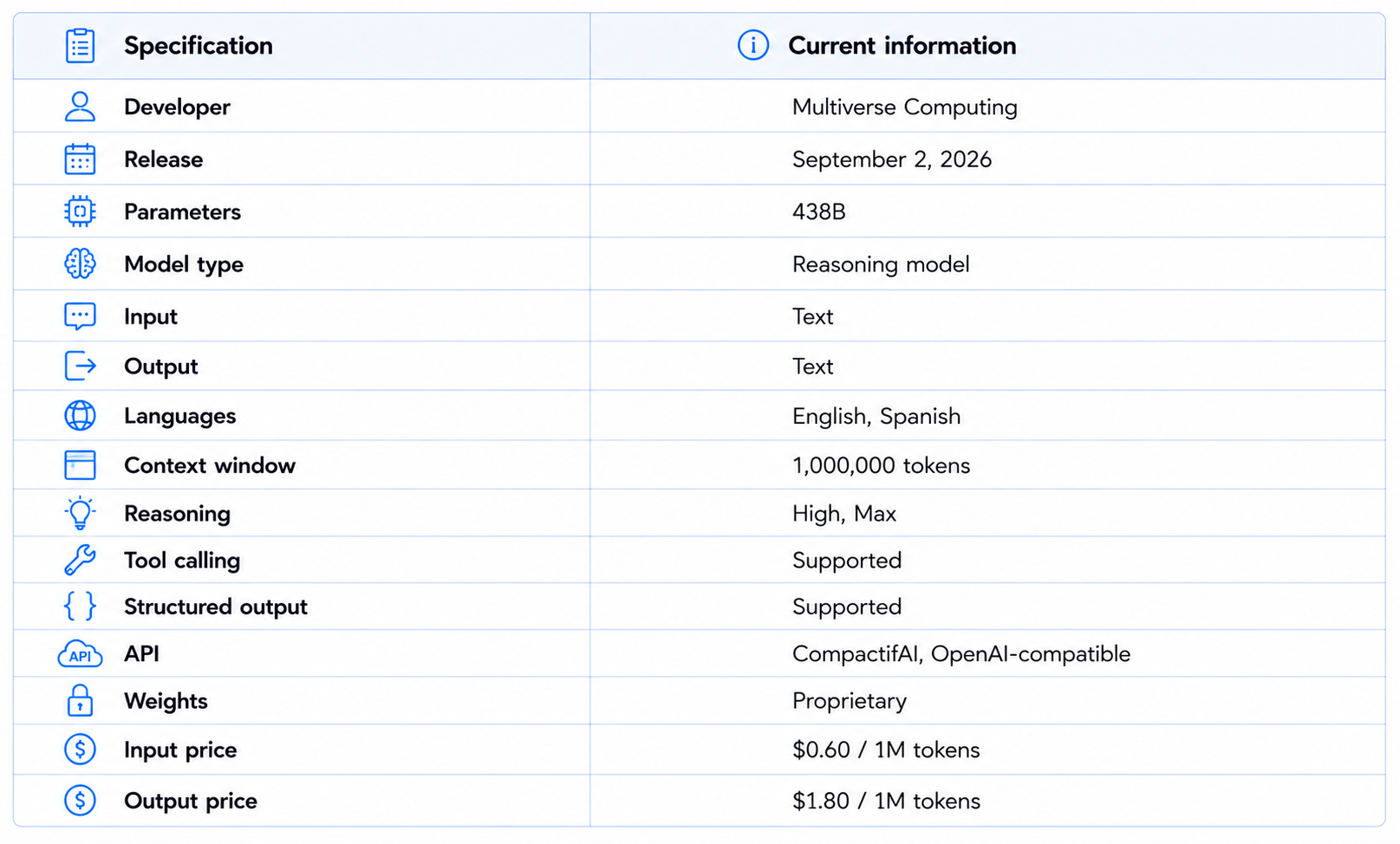
CompactifAI lists Quasar under its original models, not its separate compressed-model category. Its API supports chat completions, tool calling and structured output, making the model straightforward to test in an existing OpenAI-compatible application.
3. Quasar 438B Benchmarks
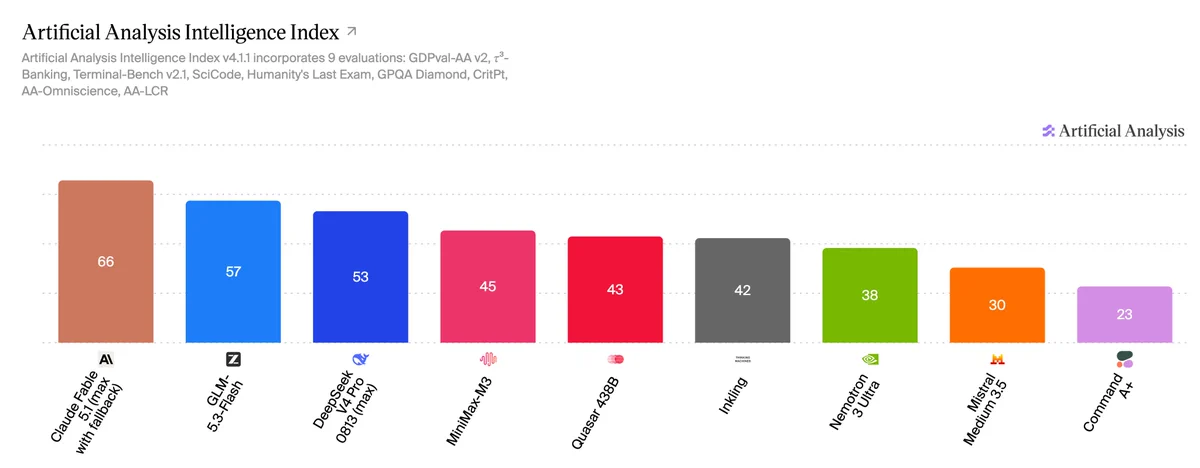
Artificial Analysis's Intelligence Index v4.1.1 combines nine evaluations across agents, coding, scientific reasoning, knowledge and long-context reasoning. Quasar's overall score is 43.
Source: Artificial Analysis - Quasar 438B
The key point is that Quasar has a mixed profile. The 43 Intelligence Index is well above the median for comparable reasoning models, and the 75.0 AA-LCR result is particularly strong. Terminal-Bench is also competitive with several European models, although it remains behind the frontier leaders.
4. Intelligence Index: How Good Is 43?
A score of 43 places Quasar well above the median of 18 among the reasoning models in Artificial Analysis's comparable-price grouping. Multiverse positions that as the highest score achieved by a European model in its selected comparison, ahead of Mistral Medium 3.5 at 30, NVIDIA Nemotron 3 Ultra at 38 and Inkling at 42. Claude Opus 5 remains far ahead at 63.
That is a meaningful launch result because the model is not winning through one narrow benchmark alone. The Intelligence Index blends agent, coding, scientific and long-context evaluations, so the 43 score suggests Quasar can handle a reasonably broad set of reasoning workloads.
At the same time, the gap to the top tier is real. Quasar should not be described as frontier-leading in general intelligence. Its stronger story is that it gets into the competitive middle of the reasoning market while keeping speed and price unusually attractive.
5. Long-Context Reasoning
AA-LCR is arguably Quasar's best benchmark. The model scores 75.0, which matches Grok 4.6 high and comes within one point of Claude Opus 5. It also leads Nemotron 3 Ultra by four points and Mistral Medium 3.5 by 9.7 points on the same evaluation.
That result aligns well with the 1M-token context window. Enterprise research often involves information spread across contracts, policies, technical manuals or long reports. A model needs to retrieve details from different locations and connect them before producing an answer.
Quasar therefore has a strong fit for document-heavy workflows. The 1M context is not just a capacity headline because the AA-LCR result shows that the model performs well on an evaluation specifically designed around long-context reasoning.
6. Terminal-Bench and Coding
Quasar scores 69.3 on Terminal-Bench v2.1, which evaluates agents operating in terminal environments. Multiverse says this result is 18.7 points above Mistral Medium 3.5 and 15.4 points above Nemotron 3 Ultra. Claude Opus 5 leads the comparison at 89.1.
Terminal-Bench is useful because it tests more than code generation. The agent has to inspect repositories, execute commands, diagnose failures and complete a sequence of connected actions. That maps closely to how coding agents are used in practice.
The 69.3 score makes Quasar a credible coding-agent model, but the 20-point gap to Opus 5 also identifies its limit. For routine repository tasks and enterprise automation, the price and speed may matter more than the gap. For extremely difficult terminal work, a stronger model still has a clear advantage.
7. Speed and Latency
Artificial Analysis currently measures Quasar at 182.7 output tokens per second through the Multiverse Computing API, with a time to first token of about 1.09 seconds. Both numbers are strong for a reasoning model.
Multiverse's own headline response figure is 15.3 seconds to produce 500 tokens with reasoning included. That is a more realistic end-to-end number for interactive use because it includes the time spent thinking rather than only output decoding.
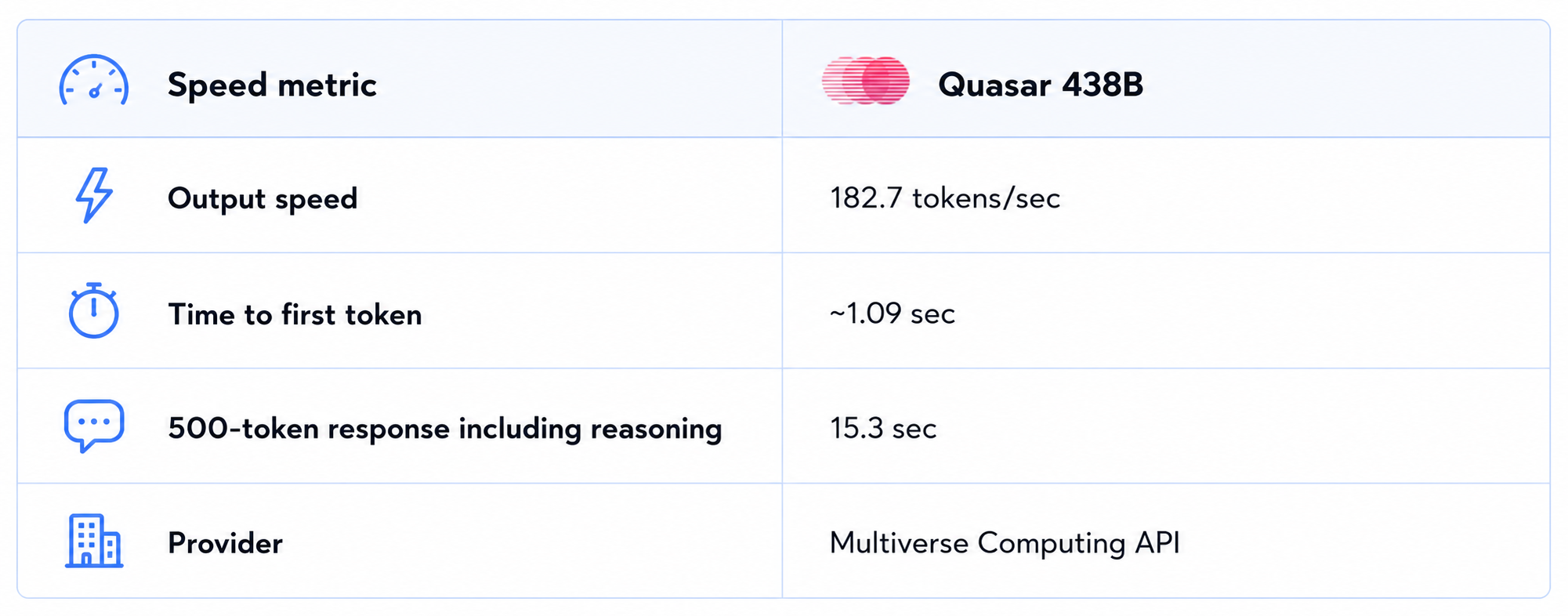
For agent loops, this matters because one user request can trigger many model calls. Fast first-token response and high output throughput help keep those loops interactive instead of making every tool cycle feel slow.
8. Quasar 438B Pricing
CompactifAI currently lists Quasar at $0.60 per million input tokens and $1.80 per million output tokens. Artificial Analysis reports a blended price of about $0.72 per million tokens using a 7:2:1 cache-input-output mix.
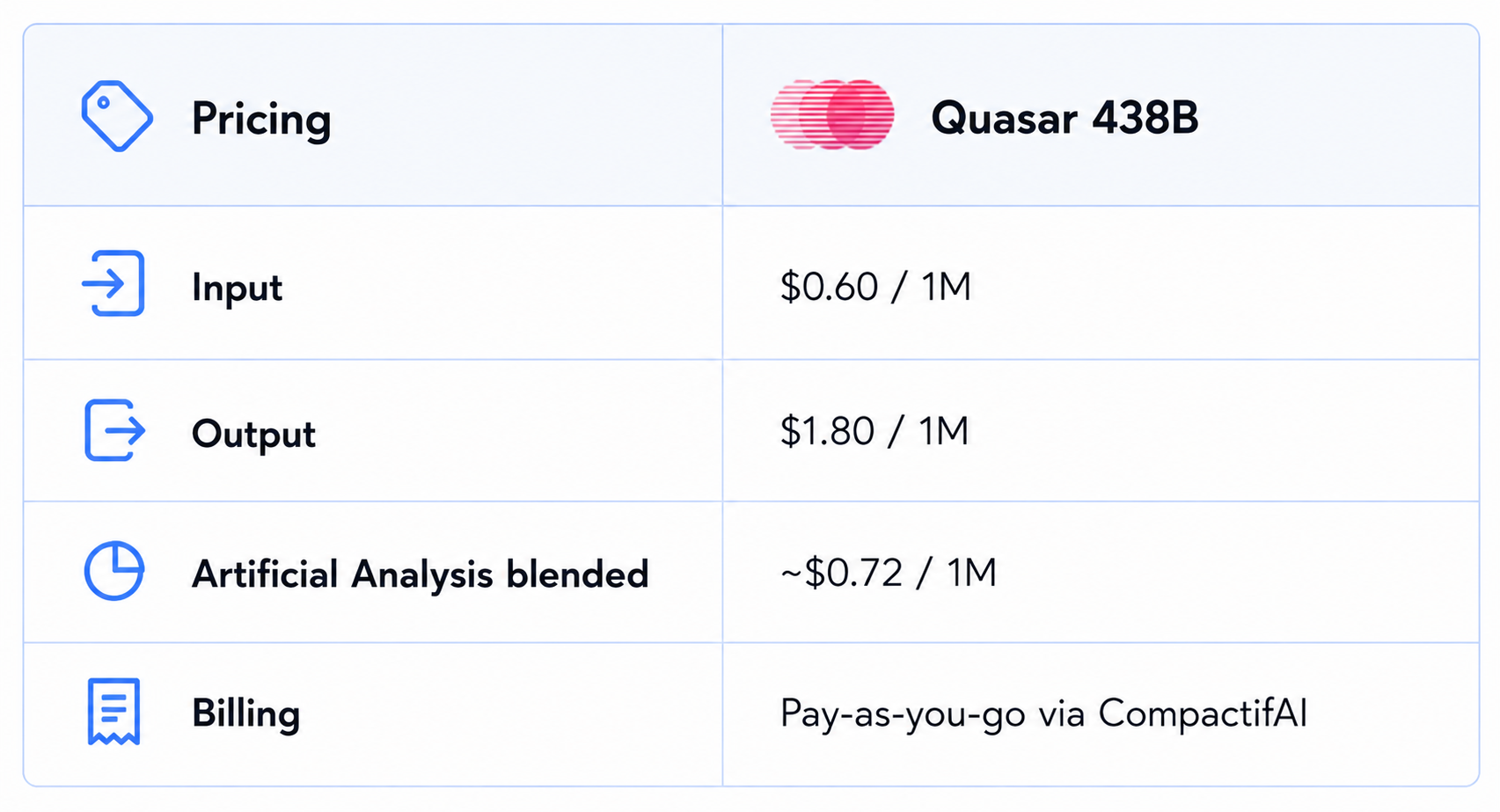
That is the main economic argument for Quasar. A system can use it as a worker model for long-context analysis, routine coding and tool-heavy tasks without paying flagship-model rates for every request.
Price should still be judged per completed task. A model that costs less per token but needs many more retries can lose its advantage. Quasar's Terminal-Bench result suggests it can handle a meaningful amount of agent work without immediately falling back to a more expensive model.
9. Tool Calling and Structured Output
CompactifAI lists function calling and structured output for Quasar 438B. Its chat-completions API is OpenAI-compatible, and the model supports high and max reasoning effort with max as the default.
That makes Quasar practical for existing agent frameworks. Developers can keep a standard chat interface while adding tool calls for search, databases, code execution or internal APIs.
Reasoning cannot simply be removed from Quasar in the current CompactifAI implementation. The API allows high or max effort instead, so teams can reduce or increase the amount of reasoning based on the difficulty of the task.
10. Quasar 438B vs Claude Opus 5
The Quasar versus Opus comparison is best understood as a speed-cost-capability tradeoff. Opus 5 is clearly stronger on overall intelligence and Terminal-Bench, while Quasar is considerably faster and cheaper.
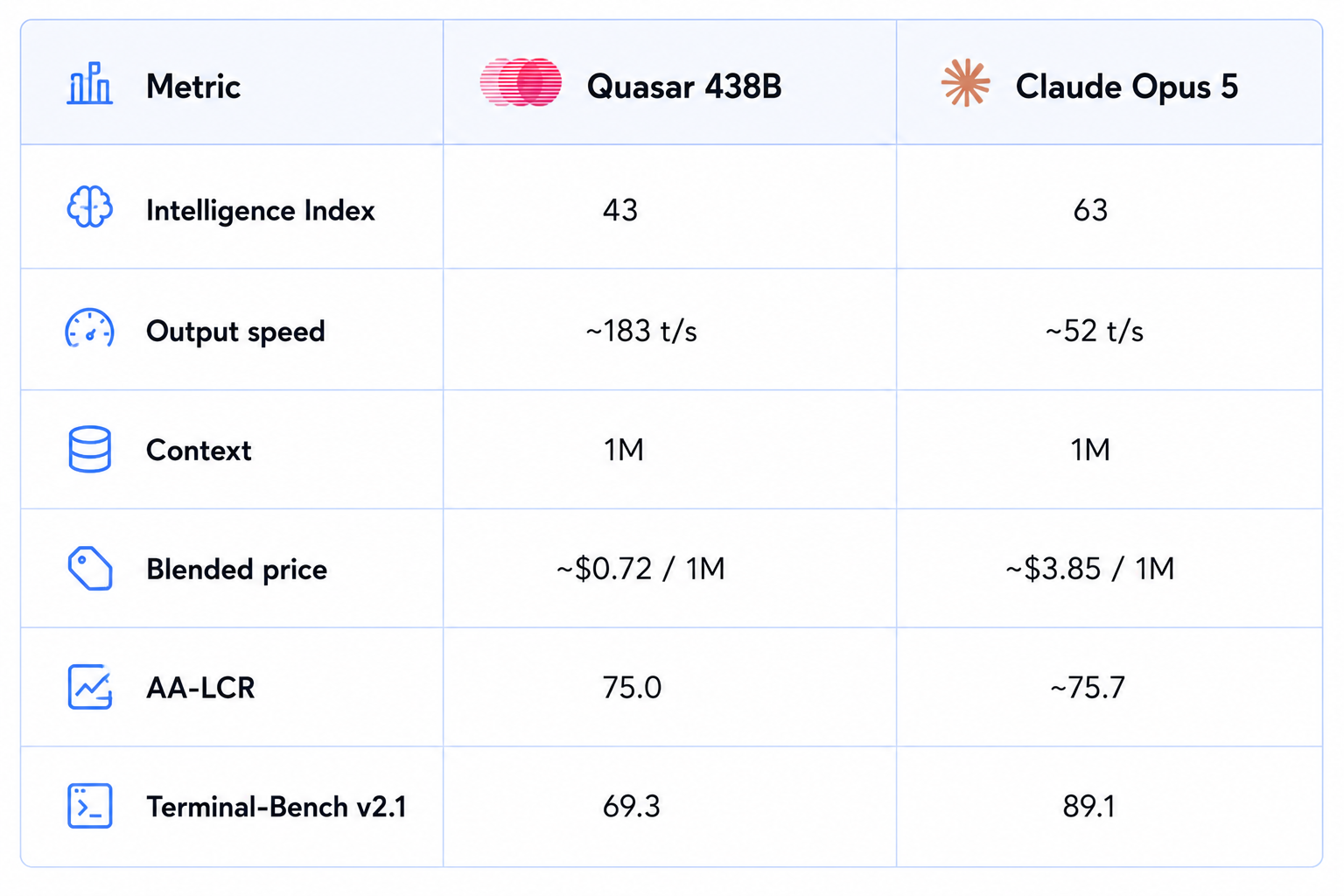
For a high-volume enterprise agent, Quasar can therefore be a sensible default worker model with escalation to Opus for the hardest tasks. For workloads where the highest reasoning quality matters more than cost, Opus remains the safer choice.
11. Quasar 438B vs Muse Spark 1.2
Quasar and Meta Muse Spark 1.2 are both interesting for agentic workloads, but they emphasize different strengths. Artificial Analysis currently scores Muse Spark 1.2 xhigh at 57 versus Quasar at 43. Quasar is faster at about 183 tokens per second versus about 148, and its time to first token is dramatically lower in the current comparison.
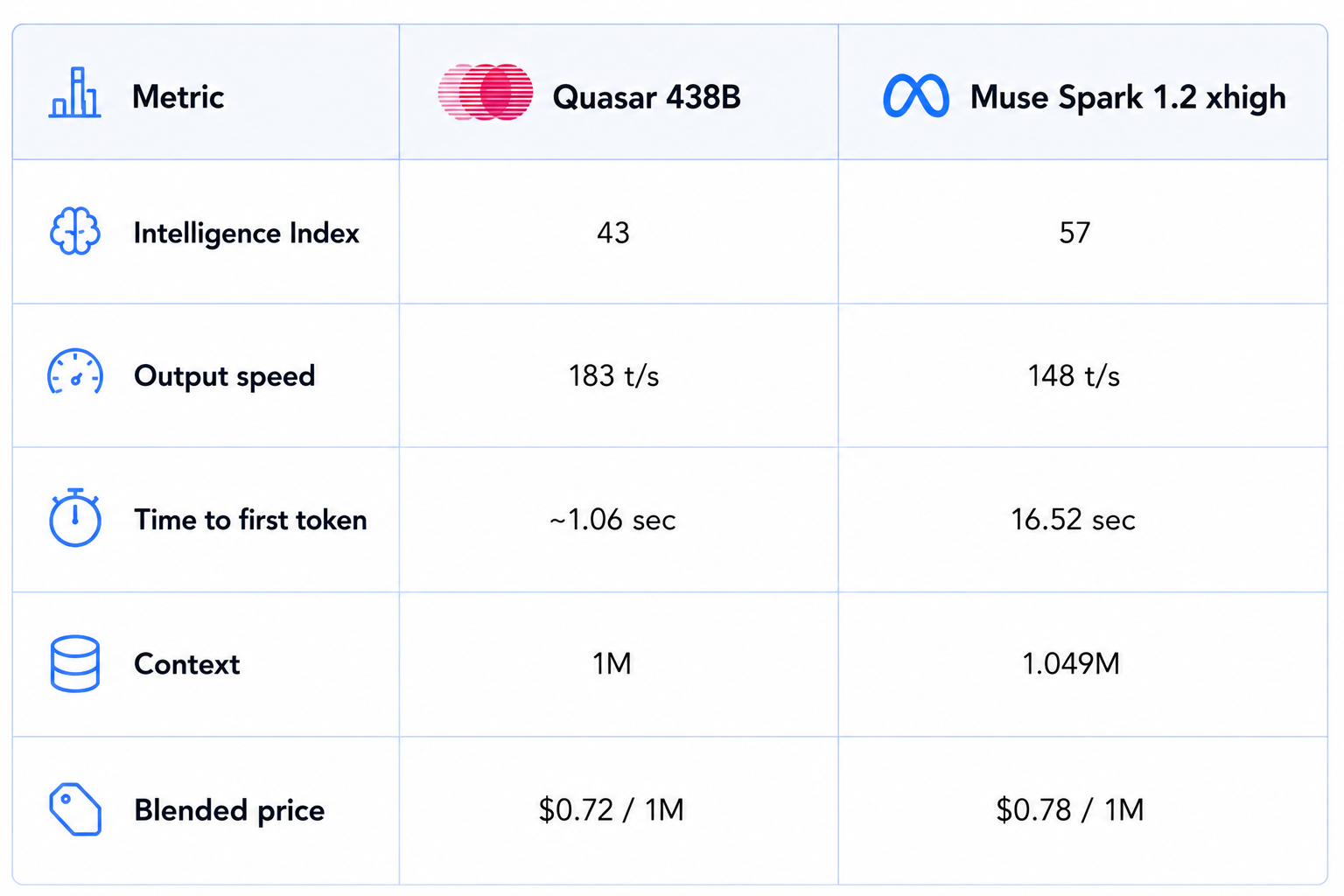
This makes the choice workload-dependent. Muse Spark is stronger on the aggregate intelligence score, while Quasar offers a compelling latency advantage and slightly lower blended price. For fast interactive agent loops, that difference can be meaningful.
12. Quasar 438B vs Mistral Medium 3.5
This is where the European positioning becomes clearest. Multiverse reports a 43 Intelligence Index score for Quasar versus 30 for Mistral Medium 3.5, while the 500-token end-to-end response is 15.3 seconds for Quasar versus 18.8 seconds for Mistral in the launch comparison. Quasar also scores 75.0 on AA-LCR versus roughly 65.3 for Mistral.
Quasar therefore combines higher aggregate benchmark performance with faster end-to-end response in the cited comparison. That gives European organizations another option for enterprise reasoning workloads beyond the better-known Mistral family.
13. English and Spanish Support
Multiverse explicitly highlights English and Spanish support. That makes Quasar relevant to organizations operating across European and international teams that need the same agent architecture in two languages.
It is still better to treat the documented language support narrowly. The launch materials highlight English and Spanish, not broad multilingual coverage. Teams working primarily in other languages should test their own datasets before assuming comparable performance.
14. The 1M-Token Context in Practice
A one-million-token context is large enough to keep very substantial documents, technical material or repository context in a single workflow. Quasar's 75.0 AA-LCR score makes this more compelling than a large context number alone.
Good applications include contract review, policy analysis, technical research, enterprise knowledge agents and large codebase exploration. The model can reason over information spread throughout the input rather than relying only on short retrieved fragments.
The usual context rule still applies: more context is useful only when the relevant evidence can be found and used correctly. Applications should still structure large inputs and remove unnecessary noise.
15. Is Quasar 438B Open Source?
No. Quasar 438B is proprietary and its weights are not publicly available. It is delivered as an API model through CompactifAI rather than as a downloadable checkpoint. Artificial Analysis classifies it as proprietary, while CompactifAI separates Quasar from its compressed-model offerings.
That means Quasar is an API-first choice. Organizations that require offline inference, self-hosting or control of model weights should evaluate open-weight alternatives.
16. What Does Multiverse's Compression Background Mean?
Multiverse Computing's broader platform is built around AI efficiency and compression, but Quasar itself is listed under CompactifAI's original models rather than its compressed-model category.
The public launch materials do not provide enough architectural detail to say exactly how Quasar was created or whether it is derived from another model. Similar benchmark behavior is not proof of model lineage.
The defensible takeaway is simpler: Multiverse has applied its efficiency-oriented product strategy to a 438B reasoning model and delivered strong speed and cost characteristics alongside competitive benchmarks.
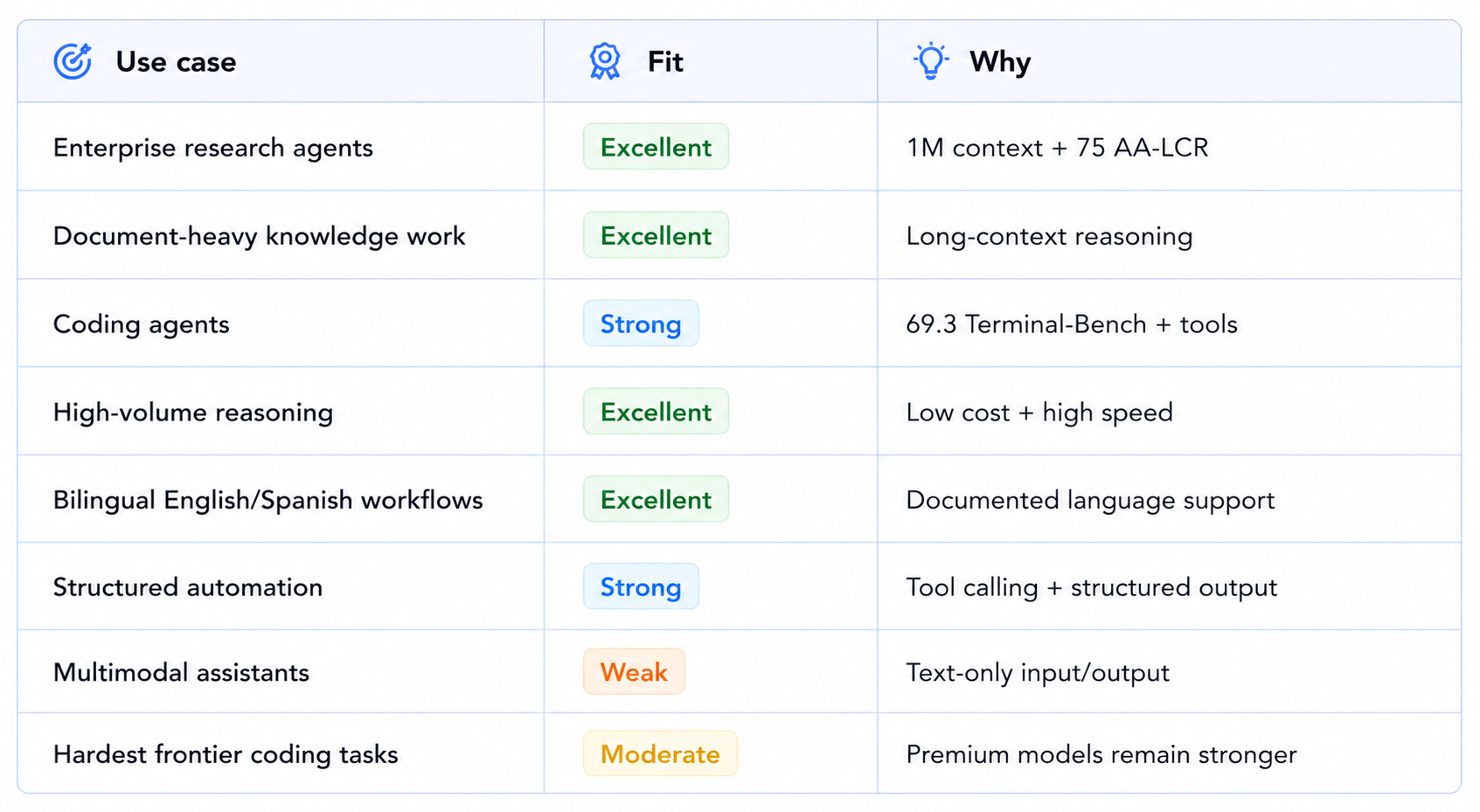
17. Best Use Cases
18. Limitations You Should Know
- Quasar's 43 Intelligence Index is below the current frontier leaders.
- Claude Opus 5 has a substantial lead on Terminal-Bench v2.1 and overall Intelligence Index.
- Quasar is text-only and does not accept image input.
- The model is proprietary and is not available for local deployment.
- Reasoning is always enabled in the current CompactifAI configuration.
- English and Spanish are the languages specifically highlighted by the launch.
- Some headline benchmark figures such as 69.3 Terminal-Bench and 75.0 AA-LCR are presented in Multiverse's launch materials, while Artificial Analysis independently confirms the 43 Intelligence Index and current runtime metrics.
19. Recommended Production Workflow
Quasar works best as a worker model inside a routed enterprise-agent architecture.
- Use Quasar for long-context research and document analysis.
- Use it for routine coding and terminal tasks where its speed and cost matter.
- Choose high reasoning when latency is more important than maximum reasoning effort.
- Use max reasoning for difficult multi-step tasks.
- Escalate unusually hard coding or computer-use requests to a stronger frontier model.
- Measure completed-task cost, retries, tool failures and latency in production.
For model routing, see Model Routing for AI Coding Agents.
20. How to Evaluate Quasar 438B Yourself
Use the same documents, prompts and tools across Quasar and your current production model. Measure the complete workflow instead of the final answer alone.
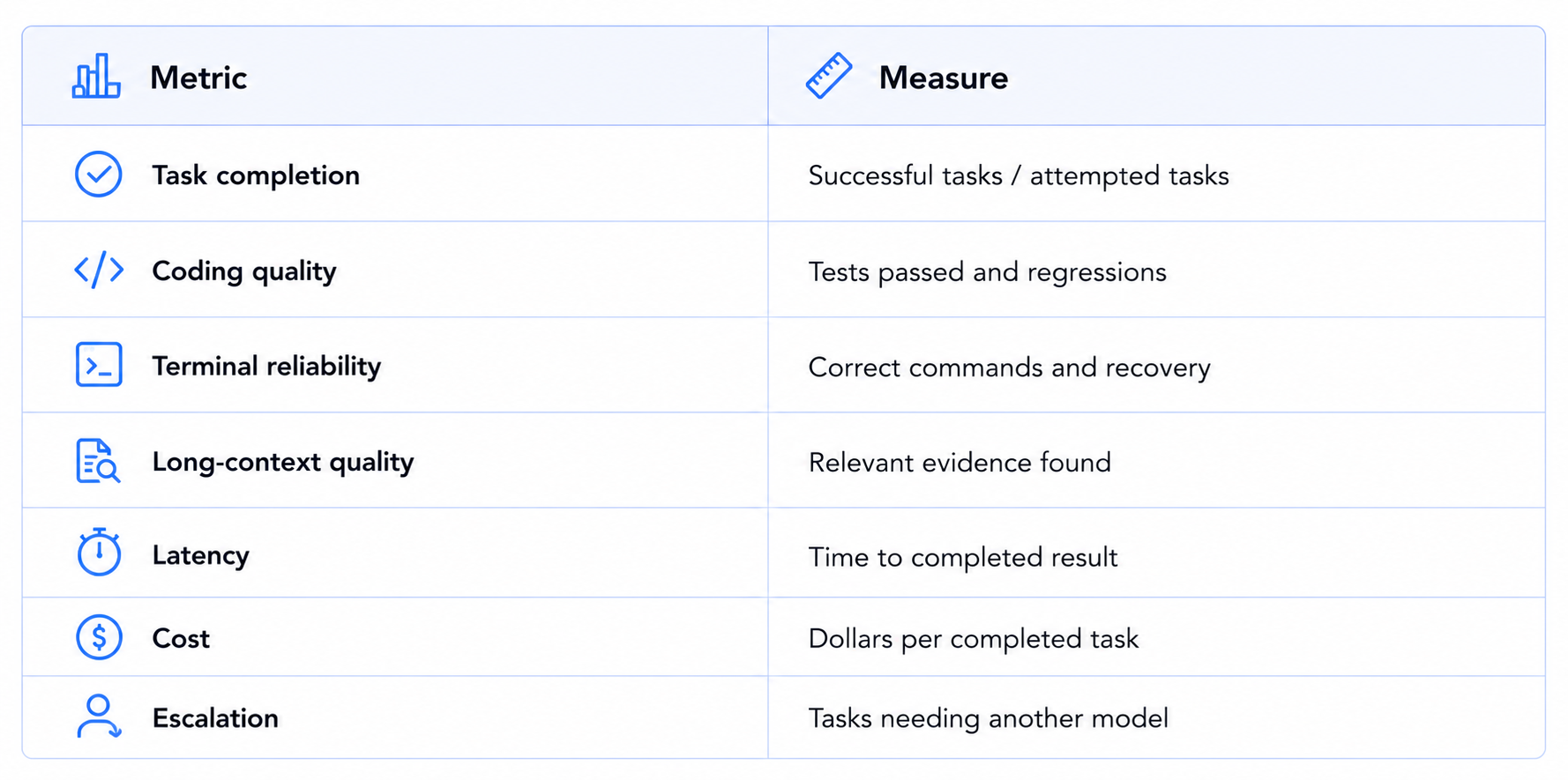
The goal is to determine whether Quasar's lower price and higher speed compensate for the gap in general capability on your specific workload. That is where its value proposition becomes measurable.
21. Is Quasar 438B Worth It?
Yes, especially for organizations that need long documents, tool use and repeated reasoning calls without paying premium-model prices on every request.
The strongest evidence is the combination of 75.0 AA-LCR, 69.3 Terminal-Bench and roughly 183 output tokens per second. Those results show that Quasar is not simply a cheap model. It is a capable enterprise workhorse with a strong performance profile in the areas it targets.
The tradeoff becomes clear against Claude Opus 5. Quasar is much cheaper and faster, but Opus is materially stronger on overall intelligence and difficult terminal-agent work. That makes Quasar most attractive as a default model with escalation rather than as the only model in a serious agent stack.
22. Final Verdict
Quasar 438B is a meaningful release for European AI because it brings together three qualities that do not often appear in the same model: very large scale, high throughput and aggressive API pricing. Multiverse has aimed the system directly at enterprise agents, coding and long-context reasoning rather than trying to position it as a universal consumer assistant.
The benchmark profile supports that positioning. Quasar scores 43 on Artificial Analysis Intelligence Index, 75.0 on AA-LCR and 69.3 on Terminal-Bench v2.1. Artificial Analysis measures about 182.7 output tokens per second, while the provider reports 15.3 seconds for a 500-token response including reasoning.
The strongest part of the model is long-context work. A 1M-token context combined with a 75.0 AA-LCR result makes Quasar especially compelling for enterprise research, document analysis and knowledge agents. Its Terminal-Bench result also makes it credible for coding and command-line workflows, even though Claude Opus 5 remains clearly stronger at the frontier.
At $0.60 per million input tokens and $1.80 per million output tokens, Quasar is priced for repeated use rather than occasional experimentation. That makes it a particularly interesting worker model for routed agent systems.
My rating: 9.2/10 for speed, 9.1/10 for price-to-performance, 8.7/10 for coding and agents, 9.3/10 for long-context work and 8.9/10 overall.
Bottom line: Quasar 438B is worth testing when your application needs long context, tool use and fast reasoning at a controlled cost. It does not replace the strongest frontier models, but it gives enterprise teams a credible European alternative with a compelling efficiency profile.
Frequently Asked Questions
What is Quasar 438B?
Quasar 438B is Multiverse Computing's 438-billion-parameter proprietary reasoning model for enterprise agents, coding and long-context work.
When was Quasar 438B released?
Multiverse Computing launched Quasar 438B on September 2, 2026.
What are the Quasar 438B benchmark scores?
Current published figures include 43 on Artificial Analysis Intelligence Index, 75.0 on AA-LCR, 69.3 on Terminal-Bench v2.1 and 61.2 on the Artificial Analysis Coding Index.
How fast is Quasar 438B?
Artificial Analysis measures about 182.7 output tokens per second and roughly 1.09 seconds to first token. Multiverse reports 15.3 seconds for a 500-token response including reasoning.
How much does Quasar 438B cost?
CompactifAI lists $0.60 per million input tokens and $1.80 per million output tokens.
What is the context window?
Current model tracking lists a 1 million-token context window.
Is Quasar 438B good for coding?
Yes. Its 69.3 Terminal-Bench v2.1 result makes it a credible coding and terminal-agent model.
Does Quasar 438B support tools?
Yes. CompactifAI lists tool calling and structured output support.
Can Quasar 438B process images?
No. It is currently a text input and text output model.
Is Quasar 438B open source?
No. It is proprietary and available through the CompactifAI API.
Is Quasar 438B better than Claude Opus 5?
Not overall. Quasar is faster and cheaper, while Opus 5 has higher aggregate intelligence and stronger Terminal-Bench performance.
Is Quasar 438B worth it?
Yes for enterprise agents, long-context analysis, coding and cost-sensitive reasoning workloads.
Recommended Blogs
Meta Muse Spark 1.3 Review: Coding, Price & Is It Worth It? (2026)
Gemini 3.8 Flash Review: Accuracy, Price & Is It Worth It? (2026)
Qwen 3.8 Max 0902 Review: Benchmarks, Price & Is It Worth It? (2026)
Mercury 2.5 AI Model Review: Speed, Price & Is It Worth It? (2026)
Replit's AI Model Routing Is Here: How Intelligent Routing Cuts Costs (2026)
How to Secure AI Coding Agents: Permissions, Sandboxing, MCP & Secrets
24GB VRAM AI Models: What Can You Actually Run Locally in 2026?
Resources & Community
Join our community of 70,000+ AI enthusiasts and learn to build powerful AI applications. Whether you're a beginner or an experienced developer, Build Fast with AI helps you understand and implement AI in your projects.
Agentic AI Launchpad 2026
A structured 6-week cohort program that takes you from AI basics to building and deploying real-world agentic AI systems. Includes live sessions, expert mentorship, project reviews and a builder community network.
Ready to go from learning to building? Join the next cohort:
Ready to go from learning to building? Join the next cohort: Agentic AI Launchpad 2026
Free AI Resources
Access free tools, workshops and micro-learning to keep building.

