



The expensive way to run an AI coding agent is simple: send every task to the strongest model available. It is also unnecessary. A coding agent does not spend every turn solving hard reasoning problems. It searches files, reads code, formats output, writes repetitive changes, runs tests, explains errors, creates documentation and occasionally tackles a genuinely difficult engineering problem. Using the most expensive model for all of those steps is like hiring a senior architect to rename variables.
Model routing fixes that inefficiency. Instead of asking one model to do everything, a router decides which model should handle each task or phase based on complexity, risk, latency and budget. A cheap model can handle routine execution. A stronger model can plan or solve difficult problems. A premium model can be reserved for the cases where failure is expensive.
This matters more now because Gemini 3.7 Flash has pushed coding model pricing sharply downward, while OpenAI has also cut GPT-5.6 Terra and Luna pricing. Our Gemini 3.7 Flash economics analysis looks at the broader price-performance shift, while this guide focuses on how to turn that shift into an actual routing strategy.
QUICK ANSWER
The best model-routing strategy for coding agents is to start with the cheapest model that is likely to succeed, then escalate when the task, failure pattern or risk level justifies a stronger model. For a practical 2026 stack, use a low-cost workhorse such as Gemini 3.7 Flash or GPT-5.6 Luna for routine tasks, a balanced model such as Claude Sonnet 5 or GPT-5.6 Terra for normal engineering, and a frontier model such as GPT-5.6 Sol for difficult architecture, debugging and long-horizon tasks.
The important part is not the exact model names. It is the routing logic. Good routing can lower average spend without lowering final quality because the expensive model is still available when the cheap model is not good enough.
The Model Routing Problem
Coding agents are unusually expensive compared with simple chat because they make many model calls and carry large contexts between steps. A typical task can involve repository search, planning, file reads, edits, tool calls, test output, debugging and a final review. The model is repeatedly processing both the original request and accumulated context.
Research published in 2026 found that agentic coding tasks can consume vastly more tokens than ordinary code chat, that token usage varies substantially between runs, and that more tokens do not necessarily produce better outcomes. The study also found meaningful differences in token efficiency across models. That makes fixed one-model deployment a poor economic assumption.
The second part of the problem is task heterogeneity. Planning a complex migration and fixing a typo are both 'coding tasks,' but they do not require the same reasoning budget.
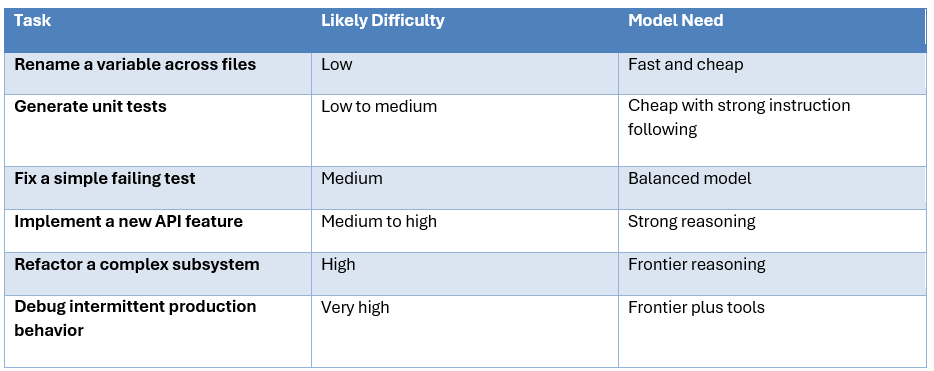
Why One Model for Everything Is Wasteful
A single-model setup is attractive because it is easy to configure. Every request uses the same provider, the same credentials and the same routing logic. But simplicity has a price.
Suppose a coding agent spends 70% of its turns on execution tasks such as file reads, mechanical edits, test invocation and tool coordination. Those turns do not always require the same intelligence as the planning turn that decides the architecture.
Recent routing research on coding agents points in exactly this direction. A paper called Scrouting reported that a smaller repository-scouting model could help route repository-level tasks and reach the best single-model solve rate on its SWE-bench Pro Python evaluation while using about one-fifth of the total cost per solve in the reported setup. The paper also found that the scouting handoff itself was a major source of the gain, which is a useful warning that routing systems have to be evaluated as full workflows rather than as a simple classifier.
The practical lesson is not that every team needs a complicated AI router. It is that the cost of using frontier intelligence for every turn is hard to justify when a large percentage of the workflow is routine.
The 2026 Model Routing Stack
The current price spread makes this strategy practical. OpenAI lists GPT-5.6 Terra at $2 per million input tokens and $12 per million output tokens, while Luna is $0.20 and $1.20. Gemini 3.7 Flash launched at $0.75 input and $3.75 output per million tokens during its introductory period. See our Gemini 3.7 Flash review and GPT-5.6 review for the model-specific details.
How Routing Decides What Model to Use
A routing system does not have to be a giant machine-learning project. A good first version can use deterministic signals that engineering teams already understand.
- Task type: documentation, bug fix, feature, refactor, architecture or security work.
- Repository size: number of files, languages, dependencies and context required.
- Risk: whether the change touches authentication, infrastructure, databases or production code.
- History: whether a previous attempt failed, timed out or produced tests that still fail.
- Tool complexity: whether the task needs browser use, MCP, cloud APIs or multiple agent handoffs.
- Budget: how much the current task is allowed to spend before escalation.
These signals can be combined into a simple score. Low score goes to Tier 1. Medium score goes to Tier 2. High score goes to Tier 3.
A Simple Routing Example
Imagine a developer asks an agent to fix a TypeScript lint error. A low-cost workhorse model receives the task because the code change is small, the test is deterministic and the risk is low.
If the model fixes the error and the test suite passes, the task ends. If the first attempt fails twice, the router can escalate to Sonnet 5 or GPT-5.6 Terra with the original context plus the observed test failures.
Now consider a request to redesign an authentication subsystem. The router sees the task involves sensitive code, many files and architectural decisions. It skips Tier 1 and sends the task directly to a frontier model.
That is the core idea: cheap by default, expensive by exception.
Phase-Based Routing Is Better Than Request-Based Routing
The strongest coding-agent architectures do not necessarily use one model for the entire task. They can route by phase.
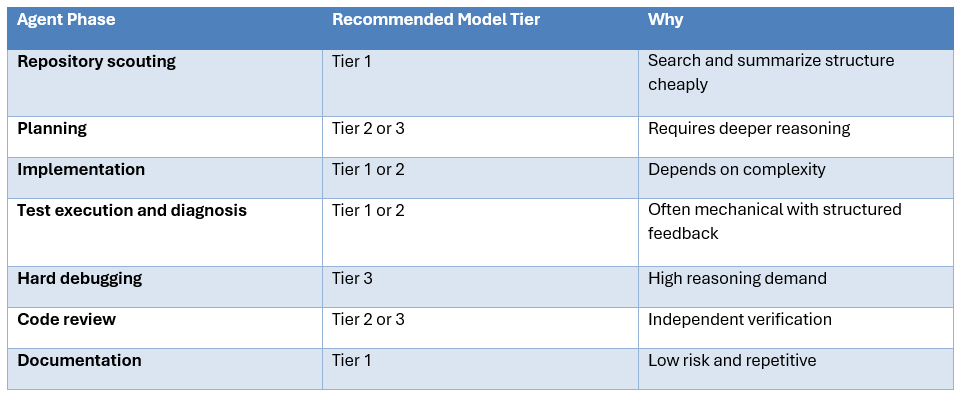
This phase model is more efficient than choosing one model before the session begins. The same coding task can start cheap, become expensive when uncertainty appears, and become cheap again once the difficult reasoning is complete.
Production routing experiments support the same intuition. One recent coding-router report describes a phase-aware production system that routes planning, implementation, debugging, testing and documentation to different models rather than using one model for every phase. The exact savings in any team's environment will differ, but the architecture is directionally sound.
The Most Important Rule: Escalate on Evidence
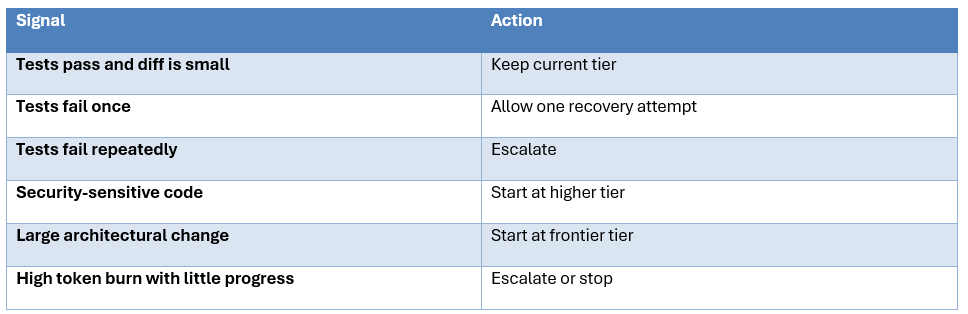
A router should not escalate just because a task sounds difficult. It should escalate because there is evidence that the current tier is struggling or the risk of failure is high.
- Tests fail after one or two reasonable repair attempts.
- The model repeatedly edits the same files without progress.
- The agent cannot reproduce the bug.
- The task requires architectural changes across many subsystems.
- The task touches sensitive security or infrastructure code.
- The model exceeds a token or time budget.
- The agent starts producing contradictory plans or unstable edits.
This is where coding-agent routing differs from basic classification. You are not only deciding which model fits the input. You are deciding whether the current model is still making useful progress.
Recovery Routing: What Happens After Failure?
A failed attempt does not always mean you need the strongest model. Sometimes a cheap model can recover from its own failure using the new information from the test output.
Recent work on budget-calibrated recovery routing for coding agents explores exactly this problem. Instead of a simple rule that always escalates after failure, it asks whether another cheap recovery step is likely to be worthwhile under the available budget. The reported results show that calibrated recovery can outperform fixed escalation strategies in some settings, which suggests that the next frontier in model routing is not just model selection but budget-aware recovery decisions.
For a practical system, keep the policy simple at first: one cheap retry, then escalate. Once you collect enough production data, replace the fixed rule with a measured recovery policy.
How Much Can Routing Save?
There is no honest universal savings number because routing efficiency depends on traffic mix, model pricing, context size, cache usage, agent architecture and how many tasks actually need escalation.
Still, the available evidence points to a large opportunity. One 2026 coding-agent routing guide reported 40% to 60% lower cost than using a frontier model for every role in its modeled scenarios. Another production routing report claimed substantially larger savings under its phase-aware setup. These are not guarantees, and they should not be copied into a business case without your own workload data.
For your own calculation, use this formula:
Total routing cost = Tier 1 spend + Tier 2 spend + Tier 3 spend + router overhead + retry cost + review cost
Then compare it with the cost of sending the same workload entirely to the strongest model.
The Hidden Cost: Quality Regression
Routing can reduce cost and still make the overall system worse if the cheap model is assigned tasks above its capability threshold.
This is why the router needs a quality gate. Cost savings only count if the final software quality remains acceptable. The gate can be automated with tests, static analysis, type checking, security scanners and pull-request validation.
The Router Should Also Understand Risk
Quality and cost are not the only dimensions. A cheap model may be perfectly adequate for documentation but inappropriate for a production authentication change.
Add a risk score to the router. Security-sensitive repositories, payment logic, infrastructure code, credentials, database migrations and production deployment paths should have stricter thresholds.
This connects directly to our AI coding agent security guide, which covers sandboxing, secrets, MCP permissions and production approval boundaries.
Model Routing for Claude Code, Codex and Cursor
Routing does not require replacing your current coding agent. It can happen inside or around the agent runtime.
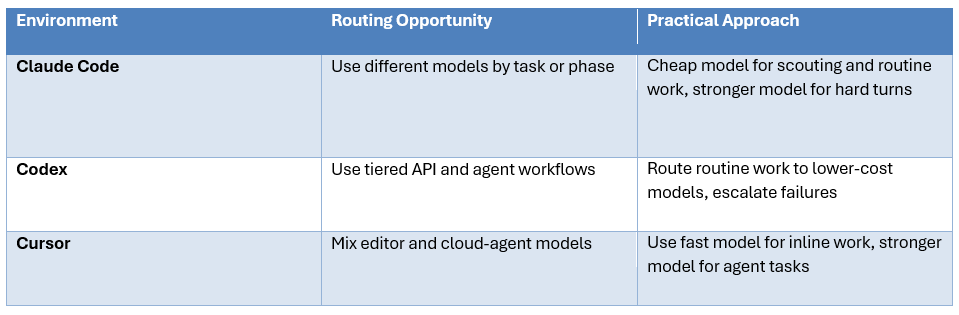
Our Claude Code vs Codex comparison explains the product differences, while the Cursor Cloud Agents guide shows why the execution environment also matters.
How to Build a Routing Policy Without Overengineering
Do not begin by training a neural network to classify every coding task. Start with rules.
- Define three model tiers.
- Assign obvious task categories to each tier.
- Set a maximum budget per task.
- Allow one cheap recovery attempt.
- Escalate when tests or progress signals indicate failure.
- Log every routing decision.
- Review outcomes weekly and adjust thresholds.
- Only add a learned router after you have enough production examples.
This produces a routing system you can understand and debug. When the model changes next month, you update the model table instead of rebuilding the whole architecture.
The Contrarian Take: Do Not Route on Price Alone
The cheapest model is often attractive because the savings are easy to explain. But pure price routing is a mistake.
A good router optimizes expected value, not token price. That means asking how much the task is worth, how costly failure is, how much review is required and how likely each model is to succeed.
A model that costs ten times more but saves an engineer two hours can be dramatically cheaper in real business terms. Conversely, a premium model used for a one-line documentation change is just waste.
The right question is not 'Which model is cheapest?' It is 'Which model is the cheapest one that is likely to complete this task correctly within the required risk and time budget?'
How to Evaluate Your Router
Before deploying routing to a whole engineering organization, run an offline evaluation.
- Collect 50 to 200 completed real coding tasks.
- Label them by difficulty and risk.
- Record which model solved each task and how many attempts it required.
- Simulate routing policies against the historical data.
- Calculate quality, cost, latency and escalation rate.
- Run the best policy on a live pilot group.
- Compare accepted changes, review time and monthly spend.
For repeatable evaluation work, the Gen-AI-Experiments cookbook repository can be used as a starting point for agent and model experiments.
Final Verdict: Route Intelligence, Not Just Tokens
Model routing is becoming one of the most important economic layers in AI coding. Gemini 3.7 Flash has made the cheap workhorse tier much more attractive, while OpenAI's GPT-5.6 pricing tiers and Anthropic's Sonnet family give teams more choices between cost and capability.
The result is a simple strategic shift. Stop thinking about one best coding model. Build a ladder of models and decide when to climb it.
For routine tasks, use a fast and inexpensive workhorse. For normal engineering, use a balanced frontier model. When the task becomes difficult, risky or repeatedly unsuccessful, escalate to the strongest model available.
The biggest mistake is trying to save money by making every task cheap, or trying to maximize quality by making every task expensive. The better approach is to match intelligence to the task.
That is what model routing really does. It turns AI coding from a flat model bill into an adaptive system where the cost rises only when the work actually requires more intelligence.
Frequently Asked Questions
What is model routing for AI coding agents?
Model routing is the process of selecting different AI models for different coding tasks or agent phases based on complexity, risk, latency and cost. A cheap model can handle routine work while a stronger model handles difficult tasks.
How does AI model routing reduce coding costs?
Routing reduces costs by preventing expensive frontier models from handling routine work. The router sends simple tasks to lower-cost models and escalates only when the task needs more reasoning or when the cheaper model fails.
Which AI model should I use for coding agents?
Use a tiered approach. Gemini 3.7 Flash or GPT-5.6 Luna can handle routine tasks, Claude Sonnet 5 or GPT-5.6 Terra can handle normal engineering, and GPT-5.6 Sol can handle the hardest tasks.
How do you know when to escalate to a stronger model?
Escalate when the task is high risk or when there is evidence the current model is failing, such as repeated test failures, contradictory plans, excessive token usage or lack of progress.
Can model routing hurt code quality?
Yes, if cheap models are assigned tasks above their capability threshold. The routing policy must include quality gates, tests, risk scoring and escalation rules.
Can routing work with Claude Code, Codex and Cursor?
Yes. Routing can happen inside the agent runtime, through an API gateway, or as a higher-level orchestration layer. The implementation depends on the product and the models you have access to.
How much money can model routing save?
There is no universal number. Published 2026 routing studies report substantial savings in specific workloads, but real savings depend on traffic mix, model prices, context size, retries and task difficulty. Measure cost per successful task on your own workload.
Recommended Blogs
- Gemini 3.7 Flash Is Changing AI Coding Economics: Speed vs Intelligence vs Cost
- Gemini 3.7 Flash vs Claude Sonnet 5 vs GPT-5.6: Which Coding Model Is Actually Best?
- Gemini 3.7 Flash Review: Benchmarks, Price & the Catch (2026)
- Claude Sonnet 5 Review: Benchmarks, Pricing & Is It Worth It?
- GPT-5.6 Review: Sol, Terra, Luna Features, Benchmarks, and Pricing
- How to Secure AI Coding Agents in 2026: Permissions, Sandboxing, MCP & Secrets
Resources & Community
Join our community of 70,000+ AI enthusiasts and learn to build powerful AI applications! Whether you are a beginner or an experienced developer, Build Fast with AI helps you understand and implement AI in your projects.
- Website - buildfastwithai.com
- LinkedIn - Build Fast with AI
- Instagram - @buildfastwithai
- Founder Twitter - @satvikps
- Twitter - @BuildFastWithAI
Agentic AI Launchpad 2026
A structured 6-week cohort program that takes you from AI basics to building and deploying real-world agentic AI systems. Includes live sessions, expert mentorship, project reviews, and a builder community network.
Ready to go from learning to building? Join the next cohort. Agentic AI Launchpad 2026
Free AI Resources
Access free tools, workshops, and micro-learning to keep building:
- AI Workshops - Free resources, upcoming events & past recordings
- Unrot - Learn AI in 5 minutes a day (free micro-learning app)
References
- OpenAI - Advancing the Price-Performance Frontier with GPT-5.6
- Reuters - Google unveils Gemini 3.7 Flash for coding and agent workflows
- Scrouting - Cost-Aware Routing of Coding Agents by Scouting the Repository First
- CodeRescue - Budget-Calibrated Recovery Routing for Coding Agents
- How Do AI Agents Spend Your Money? Token Consumption in Agentic Coding
- Model Routing Guide for Coding Agents

