



Gemini 3.7 Flash Review: Benchmarks, Price & the Catch (2026)
Google is shipping so fast it is almost hard to keep up. Just three weeks after Gemini 3.6 Flash, Google launched Gemini 3.7 Flash on August 13, 2026: half the price, meaningfully better at coding and agents, and available everywhere from the API to Antigravity on day one. On the surface it is a straightforward win, a cheaper and smarter workhorse model. But the half-price headline has an expiry date, and the improvements are real but not uniform. This review breaks down what actually changed, the benchmark gains, the pricing catch, and whether it is worth switching to.
The short version: Gemini 3.7 Flash is a genuine upgrade over 3.6 Flash, with large gains on coding and agent benchmarks like DeepSWE, delivered in a remarkable three-week turnaround through algorithmic improvements rather than a bigger model. It launches at $0.75 per million input tokens and $3.75 per million output, half the previous price, but that discount is an introductory promo through the end of 2026, after which it doubles back to the old rate. For coding and agent work on a budget, it is one of the best value models available right now, with a clear eye on that 2027 price change.
Gemini 3.7 Flash is Google's newest low-cost workhorse model, launched August 13, 2026, aimed at coding and agents. It costs $0.75 per million input tokens and $3.75 per million output through the end of 2026, half the price of Gemini 3.6 Flash, then rises to $1.50 and $7.50 on January 1, 2027. It posts big benchmark gains, including DeepSWE jumping from 49.0% to 65.3%, and arrived just three weeks after 3.6 Flash thanks to algorithmic improvements. It is available in the API, AI Studio, Antigravity, Vertex AI, and more.
What Is Gemini 3.7 Flash?
Gemini 3.7 Flash is the newest model in Google's Flash line, the family of fast, low-cost models that Google calls its workhorses. Flash models are built for high volume and everyday tasks rather than the absolute hardest reasoning, and they sit below the premium Pro tier on both price and raw capability. Gemini 3.7 Flash is the most capable Flash model yet, and Google is positioning it specifically as its most intelligent workhorse for coding and agents.
The point of a Flash model is value: strong enough quality for the bulk of real work, at a price and speed that make it viable to run constantly. This is the tier that powers high-volume products, agent loops that make many calls, and everyday coding assistance, where paying premium-model prices for every request would be wasteful. Gemini 3.7 Flash pushes that value proposition further by getting noticeably smarter at coding while launching at half its predecessor's price, which is exactly the combination developers building on a budget want.
It is worth being clear about what it is not. Gemini 3.7 Flash is not Google's top model, and it is not trying to beat the flagship Pro or Ultra tiers on the hardest tasks. It is trying to be the best cheap, fast model for the enormous middle of real work, and on that goal it succeeds. If you need the absolute best reasoning, you look higher up the Gemini range; if you need great-enough intelligence at scale, this is the model Google built for you.
For the model it replaces, see our Gemini 3.6 Flash review, and for the even cheaper tier, our Gemini Flash-Lite review.
The Three-Week Iteration Story
The most striking thing about Gemini 3.7 Flash is not the model itself, it is the speed. It arrived just three weeks after Gemini 3.6 Flash, an unusually short turnaround for a meaningful model upgrade. Google attributes this to developer feedback and algorithmic improvements, and it is a genuine signal about how Google is now operating: shipping real gains in weeks, not months, by improving the training and post-training rather than waiting for a whole new base model.
This matters for two reasons. First, it means the improvements are efficient, algorithmic wins rather than expensive scaling, which is part of why Google can cut the price at the same time. Second, it sets a pace that pressures the whole industry, because a company that can deliver significant coding and agent gains every three weeks compounds its lead quickly. Google explicitly says it looks forward to bringing these algorithmic innovations to future models, which suggests the cadence is deliberate, not a one-off.
Why the cadence is the real story: a three-week iteration cycle changes how you should think about choosing a model. If Google keeps improving Flash this fast, betting on the Flash line is betting on a model that gets better and cheaper on a short clock. For a budget-conscious builder, that trajectory can matter more than any single benchmark, because it means the value keeps improving under you.
Gemini 3.7 Flash Benchmarks
The benchmark gains from 3.6 to 3.7 Flash are large, especially for a three-week gap, and they concentrate exactly where Google aimed: coding, complex documents, and enterprise automation. These are Google's own reported numbers, so treat them as directional until independent testing confirms them, but the size of the jumps is notable.
Table 1: Gemini 3.7 Flash vs 3.6 Flash benchmarks
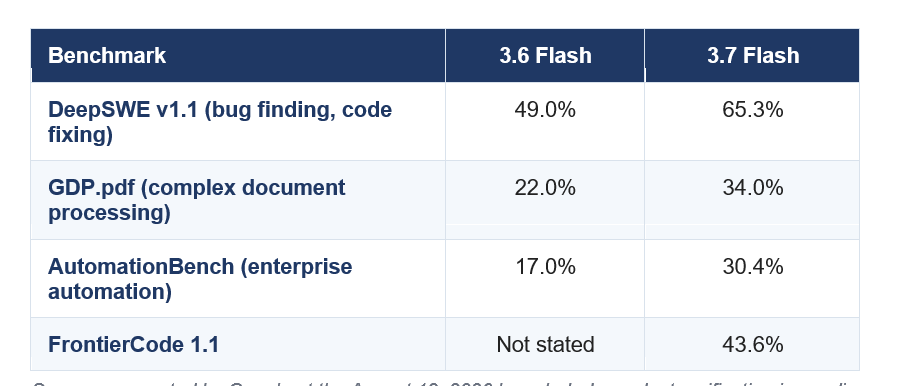
Scores as reported by Google at the August 13, 2026 launch. Independent verification is pending, so treat the numbers as directional rather than final.
Read the table and the story is clear. The DeepSWE jump from 49.0% to 65.3% is a big improvement on a real software-engineering benchmark that measures finding and fixing bugs, which is exactly what developers use a coding model for. The doubling on GDP.pdf, from 22.0% to 34.0%, points to much better handling of complex documents, and the AutomationBench leap from 17.0% to 30.4% shows stronger enterprise automation, the kind of multi-step work that agents do. These are not cosmetic gains; they are the difference between a model that often stalls on hard tasks and one that finishes more of them.
The honest caveat is scale. These are strong numbers for a Flash model, but Flash is the value tier, not the frontier, so a 65% on DeepSWE is excellent for the price rather than the best score any model can post. The premium models still lead the absolute top of these benchmarks. What Gemini 3.7 Flash offers is a large share of that top-tier coding ability at a fraction of the cost, which is the whole point of the Flash line and the reason these gains matter so much for budget-sensitive work.
The 50% Price Cut and the Catch
The headline everyone is repeating is that Gemini 3.7 Flash is 50% cheaper than 3.6 Flash. That is true, and it is a real reason to use it. But the full story has a catch that most launch coverage skips: the low price is an introductory promotion, not the permanent rate. Here are the numbers side by side.
Table 2: Gemini 3.7 Flash pricing (the catch)
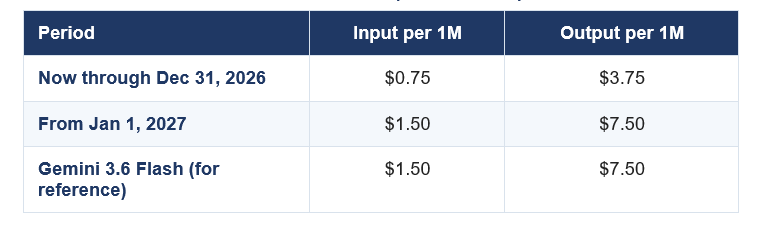
The introductory price runs through the end of 2026, then rises to the standard rate, which is the same as Gemini 3.6 Flash's pricing
Here is what the table means in plain terms. Through the end of 2026, Gemini 3.7 Flash genuinely costs half of 3.6 Flash, at $0.75 input and $3.75 output per million tokens. On January 1, 2027, it rises to $1.50 and $7.50, which is exactly what Gemini 3.6 Flash costs today. So the permanent price of 3.7 Flash is not a discount at all; it matches the old model, and you get the better model for the same money once the promo ends. The 50% saving is a real, time-limited window, not a lasting price cut.
READ THE PRICING BEFORE YOU BUDGET
The half-price rate on Gemini 3.7 Flash expires at the end of 2026. From January 1, 2027 it doubles to $1.50 input and $7.50 output per million tokens, the same as 3.6 Flash. This is good news either way, since you get a better model for the old price long term, but do not build a 2027 budget on the introductory number. If you run high volume, the promo window is a genuine opportunity to save now, and the post-promo rate is what to plan around.
The honest framing: the smart read is that Gemini 3.7 Flash is a free capability upgrade at the same long-term price, with a bonus half-price window through the end of the year. That is a very good deal, and better than a permanent cut would sound, because you are not trading quality for the lower price. Just remember the number changes in 2027 so your cost forecasts stay accurate.
For how it stacks up on value against every rival, see our best AI models of August 2026 ranking.
Coding and Agents: The Real Focus
Google was explicit that Gemini 3.7 Flash is built for coding and agents, calling it its most intelligent workhorse model yet for exactly those jobs. The benchmark gains back that up, and the qualitative improvements are aimed there too. Google says the model is better at adapting when it hits a roadblock, clarifying intent when a request is ambiguous, and following instructions with greater fidelity, which are precisely the behaviors that make or break a long agent run.
Those three improvements matter more than they sound. Agent tasks fail most often not because the model cannot write code, but because it gets stuck, misreads what you wanted, or drifts from the instructions over many steps. A model that recovers from roadblocks, asks for clarification when needed, and holds the instructions tightly is a model that finishes more multi-step work without you babysitting it. Combined with the low price that makes many agent calls affordable, that makes Gemini 3.7 Flash a strong choice for building agents on a budget.
For everyday coding, the value is just as clear. Early users report more aligned and improved responses on coding and reasoning tasks, and the DeepSWE gain suggests real improvement at finding and fixing bugs. For a developer who wants a fast, cheap model for the bulk of their coding, with a premium model reserved for the hardest problems, Gemini 3.7 Flash is exactly the kind of default that keeps costs down without giving up much quality.
Compare it against the dedicated coding agents in our best coding AI comparison and the Meta Muse Code review.
Where Gemini 3.7 Flash Still Falls Short
No review is complete without the limits, and Gemini 3.7 Flash has a few honest ones. The most noted is tone: some early users report that it remains reserved, meaning it can be cautious or restrained in how it responds, which not everyone loves. If you want a model with more personality or willingness to take a position, Flash may feel a little buttoned-up compared with some rivals.
The bigger structural limit is simply that it is a Flash model. It is the value tier, so on the very hardest reasoning and the most demanding tasks, the premium models still win, and Gemini 3.7 Flash is not trying to beat them there. If your work genuinely needs top-tier capability, this is not the model to reach for, and expecting flagship performance from a workhorse model at a workhorse price would be a mistake. The right mental model is that it is the best cheap model for most work, not the best model overall.
Finally, the benchmark numbers are Google's own, published at launch, and not yet independently verified. The gains are large and consistent enough to be believable, but the honest position until third-party testing lands is to treat them as a strong signal rather than a settled fact. As always with a launch-day model, the real test is how it holds up on your specific tasks over the coming weeks.
Gemini 3.7 Flash vs 3.6 Flash: Should You Switch?
For anyone already using Gemini 3.6 Flash, the switch to 3.7 is close to a no-brainer. You get meaningfully better coding, document, and automation performance, and through the end of 2026 you pay half the price for it. There is essentially no downside to moving up, because even after the promo ends the price simply matches what you already pay for 3.6 Flash, so you get the better model for the same long-term cost.
The nuance is what kind of gain to expect. Both are Flash models, so 3.7 does not feel like a different class of model in casual use, and light users may not notice a dramatic change. Where the upgrade shows is in the harder coding and agent work, where the benchmark jumps translate into finishing more tasks and getting stuck less often. If your usage leans on those, the switch is clearly worth it now; if it is light and conversational, it is still worth it but less dramatic, and either way there is no reason to stay on 3.6.
The switch verdict: move to Gemini 3.7 Flash now. You gain better performance immediately, you save 50% through the end of 2026, and your long-term price is unchanged from 3.6 Flash. The only thing to note is the January 2027 price step, which returns you to the current 3.6 Flash rate for a better model. That is a rare upgrade with no real catch beyond a promo that ends.
How to Access Gemini 3.7 Flash
Gemini 3.7 Flash launched with broad, day-one availability, which is a real advantage. You can use it through the Gemini API for building, in Google AI Studio for testing and prototyping, in Antigravity for coding workflows, and across Google Cloud Console, Vertex AI, and Gemini Enterprise for production and business deployments. That spread means whatever part of the Google stack you already use, the model is likely available there now.
For developers, the fastest path is Google AI Studio to try it and the Gemini API to build with it, and because it slots into the same interfaces as previous Flash models, switching is usually just a model-name change rather than a rewrite. For teams already on Vertex AI or Gemini Enterprise, it is available in those managed environments with the governance and scale controls those platforms provide. The Gemini app, which now serves around one billion monthly users, sits on top of this same model family, so the improvements flow to consumers as well as developers.
To get the most out of it, pair it with our 100 best Gemini prompts.
What This Says About Google's Strategy
Gemini 3.7 Flash is a window into how Google is competing in 2026, and the strategy is clear: iterate fast, price aggressively, and win the enormous middle of the market with value rather than only chasing the frontier. Shipping a better, cheaper Flash model every few weeks, while the Gemini app serves a billion monthly users, is a play for scale and developer mindshare, not just leaderboard bragging rights.
The context around the launch reinforces this. Reports indicate Google canceled a planned Gemini 3.5 Pro and is shifting focus toward Gemini 4, its next major model, while keeping the Flash line moving quickly in the meantime. In other words, Google is decoupling its fast, cheap workhorse cadence from its big flagship releases, letting Flash improve on a short clock while the next-generation model cooks separately. For users, that means the practical, everyday Gemini models keep getting better and cheaper regardless of when the next flagship arrives, which is a genuinely good position for anyone building on Google's stack.
Who Should Use Gemini 3.7 Flash?
Gemini 3.7 Flash is the right choice for a wide band of builders and teams who want strong coding and agent performance without premium prices. Here is the clear guidance by use case.
- Developers on a budget: yes, it is one of the best value coding models, especially with the half-price window through 2026.
- Agent builders: yes, the improvements to adapting, clarifying, and following instructions make it a strong pick for multi-step agent work at scale.
- High-volume products: yes, cheap and fast is exactly what you want when you make many calls, and the quality is now much higher.
- Existing 3.6 Flash users: yes, switch now, since you get a better model at half the price through 2026 and the same price after.
- Teams needing top-tier reasoning: look higher up the Gemini range, since Flash is the value tier, not the frontier.
Our verdict: Gemini 3.7 Flash is an excellent value release and one of the best cheap models for coding and agents in 2026. It delivers real, sizable improvements over 3.6 Flash, arrives at half the price through the end of the year, and reflects a Google strategy of shipping better, cheaper models fast. The honest caveats are that the discount expires in 2027, the benchmark numbers are Google's own for now, and it can feel reserved. None of those undercut the core recommendation: for coding and agent work on a budget, switch to it, use the promo window, and plan your 2027 costs around the standard rate.
Frequently Asked Questions
Q: What is Gemini 3.7 Flash?
Gemini 3.7 Flash is Google's newest low-cost workhorse AI model, launched August 13, 2026, and built for coding and agents. It is the most capable model in the Flash line, delivering strong performance at a fraction of premium-model prices, and it arrived just three weeks after Gemini 3.6 Flash through algorithmic improvements.
Q: How much does Gemini 3.7 Flash cost?
Through the end of 2026, Gemini 3.7 Flash costs $0.75 per million input tokens and $3.75 per million output, half the price of Gemini 3.6 Flash. On January 1, 2027, the price rises to $1.50 input and $7.50 output, which is the same as 3.6 Flash. So the discount is an introductory promotion, not a permanent rate.
Q: How good is Gemini 3.7 Flash at coding?
It is much better than 3.6 Flash at coding. On the DeepSWE benchmark for finding and fixing bugs, it jumped from 49.0% to 65.3%, and Google calls it its most intelligent workhorse model for coding and agents. It is excellent value for coding, though premium models still lead the hardest tasks.
Q: What is the difference between Gemini 3.7 Flash and 3.6 Flash?
Gemini 3.7 Flash is meaningfully better at coding, complex documents, and enterprise automation, with big benchmark gains, and it is half the price through 2026. It also adapts better to roadblocks and follows instructions more closely. It arrived just three weeks after 3.6 Flash via algorithmic improvements rather than a bigger model.
Q: Is Gemini 3.7 Flash really 50% cheaper?
Yes, but only through the end of 2026. The introductory price of $0.75 input and $3.75 output per million tokens is half of 3.6 Flash. From January 1, 2027, it rises to $1.50 and $7.50, matching the old model. So you get a better model at the same long-term price, plus a half-price window for now.
Q: What are the Gemini 3.7 Flash benchmarks?
Google reported DeepSWE v1.1 rising from 49.0% to 65.3%, GDP.pdf document processing from 22.0% to 34.0%, AutomationBench from 17.0% to 30.4%, and FrontierCode 1.1 at 43.6%. These are strong gains for a value model, though they are Google's own numbers and await independent verification.
Q: How do I access Gemini 3.7 Flash?
Gemini 3.7 Flash is available in the Gemini API, Google AI Studio, Antigravity, Google Cloud Console, Vertex AI, and Gemini Enterprise. For developers, AI Studio is the fastest way to try it and the API to build with it, and switching from a previous Flash model is usually just a model-name change.
Q: Should I switch to Gemini 3.7 Flash?
Yes, if you use Gemini 3.6 Flash. You get better coding, document, and automation performance, half the price through 2026, and the same price as 3.6 Flash after. There is essentially no downside, so the switch is worth it now, especially for coding and agent workloads that benefit most from the gains.
Q: Is Gemini 3.7 Flash good for agents?
Yes. Google built it for coding and agents, and it improves at adapting to roadblocks, clarifying ambiguous requests, and following instructions closely, which are the behaviors that decide whether long agent runs succeed. Combined with its low price for many calls, it is a strong choice for building agents on a budget.
Recommended Blogs
- Gemini 3.6 Flash review
- Gemini Flash-Lite review
- Best AI models of August 2026
- Best coding AI compared
- 100 best Gemini prompts
Resources and Community
Join our community of 70,000+ AI enthusiasts and learn to build powerful AI applications. Whether you are a beginner or an experienced developer, Build Fast with AI helps you understand and implement AI in your projects.
- Website (buildfastwithai.com)
- LinkedIn (Build Fast with AI)
- Instagram (@buildfastwithai)
- Founder Twitter (@satvikps)
- Twitter (@BuildFastWithAI)
Agentic AI Launchpad 2026
A structured 6-week cohort program that takes you from AI basics to building and deploying real-world agentic AI systems. Includes live sessions, expert mentorship, project reviews, and a builder community network.
Ready to go from learning to building? Join the next cohort: Agentic AI Launchpad 2026
Free AI Resources
Access free tools, workshops, and micro-learning to keep building:
Follow Build Fast with AI for honest, updated reviews of every major model launch, and check back as independent Gemini 3.7 Flash benchmarks arrive.

