

Best AI Models August 2026: Ranked by Use Case, Price & Benchmarks
There is no single best AI model in August 2026, and anyone who tells you otherwise is selling something. GPT-5.6 Sol leads the overall benchmarks, Claude Opus 5 tops agentic and coding, Gemini 3.1 Pro wins pure reasoning, and open models like Kimi K3 and DeepSeek V4 crush everyone on value. The right pick depends entirely on your task and budget, so this guide ranks the top models by use case with the current standings.
The short version: for the best all-round quality use GPT-5.6 Sol or Claude Opus 5, for coding and agents use Claude Opus 5, for reasoning and research use Gemini 3.1 Pro, for the lowest cost use GPT-5.6 Luna or an open model, and for open weights use Kimi K3 or DeepSeek V4. The full ranking and the reasoning behind each pick are below.
QUICK ANSWER
In August 2026, GPT-5.6 Sol is the top overall model on the LLM Stats snapshot at 57.2, just ahead of Claude Opus 5 at 56.5 and Claude Fable 5 at 56.3. Claude Opus 5 leads the Artificial Analysis Agentic Index, Gemini 3.1 Pro leads reasoning benchmarks, and open models lead on cost. Match the model to the task rather than chasing one winner.
The August 2026 AI Model Rankings
Here is the single ranking that matters: the top models this month, what each one is best at, and roughly where it sits on price. Use it as the map, then read the section for whichever row fits your need.
Table 1: Best AI models, August 2026
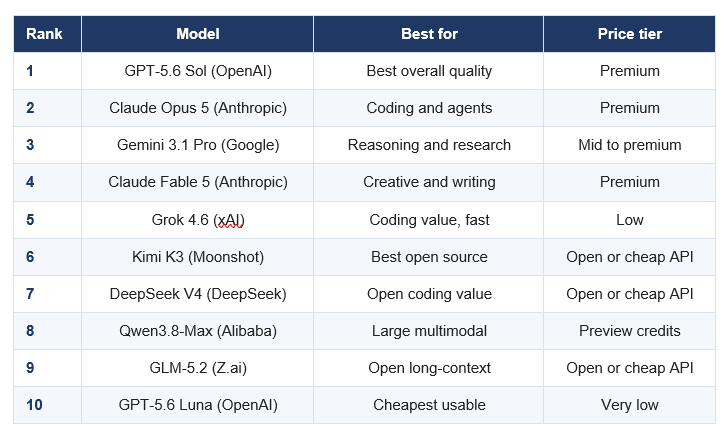
Standings blend the LLM Stats overall snapshot (Aug 7, 2026) and the Artificial Analysis indices. Rankings shift by benchmark, so read the use-case sections rather than fixating on the exact order.
Best Overall: GPT-5.6 Sol and Claude Opus 5
For the best all-round model in August 2026, it is a close race between GPT-5.6 Sol and Claude Opus 5, and either is a safe default. On the LLM Stats overall snapshot from August 7, GPT-5.6 Sol leads at 57.2, with Claude Opus 5 at 56.5 and Claude Fable 5 at 56.3 right behind. Those margins are tiny, which means in practice all three feel like frontier models and your task matters more than the leaderboard position.
The split between them is about personality and strength. GPT-5.6 Sol is the strongest generalist, excellent across writing, analysis, and multimodal work, and it comes with OpenAI's mature ecosystem. Claude Opus 5 edges ahead the moment the work turns into real engineering or multi-step agent tasks, where it tops the Artificial Analysis Agentic Index at 55.3, ahead of GPT-5.6 Sol at 54.0. If you want one model for everything, GPT-5.6 Sol is the pick. If your everything leans technical, Claude Opus 5 is.
Read the full GPT-5.6 rview and Claude Opus 5 review for the deep dives behind these rankings.
Best for Coding nd Agents: Claude Opus 5
For coding and agentic workflows, Claude Opus 5 is the model to beat in August 2026. It leads the Artificial Analysis Agentic Index and posts the top Terminal-Bench score among the coding agents at 86.7% inside Claude Code, ahead of GPT-5.6 Terra and Grok. When correctness on complex, multi-file work matters, it is the most reliable choice, which is why it is the default in most professional coding setups.
The challengers are real, though, and two of them compete on value rather than peak accuracy. Grok 4.6 from xAI is fast and aggressively cheap, making it the best intelligence-per-dollar option for high-volume coding, and Meta's new Muse Code agent undercuts everyone on price while landing just behind Claude Code on the benchmarks. For raw quality, Claude Opus 5 wins. For cost-sensitive coding at scale, Grok 4.6 and the open models below are the smarter spend.
See the head-to-head in our best coding AI comparison, the Meta Muse Code review, and the Grok 4.6 breakdown.
Best for Reasoning: Gemini 3.1 Pro
For deep reasoning, research, and long-document work, Gemini 3.1 Pro leads the pure benchmarks in August 2026. It posts a 94.3% on GPQA Diamond, a graduate-level science reasoning test, and pairs that with a very large context window that lets you paste entire reports, codebases, or datasets into a single prompt. For analysis where the model needs to hold a lot of information and reason carefully over it, Gemini 3.1 Pro is the strongest tool.
It is also a value story, not just a quality one. Google prices the Gemini line aggressively, and the Flash tiers give you strong reasoning at a fraction of the premium-model cost, which makes Gemini the smart pick when you want top-tier thinking without top-tier bills. If your work is research-heavy, multimodal, or context-hungry, start with Gemini 3.1 Pro and drop to Flash where speed and cost matter more than the last few points of quality.
Best for Value: GPT-5.6 Luna and Gemini Flash
If cost is your first concern, the cheapest genuinely usable models in August 2026 are GPT-5.6 Luna and the Gemini Flash tiers. GPT-5.6 Luna runs around $0.31 per million tokens at a typical input-output mix, and Gemini 3.5 Flash-Lite is close behind, so both let you run high volumes for very little. After OpenAI's July 30 price cut, the balanced GPT-5.6 Terra tier now matches the older GPT-5.5 quality at about 60% less, which reset the value bar for the whole market.
The honest tradeoff is that these cheap tiers are tuned for speed and volume, not for the hardest reasoning or the trickiest code. Use them for classification, summarization, drafting, and high-frequency tasks where good-enough at scale beats perfect-but-expensive. Reach for a premium model only on the harder jobs, and you get most of the quality at a fraction of the cost, which is exactly how the highest-volume AI products are built.
Best Open Source: Kimi K3 and DeepSeek V4
For open weights you can self-host or run through cheap APIs, Kimi K3 and DeepSeek V4 lead in August 2026. Kimi K3 from Moonshot is the standout, sitting near the top of the independent long-horizon agent rankings and delivering close-to-frontier quality with open weights. DeepSeek V4 is the value champion for coding, offering strong results at a price that makes the closed models look expensive. Both prove that the open-source gap to the frontier has nearly closed.
Two more open models round out the field. GLM-5.2 from Z.ai is a strong open long-context option, and Alibaba's Qwen3.8-Max is a massive 2.4 trillion parameter multimodal model, though it remains in a paid preview without published benchmarks. For most teams, the practical open picks are Kimi K3 for all-round quality and DeepSeek V4 for coding value, both of which you can run without sending your data to a closed vendor.
Explore the full field in our best open source AI models collection, plus the Kimi K3 review and DeepSeek V4 review.
What Changed This Month
August 2026 has been busy, and three shifts matter for this ranking. First, xAI shipped Grok 4.6, a post-training upgrade on the same 1.5T foundation that pushes its coding value even further and keeps it the intelligence-per-dollar leader. Second, Meta entered the coding-agent race with Muse Code and its Muse Spark 1.2 model, undercutting everyone on price and pressuring the whole category. Third, OpenAI's late-July price cut reset the value tier, making GPT-5.6 Terra and Luna far cheaper for the same quality.
The trend under all of it: the frontier is getting cheaper, not just better. The top models are clustered within a few points of each other, the open models are nearly caught up, and price is now the main battleground. For you, that means the smart move in August 2026 is less about chasing the single best model and more about matching each task to the cheapest model that clears the bar for it.
For last month's baseline, see our best AI models of July 2026 ranking, and for the all-time view, our full ranked analysis.
How to Choose the Right Model
The fastest way to pick is to match the model to the job, not to the leaderboard. Here is the simple decision guide that covers almost every use case.
- Want one model for everything: GPT-5.6 Sol, the strongest all-round generalist this month.
- Coding and agents: Claude Opus 5 for quality, Grok 4.6 or DeepSeek V4 for value at scale.
- Reasoning, research, long documents: Gemini 3.1 Pro, with Flash for cheaper thinking.
- Writing and creative work: Claude Fable 5, closely followed by GPT-5.6 Sol.
- Lowest cost at high volume: GPT-5.6 Luna or Gemini Flash-Lite.
- Open weights and data privacy: Kimi K3 for quality, DeepSeek V4 for coding value.
My overall pick for most people: keep Claude Opus 5 or GPT-5.6 Sol as your main model, add a cheap model like GPT-5.6 Luna or an open model for high-volume tasks, and use Gemini 3.1 Pro when a job needs heavy reasoning over a lot of context. That three-model stack covers nearly everything at a sensible cost, and it is how most serious AI users actually work in 2026.
Frequently Asked Questions
Q: What is the best AI model in August 2026?
GPT-5.6 Sol is the top overall model in August 2026, leading the LLM Stats snapshot at 57.2, just ahead of Claude Opus 5 at 56.5. But the margins are tiny, and Claude Opus 5 leads agentic and coding while Gemini 3.1 Pro leads reasoning. The best model depends on your task rather than a single ranking.
Q: What is the best AI model for coding right now?
Claude Opus 5 is the best AI model for coding in August 2026, leading the agentic index and topping Terminal-Bench inside Claude Code. For cheaper coding at scale, Grok 4.6 and the open model DeepSeek V4 offer close performance at a fraction of the price, so quality favours Claude and value favours Grok or DeepSeek.
Q: Which AI model is best for reasoning?
Gemini 3.1 Pro leads reasoning in August 2026, scoring 94.3% on the graduate-level GPQA Diamond benchmark and pairing it with a very large context window. It is the strongest choice for research, analysis, and long-document work, and Google prices it aggressively, so it is also a strong value pick for heavy reasoning tasks.
Q: What is the cheapest good AI model?
GPT-5.6 Luna is the cheapest genuinely usable model at around $0.31 per million tokens, with Gemini 3.5 Flash-Lite close behind. After OpenAI's July price cut, the balanced GPT-5.6 Terra tier matches older GPT-5.5 quality at about 60% less. These are best for high-volume tasks rather than the hardest reasoning.
Q: What is the best open source AI model in 2026?
Kimi K3 from Moonshot is the best all-round open source model in August 2026, sitting near the top of independent long-horizon rankings with open weights. DeepSeek V4 is the best open model for coding value. Both deliver close-to-frontier quality you can self-host or run through cheap APIs without a closed vendor.
Q: Is GPT-5.6 better than Claude Opus 5?
GPT-5.6 Sol narrowly leads Claude Opus 5 on the overall benchmark snapshot, but Claude Opus 5 leads on agentic and coding tasks. GPT-5.6 is the better generalist, and Claude Opus 5 is the better choice for engineering and multi-step agent work. The gap is small enough that either is an excellent default.
Q: Which AI model should I use for my business?
For most businesses, use a premium model like Claude Opus 5 or GPT-5.6 Sol for important work, add a cheap model like GPT-5.6 Luna for high-volume tasks, and use Gemini 3.1 Pro for research-heavy jobs. This three-model stack balances quality and cost, which is how most AI-driven teams operate in 2026.
Q: What changed in the AI model rankings this month?
In August 2026, xAI shipped Grok 4.6 with better coding value, Meta launched the cheap Muse Code agent, and OpenAI's price cut reset the value tier. The overall theme is that the frontier is getting cheaper, the top models are clustered close together, and open models have nearly caught up, so price is now the main battleground.
Recommended Blogs
Resources and Community
Join our community of 70,000+ AI enthusiasts and learn to build powerful AI applications. Whether you are a beginner or an experienced developer, Build Fast with AI helps you understand and implement AI in your projects.
- Website (buildfastwithai.com)
- LinkedIn (Build Fast with AI)
- Instagram (@buildfastwithai)
- Founder Twitter (@satvikps)
- Twitter (@BuildFastWithAI)
References
We update this ranking every month as new models launch. Bookmark it and follow Build Fast with AI for honest model reviews and comparisons.

