



Claude Fable 5 answers 95 out of every 100 real GitHub issues correctly, and it costs 71 times more per output token than the model sitting three rows below it on the same leaderboard. That gap is the entire story of picking an AI model in 2026: raw capability has stopped being the hard question, and cost per finished task has become the only one that matters.
I have tested every model below through the API and inside real products over the past month, tracking not just benchmark scores but what each one actually costs to finish a job. Here is the honest ranking, sorted by what you are trying to do rather than by a single number, with current prices, live benchmarks, and a clear winner for coding, reasoning, agents, budget, and open weights.
For the month-by-month view, our best AI models leaderboard hub tracks every ranking as it changes. This analysis is the deep version: fewer lists, more judgment.
The State of AI Models in July 2026
July 2026 delivered the most crowded frontier in the history of AI, with three flagship launches inside two weeks. OpenAI opened its GPT-5.6 family (Sol, Terra, and Luna) to general availability on July 9 after a government-gated preview. Anthropic shipped Claude Sonnet 5 on June 30 and brought Claude Fable 5 back on July 1 after an 18-day government suspension. Google, xAI, and Meta all refreshed their lineups in the same window.
The result is a market where five labs now sit inside a few points of each other on most benchmarks, and the real separation has moved to price and specialization. A frontier score no longer wins the sale, because three other models match it for a quarter of the cost. My read: 2026 is the year the AI model became a commodity input and the loop around it became the product.
One time-sensitive detail worth flagging before you commit a budget. Claude Sonnet 5 ships with introductory pricing of $2 input and $10 output per million tokens only through August 31, 2026, after which it rises to $3 and $15. If Sonnet 5 fits your stack, locking usage in before that date is real money saved.
Master Benchmark and Pricing Table
Here is the full field ranked by capability tier, with the one benchmark that best defines each model and its current API price. Prices are per million tokens, input then output, at list rate. Read this as the map, and the sections below as the directions.
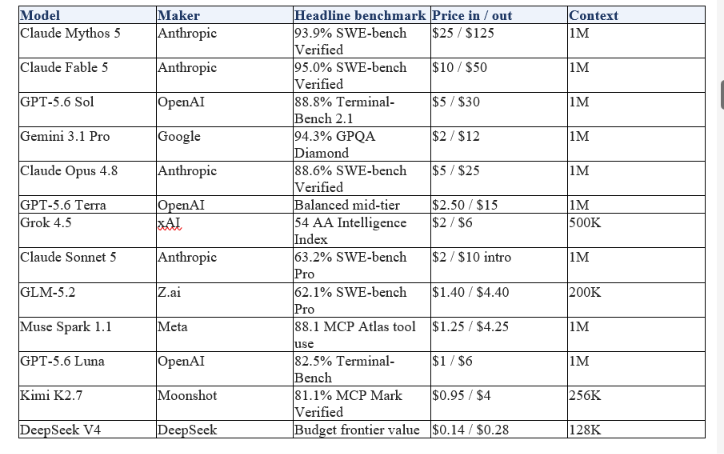
Notice the spread. From DeepSeek V4 at $0.28 output to Claude Mythos 5 at $125, the top of this table costs roughly 446 times the bottom. No workload needs the most expensive model for every call, which is exactly why the smart pattern in 2026 is routing between tiers rather than standardizing on one.
Best Overall AI Model: Claude Fable 5
Claude Fable 5 is the best overall AI model in 2026, full stop, and it earns the title on correctness rather than price. Anthropic's flagship posts 95.0% on SWE-bench Verified and 80.3% on SWE-bench Pro, the highest public scores on record for real-world coding, and it pairs that with the most careful reasoning of any model I have tested. When a task must be right the first time, Fable 5 is the one I reach for.
The catch is cost. At $10 input and $50 output per million tokens, Fable 5 is five to ten times pricier than the value tier, and it generates thorough, sometimes verbose output that adds up. My honest take: Fable 5 is worth every cent for hard, correctness-critical work, and a waste of money for routine calls a cheaper model handles fine. Treat it as your senior specialist, not your default.
Above Fable 5 sits Claude Mythos 5, the same underlying model with safety classifiers lifted, restricted to approved Project Glasswing partners at $25 and $125 per million tokens. Mythos leads the record books on paper, but since almost nobody can access it, Fable 5 is the real-world champion for everyone else.
Fable 5's coding lead is the through-line in our GLM-5.2 vs Claude vs GPT-5.6 coding comparison, where it tops the field on the hardest tasks while the value models close in on the easy ones.
Best AI Model for Coding
The best coding model depends on difficulty: Claude Sonnet 5 for everyday production work, Claude Fable 5 for the hardest problems, and GLM-5.2 or Kimi K2.7 when budget rules. Anthropic owns this category top to bottom in 2026, and the only real question is which Claude tier fits your task and wallet.
My recommended setup for a real engineering team is a two-model stack: Sonnet 5 as the default that handles most pull requests, with Fable 5 held in reserve for the gnarly debugging session that a cheaper model would spin on. GPT-5.6 Sol earns a spot when raw execution speed matters, since its 750 tokens per second on Cerebras hardware changes how agentic coding feels.
GPT-5.6 Sol is the speed pick for agentic coding, and our GPT-5.6 Sol, Terra, and Luna review covers where it wins and where Claude still pulls ahead on hard debugging.
Best AI Model for Reasoning and Math
For reasoning and math, Gemini 3.1 Pro is the best accessible model, and GPT-5.6 Sol leads on the hardest STEM problems. Google's flagship scores 94.3% on GPQA Diamond and 95.1% on MATH while costing only $2 input and $12 output, which makes it the strongest reasoning value on the market by a wide margin.
GPT-5.6 Sol takes the crown on the very hardest STEM and research reasoning, where OpenAI tuned it specifically for graduate-level problems, and it leads GPQA among models people can actually buy. Claude Mythos 5 outscores both on paper with 94.6% GPQA Diamond, but its Project Glasswing restriction keeps it out of reach for normal teams, so I leave it off the practical podium.
Quotable version: in 2026, the best reasoning you can actually access costs $2 per million tokens, not $25. The frontier has become a bargain for everyone except the labs paying to train it.
Best AI Model for Agents and Tool Use
For agents and tool use, GPT-5.6 Sol leads on speed and Meta Muse Spark 1.1 leads on value, with Claude Code plus Fable 5 as the premium choice for reliability. Agentic work rewards a different profile than raw benchmarks: fast tool calls, honest failure reporting, and clean multi-step orchestration matter more than a single test score.
Muse Spark 1.1 is my surprise pick here. Meta's model tops the MCP Atlas tool-use benchmark at 88.1, generalizes to new MCP servers without examples, and costs just $1.25 input, which makes it the cheapest serious agent brain available. GPT-5.6 Sol wins when latency matters, and its native multi-agent and programmatic tool-calling features let one model turn compose several tools in a single pass. For the deepest reliability on long-running jobs, Claude Code paired with Fable 5 remains the setup I trust with the least supervision.
Muse Spark 1.1's tool-use lead is the headline of our Meta Muse Spark review, where it undercuts every rival on price while topping the MCP charts.
If you want to build agentic loops around any of these models, the agent orchestration cookbooks in gen-ai-experiments walk through tool calling, verification, and multi-agent setups end to end.
Best Value and Budget Models
For value, Grok 4.5 is the cheapest frontier-tier model and DeepSeek V4 is the cheapest usable model overall. If you want near-top capability without top pricing, this tier is where 2026 gets genuinely exciting, because the quality-per-dollar has never been better.
Grok 4.5 is the standout, ranked fourth on the independent Artificial Analysis Intelligence Index at 54 while costing a third of the leaders, with built-in web and X search no rival can match. DeepSeek V4 sits at the opposite extreme: at $0.28 output per million tokens, it makes always-on summarization and classification pipelines almost too cheap to meter. My contrarian point: most teams overpay by defaulting to a flagship for jobs a $0.28 model finishes just as well.
Best Open-Weight Models
The best open-weight models in 2026 are GLM-5.2 for coding, Kimi K2.7 for tool use, and DeepSeek V4 for cost, and all three now rival closed models on real tasks. Open weights matter for teams that need self-hosting, fine-tuning, or data control that a closed API cannot give, and the gap to the frontier has narrowed to a handful of points.
GLM-5.2 from Z.ai posts 62.1% on SWE-bench Pro at $1.40 input, close enough to mid-tier closed models that many teams cannot tell the difference in production. Kimi K2.7 from Moonshot leads open tool use at 81.1% on MCP Mark Verified. DeepSeek V4 remains the cost king. The one caveat: none of these match Claude Fable 5 on the hardest problems, so open weights are a value and control play, not a capability crown.
We put the open-weight coding contenders head to head with the closed flagships in our GLM-5.2 vs Claude vs GPT-5.6 comparison, including where the price gap does and does not justify the quality gap.
Best Multimodal Model
Gemini 3.1 Pro is the best multimodal model in 2026, combining top-tier vision, native video understanding, and frontier reasoning at $2 input and $12 output. Google's long lead in multimodality holds, and no competitor matches its combination of image, video, and document understanding in a single model at this price.
Meta Muse Spark 1.1 deserves a mention for the widest input stack, since it natively accepts text, image, video, audio, and PDF through one endpoint. For pure multimodal reasoning quality, though, Gemini 3.1 Pro stays ahead, and its 94.3% GPQA score means you are not trading intelligence for vision. If your product touches images or video, Gemini is the default I would start with.
How to Choose: Cost Per Task, Not Per Token
Choose your model by cost per finished task, not by the per-token sticker price, because token efficiency varies enough to flip the ranking. A model that costs twice as much per token but finishes the job in half the tokens is a tie on price and a win on quality. The sticker price is the trap; the total is the truth.
Two factors decide real cost. First, how many tokens a model burns to complete a task, which varies by 20% to 30% between architectures for the same job. Second, how often it succeeds on the first try, since a cheap model that needs three retries is not cheap. I score every model on cost per completed task in my own evals, and the ranking often looks nothing like the per-token table.
The winning strategy in 2026 is a routed stack, not a single model. Send the routine 80% of calls to a value model like Luna, Grok 4.5, or DeepSeek V4, and reserve Fable 5 or Sol for the hard 20% where quality pays for itself. Switching cost is near zero because every major provider is SDK-compatible, so there is no excuse to overpay on easy calls.
Upcoming Models to Watch
The next wave is already visible, and two shifts stand out for the second half of 2026. Google is rolling Gemini 3.5 Pro and Gemini 3.5 Flash into wider availability, aimed squarely at the reasoning-value and high-volume tiers. Anthropic is expected to expand the Sonnet 5 and Fable 5 lineup, and OpenAI has signaled that a larger GPT generation is in the pipeline.
My prediction: the next six months belong to the cheap tiers, not the flagships. The frontier is close to saturated on public benchmarks, so the fiercest competition, and the biggest wins for builders, will come from models that deliver 90% of frontier quality at a tenth of the cost. Watch the value row of the table, because that is where the money moves next.
We refresh this ranking every month. For last month's board and the trend lines, see our July 2026 model ranking and the earlier June 2026 leaderboard.
Frequently Asked Questions
What is the best AI model in 2026?
Claude Fable 5 is the best overall AI model in 2026, with 95.0% on SWE-bench Verified and the most careful reasoning of any accessible model, at $10 input and $50 output per million tokens. For most teams, though, the best model depends on the task, and a routed stack of Fable 5 plus a cheaper value model beats standardizing on one.
What is the best AI model for coding?
Claude Sonnet 5 is the best everyday coding model at $2 / $10 introductory pricing, and Claude Fable 5 is best for the hardest problems at 95% SWE-bench Verified. For budget coding, GLM-5.2 and Kimi K2.7 deliver close performance at a fraction of the cost. Anthropic leads the coding category top to bottom in 2026.
Which AI model is best for reasoning?
Gemini 3.1 Pro is the best accessible reasoning model, scoring 94.3% on GPQA Diamond and 95.1% on MATH at $2 / $12 per million tokens. GPT-5.6 Sol leads on the very hardest STEM problems. Claude Mythos 5 scores higher on paper but is restricted to approved Project Glasswing partners.
What is the cheapest good AI model?
DeepSeek V4 is the cheapest usable model at $0.14 input and $0.28 output per million tokens, ideal for classification, extraction, and summarization. Grok 4.5 is the cheapest frontier-tier model at $2 / $6, offering near-top quality with native web and X search.
Is Claude better than GPT in 2026?
For hard coding and careful reasoning, yes: Claude Fable 5 leads SWE-bench Verified at 95% and outperforms GPT-5.6 Sol on the toughest debugging. For agentic execution speed and STEM reasoning, GPT-5.6 Sol is stronger. The honest answer is that they win different categories, so the best choice depends on your workload.
What is the best open source AI model?
GLM-5.2 is the best open-weight model for coding at 62.1% SWE-bench Pro, Kimi K2.7 leads open tool use at 81.1% MCP Mark Verified, and DeepSeek V4 is the cheapest. All three now rival mid-tier closed models on real tasks, though none match Claude Fable 5 on the hardest problems.
Recommended Blogs
● GPT-5.6 Sol Terra Luna review
● GLM-5.2 vs Claude vs GPT-5.6
● Best AI Models June leaderboard
Resources and Community
Join our community of 70,000+ AI enthusiasts and learn to build powerful AI applications. Whether you are a beginner or an experienced developer, Build Fast with AI helps you understand and implement AI in your projects.
● Website (buildfastwithai.com)
● LinkedIn (Build Fast with AI)
● Instagram (@buildfastwithai)
Agentic AI Launchpad 2026
A structured 6-week cohort program that takes you from AI basics to building and deploying real-world agentic AI systems. Includes live sessions, expert mentorship, project reviews, and a builder community network.
Ready to go from learning to building? Join the next cohort: Agentic AI Launchpad 2026
Free AI Resources
Access free tools, workshops, and micro-learning to keep building:
● AI Workshops (free resources and recordings)
● Unrot (learn AI in 5 minutes a day)
Found this ranking useful? Follow Build Fast with AI for a fresh model leaderboard every month, hands-on reviews, and every major launch, and subscribe so the next update lands in your inbox.
References
● Intelligence Index (Artificial Analysis)

