



Gemini 3.6 Flash Review: Faster, Cheaper, Quieter
Google shipped Gemini 3.6 Flash on July 21, 2026, and the headline number is not a benchmark score. It is 17 percent. That is how many fewer output tokens the model burns compared to Gemini 3.5 Flash on the Artificial Analysis Index, and on individual evals like DeepSWE the reduction reaches 65 percent.
Token efficiency sounds like a footnote until you run agents in production. Then it is the whole bill. Google cut the output price from 9 dollars to 7.50 dollars per million tokens, and combined with the efficiency gain, the effective cost per completed task drops roughly 31 percent, and up to about 71 percent on agentic coding workloads. That is the real release here: not a smarter model, a quieter one.
I have spent the days since launch going through the benchmark tables, the pricing page, and the early community tests, including the ones Google would rather you skipped. Gemini 3.6 Flash is a genuinely strong upgrade with one glaring weakness and one benchmark result that nobody is talking about loudly enough. Here is the full picture.
What Is Gemini 3.6 Flash?
Gemini 3.6 Flash is Google's new default workhorse model, released on July 21, 2026 as the mid-tier option between the budget Flash-Lite line and the Pro line. It builds directly on Gemini 3.5 Flash and targets three things: coding, knowledge work, and multimodal tasks, with a specific focus on agentic workflows where the model runs many steps without a human watching.
It arrived as part of a three-model drop. Gemini 3.5 Flash-Lite handles high-throughput, low-latency jobs like agentic search and document processing at 0.30 dollars per million input tokens and 2.50 dollars per million output. Gemini 3.5 Flash Cyber is the odd one out, a specialized build fine-tuned to find, validate, and patch software vulnerabilities, restricted to governments and trusted partners through a limited-access pilot. Google also used the same week to tease Gemini 4, which tells you how it views this release: a tune-up before the main event.
If you want the full arc of how Google got here, the Google Gemini and Google AI collection tracks every model in the family with benchmarks and pricing as they ship.
The specs are straightforward. One million input tokens of context, a 65,536 token output cap, and native multimodal input. What changed is not the shape of the model, it is the discipline. Google says 3.6 Flash completes complex workflows in fewer reasoning steps and fewer tool calls, with higher precision on code edits and fewer unwanted changes to files it was not asked to touch.
Gemini 3.6 Flash is not trying to be the smartest model in the room. It is trying to be the one that stops talking and finishes the job.
Pricing: The Real Cost Drop Is Bigger Than the Sticker
Gemini 3.6 Flash costs 1.50 dollars per million input tokens and 7.50 dollars per million output tokens, down from 9 dollars on output for Gemini 3.5 Flash. Cached input drops to 0.15 dollars per million, a 90 percent discount that matters enormously if you are re-sending the same system prompt or document across thousands of agent calls.
The sticker cut is about 17 percent on output. The real cut is larger, because you are also buying fewer tokens to get the same work done. Stack the price reduction on top of the 17 percent token efficiency gain and the effective cost per completed task falls around 31 percent. On agentic coding workloads, where the model previously burned enormous numbers of reasoning tokens looping through tool calls, the saving reaches roughly 71 percent.
That second number is the one worth internalizing. A 71 percent cost reduction on agentic coding is not an incremental pricing move, it changes which products are viable. Workflows that cost too much to run at scale in June are affordable in July, with no change to your code beyond a model string.
For context on what you were paying before, our Gemini 3.5 Flash review broke down the previous generation's pricing and where it fit against the Pro tier.
One caution before you celebrate. Token efficiency gains are measured on benchmark suites, not on your specific prompts. If your workload is dominated by long outputs the model cannot compress, like generating full documents, you will see the sticker discount and little more. Agentic loops are where the compounding happens, because that is where wasted reasoning tokens were piling up.
Benchmarks: Where 3.6 Flash Beats 3.5 Flash
Gemini 3.6 Flash beats Gemini 3.5 Flash on every benchmark Google published, and on several the gap is large enough to change how you would use the model. The most dramatic gains are in machine learning engineering, autonomous software fixes, and long-context retrieval.
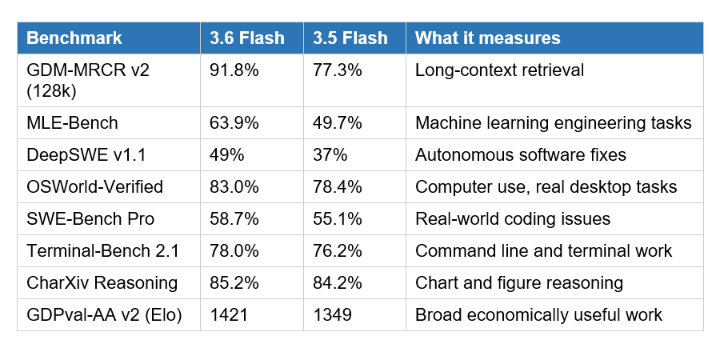
Three results deserve comment. MLE-Bench jumping from 49.7 to 63.9 percent is a 14 point gain on tasks that involve building and tuning machine learning pipelines, which is unusually large for a mid-generation refresh. DeepSWE climbing from 37 to 49 percent matters because that eval measures whether a model can fix real software issues on its own, and it is also where Google reports the 65 percent token reduction, meaning the model got both more capable and more concise on the same task.
OSWorld-Verified at 83.0 percent is the quiet one. That benchmark measures computer use, driving a real desktop environment through clicks and keystrokes, and 3.6 Flash ships with a built-in client-side computer use tool. A model that both scores well on desktop control and costs 71 percent less per agentic task is a different proposition from one that only does chat.
If you want to see how these numbers sit against the wider field rather than just the previous Flash, our ranked analysis of the best AI models in 2026 puts every frontier release on the same scale.
The Long-Context Result Nobody Is Talking About
The single biggest jump in the entire release is long-context retrieval: GDM-MRCR v2 at 128k context went from 77.3 percent on 3.5 Flash to 91.8 percent on 3.6 Flash. That is a 14.5 point gain on the benchmark that measures whether a model can actually find and use information buried deep inside a very long input.
Coverage of this launch has focused almost entirely on token efficiency and price, which is understandable because those are the numbers Google led with. But long-context reliability is the difference between a million token window that is a marketing spec and one that is an engineering tool. Plenty of models advertise huge context windows and then quietly lose the middle of the document.
Independent analysis puts it plainly: where 3.6 Flash wins against competitors is long-context retrieval and chart-based reasoning, and it wins by a margin that is not close. If your product feeds the model entire codebases, long legal documents, research papers, or multi-hour transcripts, this is the result that should drive your decision, not the price cut.
My honest read is that Google buried the lede. A cheaper model is a procurement conversation. A model that reliably reads a million tokens is an architecture conversation, because it removes chunks of retrieval plumbing you previously had to build yourself.
That said, retrieval pipelines are not obsolete. If you are building document-heavy systems, the gen-ai-experiments cookbook collection has runnable RAG and long-context patterns worth testing against a raw one million token prompt before you decide which approach your product actually needs.
Speed and Latency: A Split Verdict
Gemini 3.6 Flash outputs 280 tokens per second, ranked first for speed across all models Artificial Analysis evaluates, but it takes 12.32 seconds to produce its first token against a median of 2.79 seconds for comparable reasoning models. That combination produces a split verdict that depends entirely on what you are building.
For agentic and batch work, this profile is close to ideal. The model thinks for a while up front, then streams output faster than anything else on the board, and the total time to finish a multi-step task lands well. Nobody is watching a cursor blink during an autonomous coding run.
For interactive chat, a 12 second wait before the first word appears is rough. Users read time to first token as responsiveness, and no amount of raw throughput afterwards fully compensates for a long silence at the start. If you are putting this model behind a consumer chat interface, test that latency against your own expectations before committing.
This is where the sibling model earns its place. Gemini 3.5 Flash-Lite exists precisely for low-latency, high-throughput work at 0.30 dollars per million input tokens, and for a snappy chat surface it is very likely the better pick even though it is the weaker model on paper.
The same trade-off showed up in the previous generation, and we measured it in detail in our Gemini 3.1 Flash Lite versus 2.5 Flash speed and cost comparison, which is a useful reference for how Google positions Lite tiers against full Flash models.
Where Gemini 3.6 Flash Still Loses
Gemini 3.6 Flash does not lead the field on coding, and early community testing found real weaknesses in frontend generation and spatial reasoning that the benchmark tables do not capture. Any review that skips this part is selling you something.
On the competitive picture, GPT-5.6 Luna and Grok 4.5 lead on coding benchmarks including SWE-Bench Pro and DeepSWE, and Claude Sonnet 5 beats 3.6 Flash on MLE-Bench at 66.9 percent against 63.9. Gemini's win condition is not raw capability, it is capability per dollar plus long-context reliability. That is a strong position, but it is a different one from best model available.
The community testing is more uncomfortable. Developers running one-shot frontend prompts through Google Antigravity reported very fast inference paired with poor results on SVG generation, layout, and spatial reasoning. One widely shared test involving generated game assets found the textures visibly worse than expected and the output not functional, with the tester calling it another fail for the model on that specific task. These are informal impressions rather than measurements, and one-shot visual generation is a narrow slice of what the model does, but the reports were consistent enough to take seriously.
There is a plausible technical explanation, and it is the same 17 percent everyone is celebrating. A model tuned to spend fewer output tokens and fewer reasoning steps is a model tuned to stop earlier. On tasks where the right answer requires sustained visual reasoning and careful spatial layout, stopping earlier is exactly the wrong instinct. Efficiency is not free, it is a trade, and Google traded some deliberation for economy.
Every efficiency gain is a decision about what the model is allowed to stop thinking about. Test your own hardest task, not the benchmark.
The practical instruction: if your workload is visual generation, complex layout, or anything requiring spatial precision, benchmark 3.6 Flash against your current model on your own prompts before switching. For text, code review, document work, and tool orchestration, the upgrade looks clean.
Who Should Actually Switch
Switch to Gemini 3.6 Flash if you run agentic workloads at volume, work with very long inputs, or were already on Gemini 3.5 Flash. Hold or test carefully if you run interactive chat, frontend generation, or need best-in-class coding regardless of price.
Clear yes for these cases:
- You are already on Gemini 3.5 Flash. This is a drop-in upgrade that is better on every published benchmark and cheaper per task. There is no reason to stay.
- You run agentic coding or multi-step tool workflows, where the roughly 71 percent effective cost reduction compounds across thousands of runs.
- You feed the model very long documents or codebases and need reliable retrieval from deep inside the context, where the 91.8 percent long-context score is the strongest argument in the release.
- You are building computer-use agents, given the 83.0 percent OSWorld-Verified score and the built-in client-side tool.
Think twice in these cases:
- Consumer chat products, where 12.32 seconds to first token will read as sluggish no matter how fast the streaming is afterwards. Look at Flash-Lite instead.
- Frontend, SVG, game asset, or layout generation, given consistent early reports of weak spatial output.
- Workloads where you need the absolute top coding score and budget is secondary, since GPT-5.6 Luna and Grok 4.5 currently lead there.
For a fuller head-to-head across vendors rather than within the Gemini line, our comparison of Gemini 3.5 Flash against GPT-5.5, Claude, and DeepSeek lays out the evaluation method we use, and the same framework applies cleanly to 3.6 Flash.
One more consideration that has nothing to do with benchmarks. Google teased Gemini 4 in the same week it shipped this model. If you are planning a large migration, it is worth asking whether you want to do that work twice inside a quarter.
How to Access Gemini 3.6 Flash
Gemini 3.6 Flash is available now through the Gemini API in Google AI Studio and Android Studio, inside Google Antigravity, on the Gemini Enterprise Agent Platform, and in the consumer Gemini app and Google Search. For developers, AI Studio is the fastest way to test it without writing integration code.
Three practical notes for anyone wiring this up. First, turn on context caching if you are re-sending the same system prompt or document, because the 0.15 dollar cached input rate is a 90 percent discount and most teams leave it on the table. Second, if you are in Antigravity, 3.6 Flash is already the default behind the managed agent, so you may be using it without having opted in. Third, the built-in computer use tool runs client-side, which has real security implications worth reviewing before you point an autonomous agent at a live desktop.
On safety, Google shipped this with enhanced Frontier Safety safeguards in chemical, biological, radiological, and nuclear domains plus cyber offense, and claims reduced jailbreak susceptibility. That is standard release language, but it is more meaningful than usual here given the sibling model, Gemini 3.5 Flash Cyber, is a vulnerability-focused build restricted to governments and trusted partners. Google is clearly aware of what a cheap, fast, tool-using model enables in the wrong hands.
If you are new to evaluating models rather than just reading about them, start by running the same three prompts across your current model and this one. Our GPT-5.4 review and benchmark breakdown shows the evaluation structure we use for every release, and it takes about an hour to replicate.
Frequently Asked Questions
What is Gemini 3.6 Flash?
Gemini 3.6 Flash is Google's default workhorse AI model, released on July 21, 2026, built on Gemini 3.5 Flash and targeted at coding, knowledge work, and multimodal tasks. Its headline improvement is efficiency: it uses 17 percent fewer output tokens than 3.5 Flash on the Artificial Analysis Index, with reductions up to 65 percent on individual evals like DeepSWE. It launched alongside Gemini 3.5 Flash-Lite and Gemini 3.5 Flash Cyber.
How much does Gemini 3.6 Flash cost?
Gemini 3.6 Flash costs 1.50 dollars per million input tokens and 7.50 dollars per million output tokens, down from 9 dollars on output for Gemini 3.5 Flash. Cached input costs 0.15 dollars per million, a 90 percent discount. Combined with token efficiency gains, the effective cost per completed task drops around 31 percent, and up to roughly 71 percent on agentic coding workloads.
Is Gemini 3.6 Flash better than Gemini 3.5 Flash?
Yes, on every benchmark Google published. The largest gains are long-context retrieval (GDM-MRCR v2 at 91.8 percent versus 77.3), MLE-Bench (63.9 versus 49.7 percent), and DeepSWE (49 versus 37 percent). It is also cheaper per token and per completed task, which makes it a straightforward upgrade for existing 3.5 Flash users.
What is the context window of Gemini 3.6 Flash?
Gemini 3.6 Flash has a context window of 1,048,576 input tokens, roughly one million, with a maximum output of 65,536 tokens. More importantly, its long-context retrieval accuracy improved sharply to 91.8 percent on GDM-MRCR v2 at 128k, which means the large window is more reliably usable than in the previous generation.
Is Gemini 3.6 Flash good for coding?
It is good but not class-leading. Gemini 3.6 Flash scores 58.7 percent on SWE-Bench Pro and 78.0 percent on Terminal-Bench 2.1, both improvements over 3.5 Flash, and Google reports higher precision with fewer unwanted code edits. However, GPT-5.6 Luna and Grok 4.5 currently lead on coding benchmarks, so Gemini's advantage is cost per task rather than peak capability.
How fast is Gemini 3.6 Flash?
It outputs 280 tokens per second, ranked first for output speed among models tracked by Artificial Analysis. The catch is latency: time to first token is 12.32 seconds against a median of 2.79 seconds for similar reasoning models. That suits batch and agentic work but feels slow in interactive chat.
Where can I use Gemini 3.6 Flash?
It is available through the Gemini API in Google AI Studio and Android Studio, inside Google Antigravity where it is the default behind the managed agent, on the Gemini Enterprise Agent Platform, and in the Gemini app and Google Search. AI Studio is the quickest place to test it without integration work.
Is Gemini 3.6 Flash better than GPT-5.6 or Claude Sonnet 5?
It depends on the task. GPT-5.6 Luna and Grok 4.5 lead on coding benchmarks, and Claude Sonnet 5 beats it on MLE-Bench at 66.9 versus 63.9 percent. Gemini 3.6 Flash wins decisively on long-context retrieval and chart-based reasoning, and on cost per completed agentic task. Pick it for economics and long inputs, not for peak coding capability.
Recommended Blogs
- Gemini 3.5 Flash Review
- Gemini 3.5 Flash vs GPT-5.5
- Best AI Models 2026 Ranked
- GPT-5.4 Review and Benchmarks
- Gemini 3.1 Flash Lite Speed Test
- GPT-5.4 vs Gemini 3.1 Pro
- Gemini Omni Video Model
Resources & Community
Join our community of 70,000+ AI enthusiasts and learn to build powerful AI applications! Whether you're a beginner or an experienced developer, Build Fast with AI helps you understand and implement AI in your projects.
- Website: buildfastwithai.com
- LinkedIn: Build Fast with AI
- Instagram: @buildfastwithai
- Founder Twitter: @satvikps
- Twitter: @BuildFastWithAI
Agentic AI Launchpad 2026
A structured 6-week cohort program that takes you from AI basics to building and deploying real-world agentic AI systems. Includes live sessions, expert mentorship, project reviews, and a builder community network.
Ready to go from learning to building? Join the next cohort: Agentic AI Launchpad 2026
Free AI Resources
Access free tools, workshops, and micro-learning to keep building:
- AI Workshops: Free resources, upcoming events & past recordings
- Unrot: Learn AI in 5 minutes a day (free micro-learning app)
Every model release moves the price and capability floor. Subscribe to Build Fast with AI and get the benchmark breakdown the week it ships, not a month later.

