



Claude Fable 5.1 vs GPT-6 Astra vs Gemini 3.8 Flash vs Muse Spark 1.3: Which AI Model Is Best in 2026?
The AI model market has moved unusually fast this September. Claude Fable 5.1, GPT-6 Astra, Gemini 3.8 Flash and Muse Spark 1.3 have all arrived with a clear focus on serious work, especially coding, agents, research and long-running workflows. They are not four versions of the same product. Each one makes a different tradeoff between intelligence, speed, cost and agent performance.
The current benchmark picture makes the differences much easier to see. Claude Fable 5.1 leads the Artificial Analysis Intelligence Index at 66. GPT-6 Astra scores 61, Muse Spark 1.3 scores 61 in its xhigh configuration, and Gemini 3.8 Flash scores 59 at high reasoning. Muse Spark 1.3 also has a max configuration at 62 in limited partner preview. On the Artificial Analysis Coding Agent Index, current results put Fable 5.1 at about 70.4, Astra at 67.0, Muse Spark 1.3 xhigh at 64.2 and Gemini 3.8 Flash at 61.1.
Price changes the picture. Claude Fable 5.1 and GPT-6 Astra both list $10 per million input tokens and $50 per million output tokens. Muse Spark 1.3 is listed at $1.25 input and $4.25 output, while Gemini 3.8 Flash is $0.75 input and $3.75 output through December 31, 2026. The result is four models that sit surprisingly close in capability on some benchmarks but occupy very different positions on a production budget.
QUICK ANSWER
Claude Fable 5.1 is the strongest overall on the Artificial Analysis Intelligence Index, with a score of 66 at max effort. GPT-6 Astra and Muse Spark 1.3 xhigh both score 61, while Gemini 3.8 Flash high scores 59. Muse Spark 1.3 max reaches 62 in limited partner preview.
For coding agents, Fable 5.1 currently leads the Artificial Analysis Coding Agent Index at about 70.4, followed by GPT-6 Astra at 67.0, Muse Spark 1.3 xhigh at 64.2 and Gemini 3.8 Flash at 61.1. These are agent-level results, so the harness around each model matters, but the index is useful because it evaluates complete coding workflows rather than isolated answers.
GPT-6 Astra is the strongest all-rounder for difficult end-to-end work. OpenAI reports leading results on several computer-use, science and reasoning benchmarks, including 72.6% on OSWorld 2.0, 97.6% on FrontierMath Tier 4 and 57.9% on Terminal-Bench 4.0. Gemini 3.8 Flash is the speed and low-cost choice, while Muse Spark 1.3 is the value-focused challenger with a strong agentic profile.
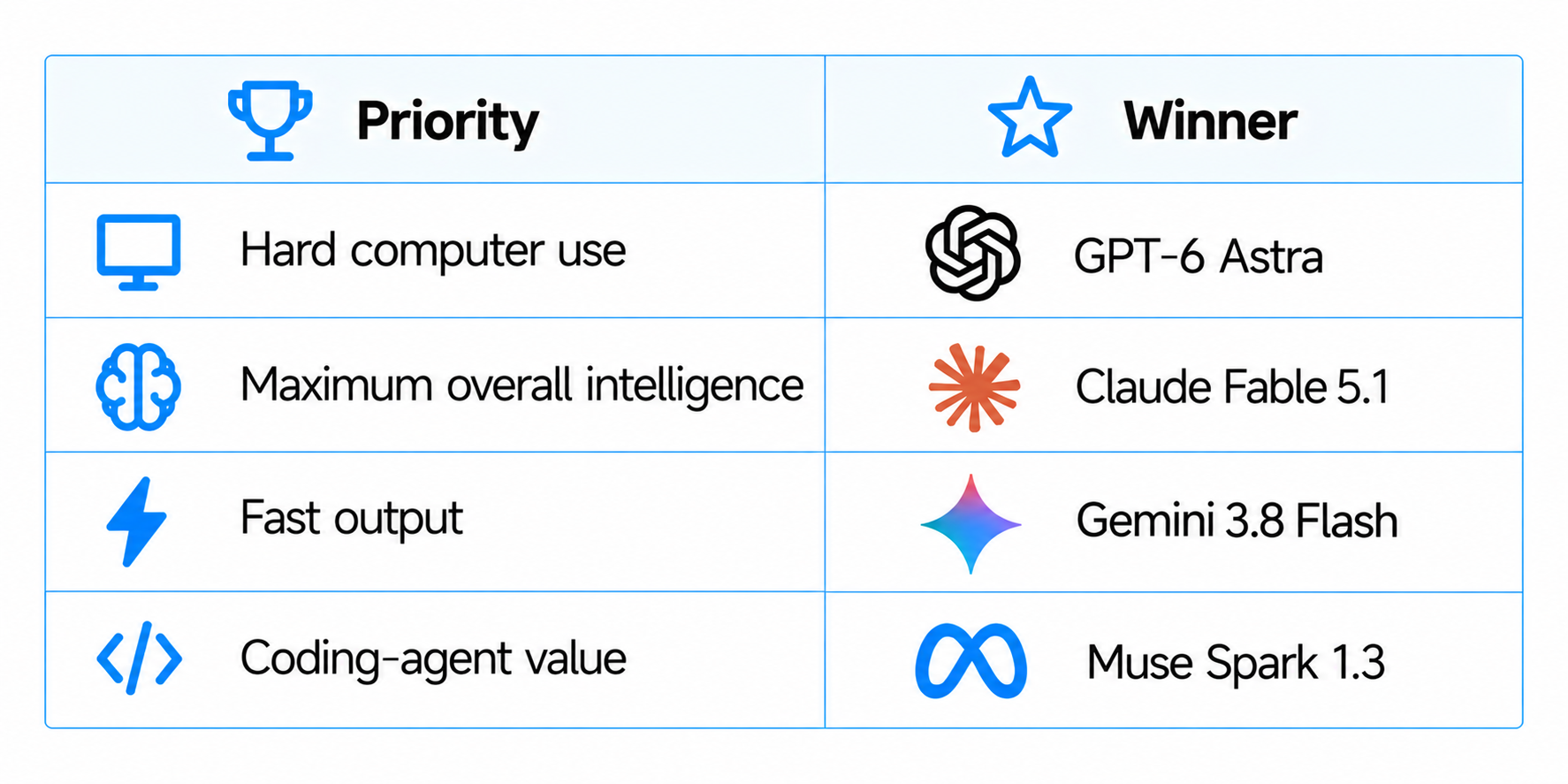
My overall recommendation is simple: choose Fable 5.1 when maximum quality matters most, Astra when you need the broadest difficult-task capability, Gemini 3.8 Flash when speed and token cost dominate, and Muse Spark 1.3 when coding-agent value is the priority.
1. The Four Models at a Glance
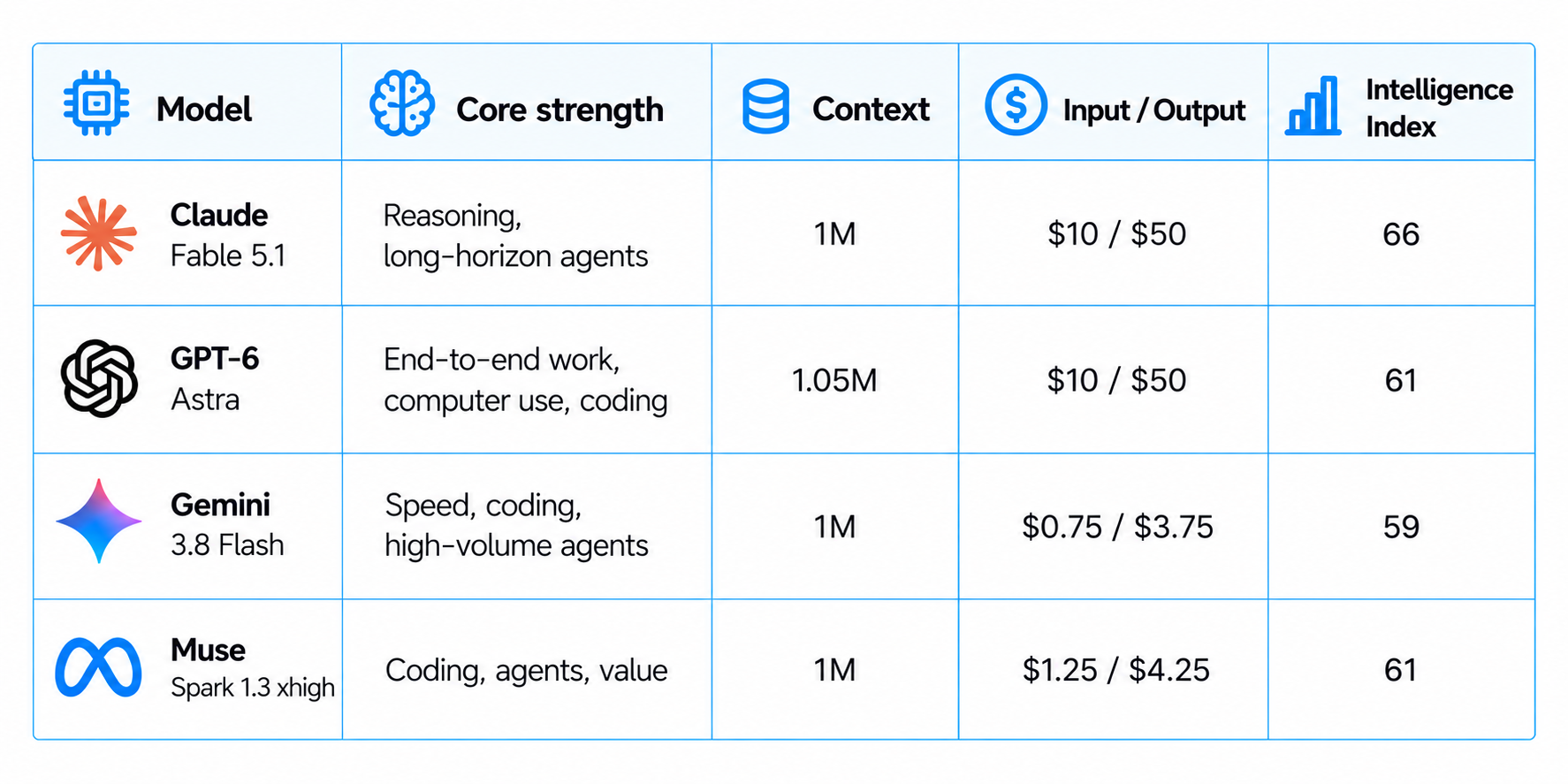
All four models operate in the million-token context class, so context size is not the deciding factor by itself. The more important question is how effectively each model uses that context and what the resulting workload costs. Anthropic lists 1M for Fable 5.1, OpenAI 1.05M for Astra, Google 1M for Gemini 3.8 Flash and Artificial Analysis 1M for Muse Spark 1.3.
2. Claude Fable 5.1: The Quality Leader
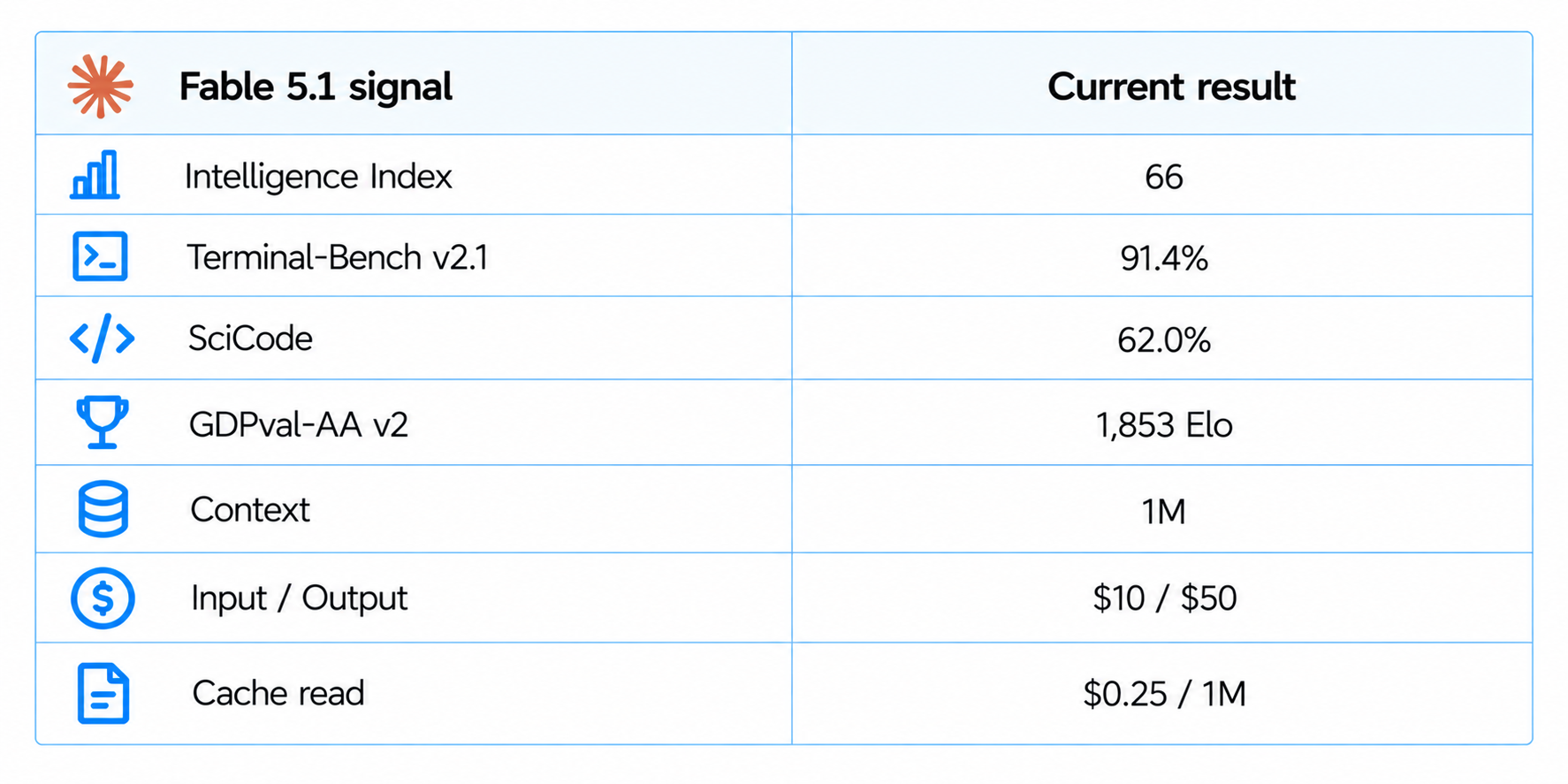
Claude Fable 5.1 currently leads the Artificial Analysis Intelligence Index at 66. It also records 59.1% on Humanity's Last Exam, 91.4% on Terminal-Bench v2.1, 62.0% on SciCode and 1,853 Elo on GDPval-AA v2 in the current Artificial Analysis evaluation.
Anthropic positions Fable 5.1 for demanding reasoning and long-horizon agentic work. It has a 1M-token context, 128K maximum output, adaptive reasoning and a default high effort setting. Cache reads cost $0.25 per million tokens, a 75% reduction from Fable 5.
Fable's weakness is cost. Its list price is the same as Astra's and far above Gemini or Muse. That premium is easier to justify when a task is hard enough that a failed attempt would cost more in engineering time than the model itself.
3. GPT-6 Astra: The End-to-End Generalist
GPT-6 Astra is OpenAI's flagship model for the hardest end-to-end tasks, covering complex reasoning, coding, computer use, research and document creation. Its API supports low, medium, high, xhigh and max reasoning effort, with a 1.05M-token context and 128K maximum output.
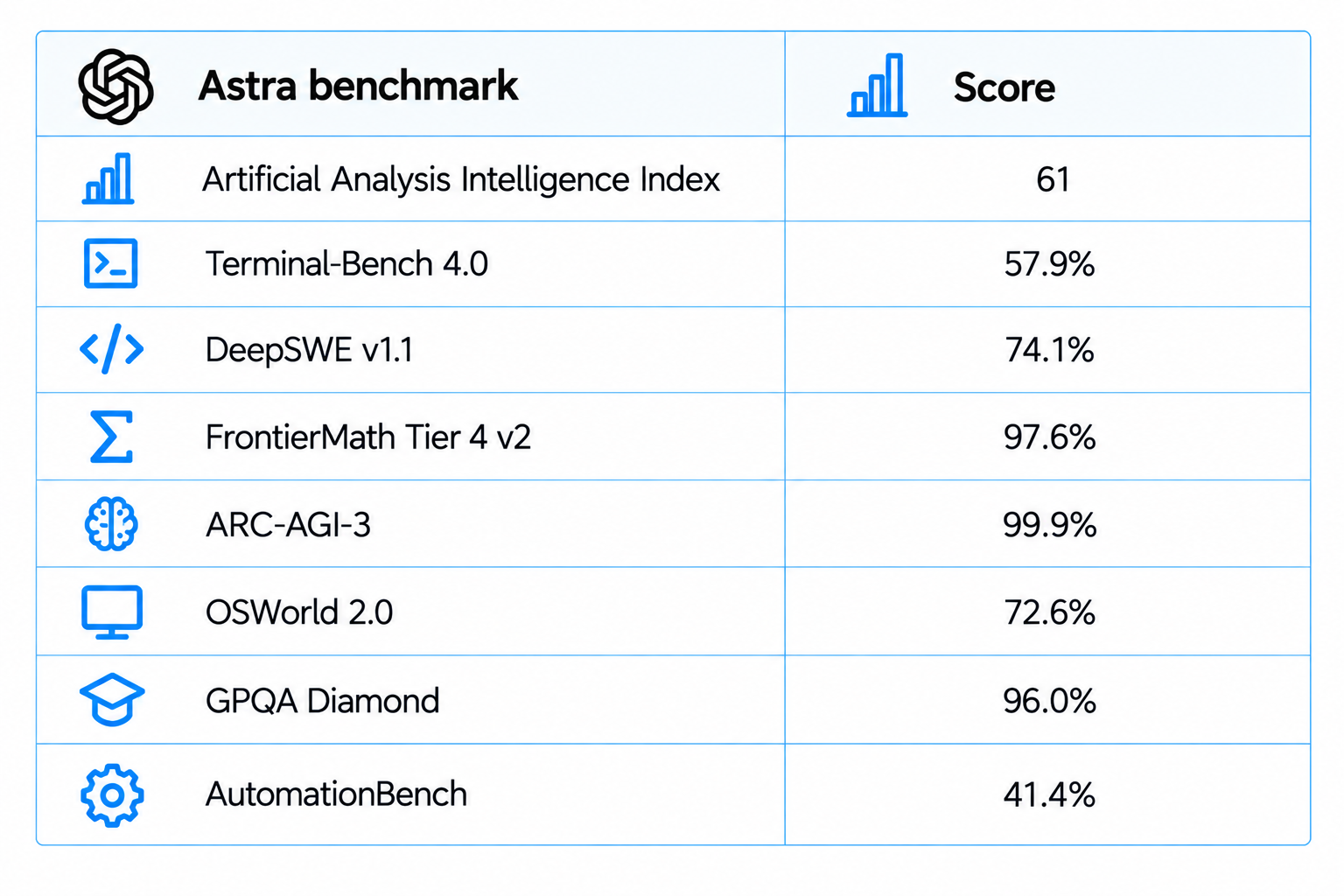
Its benchmark profile is unusually broad. OpenAI reports 97.6% on FrontierMath Tier 4, 99.9% on ARC-AGI-3, 72.6% on OSWorld 2.0, 57.9% on Terminal-Bench 4.0, 96.0% on GPQA Diamond and 41.4% on AutomationBench.
Astra also performs efficiently inside the Codex coding-agent harness. Artificial Analysis currently puts GPT-6 Astra around 67 on the Coding Agent Index, which is close to Claude Fable 5.1 while its measured task cost is much lower in the current comparison.
4. Gemini 3.8 Flash: The Speed and Value Specialist
Gemini 3.8 Flash is Google's workhorse model for long-horizon software engineering, autonomous agents and enterprise workflows. Google lists a 1M-token context, tunable low, medium and high thinking levels, and the same built-in tool family used by its current Flash stack.
Artificial Analysis gives the high configuration an Intelligence Index score of 59 and measures about 305 output tokens per second. Its current Coding Agent Index result is around 61.1 in OpenCode.
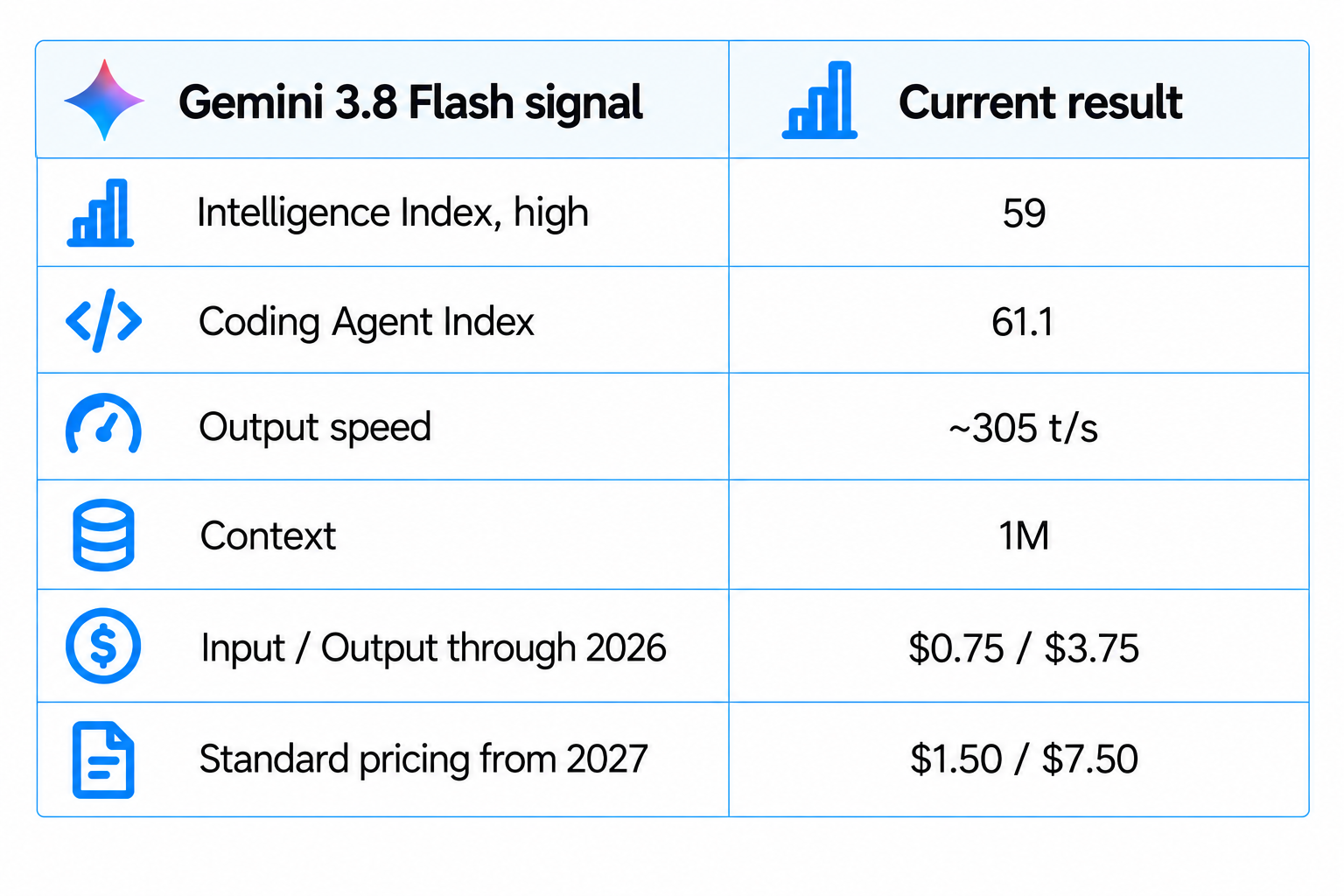
Its biggest advantage is scale economics. At the introductory rate, it is far cheaper per token than Fable or Astra. Google also warns that its stronger reasoning can increase token use on some workloads, so the useful metric is cost per completed task rather than list price alone.
5. Muse Spark 1.3: Meta's Value Challenger
Muse Spark 1.3 is Meta's latest coding and agent-focused model. The xhigh configuration scores 61 on Artificial Analysis's Intelligence Index, while a max configuration reaches 62 in limited partner preview. The xhigh score is four points above Muse Spark 1.2.
The gains are concentrated in agentic work. Artificial Analysis reports Muse Spark 1.3 xhigh at 85% on Terminal-Bench 2.1, 47% on Tau3-Bench Banking and 1,709 Elo on GDPval-AA v2. The max version reaches 86%, 52% and 1,754 Elo respectively.
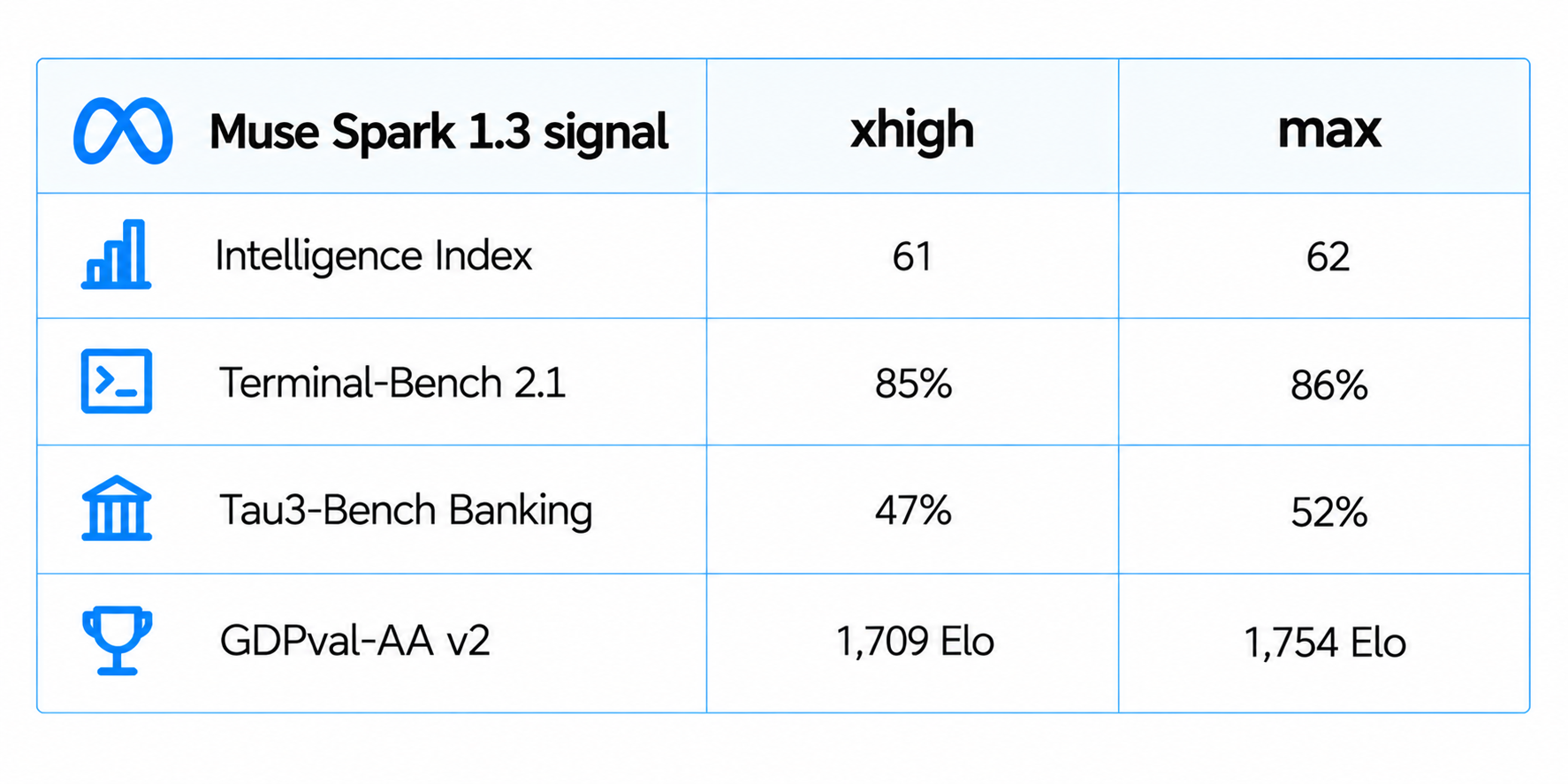
Muse is also inexpensive compared with the two premium models. Current provider listings show $1.25 per million input tokens and $4.25 per million output tokens. In Artificial Analysis's coding-agent comparison, Muse Code with Muse Spark 1.3 xhigh scores about 64.2 and costs roughly $1.72 per completed task.
6. Intelligence: Who Wins?
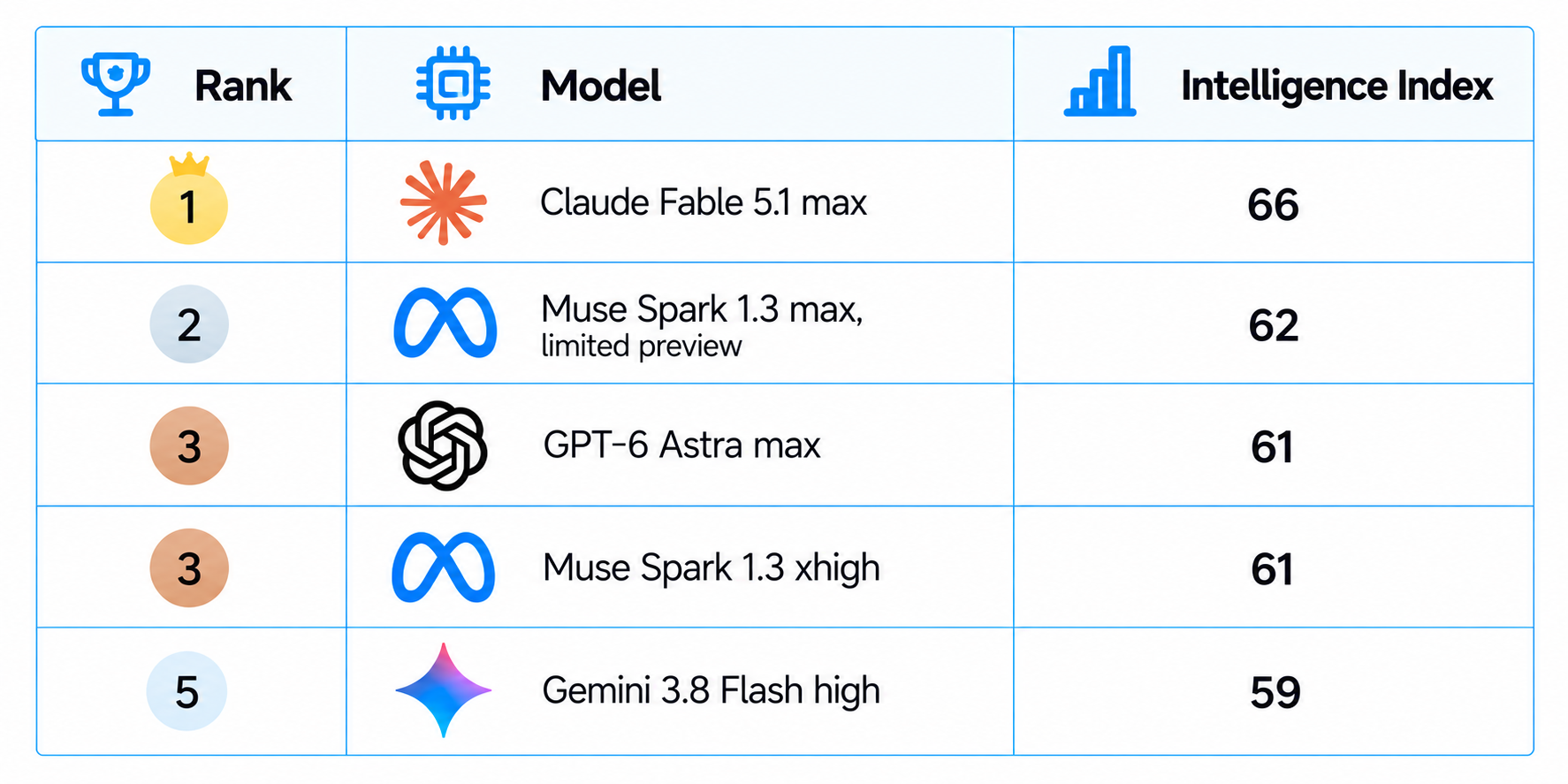
Claude Fable 5.1 has the clearest lead on the broad composite index. The more interesting competition is underneath it: Astra and Muse Spark 1.3 xhigh are tied at 61, while Gemini 3.8 Flash is only two points lower. That means task selection and cost matter more than simply picking the highest number.
7. Coding Agents: The More Practical Ranking
Artificial Analysis's Coding Agent Index measures models inside coding agents, making it closer to real software workflows than a pure language-model score. Current results put Fable 5.1 first, Astra second, Muse third and Gemini fourth.
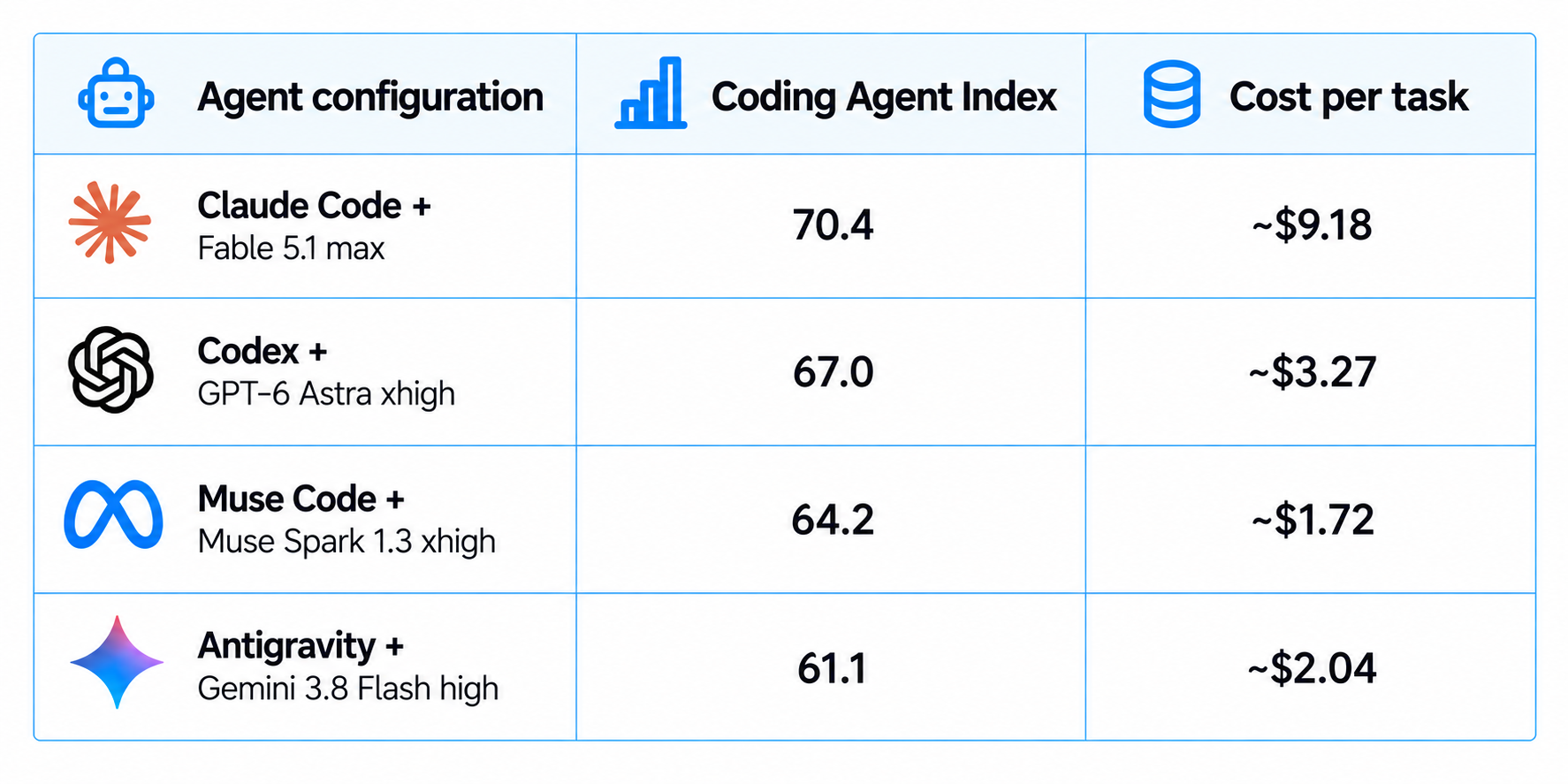
Fable leads on raw coding-agent quality, but Muse delivers an unusually strong quality-to-cost curve. Astra is the middle ground, offering a higher coding score than Muse and Gemini without Fable's measured task cost. Gemini remains attractive when the goal is very high throughput at low token price. The harnesses are different, so these costs are directional rather than a perfectly controlled four-way laboratory comparison.
8. DeepSWE: Coding Looks Different on This Benchmark
OpenAI's current benchmark table gives GPT-6 Astra 74.1% on DeepSWE v1.1, Gemini 3.8 Flash 73.8% and Claude Fable 5.1 67.4%. Muse Spark 1.3 is 75.4%.
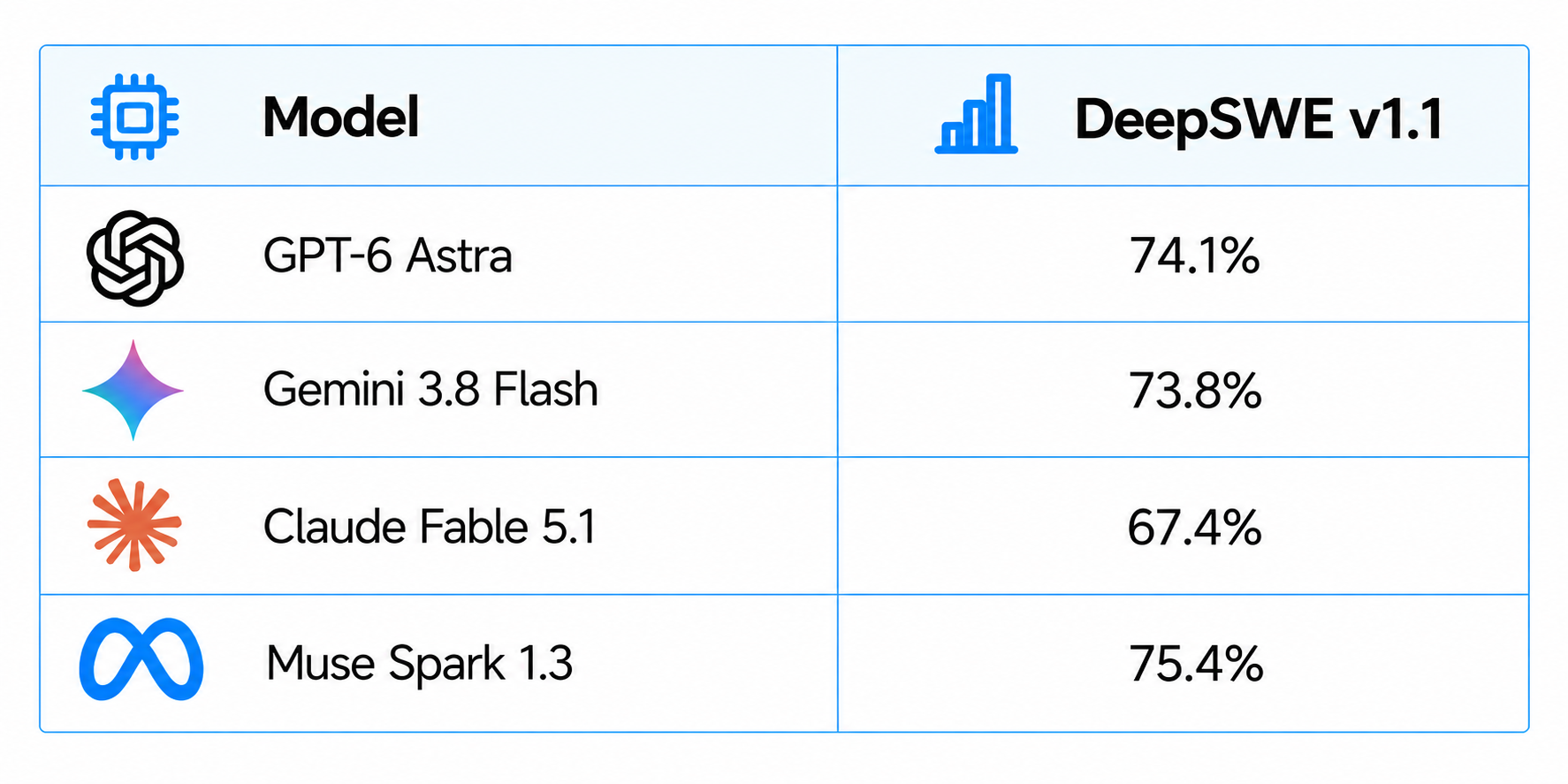
This is why a single leaderboard can be misleading. Fable leads the broad Intelligence Index and Coding Agent Index, yet Astra and Gemini score higher on this particular software-engineering benchmark. Different tests reward different capabilities.
9. Terminal-Bench: Where Agent Reliability Gets Tested
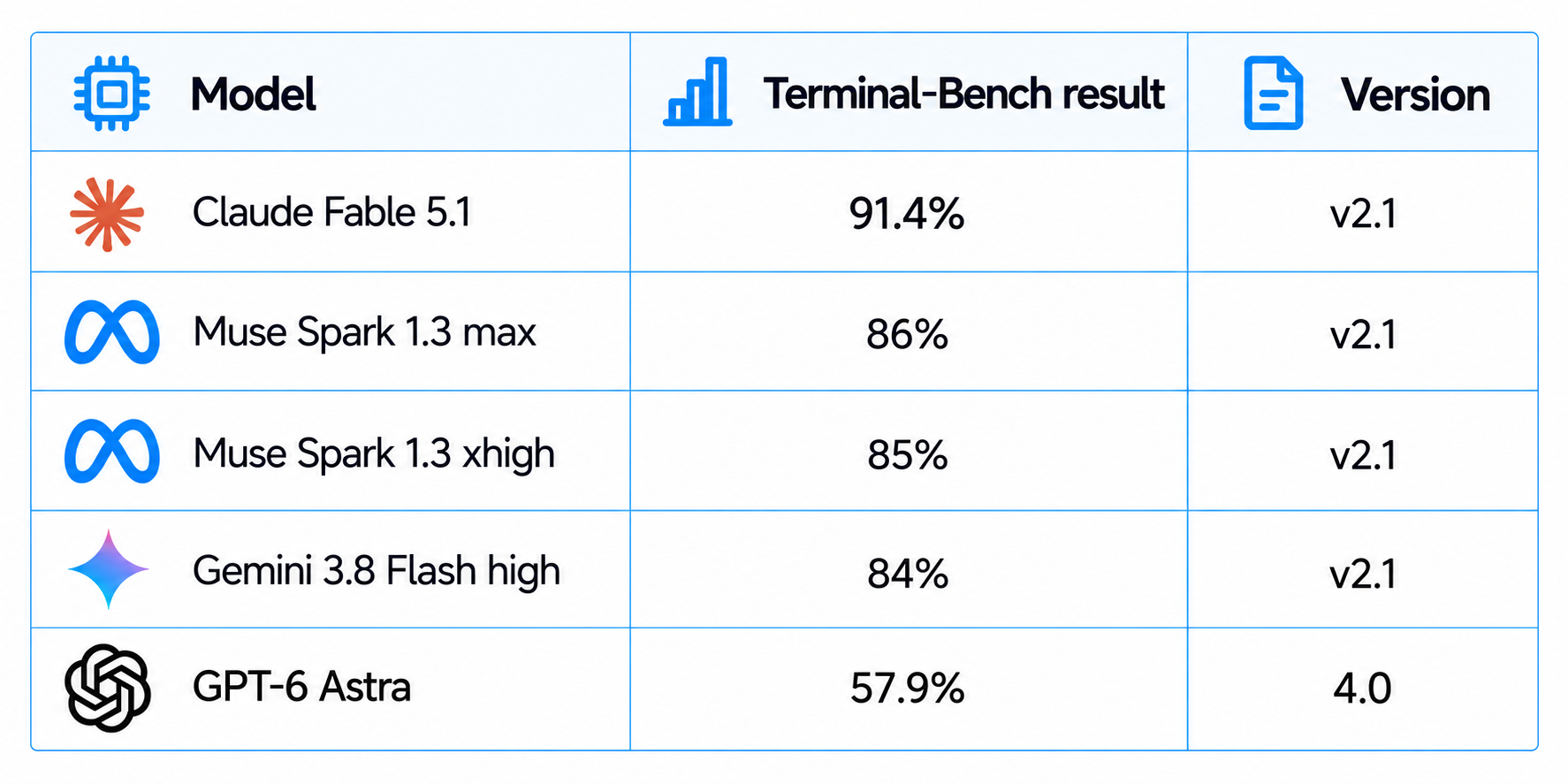
Terminal-Bench v2.1 currently puts Claude Fable 5.1 at 91.4% and Muse Spark 1.3 at 85% xhigh or 86% max. An OpenCode comparison records Gemini 3.8 Flash at 84% on the same v2.1 benchmark.
GPT-6 Astra is reported on the newer Terminal-Bench 4.0 at 57.9%. That score should not be directly ranked against the v2.1 numbers because it is a different benchmark version.
10. Computer Use: Astra Leads
Computer use is one area where GPT-6 Astra has a clear published advantage. OpenAI reports 72.6% on OSWorld 2.0 and 59.3% on Agents' Last Exam, both strong results for an agent expected to operate software rather than only write code.
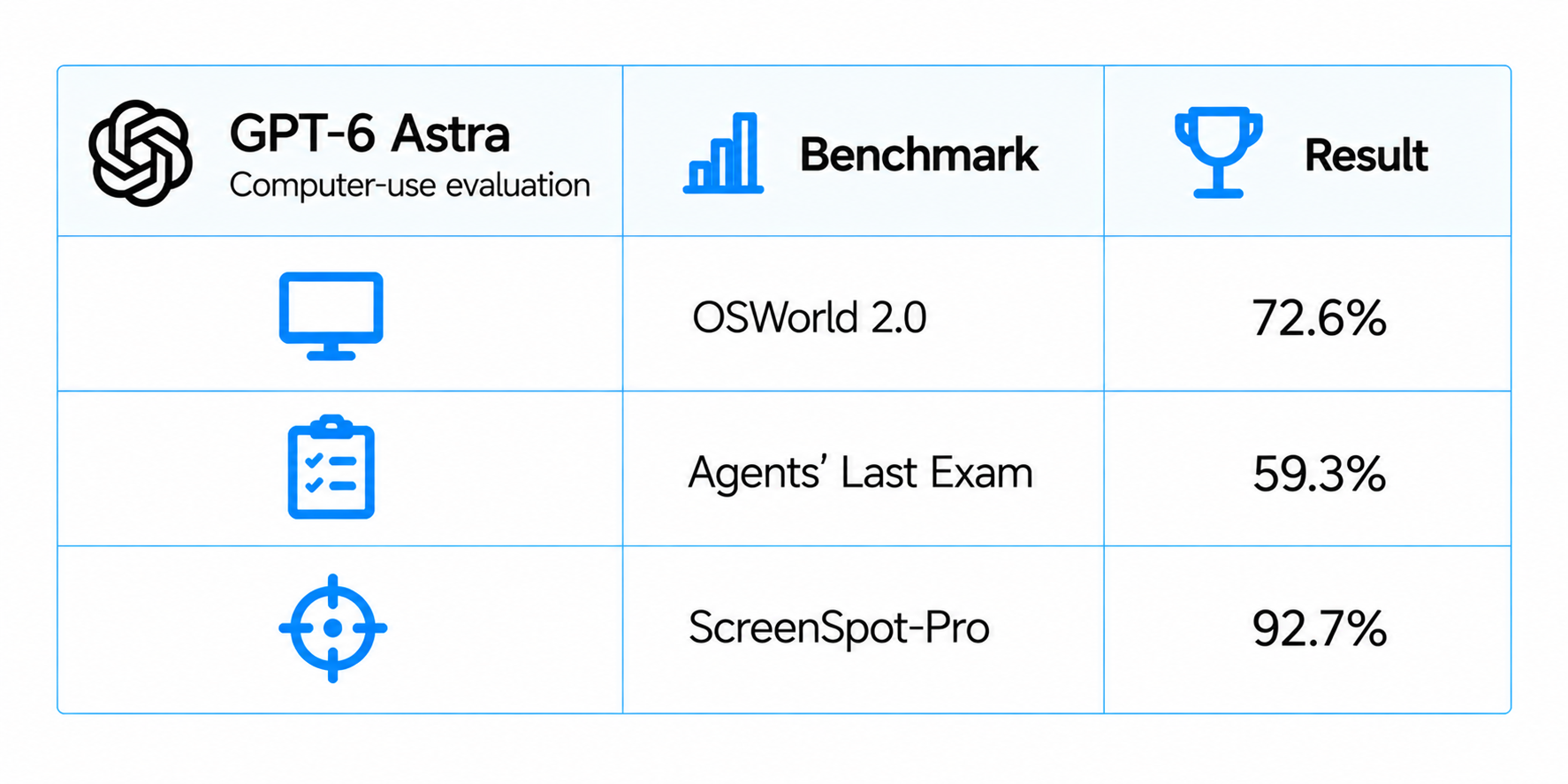
That makes Astra the safest choice of these four when computer interaction is the core workload. A coding model can be excellent at repository edits and still be less capable at navigating visual interfaces, clicking through software and managing changing desktop state.
11. Long Context: Context Size Is No Longer the Differentiator
All four models live around one million tokens of context. Fable 5.1 lists 1M, Astra 1.05M, Gemini 3.8 Flash 1M and Muse Spark 1.3 1M. The key differences are context utilization, retrieval quality and the cost of reasoning over that context.
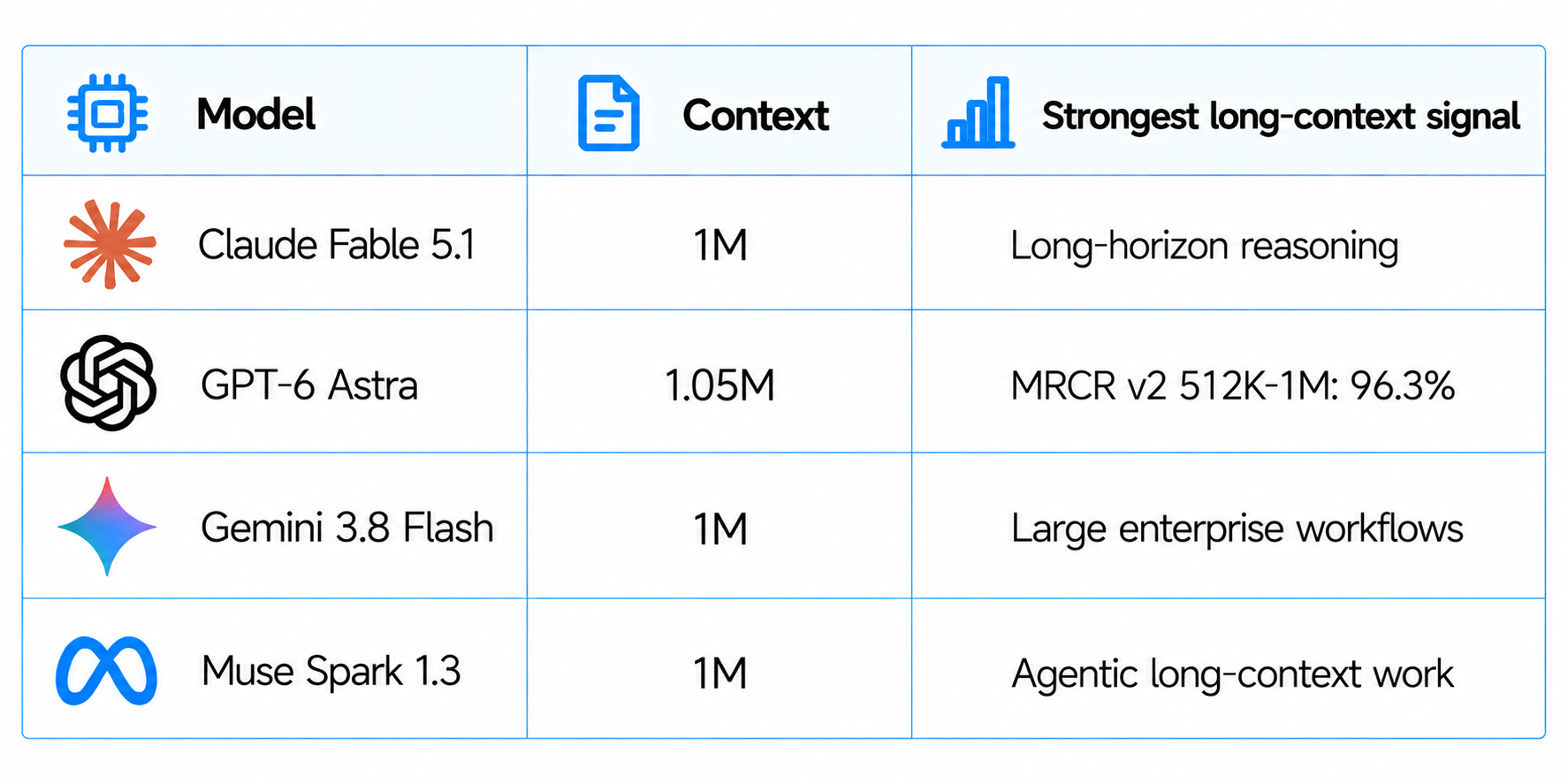
OpenAI reports 96.3% for Astra on MRCR v2's 8-needle 512K-1M test. That is a strong measured result, but it is a different evaluation from the AA-LCR results used for other models, so it should not be treated as a universal ranking.
12. Speed: Gemini Is the Clear Winner
Among the four, Gemini 3.8 Flash has the clearest raw output-speed advantage. Artificial Analysis measures about 305 tokens per second for its high configuration. Fable 5.1 is around 67 tokens per second on its current tracked configuration. Astra and Muse are better judged through end-to-end agent metrics because their practical latency depends heavily on reasoning effort and harness behavior.
That does not mean every Gemini workflow finishes fastest. Tool execution, reasoning and repeated agent turns can dominate wall time. The useful conclusion is narrower: Gemini is the strongest choice when high output throughput is itself a major requirement.
13. Price: The Biggest Difference Between the Four
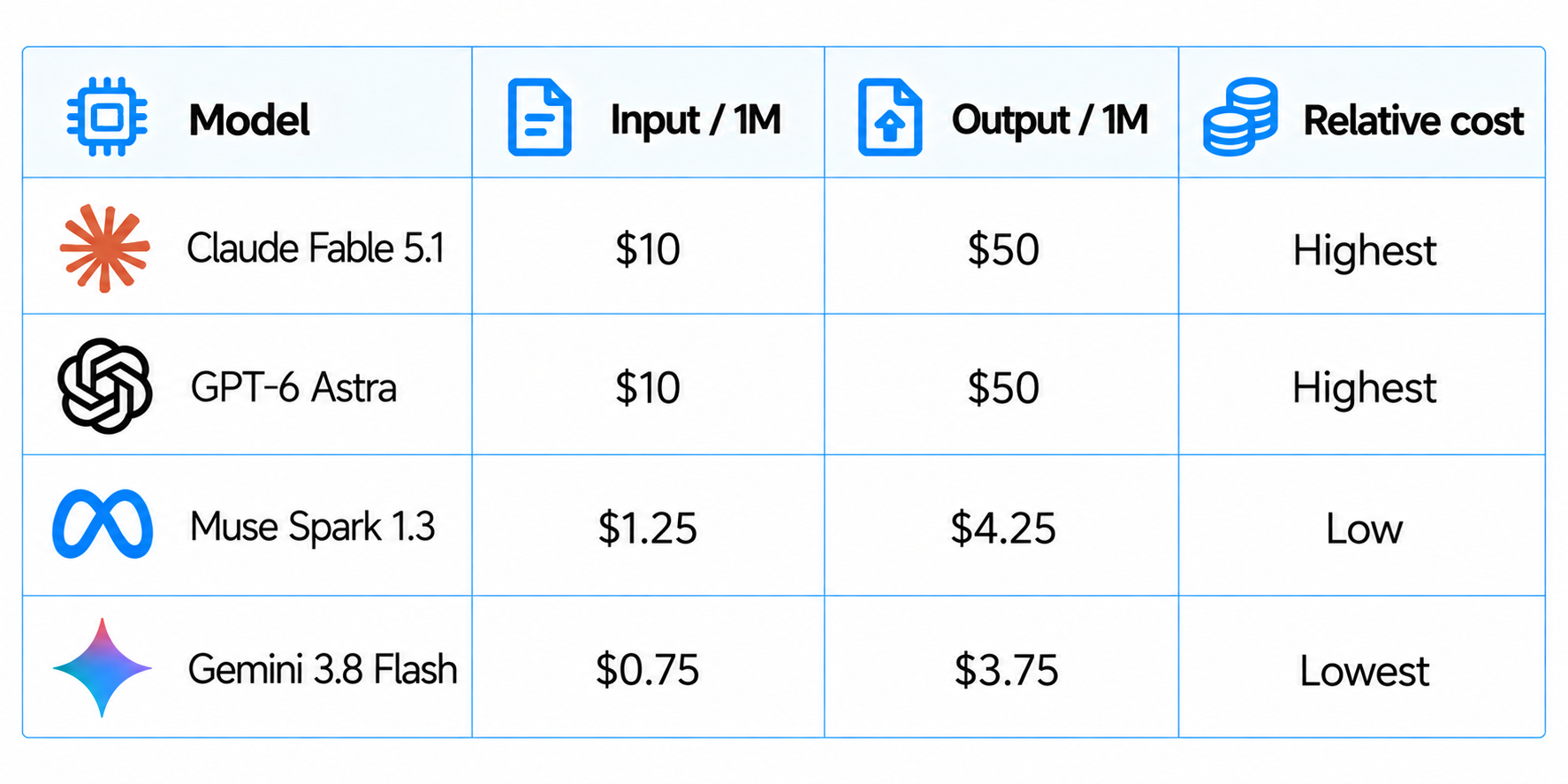
Google's Gemini 3.8 Flash pricing is promotional through December 31, 2026, after which the listed standard rate doubles to $1.50 per million input tokens and $7.50 per million output tokens. Fable 5.1 keeps $10/$50 pricing but cuts cache reads to $0.25 per million. Astra also uses $10/$50 standard API pricing.
Muse Spark 1.3 sits between the two strategies. Its $1.25/$4.25 list price is much closer to Gemini than to Fable or Astra, while the Coding Agent Index suggests stronger coding quality than Gemini in the current agent comparison.
14. Cost per Completed Coding Task
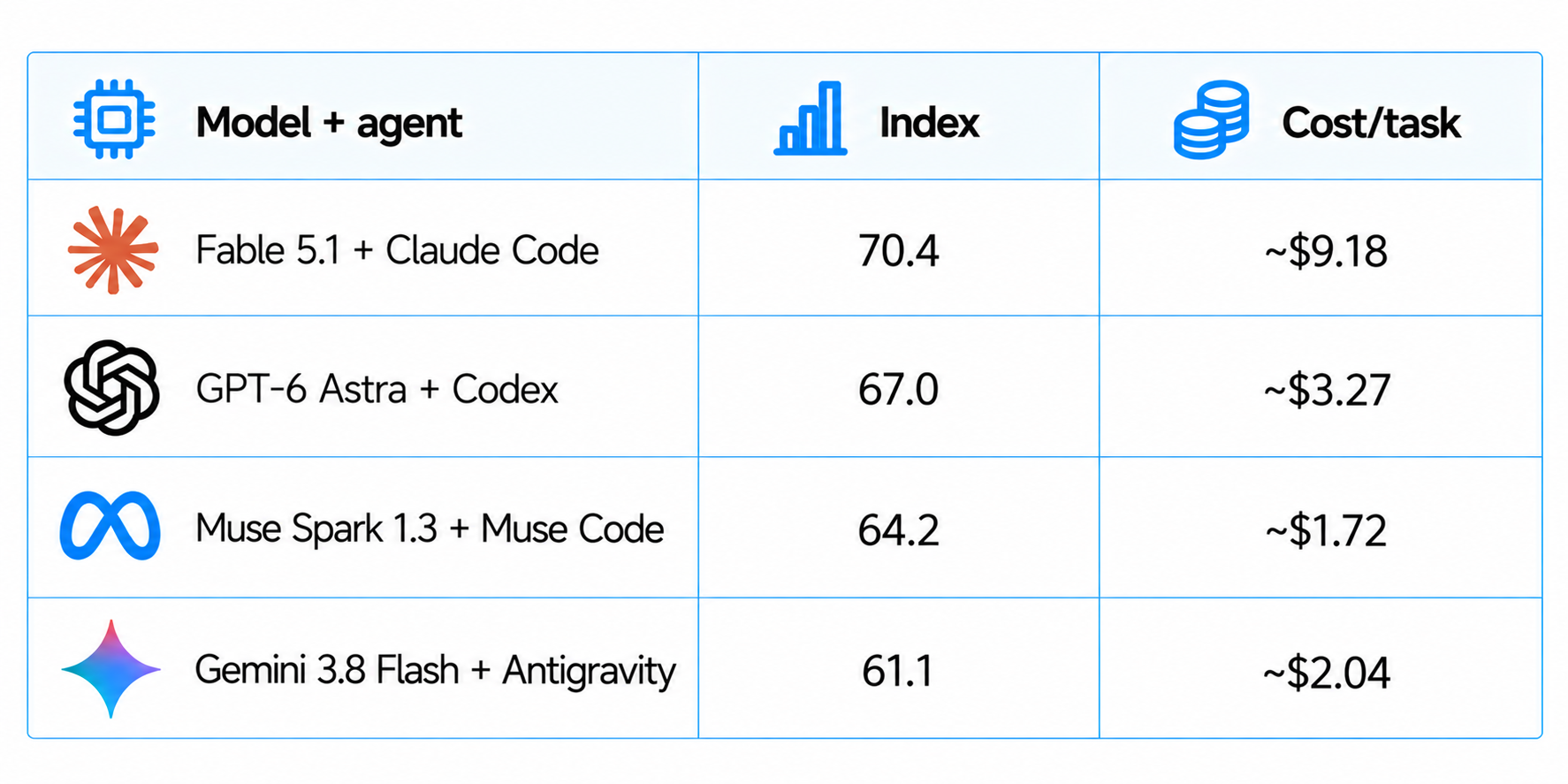
This table changes the conversation. Fable has the highest coding score but costs more than five times Muse per completed task in the current benchmark. Astra offers a strong middle ground. Muse is the value leader on this particular task-cost curve, while Gemini trades some coding-agent score for very fast output and lower raw token prices.
15. Which Model Is Best for Coding?
Claude Fable 5.1 is the quality-first winner. Its 70.4 Coding Agent Index and 91.4% Terminal-Bench v2.1 result give it the strongest current case when coding correctness and agent reliability matter more than inference cost.
GPT-6 Astra is the strongest alternative when coding is mixed with computer use, research, data work or other difficult end-to-end actions. Muse Spark 1.3 is the most interesting value choice for coding agents, while Gemini 3.8 Flash is the best option for high-volume routine development where speed and token cost matter most.
16. Which Model Is Best for Research?
Claude Fable 5.1 is the best quality-first research model in this group because it has the highest Intelligence Index and is specifically designed for demanding long-horizon knowledge work. GPT-6 Astra is the better choice when research depends heavily on browsing, code, data analysis or computer interaction.
Gemini 3.8 Flash is the budget research worker. Its lower price and high speed make it attractive for extraction, summarization and repeated research calls. Muse Spark 1.3 becomes more interesting when the research problem is embedded inside a broader agent that has to take actions after reading the material.
17. Which Model Is Best for Computer Use?
GPT-6 Astra. Its current OSWorld 2.0 and Agents' Last Exam results provide the clearest evidence for difficult computer interaction.
18. Which Model Is Best for High-Volume Agents?
Gemini 3.8 Flash and Muse Spark 1.3 are the two most interesting choices. Gemini has the lower raw token price and the highest measured output speed. Muse has the stronger current Coding Agent Index and lower cost per completed task in the cited agent comparison.
19. Which Model Should a Startup Pick?
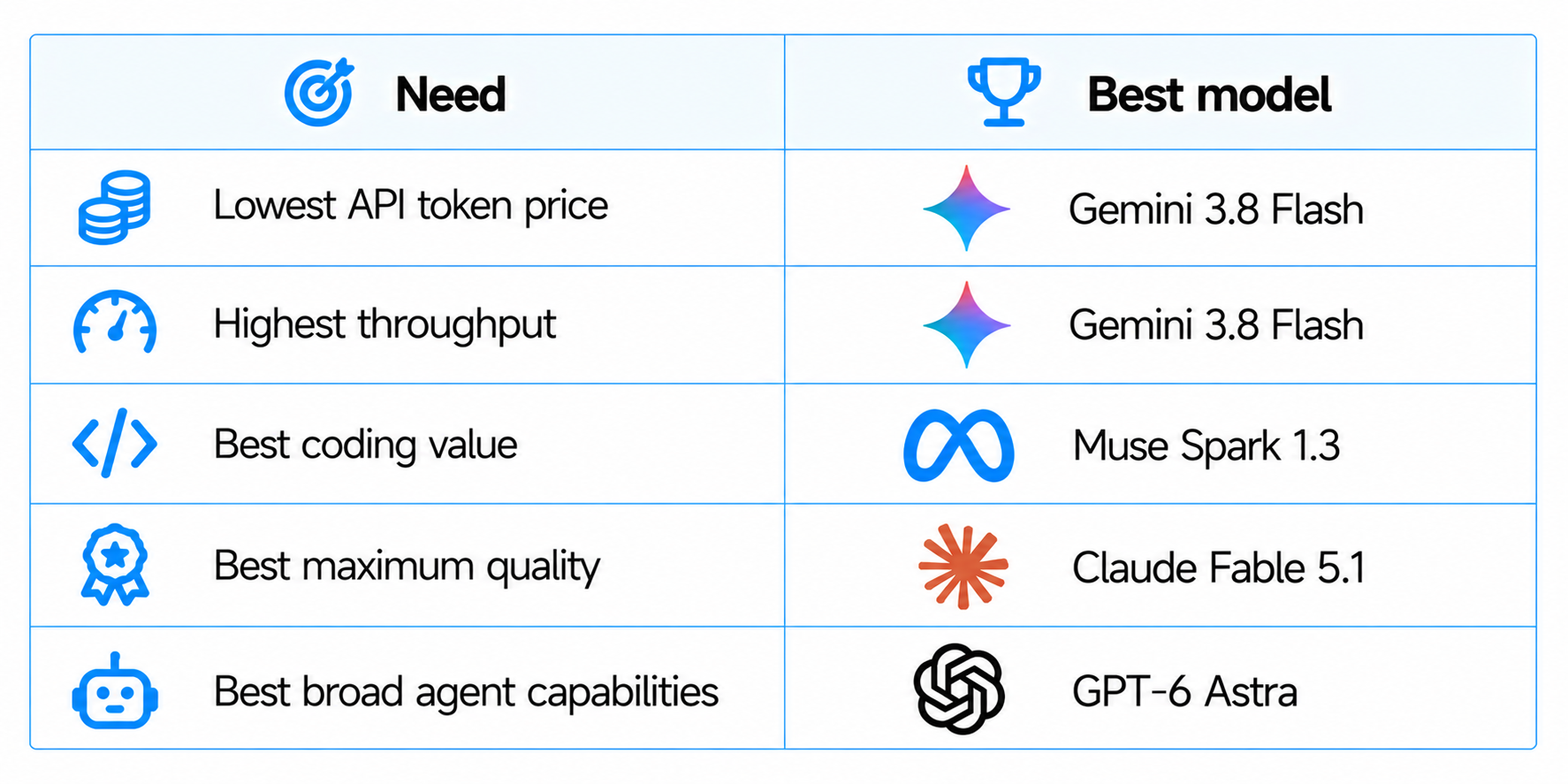
For most startups, the answer is not to standardize on the most expensive model. Gemini 3.8 Flash is a strong default worker because the token price is low and the model is fast. Muse Spark 1.3 is attractive when coding and agent reliability matter more than raw throughput. Astra becomes the escalation model for tasks where the cheaper models fail.
Fable 5.1 makes sense when the task is expensive enough that a higher success rate is worth the premium. This is especially true for complex research, major codebase changes and professional deliverables where a failed run creates real downstream cost.
20. Recommended Model Routing Strategy
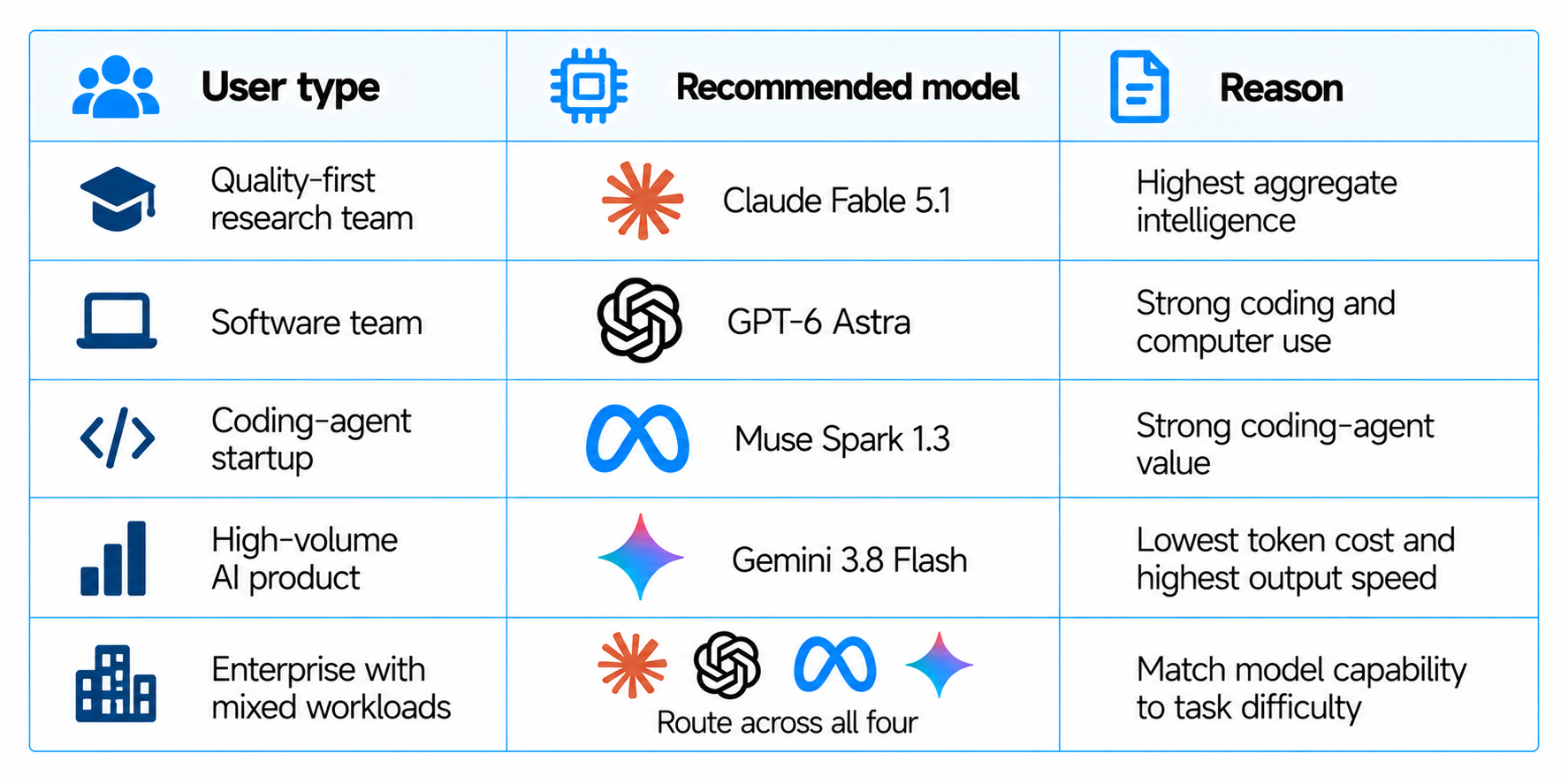
The strongest production architecture is a routed stack rather than a single-model stack.
Gemini 3.8 Flash: Routine extraction, straightforward coding, fast classification and high-volume agent steps.
Muse Spark 1.3: Coding-agent work where the quality requirement is higher but cost still matters.
GPT-6 Astra: Hard coding, computer use, research and tasks that span multiple tools.
Claude Fable 5.1: The most demanding reasoning, long-horizon coding and work where maximum quality is worth premium cost.
See our Model Routing for AI Coding Agents guide for a deeper implementation strategy.
21. Final Recommendation
22. Final Verdict
Claude Fable 5.1, GPT-6 Astra, Gemini 3.8 Flash and Muse Spark 1.3 are four different answers to the same production question: how much intelligence do you need, how quickly do you need it, and how much are you willing to pay for every completed task?
Claude Fable 5.1 is the quality leader in the current independent comparison. It scores 66 on the Artificial Analysis Intelligence Index and leads the current Coding Agent Index at about 70.4. Its 91.4% Terminal-Bench v2.1 result is also the strongest of the four on that benchmark version. The tradeoff is price: $10 per million input tokens and $50 per million output tokens.
GPT-6 Astra is the broadest all-rounder. Its 61 Intelligence Index score is below Fable 5.1, but OpenAI reports leading results on computer use and several difficult reasoning tasks, including 72.6% on OSWorld 2.0, 97.6% on FrontierMath Tier 4 and 57.9% on Terminal-Bench 4.0. Its $10/$50 pricing puts it in the same premium class as Fable.
Gemini 3.8 Flash takes the opposite approach. It scores 59 on the Artificial Analysis Intelligence Index, but it is measured at roughly 305 tokens per second and is currently priced at $0.75 per million input tokens and $3.75 per million output tokens through December 31, 2026. Google designed it specifically for long-horizon software engineering, autonomous agents and enterprise workflows.
Muse Spark 1.3 is the value challenger. Its xhigh configuration scores 61 on the Intelligence Index and about 64.2 on the Coding Agent Index, with current measured coding-agent cost around $1.72 per completed task in the cited Artificial Analysis comparison. Its max configuration reaches 62 in limited partner preview.
My overall ratings: Claude Fable 5.1 - 9.6/10; GPT-6 Astra - 9.4/10; Muse Spark 1.3 - 9.2/10; Gemini 3.8 Flash - 9.1/10.
Bottom line: choose Claude Fable 5.1 when maximum reasoning quality is the priority, GPT-6 Astra when the workload spans coding, computer use and difficult end-to-end tasks, Muse Spark 1.3 when coding-agent value is the priority, and Gemini 3.8 Flash when speed and low-cost scale matter most. For a serious production system, intelligent routing across these models is stronger than forcing a single model to do every job.
Frequently Asked Questions
Which AI model is best overall?
Claude Fable 5.1 currently has the highest Artificial Analysis Intelligence Index score among these four, at 66.
Which model is best for coding agents?
Claude Fable 5.1 leads the current Coding Agent Index, followed by GPT-6 Astra, Muse Spark 1.3 and Gemini 3.8 Flash.
Which model is fastest?
Gemini 3.8 Flash is currently measured at roughly 305 output tokens per second in its high-reasoning configuration.
Which model is cheapest?
Gemini 3.8 Flash has the lowest listed token price at $0.75 per million input tokens and $3.75 per million output tokens through December 31, 2026.
Is GPT-6 Astra better than Claude Fable 5.1?
Not overall on the Intelligence Index. Fable 5.1 scores higher, while Astra has standout results on computer use and several specialized evaluations.
Is Muse Spark 1.3 better than Gemini 3.8 Flash?
Muse Spark 1.3 has the higher current Intelligence and Coding Agent scores, while Gemini 3.8 Flash is faster and cheaper per token.
Which model is best for computer use?
GPT-6 Astra has the strongest published computer-use results in this comparison.
Which model has the largest context?
GPT-6 Astra lists a 1.05M-token context. Fable 5.1, Gemini 3.8 Flash and Muse Spark 1.3 are all in the 1M-token class.
Should I use one model or route between them?
Route between them. Use lower-cost models for routine work and escalate hard tasks to Astra or Fable when the extra capability produces a measurable benefit.
Recommended Blogs
Claude Fable 5.1 Review: Benchmarks, Pricing, Features & Is It Worth It? (2026)
GPT-6 Astra Review: Benchmarks, Speed, Price & Is It Worth It? (2026)
Gemini 3.8 Flash Review: Accuracy, Price & Is It Worth It? (2026)
Meta Muse Spark 1.3 Review: Coding, Price & Is It Worth It? (2026)
Qwen 3.8 Max 0902 Review: Benchmarks, Price & Is It Worth It? (2026)
Mercury 2.5 AI Model Review: Speed, Price & Is It Worth It? (2026)
Resources & Community
Join our community of 70,000+ AI enthusiasts and learn to build powerful AI applications. Whether you're a beginner or an experienced developer, Build Fast with AI helps you understand and implement AI in your projects.
Agentic AI Launchpad 2026
A structured 6-week cohort program that takes you from AI basics to building and deploying real-world agentic AI systems. Includes live sessions, expert mentorship, project reviews and a builder community network.
Ready to go from learning to building? Join the next cohort: Agentic AI Launchpad 2026
Free AI Resources
Access free tools, workshops and micro-learning to keep building.

