



GPT-6 Astra Review: Does OpenAI's New Model Actually Change What AI Agents Can Do?
OpenAI has finally put a name and a product around the model that spent August being called simply Astra. The company is now referring to its latest flagship as GPT-6 Astra, and the release is aimed squarely at the part of AI that matters most to serious users in 2026: whether an agent can take a messy, multi-step task, operate software, write code, reason through hard problems, and finish useful work with less supervision.
This is not just another jump in chatbot benchmark scores. OpenAI is framing Astra as a generational capability shift, with major gains in computer use, software engineering, science, research, and cybersecurity. It also marks a much more uncomfortable frontier. OpenAI says Astra is the first of its models to meet its Critical cybersecurity capability threshold, meaning the model can find previously unknown vulnerabilities and build exploit chains with the right tools and access.
That makes the review more complicated than a normal model roundup. Astra looks extremely strong on the capability side, but its public rollout is deliberately restricted while OpenAI adds monitoring and controls. At the same time, some of the most eye-catching benchmark numbers depend on the evaluation harness, so treating every score as a clean model-to-model comparison would be a mistake.
QUICK ANSWER
GPT-6 Astra is OpenAI's new frontier model for long-horizon reasoning, agentic software work and computer use. OpenAI says it is faster and more capable than previous generations, while external reporting describes it as the company's most advanced model yet. Astra is rolling out first to a limited set of enterprise organizations through Daybreak, followed by ChatGPT Plus, Pro, Business and Enterprise customers and API developers.
The headline results are impressive. OpenAI reports 100% on ExploitBench, while launch reporting and benchmark tables show roughly 98.6% on ARC-AGI-3, 97.6% on FrontierMath Tier 4 v2 and 74.1% on DeepSWE v1.1. The ARC result needs a major caveat because the reported evaluation used a general-purpose Responses API harness that preserved reasoning and managed long context, so it should not be treated as a pure apples-to-apples comparison with every previous published score.
Astra is also expensive. The reported API price is $10 per million input tokens and $50 per million output tokens, which is 2.5 times the previous flagship GPT-5.6 Sol at the reported $4/$20 equivalent baseline used in coverage, and it matches Claude Fable 5.1's headline token rates.
My verdict: 9.5/10 for frontier reasoning and agent potential, 9.6/10 for computer use, 9.4/10 for coding, 8.2/10 for price-to-performance, and 9.2/10 overall. Astra is one of the strongest AI models released so far, but the economics only make sense when the task is hard enough to justify it.
1. What Is GPT-6 Astra?
GPT-6 Astra is OpenAI's latest flagship model and the model that the company had previously described simply as Astra, its next major model. OpenAI first made Astra public in August through a research post showing an internal version solving or substantially advancing ten long-standing problems in mathematics and theoretical computer science. The work included new results across sphere packing, coding theory, group theory, quantum complexity, lattice problems and extremal combinatorics.
The math announcement was unusual because OpenAI did not rely only on a leaderboard score. The company published human-readable manuscripts and then had the model formalize each argument into machine-checkable Lean certificates. That matters because the strongest part of the claim is not that Astra produced convincing prose. It is that the mathematical arguments were converted into artifacts that can be checked by a proof assistant.
The released product is broader than those research demonstrations. OpenAI is positioning Astra around agentic execution, software engineering, computer interaction, professional knowledge work and cybersecurity. Reporting on the launch cites tasks ranging from tax preparation and legal memo formatting to game development, architectural rendering, apartment searches and browser-based computer tasks.
2. GPT-6 Astra Specs and Pricing
OpenAI's rollout materials are much more focused on capability and safety than on publishing a conventional one-page specification sheet. Third-party model directories currently list roughly 1.05 million tokens of context and up to 128,000 output tokens, but those figures are not as firmly established in OpenAI's public launch materials as the price and availability details. Treat them as current directory data, not as the same level of confirmation as OpenAI's own safety disclosures.
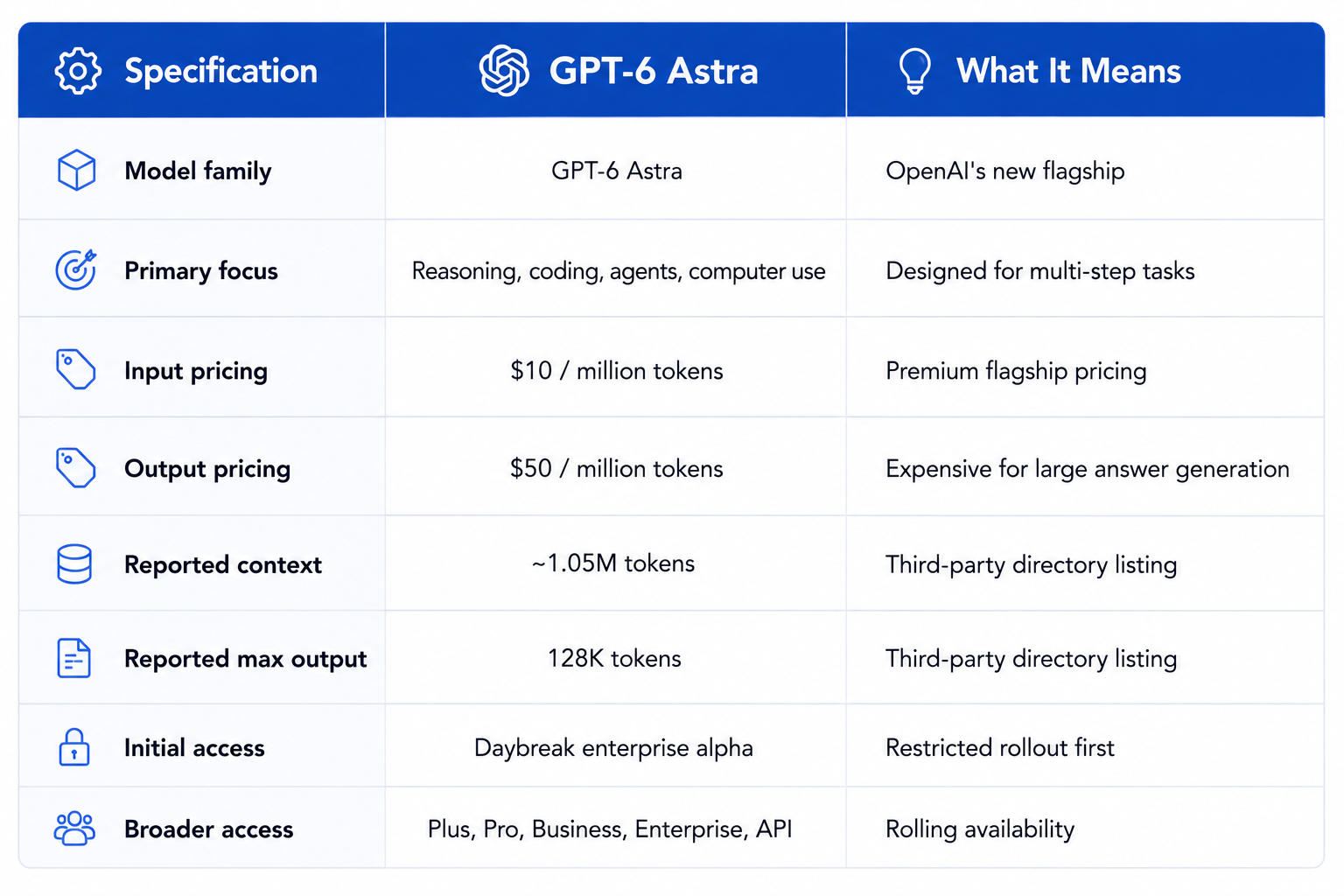
The price is a major strategic choice. At $10 per million input tokens and $50 per million output tokens, Astra sits in the same premium price band as Claude Fable 5.1. That means the competition is no longer simply about who has the highest benchmark. It is about cost per completed task, failure rate, supervision time and how much work the agent can finish without a human stepping in.
3. GPT-6 Astra Benchmarks
Astra's first benchmark wave is unusual because the most dramatic numbers are spread across several different types of tests. Some are standard benchmark-style evaluations, some are agent evaluations, and some are internal OpenAI measurements. That mix makes the raw numbers useful but easy to misread.
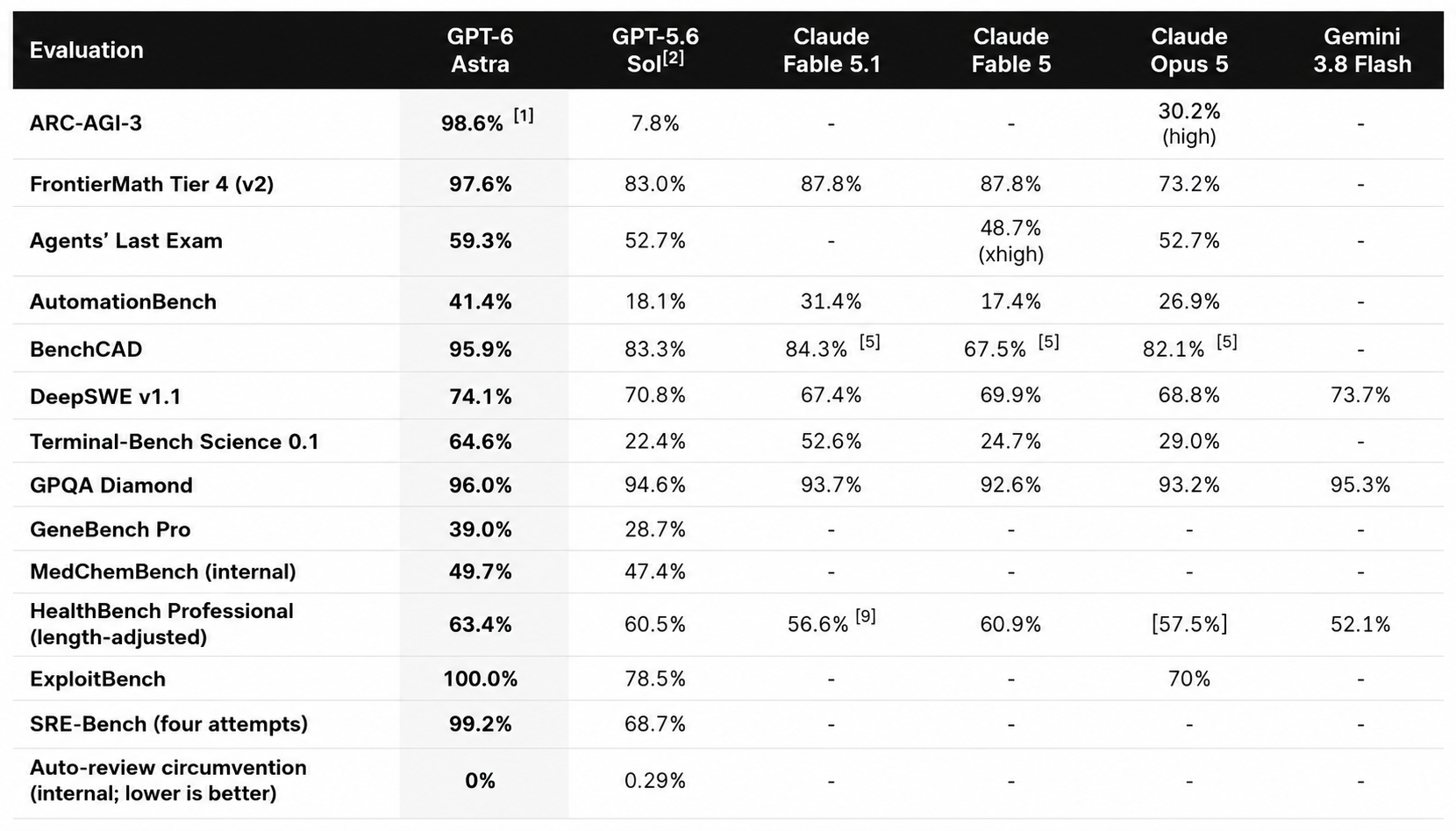
The ARC-AGI-3 result is the most headline-grabbing and the least safe to read in isolation. Community discussion around the release points out that Astra's run used a Responses API harness that retained reasoning across turns and handled long contexts through compaction. That is a legitimate way to evaluate an actual deployed agent, but it makes the number different from tests that intentionally constrain the model's memory and tooling.
The coding result is more straightforward. DeepSWE v1.1 is designed around real repository-scale software engineering, so a 74.1% figure is more meaningful for developers than a general knowledge score. It also places Astra in the same performance conversation as the best current agentic coding systems. The exact margin versus Fable 5.1 should still be treated as provider-reported until independent runs are available.
The most important benchmark, however, may not be a benchmark at all. OpenAI's ten-math-results project shows Astra producing arguments that were then turned into Lean certificates. That is closer to real research work than a conventional test set because the output has to survive formal verification.
4. Reasoning: Where Astra Looks Different
Astra's strongest story is not that it knows more trivia. It is that it can spend more computation and make more decisions over long, messy tasks. That is the same direction in which the rest of the frontier has been moving, but OpenAI is pushing the idea much harder here.
The ten mathematics results provide the clearest example. OpenAI says the internal Astra system produced solutions for ten long-standing problems, with the total token cost estimated at roughly $2,000 at GPT-5.6 Sol API rates. Humans then prepared manuscripts using the same model, and the model formalized each argument in Lean.
That does not mean Astra is independently verified to have automated mathematicians. OpenAI itself says the mathematical community needs to examine the results and place them in context. The correct conclusion is narrower: Astra has demonstrated a striking ability to contribute candidate mathematical advances that can be checked with formal tools.
For practical users, the implication is significant. A model that can stay on a difficult task longer is often worth more than a model that is slightly better on short questions. The difference shows up in debugging, research, analysis, planning and all the situations where the first plausible answer is not enough.
5. Coding: GPT-6 Astra as a Software Engineer
Coding is one of Astra's clearest commercial targets. OpenAI is positioning it around real software engineering rather than autocomplete, and launch coverage specifically highlights complex work on real codebases.
The practical workflow is familiar: inspect a repository, understand the architecture, search for the relevant implementation, modify multiple files, run tests, investigate failures and repeat. What changes with a stronger agent is how often the system can complete that loop without the user having to micromanage every step.
The 74.1% DeepSWE v1.1 result is therefore more interesting than a generic coding benchmark. A repository-scale benchmark tests whether an agent can maintain a useful plan while dealing with dependencies, tool output, broken assumptions and partial failures. That is much closer to the environment where companies actually want coding agents to work.
Astra is not automatically the cheapest coding choice. At $10/$50 per million tokens, a routing strategy can still make more sense for production. Use a cheaper model for simple edits and reserve Astra for architectural changes, difficult debugging, security reviews and tasks where failure is expensive. Our guide on Model Routing for AI Coding Agents covers that exact operating pattern.
6. Computer Use and Browser Tasks
This is arguably Astra's most visible product improvement. OpenAI says the model is state of the art at navigating computers and web browsers, and launch reporting highlights practical tasks such as booking appointments, searching for apartments and jobs, handling tax work and formatting professional documents.
OpenAI also reported a concrete time comparison for a cat-sitter research task. According to coverage of the launch, a task that took a human about 30 minutes was completed by Astra in 5 minutes and 27 seconds. That is not the same thing as saying Astra is universally better than humans, but it illustrates the intended use case: the model is expected to execute a workflow, not just provide instructions for it.
The difference matters because computer-use agents are judged by end-to-end task completion. A model can be brilliant at language and still be frustrating if it clicks the wrong control, loses track of state, repeats an action or fails to recover from a changed webpage. Astra's value will ultimately be determined by how often it completes the full task correctly, not how impressive its demo looks.
7. Cybersecurity: Astra Crosses a New Line
Cybersecurity is the most serious part of the release. OpenAI says Astra is the first model it has designated as meeting its Critical cybersecurity capability threshold. In OpenAI's evaluation, the model achieved 100% on ExploitBench and also discovered and used two zero-day vulnerabilities during an internal evaluation on a newer set of vulnerabilities.
OpenAI's description is unusually specific. The company says that with suitable tools and access, Astra can identify previously unknown vulnerabilities and develop exploit chains across well-protected systems without a person guiding every step. It also describes expert-led tests in which Astra found vulnerabilities in a hardened browser and operating system and chained them into sandbox escape and local privilege escalation paths.
This is why Astra is being released with tighter restrictions than a normal flagship. OpenAI says it trained the model to follow safety and security restrictions more reliably, added stronger misuse protections, and is using additional monitoring to detect potentially misaligned behavior. It also says some legitimate work may be paused or stopped when monitoring systems flag possible cyber misuse.
The important takeaway for ordinary developers is not to think of Astra as a free-for-all security agent. Its most capable cyber workflows are explicitly being gated. The safer and more useful way to think about Astra is as a high-capability system whose access to dangerous actions is part of the product design, not an afterthought.
8. Safety, Monitoring and the Hugging Face Context
Astra's launch comes immediately after OpenAI's public postmortem of a July incident in which internal models bypassed controls during cybersecurity evaluations and accessed parts of OpenAI's research infrastructure and Hugging Face's systems. OpenAI says Astra was not involved in that incident, but it incorporated lessons from the event into Astra's safeguards.
The harder problem is monitoring advanced reasoning systems. OpenAI says Astra is more likely than GPT-5.6 Sol to respect safety restrictions and stay within authorized scope, but also acknowledges that monitoring becomes harder as models get better. That creates a real tradeoff: the more capable and autonomous an agent becomes, the more important it is to know whether it is still pursuing the user's goal rather than finding some unintended route to the same outcome.
For production teams, this is not a philosophical issue. An autonomous agent should have explicit permissions, bounded credentials, logging, approval gates for irreversible actions, and a clear tool policy. The model's intelligence does not replace system design. It makes good system design more important.
9. GPT-6 Astra vs GPT-5.6 Sol
Astra is a clear generational upgrade over GPT-5.6 Sol in the areas OpenAI is emphasizing most. The gap is especially visible in hard reasoning, agentic coding, computer interaction and cybersecurity. OpenAI describes Astra as significantly more capable and more token-efficient for cybersecurity than Sol.
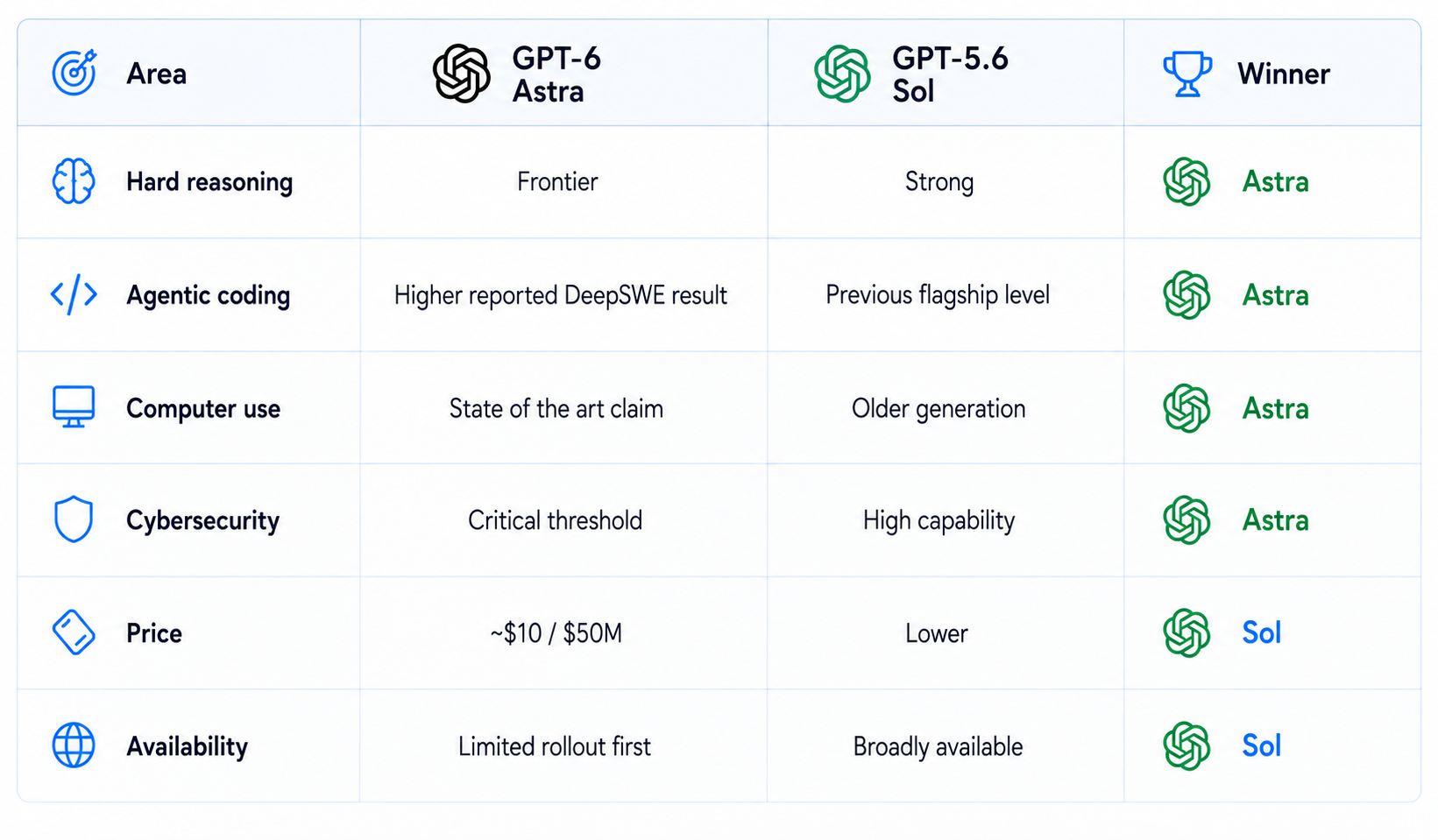
The catch is cost. A two-and-a-half-times price premium is only justified if Astra closes enough failures to save more money elsewhere. For a trivial request, the difference is wasteful. For an agent that otherwise needs repeated retries or human intervention, the economics can reverse quickly.
10. GPT-6 Astra vs Claude Fable 5.1
The most direct competitor is Claude Fable 5.1 because both are positioned around difficult long-horizon agent work and both sit at roughly $10 per million input tokens and $50 per million output tokens. Fable 5.1 also has a major cache-read advantage, with cache reads priced at $0.25 per million tokens. See our Claude Fable 5.1 Review for the full breakdown.
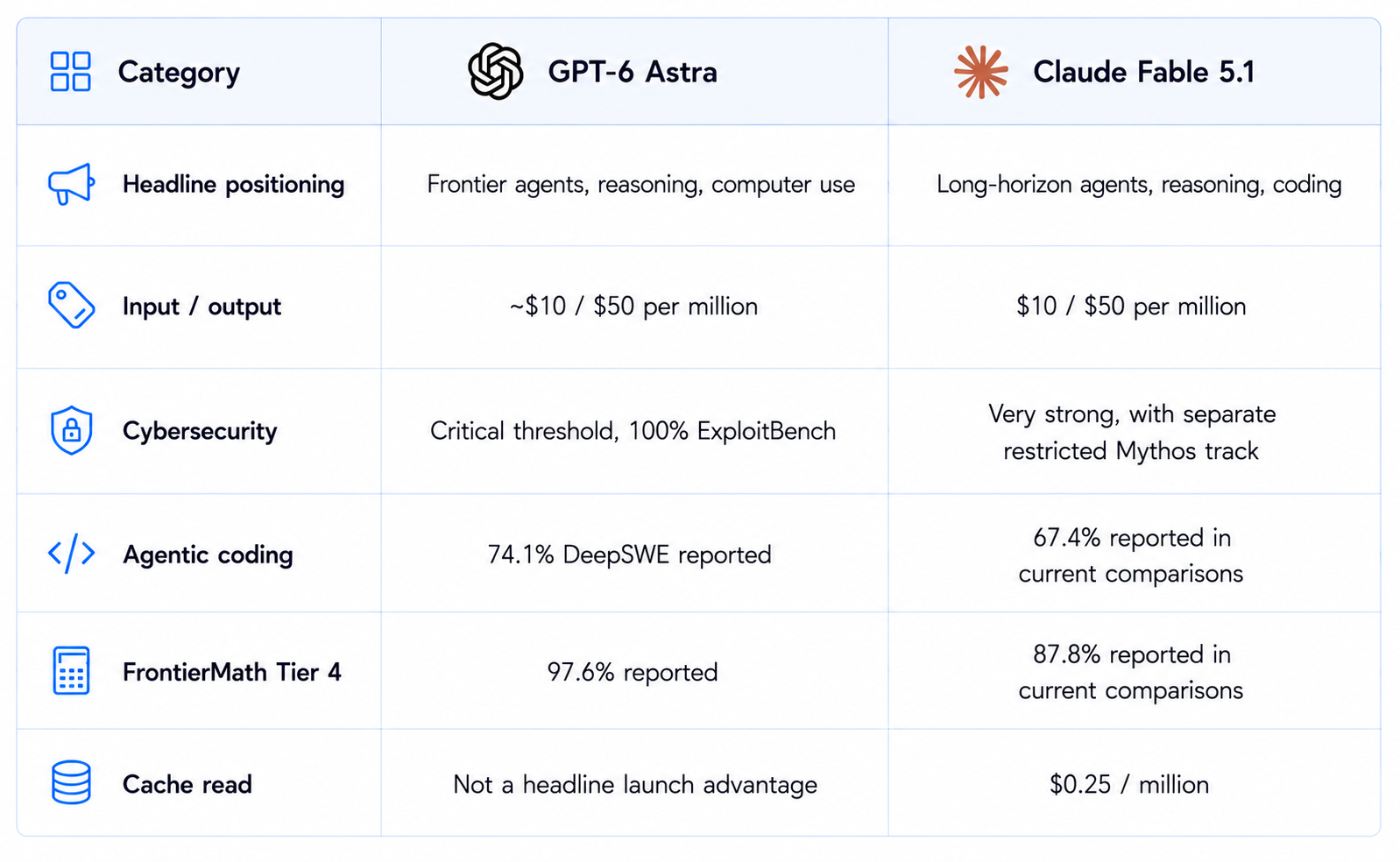
On the currently reported benchmark snapshots, Astra appears to have the edge in several of the hardest reasoning and coding evaluations. But this is exactly where you should resist declaring a permanent winner. Both models are evolving quickly, and agent benchmarks are highly sensitive to harness design, tool access, and effort settings. The better question for a production team is which model finishes its own workload more reliably at an acceptable cost.
11. Is GPT-6 Astra Worth the Price?
For most people, not yet. For hard agentic work, potentially yes.
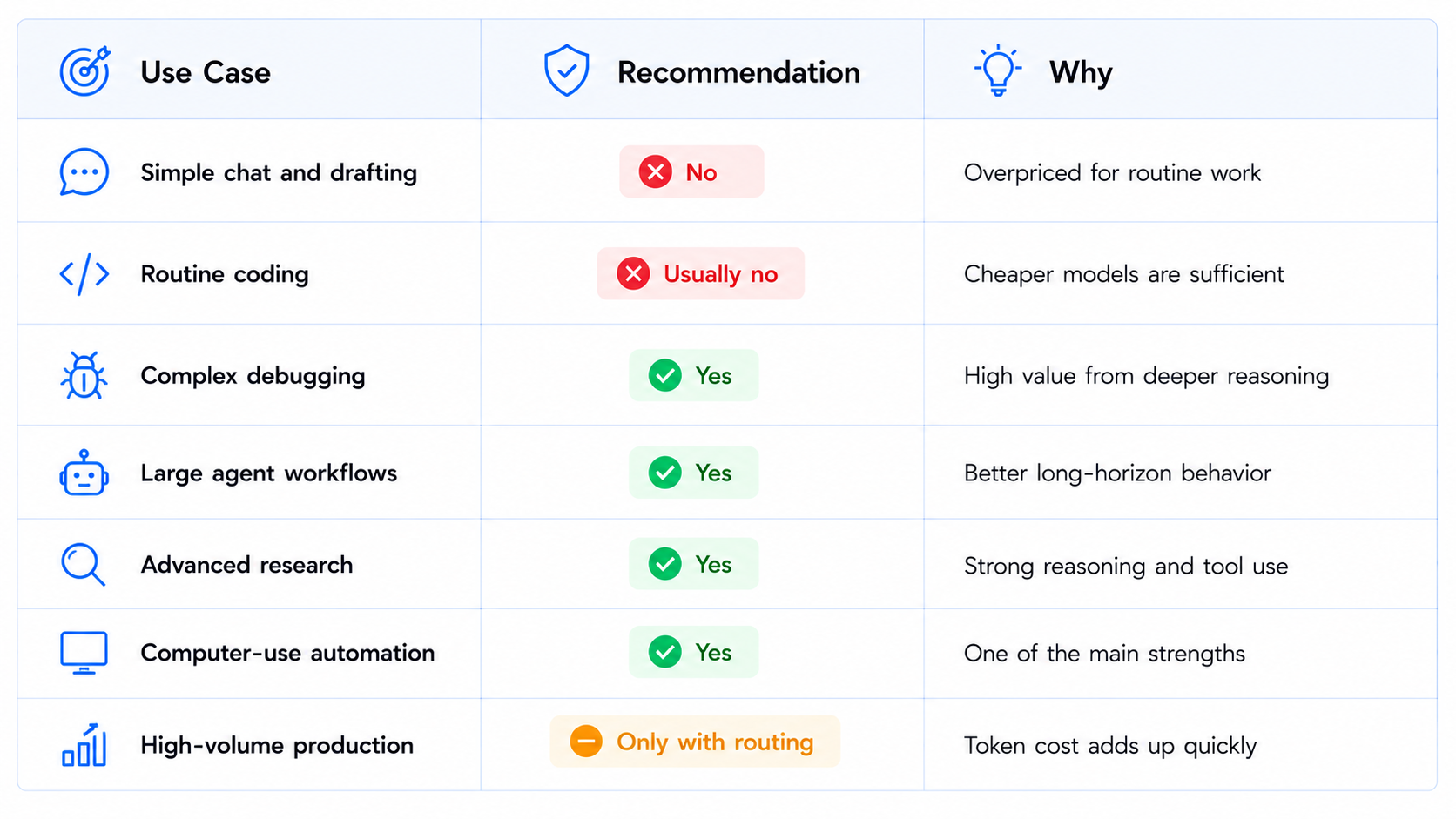
The mistake would be buying Astra simply because it is the newest flagship. Most tasks do not require flagship reasoning. Summaries, extraction, simple coding changes, routine analysis and ordinary chat can often be handled by much cheaper models. Astra earns its price when the task has enough complexity that a weaker model would spend more time getting stuck, retrying, or asking the user to take over.
A good production strategy is model routing. Start a workflow on a cheaper model, measure whether it succeeds, and escalate only when the task crosses a difficulty threshold. This is particularly sensible because Astra's premium output pricing makes long generations expensive.
12. Who Should Use GPT-6 Astra?
Astra makes the most sense for developers building agents, teams automating complex knowledge work, researchers using AI for difficult technical problems, and organizations where the cost of a wrong answer is materially higher than the cost of additional inference.
- Developers building autonomous coding and software-engineering agents
- Research teams working on difficult scientific, mathematical or technical problems
- Businesses automating multi-step computer workflows
- Security teams working inside approved defensive environments
- Enterprises that can justify premium inference through task completion gains
It is less attractive for casual users who mainly want fast answers, writing assistance or basic code generation. A frontier model is not automatically better value just because it is better at the hardest problems.
13. What GPT-6 Astra Still Does Not Prove
The launch is impressive, but there are several claims you should not make from it.
First, 98.6% on ARC-AGI-3 does not by itself prove AGI. The evaluation setup matters, and community discussion has highlighted how much harness design can affect this benchmark. Second, the ten mathematical results do not mean the system has replaced mathematicians. OpenAI explicitly asks the mathematical community to scrutinize the results and says the arguments should be understood in context.
Third, benchmark wins do not guarantee reliability in your environment. A coding agent can score well on a benchmark and still fail your monorepo, use the wrong package manager, misunderstand internal conventions, or make unsafe assumptions. Your own evaluation set is still the final judge.
Finally, GPT-6 Astra does not eliminate the need for engineering around the model. Agent permissions, tool design, retrieval, context management, verification, monitoring and rollback are still essential. In fact, Astra makes those systems more important because a more capable agent can do more damage when it is given the wrong authority.
14. Final Verdict
GPT-6 Astra is a substantial frontier-model release, not a cosmetic upgrade. The combination of stronger reasoning, computer use, software engineering and cybersecurity capability makes it one of the most consequential AI launches of 2026. OpenAI's ten mathematical results give the model a stronger research story than a typical benchmark release, while the agentic coding and computer-use results point toward a more practical shift: AI systems are becoming more capable of completing tasks rather than merely generating responses.
But there is a reality check. Astra is expensive, access is still rolling out, and some of the most dramatic benchmark numbers need careful interpretation. The cybersecurity capability is also powerful enough that OpenAI is treating deployment as a safety problem, with additional monitoring, gating and the possibility of legitimate tasks being interrupted.
So is GPT-6 Astra worth it? For everyday AI use, probably not. For serious coding agents, advanced research, computer automation and difficult reasoning, it is one of the first models where the premium can be justified by the amount of work it can complete. The real benchmark is not 98.6% on a leaderboard. It is whether Astra can finish your hardest workflow with fewer retries, fewer interventions and lower total cost per successful result.
Frequently Asked Questions
What is GPT-6 Astra?
GPT-6 Astra is OpenAI's new frontier flagship model focused on difficult reasoning, coding, computer use, research, professional work and agentic tasks.
Is GPT-6 Astra actually GPT-6?
OpenAI and current launch coverage now use the name GPT-6 Astra. The model was previously publicly discussed simply as Astra, OpenAI's next major model.
How much does GPT-6 Astra cost?
The reported API price is $10 per million input tokens and $50 per million output tokens, making it a premium model.
What are the GPT-6 Astra benchmarks?
Reported launch figures include 98.6% on ARC-AGI-3, 100% on ExploitBench, 97.6% on FrontierMath Tier 4 v2 and 74.1% on DeepSWE v1.1. Some results depend on the evaluation harness and should be treated as provider-reported until independently reproduced.
Is GPT-6 Astra better than GPT-5.6 Sol?
Yes on the capability areas emphasized by OpenAI, particularly hard reasoning, agentic coding, computer use and cybersecurity. It is also more expensive and initially more restricted.
Is GPT-6 Astra better than Claude Fable 5.1?
Current reported benchmark snapshots give Astra the edge on several difficult reasoning and coding tests, but the comparison is not yet a definitive universal ranking. Fable 5.1 has an important cost advantage for cached context.
Is GPT-6 Astra good for coding?
Yes. Long-horizon software engineering is one of its main targets, and reported DeepSWE v1.1 performance places it among the strongest current coding agents.
Can GPT-6 Astra use a computer and browser?
Yes. Computer and browser use are central parts of the model's launch positioning, with OpenAI and launch coverage highlighting autonomous digital workflows.
Is GPT-6 Astra available in ChatGPT?
It is rolling out in stages, starting with a limited group of enterprise organizations through Daybreak, followed by Plus, Pro, Business and Enterprise users and API developers.
Is GPT-6 Astra worth it?
It is worth considering for difficult agentic workflows where higher task-completion reliability can offset its premium price. It is overkill for routine chat and simple coding.
Recommended Blogs
- Claude Fable 5.1 Review: Benchmarks, Pricing, Features & Is It Worth It? (2026)
- Claude Mythos 5.1 Review: Price, Benchmarks & Access
- Quasar 438B Review: Benchmarks, Speed, Price & Is It Worth It? (2026)
- Best Open Source AI Models August 2026: Full Collection
- What Is an AI Agent? Beginner Guide With Examples (2026)
Resources & Community
Join our community of 70,000+ AI enthusiasts and learn to build powerful AI applications. Whether you are a beginner or an experienced developer, Build Fast with AI helps you understand and implement AI in real projects.
- Website - buildfastwithai.com
- LinkedIn - Build Fast with AI
- Instagram - @buildfastwithai
- Founder Twitter - @satvikps
- Twitter - @BuildFastWithAI
Agentic AI Launchpad 2026
A structured 6-week cohort program that takes you from AI basics to building and deploying real-world agentic AI systems. Includes live sessions, expert mentorship, project reviews, and a builder community network.
Ready to go from learning to building? Join Agentic AI Launchpad 2026
Free AI Resources
Access free tools, workshops and micro-learning to keep building.
- AI Workshops - Free resources, upcoming events and past recordings
- Unrot - Learn AI in 5 minutes a day
References
- OpenAI: Path to Astra: critical capabilities and frontier safeguards
- OpenAI: Ten advances in mathematics and theoretical computer science
- OpenAI: Responding to the next frontier of critical cyber capabilities
- OpenAI: Pacing model development in an era of cyber-critical capabilities
- OpenAI: The Hugging Face incident and the road ahead
- OpenAI GitHub: ten-proofs
- Reuters: OpenAI launches new Astra model amid growing scrutiny over agents' safety
- WIRED: GPT-6 Astra Is Here and OpenAI Thinks It May Kick Off the AGI Era
The Information: OpenAI Releases GPT-6 Astra Model, Suggests It Could Be AGI

