



Claude Fable 5.1: What Changed and Where the Model Actually Excels
Claude Fable 5.1 is Anthropic's latest model for demanding reasoning and long-horizon agentic work. It launched on September 1, 2026, with the same $10 per million input token and $50 per million output token pricing as Claude Fable 5, but with a much cheaper cache-read rate. Anthropic also reports substantial gains on agentic coding, scientific research, business workflows, and computer-use evaluations.
That combination makes Fable 5.1 a more interesting release than the version number suggests. This is not simply a small quality bump to an existing flagship. Anthropic is targeting a different economic and behavioral profile: the model should work for longer, handle more complex tool loops, communicate progress more clearly, and remain useful as the task grows beyond a single prompt and answer.
The catch is price. Fable 5.1 remains expensive on uncached tokens and is slower than Opus 5. Anthropic itself recommends starting with Opus 5 for most workloads, then moving to Fable 5.1 when your evaluations show that cheaper or faster models still fail on the hardest tasks.
So the right question is not whether Fable 5.1 is the biggest model in the lineup. The useful question is where its extra capability produces enough value to justify the premium. This review looks at the specifications, benchmark results, pricing changes, coding and agentic behavior, limitations, and the kinds of users who should actually use it.

QUICK ANSWER
Claude Fable 5.1 is one of the strongest current choices for long-running coding agents, multistep research, computer use, and other workflows where the model must reason, use tools, recover from failures, and keep going. It has a 1M-token context window, 128K maximum output, adaptive thinking, and a default reasoning effort of high. Its API pricing is $10/M input and $50/M output, with cache reads reduced to $0.25/M.
The blunt verdict: use Fable 5.1 when task completion matters more than raw response speed or minimum token cost. For routine chat, straightforward coding, or high-volume workloads, Opus 5 and Sonnet 5 can be better economics. For hard agentic tasks where cheaper models repeatedly stall or need human rescue, Fable 5.1 is much easier to justify.
1. What Is Claude Fable 5.1?
Claude Fable 5.1 is a frontier model in Anthropic's Fable family, designed specifically for demanding reasoning and long-horizon agentic tasks. The model accepts text and images, returns text, uses adaptive thinking that is always on, and supports a 1-million-token context window with up to 128,000 output tokens. Its API model ID is claude-fable-5-1.
The phrase long-horizon matters. A short benchmark question can test whether a model knows something. An agentic workflow tests whether the model can keep track of goals, choose tools, inspect results, revise plans, and continue after something goes wrong. Fable 5.1 is aimed at the second problem.
Anthropic specifically calls out coding, multistep research, document work, spreadsheet work, slide work, and computer use. The model is therefore best understood as an engine inside an agent loop rather than a better version of a general chatbot.
That also explains why Anthropic's model guidance does not say to use Fable 5.1 everywhere. If a cheaper model reliably completes the task, the expensive model is unnecessary. Fable 5.1 earns its keep on workloads where failure is costly, tasks are long, or the model has to make many connected decisions.
2. Fable 5.1 Specs and Pricing
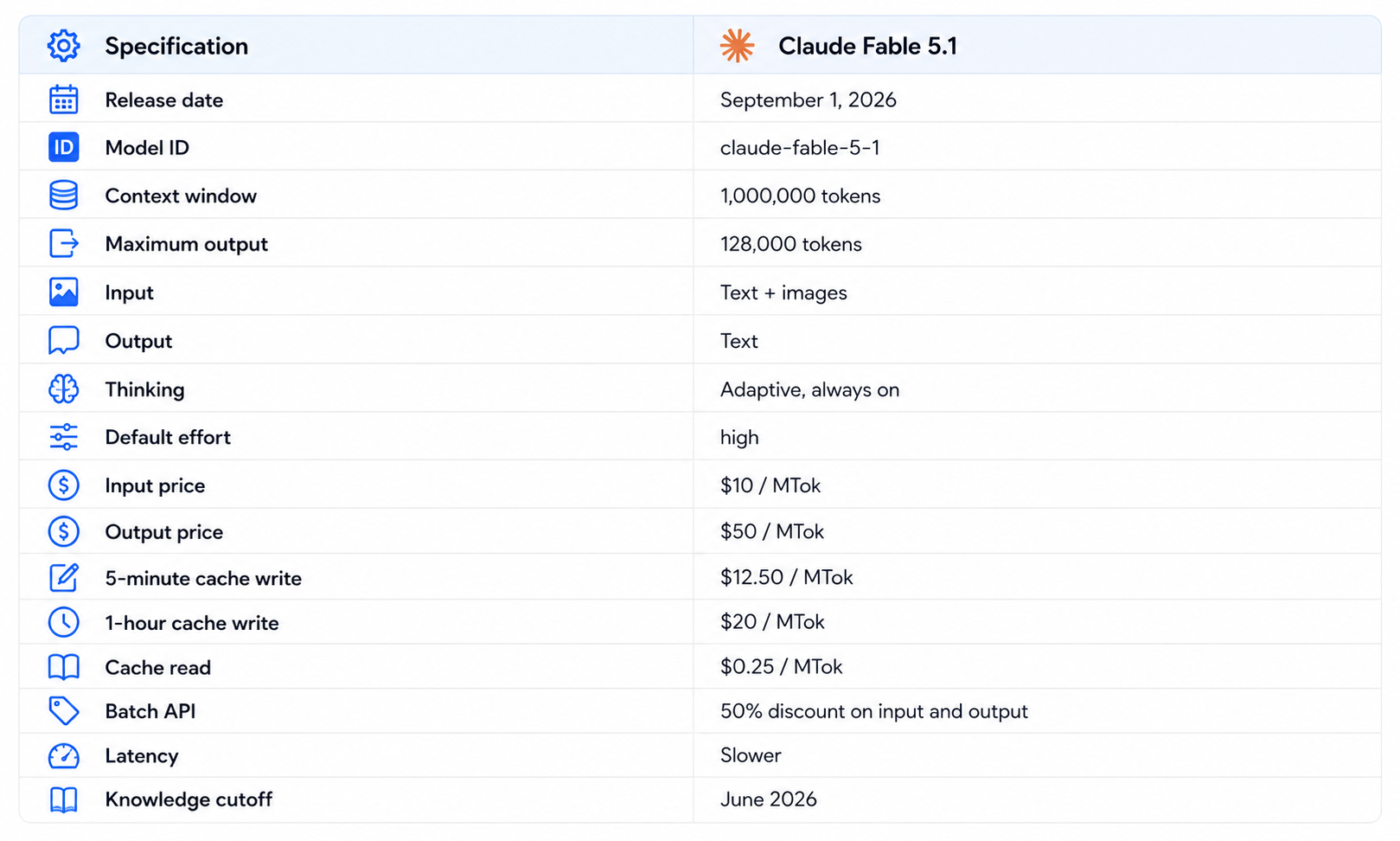
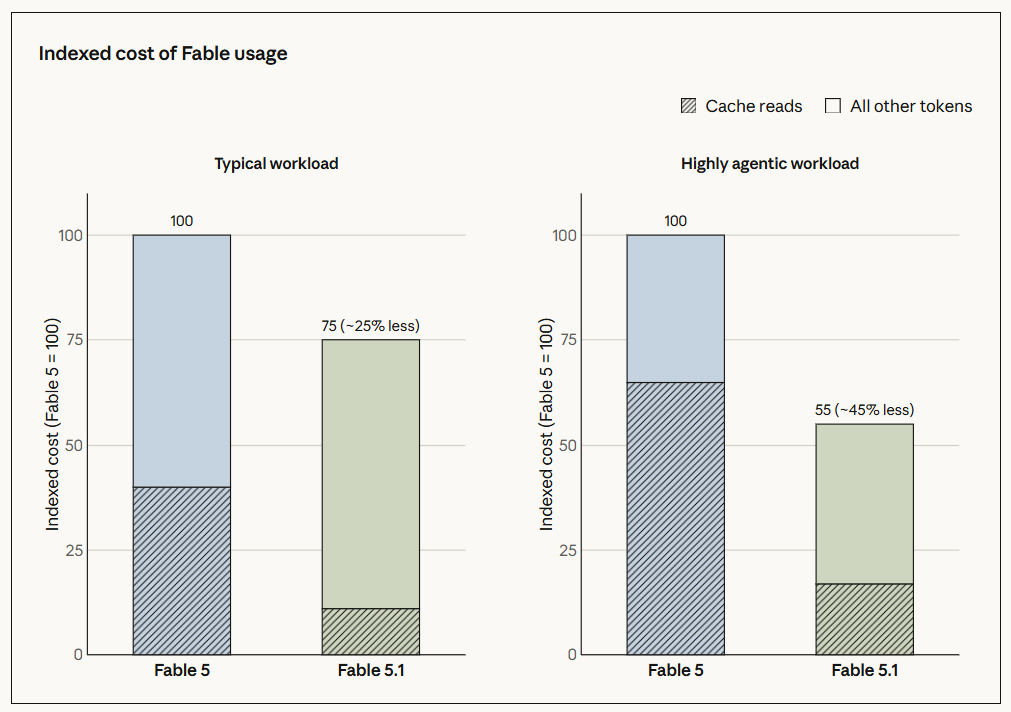
The headline API prices are unchanged from Fable 5. What changed is cached input. Fable 5.1 cache reads are $0.25 per million tokens instead of $1.00 per million for Fable 5, a 75% reduction. Anthropic says this can reduce practical costs by about 25% for typical workloads and up to around 45% for highly agentic workloads.
This is more important than it looks. Agent systems repeatedly reuse the same instructions, repository context, document indexes, tool definitions, and previous state. When those inputs are cached, reducing the read price changes the economics of keeping a large working context alive across many steps.
The other pricing detail to understand is that output remains expensive at $50/M tokens. If your workload generates huge outputs rather than rereading large cached inputs, the cache improvement will not transform the bill. Fable 5.1 is most economically attractive when the workflow is context-heavy and iterative.
Source : Anthropic: Claude Fable 5.1 and Mythos 5.1 Model Overview
3. Fable 5.1 Benchmarks
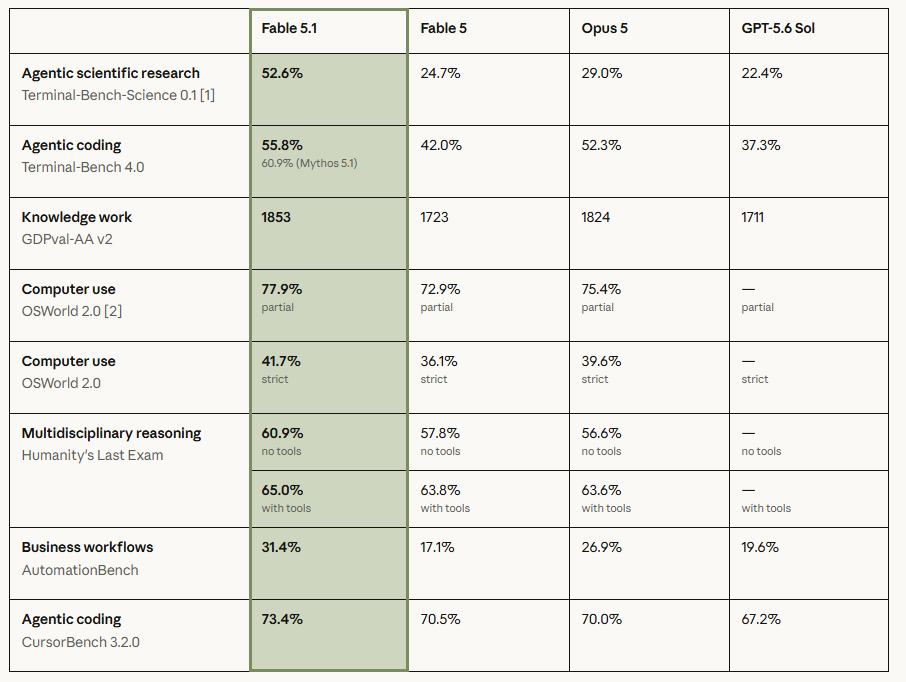
Anthropic's published evaluations show the clearest gains in agentic work. The largest jump is on Terminal-Bench-Science 0.1, where Fable 5.1 scores 52.6% versus 24.7% for Fable 5. On Terminal-Bench 4.0, it scores 55.8% versus 42.0% for Fable 5. It also leads the listed Fable 5, Opus 5, and GPT-5.6 Sol results on several other reported comparisons.
Source : Anthropic: Claude Fable 5.1 and Mythos 5.1 Model Overview
The numbers tell two different stories. Some improvements are large, while others are incremental. CursorBench moves from 70.5% to 73.4%, which is useful but not revolutionary. By contrast, the scientific-research and business-workflow gains are much larger. That pattern matches Anthropic's description of the model as a long-horizon agent rather than a pure code autocomplete system.
Benchmark caveats matter. Anthropic evaluated Fable 5.1 with production safeguards enabled. On tasks where safeguards intervened, some benchmark outcomes were zeroed, and Anthropic notes that this likely lowers Fable 5.1 and Fable 5 performance on affected tasks. Terminal-Bench-Science also carries a reported standard error of roughly 3.5 to 4.5 points per model, so small gaps should not be overinterpreted.
The practical conclusion is still strong: the release shows the largest advantages in tasks that require sustained tool use, research, automation, and recovery across multiple steps.
4. Why Fable 5.1 Is More Interesting for Agents Than Chat
The biggest shift in Fable 5.1 is behavioral. Anthropic's model-specific guidance discusses progress updates between tool calls, batching independent tool calls, append-only conversation history, task completion, compaction summaries, file edits, long outputs, subagents, and search triggering. Those are agent-engineering concerns, not normal chatbot concerns.
In a long coding session, for example, an agent may spend dozens of turns reading files, running tests, querying documentation, making changes, checking results, and revising its plan. A model that gives a strong answer on turn one but becomes unreliable on turn twenty is not actually a strong agent. Fable 5.1 is designed around the entire loop.
Anthropic also highlights clearer progress communication. For users watching a long-running agent, that matters because silence is ambiguous. You do not know whether the model is thinking, executing, stuck, or quietly repeating the same failed approach. Fable 5.1's progress-update behavior is intended to make those states more visible.
This does not remove the need for a good agent harness. Tool definitions, permissions, retries, context management, sandboxing, and evaluation still determine a large portion of real-world performance. A strong model inside a poorly designed harness can still produce an unreliable system.
5. Coding Performance: Where Fable 5.1 Makes Its Case
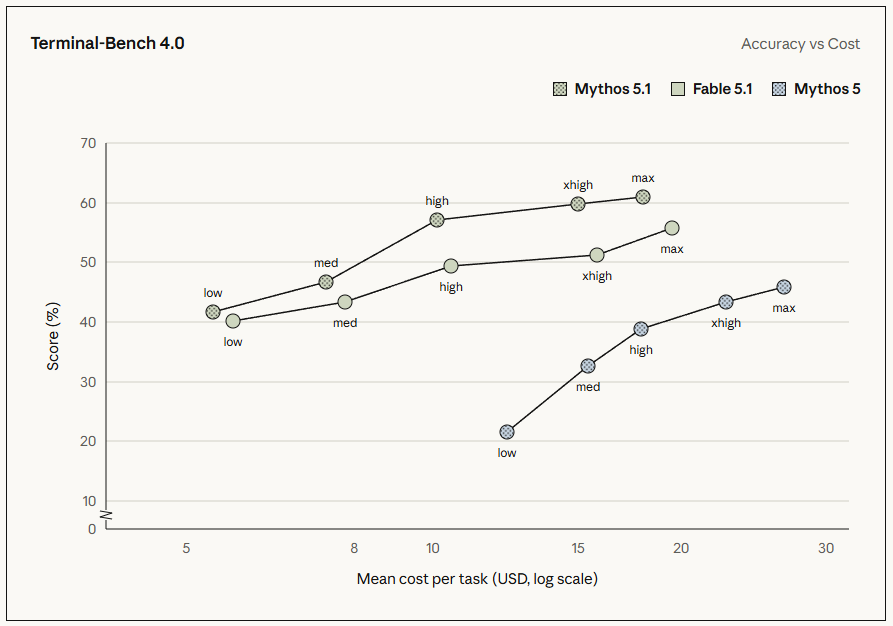
Coding is one of the clearest reasons to try Fable 5.1. Terminal-Bench 4.0 places it at 55.8%, ahead of Fable 5 at 42.0% and Opus 5 at 52.3% in Anthropic's comparison. CursorBench is less dramatic, with Fable 5.1 at 73.4% versus 70.5% for Fable 5 and 70.0% for Opus 5.
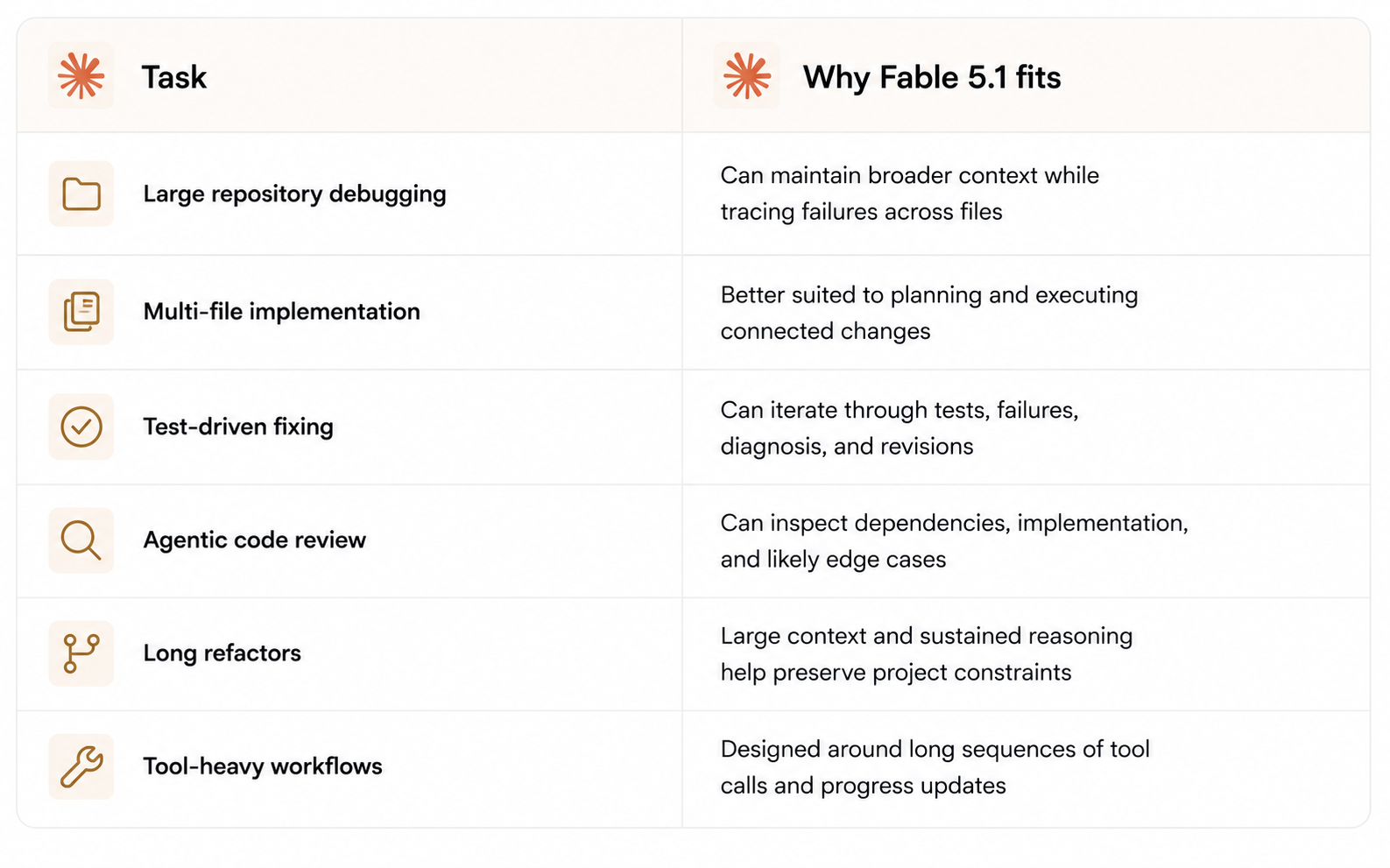
The difference suggests that Fable 5.1's advantage is less about writing an isolated function and more about completing a broader engineering task. A real software request often includes repository exploration, dependency reasoning, test execution, debugging, and changing several files without breaking unrelated behavior.
That is exactly where the economics of caching also become relevant. A coding agent can carry a large and relatively stable repository context while repeatedly adding small amounts of new state. If the harness is designed to reuse cached context efficiently, the lower cache-read price can reduce the cost of a long session without cutting the model's reasoning budget.
Source : Anthropic: Claude Fable 5.1 and Mythos 5.1 Model Overview
What Fable 5.1 is especially good at in coding
6. Scientific Research and Knowledge Work
Fable 5.1's research positioning is not just a marketing line. Terminal-Bench-Science 0.1 rises from 24.7% for Fable 5 to 52.6% for Fable 5. The model also reaches 1,853 on GDPval-AA v2, ahead of Fable 5 at 1,723 and Opus 5 at 1,824 in Anthropic's published table.
For research workflows, the value of a 1-million-token context is obvious, but context size alone is not enough. A useful research agent must decide which sources matter, keep the objective stable, compare contradictory evidence, and avoid filling gaps with confident guesses. Long context makes those operations possible at larger scale, but it does not make the agent infallible.
Fable 5.1 is therefore best suited to research systems that combine retrieval, tools, structured notes, verification, and an explicit final-answer standard. Used that way, the model can function as the reasoning layer over a much larger evidence pipeline.
7. Computer Use and Automation
Fable 5.1 also improves on the published computer-use evaluations. It scores 77.9% on OSWorld 2.0 partial and 41.7% on the strict version, compared with 72.9% and 36.1% for Fable 5.
AutomationBench shows an even larger jump, from 17.1% for Fable 5 to 31.4% for Fable 5.1. This is important because many business automations are not deterministic. The system may need to inspect information, infer what matters, decide what action to take, and communicate the result rather than simply follow a fixed sequence.
That does not mean you should give an unattended agent unrestricted access to production systems. The more capable the model becomes at taking actions, the more important least-privilege credentials, sandboxes, approval gates, logs, and rollback mechanisms become. Strong agent performance and strong operational controls need to develop together.
8. Fable 5.1 vs Fable 5
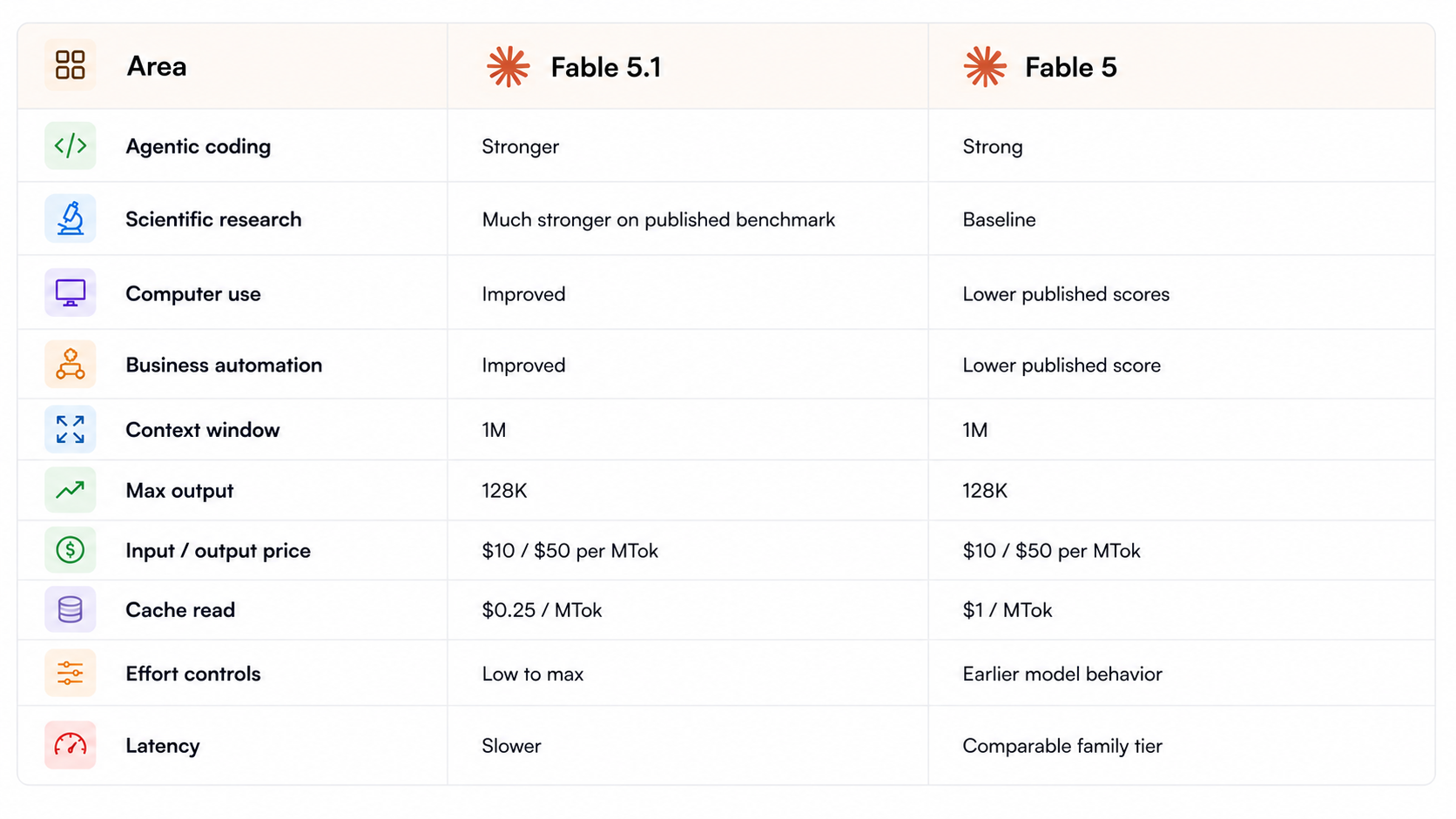
The upgrade case is straightforward. Fable 5.1 is more capable on the tasks Anthropic says matter most, while headline token prices stay the same and repeated cached context gets cheaper.
There is still a reason to keep Fable 5 around in legacy systems. If you have an existing integration that depends on older thinking-block behavior or forced tool use, migration is not completely invisible. Anthropic lists breaking changes including forced tool use returning an error, earlier models being unable to read Fable 5.1 thinking blocks, and editing earlier turns invalidating thinking blocks.
For a new build, however, the choice is easier. Fable 5.1 is the model to evaluate first when the workload itself is long-running and agentic.
9. Fable 5.1 vs Opus 5 vs Sonnet 5
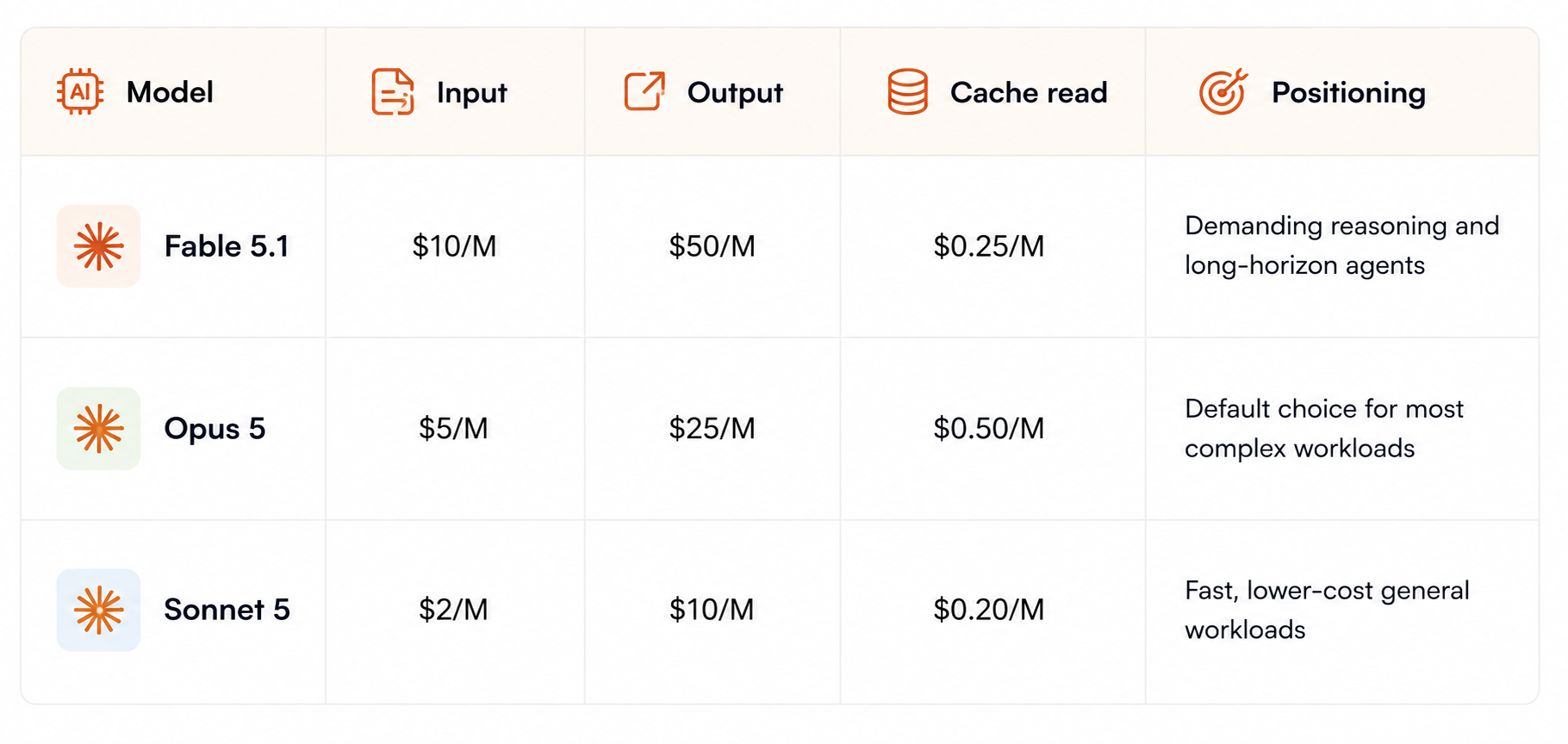
Fable 5.1 costs twice as much as Opus 5 on uncached input and output, although its cache reads are cheaper in absolute terms. That means it should not be your default simply because it is newer or stronger on a benchmark.
Anthropic's recommendation is unusually practical: start with Opus 5 for most workloads and use Fable 5.1 when demanding reasoning or long-horizon agentic tasks are the bottleneck. The correct way to validate that decision is with your own evaluation set. Measure successful task completion, intervention rate, latency, and cost per successful outcome.
If an Opus 5 agent solves a task in ten turns and Fable 5.1 solves it in six, the higher token price may be irrelevant if the expensive failures are eliminated. Conversely, if both models solve the task reliably, paying twice as much is simply wasteful.
10. Effort Levels Matter More Than Most Users Realize
Fable 5.1 supports adjustable effort levels, including low, medium, high, xhigh, and max, with high as the default. Anthropic's prompting guidance recommends evaluating the tradeoff because higher effort can improve performance on difficult tasks while increasing latency and cost.
This gives Fable 5.1 a useful operating range. A simple classification task does not deserve the same reasoning budget as a multi-hour debugging job. The mistake is to think of maximum effort as the definition of model quality. The better approach is to choose the lowest effort level that reliably completes the task.
In production, this can be implemented as a routing policy. Use lower effort for routine subtasks, increase effort for uncertain decisions, and reserve the highest settings for failures or genuinely difficult stages. That is much more sensible than running every request at max simply because the option exists.
11. Context Window: 1 Million Tokens Is Powerful, Not Magical
The 1-million-token context window is one of Fable 5.1's biggest headline specifications. It makes the model suitable for large repositories, long research collections, extended agent sessions, and complex document workflows.
But large context should not be confused with unlimited useful attention. Dumping every available document, tool output, and old conversation into the prompt can still create noise, increase retrieval mistakes, and waste money. A good agent uses retrieval and context engineering to keep the active context relevant.
The practical lesson is simple: use the million-token window as capacity, not as an excuse to stop designing a context strategy. A well-curated 200,000-token context can be more useful than an unstructured 900,000-token dump.
12. Important Changes for Developers Migrating From Fable 5
Most existing Fable 5 prompts should transfer well, but Anthropic documents several behavior changes. Forced tool use now returns an error instead of behaving like the older model path. Earlier models cannot read Fable 5.1 thinking blocks, and editing earlier turns can invalidate thinking blocks.
The additive changes are more useful for new agent systems. Per-message effort and turn-scoped system messages are available in beta, and progress updates can be surfaced between tool calls. Content provenance support is also part of the newer interface.
For production migrations, test your harness instead of assuming model compatibility means behavioral compatibility. Pay particular attention to tool invocation, history editing, thinking-block handling, and long-running session recovery.
13. Safety and Reliability Considerations
Fable 5.1 was evaluated with production safeguards enabled, and Anthropic says it improved safeguards in the release. The company reports lower false-positive rates in cybersecurity and fewer fallbacks for basic biology and medical questions. Those improvements are useful, but safeguards also affect benchmark behavior, so they are part of the real product and should not be separated from performance analysis.
For developers, the bigger lesson is that model capability does not remove operational risk. An agent that can inspect files, execute commands, browse, modify code, and interact with external services can also make expensive mistakes if permissions are too broad. For broader guidance, see our AI coding agent security guide.
Use a sandbox for tool execution, scope credentials to the minimum necessary, require approval for irreversible operations, and keep enough logs to reconstruct what the agent did. These controls matter even more with a model specifically optimized to complete long tasks.
14. Who Should Use Claude Fable 5.1?
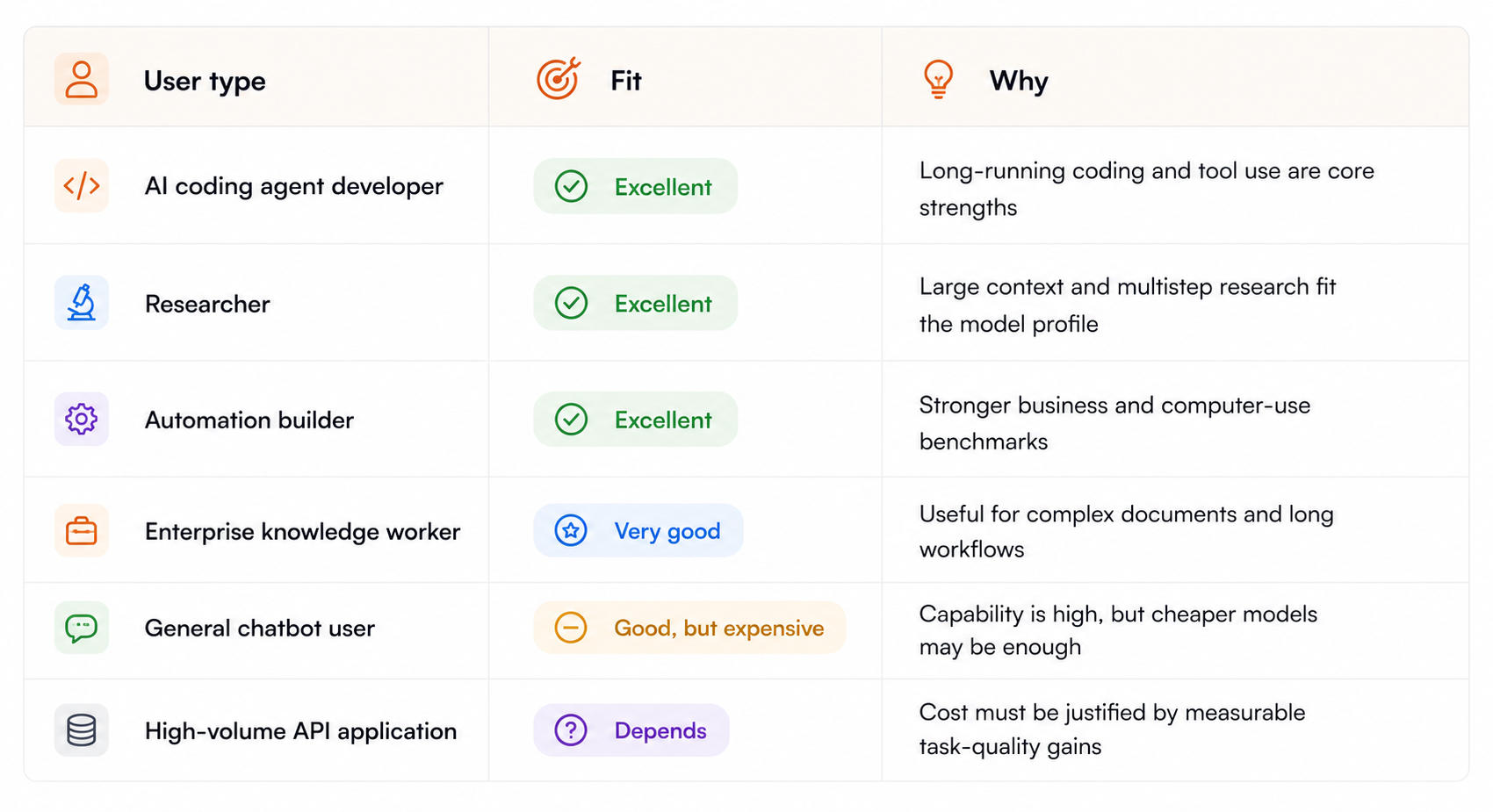
The strongest fit is anyone building or operating an agent that has to keep working after the first response. Developers building coding agents, research systems, complex automations, and document workflows are much more likely to benefit than someone who mainly asks short questions.
If your workload is simple, fast, and high volume, start lower in the model stack. Sonnet 5 is dramatically cheaper, and Opus 5 sits between Sonnet 5 and Fable 5.1 in both price and positioning. The premium model should be earned by the workload, not by the marketing page.
15. Is Claude Fable 5.1 Worth It?
Yes, but only for the right workload. Fable 5.1 is worth the premium when you care about successful completion of long-running tasks, when human intervention is expensive, or when cheaper models repeatedly fail after several steps. The stronger agentic benchmark results and lower cache-read price support that positioning.
It is not worth switching every application to Fable 5.1 just because it tops a benchmark table. A two-times higher uncached token price is material, and the model is slower. For routine coding assistance, summarization, short research answers, and simple automation, cheaper models can be the rational choice.
The best way to make the decision is to run a controlled evaluation. Take the tasks that currently consume the most human time. Measure how often each model completes them, how many turns are required, how much a successful run costs, and how often a human has to intervene. If Fable 5.1 reduces failure and intervention enough to offset the token premium, it is worth it. If not, do not pay for capability you are not using.
16. Final Verdict
Claude Fable 5.1 is a meaningful upgrade, but its importance is concentrated in the workloads Anthropic designed it for. The model is stronger at long-running agentic coding, scientific research, business automation, and computer use. It combines a 1M-token context window and 128K output ceiling with adaptive thinking, adjustable effort, and much cheaper cache reads.
The most convincing evidence is not one giant benchmark number. It is the pattern across benchmarks plus the economics of long sessions. Terminal-Bench-Science moves from 24.7% to 52.6%. Terminal-Bench 4.0 rises from 42.0% to 55.8%. AutomationBench rises from 17.1% to 31.4%. At the same time, cached input becomes 75% cheaper.
My overall take is 9.2/10 for long-horizon agentic work, 9/10 for coding agents, 8.8/10 for research and automation, 7.5/10 for everyday chat, and 8.9/10 overall. The model is expensive, and that should be treated as a real constraint. But when the job is genuinely difficult, Fable 5.1 is one of the strongest models to put inside the loop.
The smartest deployment strategy is not to run Fable 5.1 for everything. Route easy work to cheaper models, use Opus 5 for the general hard cases, and reserve Fable 5.1 for tasks where deeper reasoning and longer autonomy measurably improve the result. That is where the model's premium becomes a business decision instead of a benchmark flex.
Frequently Asked Questions
What is Claude Fable 5.1?
Claude Fable 5.1 is Anthropic's model for demanding reasoning and long-horizon agentic work, including coding, research, automation, computer use, and complex document workflows. It has a 1M-token context window and up to 128K output tokens.
How much does Claude Fable 5.1 cost?
The API price is $10 per million input tokens and $50 per million output tokens. Cache reads cost $0.25 per million tokens, while a 5-minute cache write is $12.50/M and a 1-hour cache write is $20/M.
Is Fable 5.1 better than Fable 5?
Yes on Anthropic's published evaluations. The biggest gains are on agentic scientific research, Terminal-Bench coding, automation, and computer use, although some coding benchmarks show more modest improvements.
Is Fable 5.1 better than Opus 5?
It leads Opus 5 on several published agentic benchmarks, but Anthropic still recommends Opus 5 as the starting point for most workloads because it costs half as much on input and output.
What is the context window of Fable 5.1?
Fable 5.1 has a 1-million-token context window and a maximum output of 128,000 tokens.
Is Claude Fable 5.1 good for coding?
Yes. Long-running agentic coding is a primary use case. Anthropic reports 55.8% on Terminal-Bench 4.0 and 73.4% on CursorBench 3.2.0.
Can I use Fable 5.1 in Claude Code?
Yes. Anthropic lists Fable 5.1 as available in Claude Code and on its supported paid Claude plans. Claude Code support requires a recent client version, so check the current release before upgrading an older installation.
Does Fable 5.1 cost less than Fable 5?
Headline input and output prices are unchanged. The important saving is cache reads, which are 75% cheaper than Fable 5. Anthropic estimates roughly 25% lower practical cost for typical workloads and up to around 45% for highly agentic workloads.
Should I use Fable 5.1 for every request?
No. Use the least expensive model and reasoning effort that reliably completes the task. Fable 5.1 is best reserved for difficult, long-running work where its extra capability produces measurable value.
Is Claude Fable 5.1 worth it in 2026?
For serious coding agents, research agents, automation systems, and other long-horizon workflows, yes. For simple chat or high-volume routine workloads, cheaper Claude models can be a better fit.
Recommended Blogs
- Claude Fable 5 Review: Accuracy, Price & Is It Worth It? (2026)
- Best Open Source AI Models August 2026: Full Collection
- How to Run GLM-5.3 Locally: Hardware, VRAM & Setup (2026)
- Model Routing for AI Coding Agents: How to Cut Costs Without Losing Quality
- What Is Context Engineering? Complete Guide (2026)
- How to Secure AI Coding Agents in 2026: Permissions, Sandboxing, MCP & Secrets
- How to Automate Tasks With Hermes Agent: Complete 2026 Guide
Resources & Community
Join our community of AI builders and learn to build real AI applications, agents, and automations with practical guides and examples.
Agentic AI Launchpad 2026
A structured 6-week cohort program that takes you from AI basics to building and deploying real-world agentic AI systems. Includes live sessions, expert mentorship, project reviews, and a builder community network.
Ready to go from learning to building? Join the next cohort. Agentic AI Launchpad 2026
Free AI Resources
Access free tools, workshops, and micro-learning to keep building:
AI Workshops: Free resources, upcoming events & past recordings
Unrot: Learn AI in 5 minutes a day (free micro-learning app)
Secure the agent before you scale the agent. The safest coding workflow is the one where a bad model decision becomes a small, reversible problem instead of a production incident.

