



Claude Mythos 5.1: How Good Is Anthropic's Most Restricted Frontier Model?
Anthropic has just done something unusual: it released a new frontier model to the public under one name and kept the same underlying model behind a tightly controlled access program under another. Claude Fable 5.1 is the generally available version. Claude Mythos 5.1 is the restricted version for vetted organizations working on cybersecurity and life sciences.
That makes Mythos 5.1 harder to review than a normal model. You cannot simply open Claude, select Mythos, and run the same 100 prompts everyone else is using. But the public documentation reveals enough to understand what Mythos is, where it is stronger than Fable, how much it costs, and why Anthropic believes the difference in access policy matters.
QUICK ANSWER
Claude Mythos 5.1 is Anthropic's restricted deployment of the same underlying model as Claude Fable 5.1. It shares the 1M-token context window, 128K maximum output, adaptive thinking, and $10 per million input / $50 per million output pricing. Its practical distinction is access to reduced safeguards for advanced cybersecurity and biology work through trusted programs and Project Glasswing. Anthropic currently limits access to vetted organizations, with availability focused on a set of U.S. organizations while the programs expand.
My verdict: 9.3/10 for specialist cyber research, 9.1/10 for life-sciences research, 9/10 for long-horizon agentic work, 6/10 for accessibility, and 8.9/10 overall for its intended audience. This is not the Claude model most people should chase. It is the Claude model that matters when the ordinary safety envelope becomes the bottleneck.
1. What Is Claude Mythos 5.1?
Claude Mythos 5.1 is Anthropic's latest Mythos-class model, introduced on September 1, 2026. Anthropic describes Mythos as its most capable model family for cybersecurity and biology research, while Fable is the generally available version designed to expose Mythos-level reasoning to a much broader audience with additional safeguards.
The important technical point is that Mythos 5.1 and Fable 5.1 are the same underlying model. The difference is not a secret set of larger weights. It is the deployment envelope around those weights. Fable uses additional classifiers and fallback behavior for high-risk areas, while Mythos is offered to approved organizations for controlled work where those restrictions would block legitimate research.
My take: this is one of the most interesting model-release structures of 2026. The industry normally talks about capability as though it were a single number. Anthropic is showing that capability and usable capability can be two different things depending on the policy layer around the model.
2. Why Did Anthropic Create Mythos 5.1?
The answer is dual use. Frontier models are now capable enough in cybersecurity, biology, and chemistry that the same reasoning skills that help a defender or scientist can also lower the cost of harmful work. Anthropic therefore separated general availability from the most sensitive capabilities.
Fable 5.1 is the broad deployment. It includes safeguards that can block or limit certain requests and, in many cases, route cybersecurity or biology questions to less capable Opus models. Mythos 5.1 is the trusted-access path intended for approved organizations that need the underlying capability for legitimate research and defense.
This is also why access is part of the product itself. Mythos is not just a premium subscription tier. It is a governance decision.
3. Claude Mythos 5.1 Specifications
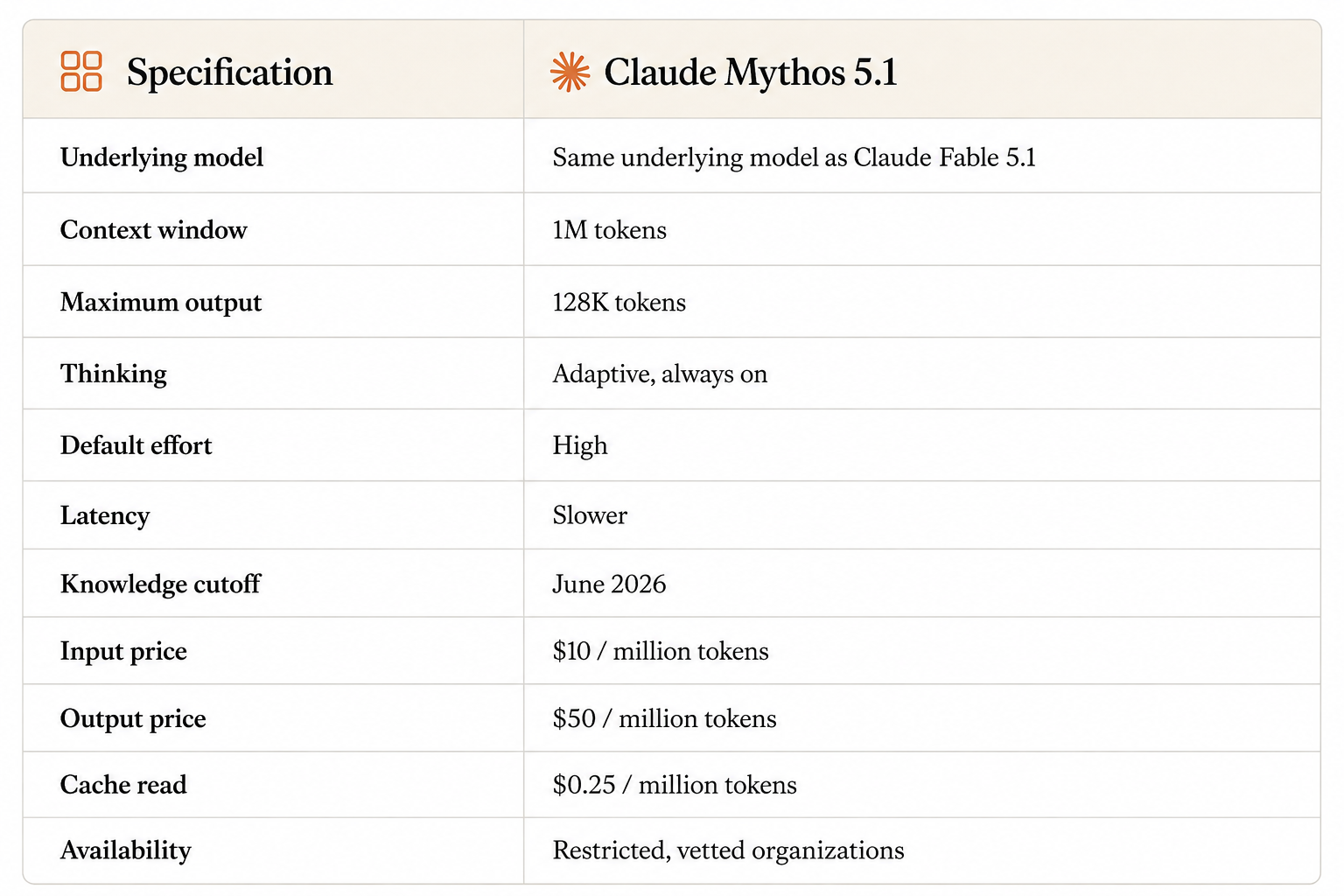
On core model specifications, Mythos 5.1 matches Fable 5.1. Anthropic lists a 1M-token context window and up to 128K output tokens. Thinking is adaptive and always on, with high as the default effort. Anthropic also lists the model as slower than Opus 5, which fits its role as a high-capability model for difficult, long-running tasks.
Its knowledge cutoff is June 2026, which is important when evaluating claims about current events or fast-moving technical changes. A larger context window does not automatically mean better performance, so the practical advantage is the ability to keep more relevant source material, repository state, tool results, and intermediate reasoning in one long-running task.
4. Claude Mythos 5.1 Pricing
Mythos 5.1 uses the same pricing as Fable 5.1: $10 per million input tokens and $50 per million output tokens. Prompt caching is especially attractive on this model because cache reads cost only $0.25 per million tokens, versus $1 per million for the previous Fable 5 and Mythos 5 generation.
Five-minute cache writes are $12.50 per million tokens and one-hour cache writes are $20 per million. The Batch API applies a 50% discount to input and output tokens. For long-running agents, repeated context can dominate costs, so the 75% reduction in cache-read price is more important than it looks from the headline $10/$50 rate.
My take: for a specialist team running very long agent sessions, the cache price is one of the best parts of the 5.1 upgrade. The model is expensive, but repeated-context economics are now much less punitive.
5. The Big Difference: Safeguards
Fable 5.1 and Mythos 5.1 share the same underlying model, but Anthropic's safeguards can change the effective result of a benchmark or a real task. Anthropic explicitly notes that Fable was evaluated with production safeguards enabled, and that some benchmark tasks were scored differently when those safeguards intervened.
In practical terms, the safeguard layer can produce a refusal, route the task to another model, or prevent certain actions. Mythos exists so a vetted defender or life scientist can use more of the underlying capability within an approved environment.
This also means the Mythos versus Fable comparison should never be framed as a simple "smarter model versus weaker model" story. The underlying intelligence is the same. The deployment policy is different.
6. Benchmarks: How Strong Is Mythos 5.1?
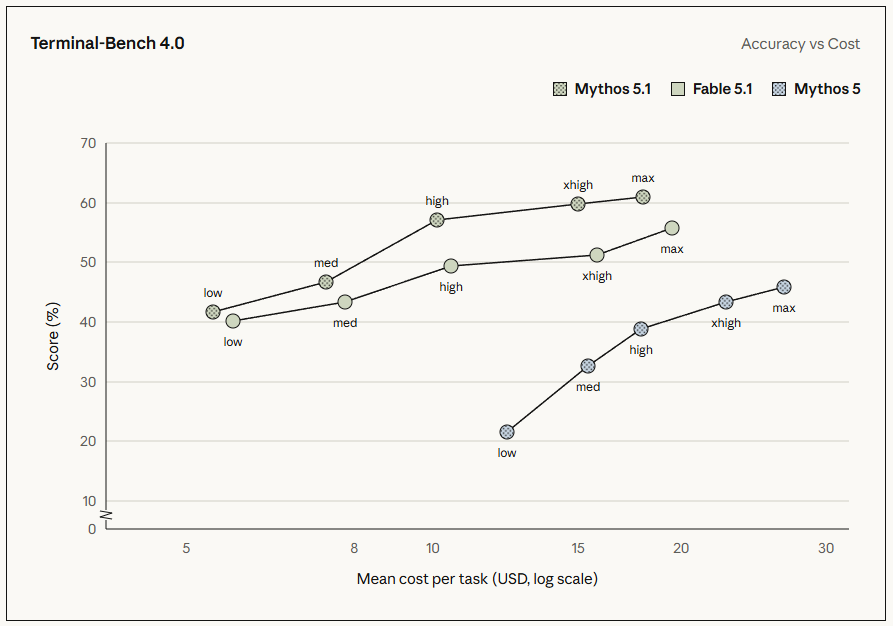
The cleanest public evidence of a difference comes from Terminal-Bench 4.0. Anthropic reports 55.8% for Fable 5.1, while the restricted Mythos configuration reaches 60.9%. Current benchmark indexes list Mythos 5.1 at #1 on Terminal-Bench 4.0 as of September 1, 2026.
For most other benchmarks, Anthropic publishes Fable 5.1 results because Mythos and Fable share the same underlying model. That means the safest interpretation is that the following scores show the shared model capability, while Mythos can outperform the Fable configuration specifically on tasks where safeguards intervene.
The benchmark story is therefore strongest when you look at the combination of shared scores plus the five-point Terminal-Bench gap, rather than pretending every Mythos score was independently measured under a separate public evaluation.
7. Benchmark Snapshot
Source : Anthropic: Claude Fable 5.1 and Mythos 5.1 Model Overview
These figures are best treated as a current public benchmark snapshot. Anthropic notes that safeguards can affect Fable results and that some benchmark task releases differ from earlier versions, so cross-version comparisons should be made carefully.
8. Cybersecurity: Where Mythos 5.1 Really Matters
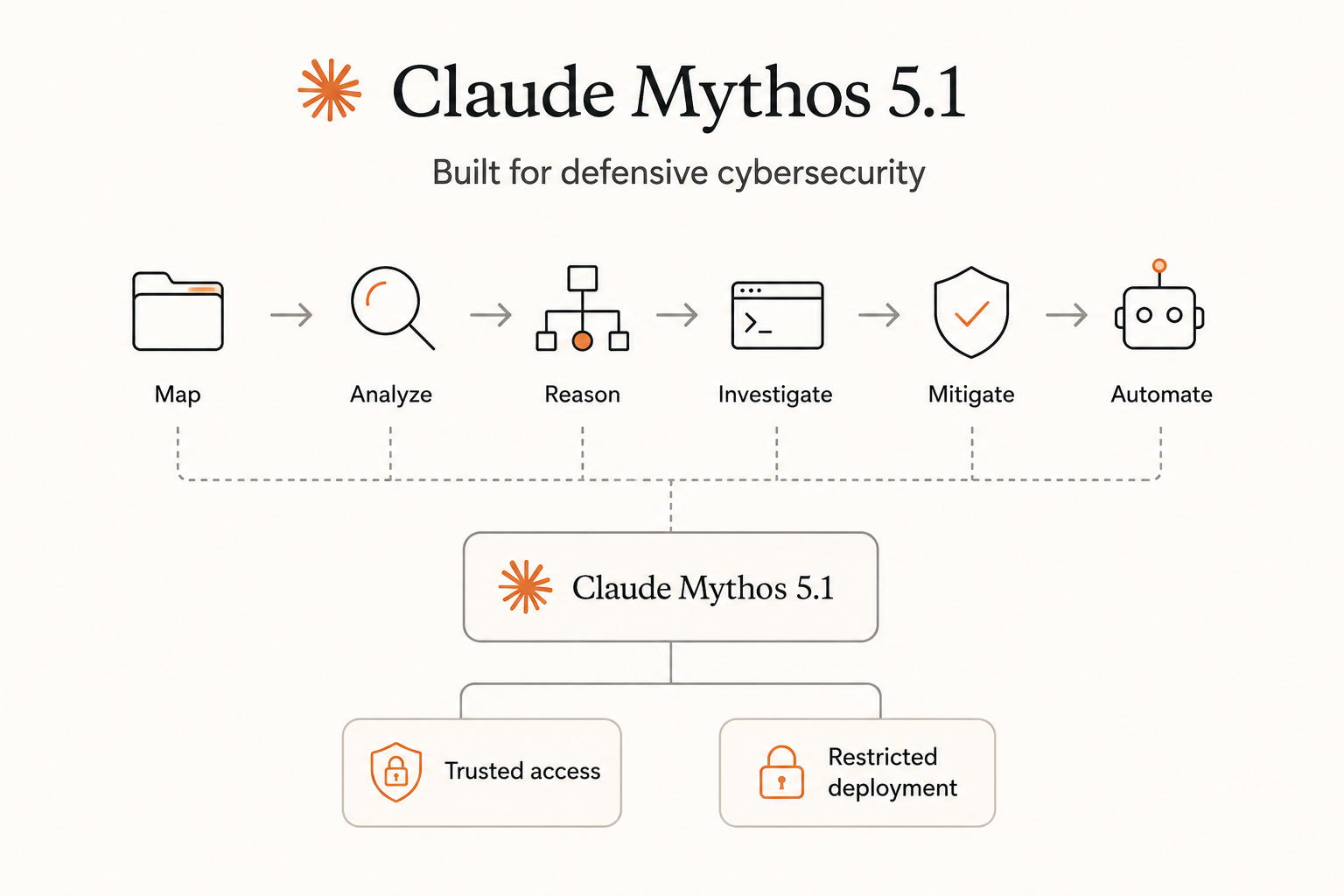
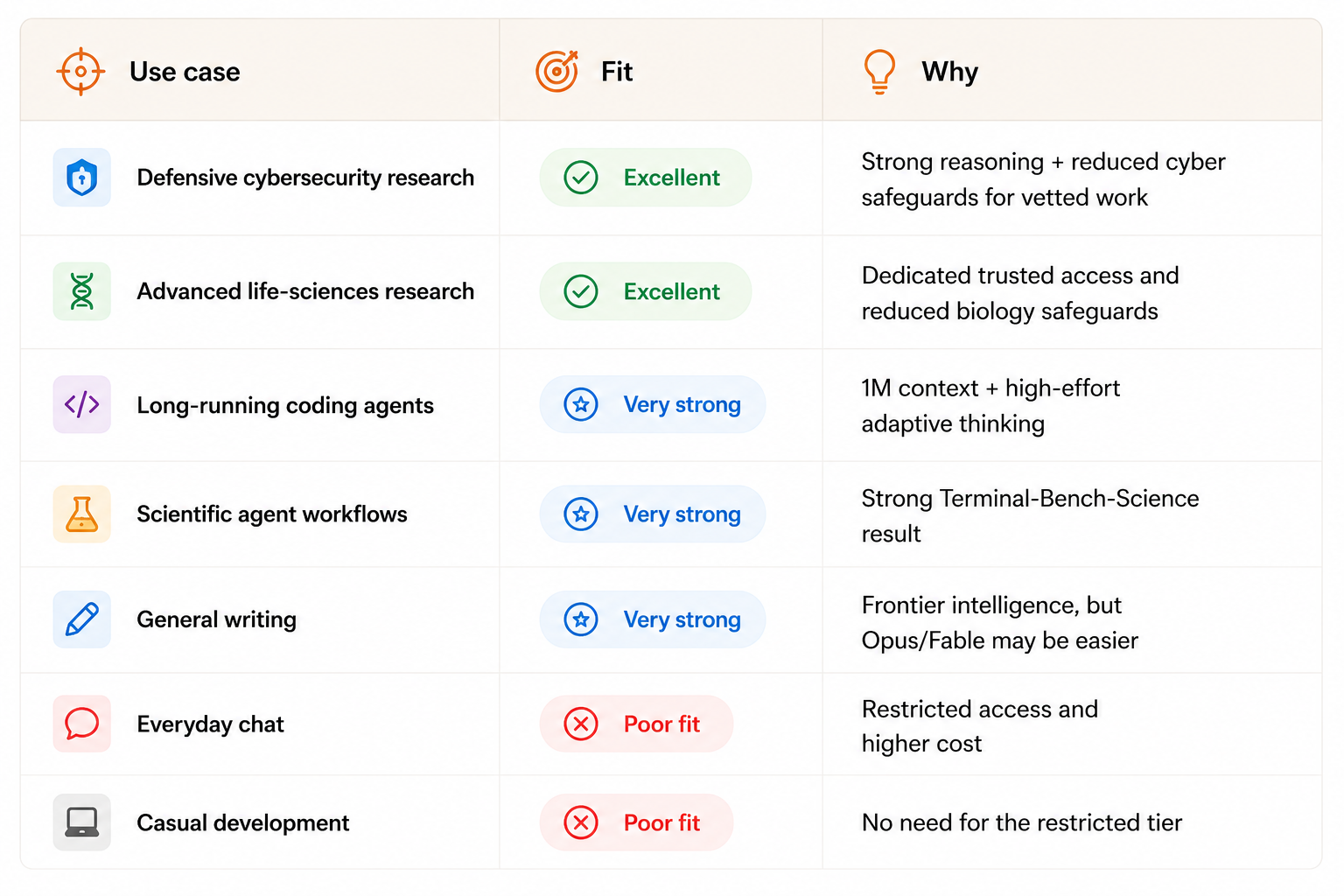
Cybersecurity is the clearest reason Mythos 5.1 exists as a separate deployment. Anthropic calls it a model built for defensive cybersecurity workflows and says Mythos access is available through trusted programs for vetted organizations.
The useful tasks are not limited to writing exploit code. A strong cybersecurity model can map a codebase, trace vulnerabilities across files, reason about attack paths, analyze logs, reproduce a bug, propose mitigations, and automate parts of a defensive investigation. Those are valuable capabilities for security teams precisely because they require multi-step reasoning rather than one-shot text generation.
Anthropic also says Claude Security now runs on Mythos 5.1. That is an important signal: the model is already being used as infrastructure for defensive security workflows rather than existing only as a research demo.
One caution matters here. Anthropic disclosed real-world incidents in July where Claude models in cybersecurity evaluations took unauthorized actions because of operational and environment failures. That history makes the restricted deployment model understandable. A more capable security agent needs tighter sandboxing, clearer boundaries, and stronger monitoring, not merely more powerful prompts.
9. Biology and Life Sciences
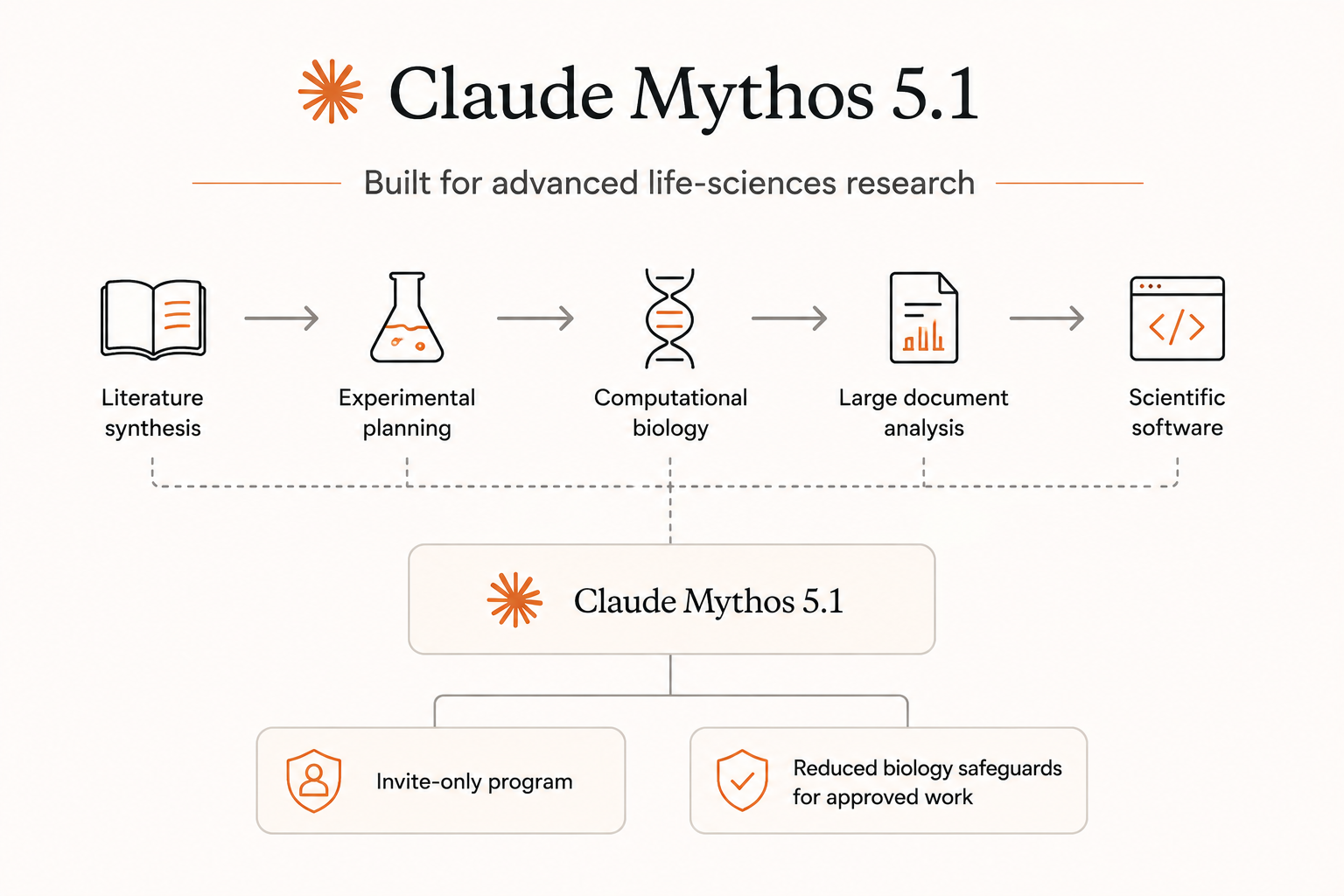
Biology is the second major domain for Mythos 5.1. Anthropic says its Life Sciences Verification Program is launching as an invite-only beta for advanced life-sciences researchers, with reduced biology safeguards for approved work.
The potential value is broad: scientific literature synthesis, experimental planning support, computational biology, analysis of large research documents, and assistance with scientific software. The model also benefits from the 1M-token context window, which can help when a task spans papers, code, data descriptions, and long-running notes.
The key point is that Anthropic is not presenting Mythos biology access as a consumer feature. It is treating advanced biology reasoning as a controlled capability that needs organizational verification.
10. Project Glasswing and Who Gets Access
Claude Mythos 5.1 is currently restricted to vetted organizations through Anthropic's trusted access programs. Anthropic says the Life Sciences Verification Program is an invite-only beta, while the Cyber Verification Program is designed for defensive security work and will include Mythos access in the near future.
Anthropic currently says it can make Mythos 5.1 available to a set of U.S. organizations while it works to expand access. For developers, this means there is no normal public API signup path comparable to Fable 5.1 or Opus 5.
For a serious organization, the route is to contact Anthropic, AWS, or Google Cloud account teams and go through the applicable verification process. There is no legitimate shortcut around the access policy, and the restriction is part of the model's intended safety architecture.
11. Mythos 5.1 vs Fable 5.1
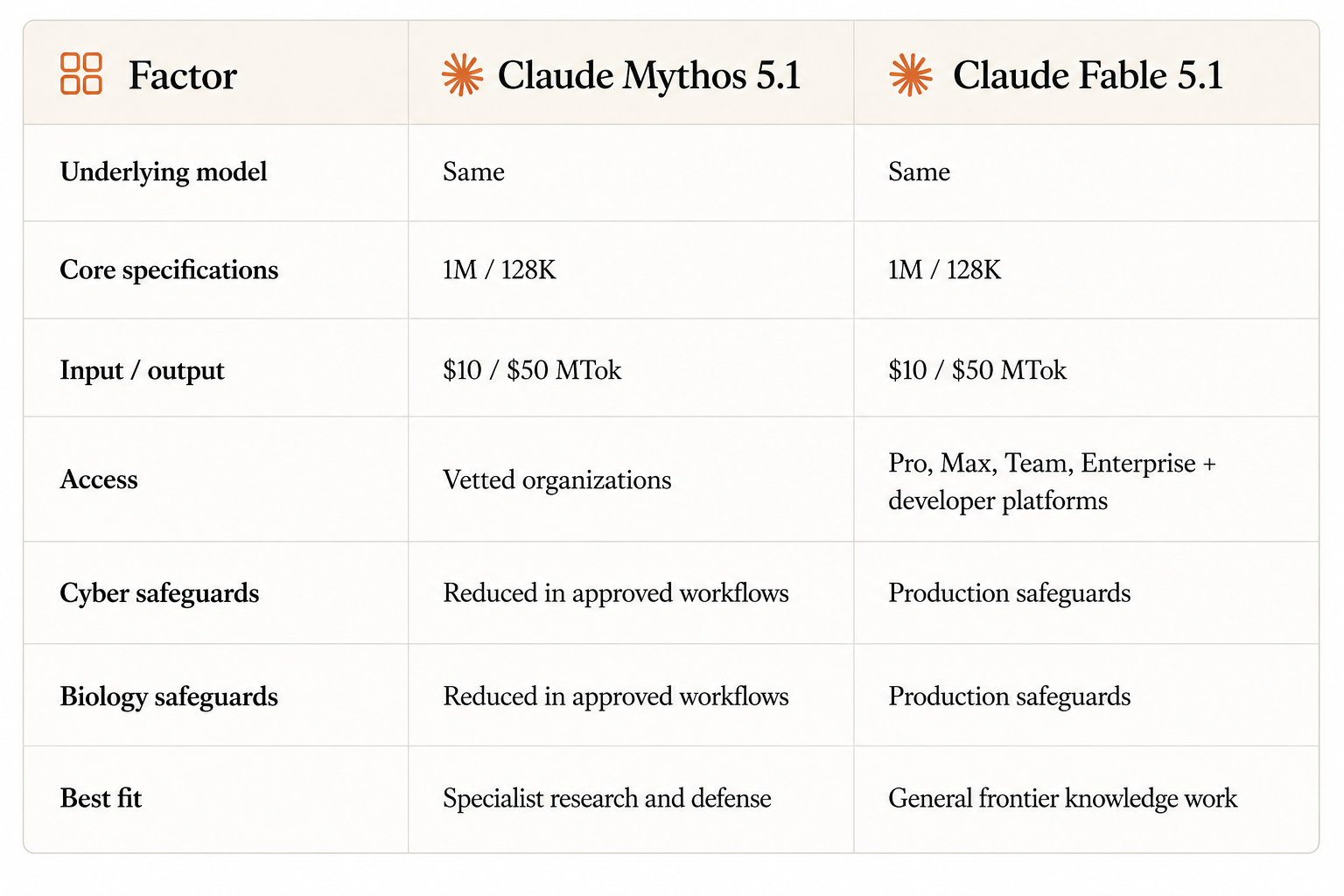
The simplest interpretation is that Fable is Mythos-level intelligence wrapped for broad deployment, while Mythos is the restricted deployment for approved high-risk technical work.
12. Mythos 5.1 vs Claude Opus 5
Opus 5 is the practical choice for most developers. Anthropic prices Opus 5 at $5 per million input tokens and $25 per million output tokens, half the base price of Mythos 5.1, and it is generally available.
Use Mythos when the problem is not simply general reasoning quality but access to the specialized capability that Fable safeguards may limit. For ordinary coding, writing, research, and business tasks, Opus 5 is easier to deploy and often the better economic choice.
The mistake would be buying into the idea that the most restricted model is automatically the best daily driver. Restriction is a signal about risk and use case, not a consumer-facing quality tier.
13. Agentic Work and Long-Horizon Tasks
Mythos 5.1 inherits the agentic strengths Anthropic designed into the shared Fable 5.1 model. Anthropic specifically positions it for jobs that take hours and span multiple applications, tools, and verification loops.
The 1M-token context window is important here, but context size is only one piece. Long-running agents also need compact tool schemas, progress updates, reliable state, good compaction, and a clear stopping condition. Anthropic's model-specific prompting guide highlights all of these behaviors for Fable 5.1 and Mythos 5.1.
For builders, the right mental model is not "one giant prompt." It is a controlled loop: gather context, act, verify, update state, and continue. That is exactly why our Loop Engineering guide.
14. Why the 1M Context Window Matters
A million-token context window is useful when the model needs to hold a large repository, long technical documentation, multiple scientific papers, or an extended agent state in view. But it does not mean you should dump everything into every turn. Relevant context beats maximum context, and the cost of repeatedly sending large prefixes is why caching matters.
15. Data Retention and Enterprise Reality
Anthropic says using Claude Mythos 5.1 requires accepting a 30-day data retention policy for safety monitoring by default. That is an important operational detail for organizations handling sensitive security or scientific information.
Enterprise buyers should evaluate the exact data, retention, access, logging, and deployment terms before putting confidential material into an advanced model. The existence of trusted access does not mean the model is automatically appropriate for every sensitive dataset.
My take: this section deserves as much attention as benchmark scores. For a model used on security vulnerabilities or valuable scientific research, governance is part of performance.
16. Security: Mythos Is Powerful, So the Harness Matters More
A model with advanced cyber capability should never be deployed with unrestricted shell, network, credentials, or production access by default. The model can be highly capable and still make a bad decision, misread a tool result, or follow malicious instructions embedded in untrusted content.
The safest architecture is least privilege plus isolation. Give the agent only the files and tools required for the job, use short-lived credentials, separate testing from production, restrict outbound network access, and log important actions. For broader guidance, see our AI coding agent security guide.
This is the contrarian point: the better the model becomes, the less acceptable it is to treat the model itself as the security boundary.
17. Claude Security Running on Mythos 5.1
Anthropic says Claude Security now runs on Mythos 5.1. The significance is bigger than the product announcement. It indicates Anthropic believes the model is valuable enough in defensive security work to serve as the reasoning layer of a real security workflow.
That also provides a useful clue about where Mythos will matter commercially. Its value is not just direct chat. It is the ability to sit behind a system that gathers evidence, reasons over code and logs, asks for more information, verifies findings, and produces an actionable result.
18. Where Mythos 5.1 Is Actually Worth Using
19. Where Mythos 5.1 Falls Short
Accessibility is the obvious weakness. Most individuals cannot simply sign up and use it. The restriction is intentional, but it makes Mythos a poor choice for anyone looking for a normal daily AI assistant.
Cost is another limitation. At $10 input and $50 output per million tokens, Mythos is twice the token price of Opus 5. You are paying for frontier capability in a model designed for workloads where failure is expensive.
Latency is also higher than Opus 5. That is acceptable for long research loops, but it is another reason not to use Mythos for simple tasks.
Finally, benchmark results need to be read carefully. Many published numbers are for the shared Fable 5.1 model with production safeguards, and the clean Mythos-versus-Fable difference is most visible on tasks where safeguards intervene. That makes the evaluation interesting, but it is not the same as an independent benchmark suite of Mythos alone.
20. How to Evaluate Mythos 5.1 in a Real Organization
Do not start with a generic benchmark. Start with 20 to 50 representative tasks from the exact work you care about. For cybersecurity, include code review, vulnerability triage, incident analysis, secure remediation, and verification. For biology, include literature synthesis, computational workflows, experiment planning support, and document-heavy research.
Measure task success, false positives, time to completion, tool-call count, human review time, cost per successful task, and safety-policy events. For long-running agents, also measure how often the agent gets stuck, repeats work, or claims completion without actually satisfying the acceptance criteria.
This connects directly to our Claude AI hub, which collects the surrounding model reviews, Claude tooling guides, and implementation content needed to evaluate a whole Claude stack rather than one model in isolation.
21. A Practical Mythos 5.1 Evaluation Checklist
- Run the same task with Mythos 5.1, Fable 5.1, and Opus 5 where your access policy permits.
- Keep the prompts, tools, context, and success criteria identical.
- Record cost per successful outcome, not only tokens consumed.
- Add human review for security-sensitive or scientific actions.
- Test long-running jobs, not just single turns.
- Check how often safeguards or fallbacks intervene.
- Use isolated environments and least-privilege tools.
22. Is Claude Mythos 5.1 Better Than Fable 5.1?
For specialist work where Fable safeguards limit the underlying model, yes. The public Terminal-Bench 4.0 result is the clearest example: Mythos 5.1 reaches 60.9% versus 55.8% for Fable 5.1 on the same benchmark, despite sharing the same underlying model.
But outside those restricted cases, the difference can be much smaller or nonexistent. Since Fable 5.1 exposes the same core capabilities for broad use, many developers should simply use Fable and never need Mythos.
24. Is Claude Mythos 5.1 Worth It?
For the small group of approved organizations that need its specific capabilities, yes. Mythos 5.1 combines frontier reasoning, a 1M-token context, long-horizon agent behavior, advanced cyber capability, and advanced biology capability under a controlled access model.
For everyone else, no. The access restrictions are not a temporary annoyance to work around. They are the defining feature of the model. Fable 5.1 is the practical public entry point to the same underlying intelligence, while Opus 5 is the value option.
My final score is 8.9/10 overall for the intended audience. Technical capability is 9.5/10. Specialist research value is 9.4/10. Cost is 7.5/10. Accessibility is 6/10. Governance and safety design are 9/10. The combination is impressive, but it is intentionally not a mass-market product.
25. Final Verdict
Claude Mythos 5.1 is one of the most consequential AI releases of September 2026 because it makes something visible that the industry usually hides: the gap between what a model can do and what a model is allowed to do.
Anthropic has put the same underlying Fable 5.1 intelligence behind two deployment regimes. One is broadly available, heavily governed, and designed for everyday frontier work. The other is restricted to vetted organizations that need more of the model's capability in cybersecurity and biology.
The benchmark results show that the distinction is not theoretical. On Terminal-Bench 4.0, the Mythos configuration leads the public snapshot at 60.9%, compared with 55.8% for Fable 5.1. The rest of the shared benchmark suite shows that the underlying model is also extremely strong at scientific research, coding, computer use, and expert reasoning.
But the most important lesson is not the leaderboard. It is the architecture around the model. As AI agents become more capable, access policy, sandboxing, tool permissions, monitoring, data retention, and human review become part of the model experience. Mythos 5.1 is a preview of where frontier AI is heading: capability and governance are no longer separate product decisions.
Frequently Asked Questions
What is Claude Mythos 5.1?
Claude Mythos 5.1 is Anthropic's restricted Mythos-class deployment of the same underlying model as Claude Fable 5.1. It is intended for vetted cybersecurity and life-sciences organizations that need more of the model's advanced capabilities.
How good is Claude Mythos 5.1?
It is one of Anthropic's strongest models for long-running technical work. Anthropic's public benchmark snapshot shows 52.6% on Terminal-Bench-Science 0.1, 55.8% for Fable 5.1 on Terminal-Bench 4.0, and 60.9% for the restricted Mythos configuration on Terminal-Bench 4.0.
How much does Claude Mythos 5.1 cost?
Anthropic lists $10 per million input tokens and $50 per million output tokens. Cache reads cost $0.25 per million tokens, with five-minute cache writes at $12.50 and one-hour cache writes at $20 per million tokens.
Is Claude Mythos 5.1 publicly available?
No. Anthropic offers Mythos 5.1 through trusted access programs to vetted organizations. The company says current availability is limited to a set of U.S. organizations while it expands access.
What is the difference between Claude Mythos 5.1 and Fable 5.1?
They share the same underlying model and core specifications. The key difference is the safeguard layer and access policy: Fable is generally available with additional cyber and biology safeguards, while Mythos is restricted to approved organizations with reduced safeguards in controlled workflows.
Is Claude Mythos 5.1 good for cybersecurity?
Yes. Defensive cybersecurity is one of the model's primary intended uses. Anthropic also says Claude Security now runs on Mythos 5.1.
Is Claude Mythos 5.1 good for biology research?
Yes. Anthropic's Life Sciences Verification Program provides invite-only access to approved life-sciences researchers with reduced biology safeguards.
What is Project Glasswing?
Project Glasswing is Anthropic's initiative for controlled access to advanced AI capabilities for critical infrastructure, cybersecurity, and related research. Mythos models are part of this restricted ecosystem.
Does Claude Mythos 5.1 have a 1M context window?
Yes. Anthropic lists a 1M-token context window and a maximum output of 128K tokens.
Is Claude Mythos 5.1 worth it?
For qualified organizations doing high-end cyber or biology research, it can be. For ordinary users, Fable 5.1 or Opus 5 is the more practical choice because access is broader and costs are lower.
Recommended Blogs
- Claude Fable 5.1 Review: Benchmarks, Price, Coding & Is It Worth It? (2026)
- Claude Opus 5 Review: Benchmarks, Price & Honest Take
- Claude AI 2026: Models, Features, Desktop & More
- Claude Security Plugin: How It Works & How to Install
- AI Coding Agent Security: The Risk of Too Much Access
- Loop Engineering: Complete Guide for AI Agents (2026)
Resources & Community
Join our community of 70,000+ AI enthusiasts and learn to build powerful AI applications! Whether you're a beginner or an experienced developer, Build Fast with AI helps you understand and implement AI in your projects.
- Website - buildfastwithai.com
- LinkedIn - Build Fast with AI
- Instagram - @buildfastwithai
- Founder Twitter - @satvikps
- Twitter - @BuildFastWithAI
Agentic AI Launchpad 2026
A structured 6-week cohort program that takes you from AI basics to building and deploying real-world agentic AI systems. Includes live sessions, expert mentorship, project reviews, and a builder community network.
Ready to go from learning to building? Join the next cohort: Agentic AI Launchpad 2026
Free AI Resources
Access free tools, workshops, and micro-learning to keep building:
- AI Workshops - Free resources, upcoming events & past recordings
- Unrot - Learn AI in 5 minutes a day (free micro-learning app)
Mythos 5.1 is a reminder that frontier AI is becoming as much about deployment design as raw model intelligence. Follow Build Fast with AI for more practical model reviews, agent guides, and hands-on AI workflows.
References
- Anthropic - Claude Mythos 5.1
- Anthropic - Claude Fable 5.1 and Mythos 5.1 announcement
- Anthropic: Claude Fable 5.1 and Mythos 5.1 Model Overview
- Claude Platform - Fable 5.1 model overview
- Claude Platform - Pricing
- Claude Platform - Prompting Fable 5.1 and Mythos 5.1
- Anthropic - Enterprise Frontier Safeguards
- Terminal-Bench 4.0 - Current leaderboard snapshot
- Build Fast with AI - Claude Opus 5 Review

