



Teffa Alpha Review: Is LMArena's Mystery Model a Hidden Coding Powerhouse?
Teffa Alpha is a mystery model label that has appeared in LMArena's public coding ecosystem and attracted attention for the quality of its generated webpages. Unlike a conventional model launch, it does not currently come with a public model card, company announcement, pricing page or documented API that identifies the provider. What is visible instead is the model's output: complete web experiences generated through Arena and a growing set of community comparisons.
The identity story has changed quickly. An early community attribution pointed to Google, but that attribution was later retracted. A current mystery-model tracker reports a dirty-token match that points toward the Qwen family, while explicitly treating the result as a leading hypothesis rather than confirmation. Another public Arena result names itself Claude, but model-generated self-identification is not evidence of the underlying provider.
The more useful part of Teffa Alpha is its behavior. Four public Arena outputs are currently archived: a mixed-language web-residue explanation page, a sketchbook-style running scene, an origami-and-starfield webpage, and a self-introduction webpage. Community posts repeatedly highlight the model's frontend quality, making web generation the clearest area to examine.
QUICK ANSWER
Teffa Alpha is an anonymous model currently visible through the LMArena ecosystem, particularly in web-generation and coding-oriented outputs. The clearest public evidence is behavioral: four Arena results have been archived and community users have praised its frontend quality. A Qwen attribution is currently the leading identity hypothesis because of a reported dirty-token match, but the provider has not been officially confirmed.
Teffa Alpha's standout strength is frontend generation. Public examples show complete webpages rather than isolated snippets, and community discussion emphasizes its visual polish. That makes the model interesting for landing pages, UI concepts, interactive prototypes and design-heavy coding.
The model does not currently have a verified public pricing page or general-purpose API in the reviewed sources, so there is no defensible context-window figure, parameter count or token price to publish. This review therefore evaluates what can actually be observed and separates model behavior from identity speculation.
My verdict: 9.1/10 for frontend quality, 8.7/10 for coding potential, 8.5/10 for accessibility and 8.8/10 overall. Teffa Alpha is worth testing for web development, but it should not be treated like a fully documented production model yet.
1. What Is Teffa Alpha?
Teffa Alpha is an anonymous model name being used in LMArena's Arena environment. The label has appeared in public web-generation outputs, but no first-party provider page has been identified in the sources reviewed.
The current mystery-model tracker records four public Arena results. These include mixed-language explanation and web generation, a simple illustration page, an origami-and-starfield page and a self-introduction page that calls itself Claude.
The important distinction is between a model name and a confirmed model identity. Teffa Alpha is a real observed label with real public outputs. The company, weights and exact backend remain separate questions.
2. The Teffa Alpha Identity Mystery
Teffa Alpha became interesting partly because users could not immediately tell which company was behind it. One early post attributed the model to Google, but the tester later retracted that attribution.
A current tracker reports a dirty-token match pointing toward Qwen and therefore treats Qwen as the leading hypothesis. The same tracker says the raw response, triggering token and independently reproducible probe are not public. That makes the Qwen theory useful evidence, but not a confirmed provider attribution.
The model's own 'I am Claude' webpage should also be interpreted carefully. An output can claim any identity; that does not establish who supplied the underlying model.
3. Where Can You See Teffa Alpha?
The verified public footprint reviewed for this article is LMArena and its Arena coding or web-generation environment. Community users discussing the model repeatedly refer to Arena, while some users say they could not find a normal OpenCode endpoint or another standalone access route.
A dedicated tracker currently archives four public Arena outputs. That is enough to establish observable use, but not enough to infer a stable API or commercial availability.
4. Web Design Is the Standout
The strongest qualitative signal around Teffa Alpha is frontend quality. Community users describe the model's webpage output as impressive and visually polished, with particular interest in how it handles frontend design.
This matters because AI coding is increasingly judged by the finished interface, not only by whether a code sample compiles. A model that can produce stronger hierarchy, spacing, typography and visual composition can save a meaningful amount of design iteration.
The limitation is that public showcase pages are not standardized tests. They demonstrate what the model can produce, but they do not establish a general ranking against Claude, Gemini, GPT or Qwen.
5. Coding Performance
Teffa Alpha is being discussed as a coding model because the public outputs are generated through a coding-focused Arena environment. However, the available evidence is strongest for frontend work rather than backend engineering or repository-wide changes.
A production coding model has to do more than create an attractive first page. It must understand an existing codebase, preserve behavior, use dependencies correctly, run tests and recover from errors. Those dimensions have not been publicly measured for Teffa Alpha in a reproducible benchmark.
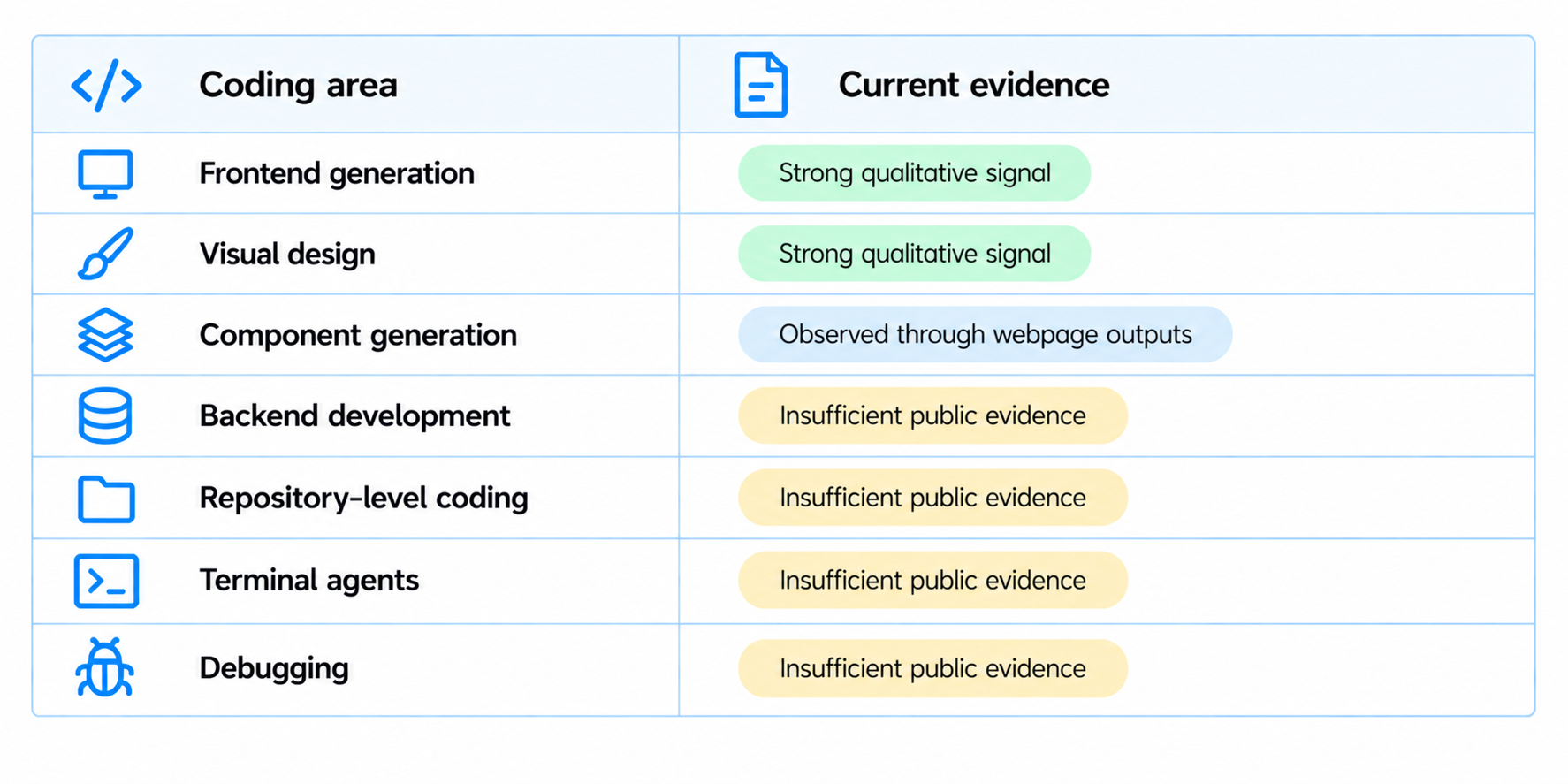
6. Why Frontend Quality Matters
Modern AI coding is moving from autocomplete toward complete product construction. That makes the visual result part of the evaluation. Two models can produce functioning React code, but one can still create a noticeably better interface.
Teffa Alpha's popularity comes from this visible difference. Users can immediately see a polished layout, so the model's strengths are easier to demonstrate than an invisible backend optimization. The public Arena examples give it a strong qualitative signal for UI-oriented work.
The right production test is therefore two-dimensional: inspect the rendered interface and validate the underlying application. Visual quality without functional correctness is not enough.
7. Teffa Alpha vs Gemini 3.8 Flash
Gemini 3.8 Flash is a useful benchmark because it is a documented production model with a public API, published specifications and independent benchmark coverage. Teffa Alpha is more interesting as a behavioral experiment because its frontend outputs are attracting attention.
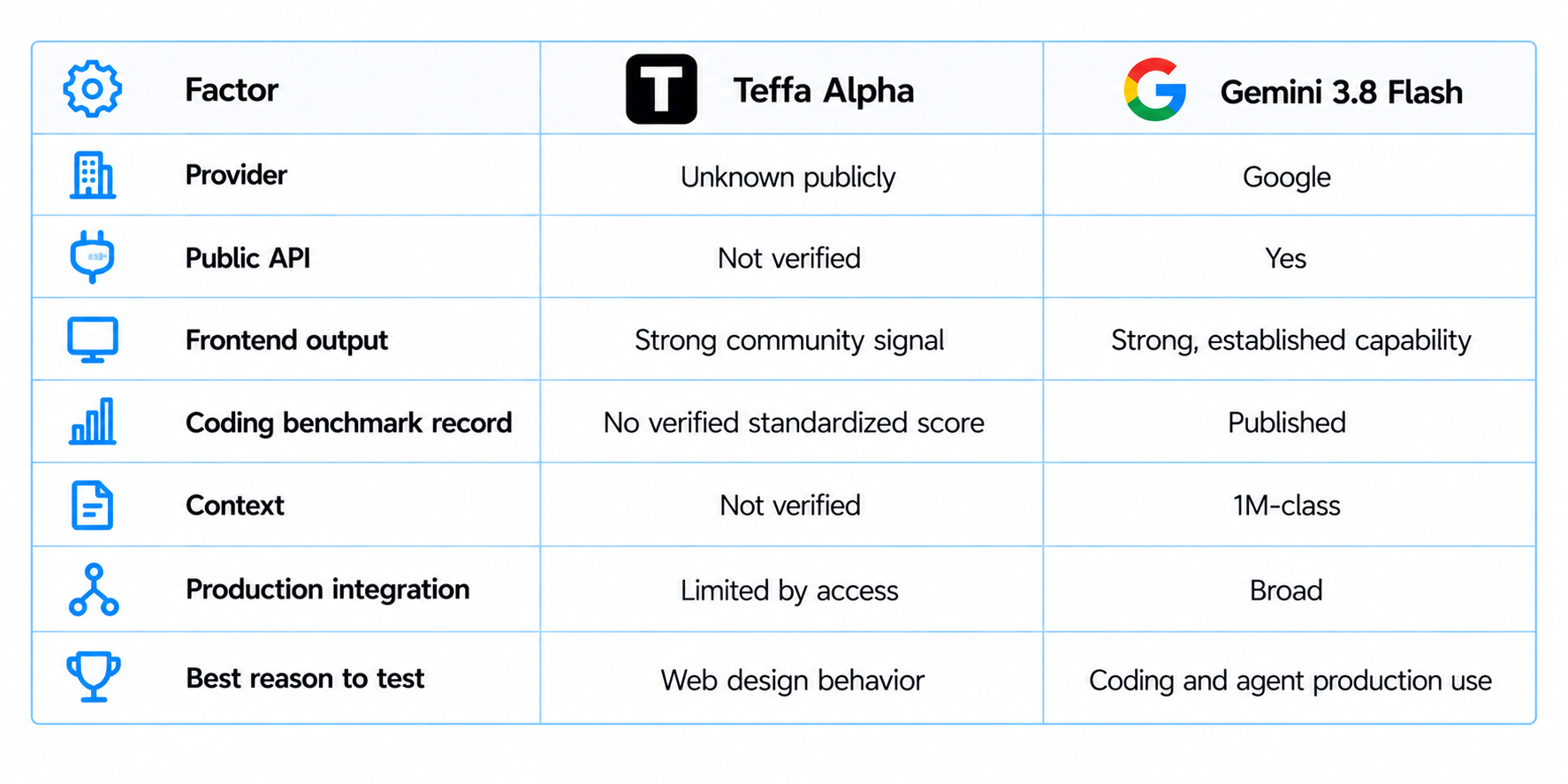
For a production application, Gemini is the safer engineering choice because the model contract is documented. Teffa Alpha is worth keeping in the test set because its web-generation behavior may be unusually competitive.
8. Teffa Alpha vs Claude
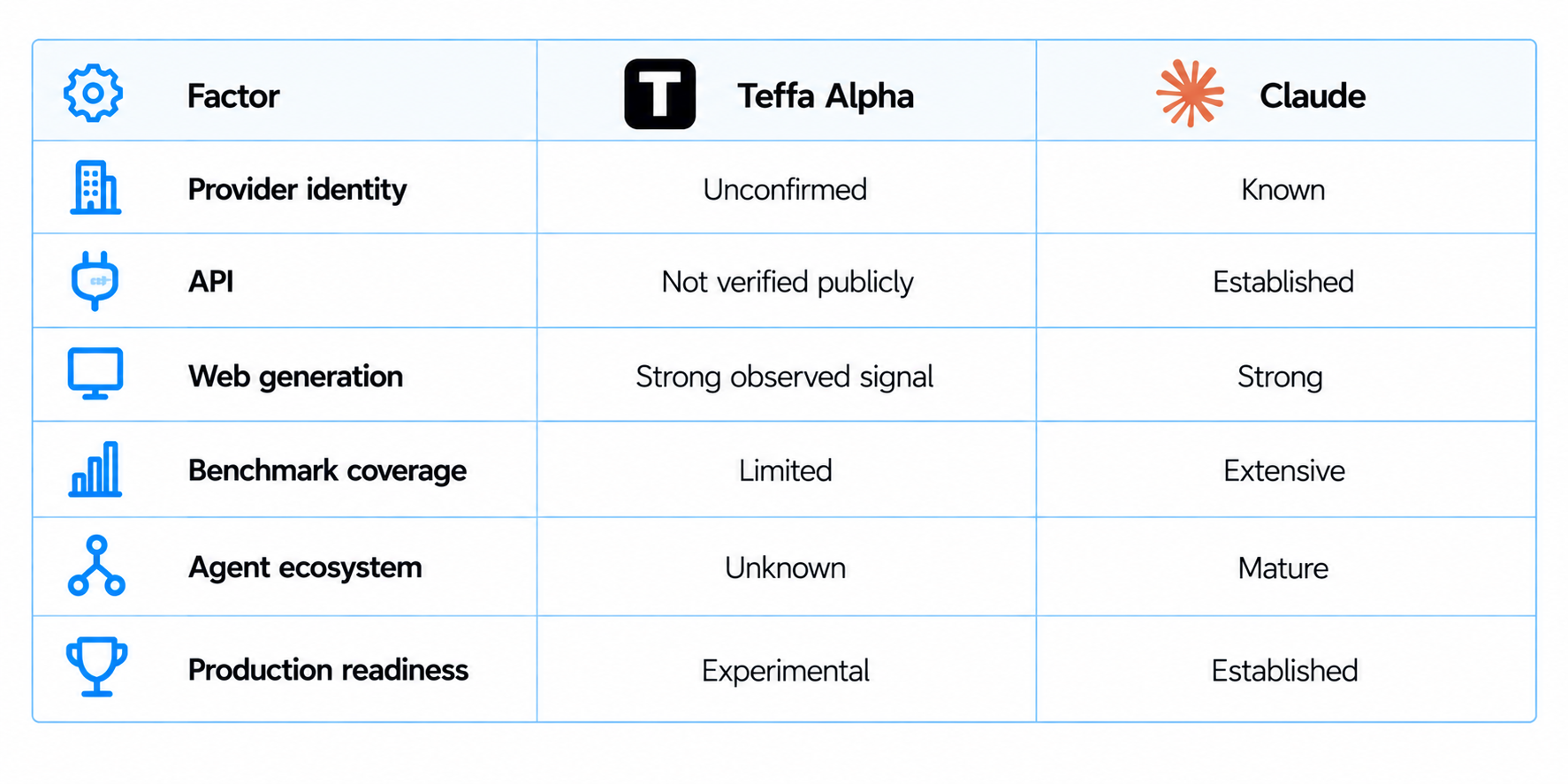
The Claude connection is one of the more confusing parts of the mystery. One archived Arena page is titled as a Claude self-introduction, but the tracker treats that as output behavior rather than provider evidence.
Claude is therefore the easier production model to select. Its provider, APIs, pricing and benchmark ecosystem are documented, while Teffa Alpha currently has none of that public infrastructure.
9. Teffa Alpha and Qwen
Qwen is currently the leading public identity hypothesis. The main evidence is a reported dirty-token match, and community users have also speculated about Qwen based on the model's behavio
The recent Qwen 3.8 Max 0902 release makes the theory especially interesting, but similarity is not proof. Until the raw identity signal is independently reproduced or Qwen publicly claims the model, Teffa Alpha should remain its own label in a review.
For the confirmed Qwen release, read Qwen 3.8 Max 0902 Review.
10. Benchmark and Evaluation Status
The available Teffa Alpha evidence is mostly real-world Arena behavior rather than a standardized benchmark suite. The current tracker lists four public outputs and explicitly says the sample set does not establish a reproducible benchmark ranking.
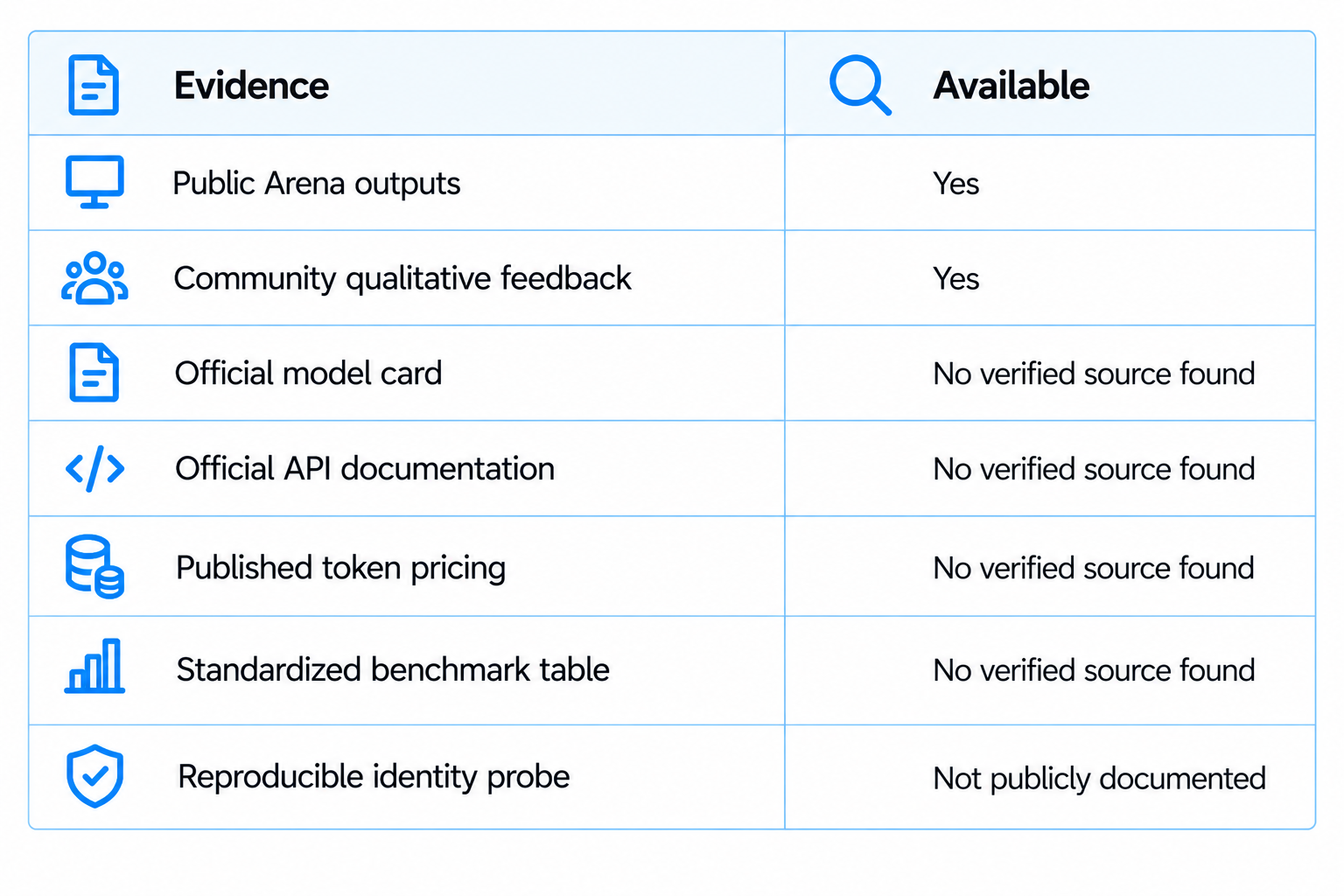
That does not make the model uninteresting. It simply changes how the review should be written. The strongest claims should come from observed outputs and repeatable testing, not from a speculative provider name or an invented benchmark score.
11. The Four Public Arena Samples
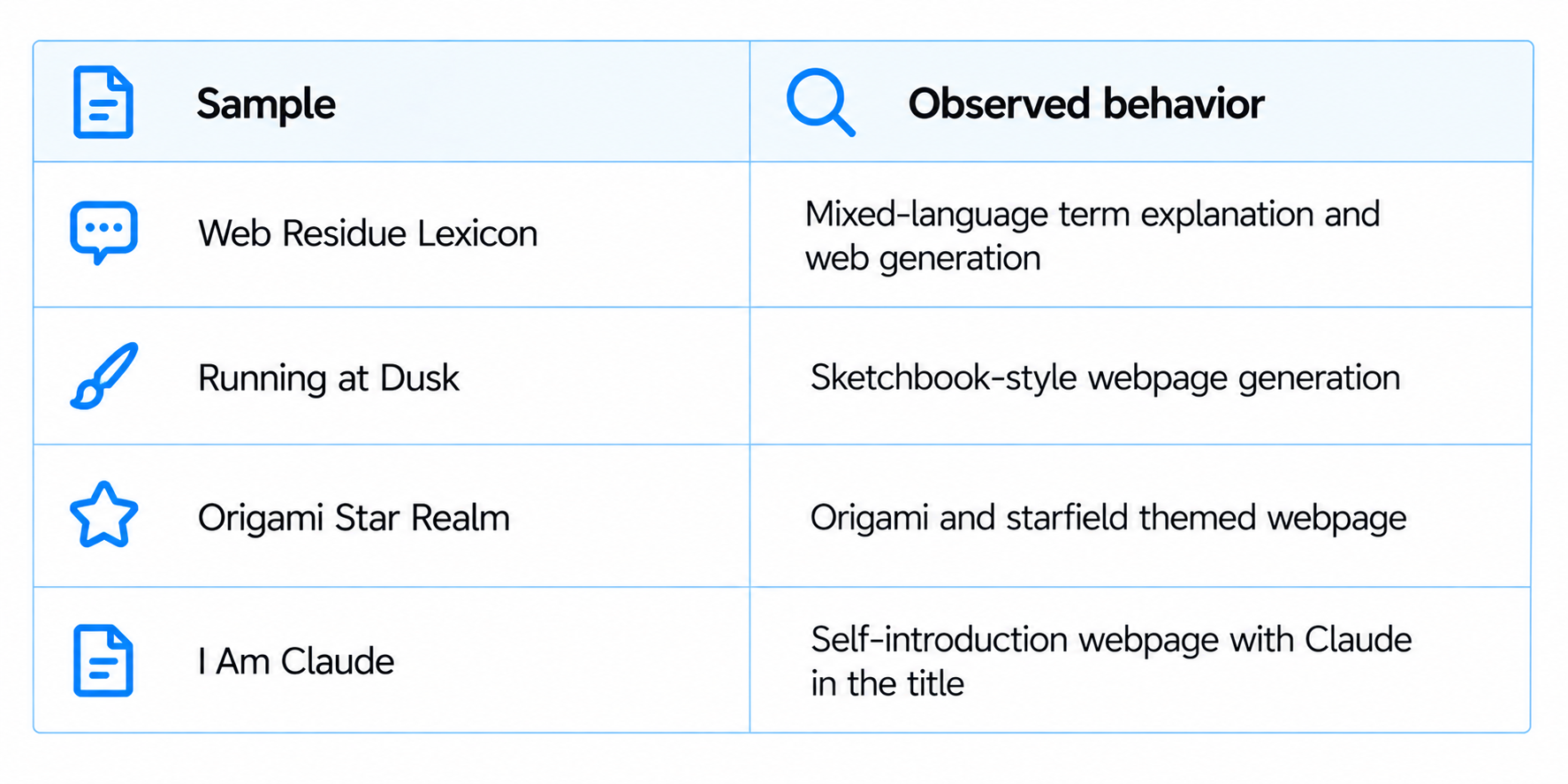
These examples show the model being used as a generative web system. They do not provide enough information to infer the exact benchmark prompts for every result, and the tracker notes that original prompts for some samples are not available.
12. Speed and User Experience
The community conversation focuses on output quality rather than a measured tokens-per-second figure. Some users emphasize the quality of the resulting page, while others mention that the model can spend a long time thinking before producing the final result.
Because there is no controlled latency dataset in the reviewed sources, a numeric speed score would be misleading. A proper test should measure time to first result, complete generation time and the amount of manual cleanup needed.
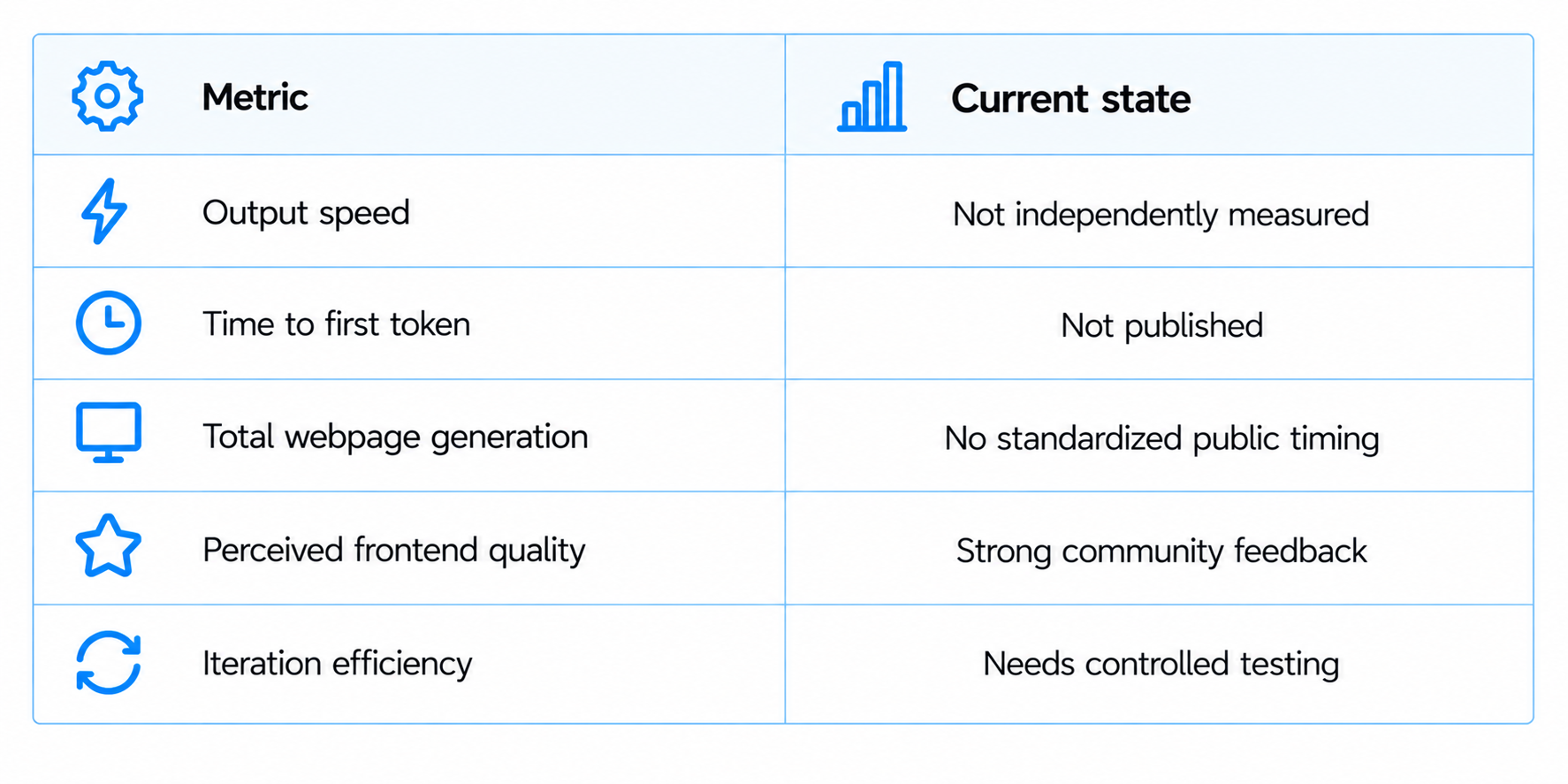
13. Access and API
The current public footprint points to Arena rather than a conventional developer API. The mystery-model tracker reports no verified public API, and community users have discussed being unable to find the model in ordinary coding clients.
That matters for developers because access is part of model quality in production. A technically excellent model still needs stable authentication, quotas, documentation, pricing and data policies before it can become a dependable infrastructure component.
14. Can Teffa Alpha Be Used for AI Agents?
Potentially, but the public evidence is currently centered on web generation rather than complete autonomous agent loops. The Arena outputs demonstrate that the model can produce substantial artifacts, but they do not establish reliable tool calling, memory, recovery or stopping behavior.
For an agent evaluation, the model should be given a repository task and scored on planning, tool selection, implementation, testing and recovery. That is the next useful step for understanding whether the frontend strength extends into broader software engineering.
15. Best Use Cases
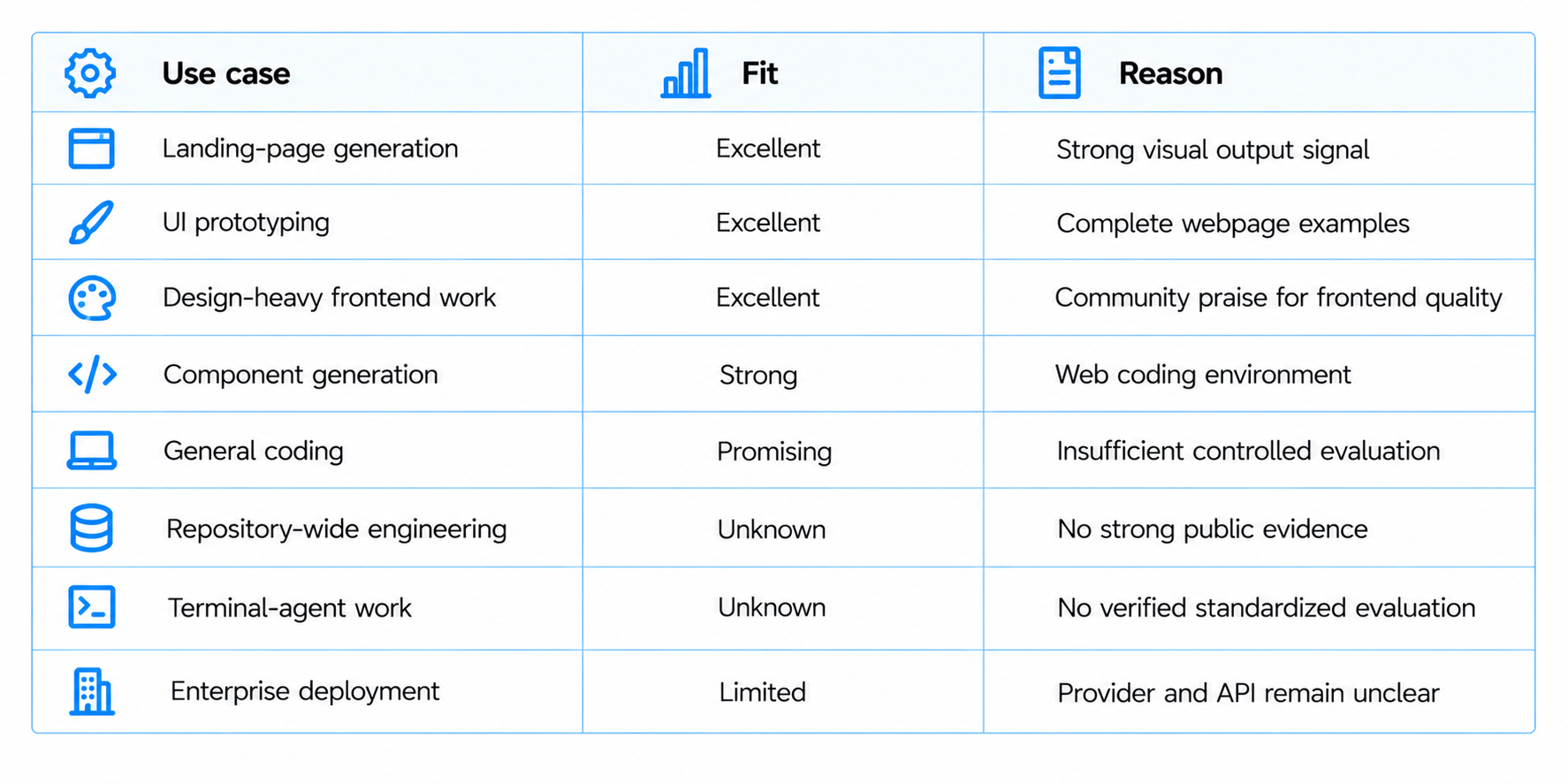
16. Limitations You Should Know
- Provider identity is not officially confirmed.
- Qwen is a leading hypothesis, not a confirmed provider attribution.
- There is no verified public token pricing page.
- No verified standalone public API was found in the reviewed sources.
- The public sample size is small and heavily weighted toward web generation.
- Some archived Arena prompts are unavailable, limiting exact reproducibility.
- Model self-identification in generated webpages does not prove the underlying provider.
- Frontend polish does not automatically imply strong backend, repository or terminal-agent performance.
17. How to Evaluate Teffa Alpha Yourself
A useful Teffa Alpha test should focus on the area that created the model's reputation: complete frontend work.
- Run five landing-page tasks with identical requirements.
- Run five dashboard or SaaS interface tasks.
- Run three responsive-layout tasks at desktop and mobile widths.
- Run three frontend bug-fixing tasks with actual code and errors.
- Run two repository-level tasks if the model becomes available for direct testing.
- Compare rendered screenshots as well as source code.
- Measure manual fixes, browser errors, task completion and generation time.
This evaluation separates aesthetics from engineering. A strong model should score well on both.
18. Teffa Alpha vs a Production Coding Stack
The practical question for a developer is not whether Teffa Alpha is interesting. It is whether it should replace a model that is already working in production.
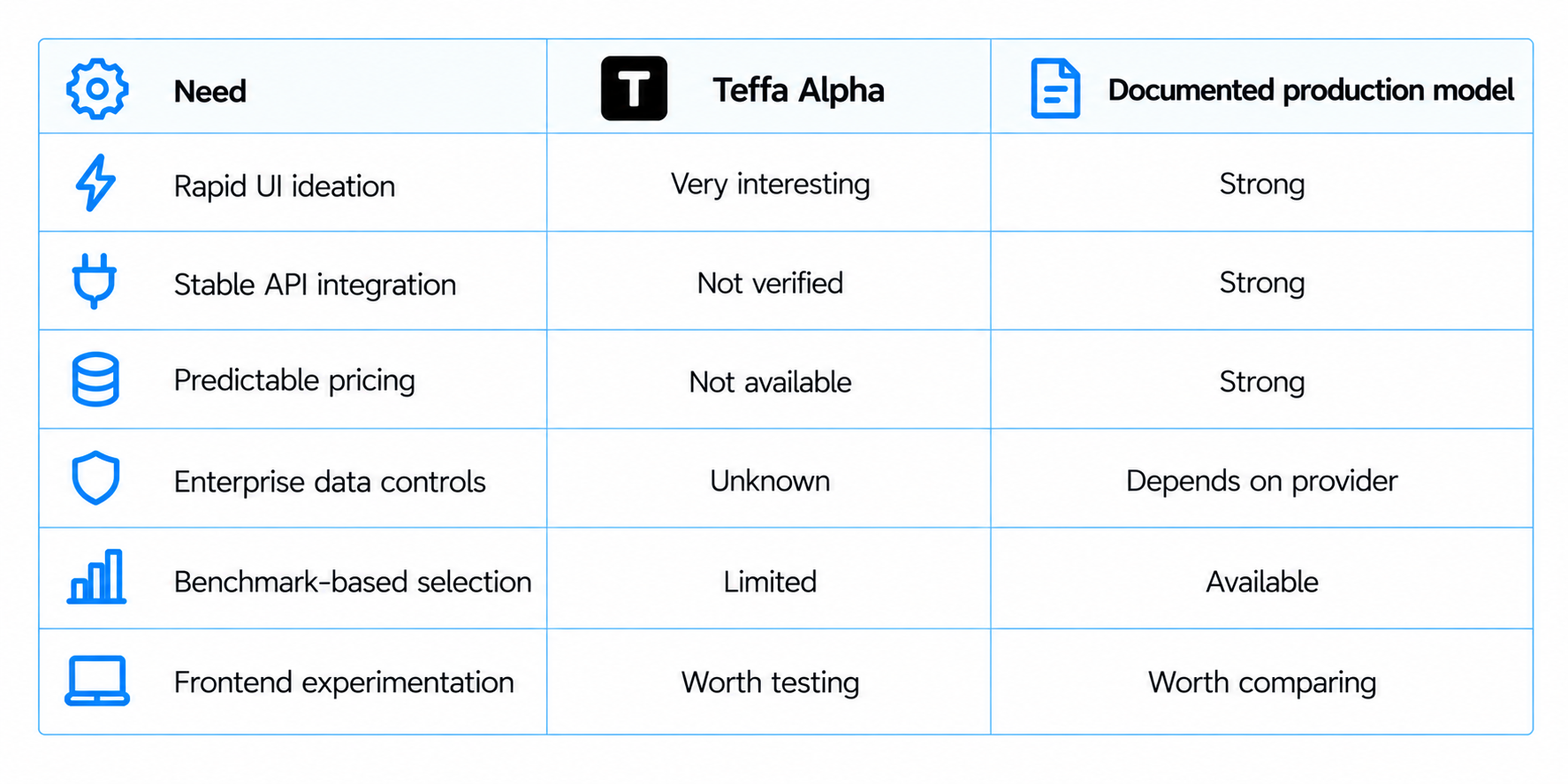
For most teams, the right approach is to keep Teffa Alpha in an experimental comparison set rather than making it the only coding dependency.
19. Is Teffa Alpha Worth Testing?
Yes. The frontend evidence is strong enough to justify testing, especially if your work involves landing pages, dashboards, polished UI concepts or visually rich web applications.
What makes the model interesting is precisely what makes it difficult to evaluate: its public reputation is based on visible behavior rather than a conventional launch package. That means a good independent test can add more value than another round of speculation about the provider.
The best comparison is simple. Give Teffa Alpha and your current coding model the same design brief, the same functional requirements and the same time budget. Then compare the rendered result, source quality and amount of cleanup required.
20. Final Verdict
Teffa Alpha is one of the most interesting mystery models currently circulating through LMArena because its strongest signal is immediately visible: high-quality web and frontend generation. Four public Arena outputs have been archived, and multiple community posts specifically praise its frontend work.
The identity should remain separate from the performance. The early Google attribution was retracted, Qwen is currently the leading hypothesis based on a reported dirty-token match, and a Claude self-identification page does not prove Anthropic ownership.
The biggest practical limitation is access. Without a verified public API, published pricing and a normal model card, Teffa Alpha is harder to deploy than documented production models. But that does not reduce the value of its observable output quality.
My rating: 9.1/10 for frontend quality, 8.7/10 for coding potential, 8.5/10 for accessibility and 8.8/10 overall.
Bottom line: Teffa Alpha is worth testing for web development and design-heavy coding tasks. Treat the provider identity as unresolved, evaluate the rendered product as well as the code, and avoid turning community clues into unsupported facts.
Frequently Asked Questions
What is Teffa Alpha?
Teffa Alpha is an anonymous AI model label currently observed in LMArena's public coding and web-generation ecosystem.
Who made Teffa Alpha?
The provider has not been officially confirmed. Qwen is the current leading hypothesis from a reported dirty-token match, while an earlier Google attribution was retracted.
Is Teffa Alpha a Qwen model?
Qwen is the leading public identity hypothesis, but it is not officially confirmed in the sources reviewed.
Where can I use Teffa Alpha?
The verified public sightings reviewed here are in the LMArena/Arena ecosystem. A stable standalone developer API has not been verified.
Does Teffa Alpha have an API?
No verified public API endpoint was found in the current sources reviewed.
Is Teffa Alpha good at coding?
Its strongest observable capability is frontend and webpage generation. Broader coding, repository and terminal performance needs direct evaluation.
Why is Teffa Alpha popular for web design?
Community users have praised its frontend output, and public Arena examples show complete, visually polished webpages.
What benchmarks does Teffa Alpha have?
The reviewed sources do not provide a reproducible standardized benchmark table. The main evidence is public Arena output and community testing.
Is Teffa Alpha better than Claude or Gemini?
There is not enough controlled evidence to make a general claim. Teffa Alpha is interesting for frontend output, while Claude and Gemini have documented APIs and broad benchmark coverage.
Is Teffa Alpha worth testing?
Yes, especially for web interfaces, landing pages and design-heavy coding tasks where its visible frontend quality can be compared directly.
Recommended Blogs
Omen Alpha Review: Benchmarks, Price & Is It Worth It? (2026)
Ox Alpha Review: The Mystery AI Model With 1M Context (2026)
Gemini 3.8 Flash Review: Accuracy, Price & Is It Worth It? (2026)
Meta Muse Spark 1.3 Review: Coding, Price & Is It Worth It? (2026)
Qwen 3.8 Max 0902 Review: Benchmarks, Price & Is It Worth It? (2026)
How to Secure AI Coding Agents: Permissions, Sandboxing, MCP & Secrets
Resources & Community
Join our community of 70,000+ AI enthusiasts and learn to build powerful AI applications. Whether you're a beginner or an experienced developer, Build Fast with AI helps you understand and implement AI in your projects.
Agentic AI Launchpad 2026
A structured 6-week cohort program that takes you from AI basics to building and deploying real-world agentic AI systems. Includes live sessions, expert mentorship, project reviews and a builder community network.
Ready to go from learning to building? Join the next cohort: Agentic AI Launchpad 2026
Free AI Resources
Access free tools, workshops and micro-learning to keep building.

