



Omen Alpha Review: Is OpenCode's Mystery Coding Model the Best $10 AI Deal for Developers?
Omen Alpha is OpenCode's newest stealth coding model, added to OpenCode Go on September 4, 2026. Instead of launching with a traditional model card, parameter count and benchmark table, OpenCode presents Omen Alpha as a model inside its Go subscription. The user sees the model ID, the endpoint and the coding experience, while the company behind the model remains undisclosed.
That makes Omen Alpha unusual, but the product around it is straightforward. OpenCode Go costs $10 per month and is designed to provide managed access to coding models through OpenCode and compatible agents. The current Go documentation includes Omen Alpha alongside GPT 5.6 Luna, Qwen3.8 Max, DeepSeek V4, GLM models, Kimi models, MiniMax models and other coding-focused systems.
The interesting part is the combination of scale and speed. Current Pi model metadata lists a 500,000-token context window, 128,000 maximum output tokens, reasoning support and text plus image input. Community users are reporting roughly 180 to 190 tokens per second, including one reported result of 189 tokens per second. That puts Omen Alpha squarely in the high-throughput coding-worker category.
QUICK ANSWER
Omen Alpha is a stealth coding model available through OpenCode Go. OpenCode exposes it as omen-alpha through an OpenAI-compatible chat-completions endpoint. Pi currently lists text and image input, reasoning support, a 500,000-token context window and 128,000 maximum output tokens.
OpenCode Go costs $10 per month, and its current documentation estimates 11,600 Omen Alpha requests per five-hour window, 29,000 per week and 57,900 per month under its typical request assumptions. These are usage estimates derived from request patterns and the service's internal pricing model, not fixed request quotas.
Omen Alpha is also one of the fastest models people are testing inside OpenCode. Community reports currently place it around 189 tokens per second. The model has also accumulated substantial OpenCode usage, with one current data snapshot showing roughly 39 billion recent tokens, about 2,900 unique users and 7,518 completed sessions.
The central mystery is the provider. OpenCode's active model listing does not identify the company behind Omen Alpha. A public OpenCode data path briefly exposed zhipu/omen-alpha, which triggered widespread speculation about a Zhipu AI or GLM-family backend. That is a useful clue, but it is not an official model attribution.
My verdict: 8.8/10 overall. Omen Alpha is highly attractive for OpenCode Go users who care about speed, large context and high-volume coding. Its opaque model identity is the main thing that separates it from a conventional model choice.
1. What Is Omen Alpha?
Omen Alpha is a stealth model built into OpenCode Go, the $10 monthly access plan for managed coding models. OpenCode describes Go as a low-cost service for reliable access to models used in coding agents, and Omen Alpha is now part of that lineup.
The model ID is omen-alpha, and OpenCode provides it through a standard chat-completions endpoint. This means developers can use the model through the same general agent interface used for other Go models.
Unlike a conventional public model release, Omen Alpha does not currently expose a public parameter count, architecture, named provider or model card. The model is therefore best evaluated as a deployed coding service rather than as an independently downloadable model.
2. Omen Alpha Specifications
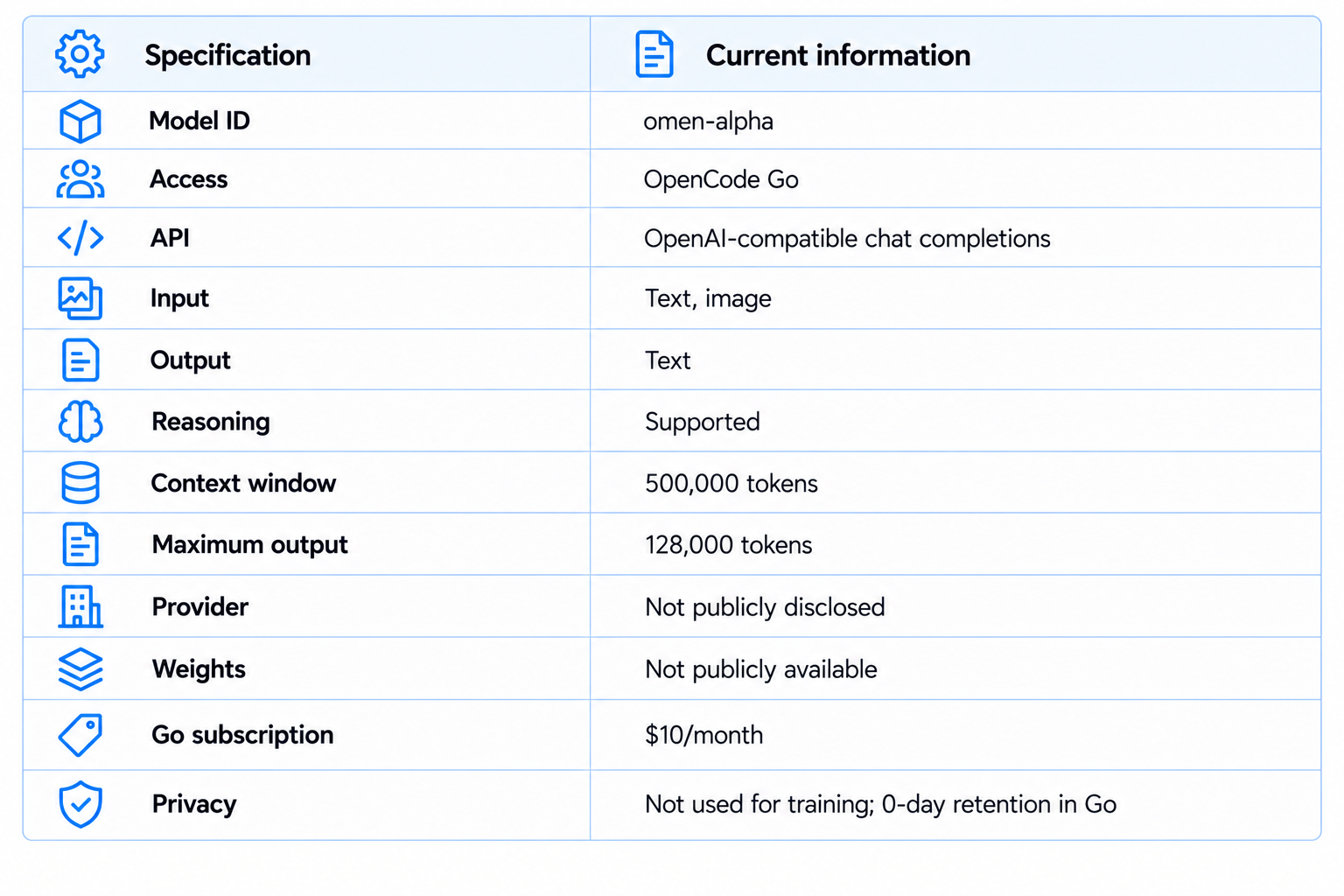
The 500K context, 128K output, reasoning and multimodal-input fields are listed by Pi's current model registry. OpenCode's own documentation confirms the Omen Alpha model ID, Go access and zero-day retention policy.
This is enough to understand the deployment profile even though the underlying model lineage is intentionally hidden.
3. OpenCode Go Pricing and Allowance
OpenCode Go is priced at $10 per month. Instead of giving every model the same number of requests, OpenCode assigns usage limits in dollar value and estimates the number of requests each model can support based on observed request patterns.
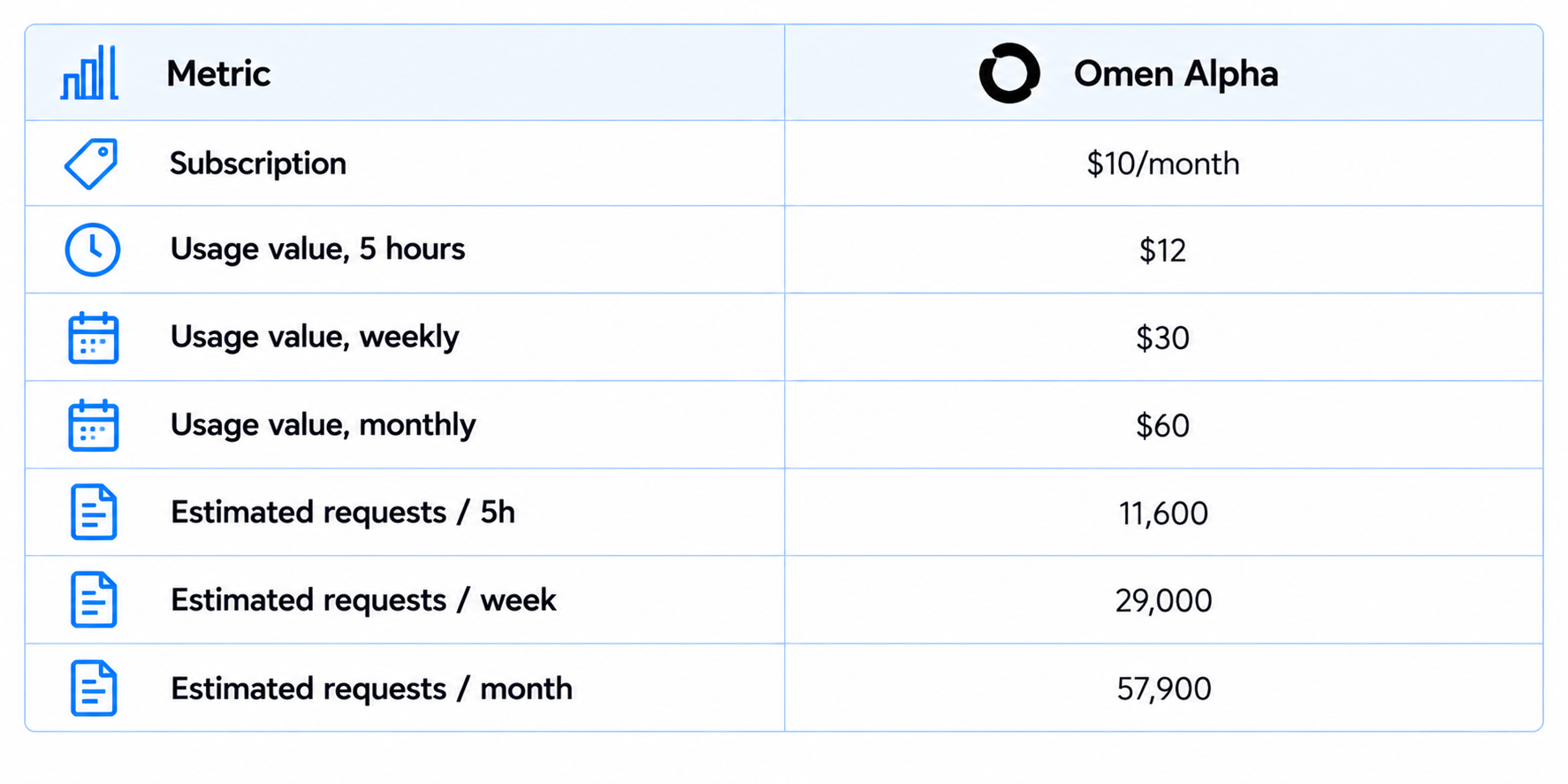
The request estimates are unusually high because Omen Alpha is placed in a low-cost, high-throughput tier. OpenCode's documentation lists much lower estimated request counts for more expensive models such as Kimi K3 and Qwen3.8 Max. The allowance should therefore be viewed as a consequence of model economics, not as evidence that Omen Alpha is more intelligent than those models.
4. How Fast Is Omen Alpha?
Current community measurements put Omen Alpha around 189 output tokens per second. One user reported 189 tokens per second during OpenCode testing, while several other reports describe the model as extremely fast.
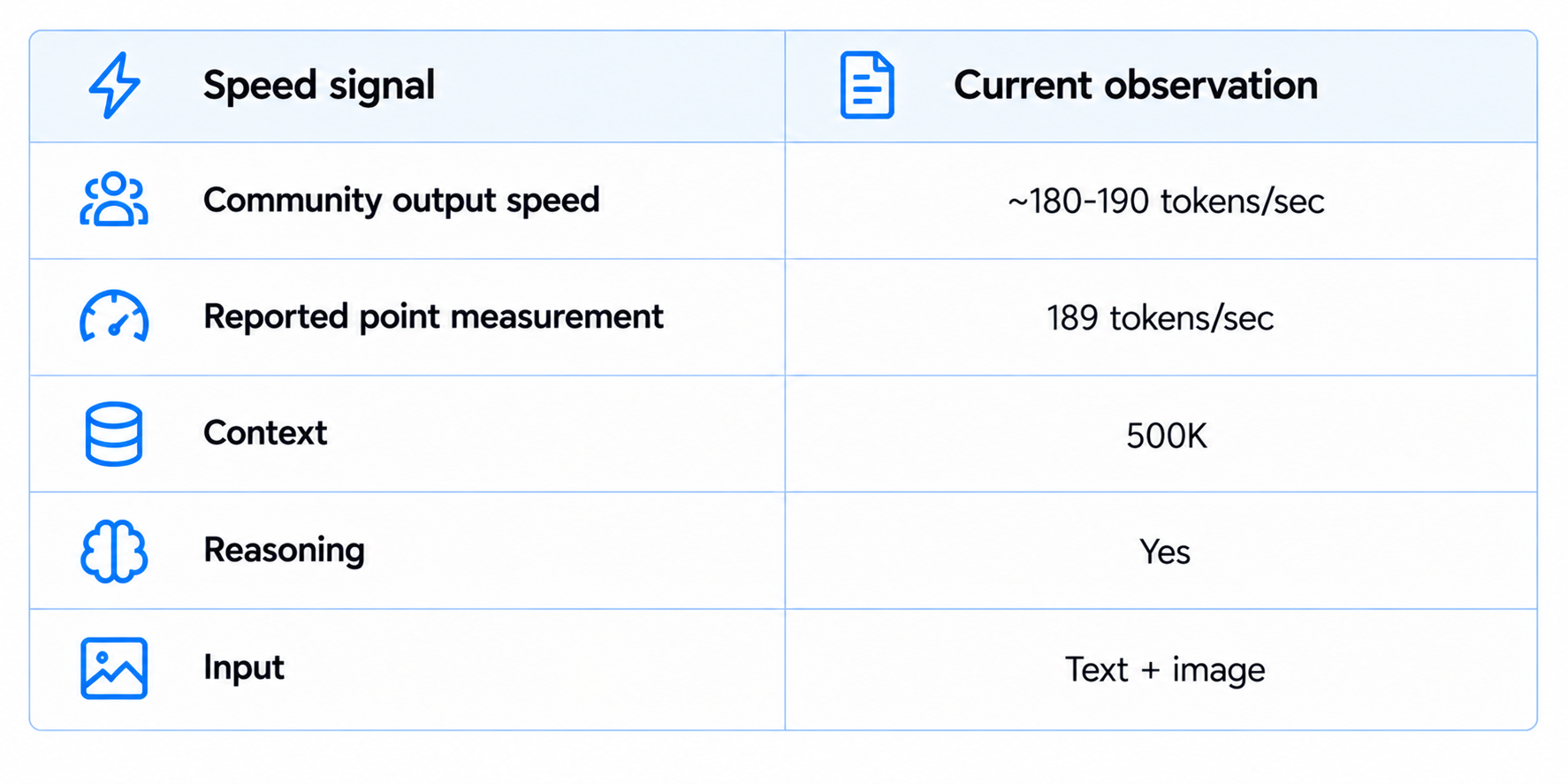
There is no public standardized throughput benchmark for Omen Alpha, so the 189-token figure should be treated as a real-world observation rather than a guaranteed service rate. Prompt length, reasoning effort, caching, provider load and agent behavior can all change observed speed.
Even with those variables, the speed is significant for coding agents because every task may require many sequential model calls.
5. Why Speed Matters More in Coding Agents
An ordinary chat session can hide latency because the user sends one prompt and waits for one answer. A coding agent is different. It may inspect files, search the repository, write a patch, run tests, read an error, revise the code and repeat the process.
When a model produces responses quickly, the entire loop becomes more interactive. Developers can test another approach instead of waiting through long pauses between tool calls.
This is where Omen Alpha's positioning makes sense. Its value is not only the speed of one answer. It is the amount of engineering work that can move through the agent loop before the user notices friction.
6. The 500K Context Window
Pi currently lists Omen Alpha with a 500,000-token context window and a 128,000-token maximum output. A context window of this size is enough for substantial repository analysis, documentation-heavy tasks and long agent sessions.
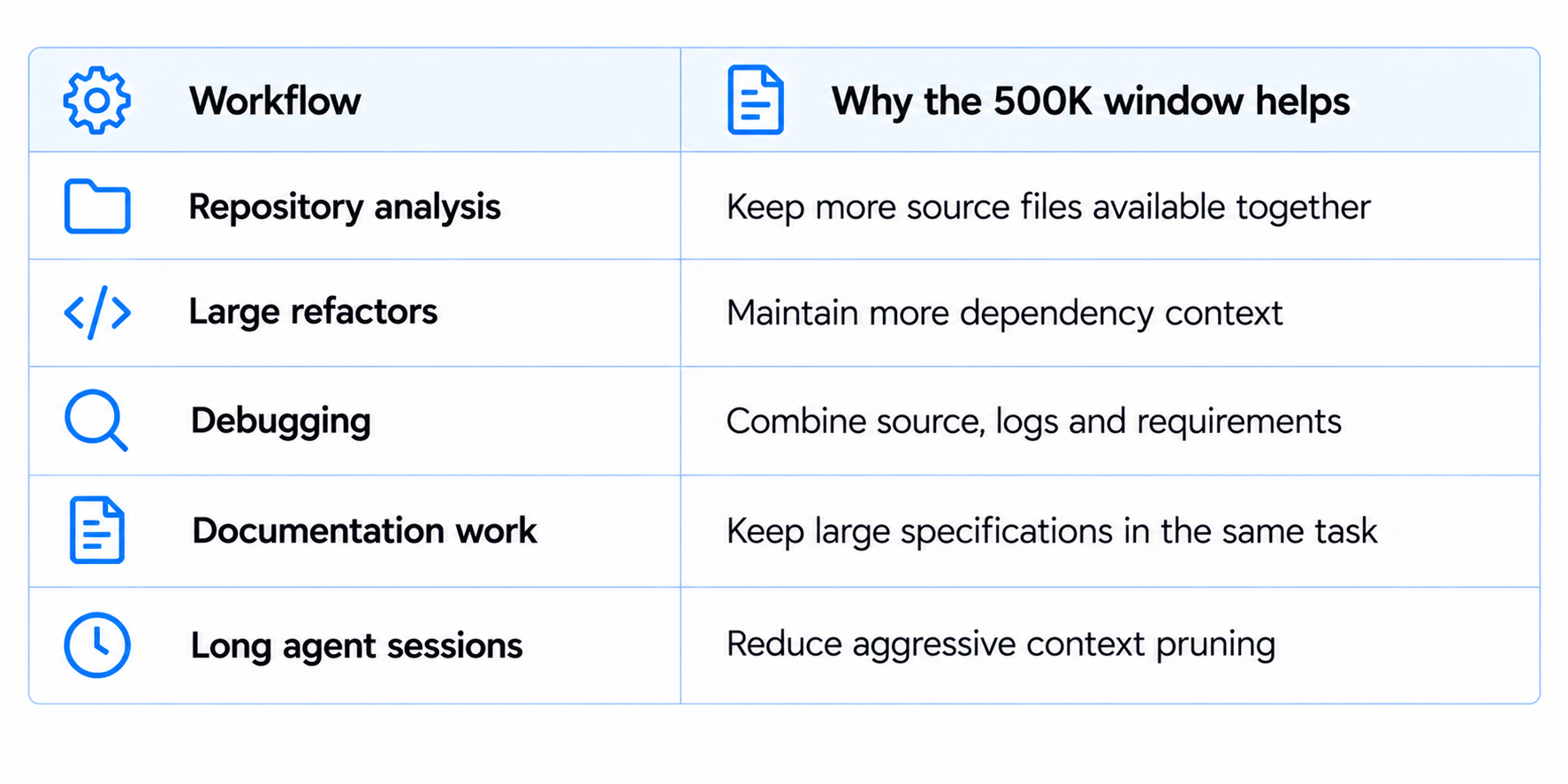
The main benefit is continuity. A coding agent does not have to repeatedly summarize or reload every piece of context when a task extends across many files. Context capacity still needs to be paired with good retrieval and tool use, but 500K gives the agent considerable room to work.
7. Image Input and UI Debugging
Omen Alpha is listed with text and image input, which gives it an interesting role inside development workflows. A coding agent can receive a screenshot of a broken interface, an architecture diagram or a visual test result alongside the code it needs to modify.
This is useful for frontend work in particular. A developer can describe the bug, attach the current screenshot and let the agent connect the visible problem with the underlying source.
The current metadata does not list image or audio generation. Omen Alpha should therefore be viewed as a multimodal input reasoning model rather than a media-generation model.
8. Reasoning and Agentic Coding
Pi lists Omen Alpha as a reasoning model, and the current configuration exposes low and high thinking levels. OpenCode also exposes the model through an OpenAI-compatible endpoint, making it straightforward to test inside coding agents that already support standard chat-completions APIs.
The combination is important: a model with reasoning capability can handle more than autocomplete, while high throughput keeps the agent loop responsive.
9. Who Is Behind Omen Alpha?
This is the part of the model that remains intentionally hidden. OpenCode's current active documentation lists the model as Omen Alpha but does not identify the provider. OpenCode's data system currently has both an unknown-provider page and a separate Zhipu path that has attracted attention from the community.
That Zhipu clue is significant because Zhipu AI operates the GLM model family, and several researchers have suggested that Omen Alpha behaves like a GLM-family system. However, a backend path is not equivalent to an official announcement, and community attribution attempts based on tokenizer behavior or model responses are not proof of lineage.
The right way to describe the model today is therefore simple: Omen Alpha is an OpenCode stealth model with an undisclosed provider. Zhipu is a leading community hypothesis, not a confirmed fact.
10. Community Coding Reports
The first reports are strongly positive on speed. One user reported that Omen Alpha finished a coding test quickly, while another noted roughly 189 tokens per second. Other community discussion describes the model as fast and competent for coding.
There are also contradictory experiences. One Reddit discussion includes a user who found that the model struggled to recall information from earlier turns and repeatedly asked for clarification, while another user described it as capable of planning and executing complex coding work. These differences are exactly why agent behavior should be tested on a controlled repository rather than inferred from a few anecdotes.
11. Omen Alpha vs GLM-5.3-Flash
GLM-5.3-Flash is the most obvious comparison because it is another fast coding model available through OpenCode Go. The difference is transparency. GLM-5.3-Flash has a named provider and published model identity, while Omen Alpha is intentionally masked.
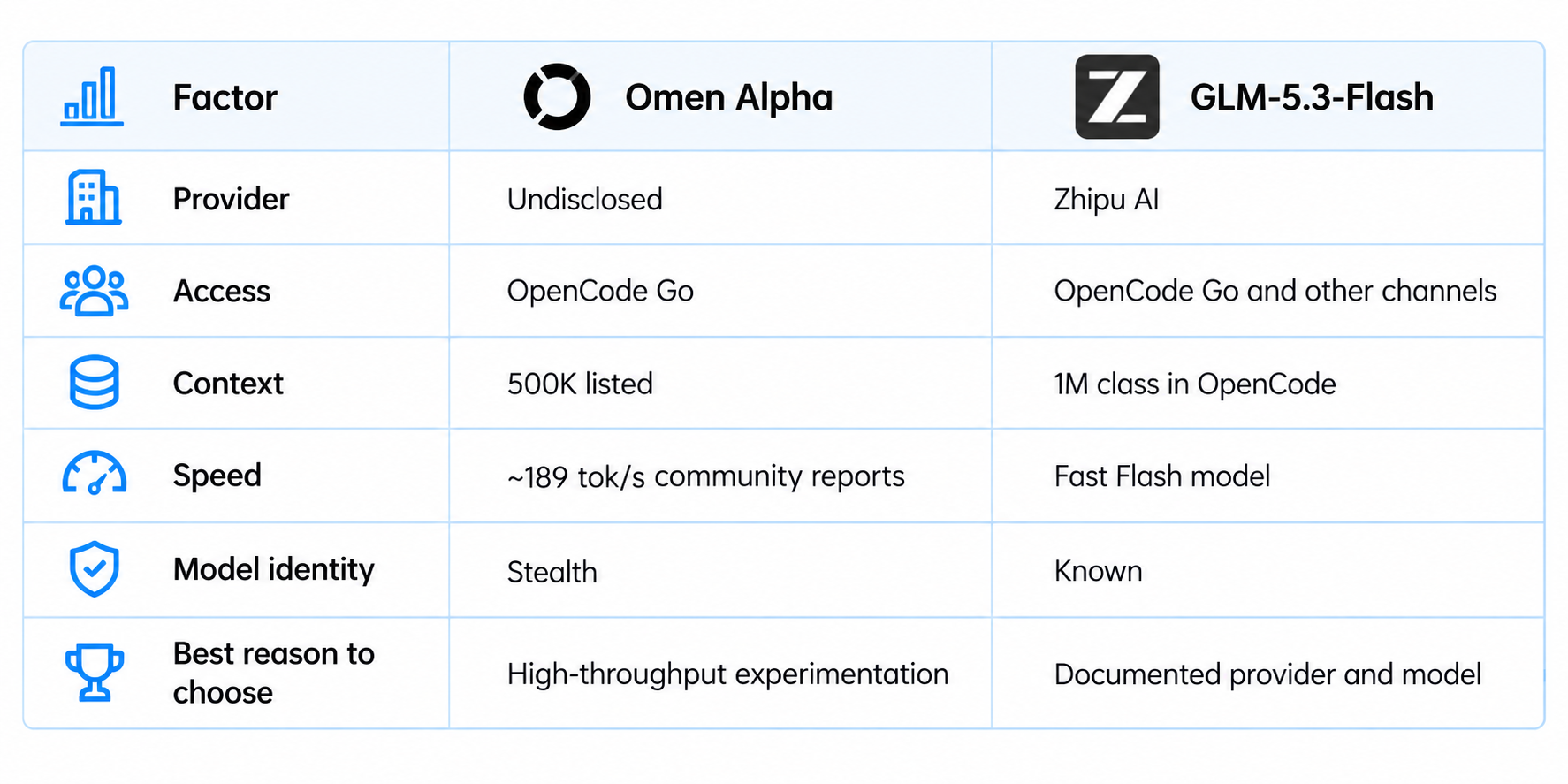
If provenance matters, GLM-5.3-Flash is easier to evaluate. If the actual coding experience matters most, Omen Alpha is worth trying because its speed and agent behavior may be different from what the model name suggests.
12. Omen Alpha vs GPT-5.6 Luna
Both models are available through OpenCode Go, but the economics are different. OpenCode estimates roughly 11,600 Omen Alpha requests per five hours compared with 2,050 for GPT-5.6 Luna under its typical request assumptions.
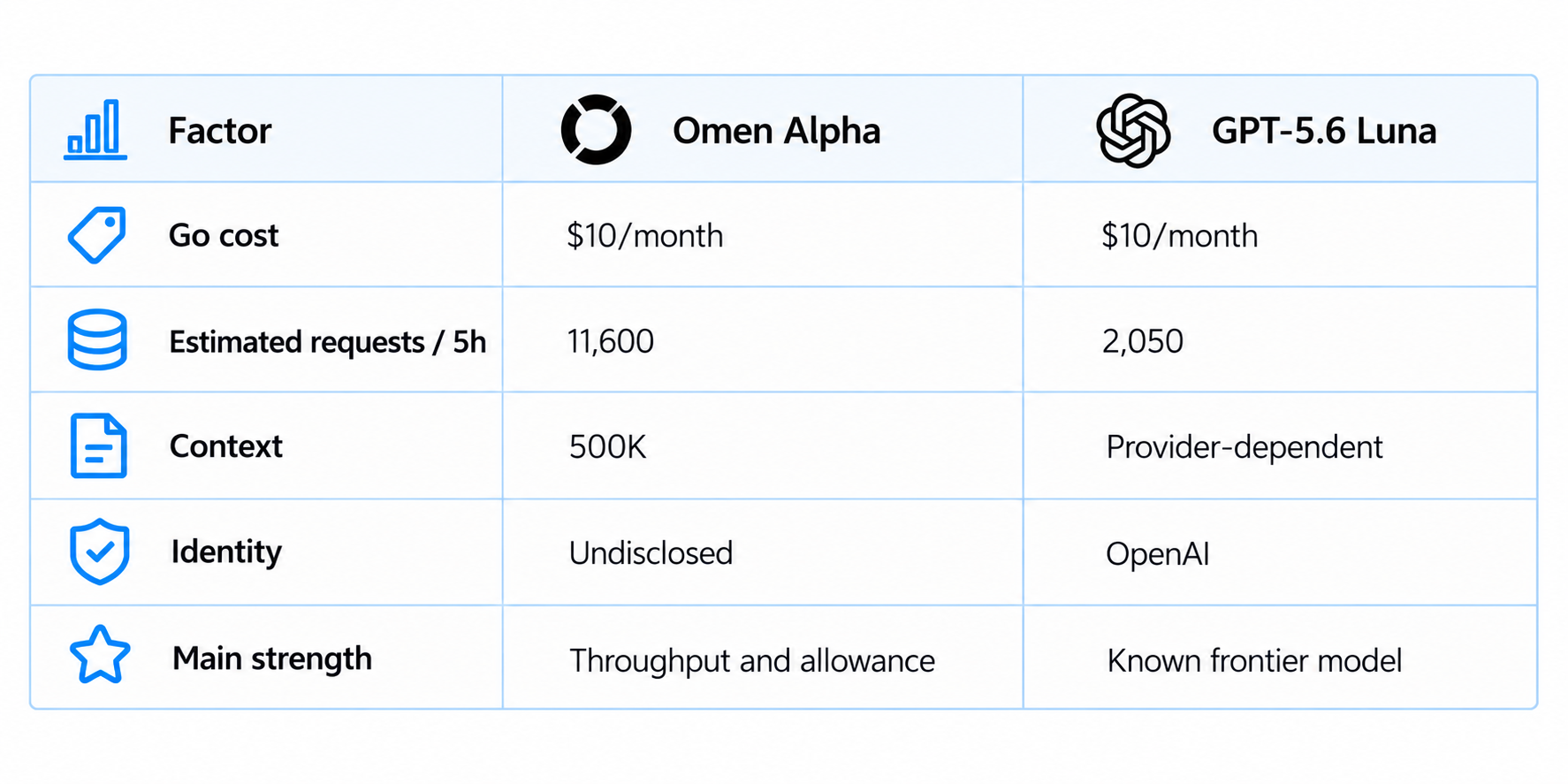
The request allowance is not a model-quality comparison. It is mainly an expression of OpenCode's pricing and observed request economics. The useful question is how many real coding tasks each model can complete before you need to escalate.
13. Privacy and Data Retention
OpenCode's current Go privacy table lists Omen Alpha as not used for model training and with 0 days of data retention. This is an important advantage for developers who use coding agents with source code.
The policy should be read as the current OpenCode Go service policy. Teams with strict compliance requirements should still verify the current terms and the exact endpoint configuration before using regulated or highly confidential information.
14. Omen Alpha Usage on OpenCode
OpenCode's live usage analytics show that Omen Alpha is already being used at meaningful scale. A current snapshot records roughly 39 billion recent tokens, around 2,900 unique users and 7,518 completed sessions, with an average session cost of about $0.27 in that dataset.
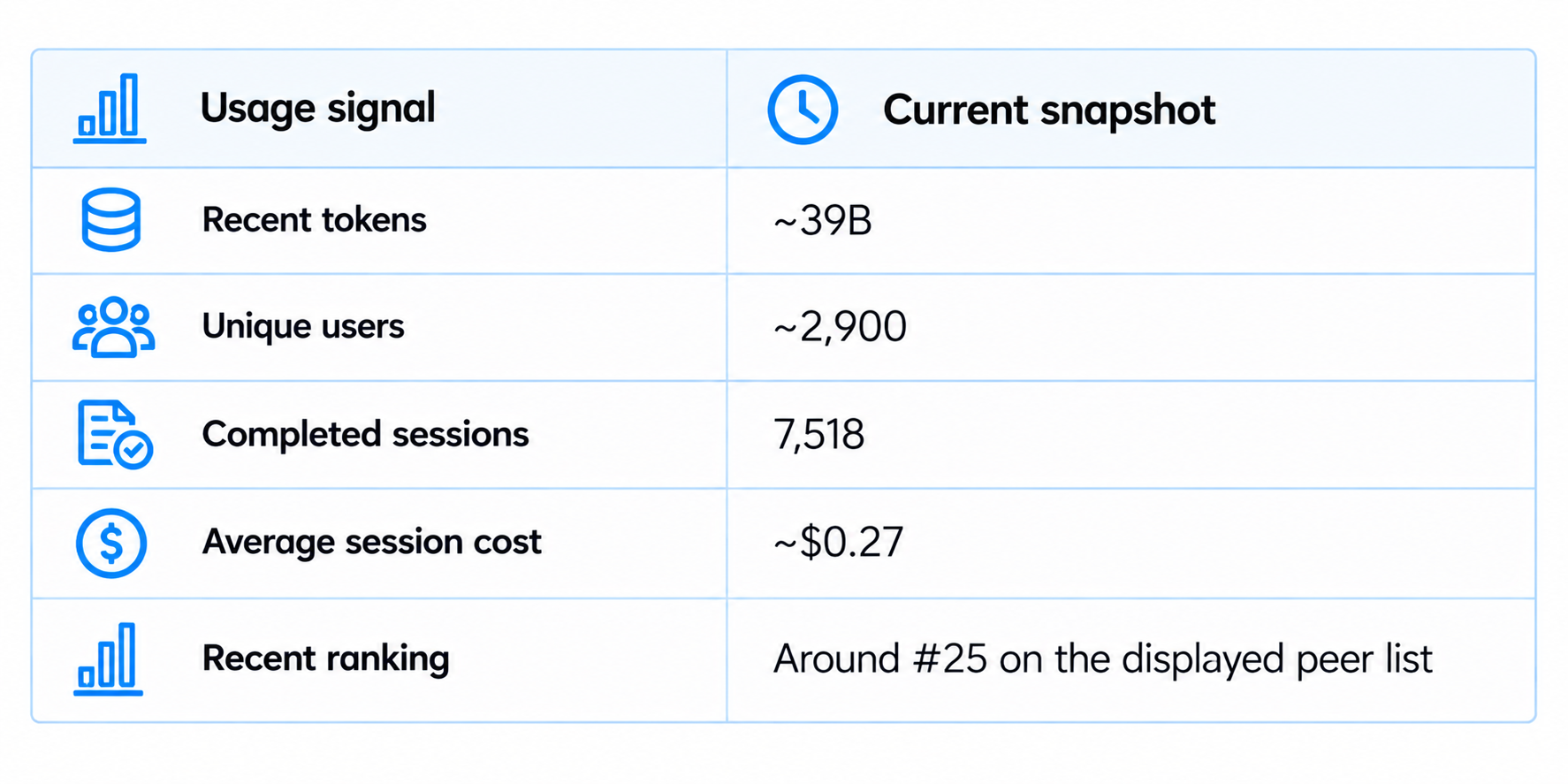
These numbers are usage statistics, not benchmark scores. They show adoption and session economics, but they do not prove that Omen Alpha is better than the models around it.
15. Best Use Cases
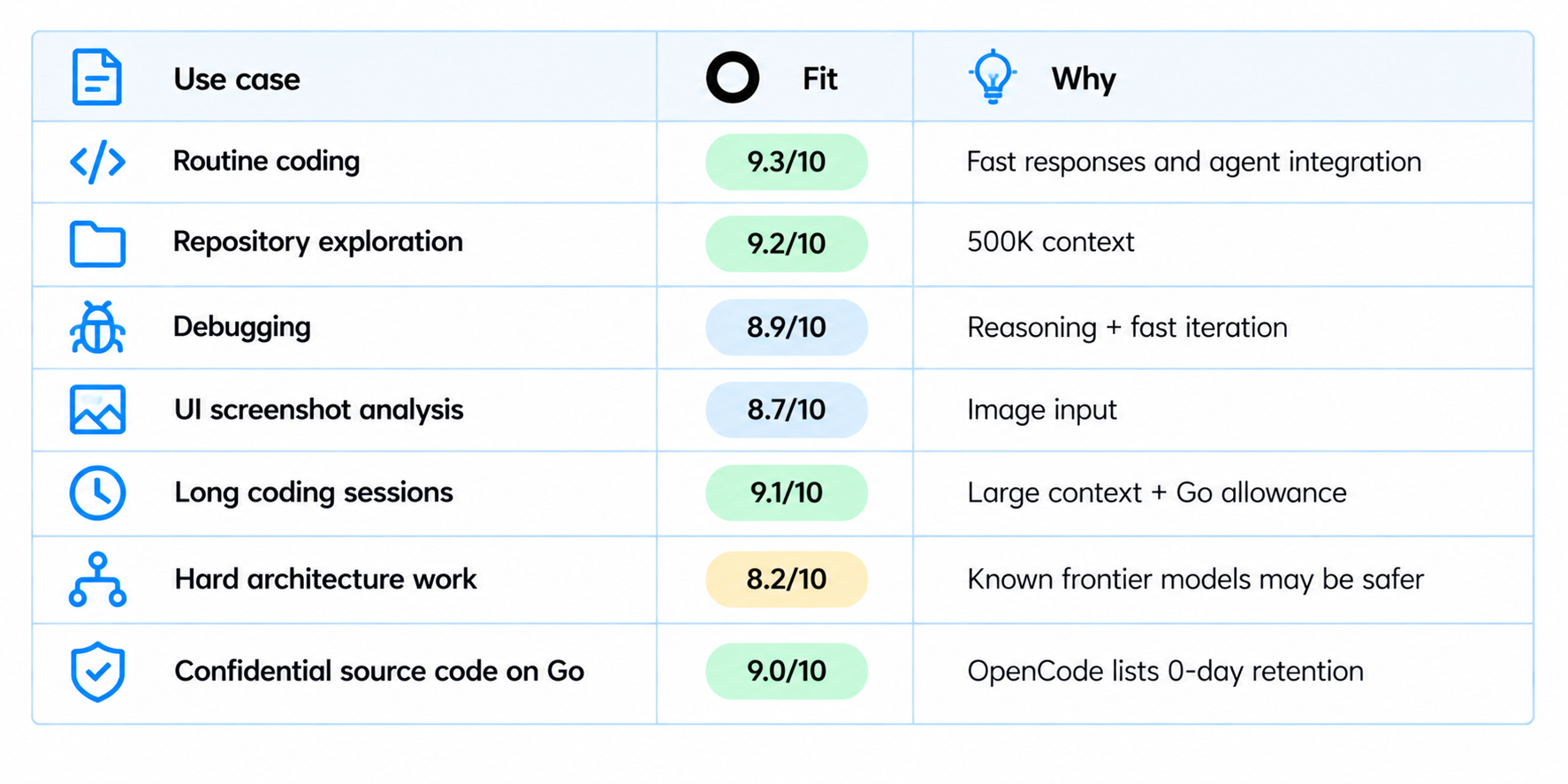
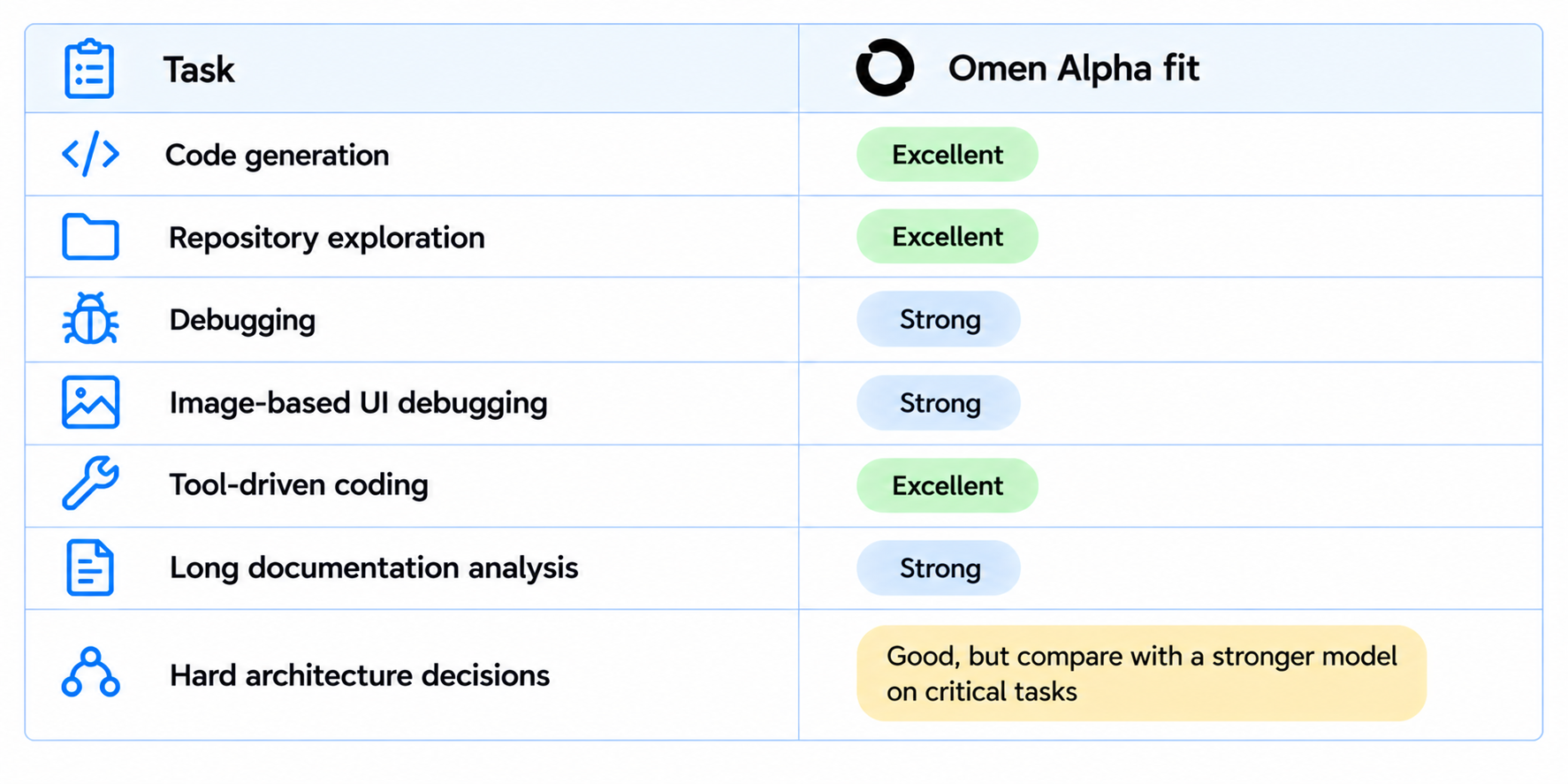
16. Limitations You Should Know
- The provider and exact model lineage are not publicly identified.
- Public model metadata is much thinner than for named models such as GPT, Claude or GLM.
- Community coding tests are informative but not a substitute for standardized benchmark suites.
- Identity guesses based on URL paths, tokenizer behavior or response style are not proof.
- Omen Alpha is primarily accessed through OpenCode Go rather than as a conventional public model product.
- OpenCode's request estimates are not guaranteed hard request quotas.
- Actual quality depends on the full agent stack, tools, prompts and repository.
17. Recommended Production Workflow
The strongest way to use Omen Alpha is as a high-throughput worker inside a routed coding-agent architecture.
- Use Omen Alpha for routine implementation, repository exploration and iterative debugging.
- Use its larger context for codebases and documentation-heavy tasks.
- Use image input for screenshot-driven frontend work.
- Keep a documented frontier model available for difficult architecture or high-risk changes.
- Measure completed tasks, retries and tool failures rather than speed alone.
- Review OpenCode Go's limits and privacy policy before scaling production use.
For this architecture, see Model Routing for AI Coding Agents.
18. How to Evaluate Omen Alpha Yourself
Because the model identity is hidden, your own benchmark is more useful than trying to identify the lab. Use the same repository, tools and prompts across Omen Alpha, GLM-5.3-Flash, GPT-5.6 Luna and your current default.
This makes Omen Alpha a normal engineering decision. You do not need to know the hidden provider to know whether the model is useful for your codebase.
19. Is Omen Alpha Worth It?
For OpenCode Go users, yes. The model combines a 500K context window, image input, reasoning and reported output around 189 tokens per second with a $10 monthly subscription. That is a compelling package for daily coding.
The strongest reason to use it is throughput. Many coding-agent tasks are made up of relatively small steps, and a fast model can move through those steps without constantly interrupting the developer's flow.
The main tradeoff is transparency. Developers who require a named provider, architecture documentation and a public model card will prefer a conventional model. Developers who care primarily about completed work can evaluate Omen Alpha on the same tasks they already use for other coding models.
20. Final Verdict
Omen Alpha is one of the most interesting coding models to appear in OpenCode Go because OpenCode has turned the model's anonymity into part of the product. You do not get a long launch document. You get a model, a coding environment and a large amount of usage capacity.
The practical specifications are strong: 500K context, 128K maximum output, reasoning, text and image input, OpenAI-compatible access and 0-day retention under the current OpenCode Go privacy table.
The speed signal is equally compelling. Community reports around 189 tokens per second suggest a very responsive model, while OpenCode usage analytics show meaningful adoption with billions of tokens already flowing through the service.
The biggest question is the identity. A Zhipu-labelled OpenCode data path has fueled strong GLM-family speculation, but OpenCode's active documentation does not officially name the provider. The right review therefore evaluates Omen Alpha as a black-box coding model instead of assigning it an unverified model name.
My rating: 9.3/10 for speed, 9.1/10 for coding-agent workflow, 9.2/10 for value through OpenCode Go and 8.8/10 overall.
Bottom line: Omen Alpha is worth testing if you use OpenCode Go and want a fast, large-context coding worker. It is especially attractive for routine agent loops and high-volume development, while harder or high-risk tasks can still be routed to a documented frontier model.
Frequently Asked Questions
What is Omen Alpha?
Omen Alpha is a stealth coding model available through OpenCode Go, with reasoning, image input, a 500K context window and 128K maximum output listed by Pi.
Who makes Omen Alpha?
OpenCode does not publicly identify the underlying provider. A Zhipu-labelled OpenCode data path has led to GLM-family speculation, but that is not an official attribution.
How much does Omen Alpha cost?
It is included in OpenCode Go, which costs $10 per month under the current plan.
How many requests can I make with Omen Alpha?
OpenCode estimates about 11,600 requests per five hours, 29,000 per week and 57,900 per month under its typical request assumptions.
How fast is Omen Alpha?
Community reports currently place it around 180 to 190 tokens per second, including a reported 189-token-per-second result.
What is the context window?
Pi lists 500,000 tokens with 128,000 maximum output.
Does Omen Alpha support images?
Yes. Current model metadata lists text and image input.
Is Omen Alpha open source?
No. There are no public model weights.
Does Omen Alpha train on user data?
OpenCode's current Go privacy table lists Omen Alpha as not used for model training and 0 days of data retention.
Is Omen Alpha the same as GLM?
That has not been officially confirmed. GLM/Zhipu is a community hypothesis based on backend clues.
Is Omen Alpha good for coding?
It is designed for coding-agent use and current community reports are positive about speed and practical coding behavior.
Is Omen Alpha worth it?
Yes for OpenCode Go users who want fast, high-volume coding assistance.
Recommended Blogs
Meta Muse Spark 1.3 Review: Coding, Price & Is It Worth It? (2026)
Gemini 3.8 Flash Review: Accuracy, Price & Is It Worth It? (2026)
Qwen 3.8 Max 0902 Review: Benchmarks, Price & Is It Worth It? (2026)
Mercury 2.5 AI Model Review: Speed, Price & Is It Worth It? (2026)
Model Routing for AI Coding Agents: How to Cut Costs Without Losing Quality
How to Secure AI Coding Agents: Permissions, Sandboxing, MCP & Secrets
24GB VRAM AI Models: What Can You Actually Run Locally in 2026?
Resources & Community
Join our community of 70,000+ AI enthusiasts and learn to build powerful AI applications. Whether you're a beginner or an experienced developer, Build Fast with AI helps you understand and implement AI in your projects.
Agentic AI Launchpad 2026
A structured 6-week cohort program that takes you from AI basics to building and deploying real-world agentic AI systems. Includes live sessions, expert mentorship, project reviews and a builder community network.
Ready to go from learning to building? Join the next cohort:
Ready to go from learning to building? Join the next cohort: Agentic AI Launchpad 2026
Free AI Resources
Access free tools, workshops and micro-learning to keep building.

