



Mercury 2.5 AI Model Review: Is Inception's Diffusion LLM Finally Fast Enough to Change AI Workflows?
Mercury 2.5 Preview is one of the most interesting AI model releases of late August 2026 because its main advantage is not a larger parameter count. It is how the model generates text. Inception Labs uses a diffusion-based language model, or dLLM, that generates and refines multiple tokens in parallel instead of producing one token after another.
OpenRouter currently reports 1,107 tokens per second on standard GPUs for Mercury 2.5. Inception positions it as its most intelligent reasoning dLLM and targets workloads where latency compounds across many calls, such as search agents, voice pipelines and coding subagents.
The bigger question is whether that speed comes with enough quality. Early evidence suggests that Mercury 2.5 occupies an interesting middle ground between tiny efficient models and premium frontier systems. But it is still a Preview model, and its independent benchmark record is much less mature than the established leaders.
QUICK ANSWER
Mercury 2.5 Preview is Inception Labs' newest diffusion large language model, released August 31, 2026. It has a 260K-token context window, reasoning, tool use and structured outputs. Inception lists $0.20 per million input tokens, $0.02 cached input and $0.75 per million output tokens. OpenRouter currently shows an 80% promotional rate of $0.04 input and $0.15 output. OpenRouter reports 1,107 tokens per second on standard GPUs.
My verdict: 9.8/10 for speed, 9.4/10 for price, 8.5/10 for agent responsiveness, 8/10 for evidence depth, and 8.8/10 overall.
1. What Is Mercury 2.5?
Mercury 2.5 is a reasoning-focused diffusion language model from Inception Labs. Unlike a conventional autoregressive LLM, it does not have to produce the response strictly from left to right. The diffusion approach generates and refines multiple parts of the response in parallel.
Inception describes Mercury 2.5 as its most intelligent reasoning dLLM and targets it at complex applications where quality and speed both matter. It is also OpenAI-compatible, which makes it relatively easy to test in applications already built around standard chat-completion interfaces.
The result is a different tradeoff from conventional models. Traditional LLMs often exchange speed for more reasoning depth. Mercury's approach attempts to push more useful reasoning into a much faster generation pipeline.
2. Mercury 2.5 Specifications
Parameter count is not publicly disclosed. The more useful specifications are the 260K context, reasoning support, tool calling, structured output support and very high decoding throughput.
3. The Diffusion Architecture Is the Real Innovation
With an autoregressive model, a long response requires many sequential decoding steps. Mercury instead uses parallel generation and iterative refinement. Inception's broader explanation of the Mercury family says this approach is intended to increase GPU efficiency and make language generation much faster.
This matters most when a system needs many model calls. A search agent can call a model repeatedly. A coding agent can call it after every tool result. A voice assistant can generate a response while trying to keep conversation natural.
The value of diffusion is therefore not simply a faster benchmark. It can change the architecture of an AI application by making more model calls economically and temporally feasible.
4. Speed: 1,107 Tokens Per Second
OpenRouter currently reports 1,107 tokens per second for Mercury 2.5 on standard GPUs. That is the model's biggest headline advantage.
Tokens per second is not end-to-end latency. Time to first token, prompt processing, network latency, queueing and tool calls still matter. A model can stream at extreme speed and still feel slow if the first token arrives late.
Even with those caveats, the decoding speed can dramatically reduce the latency of long responses and repeated agent calls.
5. Why Speed Matters More for Agents
In a normal chatbot, latency happens once per answer. In an agent, latency compounds across every step. A workflow may perform dozens of model calls before the user receives the final result.
Inception explicitly targets rapid coding iteration, agents and subagents, customer support and enterprise search for Mercury 2.5.
That makes Mercury 2.5 particularly interesting as an infrastructure model. It does not have to win every benchmark. It has to be good enough for the majority path and substantially faster or cheaper than the alternative.
6. Reasoning: Is a Fast Diffusion Model Actually Smart?
Mercury 2.5 is explicitly positioned as a reasoning model. Inception says it brings a more than 10-point intelligence improvement over Mercury 2, while its model listing confirms reasoning support.
Diffusion decoding does not mean the model cannot perform extended reasoning. The important difference is the mechanism used to generate the final response.
The caution is evidence. Current independent trackers are still building enough data to establish where Mercury 2.5 sits across science, mathematics, coding and knowledge work.
7. Mercury 2.5 Benchmarks: What We Know So Far
The benchmark picture is still young. OpenRouter describes Mercury 2.5 as comparable in quality to cost-optimized models such as GPT-5.6 Luna at Low reasoning, Gemini 3.5 Flash-Lite and Claude Haiku 4.5. That is a provider positioning statement, not an independent certification.
AI BENCHY's September 2 snapshot reports a 47% pass rate in its tracked evaluation, with particularly strong puzzle-solving and weaker tool-calling performance. It also reports an average response time around 1.31 seconds. These numbers are useful early signals, but the model has only just entered the public ecosystem.
The Known Good tracker currently does not assign a quality index because it needs enough results across science, mathematics and coding. That is a strong reminder that the quality record is still forming.
8. Tool Calling and Structured Outputs
Mercury 2.5 supports tool calling and structured output. OpenRouter documents tool parameters and JSON-schema response formatting, while Inception lists tool use and structured output as core capabilities.
Those features are important because Mercury's intended use cases are agentic. A fast language model is only useful as an agent component if it can reliably decide when to call a tool and return machine-readable results.
Early third-party testing suggests tool calling may be less mature than the model's speed advantage, so developers should test argument accuracy and recovery from tool errors.
9. The 260K Context Window
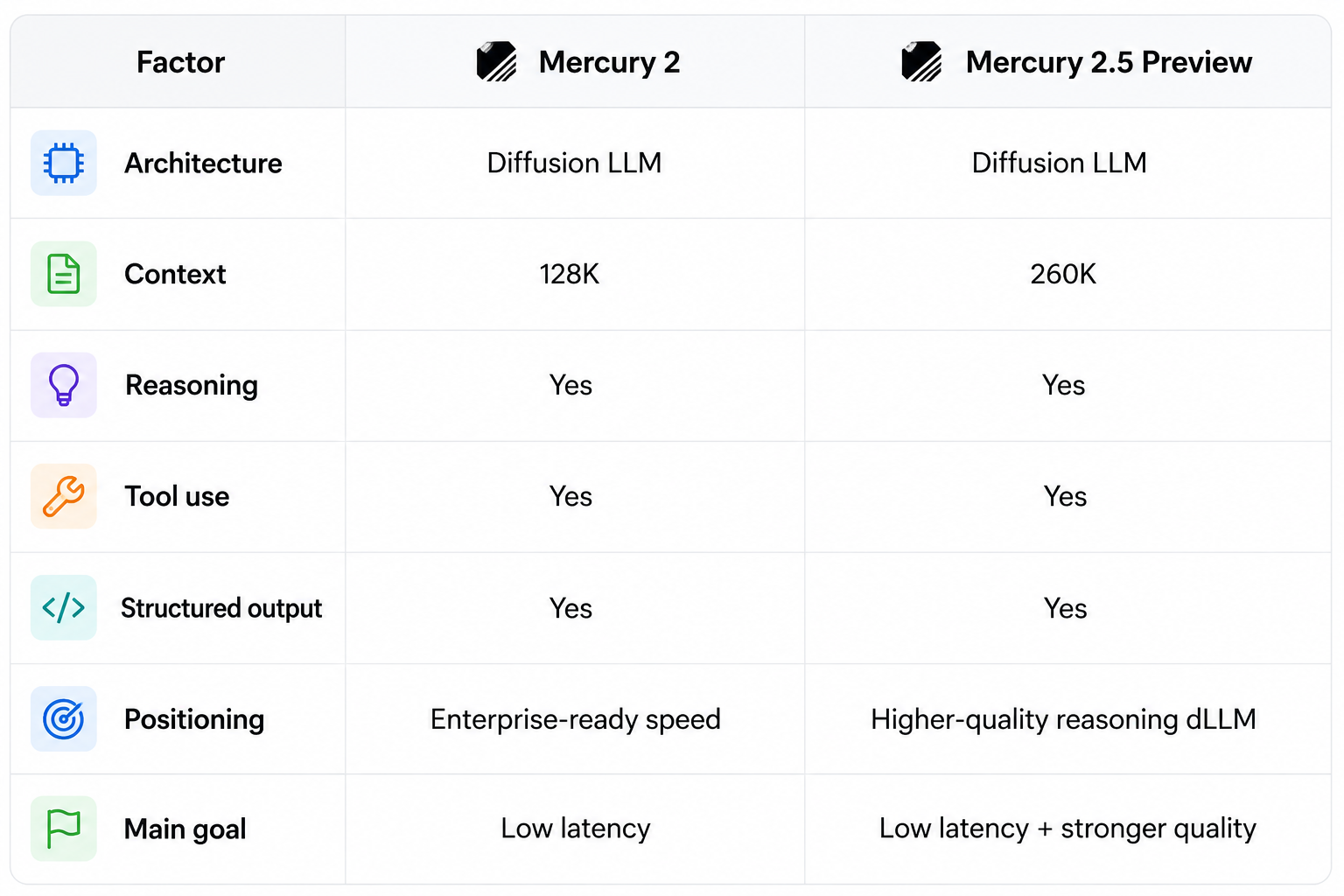
Mercury 2.5 has a 260,000-token context window, double the 128K context listed for Mercury 2.
That gives it room for substantial codebases, long documents and extended agent histories. The practical advantage is fewer context rebuilds and less need to summarize everything into a short prompt.
Large context should still be managed carefully. Retrieval, compression and prompt organization remain important.
10. Pricing: Mercury 2.5 Is Extremely Aggressive
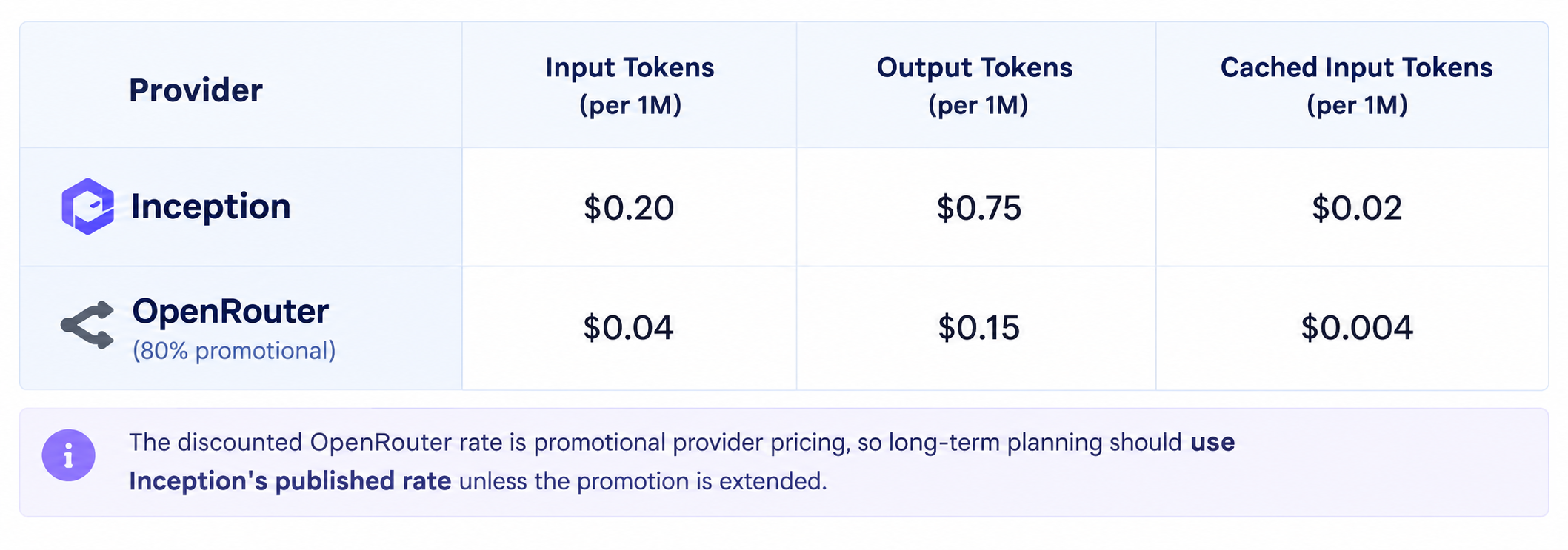
Inception lists $0.20 per million input tokens, $0.75 per million output tokens and $0.02 per million cached input tokens. OpenRouter is currently showing an 80% promotional price of $0.04 input and $0.15 output, with cache reads at $0.004 per million. The discounted OpenRouter rate is promotional provider pricing, so long-term planning should use Inception's published rate unless the promotion is extended.
The price changes the economics of agent systems. A search product can afford more ranking and extraction calls. A coding agent can afford more verification steps. A support system can process high traffic without the same inference bill as a premium frontier model.
11. Mercury 2.5 vs Mercury 2
Mercury 2 was already designed around extremely fast reasoning. Mercury 2.5 pushes the same architecture toward higher intelligence and a larger context. Inception lists Mercury 2 with a 128K context and Mercury 2.5 with 260K.
The upgrade is therefore useful even before considering raw benchmark scores. More context and a stronger reasoning target make the fast architecture useful for a broader set of tasks.
12. Mercury 2.5 vs Claude Haiku 4.5
Inception and OpenRouter position Mercury 2.5 as comparable to cost-optimized models such as Claude Haiku 4.5. The important distinction is architectural: Haiku is an established autoregressive model, while Mercury is built around diffusion decoding.
For mature general-purpose workflows, Haiku benefits from a longer operational track record and a broader ecosystem. For applications where latency is the bottleneck, Mercury has a more unusual value proposition.
13. Mercury 2.5 vs Qwen 3.8 Max 0902
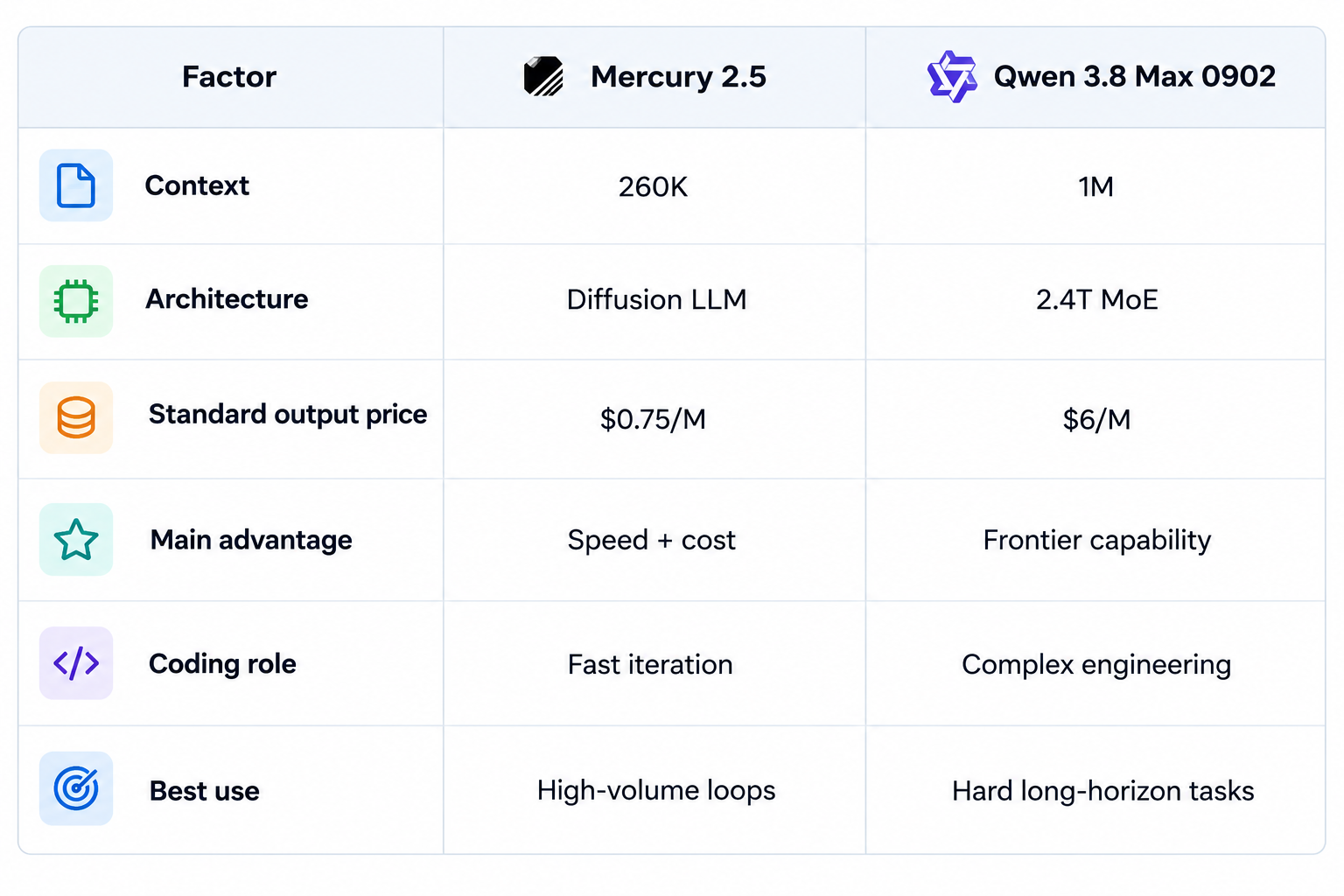
Qwen 3.8 Max 0902 and Mercury 2.5 occupy different points on the capability curve. Qwen is a giant frontier system focused on difficult coding and Cowork tasks. Mercury is optimized around fast inference, low cost and repeated calls.
If your workload is one exceptionally difficult reasoning task, Qwen is the more obvious candidate. If your workload is dozens of model calls inside an agent, Mercury becomes much more interesting.
14. Mercury 2.5 vs GPT-5.6 Luna
GPT-5.6 Luna remains a stronger reference point for established frontier reasoning. Mercury's argument is different: deliver enough quality for the workflow while making generation dramatically faster and cheaper.
That distinction is valuable in applications where latency matters more than squeezing out the final points of benchmark performance.
15. Coding Performance
Inception lists rapid coding iteration as a Mercury 2.5 use case, while OpenRouter specifically highlights coding subagents.
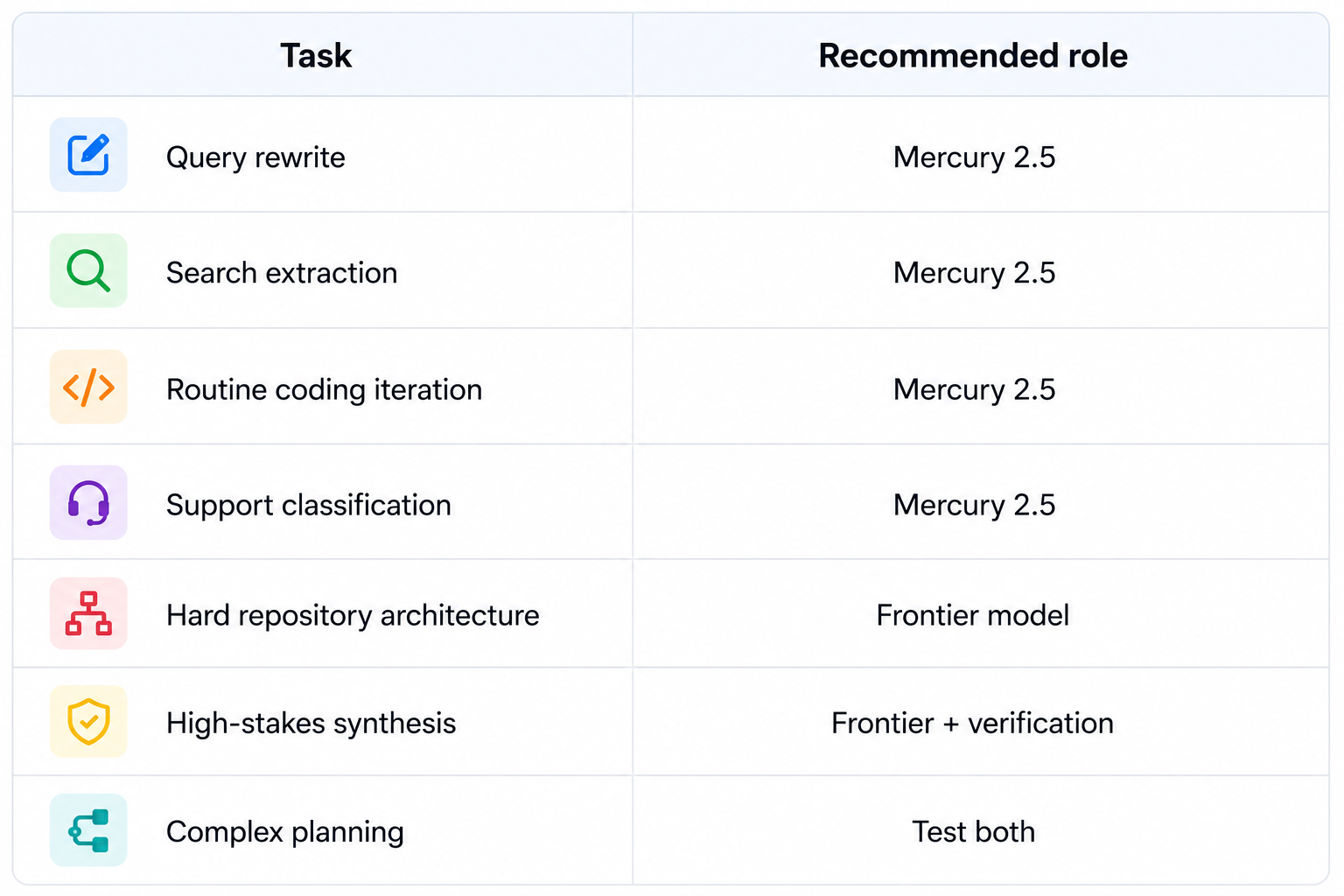
The natural coding workflow is not necessarily replacing the strongest coding model. It is speeding up the loop around coding: generate a patch, inspect tool output, fix a test, rewrite a function and keep moving.
Repository-level engineering is the harder test. Current independent evidence is not deep enough to claim Mercury 2.5 beats leading coding systems on complex repositories.
16. Search Agents
Search systems can require many model calls for query rewriting, ranking, extraction, deduplication, citation selection and final synthesis.
Inception has already positioned the Mercury family for search systems, emphasizing that very high throughput can make many model calls feasible inside normal latency budgets.
This is perhaps the cleanest example of why a diffusion LLM can matter. Instead of making one expensive, slow reasoning call, an application can afford many smaller reasoning steps.
17. Voice and Real-Time Applications
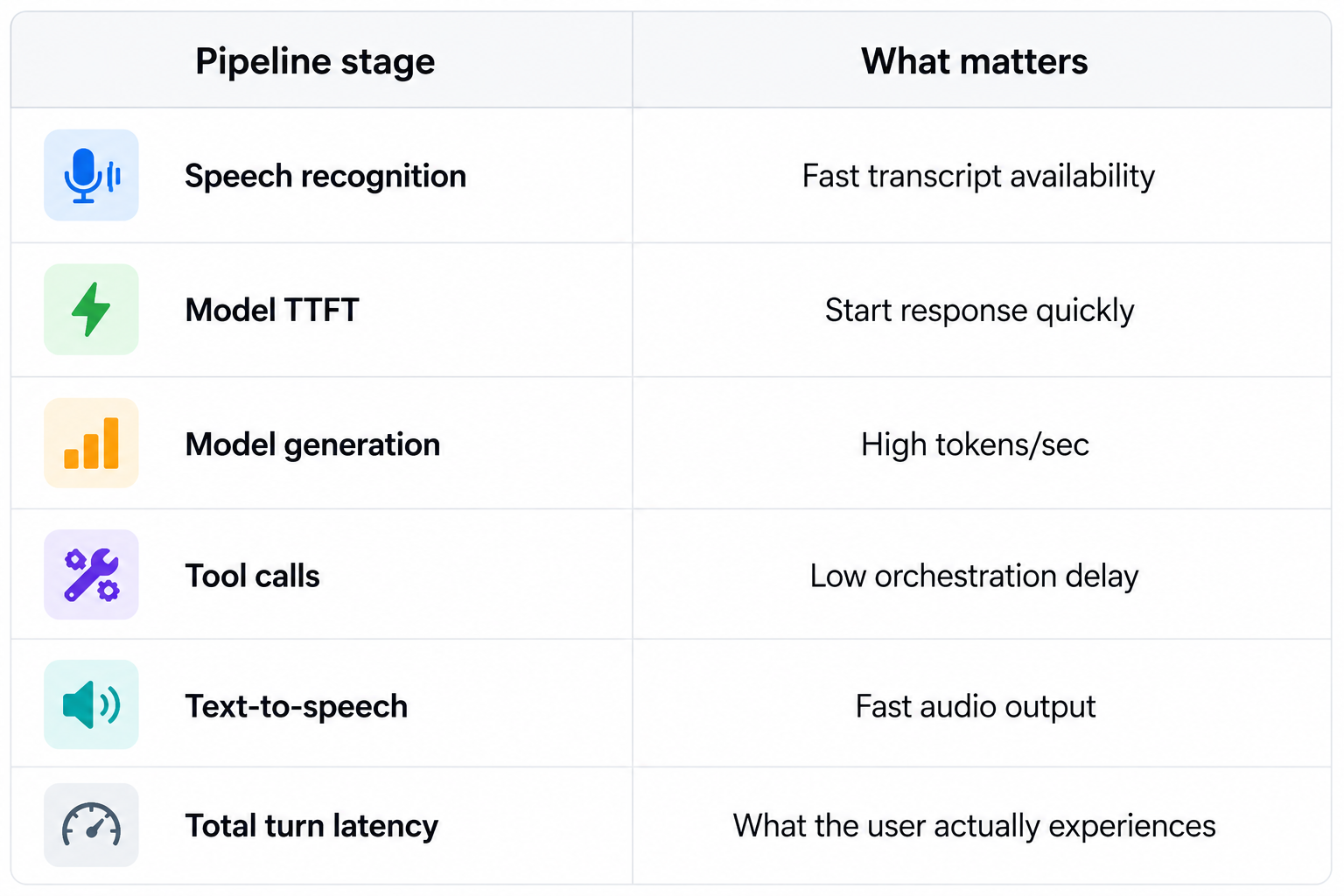
Voice applications amplify latency problems because users expect conversation to feel immediate. Model throughput matters, but so do time to first token, streaming, speech recognition and text-to-speech.
Mercury 2.5's architecture is well matched to this kind of application because its main objective is to reduce generation latency. The model itself is only one part of total voice latency.
18. Enterprise Search and Customer Support
Customer support and enterprise search combine high request volume with a strong need for responsiveness. Mercury does not have to be the smartest model in the organization. It needs to be good enough for common requests, fast enough for a good experience and cheap enough to scale.
Inception explicitly lists customer support and enterprise search among the target use cases for Mercury 2.5.
19. Where Mercury 2.5 Falls Short
The biggest limitation is evidence maturity. Mercury 2.5 was released only days ago, so its quality record is still developing.
Second, extreme speed does not guarantee accurate outputs. Tool calling, factual accuracy and long-horizon consistency need real application testing.
Third, current published capability listings describe Mercury 2.5 as text in and text out, so multimodal applications need additional models for vision or audio input.
Finally, Mercury 2.5 is a Preview release. APIs, pricing and performance characteristics can evolve.
20. The Best Way to Use Mercury 2.5
The model is most compelling when latency compounds or when the application needs many calls. Use it for query rewriting, extraction, fast coding iteration, search ranking, support routing and subagent tasks.
For difficult requests, use model routing. Let Mercury handle the fast majority path and send the hardest cases to a stronger frontier model.
This creates a practical quality-speed architecture instead of forcing one model to handle every request.
21. How to Evaluate Mercury 2.5 Yourself
Build a benchmark around your actual workload. Use at least 20 to 50 representative tasks and compare Mercury 2.5 with the model you already use.
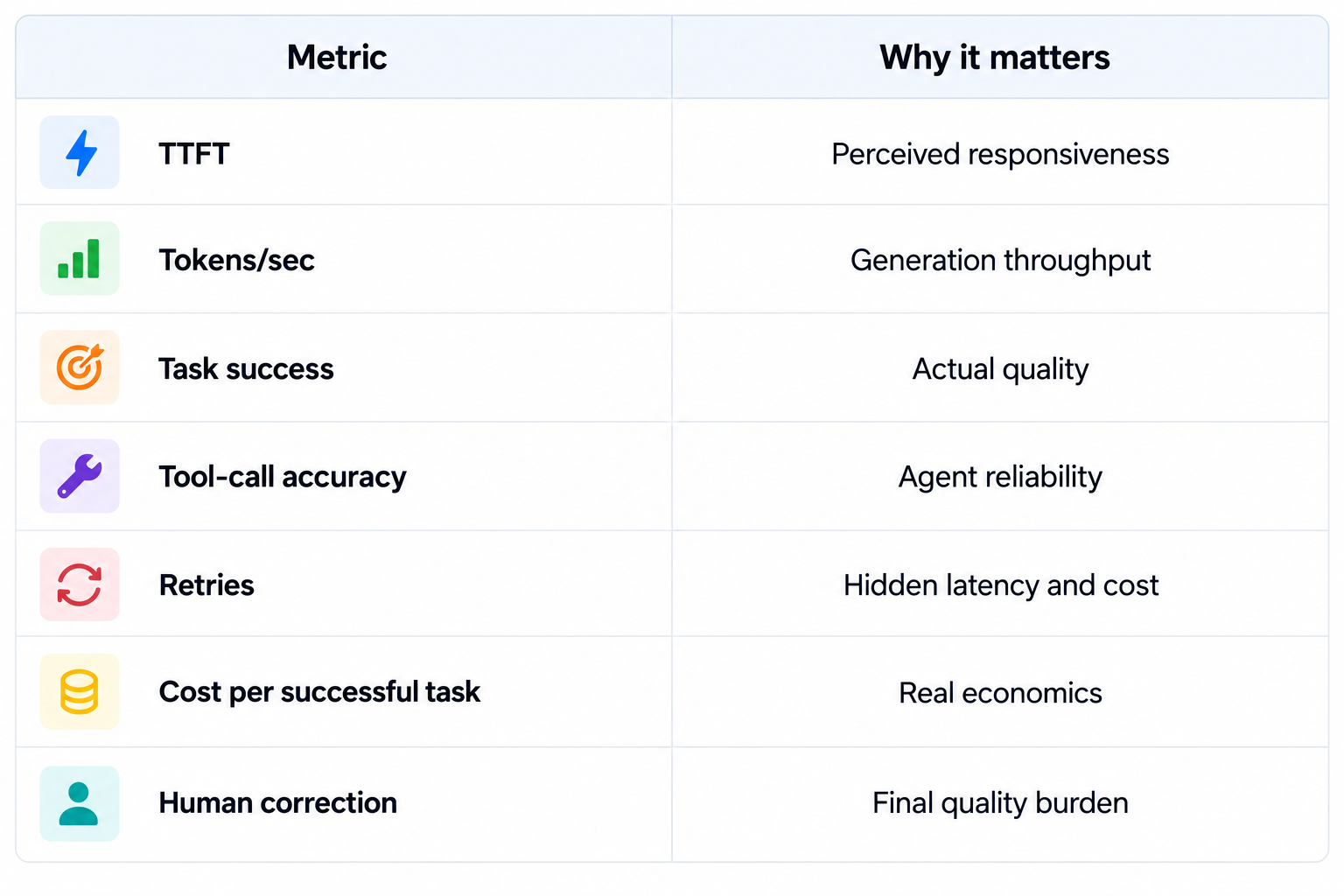
Measure time to first token, end-to-end latency, output speed, success rate, tool-call accuracy, retries, token usage and total cost.
Do not make the benchmark a speed contest. A model that is ten times faster but needs several additional retries may not improve the product.
22. Is Mercury 2.5 Worth It?
Yes, especially for developers building latency-sensitive AI applications. The architecture is genuinely different, the speed is unusually high, the context is large and the price is low enough to support high-volume agent loops.
I would not claim that Mercury 2.5 has replaced the strongest frontier reasoning models. The independent benchmark record is too new. Its real value is creating a new price-speed-quality point that is difficult to ignore.
If your application makes many model calls, Mercury 2.5 deserves an A/B test. Measure cost per successful workflow rather than tokens per second alone.
23. Final Verdict
Mercury 2.5 Preview is one of the most technically interesting AI models of September 2026. Inception is not simply making another transformer larger. It is changing the decoding approach so reasoning models can generate text through parallel refinement.
With a 260K context window, reasoning, tool use, structured outputs, a reported 1,107 tokens per second and a standard price of $0.20 input and $0.75 output per million tokens, Mercury 2.5 has an unusually strong speed-to-cost profile.
The caveat is quality maturity. Mercury 2.5 is still a Preview model, and independent testing is only beginning. That makes it a model to benchmark aggressively, not blindly standardize on.
My rating: 9.8/10 for speed, 9.4/10 for price, 8.5/10 for agent responsiveness, 8/10 for evidence maturity and 8.8/10 overall.
Frequently Asked Questions
What is Mercury 2.5?
Mercury 2.5 Preview is Inception Labs' latest diffusion large language model, designed for reasoning, fast generation, tool use and structured outputs.
How fast is Mercury 2.5?
OpenRouter currently reports up to 1,107 tokens per second on standard GPUs, although actual end-to-end latency varies by provider and workload.
How much does Mercury 2.5 cost?
Inception lists $0.20 per million input tokens and $0.75 per million output tokens, with cached input at $0.02 per million. OpenRouter currently shows a promotional $0.04/$0.15 rate.
What is a diffusion LLM?
A diffusion LLM generates and refines multiple parts of a response in parallel instead of producing every token strictly one at a time.
Does Mercury 2.5 support reasoning?
Yes. Inception positions Mercury 2.5 as its most intelligent reasoning dLLM.
Does Mercury 2.5 support tool calling?
Yes. It supports tool use and structured output, including JSON-schema response formatting.
How large is the context window?
Mercury 2.5 currently lists a 260,000-token context window.
Is Mercury 2.5 good for coding?
It is promising for rapid coding iteration and coding subagents where speed matters, but independent evidence is not mature enough to call it the best coding model.
Is Mercury 2.5 multimodal?
Current listings describe Mercury 2.5 as text in and text out, so multimodal applications need additional models.
Is Mercury 2.5 worth using?
Yes, especially for search, voice, support, high-volume agents and fast coding loops where latency and cost are major constraints.
Recommended Blogs
- Qwen 3.8 Max 0902 Review: Benchmarks, Price & Is It Worth It? (2026)
- Claude Fable 5.1 Review: Benchmarks, Price, Coding & Is It Worth It? (2026)
- Model Routing for AI Coding Agents: How to Cut Costs Without Losing Quality
- What Is an AI Agent? Beginner Guide With Examples (2026)
- How to Secure AI Coding Agents in 2026: Permissions, Sandboxing, MCP & Secrets
Resources & Community
Join our community of 70,000+ AI enthusiasts and learn to build powerful AI applications. Build Fast with AI helps creators, developers and teams understand and implement practical AI.
- Website - buildfastwithai.com
- LinkedIn - Build Fast with AI
- Instagram - @buildfastwithai
- Founder Twitter - @satvikps
- Twitter - @BuildFastWithAI
Agentic AI Launchpad 2026
A structured 6-week cohort program that takes you from AI basics to building and deploying real-world agentic AI systems. Includes live sessions, expert mentorship, project reviews, and a builder community network.
Ready to go from learning to building? Join the next cohort. Agentic AI Launchpad 2026
Free AI Resources
Access free tools, workshops, and micro-learning to keep building:
AI Workshops: Free resources, upcoming events & past recordings
Unrot: Learn AI in 5 minutes a day (free micro-learning app)
Secure the agent before you scale the agent. The safest coding workflow is the one where a bad model decision becomes a small, reversible problem instead of a production incident.

