



Gemini 3.8 Flash Review: Is Google's New Flash Model Good Enough to Challenge the Best Coding Models?
Gemini 3.8 Flash is Google's newest Flash model, built around the idea that a fast workhorse can also handle serious software engineering. The model is aimed at long-horizon coding, autonomous agents and enterprise workflows, while retaining the lower-latency and lower-cost positioning that makes Flash models practical for high-volume use.
Google released Gemini 3.8 Flash on September 2, 2026, and the model is available through the Gemini API. Google's current model documentation lists a 1,048,576-token input limit, a 65,536-token maximum output, multimodal input across text, image, video, audio and PDF, and support for function calling, code execution, file search, search grounding, structured outputs and thinking at low, medium and high levels.
The biggest reason developers are paying attention is coding. Current independent tracking gives Gemini 3.8 Flash a strong benchmark profile, including a 59 Artificial Analysis Intelligence Index score at high reasoning and 305 output tokens per second in that configuration. On DeepSWE v1.1, the model reaches 74% at high reasoning, matching Claude Opus 5, although it trails Opus 5 significantly on several harder general-agent benchmarks.
QUICK ANSWER
Gemini 3.8 Flash is a major step up for Google's Flash lineup. It combines a 1M-token context window with configurable low, medium and high reasoning, multimodal input, tool use and very high output speed. Artificial Analysis currently gives the high-reasoning version an Intelligence Index of 59, compared with 56 for Gemini 3.7 Flash, and measures the high configuration at about 305 output tokens per second.
For coding, Gemini 3.8 Flash scores 74% on DeepSWE v1.1 at high reasoning, matching Claude Opus 5, while its medium setting scores 71%. It also leads on several specialist evaluations, including BioMysteryBench Human Difficult at 56.5%, but Claude Opus 5 remains clearly ahead on Terminal-Bench 4.0, OSWorld-2.0 and GDPVal-AA v2.
Google's official model page lists the model as stable, with a 1,048,576-token input limit, 65,536-token output limit, and support for code execution, computer use in Preview, file search, function calling, search grounding, structured outputs and three thinking levels.
My verdict: 9.2/10 overall. Gemini 3.8 Flash is one of the best value-oriented coding and agent models to test in 2026, especially when speed, large context and high request volume matter.
1. What Is Gemini 3.8 Flash?
Gemini 3.8 Flash is Google's newest stable Flash model and succeeds Gemini 3.7 Flash. Google describes it as its most intelligent Flash model, engineered for long-horizon software engineering, autonomous agents and complex enterprise workflows while maintaining Flash-level speed and cost efficiency.
The important part is that Google is no longer positioning Flash as merely a lighter chatbot model. The target is production work where an AI system has to act repeatedly, use tools and preserve context across an extended task.
That makes Gemini 3.8 Flash especially relevant to coding agents. An agent can inspect a repository, modify files, execute code, read test failures and continue through several rounds without requiring a premium model for every step.
2. Gemini 3.8 Flash Specifications
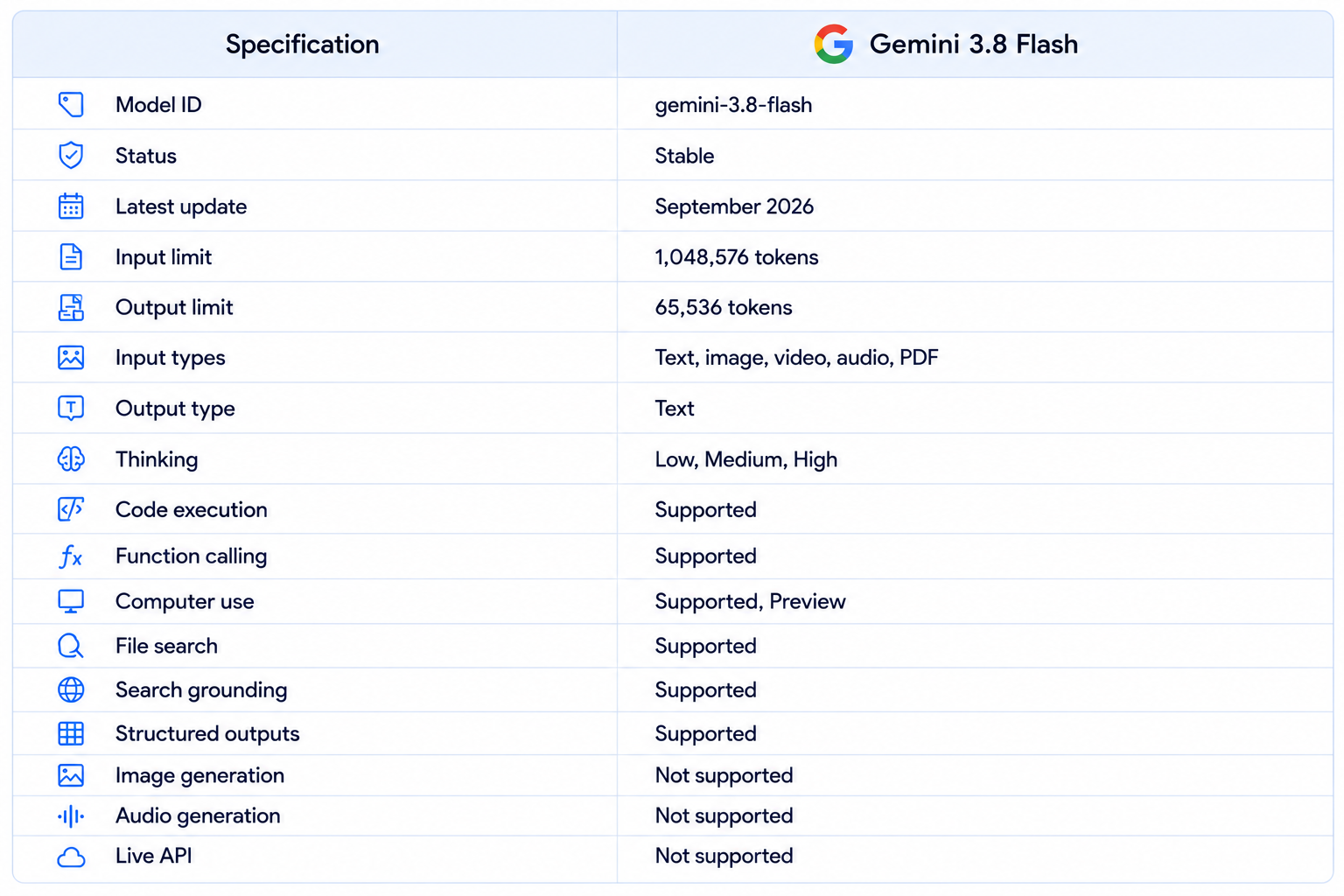
These specifications come directly from Google's current Gemini 3.8 Flash API documentation. The model is designed to consume a broad set of multimodal inputs but returns text rather than generated images or audio.
3. Gemini 3.8 Flash Benchmark Performance
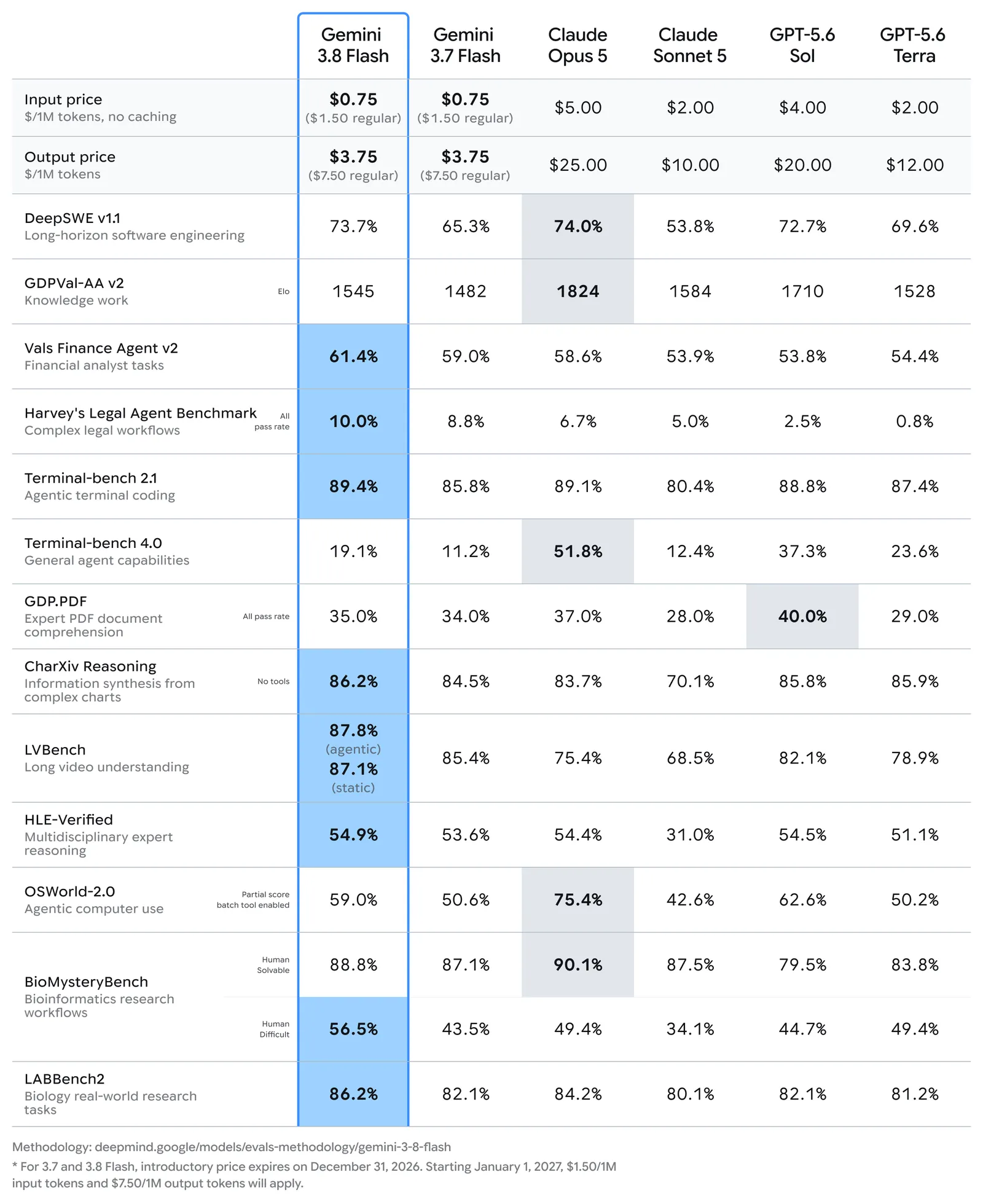
The release has a broad benchmark profile rather than a single overwhelming win. That matters because the model is intended for many kinds of work, from coding to research and autonomous agents.
Source: Introducing Gemini 3.8 Flash and 3.8 Flash Cyber
The benchmark pattern is important. Gemini 3.8 Flash is not simply winning or losing across the board. It is highly competitive on DeepSWE and strong on several specialist evaluations, while Claude Opus 5 remains substantially stronger on some of the hardest general agent and computer-use workloads.
4. Coding Performance
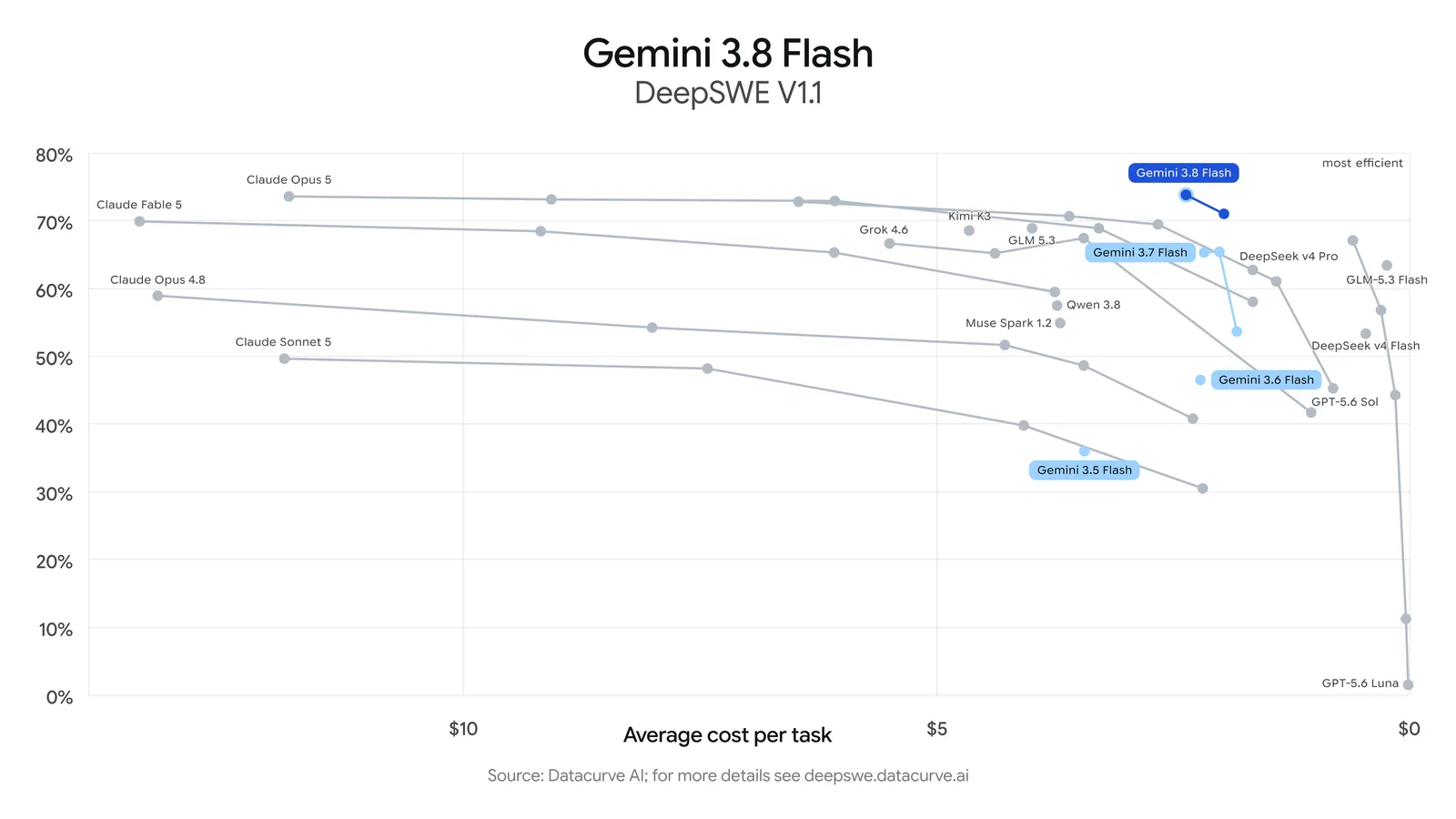
Coding is arguably Gemini 3.8 Flash's most important use case. The model scores 74% on DeepSWE v1.1 at high reasoning, matching Claude Opus 5. The medium reasoning setting reaches 71%, which shows that the model remains competitive even without using its highest reasoning level.
DeepSWE is more representative of real coding-agent work than a simple code-completion test because long-horizon software engineering requires multiple decisions rather than one isolated answer. That makes the result particularly relevant for repository-level coding agents.
However, Terminal-Bench 4.0 tells a different story. Gemini 3.8 Flash scores 19.1%, compared with 51.8% for Claude Opus 5. The gap shows that high performance on software-engineering tasks does not automatically translate to every terminal-driven agent workflow.
Source: Introducing Gemini 3.8 Flash and 3.8 Flash Cyber
5. Reasoning Modes
Gemini 3.8 Flash supports three thinking levels: low, medium and high. Google exposes these as distinct reasoning settings, allowing developers to trade computation for speed depending on the difficulty of a request.
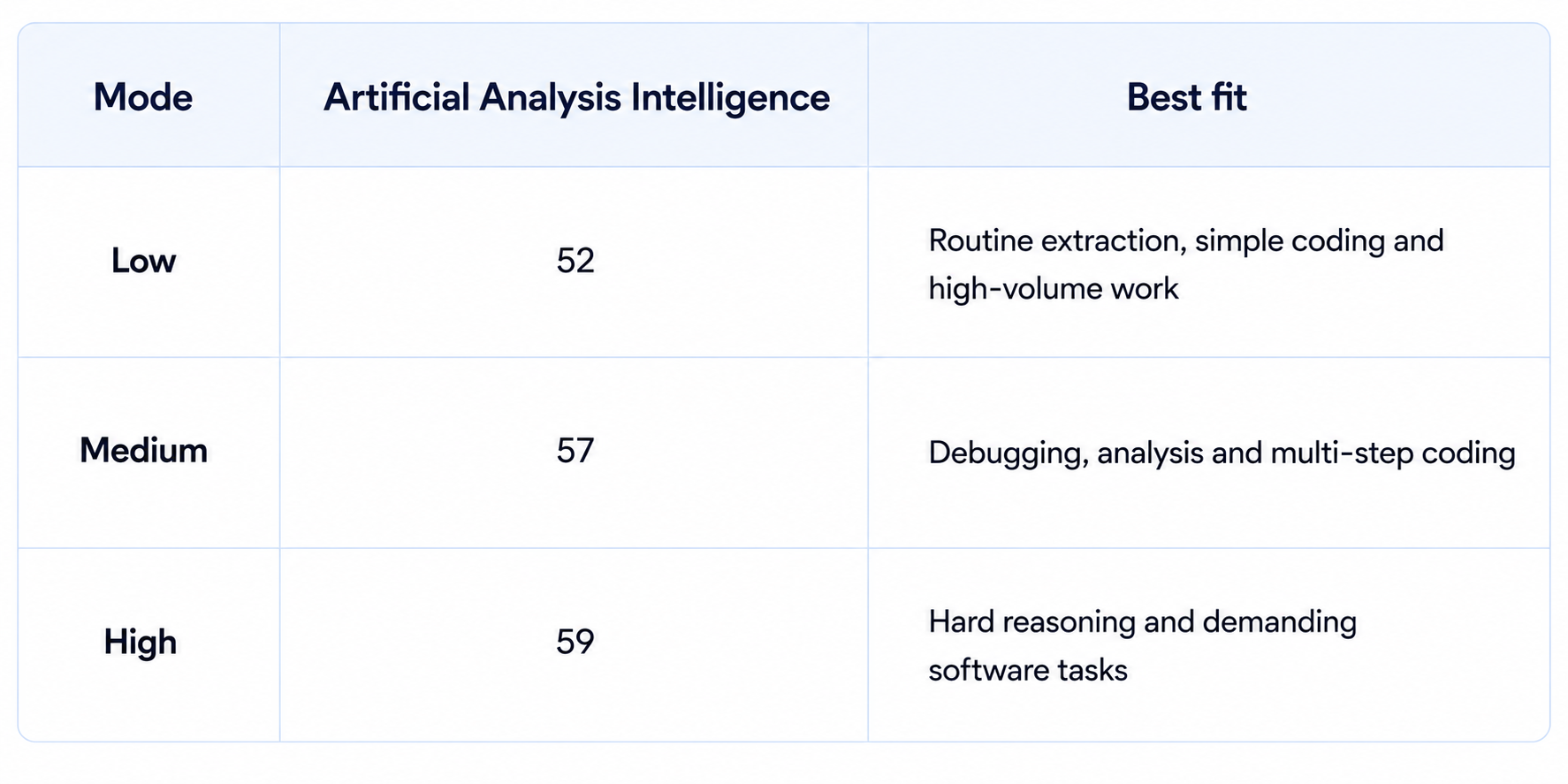
This makes the model particularly useful inside an agent router. A straightforward task does not need to consume the same reasoning budget as a difficult repository change. Developers can move requests between levels rather than choosing one fixed configuration for the entire application.
6. Speed
Artificial Analysis currently measures about 305 output tokens per second for Gemini 3.8 Flash at high reasoning. The 3.7 Flash high configuration is listed at 279 tokens per second, so the new model improves speed as well as intelligence in the current measurement.
This matters most in agent loops. If an agent needs to make ten or twenty model calls, response speed affects the total time required to complete the task. Flash becomes valuable not because every response is spectacularly fast in isolation, but because the savings accumulate across the entire workflow.
Actual end-to-end latency will vary with prompt size, reasoning level, provider load and network conditions, so the benchmark speed should be treated as a controlled model measurement rather than a universal user-facing latency guarantee.
7. Gemini 3.8 Flash Pricing
Google's current pricing for Gemini 3.8 Flash is $0.75 per million input tokens and $3.75 per million output tokens through December 31, 2026. From January 1, 2027, Google lists standard pricing of $1.50 per million input and $7.50 per million output tokens.
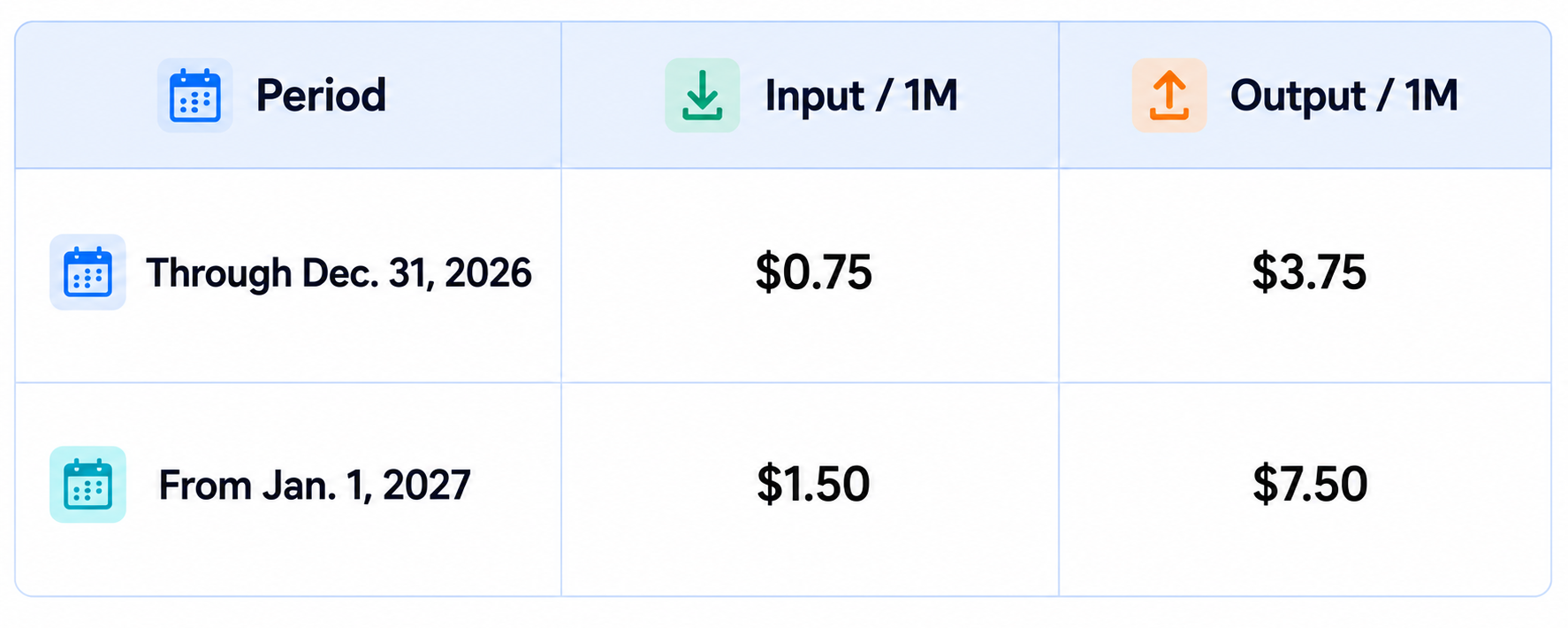
The temporary pricing is a major part of the model's value proposition. At $0.75 per million input tokens, a high-volume coding or agent workload can use Flash as its default worker model and reserve a more expensive model for difficult escalations.
Google also lists context caching at $0.075 per million tokens through December 31, 2026, with storage billed separately. That can matter for applications repeatedly sending the same large repository or knowledge base context.
8. Gemini 3.8 Flash vs Gemini 3.7 Flash
Gemini 3.8 Flash is an incremental model release, but the measured improvement is clear in the Artificial Analysis Intelligence Index. High reasoning rises from 56 to 59, medium from 53 to 57 and low from 51 to 52. Output speed at high reasoning also increases from 279 to 305 tokens per second in the current Artificial Analysis measurements.
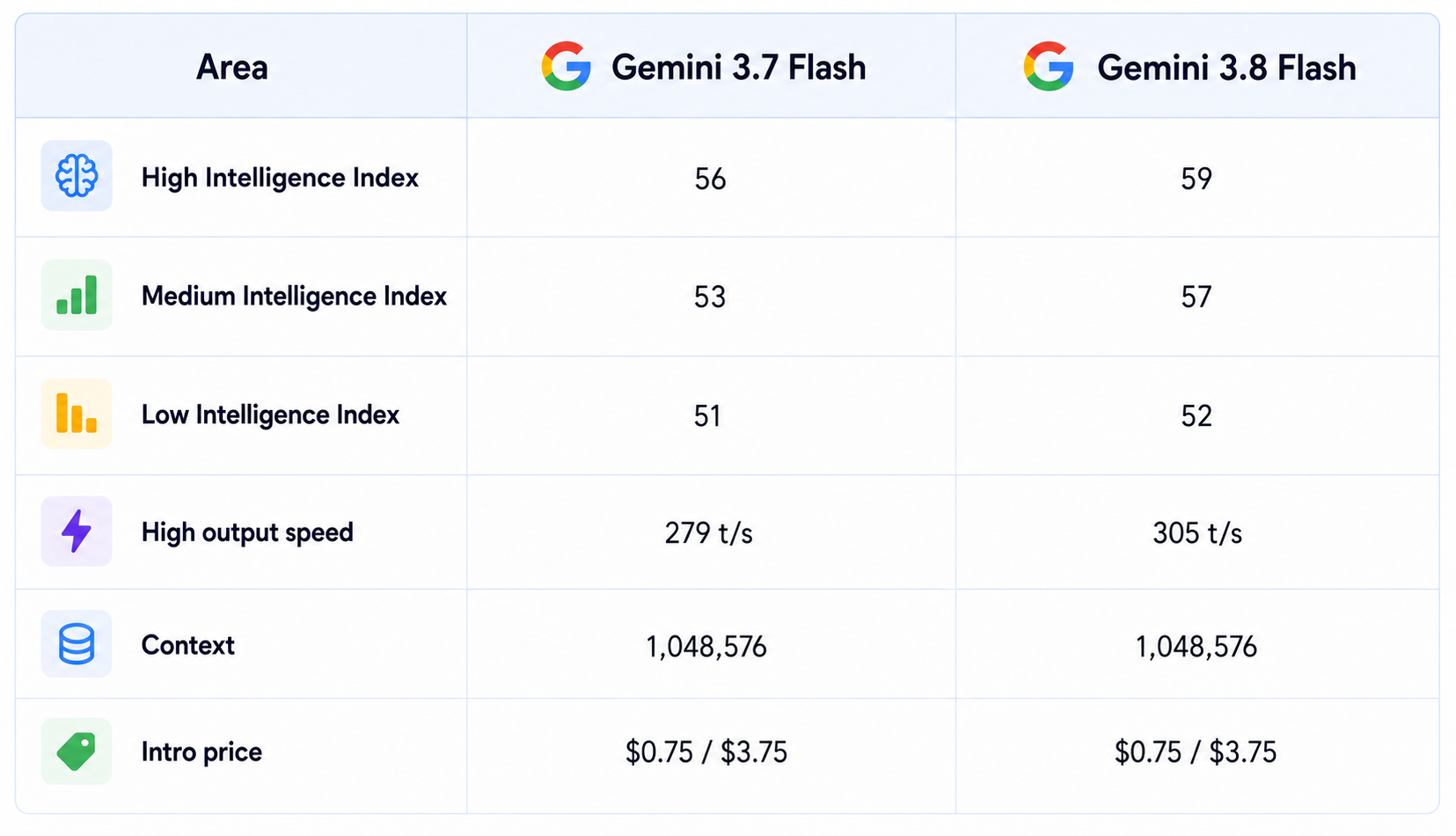
The upgrade is therefore not a complete change in pricing or context capacity. It is primarily a quality and throughput improvement within the same Flash operating model.
9. Gemini 3.8 Flash vs Claude Opus 5
The most interesting comparison is DeepSWE. Gemini 3.8 Flash at high reasoning reaches 74%, exactly matching the current Claude Opus 5 result in the published comparison. On BioMysteryBench Human Difficult, Gemini 3.8 Flash scores 56.5%, ahead of Opus 5 at 49.4%.
But Opus 5 is still significantly ahead in other demanding areas. It scores 51.8% on Terminal-Bench 4.0 versus 19.1% for Gemini 3.8 Flash, 75.4% on OSWorld-2.0 versus 59.0%, and 1824 Elo on GDPVal-AA v2 versus 1545.
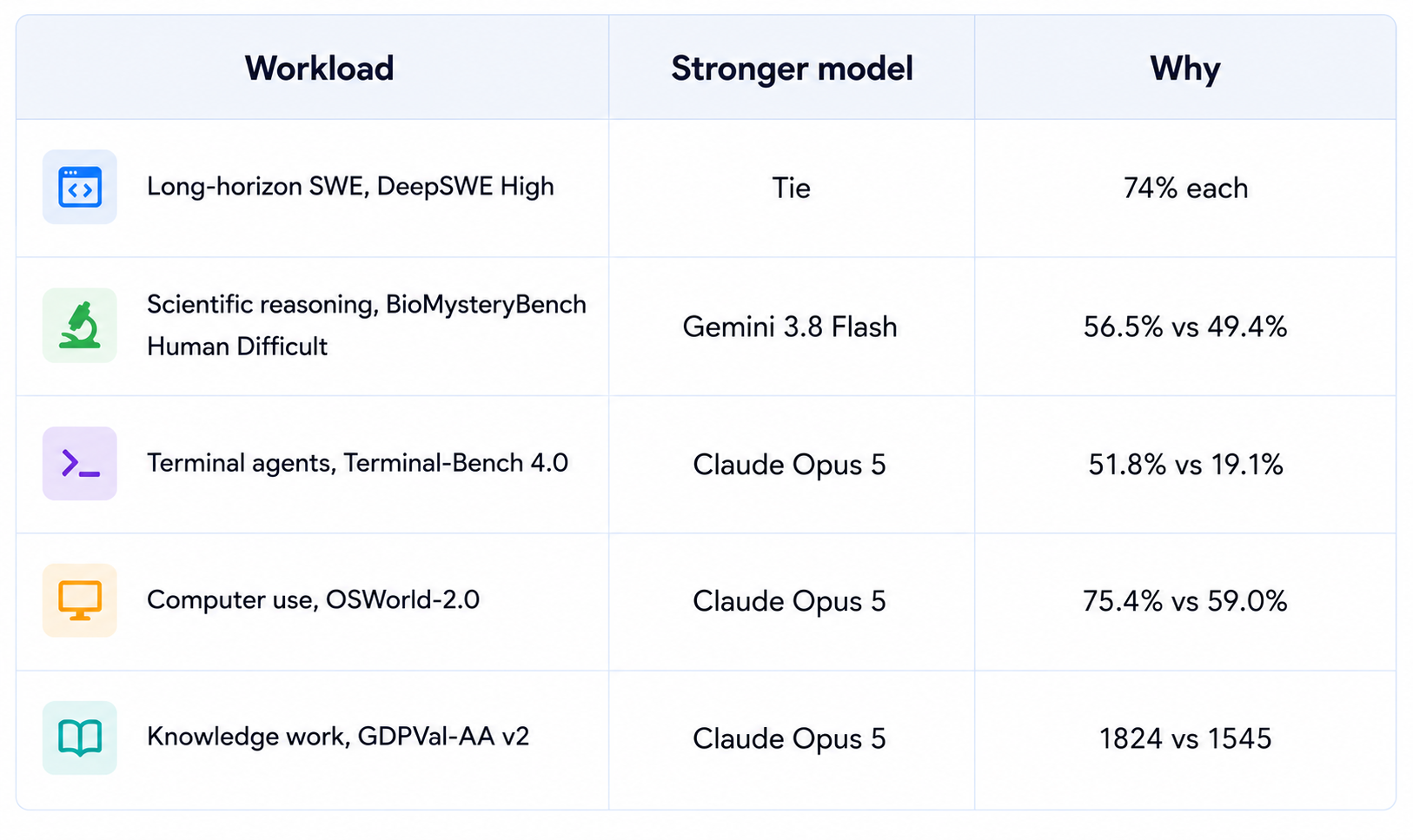
That is a better way to understand the competition than declaring a single overall winner. Gemini 3.8 Flash has reached premium-model territory on important coding tasks, but Opus 5 remains the stronger option for several difficult general-agent workloads.
10. Multimodal Capabilities
Google's official model page lists text, image, video, audio and PDF as supported input types. That makes Gemini 3.8 Flash useful for workflows that combine code with screenshots, videos, PDFs, voice or other media.
The output side is intentionally simpler: Gemini 3.8 Flash returns text and does not support image or audio generation on this model page. That keeps the model focused on reasoning, analysis, coding and orchestration rather than direct media generation.
11. Tool Use and Agentic Workflows
Gemini 3.8 Flash supports function calling, code execution, file search, search grounding, URL context and structured outputs. Computer use is also listed as supported in Preview. These capabilities make the model a natural fit for agents that need to work with external systems rather than simply generate text.
The benchmark profile also provides a useful warning. Gemini 3.8 Flash is strong on some coding and professional-agent tasks, but its Terminal-Bench and OSWorld results show that highly autonomous computer interaction is still a different problem from writing code inside a controlled benchmark.
12. Best Use Cases
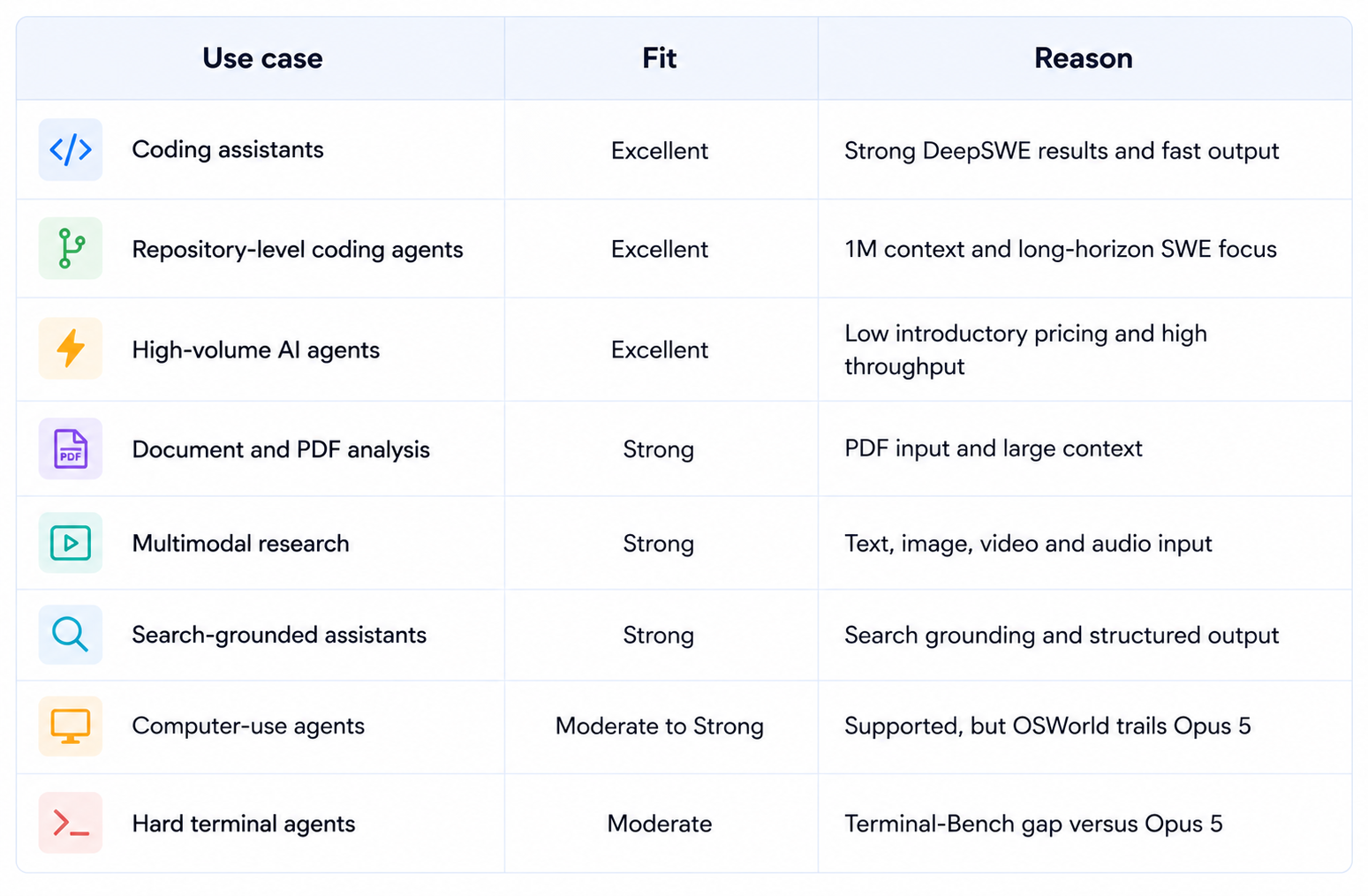
13. Limitations
- Gemini 3.8 Flash is not the best model on every benchmark.
- Claude Opus 5 remains substantially stronger on Terminal-Bench 4.0, OSWorld-2.0 and GDPVal-AA v2.
- The model's 1M-token context is a capacity advantage, not a guarantee of perfect long-context reasoning.
- Computer use is currently listed as Preview.
- The introductory API price changes on January 1, 2027.
- Image and audio generation are not supported by Gemini 3.8 Flash itself.
14. Recommended Production Workflow
Gemini 3.8 Flash works best as the default worker model in a routed system rather than as the only model in an application.
- Use low reasoning for routine extraction, classification and simple edits.
- Use medium reasoning for debugging and multi-step implementation.
- Use high reasoning for difficult coding and long-horizon tasks.
- Escalate complex terminal or computer-use workflows to a stronger model when your evaluation shows a meaningful gap.
- Track cost per completed task, not only token price.
- Log tool calls, retries and final outcomes so model routing can be optimized from real task data.
For more on this approach, read Model Routing for AI Coding Agents.
15. How to Evaluate Gemini 3.8 Flash Yourself
A benchmark leaderboard is useful, but your own workload is the final test. Run identical tasks through Gemini 3.8 Flash, Gemini 3.7 Flash and your current model.
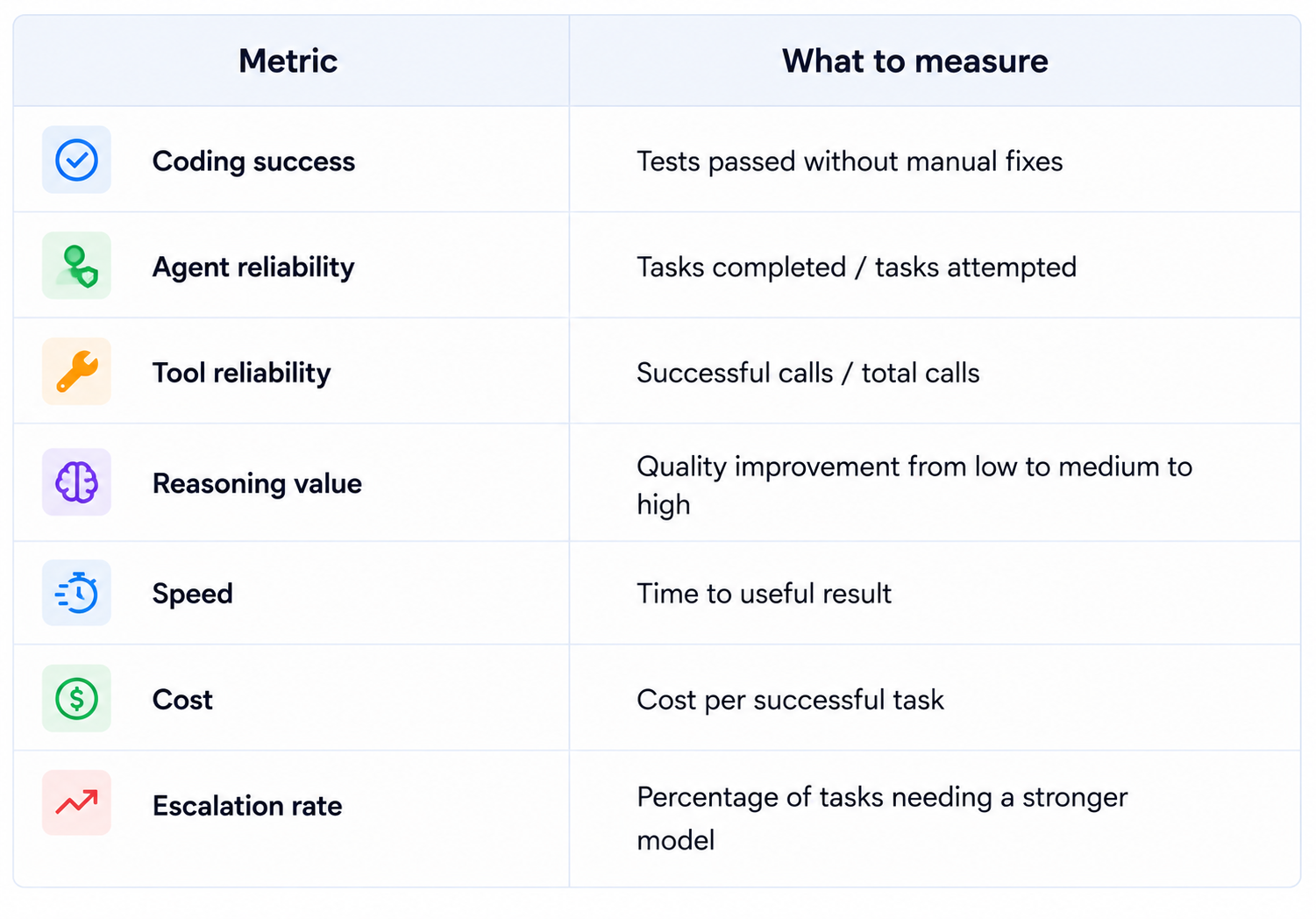
This gives you a practical picture of whether the higher benchmark score translates into less engineering work. The most valuable result is not the model that wins one evaluation, but the one that completes your real tasks with the fewest retries at an acceptable cost.
16. Gemini 3.8 Flash Pros and Cons
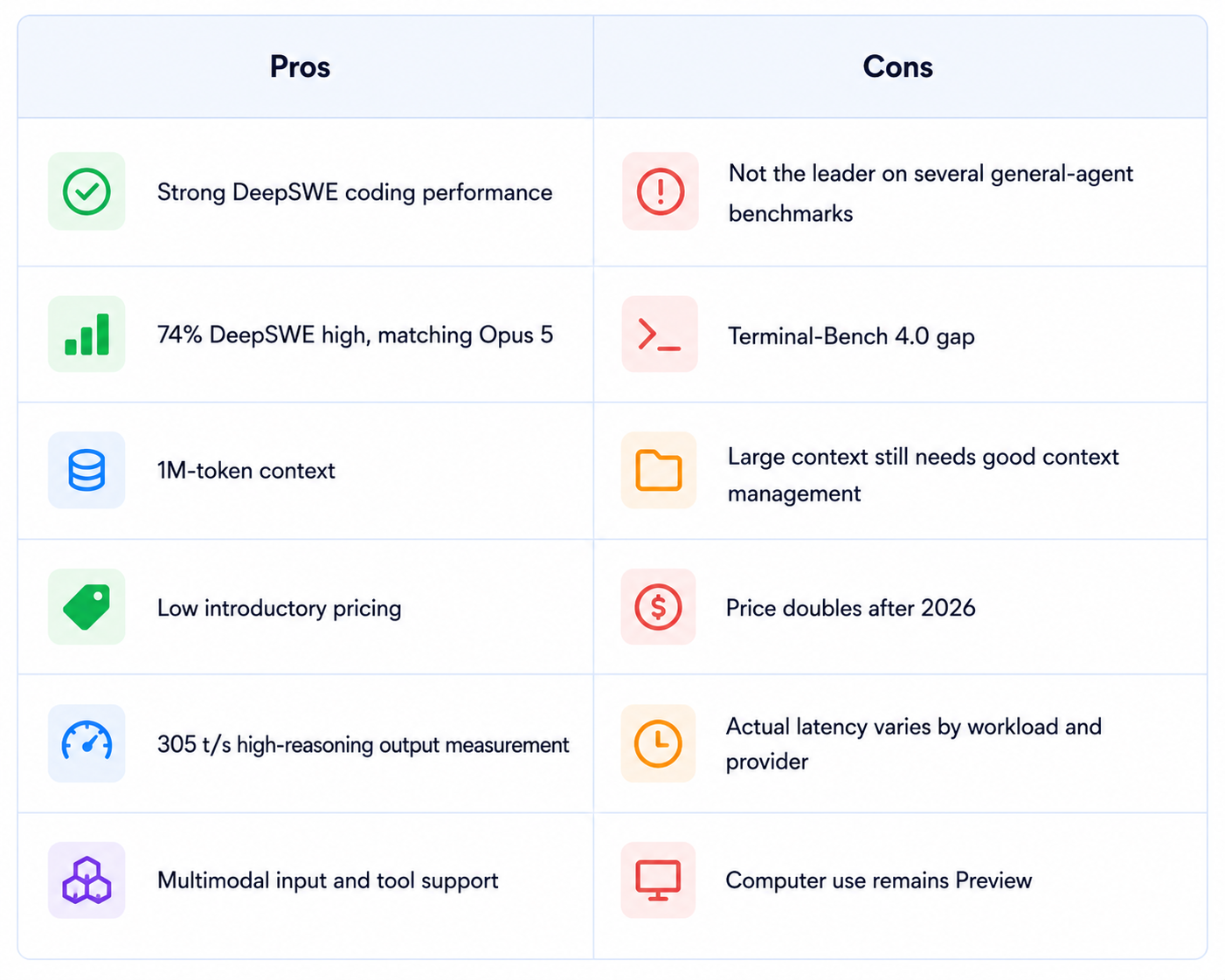
17. Is Gemini 3.8 Flash Worth It?
Yes. Gemini 3.8 Flash is worth using when your workload needs strong coding, large context, tool use and a high number of model calls. The combination is particularly attractive during Google's introductory pricing period through the end of 2026.
The biggest reason to adopt it is not that it beats every premium model. It does not. The reason is that it now reaches premium-level performance on important coding workloads while keeping Flash-level economics and speed.
For a production system, the strongest architecture is a routed one. Let Gemini 3.8 Flash handle most coding, research and automation tasks, then send the hardest terminal, computer-use or deep reasoning cases to a stronger model. That keeps average cost down without forcing one model to do everything.
18. Final Verdict
Gemini 3.8 Flash is a serious release, not merely a small refresh. Google has pushed its Flash family into a stronger position for software engineering and agentic work while preserving the pricing model that makes high-volume use practical.
The benchmark evidence supports that conclusion. High reasoning reaches 59 on the Artificial Analysis Intelligence Index, DeepSWE v1.1 reaches 74%, and high-reasoning output speed is measured at about 305 tokens per second.
The comparison with Claude Opus 5 is especially revealing. Gemini 3.8 Flash matches Opus 5 on DeepSWE high and exceeds it on the cited BioMysteryBench Human Difficult result, while Opus 5 remains far ahead on Terminal-Bench 4.0, OSWorld-2.0 and GDPVal-AA v2.
At $0.75 per million input tokens and $3.75 per million output tokens through December 31, 2026, the model has one of the strongest price-to-performance cases in the current Flash market.
My rating: 9.4/10 for coding, 9.2/10 for agentic workflows, 9.5/10 for speed and 9.3/10 overall.
Bottom line: Gemini 3.8 Flash is an excellent default model for coding assistants, repository agents, multimodal analysis and high-volume automation. It does not eliminate the need for premium models, but it can reduce how often you need them.
Frequently Asked Questions
What is Gemini 3.8 Flash?
Gemini 3.8 Flash is Google's latest stable Flash model for long-horizon software engineering, autonomous agents and enterprise workflows.
What is the Gemini 3.8 Flash context window?
The official Google model page lists a 1,048,576-token input limit and 65,536-token maximum output.
What are the Gemini 3.8 Flash benchmark scores?
Artificial Analysis currently lists Intelligence Index scores of 52 low, 57 medium and 59 high. DeepSWE v1.1 is 71% at medium reasoning and 74% at high reasoning.
How fast is Gemini 3.8 Flash?
Artificial Analysis currently measures about 305 output tokens per second for the high-reasoning version.
How much does Gemini 3.8 Flash cost?
Google lists $0.75 per million input tokens and $3.75 per million output tokens through December 31, 2026. Standard pricing rises to $1.50 and $7.50 on January 1, 2027.
Is Gemini 3.8 Flash better than Gemini 3.7 Flash?
The current Artificial Analysis comparison shows higher intelligence scores and higher measured high-reasoning output speed for 3.8 Flash.
Does Gemini 3.8 Flash beat Claude Opus 5?
It matches Opus 5 on DeepSWE v1.1 high and beats it on the cited BioMysteryBench Human Difficult result, but Opus 5 remains much stronger on several general-agent benchmarks.
Is Gemini 3.8 Flash good for coding agents?
Yes. Coding and autonomous software engineering are central use cases, and its DeepSWE result is strong.
Does Gemini 3.8 Flash support tools?
Yes. Google lists function calling, code execution, file search, search grounding, URL context and structured outputs. Computer use is supported in Preview.
Is Gemini 3.8 Flash worth it?
Yes. It is particularly attractive for high-volume coding and agent workloads where speed, context and cost all matter.
Recommended Blogs
How to Secure AI Coding Agents: Permissions, Sandboxing, MCP & Secrets
24GB VRAM AI Models: What Can You Actually Run Locally in 2026?
Resources & Community
Join our community of 70,000+ AI enthusiasts and learn to build powerful AI applications. Whether you're a beginner or an experienced developer, Build Fast with AI helps you understand and implement AI in your projects.
Agentic AI Launchpad 2026
A structured 6-week cohort program that takes you from AI basics to building and deploying real-world agentic AI systems. Includes live sessions, expert mentorship, project reviews and a builder community network.
Ready to go from learning to building? Join the next cohort: Agentic AI Launchpad 2026
Free AI Resources
Access free tools, workshops and micro-learning to keep building.

