



MAI-Transcribe-2 Review: Is Microsoft's New Speech Model the Best Combination of Accuracy, Speed and Price?
MAI-Transcribe-2 is Microsoft's newest speech-to-text model, and it is built around a practical idea: transcription should not force developers to choose between accuracy, processing speed, language coverage and production features. The second-generation model combines multilingual transcription with speaker diarization, word-level timestamps, keyword biasing, configurable output styles and automatic language identification.
Microsoft made MAI-Transcribe-2 available in public preview through Microsoft Foundry on September 3, 2026. The model covers 60 languages and is designed for noisy, real-world recordings, including meetings, calls, interviews, captions and voice-agent inputs. It also adds features that turn a transcript into structured data, including speaker labels and precise word timing.
The benchmark results make the release particularly interesting. Microsoft reports a 5.2% average Word Error Rate on FLEURS across 60 languages and 3.4% across its top 25 languages. Artificial Analysis currently measures 2.0% AA-WER, a 410.7x median speed factor and $1.67 per 1,000 minutes on its normalized provider comparison. MAI-Transcribe-2 ranks second on that AA-WER leaderboard while sitting on the accuracy-latency Pareto frontier.
QUICK ANSWER
MAI-Transcribe-2 is a strong dedicated speech-to-text model for production transcription. It supports 60 languages, automatic language identification, multilingual recordings and code switching, plus speaker diarization, word-level timestamps, keyword biasing and configurable verbatim or clean output.
Microsoft's FLEURS evaluation reports 5.2% average WER across 60 languages and 3.4% across its top 25 languages. Artificial Analysis currently gives MAI-Transcribe-2 a 2.0% AA-WER score, placing it second on its current non-streaming accuracy leaderboard.
Speed is one of the model's biggest strengths. Artificial Analysis measures 410.7x real-time median speed, while Microsoft describes one hour of audio being processed in roughly 10 seconds of model inference. The actual end-to-end application time will depend on upload, queueing, service overhead and the surrounding pipeline.
Pricing is $0.10 per hour through December 31, 2026 in Microsoft Foundry. That is approximately $1.67 per 1,000 minutes and gives the model a strong cost advantage for large audio archives and high-volume applications.
My verdict: 9.4/10 overall. MAI-Transcribe-2 is one of the most compelling transcription models to test in 2026 when accuracy, speed, language coverage and downstream structure all matter.
1. What Is MAI-Transcribe-2?
MAI-Transcribe-2 is the second-generation automatic speech recognition model developed by Microsoft's Microsoft AI team. It is available in public preview through Microsoft Foundry and Azure Speech, with a Microsoft AI Playground for experimentation.
The model is designed to convert speech into structured text that other systems can use. That sounds simple, but production transcription requires more than getting the words approximately right. Applications often need to know which person spoke, exactly when a word appeared, whether the transcript should preserve fillers, and how to recognize specialized vocabulary.
MAI-Transcribe-2 addresses those requirements directly. Microsoft lists speaker diarization, word-level timestamps, keyword biasing, automatic language identification and configurable transcription style as core capabilities.
2. MAI-Transcribe-2 Specifications
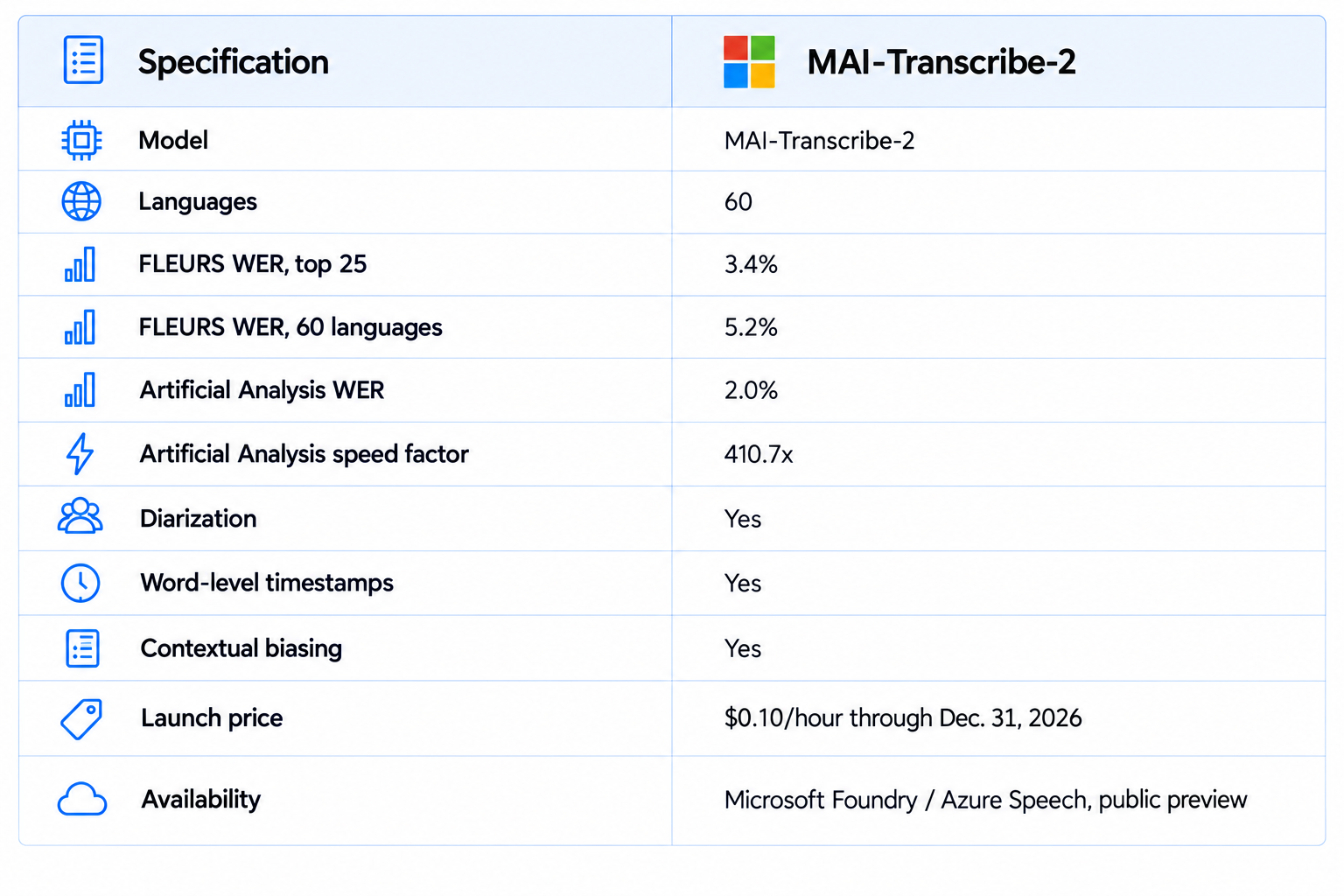
Microsoft's current Foundry catalog describes MAI-Transcribe-2 as the second generation of its speech-to-text family, covering 60 languages and adding automatic language detection, speaker diarization and word-level timing.
3. Accuracy: How Good Is MAI-Transcribe-2?
Word Error Rate, or WER, is the standard metric for speech recognition. Lower WER means fewer substitutions, deletions and insertions in the transcript.
Microsoft reports 5.2% average WER on FLEURS across 60 languages and 3.4% across its top 25 languages. On the Microsoft comparison page, MAI-Transcribe-2 is shown outperforming Whisper-Large-V3, GPT-Transcribe, ScribeV2 and Gemini 3.5 Transcribe on the FLEURS evaluation it presents.
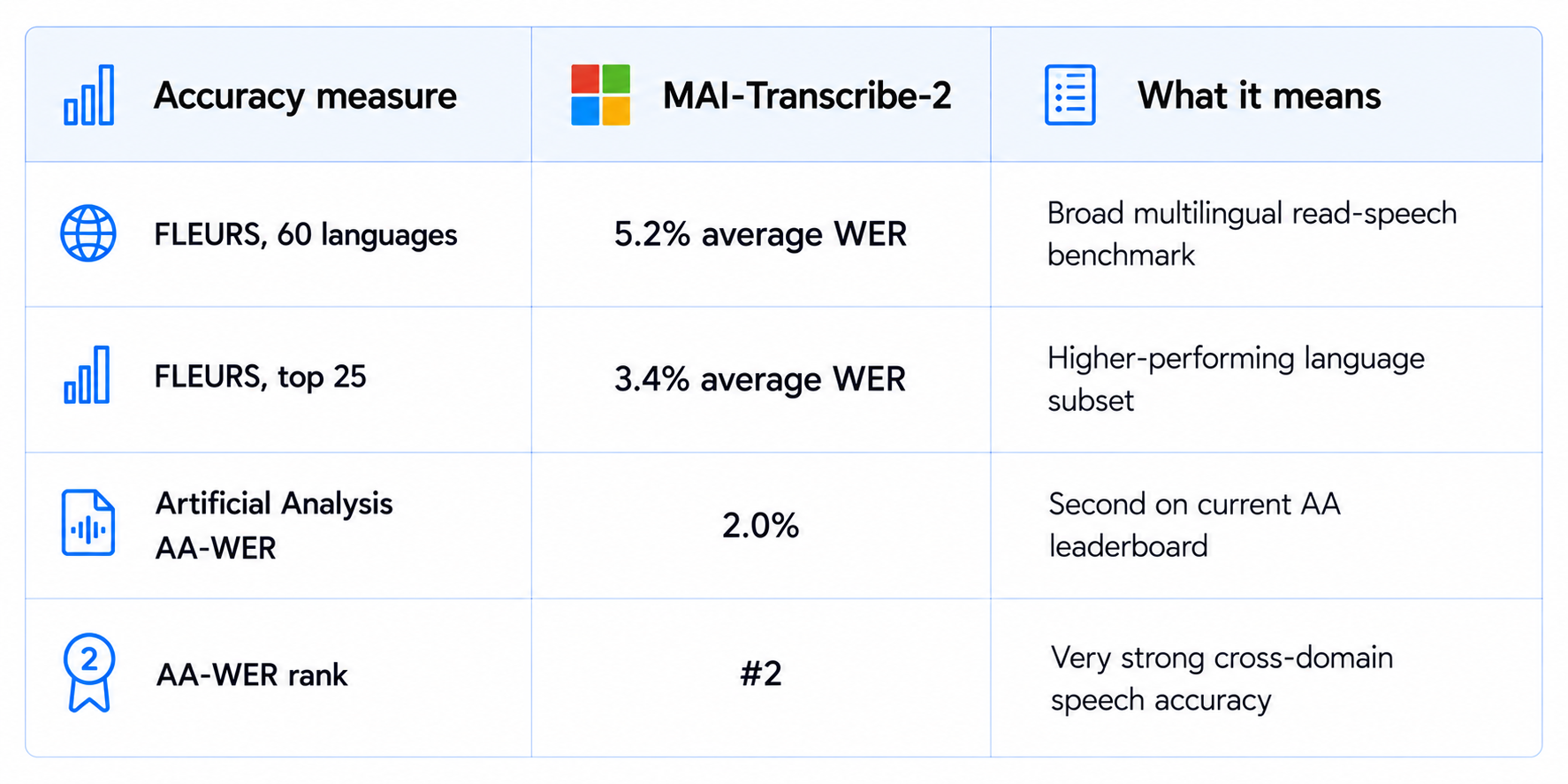
The FLEURS and Artificial Analysis scores should not be treated as interchangeable. FLEURS is a multilingual benchmark, while Artificial Analysis's AA-WER v2 combines approximately eight hours of data from AA-AgentTalk, VoxPopuli-Cleaned-AA and Earnings22-Cleaned-AA to cover accents, domain-specific language and difficult acoustic conditions.
4. Artificial Analysis: Accuracy, Speed and Price Together
Artificial Analysis currently reports MAI-Transcribe-2 at 2.0% AA-WER, 410.7x median speed factor and $1.67 per 1,000 minutes on its normalized comparison. Lower WER is better, higher speed factor is better and lower price is better.
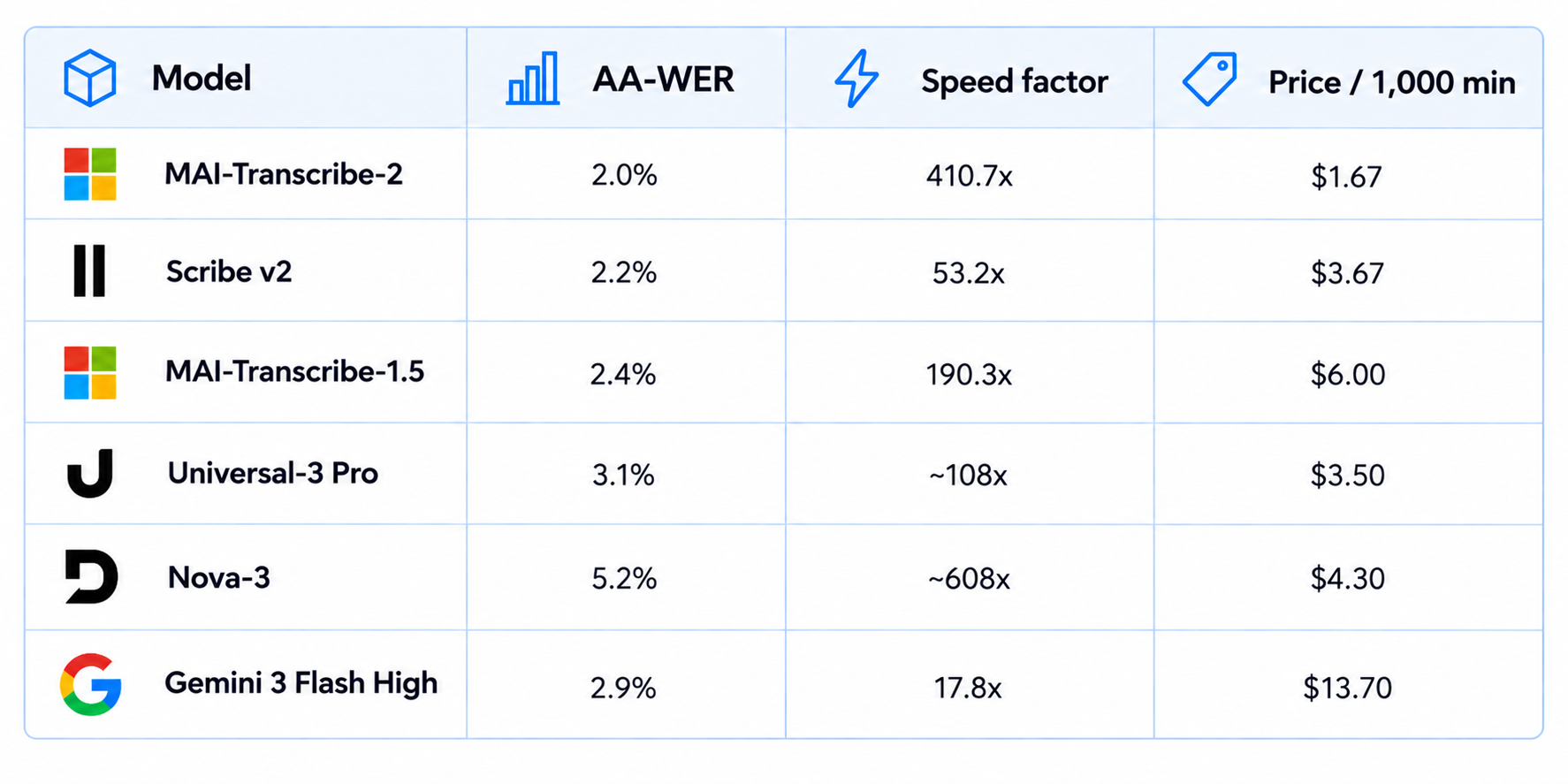
This table shows the real positioning of MAI-Transcribe-2. It is not the absolute fastest speech model on the chart, because Nova-3 has a higher speed factor. It is also not the absolute lowest-WER model, because the current leaderboard has a 1.7% entry above it. The advantage is balance: MAI-Transcribe-2 sits very close to the top in accuracy while remaining extremely fast and inexpensive.
5. The Accuracy-Latency Pareto Frontier
Artificial Analysis currently places MAI-Transcribe-2 on the top accuracy-versus-latency Pareto frontier. This means that among the measured models, there is no other model that simultaneously delivers a better accuracy result at the same speed or a better speed result at the same accuracy for the measured point.
For production systems, this is often more useful than winning one isolated metric. A company processing call recordings needs accurate text, but it also needs that text quickly enough for analytics, search and agent workflows to start operating. A voice agent needs the speech recognition layer to respond without creating noticeable conversational delay.
The Pareto result therefore describes the practical position of MAI-Transcribe-2: high accuracy without paying the latency penalty that often comes with the most accurate speech models.
6. Speed: 410x Real-Time Processing
Artificial Analysis reports a 410.7x median speed factor for MAI-Transcribe-2. Its benchmark defines speed factor as input audio seconds transcribed per second of processing time, with measurements based on 10-minute audio.
Microsoft's model page summarizes the same capability as roughly one hour of audio processed in 10 seconds of model inference. These figures describe model processing, not guaranteed end-to-end application latency.
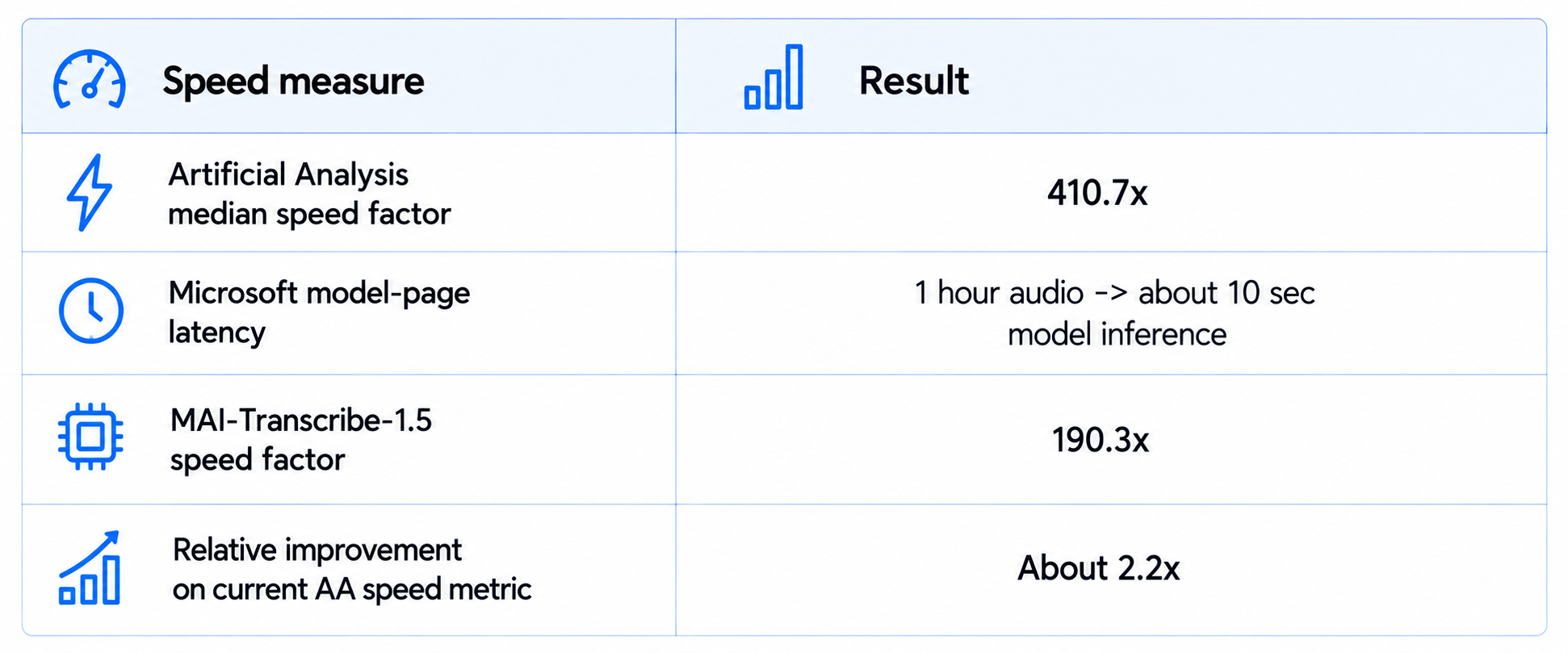
That level of throughput makes the model useful for both live and offline workloads. Large meeting archives can be processed rapidly, while a real-time voice application has more headroom to keep the transcription layer responsive.
7. 60 Languages and Automatic Language Identification
MAI-Transcribe-2 covers 60 languages and includes automatic language identification. Microsoft says this enables multilingual recordings to move through a single transcription model rather than being routed through separate language-specific systems.
The model also supports code switching. Microsoft specifically highlights mixed-language conversations such as Hinglish and Spanglish, which is important for real-world speech because speakers often switch languages naturally during a conversation.
For global products, this can reduce model-management overhead. The same speech layer can support meetings, calls, captions and content workflows across multiple markets.
8. Speaker Diarization
Speaker diarization identifies and separates different speakers in the same recording. MAI-Transcribe-2 adds this capability as part of the second generation, making the transcript much more useful for meetings, interviews, contact centers and panels.
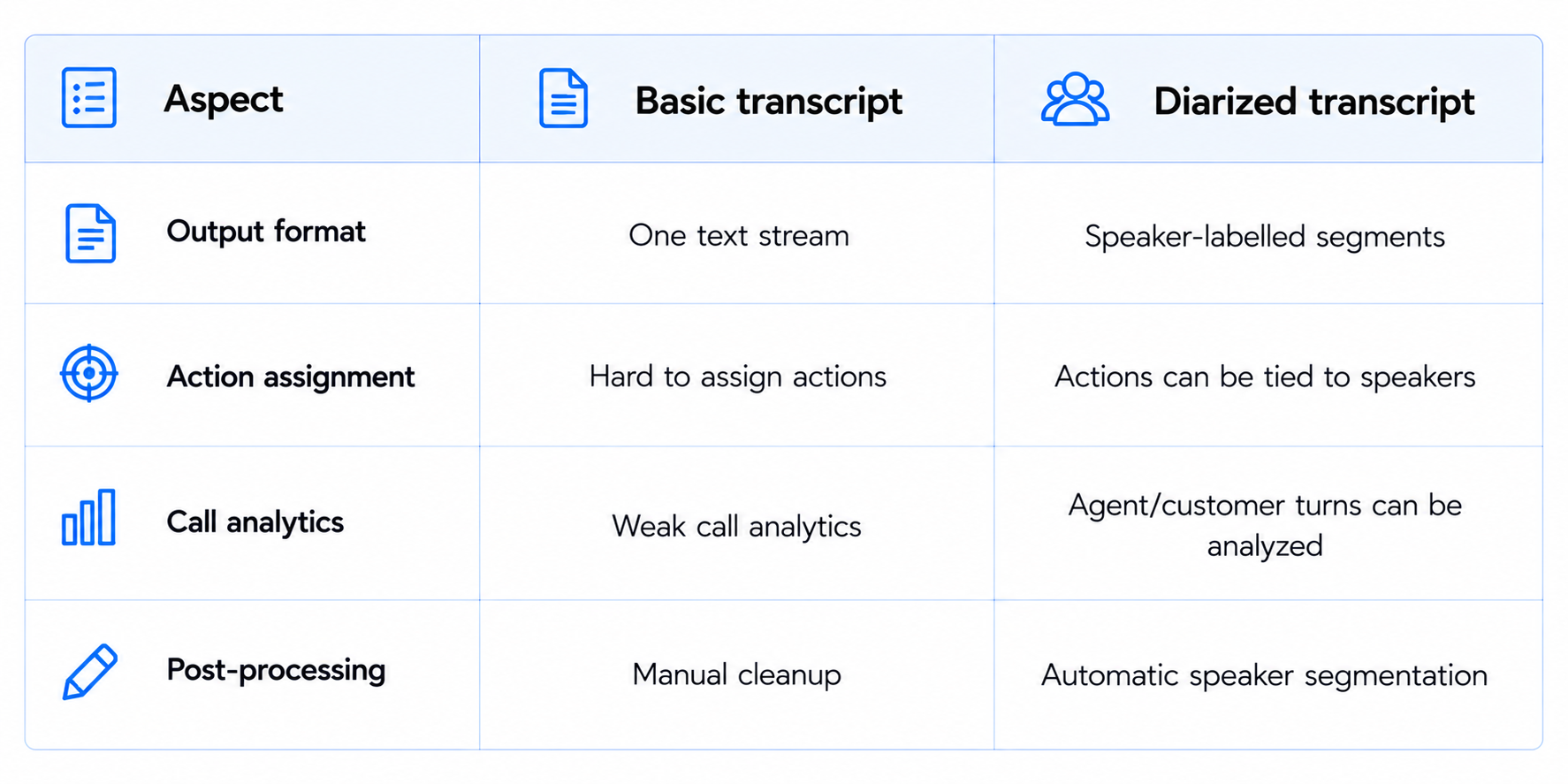
Diarization is especially valuable when transcription feeds another AI system. Instead of sending an undifferentiated block of dialogue into a summarizer, the downstream model receives information about who said each part of the conversation.
9. Word-Level Timestamps
Word-level timestamps attach start and end timing to individual words. Microsoft says this enables precise alignment, search, navigation, editing and redaction.
This is a major improvement for media workflows. A captioning system can synchronize each word more precisely, a video editor can jump directly to the relevant moment, and a searchable archive can open a recording at the exact phrase a user searched for.
For compliance and audit workflows, timestamps also create a tighter connection between a transcript and the source audio.
10. Keyword Biasing for Domain-Specific Terms
Speech models often struggle with product names, medical terminology, abbreviations and unusual proper nouns. MAI-Transcribe-2 includes keyword or phrase biasing so developers can provide domain vocabulary that the recognizer should pay additional attention to.
The Microsoft documentation describes these phrases as recognition hints rather than forced output. That gives the model extra context without turning the phrase list into a rigid substitution dictionary.
11. Verbatim vs Clean Transcription
MAI-Transcribe-2 supports configurable transcription styles. Verbatim preserves fillers, false starts and the way speech was actually delivered. Clean removes disfluencies to create easier-to-read output for captions, notes and published transcripts.
This matters because many transcription pipelines otherwise need a second text-cleaning model after speech recognition. With style selection built into the speech layer, the transcript can be shaped for its final downstream use earlier in the workflow.
12. Noise, Accents and Real-World Speech
Microsoft positions MAI-Transcribe-2 for noisy environments, varied audio quality, accents, dialects and multilingual conversations rather than limiting the product story to studio-quality speech.
That matters because real enterprise audio is messy. Contact-center recordings contain phone compression and background sound. Meetings contain cross-talk. Interviews can include varying microphone distances. A model that only performs on clean read speech will often require additional cleanup before the transcript is useful.
Artificial Analysis's AA-WER benchmark also attempts to capture more realistic conditions through agent conversations, VoxPopuli data and earnings-call audio.
13. MAI-Transcribe-2 vs MAI-Transcribe-1.5
The second generation improves both the model and the product surface. Microsoft reports a lower FLEURS error rate, more languages, faster model inference and two important structural capabilities that were unavailable in the previous generation.
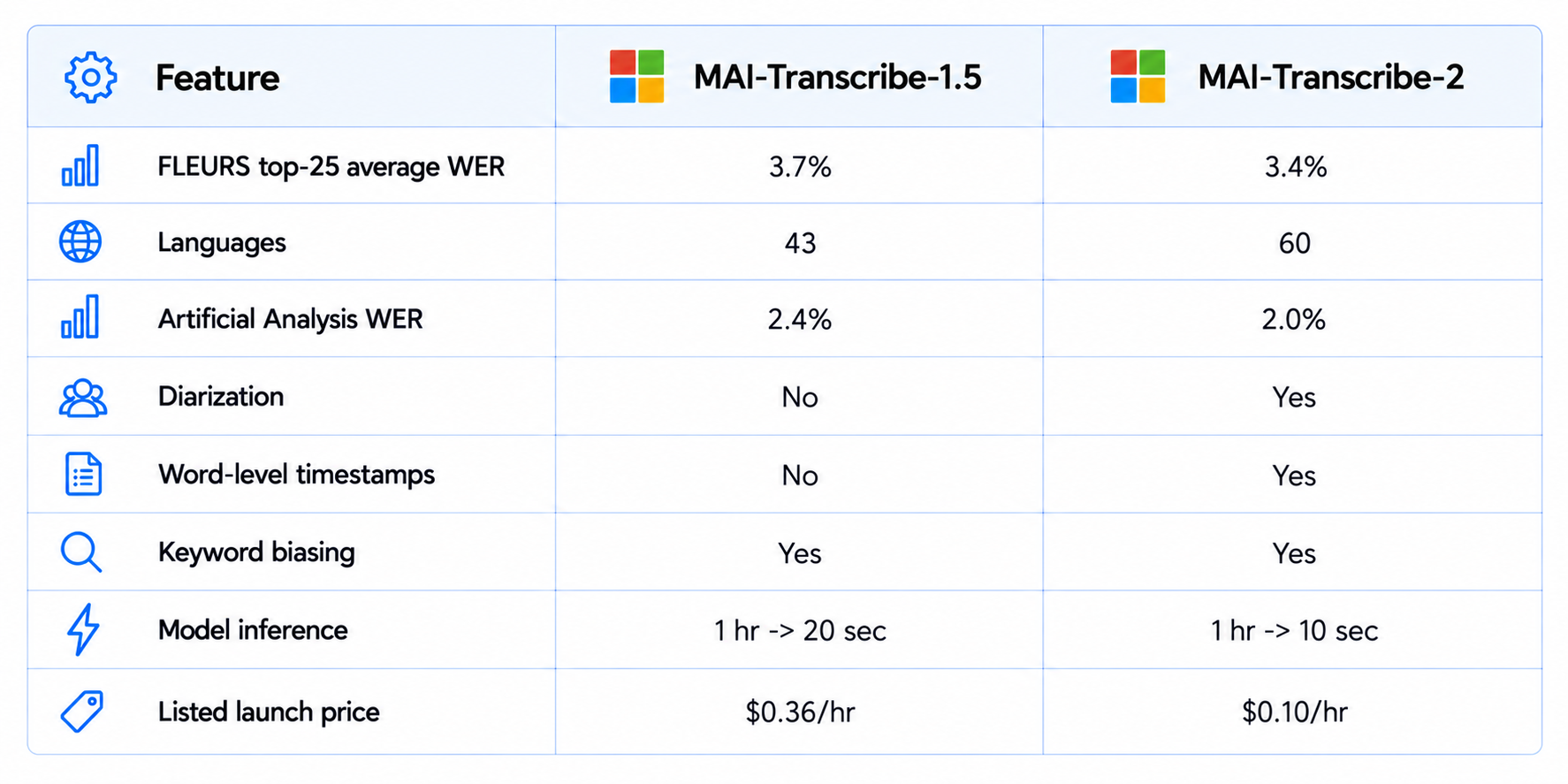
The update is therefore much broader than a small accuracy improvement. The new model expands language coverage, adds structure to the transcript and substantially reduces the model-processing time and introductory cost.
14. MAI-Transcribe-2 vs Scribe v2
Scribe v2 is one of the strongest independent comparison points. Artificial Analysis currently reports 2.2% AA-WER for Scribe v2 versus 2.0% for MAI-Transcribe-2. The speed difference is much larger: about 410.7x versus 53.2x in the current median benchmark snapshot.
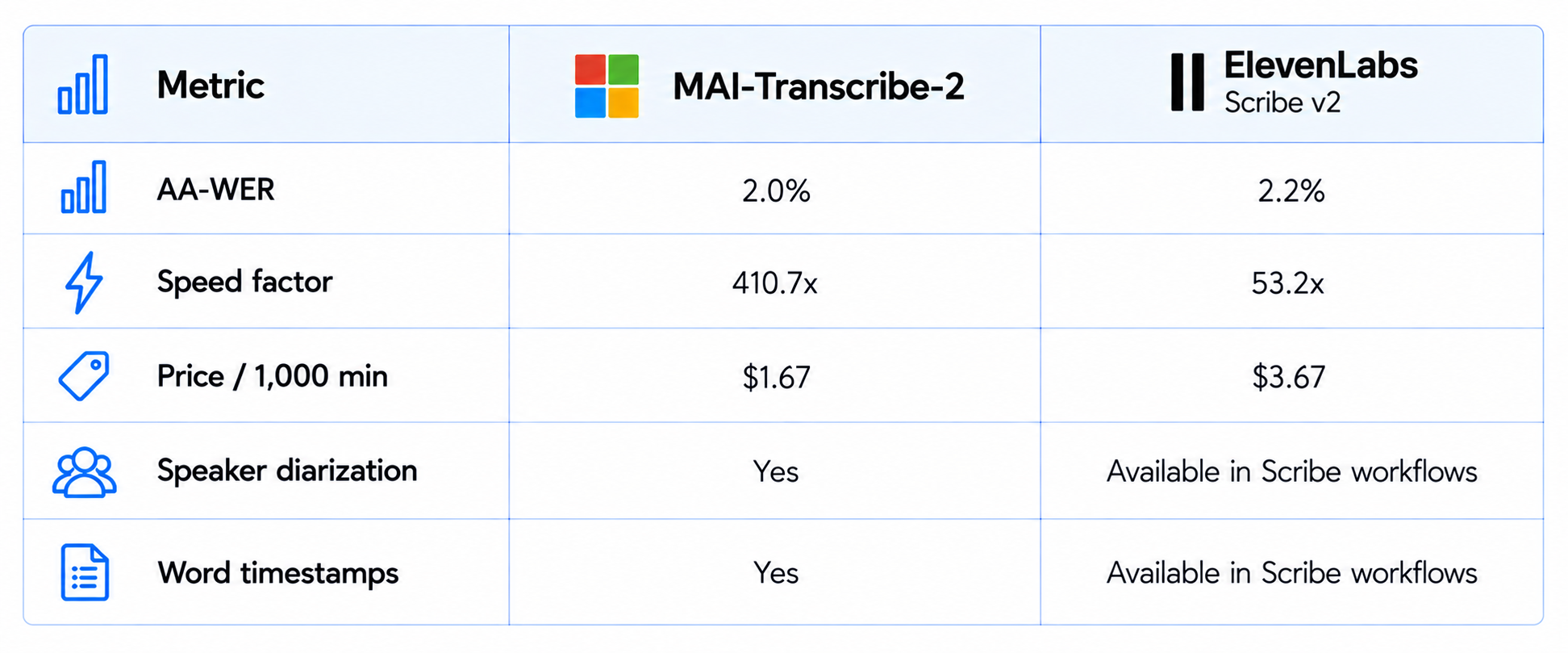
On the current Artificial Analysis numbers, MAI-Transcribe-2 has the better balance of accuracy, throughput and normalized cost. Scribe v2 remains strong, but Microsoft has a clear advantage on operating economics in this snapshot.
15. MAI-Transcribe-2 vs Nova-3
Nova-3 is an important counterexample because it is faster on Artificial Analysis. Its current speed factor is about 607.7x compared with MAI-Transcribe-2's 410.7x. But Nova-3's AA-WER is 5.2%, versus 2.0% for MAI-Transcribe-2, and its normalized price is about $4.30 per 1,000 minutes.
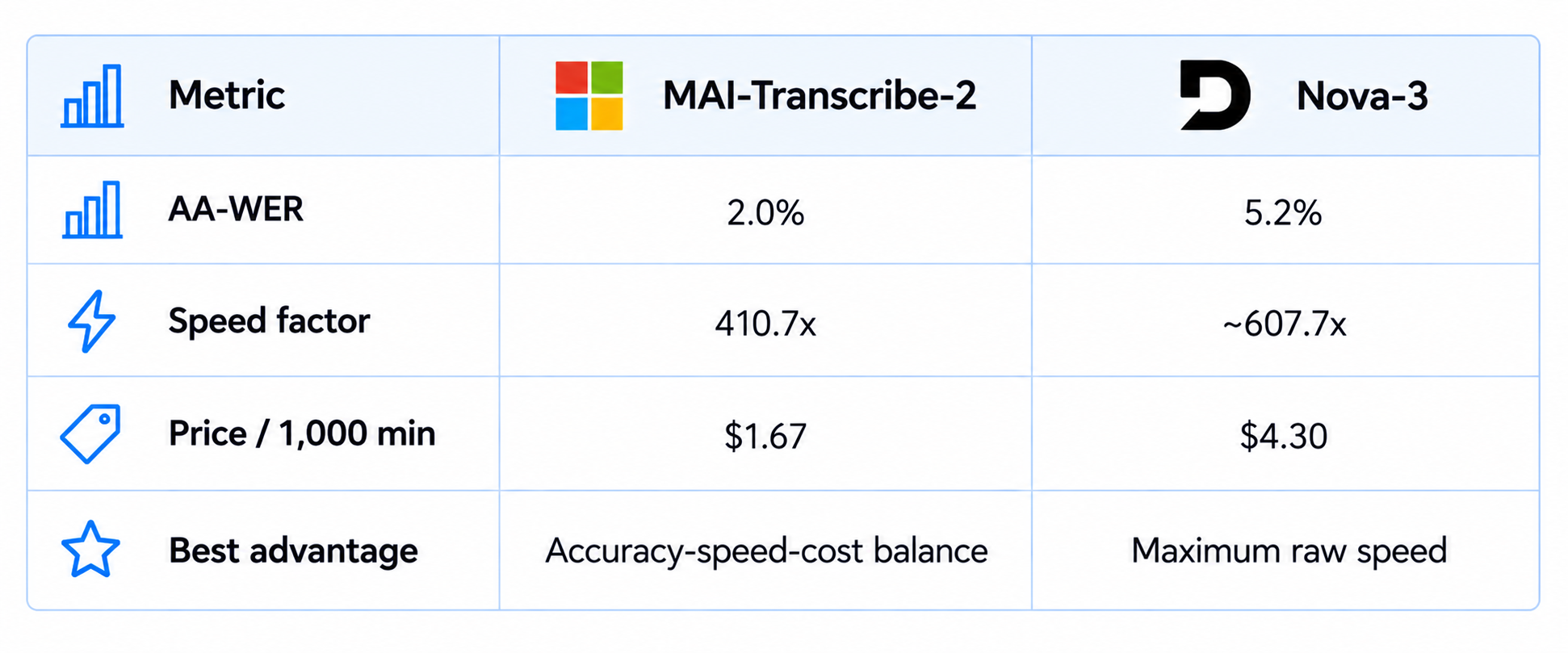
For a transcription system, that tradeoff is important. Nova-3 is faster, but MAI-Transcribe-2 gives up some raw throughput to achieve a substantially lower measured error rate while also costing less.
16. MAI-Transcribe-2 vs Gemini Transcribe
Artificial Analysis currently lists Gemini 3 Flash High at 2.9% AA-WER, 17.8x speed factor and $13.70 per 1,000 minutes. MAI-Transcribe-2 measures 2.0%, 410.7x and $1.67 in the current snapshot.
This is a reminder that a dedicated ASR model can be a better choice when transcription is the actual product requirement. A broader multimodal model can still be useful when audio must be combined immediately with reasoning, but for pure speech-to-text, the specialized model can have a much better accuracy-latency-price profile.
17. MAI-Transcribe-2 Pricing
Microsoft's current launch price is $0.10 per hour of audio through December 31, 2026. Artificial Analysis normalizes that to about $1.67 per 1,000 minutes.
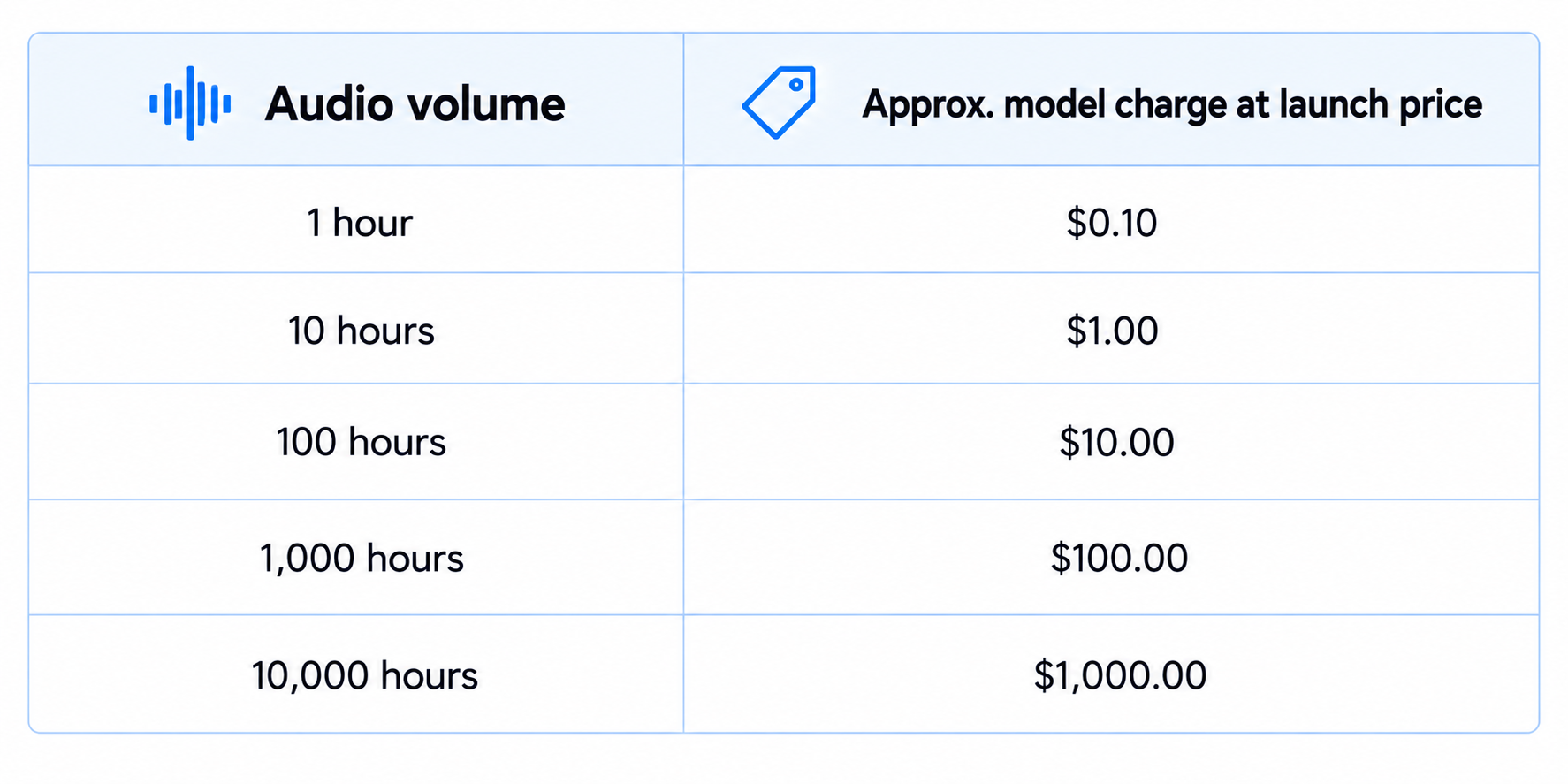
These figures describe the transcription model charge. A production deployment can have additional Azure service, networking, storage and application costs, so organizations should budget the complete pipeline rather than only the ASR line item.
Even with that qualification, the launch price is unusually aggressive for a model that is currently near the top of the independent accuracy leaderboard.
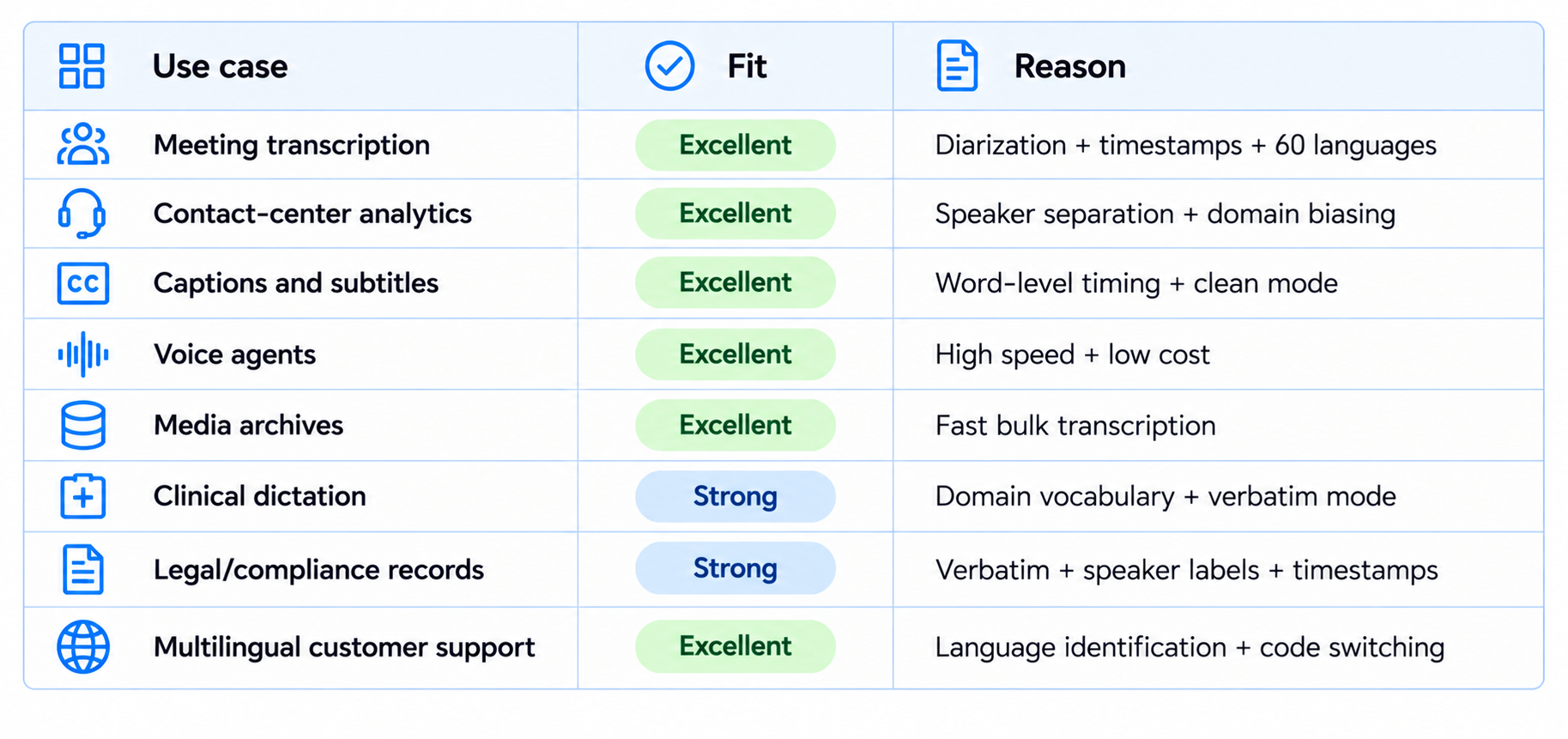
18. Who Should Use MAI-Transcribe-2?
19. Why the New Features Matter
A lower WER is valuable, but the new structure features may have a bigger impact on application architecture. Before MAI-Transcribe-2, a team could need separate processing steps for transcription, speaker identification, timestamp alignment and transcript cleanup. The new model brings several of those tasks into one speech service.
That reduces pipeline complexity. A meeting assistant can receive speaker-attributed, timestamped text and move directly to summary generation. A media workflow can send word timestamps into a subtitle editor. A contact-center system can calculate speaker-level metrics without first rebuilding the conversation structure.
The result is not simply a more accurate transcript. It is a transcript that is more useful as structured application data.
20. Recommended Production Workflow
MAI-Transcribe-2 works best as the audio understanding layer at the front of a larger pipeline.
- Keep the original recording as the source of truth.
- Use keyword biasing for names, product terms, abbreviations and industry vocabulary.
- Enable diarization for multi-speaker audio.
- Use word-level timestamps when captions, search or media alignment matter.
- Choose verbatim for compliance and analysis, and clean for publishing or notes.
- Pass the resulting transcript to a language model only when you need summaries, extraction, action items or other reasoning.
- Keep the timestamps and speaker metadata so downstream outputs can be traced back to the source audio.
21. How to Evaluate MAI-Transcribe-2 Yourself
The best evaluation uses the audio your product actually receives, not only a clean microphone sample.
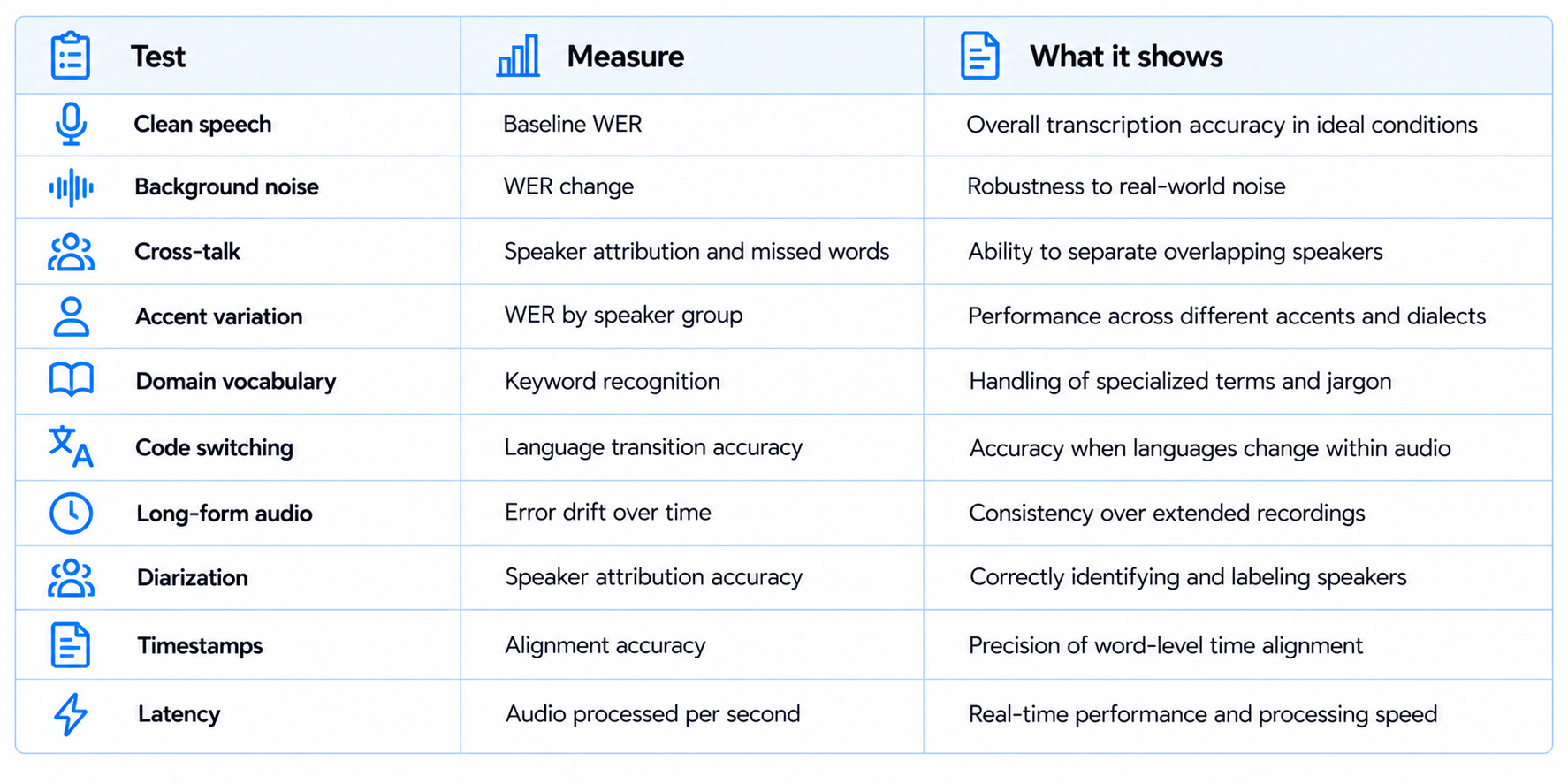
For example, a company building an Indian customer-support assistant should include Indian English, Hinglish, background call-center noise, product names and multiple speakers in its test set. A broadcaster should prioritize timestamps and subtitle alignment. A legal team may care more about verbatim output and speaker attribution.
22. Limitations You Should Know
- MAI-Transcribe-2 is currently listed as Public Preview in Microsoft Foundry.
- FLEURS is a benchmark of read speech, so its WER should not be treated as a guarantee for every conversational recording.
- Artificial Analysis currently ranks MAI-Transcribe-2 second on AA-WER, not first.
- Nova-3 is currently faster on the Artificial Analysis speed-factor metric.
- The $0.10 per-hour price is a limited-time launch offer through December 31, 2026.
- Application latency includes more than model inference.
- Regulated domains still need appropriate human review, audit controls and data-governance procedures.
23. Is MAI-Transcribe-2 Worth It?
Yes. MAI-Transcribe-2 has a rare combination of strong accuracy, very high throughput, broad language support and useful production structure.
The current independent data is especially compelling. At 2.0% AA-WER, the model is near the top of the accuracy leaderboard. At 410.7x speed, it is dramatically faster than several other highly accurate models. At about $1.67 per 1,000 minutes, its normalized cost is also low.
The Microsoft feature set strengthens the case. Speaker diarization, word timestamps, keyword biasing, language detection and transcript styles reduce the amount of post-processing many applications would otherwise have to build themselves.
For teams processing large amounts of audio, the economics are even more important. The introductory $0.10-per-hour rate makes 100 hours of transcription about $10 before the rest of the application stack is included.
24. Final Verdict
MAI-Transcribe-2 is one of Microsoft's strongest specialized AI releases in 2026 because it improves the whole transcription workflow instead of only chasing a smaller WER.
The accuracy story is excellent. Microsoft reports 5.2% FLEURS WER across 60 languages and 3.4% across its top 25, while Artificial Analysis currently measures 2.0% AA-WER and ranks the model second in its current non-streaming leaderboard.
The speed story is just as strong. Artificial Analysis measures 410.7x median speed factor, and Microsoft describes roughly 10 seconds of model inference for an hour of audio. That makes the model practical for both live applications and large transcription backlogs.
Then there are the workflow features. Sixty languages, automatic language identification, code switching, speaker diarization, word-level timestamps, keyword biasing and clean or verbatim transcription turn the output into structured application data rather than plain text.
At $0.10 per audio hour through December 31, 2026, MAI-Transcribe-2 also has an unusually strong price-to-performance story.
Frequently Asked Questions
What is MAI-Transcribe-2?
It is Microsoft's second-generation speech-to-text model for multilingual and production audio workflows.
How accurate is MAI-Transcribe-2?
Microsoft reports 5.2% average WER on FLEURS across 60 languages and 3.4% across its top 25. Artificial Analysis currently measures 2.0% AA-WER.
What is the MAI-Transcribe-2 WER?
Its current Artificial Analysis AA-WER is 2.0%. Microsoft's FLEURS results are 5.2% across 60 languages and 3.4% across the top 25.
How fast is MAI-Transcribe-2?
Artificial Analysis measures 410.7x median speed factor, and Microsoft describes about 10 seconds of model inference for one hour of audio.
How many languages does it support?
60 languages.
Does it support speaker diarization?
Yes. It can separate and label multiple speakers.
Does it provide word-level timestamps?
Yes. Each word can carry precise timing information.
Does it support code switching?
Yes. Microsoft specifically highlights mixed-language conversations such as Hinglish and Spanglish.
What is keyword biasing?
It lets developers provide domain-specific terms, abbreviations, names and phrases as recognition hints.
What are the transcript styles?
Verbatim preserves fillers and false starts; Clean removes disfluencies for easier reading.
How much does it cost?
$0.10 per hour of audio through December 31, 2026.
Is it better than Whisper?
Microsoft's FLEURS comparison reports MAI-Transcribe-2 outperforming Whisper-Large-V3.
Is MAI-Transcribe-2 worth it?
Yes. Its combination of accuracy, speed, language coverage, structure and launch pricing makes it one of the strongest speech-to-text options to test in 2026.
Recommended Blogs
Gemini 3.8 Flash Review: Accuracy, Price & Is It Worth It? (2026)
Meta Muse Spark 1.3 Review: Coding, Price & Is It Worth It? (2026)
Quasar 438B Review: Benchmarks, Speed, Price & Is It Worth It? (2026)
Mercury 2.5 AI Model Review: Speed, Price & Is It Worth It? (2026)
Google TimesFM-3 Review: Accuracy, Benchmarks, Features & Is It Worth It? (2026)
How to Secure AI Coding Agents: Permissions, Sandboxing, MCP & Secrets
Best AI Video Models 2026: Ranked by Quality, Speed, Price & Use Case
Resources & Community
Join our community of 70,000+ AI enthusiasts and learn to build powerful AI applications. Whether you're a beginner or an experienced developer, Build Fast with AI helps you understand and implement AI in your projects.
Agentic AI Launchpad 2026
A structured 6-week cohort program that takes you from AI basics to building and deploying real-world agentic AI systems. Includes live sessions, expert mentorship, project reviews and a builder community network.
Ready to go from learning to building? Join the next cohort: Agentic AI Launchpad 2026
Free AI Resources
Access free tools, workshops and micro-learning to keep building.

