



TimesFM-3: How Good Is Google's New Multivariate Forecasting Model?
Google Research introduced TimesFM-3 on August 31, 2026 as the next generation of its time-series foundation model. Unlike earlier TimesFM versions, TimesFM-3 is natively built for multivariate forecasting. It can forecast several related series together, incorporate historical-only covariates and known future covariates, and produce both point and probabilistic forecasts in a single forward pass.
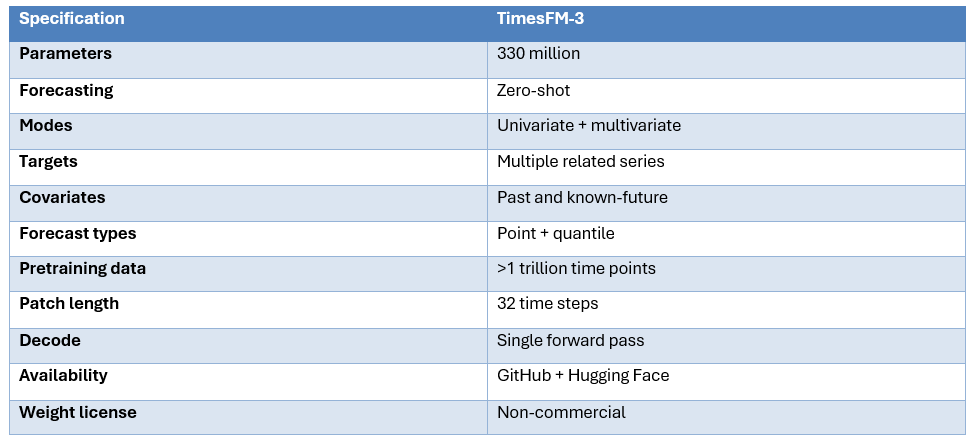
The headline specification is surprisingly modest for a foundation model: 330 million parameters. Google says TimesFM-3 was pretrained on more than one trillion time points from real-world, synthetic and augmented data. The model uses 32-step patches and alternating temporal and variate attention so it can learn patterns over time and dependencies across series.
The benchmark results are strong. Google reports TimesFM-3 as the top-ranked pretrained foundation model on GIFT-Eval, FEV-Bench and TIME for both point and probabilistic forecasting. That is promising evidence, but these are Google's benchmark results, so the sensible conclusion is that TimesFM-3 deserves serious testing rather than that it will beat every specialized forecaster on every dataset.
QUICK ANSWER
TimesFM-3 is Google's new 330M-parameter time-series foundation model for zero-shot multivariate forecasting. It supports multiple targets, past covariates, known future covariates and quantile forecasts, and predicts the entire horizon in one forward pass. Google reports first-place average ranking on GIFT-Eval, FEV-Bench and TIME against pretrained foundation-model baselines.
The biggest improvement over TimesFM-2.5 is native multivariate reasoning. A demand forecast can jointly use related products, historical traffic and planned promotions instead of treating every target independently.
My verdict: 9/10 for forecasting capability, 9/10 for multivariate support, 8/10 for efficiency, 6.5/10 for commercial readiness of the released weights, and 8.3/10 overall. The technical model is excellent, but the current non-commercial weight license is a real production limitation.
1. What Is Google TimesFM-3?
TimesFM-3 is the latest generation of Google's TimesFM family. The original TimesFM showed that a relatively small pretrained model could forecast unseen time series without task-specific training. TimesFM-2.5 improved efficiency and context handling. TimesFM-3 changes the main problem definition by making multivariate forecasting and covariates first-class capabilities.
2. Why Multivariate Forecasting Matters
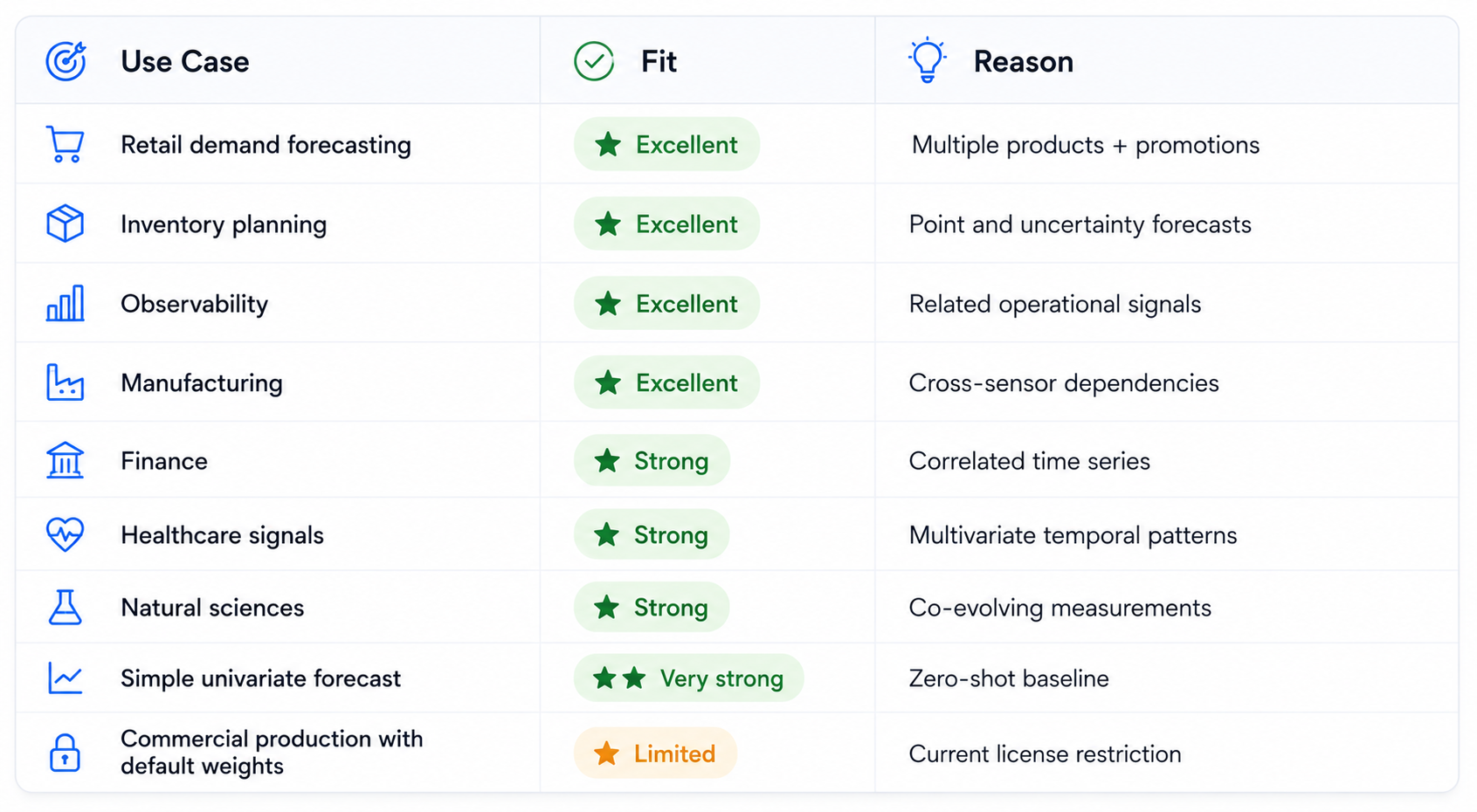
Real forecasting problems rarely depend on one signal. Retail demand can depend on related products, traffic, promotions, weather and holidays. Manufacturing metrics can move together across machines. Observability signals can co-evolve. Finance series can influence one another.
TimesFM-3 can reason over those relationships directly. Its temporal attention models how each series changes over time, while variate attention lets the model use information from the other series at the same time step.
This is the real reason TimesFM-3 matters. It is not merely TimesFM-2.5 with a larger parameter count. The model is designed around the structure of real multivariate forecasting problems.
3. What Are Covariates in TimesFM-3?
Covariates are additional variables that can help explain the target forecast. TimesFM-3 supports historical covariates and dynamic covariates whose future values are known at prediction time.
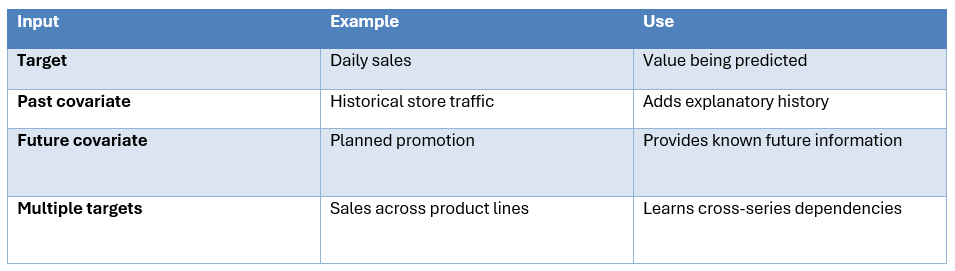
This is particularly useful for business forecasts because known future events can be incorporated directly. Google uses planned promotions as an example of a future signal that can influence the expected sales trajectory.
4. Architecture: How TimesFM-3 Works
TimesFM-3 groups observations into patches of 32 time steps. These patches become the model's tokens. The transformer then alternates between causal temporal attention and full variate attention.
The temporal attention remains causal, so future target values cannot leak into the forecast. Variate attention can still use other series at the same time step, which is what lets TimesFM-3 capture cross-series relationships.
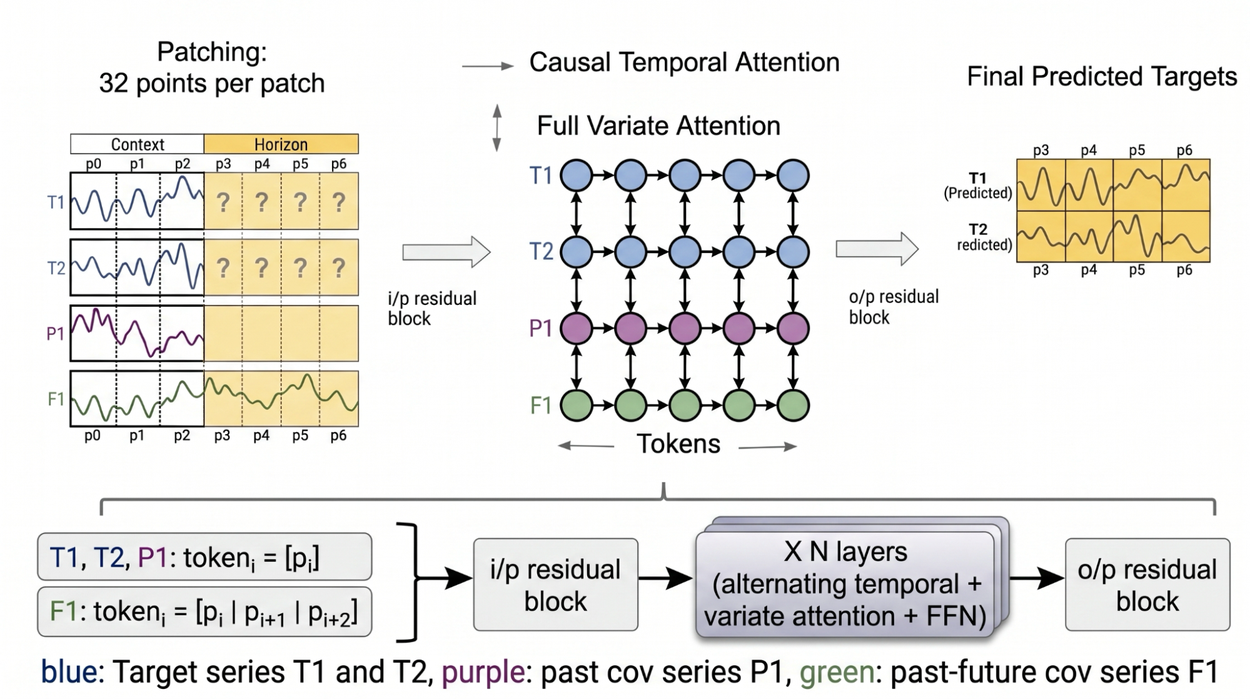
Image Source: Google Research: TimesFM-3: A zero-shot foundation model for multivariate forecasting
5. The Single-Pass Forecasting Change
Previous TimesFM versions generated future patches sequentially. TimesFM-3 masks the future horizon and predicts the missing patches together in one forward pass. Google calls this Contiguous Patch Masking.
That has two obvious benefits: lower sequential latency and no repeated autoregressive loop across the forecast horizon. It can also reduce compounding error because one future patch does not have to become the input for the next patch.
It is still not a universal speed guarantee. Runtime depends on data length, forecast horizon, hardware and implementation. The important improvement is the computational pattern.
6. Quantile Forecasts and Uncertainty
TimesFM-3 predicts nine quantiles from the 10th through the 90th percentile, rather than producing only one number for each future point. That gives users a way to represent forecast uncertainty.
For inventory, capacity planning or operations, the range can matter as much as the median. A business may choose different staffing or inventory levels depending on downside and upside scenarios.
The limitation is calibration. A forecast interval is useful only if its coverage is trustworthy. Teams using TimesFM-3 for important decisions should evaluate interval calibration on their own data rather than assuming benchmark performance transfers unchanged.
7. TimesFM-3 Benchmarks
Google evaluated TimesFM-3 on GIFT-Eval, FEV-Bench and TIME. The company reports that TimesFM-3 achieved the best average rank among pretrained foundation models on all three benchmarks for both point forecasting and probabilistic forecasting. Competing models included Chronos-2, the Toto 2.0 family and TimesFM-2.5.
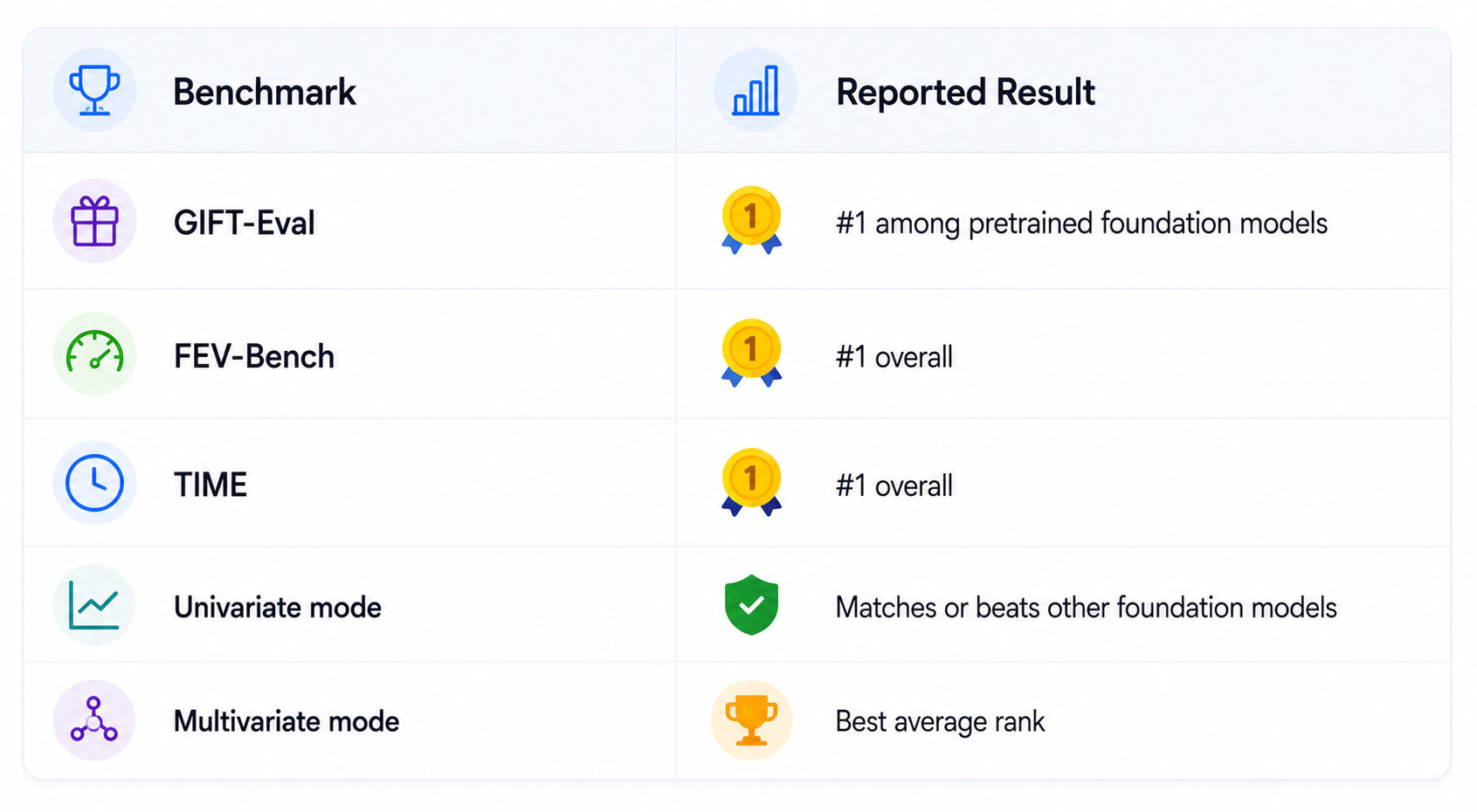
A useful detail is that TimesFM-3 still performs strongly in univariate mode, where the extra cross-series information is removed. That suggests the improvement is not purely dependent on having many related signals available.
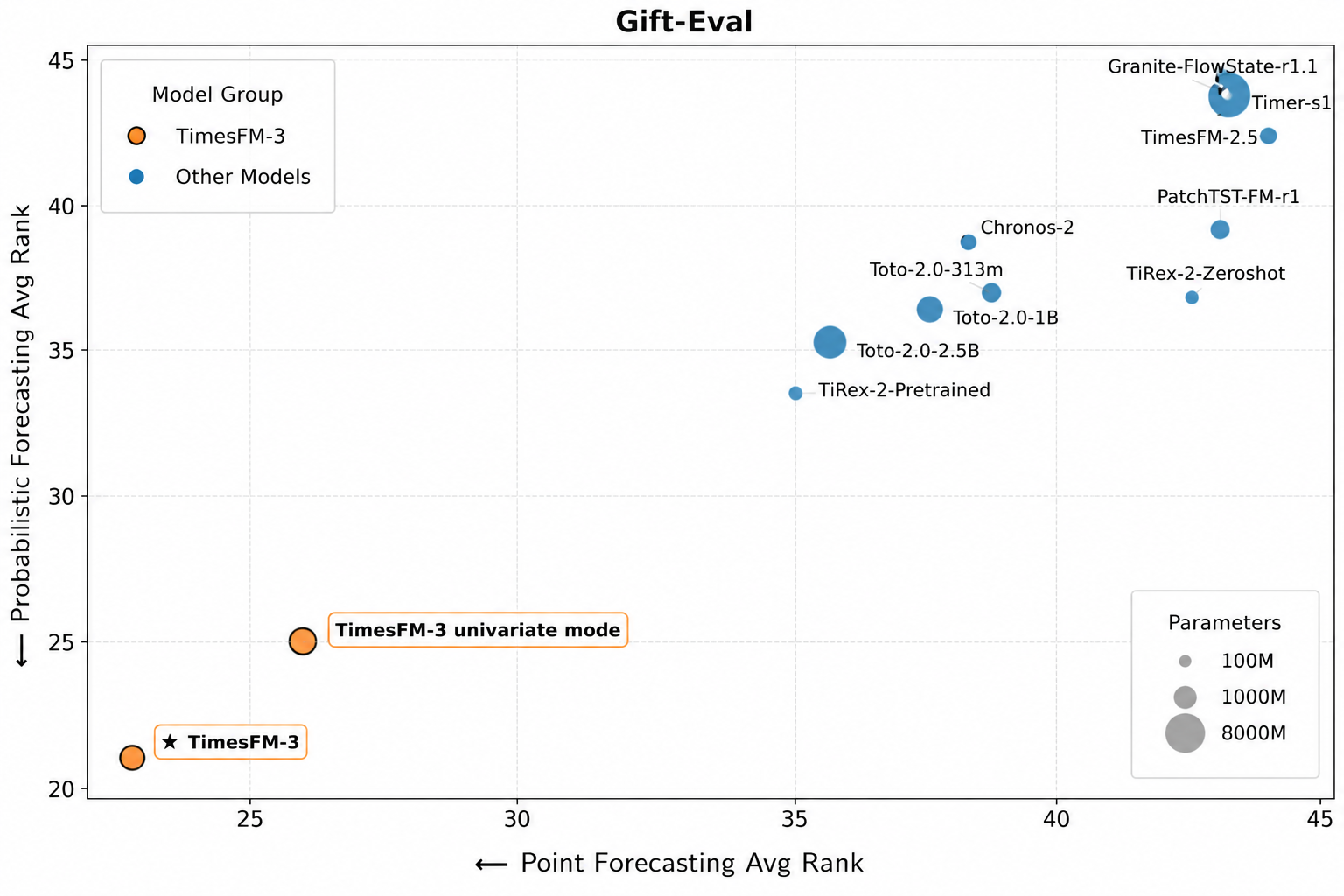
Image Source: Google Research: TimesFM-3: A zero-shot foundation model for multivariate forecasting
8. Accuracy: How Good Is TimesFM-3?
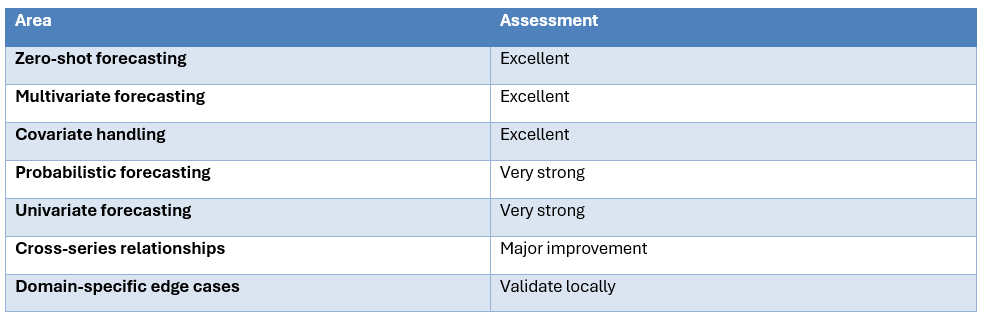
The evidence supports strong general forecasting capability, but it does not justify treating TimesFM-3 as a universal replacement for specialized models. A tuned domain model can still win when a dataset has unusual seasonality, structural changes or specialized business constraints.
The right benchmark for production is therefore your own historical forecasting task with rolling evaluation, not just the public leaderboard.
9. TimesFM-3 vs TimesFM-2.5
TimesFM-2.5 was a compact 200M-parameter model with a 16K context window and optional quantile forecasting. TimesFM-3 moves to 330M parameters and makes native multivariate inputs, flexible covariates and single-pass decoding central to the architecture.
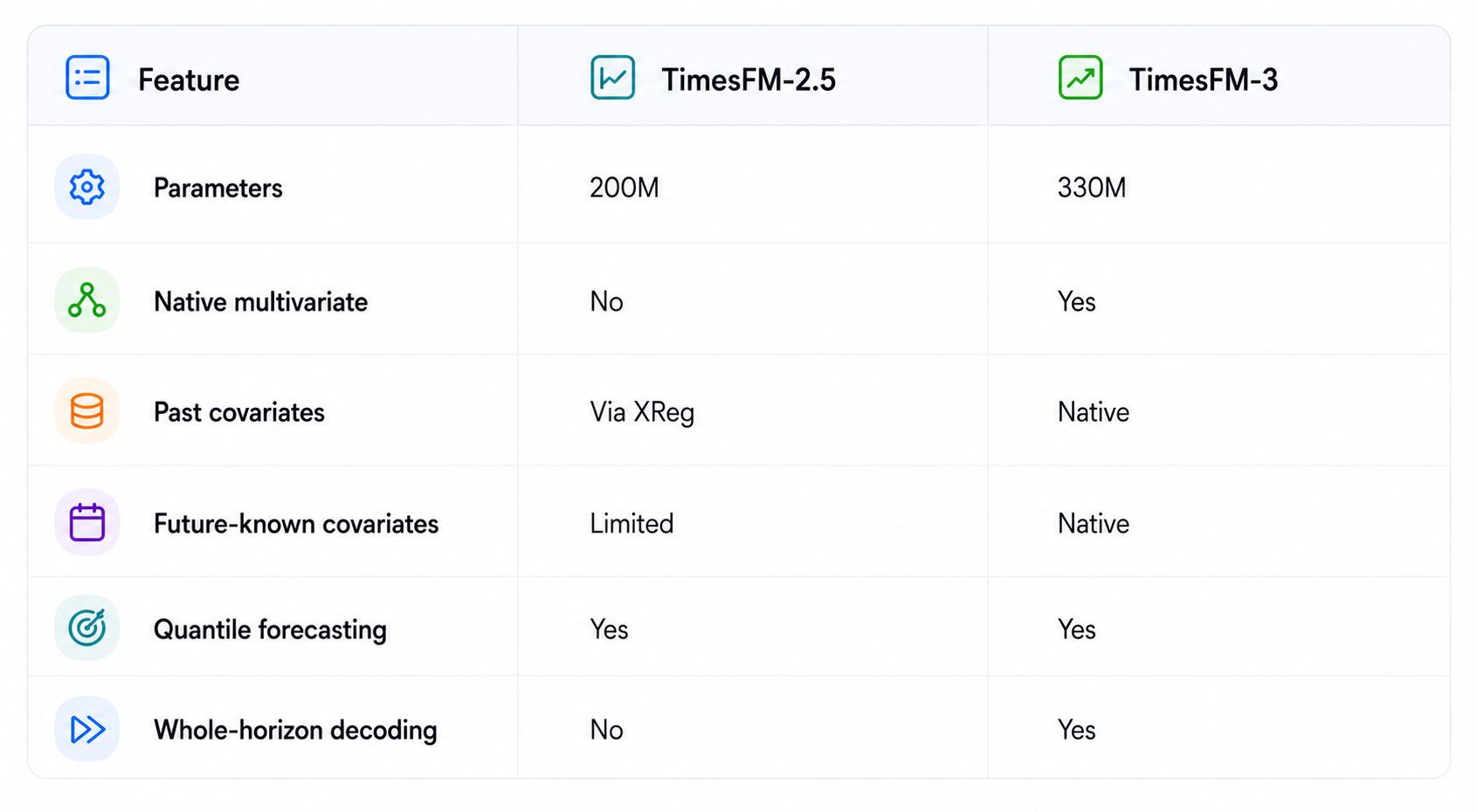
For a simple univariate workload that already performs well on TimesFM-2.5, there may be little reason to switch immediately. The biggest upgrade is for problems where related series and covariates contain useful information.
10. TimesFM-3 vs Other Foundation Forecasters
Google's own evaluation compares TimesFM-3 with multivariate-capable foundation models including Chronos-2 and Toto 2.0. TimesFM-3 ranks first across the three cited benchmark families in Google's comparison.
That places TimesFM-3 in the same emerging category as other pretrained forecasting models designed to transfer across datasets without retraining from scratch.
Still, a foundation model is not automatically better than a domain-specific system. Teams should compare it against strong local baselines, including statistical models and tuned machine-learning models, using rolling-origin validation.
11. Is TimesFM-3 Open Source?
The TimesFM codebase is Apache-2.0, and Google publishes TimesFM-3 weights and configuration on Hugging Face. However, the current TimesFM-3 pretrained weights use Google's separate TimesFM Non-Commercial License v1.0. That license restricts the default weights to non-commercial and non-production use.
That distinction matters. The checkpoint is downloadable, but it should not be described as having unrestricted commercial or production rights. Before deploying TimesFM-3 in a commercial product, teams need an appropriately licensed option.
For broader open-model context, see our Best Open Source AI Models August 2026: Full Collection.
12. Can You Run TimesFM-3 Locally?
Yes. The official PyTorch checkpoint is available on Hugging Face, and the project repository contains the relevant code. The model card lists TimesFM-3 at about 0.3B parameters and currently requires users to accept access conditions before downloading the model files.
The current Hugging Face page also says the checkpoint is not deployed by an inference provider in the cited snapshot. That makes local execution the most direct path for immediate experimentation.
Local execution is attractive for sensitive forecasting data and predictable compute costs, but the real engineering work remains in data pipelines, covariate availability, backtesting and monitoring.
13. Is There a TimesFM-3 API?
The Google Research launch says TimesFM-3 is available on GitHub and Hugging Face, with BigQuery integration expected in the coming weeks. The immediate release is therefore centered on the checkpoint and code rather than a mature first-party metered API.
For teams already using BigQuery, the upcoming integration could be a much easier production path. For everyone else, running the checkpoint means managing serving, batching, dependencies and scaling yourself.
14. TimesFM-3 Pricing: Is It Free?
There is no published per-request API price for TimesFM-3 in the current official launch material. The public distribution path is the GitHub and Hugging Face checkpoint, so local experimentation does not carry a model usage charge, although compute still costs money.
The bigger issue is licensing rather than price. A free download does not mean free commercial deployment. The default pretrained weights are currently restricted to non-commercial and non-production use.
15. Best Use Cases for TimesFM-3
16. Where TimesFM-3 Is Not the Right Tool
- A simple statistical model already solves your series well.
- You need immediate commercial production use of the released pretrained weights.
- Your data distribution is highly unusual and outside the model's validated range.
- You need a fully managed API immediately.
- Your forecast depends on proprietary rules that are not captured by the observed time series.
- You require perfectly calibrated uncertainty for a high-stakes decision without local validation.
17. How to Evaluate TimesFM-3 on Your Data
Run TimesFM-3 against your real historical workflow instead of assuming benchmark leadership transfers directly.
- Create several rolling forecast cutoffs.
- Compare TimesFM-3 with your current baseline and at least one tuned model.
- Measure point accuracy with the metrics that fit your use case.
- Measure probabilistic calibration if you will use quantiles.
- Run univariate mode before adding cross-series information.
- Add only covariates that are genuinely available at forecast time.
- Track errors separately for promotions, holidays and unusual events.
- Measure inference cost and latency alongside accuracy.
18. Why TimesFM-3 Could Matter Beyond Forecasting
TimesFM-3 is part of a larger shift from task-specific predictive models toward pretrained foundation models that transfer across domains. The interesting promise is not just higher accuracy. It is reducing the amount of model development needed before a forecasting system can be tested on a new dataset.
That shifts engineering work. Instead of spending the bulk of the effort training separate models for each series, teams can spend more time on data quality, feature availability, backtesting, calibration and production monitoring.
In that sense, the model is closer to an infrastructure primitive for forecasting than a replacement for every forecasting stack.
19. Is Google TimesFM-3 Worth It?
For researchers and forecasting teams, absolutely worth testing. Native multivariate forecasting and flexible covariates address a real limitation in earlier TimesFM versions, while the reported benchmark performance is strong across three major foundation-model forecasting suites.
For commercial production today, the answer is more complicated. The released weights are under a non-commercial license, so production use is not permitted under the default license. That is a material blocker regardless of how good the model is.
My overall rating is 8.3/10. The model is technically impressive and the multivariate design is a real step forward. The current weight license keeps it from being an unrestricted production recommendation.
20. Final Verdict
TimesFM-3 is a meaningful upgrade to the TimesFM family because multivariate forecasting is native rather than an external add-on.
It has 330M parameters and was pretrained on more than one trillion time points, with support for multiple targets, historical covariates and known future covariates.
Google reports first-place average ranking on GIFT-Eval, FEV-Bench and TIME for both point and probabilistic forecasting.
The single-pass forecast design is an important efficiency change because the full horizon is predicted together instead of one patch at a time.
The main weakness is licensing. The default pretrained TimesFM-3 weights are currently limited to non-commercial and non-production use.
My rating: 9/10 forecasting capability, 9/10 multivariate support, 8/10 efficiency, 6.5/10 production readiness, 8.3/10 overall.
Bottom line: TimesFM-3 is one of the strongest new time-series foundation models to test right now, especially for genuinely multivariate forecasting problems.
A sensible evaluation starts with the forecasting workflow you already trust. Prepare several historical forecast cutoffs, run your existing baseline, then run TimesFM-3 under the same information constraints. Start with the univariate mode so you have a clean baseline, then add related target series, historical covariates and known future covariates separately. This makes it possible to measure exactly which additional information improves the forecast instead of assuming that a larger input set must be better. For business use, also evaluate the decision that the forecast supports. A small improvement in error may be more valuable than a large numerical improvement that does not change inventory, staffing, capacity or planning decisions. This kind of rolling evaluation is the safest way to determine whether TimesFM-3 deserves a place in a real production stack.
Frequently Asked Questions
What is Google TimesFM-3?
TimesFM-3 is Google's latest time-series foundation model, built for zero-shot univariate and multivariate forecasting with native covariate and probabilistic forecast support.
How accurate is TimesFM-3?
Google reports that TimesFM-3 achieves the best average rank among pretrained foundation models on GIFT-Eval, FEV-Bench and TIME for both point and probabilistic forecasting.
How many parameters does TimesFM-3 have?
TimesFM-3 has 330 million parameters.
What makes TimesFM-3 different from TimesFM-2.5?
TimesFM-3 adds native multivariate forecasting, flexible covariates and single-pass horizon prediction. TimesFM-2.5 focused primarily on univariate forecasting.
Can TimesFM-3 forecast multiple series at once?
Yes. It can jointly forecast multiple related target series and model relationships across them.
Does TimesFM-3 support future covariates?
Yes. It supports dynamic covariates whose future values are known at forecast time.
Does TimesFM-3 provide uncertainty estimates?
Yes. It predicts nine quantiles covering the 10th through 90th percentiles.
Can I run TimesFM-3 locally?
Yes. Google has released official PyTorch weights and configuration through Hugging Face along with the surrounding repository code.
Is TimesFM-3 open source?
The source code is Apache-2.0, but the TimesFM-3 pretrained weights are currently under a separate non-commercial license.
Is TimesFM-3 free?
The checkpoint does not have a published per-request API price in the current launch materials. Local inference still has compute costs.
Can I use TimesFM-3 commercially?
Not with the default pretrained weights under the current TimesFM Non-Commercial License v1.0, which restricts them to non-commercial and non-production use.
Is TimesFM-3 worth using?
Yes for research and evaluation, especially for multivariate forecasting. Commercial teams need to resolve the current weight-license restriction before production deployment.
Recommended Blogs
- Best AI Models 2026: Ranked by Quality, Speed, Price & Use Case
- Best Open Source AI Models August 2026: Full Collection
- What Is Context Engineering? Complete Guide (2026)
- Model Routing for AI Coding Agents: How to Cut Costs Without Losing Quality
Resources & Community
Join our community of 70,000+ AI enthusiasts and learn to build powerful AI applications. Whether you're a beginner or an experienced developer, Build Fast with AI helps you understand and implement AI in your projects.
- Website - buildfastwithai.com
- LinkedIn - Build Fast with AI
- Instagram - @buildfastwithai
- Founder Twitter - @satvikps
- Twitter - @BuildFastWithAI
Agentic AI Launchpad 2026
A structured 6-week cohort program that takes you from AI basics to building and deploying real-world agentic AI systems. Includes live sessions, expert mentorship, project reviews and a builder community network.
Ready to go from learning to building? Join the next cohort: Agentic AI Launchpad 2026
Free AI Resources
Access free tools, workshops and micro-learning to keep building.
- AI Workshops - Free resources, upcoming events and past recordings
- Unrot - Learn AI in 5 minutes a day

