



Google WeatherNext 3 Review: How Good Is Google's New AI Weather Model?
Weather forecasting is one of the rare AI problems where a model upgrade can change decisions outside the software itself. A better forecast can affect whether a farmer irrigates, whether a grid operator expects renewable generation, whether a logistics team reroutes a shipment, or whether a traveler leaves before a storm arrives.
Google DeepMind and Google Research launched WeatherNext 3 on September 3, 2026, and the upgrade is much more than a cosmetic refresh. The system combines live geostationary satellite mosaics with historical atmospheric information, runs on an hourly cycle, produces forecasts at resolutions as fine as about 5 kilometers for selected surface variables, improves precipitation prediction, and adds outputs designed specifically for clean-energy forecasting. Google says it is its most advanced and accurate global weather AI model yet, with the launch citing independent live evaluations by Brightband.
The important question is not whether 5 km sounds better than 25 km. It obviously does. The real question is whether the extra resolution, fresher observations and different output fields make forecasts more useful in the situations where weather information actually matters. That is what this review focuses on.
QUICK ANSWER
Google WeatherNext 3 is a major upgrade to the WeatherNext family and one of the more interesting AI model launches of 2026. Its main advantages are hourly initialization, direct use of real-time satellite observations, up to 5 km station-calibrated surface forecasts, sharper precipitation forecasts, a 64-member ensemble, and dedicated renewable-energy variables. Google reports up to 50% reductions in Brier score and CRPS against numerical weather prediction baselines for precipitation, while the developer documentation describes the model as supporting up to 15-day forecasts.
For ordinary users, the upgrade matters because Google is feeding WeatherNext 3 into Search, Gemini and Maps. For developers and researchers, the more important story is access through BigQuery, Earth Engine and Google Cloud Storage, where the forecast becomes data that can feed downstream systems.
My verdict: 9.3/10 for technical ambition, 9.1/10 for precipitation work, 9/10 for real-world usefulness, 8.7/10 for developer access and 9/10 overall. The model is genuinely important, but it is still an experimental AI forecasting system and should not replace official local warnings.
1. What Is Google WeatherNext 3?
Google WeatherNext 3 is a global AI weather forecasting model from Google DeepMind and Google Research that is designed to produce more localized, more frequently refreshed forecasts from current observations. The model sits in Google's broader WeatherNext family, which includes earlier forecasting approaches such as WeatherNext 2, WeatherNext Graph and WeatherNext Gen.
What makes WeatherNext 3 different is the forecasting input loop. Google says the model ingests live one-hour geostationary satellite mosaics alongside historical analysis, then uses a flexible Functional Generative Network mesh transformer to generate gridded fields, cyclone tracks and native station-level forecasts.
That architecture matters because the model is trying to solve two problems simultaneously: knowing what the atmosphere is doing right now and predicting how it will evolve later. Better AI cannot compensate for stale initial conditions if a storm is changing quickly.
2. WeatherNext 3 Specs at a Glance
WeatherNext 3 is best understood as a multi-resolution, probabilistic forecasting system rather than a single fixed-resolution weather map. The headline specifications below show why.
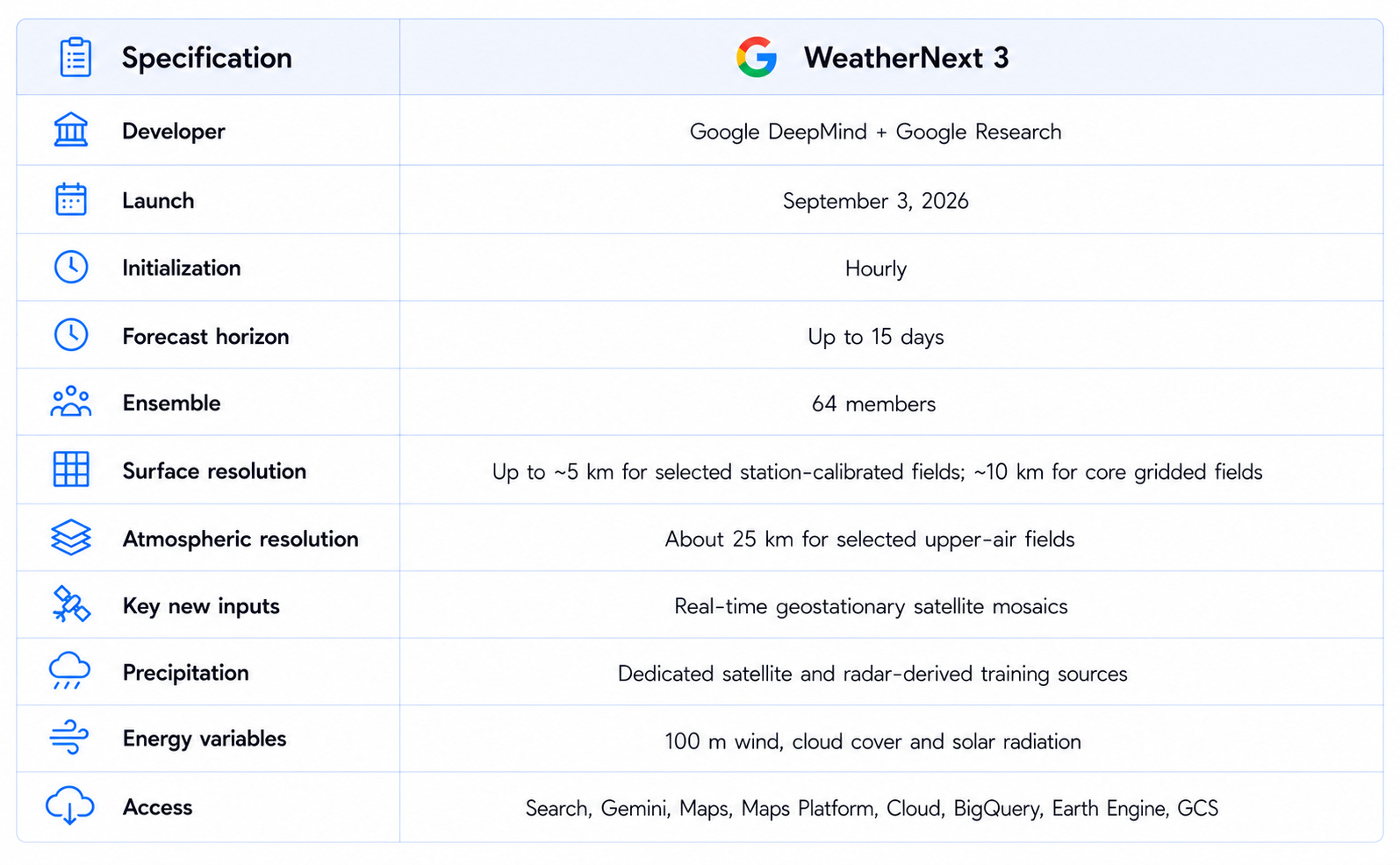
The most important number here is not the 15-day horizon. It is the combination of hourly initialization and higher-resolution surface output. Those two changes attack the exact places where global forecasts can become less useful: rapidly changing weather and local geography.
3. What Changed From WeatherNext 2?
WeatherNext 3 changes the cadence, spatial detail and source data of the WeatherNext system rather than simply scaling up the previous model. WeatherNext 2 used a 25 km grid with six-hour forecast steps in the comparison Google provides, while WeatherNext 3 reaches finer resolutions and hourly initialization.
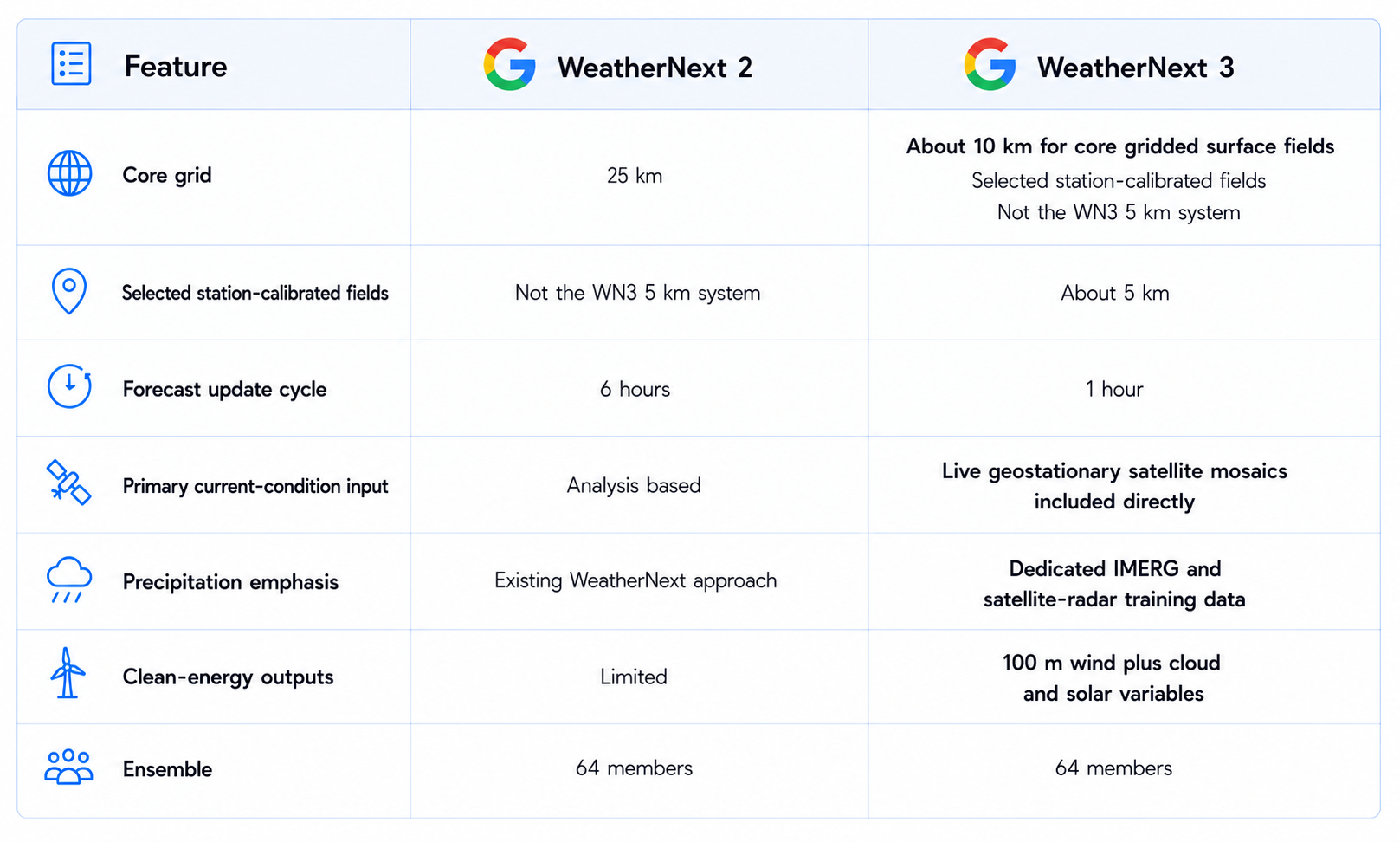
This is a meaningful upgrade because each change compounds the others. Higher resolution without fresher observations would still miss rapidly developing systems. Fresh observations without higher resolution would still blur local differences. WeatherNext 3 pushes both dimensions at once.
4. Why Real-Time Satellite Data Matters
The real-time satellite feed is arguably the most important technical change in WeatherNext 3 because weather is an initial-condition problem before it becomes a forecasting problem.
Google says many earlier AI approaches, including WeatherNext 2, were trained on data derived from numerical weather prediction systems. Those systems remain extremely valuable, but the analysis they provide can contain time lag relative to rapidly changing weather. WeatherNext 3 directly ingests global geostationary satellite mosaics so each hourly cycle starts from a much fresher observation of cloud and atmospheric structure.
That should matter most for fast-moving fronts, convective systems and rapidly developing precipitation. If the atmosphere changes substantially between two six-hour refreshes, a six-hourly system has already lost information before it starts forecasting. An hourly initialization shortens that gap.
5. The 5 km Resolution Upgrade
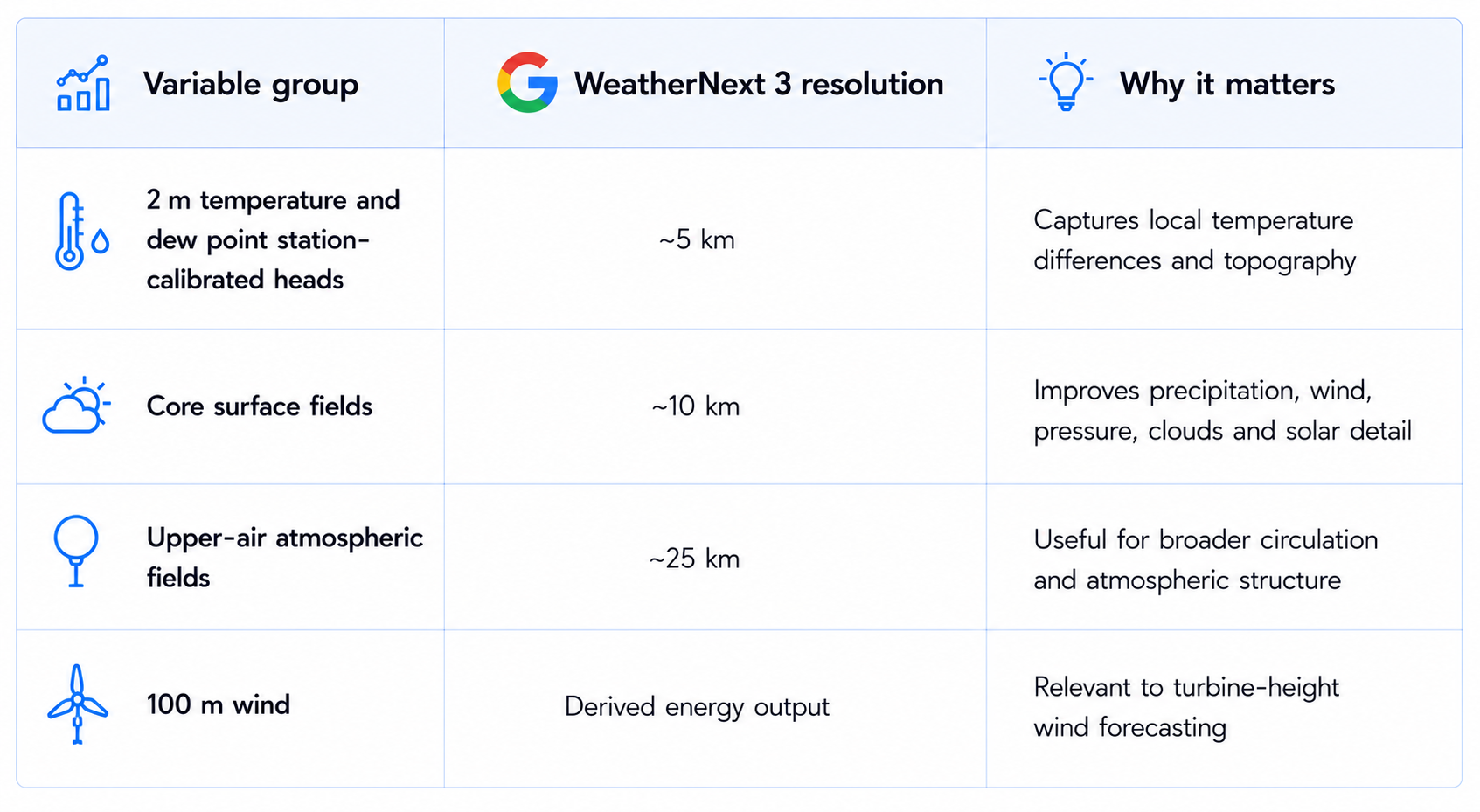
WeatherNext 3 reaches about 5 km spatial resolution for selected station-calibrated surface variables, while core gridded fields are provided at about 10 km. Google describes the overall system as roughly five times sharper than WeatherNext 2, which used a 25 km global grid.
6. Hourly Forecast Refreshes
WeatherNext 3 updates its forecast cycle every hour, which directly improves how quickly the system can react to newly observed atmospheric changes.
7. How WeatherNext 3 Handles Precipitation
Precipitation is one of WeatherNext 3's strongest technical arguments because Google specifically redesigned the training data around rain and snow prediction.
Google reports that WeatherNext 3 trains against multiple high-quality precipitation sources, including ECMWF reanalysis, NASA's IMERG satellite product and Google's satellite-radar reanalysis. The company reports up to 50% improvement in Brier score and CRPS against numerical weather prediction baselines in the cited evaluation setup. Its launch article also reports larger gains against some satellite precipitation datasets in medium-range evaluation.
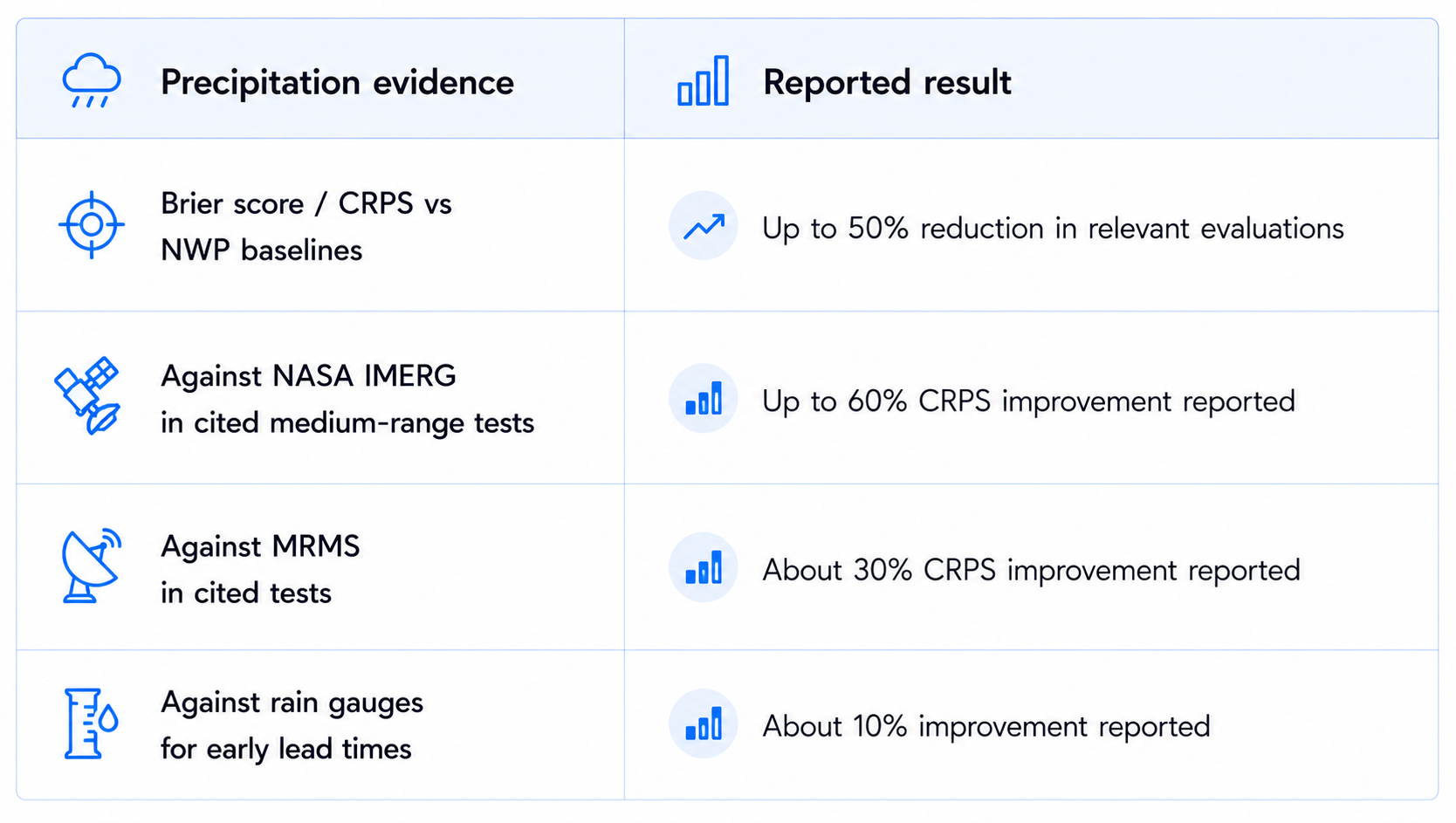
The key point is not that WeatherNext 3 will predict every shower perfectly. It will not. Rain is chaotic, localized and highly sensitive to small-scale cloud processes. The meaningful improvement is that the model is being trained against observations that are closer to what actually happens on the ground.
8. The 64-Member Ensemble
WeatherNext 3 is probabilistic, which means it does not pretend that one forecast path is the only future that can occur. Google describes a 64-member ensemble, and Weather Lab shows the ensemble mean for its global WeatherNext 3 visualization.
This matters because uncertainty is a feature of weather forecasting, not an error to hide. If 50 ensemble members say heavy rain is plausible and 14 say it is unlikely, that distribution carries more decision value than a single deterministic prediction that says 4 mm.
For developers, percentile outputs can be more useful than a single mean. Google's BigQuery distribution includes precomputed p10, p25, p50, p75 and p90 statistics for many variables, making it possible to build risk-oriented applications without downloading the full ensemble.
9. Forecast Horizon and Time Resolution
WeatherNext 3 supports forecasts extending to 15 days, but hourly detail is most valuable close to the present while longer horizons are better treated as probabilistic guidance.
Google's Weather Lab documentation shows WeatherNext 3 with 15-day forecasts at six-hourly output for the longer range and an interim 48-hour hourly view. This split is sensible because short-horizon decisions need temporal detail while long-horizon prediction has to acknowledge growing uncertainty.
This is also why comparing WeatherNext 3 to a simple weather app by asking which one has the nicest 10-day card misses the point. WeatherNext 3 is a forecast engine whose outputs can be aggregated differently depending on the application.
10. What Variables Does WeatherNext 3 Predict?
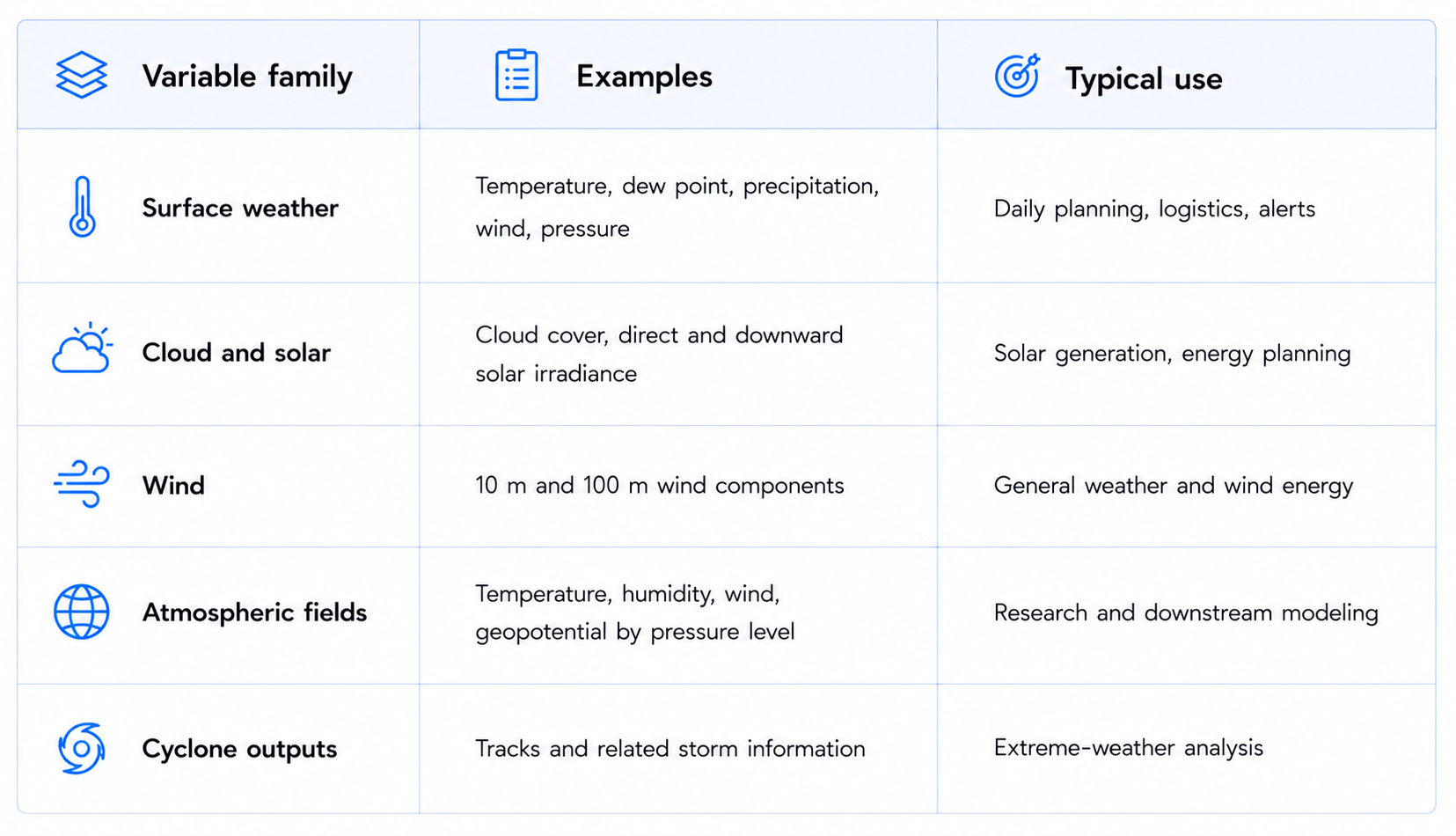
WeatherNext 3 covers a broad set of meteorological variables, with the highest-resolution emphasis on surface conditions and practical decision variables.
11. Ground-Station Calibration
WeatherNext 3 uses ground weather station observations to calibrate selected surface variables, especially temperature and dew point.
This is important because a global numerical field can be physically consistent while still being biased at specific locations. A model that learns from station observations has access to information about how the real atmosphere behaves at actual measurement sites.
Google says this station calibration enables global forecasts at about 5 km resolution for those variables and helps account for regional effects such as valleys, coastlines and terrain. It is a practical example of where observational data can make an AI forecast more useful without requiring a full high-resolution physics simulation everywhere.
12. Renewable Energy Forecasting
Renewable energy is one of WeatherNext 3's most commercially interesting additions because the model directly predicts variables that influence power generation.
Google highlights 100-meter wind speeds, roughly representative of turbine height, along with cloud cover and solar radiation components. That means the same forecasting system can estimate not just whether the weather will be sunny or windy, but how those conditions may translate into energy availability.
For grid operators, this can improve day-ahead and intraday balancing. For solar farms, better cloud and radiation forecasts can improve production estimates. For wind developers, better wind forecasts can improve scheduling and maintenance planning.
13. Extreme Weather and Cyclone Tracking
WeatherNext 3 arrives after Google has already demonstrated that its broader WeatherNext family can make meaningful progress on tropical cyclone forecasting.
Google DeepMind reported in August 2026 that a WeatherNext cyclone model achieved state-of-the-art results for cyclone track, intensity and wind structure, with the potential to provide additional warning time. WeatherNext 3 extends the broader forecasting stack with fresher observations and higher-resolution global fields.
That does not mean WeatherNext 3 is an emergency-warning replacement. Google's own documentation explicitly says WeatherNext is experimental and should not be used as the sole source for life or property decisions. Official meteorological agencies remain the correct source for warnings and advisories.
14. WeatherNext 3 in Search, Gemini and Maps
Google is integrating WeatherNext 3 across its consumer and developer ecosystem, which is arguably more significant than the research model itself.
Google says WeatherNext 3 is now powering weather experiences in Search, the Gemini app and Google Maps, alongside Google Maps Platform and Google Cloud. The stated user-facing benefit is improved longer-range precipitation forecasting, with up to 50% more accurate precipitation forecasts for some day-ahead planning scenarios.
For the broader Google AI ecosystem, our Google Gemini & Google AI collection tracks the wider ecosystem, from Gemini models to other Google AI systems.
The pattern is similar to what we saw with Google TimesFM-3, where a specialized model becomes more interesting when its forecasts can feed real applications rather than existing only as a research demo.
15. Weather Lab and Exploring Forecasts
Weather Lab is Google's interactive way to inspect AI weather forecasts without building a full data pipeline first.
The Weather Lab interface provides global forecast layers, cyclone tracks and experimental data downloads. For WeatherNext 3, Google documents 64 ensemble members, 15-day horizons and a short-range hourly view. It is particularly useful for understanding uncertainty visually because you can inspect an ensemble mean rather than a single deterministic path.
16. Developer Access: BigQuery, Earth Engine and Cloud
WeatherNext 3 is unusually accessible as a data product because Google distributes it across several cloud surfaces instead of forcing developers into a single API.
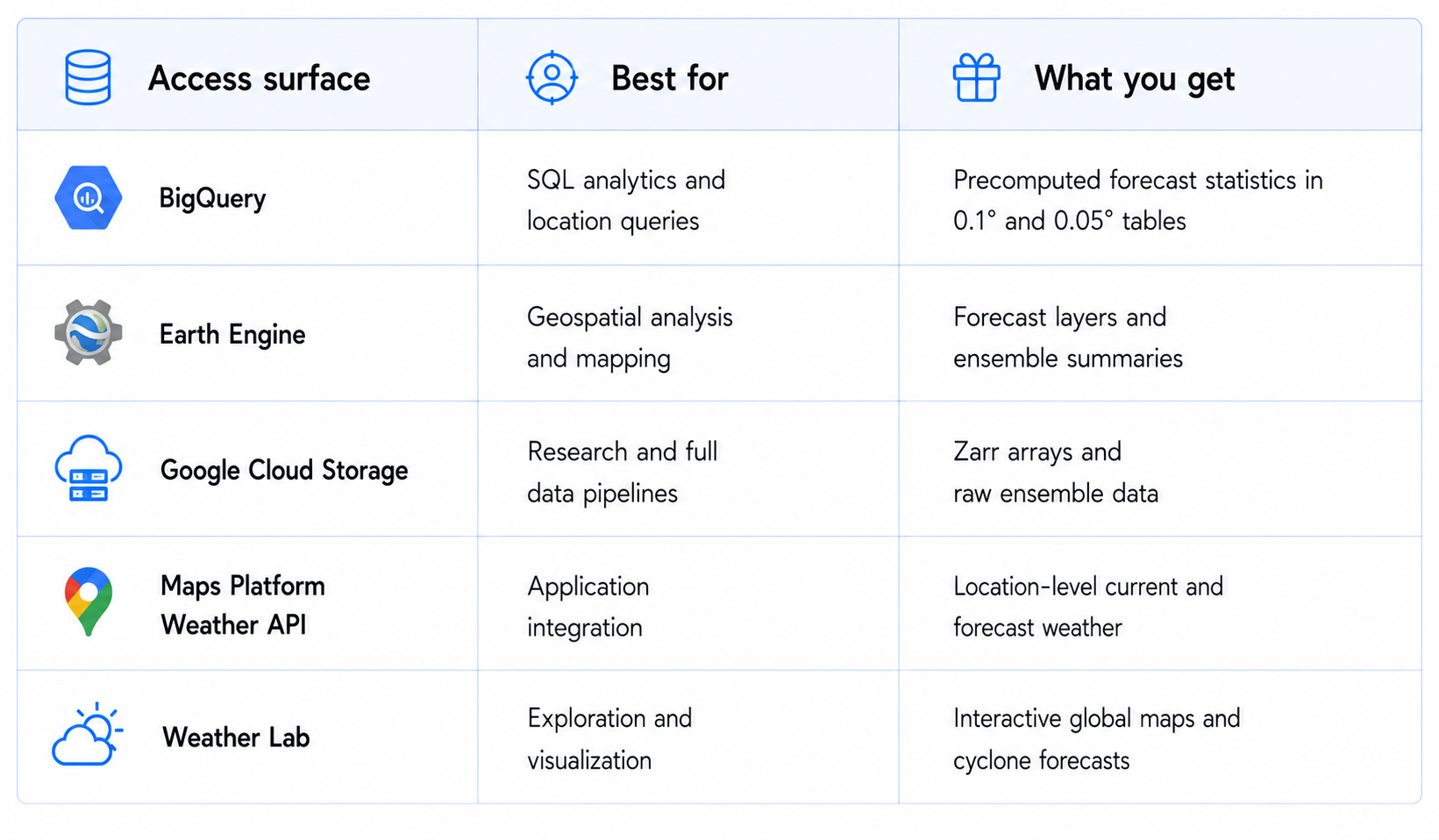
Google's Cloud Storage documentation warns that a full 64-member global ensemble can occupy hundreds of gigabytes, so teams should slice by variable, region and time instead of loading an entire forecast into memory. That is an important practical warning: the model may be efficient to generate, but the raw output is still a large data engineering problem.
For context on evaluating model-backed applications rather than trusting a headline benchmark, see our Best AI Models 2026 analysis.
17. WeatherNext 3 API and Cost Considerations
There is no single WeatherNext 3 API price because Google exposes the data through different products, and the commercial terms differ by surface.
For Google Maps Platform, the Weather API is billed per successful request, with separate global and India pricing lists and billing enabled on the project. For research distribution, WeatherNext 3 data is also available through BigQuery, Earth Engine and Cloud Storage under the applicable WeatherNext data terms.
18. How WeatherNext 3 Compares With Traditional Forecasting
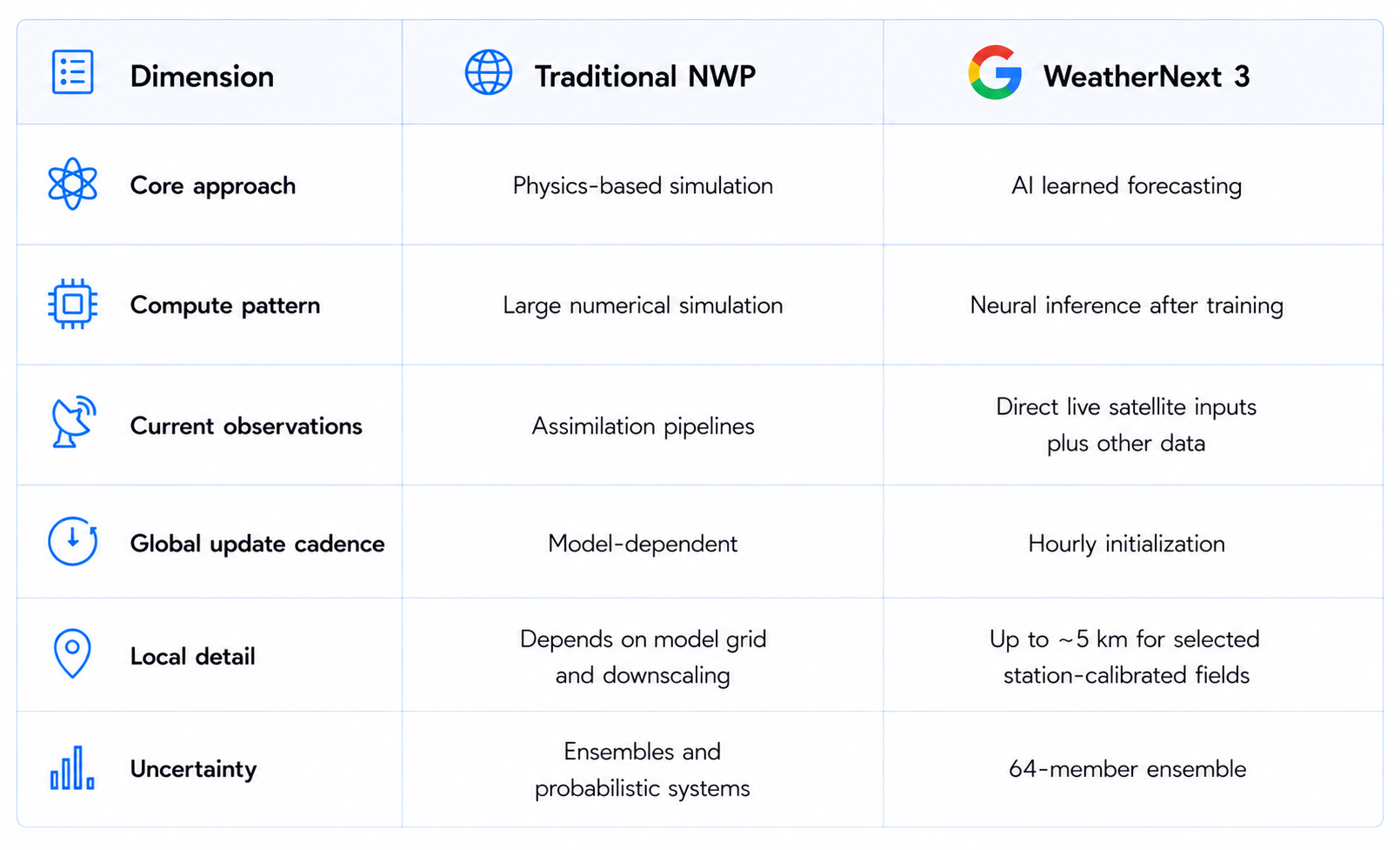
WeatherNext 3 is not a replacement for numerical weather prediction in the simplistic sense. It is a different way of using data and computation to produce forecasts, and Google is building it to complement the broader forecasting ecosystem.
Traditional NWP remains powerful because it explicitly represents physical processes and can be initialized from massive observation systems. AI weather models learn statistical structure from huge datasets and can generate forecasts far more quickly once trained. WeatherNext 3 pushes that AI advantage toward fresher observations and higher resolution.
19. Limitations and What Google Does Not Promise
WeatherNext 3 has serious limitations, and ignoring them would make this review useless.
5 km resolution is not street-level truth. Microclimates, buildings and very local terrain can still require specialized models.
Hourly updates do not eliminate uncertainty. Forecast skill still falls as lead time increases.
Rain remains difficult. Even a large improvement in CRPS does not mean deterministic rainfall timing will always be correct.
Raw global ensemble data is expensive to move and process at scale. Google's own Cloud Storage guidance warns that full ensembles can be hundreds of gigabytes.
WeatherNext 3 is experimental. Google explicitly says not to use it as the sole basis for safety-critical decisions or official warnings.
The last point is the most important. AI weather forecasting is improving quickly, but a leaderboard score is not a substitute for an official warning system. Use WeatherNext 3 to enrich decisions, not to invent confidence that the model does not have.
20. Is Google WeatherNext 3 Worth It?
Yes, WeatherNext 3 is worth paying attention to if you care about AI weather forecasting, but the value depends on what you are doing with the data.
For everyday users, the benefit is passive. You may simply notice better rain and temperature forecasts inside Google Search, Maps and Gemini without knowing that WeatherNext 3 is running underneath.
For developers, researchers and businesses, the upgrade is much more significant. Hourly initialization, higher-resolution grids, ensemble statistics, precipitation improvements and energy-specific outputs make WeatherNext 3 a useful foundation for applications that react to real-world conditions.
My biggest positive is the shift toward observations. My biggest criticism is that the marketing language around 'most accurate' can tempt people to think a global AI model has solved local weather. It has not.
The honest verdict is that WeatherNext 3 is one of the strongest examples in 2026 of AI moving from benchmark research into infrastructure. It does not make the atmosphere predictable. It makes more of the information required for prediction available, faster and at more useful spatial scales.
For broader model comparisons, our Best AI Models & Leaderboards collection tracks how specialized AI systems compare across tasks. For another Google forecasting example, see our Google TimesFM-3 review.
Final Verdict
Google WeatherNext 3 is a substantial upgrade rather than a routine model refresh. The combination of real-time satellite inputs, hourly initialization, up to 5 km selected surface forecasts, improved precipitation modeling, 64-member ensembles and renewable-energy outputs gives it a much broader practical footprint than a normal weather AI research release.
It is especially impressive that Google has put the system into Search, Gemini, Maps and developer-facing cloud infrastructure on the same launch cycle. That is what turns the model from an interesting research result into a platform.
Overall rating: 9/10.
Best for: weather applications, energy forecasting, research, geospatial systems, logistics and developers building physical-world AI.
Not for: replacing national weather services, making safety-critical decisions from a single model, or assuming higher resolution guarantees perfect local forecasts.
Frequently Asked Questions
What is Google WeatherNext 3?
WeatherNext 3 is Google DeepMind and Google Research's latest global AI weather forecasting model. It uses live geostationary satellite mosaics, hourly initialization, probabilistic ensembles and higher-resolution surface forecasts.
How accurate is WeatherNext 3?
Google reports significant improvements in precipitation metrics, including up to 50% reductions in Brier score and CRPS versus numerical weather prediction baselines in relevant evaluations. Google also cites independent Brightband live evaluations, but the exact benchmark should be interpreted in the context of the evaluation methodology.
What is the resolution of WeatherNext 3?
Selected station-calibrated surface variables reach about 5 km. Core gridded surface variables are around 10 km, while selected atmospheric variables are available around 25 km.
How often does WeatherNext 3 update?
WeatherNext 3 is initialized every hour. Google Weather Lab also documents longer-range output at six-hourly intervals and an interim hourly view for the first 48 hours.
Is WeatherNext 3 better than WeatherNext 2?
Yes. WeatherNext 3 improves the refresh cadence, spatial resolution, use of live satellite observations and precipitation modeling compared with the WeatherNext 2 configuration described by Google.
Can WeatherNext 3 predict rain accurately?
It is significantly better on the precipitation metrics Google reports, but rainfall remains intrinsically difficult. Treat the forecast as probabilistic guidance, especially for storms and longer lead times.
Is WeatherNext 3 available in Google Maps and Gemini?
Yes. Google says WeatherNext 3 is rolling into Search, Gemini, Google Maps and Google Maps Platform, as well as cloud data services.
Can developers access WeatherNext 3 data?
Yes. Google provides access through BigQuery, Earth Engine, Google Cloud Storage and Maps Platform, with different data products and terms on each surface.
Is WeatherNext 3 free?
The model itself does not have one universal consumer price. Some exploration surfaces are available for experimentation, while API and cloud data usage can involve billing depending on the product and request volume.
Is WeatherNext 3 safe to use for emergency warnings?
No. Google explicitly describes WeatherNext as an experimental AI forecasting system and says it should not be the sole source for life or property decisions. Follow official local meteorological agencies and emergency services for warnings.
Recommended Blogs
- Google TimesFM-3 Review: Accuracy, Benchmarks, Features & Is It Worth It? (2026)
- Gemini 3.8 Flash Review: Accuracy, Price & Is It Worth It? (2026)
- Best AI Models 2026: Full Ranked Analysis and Benchmarks
- What Is Context Engineering? Complete Guide (2026)
- Best Open Source AI Models August 2026: Full Collection
- Gemini 3.7 Flash Is Changing AI Coding Economics: Speed vs Intelligence vs Cost
Resources & Community
Join our community of 70,000+ AI enthusiasts and learn to build powerful AI applications! Whether you're a beginner or an experienced developer, Build Fast with AI helps you understand and implement AI in your projects.
- Website - buildfastwithai.com
- LinkedIn - Build Fast with AI
- Instagram - @buildfastwithai
- Founder Twitter - @satvikps
- Twitter - @BuildFastWithAI
Agentic AI Launchpad 2026
A structured 6-week cohort program that takes you from AI basics to building and deploying real-world agentic AI systems. Includes live sessions, expert mentorship, project reviews, and a builder community network.
Ready to go from learning to building? Join the next cohort: Agentic AI Launchpad 2026.
Free AI Resources
Access free tools, workshops, and micro-learning to keep building.
- AI Workshops - Free resources, upcoming events & past recordings
- Unrot - Learn AI in 5 minutes a day (free micro-learning app)
Stay ahead of the latest AI model releases, benchmarks and practical building guides. Follow Build Fast with AI for the next update.
References
- Google - Introducing WeatherNext 3, our most advanced and accurate global weather AI model
- Google for Developers - WeatherNext 3 benefits and limitations
- Google for Developers - Weather Lab
- Google for Developers - WeatherNext 3 forecasts on BigQuery
- Google for Developers - WeatherNext 3 forecasts on Google Cloud Storage
- Google for Developers - Weather API usage and billing
- Google for Developers - WeatherNext terms of service and disclaimers
Google DeepMind - WeatherNext AI model achieves breakthrough in forecasting cyclones

