



Ox Alpha Review: The Mystery AI Model With 1M Context, Free Access & Frontier Coding Performance (2026)
Ox Alpha is the strangest AI model release of August 2026. It appeared on OpenRouter on August 20 under the anonymous provider name Stealth, with a 1,048,576-token context window, 131,072-token maximum output, text, image and video input, tool support and a $0 preview price. There was no launch keynote, no named lab and no normal model card announcing who built it.
The interesting part is not only the mystery. Early coding tests are surprisingly strong. A small independent-style run published by the Ox Alpha site showed Ox Alpha solving 8 of 10 real-world coding tasks, or 80%, compared with 65% for Fable 5, 62% for GLM-5.3, 62% for Grok 4.6 and 52% for GPT-5.6 Sol. That does not prove Ox Alpha is the best coding model in the world. Ten tasks are far too few for that. It does prove something more useful: this free stealth model is good enough that developers are testing it seriously against frontier systems.
The real question for builders is therefore not 'Who secretly made Ox Alpha?' but 'What can I safely use it for right now?' The answer is promising but cautious: it is worth testing for coding agents, long-context reasoning, multimodal workflows and high-volume experiments, but its anonymous provider, preview status and current data-retention disclosure mean it should not automatically receive sensitive production data.
QUICK ANSWER
Ox Alpha is an anonymous reasoning model available as stealth/ox-alpha through OpenRouter. It is positioned for coding, sustained agentic work, long-horizon software engineering and workflows that combine text with visual context. The current OpenRouter listing shows a 1,048,576-token context window, 131,072-token maximum output, text/image/video input and $0 input and output during the preview. OpenRouter says the model is developed and operated by an unnamed third-party provider, and that prompts and completions are retained by that provider but are not used for training.
Early coding results are excellent enough to justify testing, but the strongest benchmark evidence is still a tiny 10-task sample. My verdict: Ox Alpha is currently one of the most interesting free models for coding agents and long-context experiments, not yet a proven universal replacement for GPT-5.6, Claude Sonnet 5 or other frontier models.
1. What Is Ox Alpha?
Ox Alpha is a stealth reasoning model that surfaced publicly without a named developer. OpenRouter describes it as designed for coding, sustained agentic work, production workloads, long-horizon software engineering, complex reasoning and workflows that combine text with visual context.
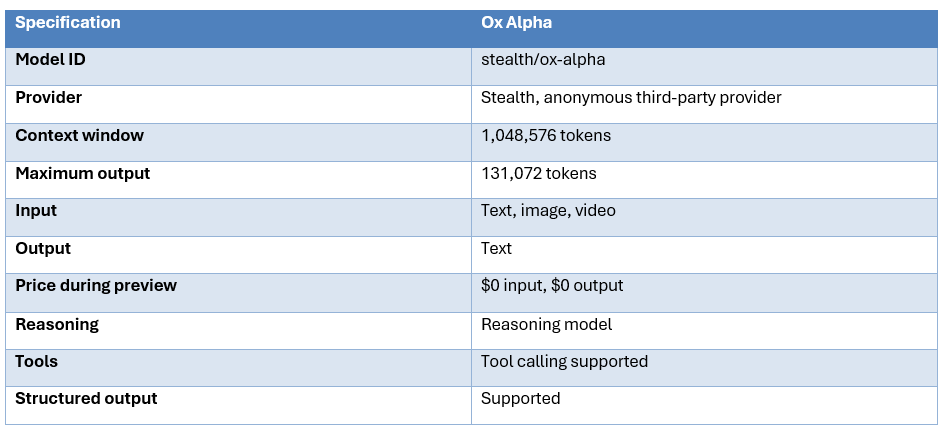
The 1M context window is the obvious headline because it makes the model usable for unusually large inputs. You can theoretically provide a very large codebase, long specification, long transcript or extensive research material in one context. But a million-token window is capacity, not intelligence. Filling the context with everything you have can make an agent more expensive and less focused once the preview becomes paid.
This connects directly to our What Is Context Engineering? Complete Guide (2026), because the practical challenge is deciding which part of a huge available context the model actually needs.
2. Why Is Ox Alpha a Mystery?
Unlike a normal model launch, Ox Alpha appeared under the provider name Stealth. OpenRouter explicitly says the developer is a third-party provider that chose to remain anonymous during the preview and that OpenRouter itself is not the developer, owner or provider.
That has triggered a guessing game. Some community discussions have suggested Z.ai and GLM-like behavior. Other reports have floated Microsoft and other major labs. None of those theories has been publicly confirmed by the model's operator.
This distinction matters. Similar tokenization behavior, output style or benchmark performance can create a compelling theory, but it does not establish ownership. A serious review should separate confirmed facts from fingerprints and community speculation.
The verified facts are simpler: the model exists, it is accessible, it has the published capabilities and limits, it is currently free on OpenRouter, and its creator remains undisclosed.
3. Ox Alpha Benchmarks: Is the Coding Performance Real?
The strongest early evidence comes from a small coding evaluation covering 10 real-world tasks. The published result shows Ox Alpha solving 8 of 10 tasks, for an 80% mean pass rate.
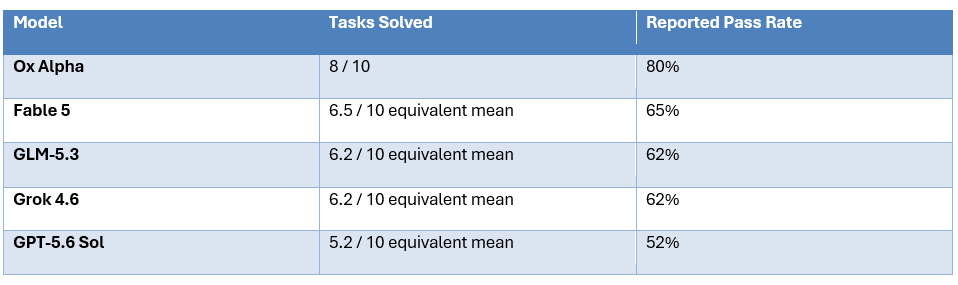
The table looks spectacular for Ox Alpha. It is also exactly where you should slow down. A 10-task benchmark is directional evidence, not a frontier leaderboard. The task selection, prompting, harness, model settings and evaluation procedure can materially change the result. The published page itself describes it as an independent run of 10 real-world coding tasks, so the useful conclusion is that Ox Alpha produced an unusually strong early signal, not that it has permanently defeated every competitor.
A better interpretation is this: if a free anonymous model can score 80% on a small but realistic coding sample while known frontier models score lower on the same tasks, it deserves a larger controlled evaluation. That is the experiment worth running next.
4. Ox Alpha vs GPT-5.6
The comparison with GPT-5.6 is especially interesting because both models now sit in the 1M-context class. OpenRouter lists Ox Alpha at 1,048,576 tokens, while GPT-5.6 variants are also around 1.05M tokens.
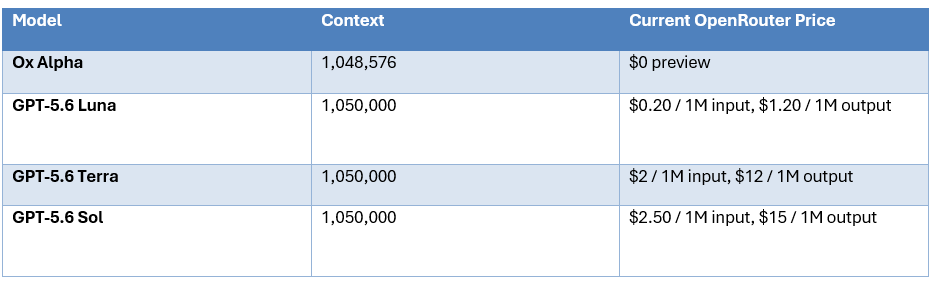
The economic difference is enormous. During the preview, Ox Alpha costs nothing on OpenRouter while retaining essentially the same class of context-window capacity. That makes it an obvious experimentation model and a tempting default for coding agents.
But price is not quality. GPT-5.6 benefits from a named provider, mature tooling, predictable billing and a much larger ecosystem. Ox Alpha's advantage is that you can test frontier-like behavior at no model-token cost during the preview. Your business decision should therefore compare total workflow cost and reliability, not just API price.
Our Gemini 3.7 Flash Is Changing AI Coding Economics makes the broader point: AI coding economics are shifting toward routing and price-performance rather than one model doing everything.
5. Why the 1M Context Window Matters for Coding
The strongest use case for Ox Alpha is not a 20-line coding question. It is long-horizon software engineering.
- Large repository analysis without aggressive truncation.
- Long bug investigations involving issues, logs, code and tests.
- Cross-file refactors that require understanding many modules.
- Large technical specifications combined with an existing codebase.
- Agent sessions that accumulate substantial tool output.
- Visual coding workflows that alternate between screenshots and code.
The catch is obvious: you should not send an entire repository just because you can. A 1M-token limit is a maximum, not a target. Good context engineering still retrieves relevant files, trims noise and summarizes stale tool output.
This is exactly why the model pairs naturally with our LangGraph multi-agent systems guide and our model-routing guide.
6. Multimodal Input: Text, Images and Video
Ox Alpha is not just a text model. The current OpenRouter listing supports text, image and video input, which opens up agent workflows where code and visual state are part of the same task.
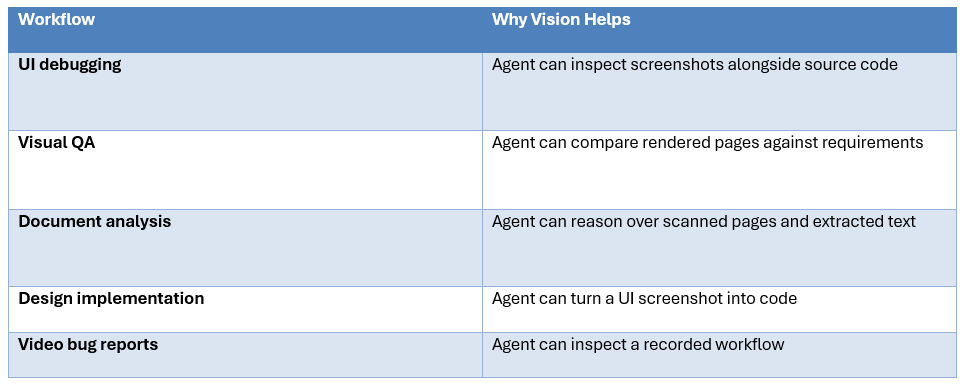
This is where Ox Alpha overlaps with the new DeepSeek V4 Flash Vision Exp you have already published. The difference is positioning. DeepSeek explicitly launched its model as an experimental vision-enabled Flash variant, while Ox Alpha presents vision as part of a broader anonymous reasoning system for long-horizon agents.
See our DeepSeek V4 Flash Vision Exp Review for the other major multimodal model that has just entered your publishing cycle.
7. The Biggest Red Flag: The Provider Is Unknown
This is the section many Ox Alpha reviews will avoid, and that would be a mistake. A free frontier-looking model from an anonymous provider raises operational questions that benchmarks cannot answer.
OpenRouter's current model listing says prompts and completions are retained by the anonymous provider and are not used for training. That is materially different from saying the data is never stored. The retention period is not specified on the current listing. For proprietary code, credentials, customer records or confidential documents, that is enough reason to treat the preview as an experimentation environment rather than a trusted enterprise boundary.
The privacy language also changed during the launch period across related announcements and platforms. That makes a fresh review of the live provider terms essential before every production deployment.
My rule is simple: do not send secrets to an anonymous model because it is free. Use sanitized repositories, synthetic customer data and non-sensitive screenshots until the provider is identified and its security posture is independently reviewable.
8. Is Ox Alpha Actually Free?
On OpenRouter, Ox Alpha is currently listed at $0 per million input and output tokens during its preview. OpenCode also promoted a roughly one-week free testing period with generous capacity.
That does not mean the business model is permanent. Stealth previews exist precisely because a provider is testing a model under real-world traffic. Pricing, limits, availability and even the model's identity can change quickly.
The safest assumption is that the preview is temporary. Build your application so you can switch models through configuration rather than hard-coding an anonymous preview provider into production.
9. How to Try Ox Alpha
The simplest route is OpenRouter using the model ID stealth/ox-alpha. OpenRouter supports OpenAI-compatible access, and the listing also exposes reasoning and tool-related controls.
from openai import OpenAI

client = OpenAI(
    api_key="OPENROUTER_API_KEY",
    base_url="https://openrouter.ai/api/v1",
)

response = client.chat.completions.create(
    model="stealth/ox-alpha",
    messages=[
        {
            "role": "user",
            "content": "Review this repository architecture and propose the safest refactor plan."
        }
    ],
)

print(response.choices[0].message.content)
OpenCode has also made Ox Alpha available for agentic coding workflows, which explains why the model is attracting so much developer usage so quickly. For a first experiment, use a small non-sensitive repository and compare the output against the model you currently use.
10. How I Would Test Ox Alpha
Do not test it by asking five random coding questions and deciding whether it is good. Use a repeatable benchmark that matches your actual work.
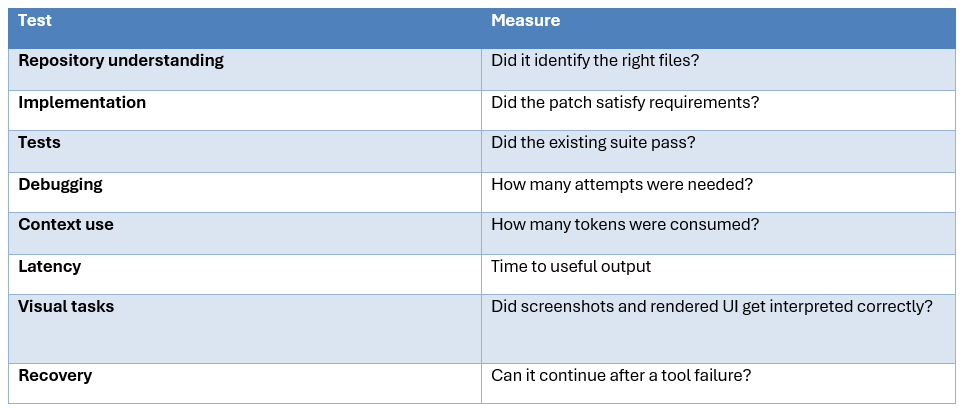
Run the same tasks against Ox Alpha, GPT-5.6, Claude Sonnet 5 and your current production model. Score the result by accepted code, not by how impressive the reasoning looks. That will tell you whether Ox Alpha is actually useful for your workload.
11. Is Ox Alpha Better Than GPT-5.6 or Claude Sonnet 5?
There is not enough evidence to make a universal claim. The early 10-task sample says Ox Alpha can beat the tested GPT-5.6 Sol and other reference models on that particular set. OpenRouter's current pricing pages show Ox Alpha is dramatically cheaper during the preview than GPT-5.6 and Claude Sonnet 5.
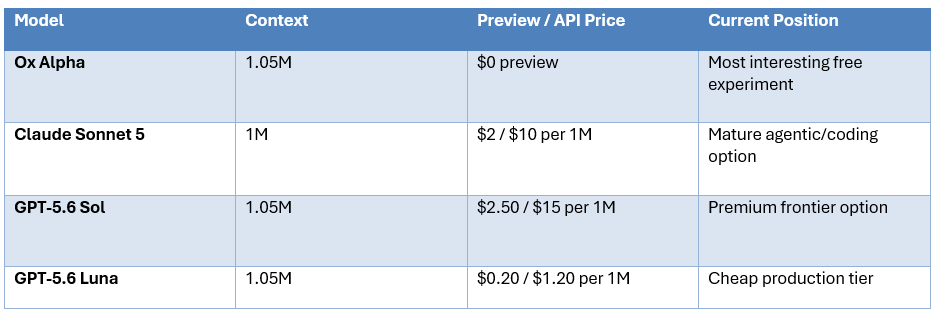
The real choice is not 'Ox Alpha wins.' It is 'Ox Alpha gives you a new low-cost tier to test against your existing stack.' For routine agent work, the economics are compelling. For sensitive enterprise workloads, provider transparency still gives the named models an advantage.
Our Gemini 3.7 Flash vs Claude Sonnet 5 vs GPT-5.6 comparison provides the broader coding-model comparison, while the GLM-5.3 vs DeepSeek V4-Pro vs Kimi K3 comparison covers the current open-model field.
12. Final Verdict
Ox Alpha is one of the most interesting AI releases of August 2026 precisely because so much is still unknown. The model has the capability profile developers want: a 1M context window, multimodal input, tools, long outputs, reasoning and excellent early coding results. And during the preview it is free.
But the mystery is also the biggest weakness. We do not know the lab, we do not have a mature independent benchmark suite, and the current OpenRouter privacy disclosure says the provider retains prompts and completions even though it does not use them for training.
So the right conclusion is not 'Ox Alpha is the new best AI model.' The right conclusion is that Ox Alpha has produced a strong enough early signal to deserve immediate testing, especially for coding agents and long-context workflows where price matters.
My rating today: coding potential 9/10, long-context utility 9.5/10, multimodal potential 8.5/10, price-performance 10/10 during preview, transparency 2/10, production trust 5/10.
Use it aggressively for experiments. Keep it behind a model-routing layer for production. Do not send secrets to it. And rerun your own benchmark before making any claim that it has actually beaten the established frontier.
Frequently Asked Questions
What is Ox Alpha AI?
Ox Alpha is an anonymous reasoning model available through OpenRouter under the model ID stealth/ox-alpha. It is designed for coding, sustained agentic work, long-horizon software engineering and multimodal workflows.
Who created Ox Alpha?
The creator has not been publicly confirmed. OpenRouter currently describes it only as an anonymous third-party provider called Stealth. Community theories about Z.ai, Microsoft and other labs remain unverified.
Is Ox Alpha free?
Yes, it is currently listed at $0 input and output on OpenRouter during the preview. OpenCode has also offered a limited free testing window.
What is Ox Alpha's context window?
The current OpenRouter listing shows a 1,048,576-token context window and a 131,072-token maximum output.
Is Ox Alpha good for coding?
Early results are promising. A 10-task coding sample reported an 80% pass rate for Ox Alpha, ahead of the reference models in that small test. That is encouraging but not enough to establish universal coding superiority.
How does Ox Alpha compare with GPT-5.6?
Ox Alpha currently has a similar 1M-class context window and is free during the preview. A small 10-task coding test reported higher results for Ox Alpha than GPT-5.6 Sol, but the sample is too small to support a universal ranking.
Is Ox Alpha safe for private code?
Do not assume it is. OpenRouter's current listing says prompts and completions are retained by the anonymous provider and are not used for training. Until the provider and its security controls are known, use sanitized or non-sensitive data.
Where can I try Ox Alpha?
The current OpenRouter model ID is stealth/ox-alpha. OpenCode also exposes it in its agentic coding environment, and independent interfaces exist, but the provider remains anonymous.
Recommended Blogs
- Mystery Model OX Alpha Beats GPT-5.6: AI News Aug 22-23
- DeepSeek V4 Flash Vision Exp Review: Benchmarks & Price
- GLM-5.3 vs DeepSeek V4-Pro vs Kimi K3: Best Open Coding AI
- What Is Context Engineering? Complete Guide (2026)
- How to Use LangGraph for Multi-Agent Systems (2026)
- Model Routing for AI Coding Agents: How to Cut Costs Without Losing Quality
Resources & Community
Join our community of 70,000+ AI enthusiasts and learn to build powerful AI applications. Whether you're a beginner or an experienced developer, Build Fast with AI helps you understand and implement AI in your projects.
- Website - buildfastwithai.com
- LinkedIn - Build Fast with AI
- Instagram - @buildfastwithai
- Founder Twitter - @satvikps
- Twitter - @BuildFastWithAI
Agentic AI Launchpad 2026
A structured 6-week cohort program that takes you from AI basics to building and deploying real-world agentic AI systems. Includes live sessions, expert mentorship, project reviews and a builder community network.
Ready to go from learning to building? Join the next cohort: Agentic AI Launchpad 2026
Free AI Resources
Access free tools, workshops and micro-learning to keep building.
References
- OpenRouter model listings and Ox Alpha provider disclosure
- OpenRouter Ox Alpha model comparison page
- AI Primer - OpenRouter tests free Ox Alpha with a 1M-token context window
- Business Insider - A mysterious free AI model is impressing developers
- Ox Alpha Benchmarks - 10-task coding comparison
Ox Alpha About - Model description and independent site disclaimer

