



DeepSeek V4 Flash Vision Exp Review: Benchmarks, Price & Is It Worth It? (2026)
DeepSeek quietly fixed one of the biggest holes in its V4 family on August 21, 2026: V4 Flash can now see. DeepSeek V4 Flash Vision Exp adds native image input to the cheap V4 Flash line, keeps the model's text capabilities, supports screenshots, charts and document images inside the same agent workflow, and charges images under the same token pricing as V4 Flash. The most striking detail is the 384-token ceiling per image after resizing.
That combination changes the economics of multimodal agents more than the benchmark headline does. A screenshot-heavy coding agent can inspect visual UI state without paying premium vision-model rates on every frame. A document pipeline can analyze images without adding a separate image-to-text model. But the 384-token cap is also the clearest warning: cheap visual input is not the same thing as unrestricted visual fidelity. Current launch data is strong, but the model is experimental and independent evaluations are still thin because it launched yesterday.
1. What DeepSeek V4 Flash Vision Exp Actually Is
DeepSeek V4 Flash Vision Exp is an experimental multimodal API model that accepts text and images and returns text, using the V4 Flash family as its capability and pricing base. The model ID is deepseek-v4-flash-vision-exp, and it went live on the DeepSeek API on August 21, 2026.
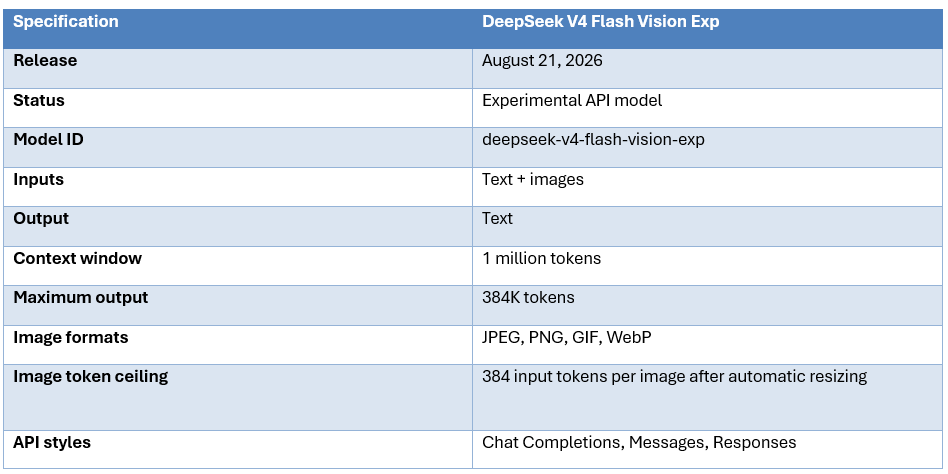
DeepSeek says its pure-text agent, reasoning and world-knowledge capabilities are on par with the official V4 Flash. The new capability is native visual understanding inside the same API workflow. An agent can receive a screenshot, inspect it, call a tool, see a new screenshot and continue without a separate vision adapter.
Our earlier DeepSeek V4 Flash review covers the text-only Flash model in detail. This Vision Exp release is the answer to the question that review left open: what happens when the cheap Flash model gets eyes?
Do not overstate the release. DeepSeek has not published a separate parameter count or new architecture breakdown for Vision Exp. The safe description is an experimental vision-enabled version of V4 Flash, not a completely new V5-style generation.
2. Benchmarks: How Close Is It to Opus 4.8?
The short answer is that the launch benchmarks are genuinely strong, but the phrase near Opus 4.8 needs qualification. DeepSeek reports strong results on both text-agent and multimodal tasks. Those are vendor-published numbers, not an independent end-to-end benchmark run.
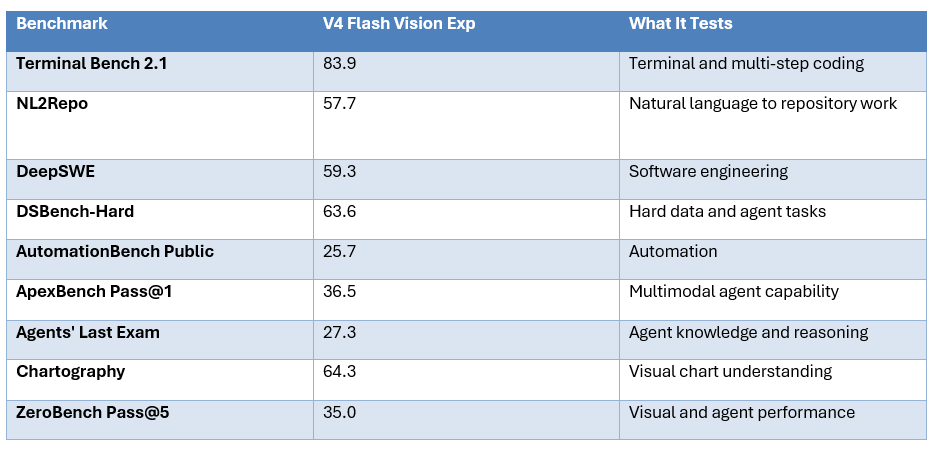
DeepSeek's comparison table places V4 Flash Vision Exp at 83.9 on Terminal-Bench 2.1 versus 85.0 for Claude Opus 4.8, and 59.3 on DeepSWE versus 58.0 for Opus 4.8. On Chartography, the vision model scores 64.3 versus 65.0 for Opus 4.8. The gap is much larger on NL2Repo and DSBench-Hard, where the reported Opus numbers are 69.7 and 71.7.
That is why calling the model an Opus killer would be sloppy. It is close on selected benchmarks, not universally equal. The more interesting conclusion is that DeepSeek has produced an experimental multimodal model whose results can sit within striking distance of a far more expensive frontier model while keeping Flash economics.
There is another caveat. DeepSeek evaluated its public code-agent benchmarks with the DeepSeek Harness in minimal mode, maximum effort, top_p=0.95 and temperature=1.0. Benchmark scores therefore measure the model plus an execution setup, not a pure model score independent of tooling.
My take: the benchmarks justify paying attention, not switching everything today. A model does not earn a production migration because it is close on nine rows. It earns it when it wins your actual screenshot, document, chart, browser and coding workloads at a lower cost.
3. Pricing: The 384-Token Image Trick
The strongest competitive advantage is not the benchmark table. It is how DeepSeek bills images. Each image is converted into tokens and capped at 384 input tokens after automatic resizing, while the model uses the V4 Flash pricing structure.
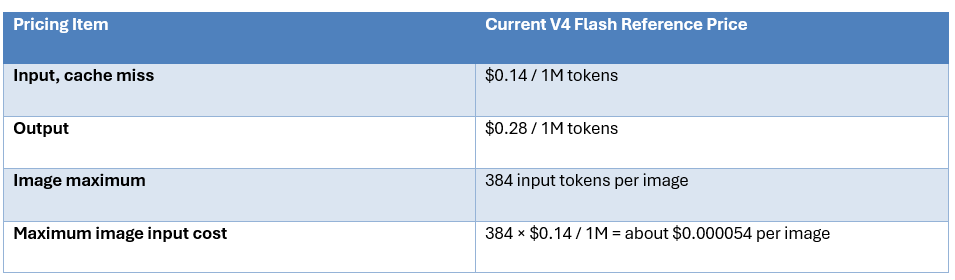
The last number is a calculation, not a separate image fee. At $0.14 per million uncached input tokens, a fully capped 384-token image costs roughly $0.000054 in image input tokens before text input and generated output. A 1,000-image batch at the maximum allocation would therefore be about $0.054 in image input tokens.
That is exceptionally cheap for multimodal input. It changes the economics of workloads where images are frequent rather than occasional: UI screenshots, visual QA, document pages, dashboard snapshots, charts and image-heavy agent loops.
But the low bill comes from a deliberate constraint. Images are resized before inference. Large images can therefore lose tiny labels, dense chart annotations or precise UI details. This is the tradeoff in one sentence: DeepSeek made vision cheap by making the amount of visual information predictable.
Our DeepSeek V4 review explains why the base V4 family is so aggressive on cost. Vision Exp extends that cost philosophy to images.
4. Vision Quality: Where It Shines and Where It Breaks
DeepSeek V4 Flash Vision Exp is most compelling when the image is evidence rather than artwork. Screenshots, charts, UI state, diagrams, document pages and structured visual information are the sweet spot.
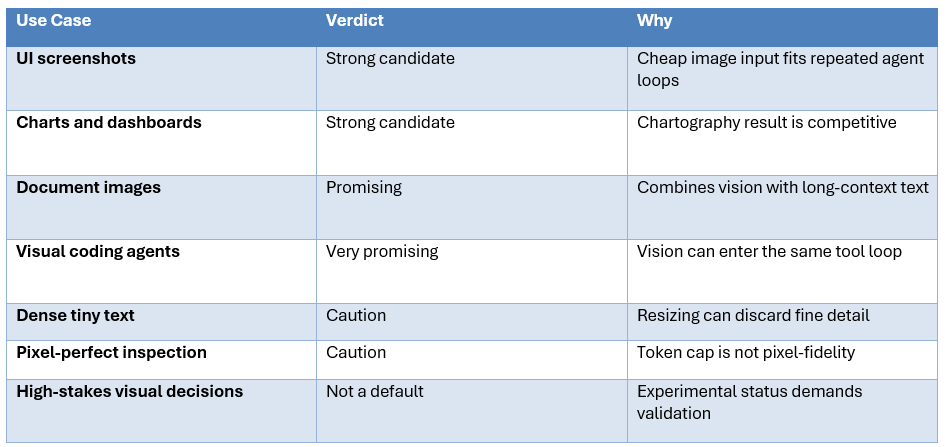
The distinction between visual understanding and visual fidelity matters. A model can correctly understand the overall state of a screenshot while missing a tiny error message in the corner. That is acceptable for some agent workflows and disastrous for others.
For example, an agent deciding whether a web page layout is broken may only need the overall screenshot. An agent asked to read six-point text inside a dense enterprise dashboard may need more visual information than the resizing pipeline preserves.
Early community feedback is mixed, which is exactly what you should expect one day after launch. Some users report strong basic image understanding while others report weak results on dense ERP screenshots. These are anecdotes, not controlled tests, so treat them as prompts for evaluation rather than proof of either conclusion.
This is also where context engineering matters. Do not send ten unrelated screenshots just because the API can accept them. Give the agent the image it needs, define what to inspect and keep the active context focused.
5. API, Image Limits and Developer Experience
The developer experience is unusually flexible for an experimental model. The Vision Exp API supports OpenAI-compatible Chat Completions, Anthropic-compatible Messages and Responses-style calls. Images can be sent as inline Base64 data, a public URL or a Files API reference.
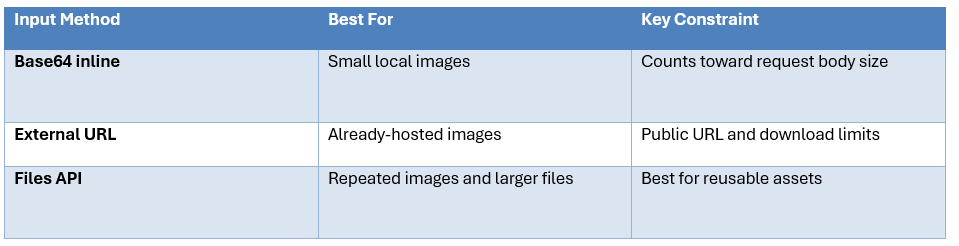
The Files API is especially interesting. DeepSeek launched a free Files API alongside the vision model, letting developers upload an image once and reuse its file_id across requests. That is useful for multi-turn agents where the same screenshot, document page or product image must be referenced repeatedly.
Current API summaries also report that images belong in user messages for Chat Completions. URL-based images have size and download constraints, while Files API references can handle larger files. This is important if you are building a high-throughput visual agent rather than sending one-off images from a developer script.
A minimal OpenAI-compatible call looks like this:
from openai import OpenAI

client = OpenAI(
    api_key="DEEPSEEK_API_KEY",
    base_url="https://api.deepseek.com",
)

response = client.chat.completions.create(
    model="deepseek-v4-flash-vision-exp",
    messages=[{
        "role": "user",
        "content": [
            {"type": "text", "text": "Analyze this dashboard and list the three biggest anomalies."},
            {"type": "image_url",
             "image_url": {"url": "https://example.com/dashboard.png"}},
        ],
    }],
)

print(response.choices[0].message.content)
Because DeepSeek already exposes OpenAI-compatible and Anthropic-compatible interfaces across the V4 family, teams with existing agent infrastructure can experiment without rebuilding the entire orchestration layer.
6. DeepSeek V4 Flash Vision Exp vs Other Models
Against the current field, Vision Exp's strongest argument is not that it is the best vision model. It is that it puts useful vision into one of the cheapest high-capability agent models.
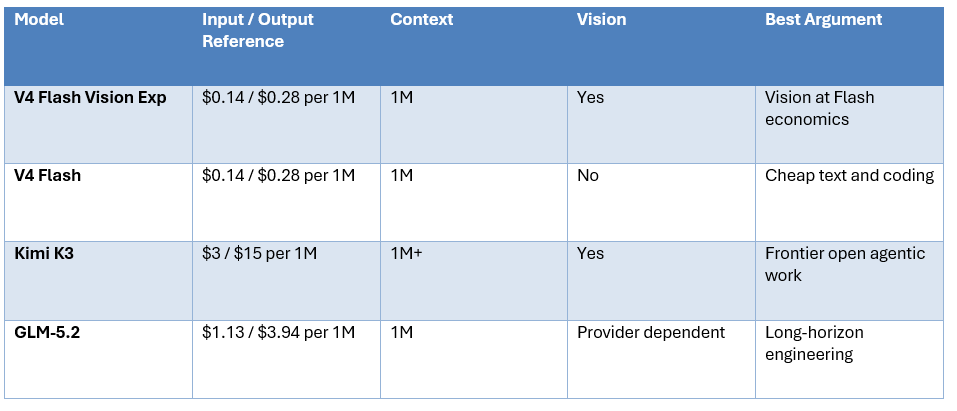
Kimi K3 is the obvious open-model comparison because it combines large context and multimodal inputs, but it is dramatically more expensive through API pricing. Current comparison data puts Kimi K3 around $3 input and $15 output per million tokens versus $0.14 and $0.28 for V4 Flash Vision Exp.
Our Kimi K3 review covers why Kimi earns that premium on demanding agentic work. The real question is whether you need Kimi-level capability on every visual task or only on the hardest ones.
Against closed frontier models, the comparison is even more asymmetric. DeepSeek reports Vision Exp close to Claude Opus 4.8 on selected multimodal-agent benchmarks, but the model does not need to beat Opus everywhere to be economically useful. If it handles 80 to 90 percent of your visual agent turns, a premium model can become the escalation layer instead of the default.
That makes Vision Exp more than a model choice. It is a routing tier. A cheap text-and-vision model can handle the common path while expensive multimodal frontier models handle difficult visual reasoning, dense screenshots and high-risk decisions.
7. Is It Worth Using in Production?
For experimentation and cost-sensitive multimodal agents, yes. As a universal production default on August 22, no. The experimental label matters, the visual compression tradeoff is real, and independent evaluations are still thin because the model launched only yesterday.
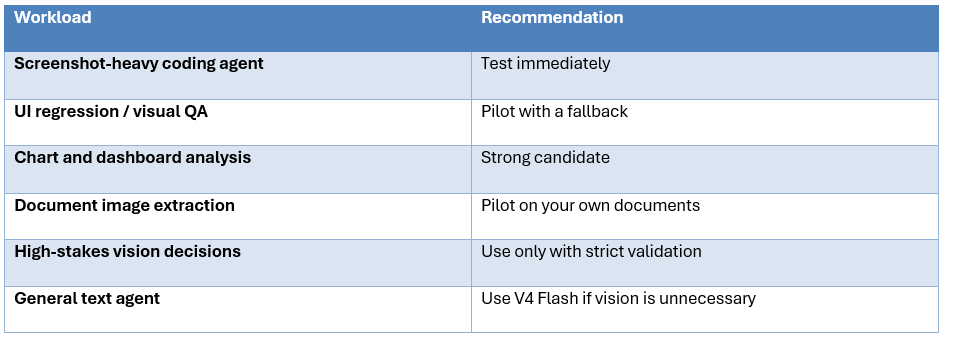
The best reason to deploy it is economic. If your agent already uses DeepSeek V4 Flash and occasionally needs to understand a screenshot, the new model removes the need for a second vision provider. That simplifies orchestration and can reduce the average cost of every multimodal turn.
The best reason not to deploy it blindly is equally simple: experimental models can change. Limits, behavior and performance may shift, and the launch benchmark set is vendor-controlled. Build a fallback path and log visual failures before making it a hard dependency.
This fits the same cost-control philosophy as our Model Routing for AI Coding Agents where the cheapest capable model handles the common path and stronger models handle exceptions.
My rating today: 8.5/10 for developers building multimodal agents, 7/10 as a general-purpose vision model, and 9.5/10 for the price-performance proposition. Those scores are intentionally different. The model is more compelling as infrastructure for agents than as a universal visual intelligence replacement.
A Better Way to Test It Before You Migrate
Do not evaluate Vision Exp with one impressive screenshot. Build a small evaluation set from the images your product actually sees: five common screenshots, five difficult screenshots, several charts, several document pages and a few deliberately noisy examples. Give every image the same task and score factual accuracy, missed details, formatting, latency and cost.
Then compare it with the vision model you currently use. A fair test should include the full agent workflow, not only the first answer. Measure how often the model needs a retry, whether it calls the right tool after seeing the image, and whether it correctly preserves visual facts across multiple turns.
This matters because the main advantage of DeepSeek V4 Flash Vision Exp is economic. The question is not whether it wins every visual benchmark. The question is whether it is good enough on your workload that you can move most visual turns onto a much cheaper model and reserve a premium model for the failures.
Frequently Asked Questions
What is DeepSeek V4 Flash Vision Exp?
It is an experimental multimodal version of DeepSeek V4 Flash that accepts text and image inputs and returns text. It launched on the DeepSeek API on August 21, 2026, with a 1 million token context window and a maximum 384K output.
How much does DeepSeek V4 Flash Vision Exp cost?
It uses the V4 Flash reference pricing of $0.14 per million uncached input tokens and $0.28 per million output tokens. Each image is capped at 384 input tokens after automatic resizing.
What are the DeepSeek V4 Flash Vision Exp benchmarks?
DeepSeek reports 83.9 on Terminal-Bench 2.1, 59.3 on DeepSWE, 57.7 on NL2Repo, 63.6 on DSBench-Hard, 64.3 on Chartography and 36.5 on ApexBench Pass@1. These are launch figures under DeepSeek's stated evaluation setup.
Is DeepSeek V4 Flash Vision Exp close to Claude Opus 4.8?
On selected launch benchmarks it is close. DeepSeek reports 83.9 versus 85.0 on Terminal-Bench 2.1 and 59.3 versus 58.0 on DeepSWE. It is not universally equal, and the comparison is vendor-reported.
Does DeepSeek V4 Flash Vision Exp support images through an API?
Yes. It supports image input through Chat Completions, Messages and Responses-style APIs. Developers can send Base64 images, external URLs or Files API references.
What is the 384-token image limit?
DeepSeek converts an image into input tokens and caps the image contribution at 384 tokens after resizing. This keeps visual input cheap, but it can reduce fine detail in large screenshots, tiny text and dense charts.
Is DeepSeek V4 Flash Vision Exp open source?
Do not treat Vision Exp itself as an open-weight release. The V4 family has open-weight models, but the August 21 Vision Exp launch is an experimental API model. Use the API unless DeepSeek separately announces weights.
Is DeepSeek V4 Flash Vision Exp worth using?
Yes for multimodal agent experiments, screenshot-heavy workflows and cost-sensitive visual analysis, but keep a fallback because the model is experimental and has only just launched. Validate it on your real images before making it the only vision provider.
Recommended Blogs
- DeepSeek V4 Review: Benchmarks, Pricing & Verdict
- DeepSeek V4 Flash: Review, Pricing & When to Use It
- Kimi K3 Review: Benchmarks, Pricing, and K2 Comparison
- GLM-5.3 vs DeepSeek V4-Pro vs Kimi K3: Best Open Coding AI
- What Is Context Engineering? Complete Guide (2026)
Resources & Community
Join our community of 70,000+ AI enthusiasts and learn to build powerful AI applications! Whether you're a beginner or an experienced developer, Build Fast with AI helps you understand and implement AI in your projects.
- Website - buildfastwithai.com
- LinkedIn - Build Fast with AI
- Instagram - @buildfastwithai
- Founder Twitter - @satvikps
- Twitter - @BuildFastWithAI
Agentic AI Launchpad 2026
A structured 6-week cohort program that takes you from AI basics to building and deploying real-world agentic AI systems. Includes live sessions, expert mentorship, project reviews, and a builder community network.
Ready to go from learning to building? Join the next cohort: Agentic AI Launchpad 2026
Free AI Resources
Access free tools, workshops, and micro-learning to keep building.
- AI Workshops - Free resources, upcoming events & past recordings
- Unrot - Learn AI in 5 minutes a day (free micro-learning app)
DeepSeek has made the cheap multimodal agent tier much more interesting. The smart move is not to believe the launch hype or dismiss it because it is experimental. Put it against your real screenshots, documents and agent loops, keep a fallback, and let cost and quality data decide.

