

Best Open-Source AI Models (Nov 2026): I Tested 5
Best Open-Source AI Models November 2026: I Tested the Top 5
A 2.8-trillion-parameter AI model is now free to download. I still would not run it for most of my work.
That one sentence sums up open-source AI in November 2026. Moonshot pushed the Kimi K3.1 Pro weights to Hugging Face on November 4, DeepSeek refreshed V4.1 Flash on October 17, and the best open model on the planet now sits within a single point of Claude Opus 5.5 on a hard agentic coding benchmark. Meanwhile, Alibaba launched its newest flagship, Qwen4-Max, on November 16 as an API-only model. So the open leaderboard has shifted again, and the "best" answer depends far more on your license, hardware and budget than on any one score.
I took the five strongest open-weight models from five different labs (Moonshot, DeepSeek, Tencent, Alibaba and Z.ai) and put them through the same set of real tasks. I also lined them up against BenchLM's independent open-weight composite, the vendors' own model cards, and live API prices. Below is who won, who surprised me, and which one I would actually put into production. If you want the wider field and last month's picks, see our best open-source AI models of October 2026.
The Short Verdict
Kimi K3.1 Pro wins on capability, DeepSeek V4.1 Flash 1017 wins on value, and nobody wins everything. Here is the honest summary before the detail.
● Best overall (raw capability): Kimi K3.1 Pro. Number one on BenchLM's open-weight ranking at 70.6 and the strongest open model on long, multi-step agent work.
● Best for most teams: DeepSeek V4.1 Flash 1017. A 69.9 composite score, MIT license, and API prices that make Kimi look expensive.
● Best truly open license: Tencent Hy4 preview. 770B parameters under unmodified Apache 2.0, ranked third at 68.2.
● Best for front-end and multimodal: Qwen3.8 Max. First on CodeArena's web-development board (preliminary) with text, image and video input.
● Best coding and security specialist: GLM-5.3. Leads the CyberGym defensive-security benchmark at 84.5% and has the friendliest coding plans.
If I could only keep one, I would keep DeepSeek. That is my hot take for this month, and the rest of this post explains why the number one model is not my default.
The 5 Open-Source Models I Tested
The five models below are the top open-weight releases from five different labs on BenchLM's November 19 leaderboard. I skipped Kimi K3 (the older Moonshot model) and Ling 3.1 Flash (an estimated score) so each lab gets one slot.
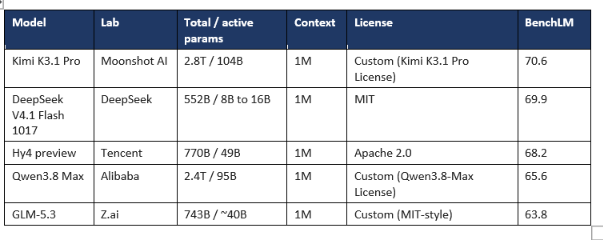
Two things jump out. Every single model now carries a 1-million-token context window, so long context is no longer a differentiator. And the top three are separated by just 2.4 points, which is inside BenchLM's own confidence intervals. The gap between first and third is basically noise. The gap in price and license is not.
One note on DeepSeek's parameter count: the 552B figure is the backbone, and the model activates about 8B parameters during prefill and 16B during decoding. That tiny active footprint is a big part of why it is so cheap to serve.
How I Tested Them
I gave every model the same five tasks, run through the same agent harness, and judged them on whether the job got done, not on how nice the answer sounded. Here is the setup, so you can rerun it yourself.
Repo bug fix: a failing test in a mid-sized TypeScript monorepo, with no hint about which file was broken. The model had to find it, patch it, and get the suite green.
Long agent run: scaffold a small FastAPI service, write tests, run them in a terminal, and recover from at least two deliberate environment errors.
Research with tools: answer a multi-hop question that needed web search, three sources, and a cited summary.
Long document: a 300-page annual report, with ten questions whose answers sat in different sections and tables.
Cost per finished task: total tokens multiplied by each model's list price, counted only on tasks that actually succeeded.
The exact prompt I used for the repo task was simple on purpose: "The test suite is failing. Find the root cause, fix it with the smallest safe change, and explain what broke in two sentences." Short prompts expose weak planning fast.
Two fairness rules. I weighted reliability as heavily as peak skill, because a model that nails four runs and quietly breaks the fifth is worse in production than one that is merely good every time. And I counted price per completed task, not per token, since a cheap model that needs three retries is not cheap. To keep myself honest, I cross-checked my impressions against public numbers: BenchLM for the independent composite, and the Kimi K3.1 Pro model card, which happens to benchmark DeepSeek V4.1 Flash 1017 and GLM-5.3 under the same harness.
1. Kimi K3.1 Pro: The Most Capable Open Model
Kimi K3.1 Pro is the most capable open-weight model you can download today. It is a 2.8-trillion-parameter mixture-of-experts model with 104B active parameters, a 1,048,576-token context window and native image input, released by Moonshot AI on October 23, 2026, with weights published on Hugging Face on November 4.
The numbers back up the hype. On its model card, Kimi K3.1 Pro scores 65.7% on Terminal-Bench 4.0, against 66.4% for Claude Opus 5.5 and 58.2% for GPT-6 Astra. It also posts 70.0 on HLE-Full with tools, 92.1 on BrowseComp and 94.2 on GPQA-Diamond. Artificial Analysis placed it fourth overall at launch and said it would lead all open-weight models once the weights shipped. They shipped.
In my testing, the long agent run is where Kimi pulled away. When I broke the environment mid-task, it diagnosed the missing dependency, fixed it, and carried on without losing the thread. The other four needed at least one nudge somewhere in that run. On the plain repo bug fix, though, the lead mostly disappeared (more on that in the DeepSeek section).
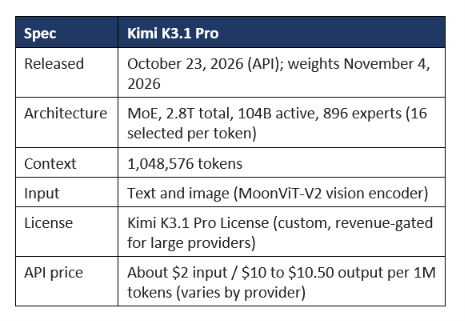
My take: Kimi K3.1 Pro is the first open model I would trust with a genuinely long autonomous task. But "open" here mostly means "you can audit it and pick your provider", not "you will run it on your own box". Full detail is in our Kimi K3.1 Pro review.
2. DeepSeek V4.1 Flash 1017: The One I'd Actually Deploy
DeepSeek V4.1 Flash 1017 is the open model I would actually deploy for most teams. It scores 69.9 on BenchLM, just 0.7 points behind Kimi K3.1 Pro, ships under the MIT license, and costs $0.15 per million input tokens and $0.60 per million output tokens off-peak on DeepSeek's own API.
Here is the part that surprised me. On DeepSWE v1.1, the repo-level coding benchmark, DeepSeek's refresh scores 77.0, which is higher than Kimi K3.1 Pro's 75.5 in Moonshot's own table. That matched what I saw on the repo bug fix: DeepSeek found the broken file quickly, made a tight patch, and wrote a clean two-sentence explanation. Its outputs were noticeably shorter too, which DeepSeek says was a goal of the October update.
Where it falls behind is the long, messy agent run. Terminal-Bench 4.0 tells the same story: 42.3 for DeepSeek versus 65.7 for Kimi. Give DeepSeek a well-scoped task and it flies. Give it an hour-long job with surprises and it needs more supervision.
Specs: 552B backbone, about 8B active in prefill and 16B in decode, 1M context, up to 384K output, text and image input.
Pricing: $0.15 input, $0.003 cached input, $0.60 output per 1M tokens off-peak; peak rates are double.
Other scores (DeepSeek-reported): 42.3 on Terminal-Bench 4.0, 68.2 on NL2Repo-Bench, 60.5 on Automation-Bench.
My take: the smartest setup I know right now is DeepSeek as the default worker and Kimi (or a closed model) as the escalation path for the hard 10%. You get most of the quality at a fraction of the bill. Check the live DeepSeek API pricing page before you budget, and see our DeepSeek-V4.1-Flash-1017 review for the full benchmark set.
3. Tencent Hy4 Preview: The Truly Open Dark Horse
Tencent Hy4 preview is the highest-ranked open model with a genuinely open license. It is a 770B mixture-of-experts model with 49B active parameters and a 1M context, released on August 28, 2026 under unmodified Apache 2.0, and it ranks third on BenchLM at 68.2.
Why does that license matter so much? Because Kimi, Qwen3.8 Max and GLM-5.3 all carry custom terms with revenue or security clauses. Apache 2.0 has none. Any company, including a hyperscaler, can host, fine-tune and resell Hy4 without asking Tencent. For a legal team, that alone can decide the shortlist.
Tencent reports 92.3 on GPQA Diamond, 65.7 on SWE-bench Pro and 82.9 on SWE-bench Multilingual. In its own blind evaluation, 163 experts rated outputs on 203 engineering tasks, and Hy4 preview averaged 2.99 out of 4, against 2.94 for Kimi K3 and 2.92 for GLM-5.3. Hosted access through DeepInfra and Novita runs $0.834 input and $2.501 output per million tokens.
Now the honest criticism. That blind evaluation was run by Tencent on Tencent's model, and a 0.05 gap on a four-point scale is a tie, not a win. Tencent also lists "over-verification" and unnecessarily long reasoning as known issues, and I saw exactly that: on the research task, Hy4 kept re-checking sources it had already confirmed, which burned tokens. And it is still labelled a preview, so expect changes before a stable release.
My take: if your company needs a frontier-scale open model with zero license homework, Hy4 preview is the default answer in November 2026. The Hy4 preview model card ships FP8 weights plus vLLM and SGLang recipes, so getting it running is easier than most. Our Tencent Hy4 news breakdown covers the launch.
4. Qwen3.8 Max: Best for Front-End and Multimodal Work
Qwen3.8 Max is the open model to pick for front-end coding and multimodal work. It is Alibaba's 2.4-trillion-parameter flagship (95B active), with a 1M context and text, image and video input, and its open weights went up on Hugging Face in August 2026 as Qwen3.8-2.4T-A95B.
Its standout signal is web development. The September 2 snapshot, qwen3.8-max-0902, debuted first on CodeArena's web-development leaderboard at 1691, just ahead of Claude Opus 5 at 1688 (a preliminary score, so treat it as a strong hint rather than proof). On my tasks, Qwen produced the best-looking UI when the FastAPI service needed a small dashboard, and it was the most comfortable reading charts inside the 300-page report.
So why only fourth? Its BenchLM composite is 65.6, about five points behind Kimi, and it was less persistent than Kimi or DeepSeek when the agent run went sideways. The API is fair at $2 input and $6 output per million tokens on QwenCloud, with cache reads at $0.17.
Alibaba's licensing comes with a twist worth flagging. The open Qwen3.8 Max weights use a custom Qwen3.8-Max License with commercial limits for large AI-service businesses, while the smaller Qwen3.8-27B is plain Apache 2.0. And Alibaba's newest flagship, Qwen4-Max, launched on November 16 as API-only. Alibaba says smaller Qwen4 models will be open, but the crown jewel is closed for now.
My take: Qwen3.8 Max is the most versatile model here if you care about UI work, charts or video understanding. If you want something you can run at home, the 27B sibling is the real gift. See our Qwen 3.8 Max 0902 review and the guide to running Qwen3.8-Max locally.
5. GLM-5.3: The Coding and Security Specialist
GLM-5.3 is the open model built for coding agents and defensive security. Z.ai released it in mid-August 2026 on the same 743B base as GLM-5.2 (about 40B active), with a 1M context, and published the weights on August 28 under a custom MIT-style license.
Its headline result is security: 84.5% on CyberGym, ahead of GPT-5.6 Sol at 83.6%, and Z.ai says it found more than 2,400 vulnerabilities across 269 open-source projects. On raw agentic coding it is solid but not the leader. In Moonshot's same-harness table, GLM-5.3 scores 41.8 on Terminal-Bench 4.0 and 66.9 on DeepSWE v1.1, roughly level with DeepSeek on terminal work and behind it on repo fixes.
Price is middle of the pack: $1.40 input, $0.26 cached and $4.40 output per million tokens on Z.ai's API. The better deal for individual developers is the GLM Coding Plan, which plugs into tools like OpenCode and Cline.
In my run, GLM-5.3 was the most careful reviewer. When I asked each model to audit the FastAPI service before shipping, GLM flagged an unsafe file-upload path the others missed. It was slower to finish the long agent run, though.
My take: GLM-5.3 is not the best general model here, and its composite of 63.8 says so. But if your work leans toward code review, security audits, or a cheap monthly coding plan, it earns its spot. Read our GLM-5.3 pricing and access guide before you sign up.
Head-to-Head Benchmarks
On the hardest agentic benchmark, Kimi K3.1 Pro leads every open model by a wide margin, but DeepSeek V4.1 Flash 1017 wins repo-level coding. The cleanest comparison comes from the Kimi K3.1 Pro model card, which runs Kimi, DeepSeek and GLM-5.3 under the same harness, plus two closed models for reference.
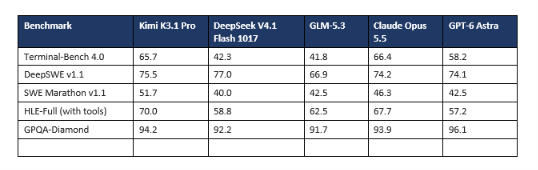
Source: Kimi K3.1 Pro model card (Moonshot-run evaluations at max reasoning effort). Hy4 preview and Qwen3.8 Max are not in this table, so I compare them on the independent composite below instead.
Two lessons. First, a single open model now beats Claude Opus 5.5 on SWE Marathon and HLE with tools, which would have sounded absurd a year ago. Second, the benchmarks disagree with each other a lot: DeepSeek is 23 points behind Kimi on Terminal-Bench but ahead on DeepSWE. Coding benchmarks and agent benchmarks measure different muscles, which we unpack in why AI benchmarks disagree. All five models are vendor-reported on their own cards, so the BenchLM open-source leaderboard is the fairest single view.
Price Comparison: The Gap Is Huge
DeepSeek V4.1 Flash 1017 is roughly 13 times cheaper than Kimi K3.1 Pro on input tokens and about 17 times cheaper on output at off-peak rates. That price gap is bigger than any capability gap in this post.
Run the math on a real workload. One million agent tasks that each use 20K input and 4K output tokens would cost about $5,400 on DeepSeek off-peak and roughly $82,000 on Kimi K3.1 Pro at the listed rates. Even if Kimi finishes 10% more tasks on the first try, that is a hard sell for routine work.
Prices also move fast in this market, and caching changes everything for agents that reuse long contexts. Treat this table as a starting point and price your own traffic.
Open Weights vs Open Source: Read the License
Only two of these five models use a standard open-source license: DeepSeek V4.1 Flash 1017 (MIT) and Tencent Hy4 preview (Apache 2.0). The other three are open weights under custom terms, and that difference matters more than most leaderboards admit.
Kimi K3.1 Pro: internal use is broadly free, but model-as-a-service operators above a revenue threshold (reported as $20 million over 12 months, including affiliates) need a separate agreement, and very large products must display "Kimi K3.1-Pro" in their UI.
Qwen3.8 Max: a custom Qwen3.8-Max License adds commercial limits for large AI-service businesses. Qwen3.8-27B stays on Apache 2.0.
GLM-5.3: MIT-style terms, plus a security review for model-as-a-service operators above $10 billion in revenue. The smaller GLM-5.3-Flash is plain MIT.
Here is my contrarian point. People argue about which open model is "smartest" while ignoring the clause that decides whether they can ship it. For a startup, none of these limits will bite. For an enterprise or a hosting company, the license is the first filter, and on that filter Hy4 and DeepSeek beat Kimi easily.
Always read the actual LICENSE file on Hugging Face before you build. Press summaries of these terms disagree in the details.
Can You Actually Run These Locally?
Not on a normal computer. All five flagships need server-class hardware, and the "best" open model is the hardest one to self-host.
Weight sizes come from model cards and early community reports, so treat them as approximate. If you want something on a single 24GB GPU, none of these five is the answer. Qwen3.8-27B (Apache 2.0) is the practical pick there, and our 24GB VRAM AI models guide shows what fits once you account for KV cache. For the bigger models, see how to run GLM-5.3 locally and how to run Kimi K3 locally.
Also Worth Knowing: MiMo, Muse Spark Open and Qwen3.8-27B
Three more open models deserve a mention, even though they did not make my top five.
Xiaomi MiMo-V2.6-Pro: 1.02T parameters (42B active), MIT license, text, image, video and audio input, and absurdly cheap at $0.435 input and $0.87 output per million tokens. It scores 63.5 on BenchLM, only 0.3 behind GLM-5.3. Read our MiMo-V2.6 review.
Meta Muse Spark Open: 816B parameters (42B active), Meta's answer to China's open models, with native multimodal input and a 1M context. But it ranks 18th on BenchLM at 55.8 and uses a custom Muse Model License. More in our Muse Spark Open news story.
Qwen3.8-27B: the best open model for local use, under Apache 2.0, and small enough for high-end consumer hardware when quantized.
Honestly, MiMo-V2.6-Pro could swap places with GLM-5.3 depending on your workload. If you need audio or video understanding on a budget, test it first.
Which Model Wins for Your Use Case?
Match your job to the row below and you have your answer.
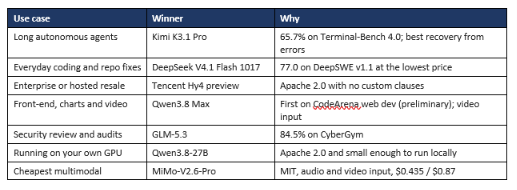
The pattern is clear. No single open model is best at everything, so the strongest setups route work: a cheap, fast model for the bulk of tasks and a heavier one for the hard cases. For how open models stack up against Claude and GPT, see our best AI models of October 2026.
My Final Ranking
Weighing capability, reliability, price and license together, here is my November 2026 ranking of open-source AI models.
Kimi K3.1 Pro. The most capable open model and the one I trust most on long agent runs. Expensive and hard to self-host.
DeepSeek V4.1 Flash 1017. Second on paper, first in my workflow. Near-Kimi quality, MIT license, tiny price.
Tencent Hy4 preview. The best model with a truly open license. A preview, so expect changes.
Qwen3.8 Max. The most versatile for UI and multimodal work, with a great 27B sibling for local use.
GLM-5.3. A focused coding and security specialist with friendly coding plans.
If you forced me to pick one winner for the average developer, it is DeepSeek V4.1 Flash 1017. If you forced me to pick the best open model, full stop, it is Kimi K3.1 Pro. Both answers are true, and that tension is the real story of open-source AI right now. I will rerun this test next month, and I am watching for Alibaba's promised smaller Qwen4 open models. For a related head-to-head, see GLM-5.3 vs DeepSeek V4-Pro vs Kimi K3.
Frequently Asked Questions
What is the best open-source AI model in November 2026?
Kimi K3.1 Pro is the best open-source AI model in November 2026 on raw capability. It leads BenchLM's open-weight ranking at 70.6 (November 19) and scores 65.7% on Terminal-Bench 4.0, close to Claude Opus 5.5's 66.4%. For most teams, though, DeepSeek V4.1 Flash 1017 (69.9) is the better pick because of its MIT license and far lower price.
Is Kimi K3.1 Pro really open source?
Kimi K3.1 Pro is open-weight, not open source in the strict sense. Moonshot published the full 2.8T-parameter weights on Hugging Face on November 4, 2026 under a custom Kimi K3.1 Pro License. Internal use is broadly free, but large model-as-a-service providers above a revenue threshold need a separate agreement with Moonshot.
Kimi K3.1 Pro vs DeepSeek V4.1 Flash: which is better?
Kimi K3.1 Pro is better for long, autonomous agent work, scoring 65.7 on Terminal-Bench 4.0 against DeepSeek's 42.3. DeepSeek V4.1 Flash 1017 is better for repo-level coding (77.0 vs 75.5 on DeepSWE v1.1) and costs about $0.15 versus $2 per million input tokens. Use DeepSeek as your default and Kimi for the hardest tasks.
Which open-source AI model is best for coding?
For everyday repository coding, DeepSeek V4.1 Flash 1017 is the best value, with 77.0 on DeepSWE v1.1. For long terminal-based coding agents, Kimi K3.1 Pro leads with 65.7% on Terminal-Bench 4.0. For front-end and web UI work, Qwen3.8 Max ranked first on CodeArena's web-development board, and GLM-5.3 is strongest for security review.
Which open-source model has the most permissive license?
Tencent Hy4 preview has the most permissive license among the top open models, using unmodified Apache 2.0 for its 770B-parameter weights. DeepSeek V4.1 Flash 1017 is also fully permissive under MIT. Kimi K3.1 Pro, Qwen3.8 Max and GLM-5.3 all use custom licenses with revenue or security conditions for very large providers.
Can I run these open-source models locally?
Not on a typical PC. Kimi K3.1 Pro's checkpoint is about 1.5TB, Tencent Hy4 preview needs roughly 814GB in FP8, and the others also need multi-GPU servers. For a single 24GB GPU, Qwen3.8-27B under Apache 2.0 is the practical choice, and most people use the big models through an API.
Is Qwen4-Max open source?
No. Alibaba launched Qwen4-Max on November 16, 2026 as an API-only model with 2.4 trillion parameters and a 1M context. Alibaba has said smaller Qwen4 models will be released with open weights, but no date has been confirmed. The newest open-weight Qwen flagship is still Qwen3.8 Max.
Are open-source models as good as Claude Opus 5.5 and GPT-6 Astra?
On some benchmarks, yes. In Moonshot's published comparison, Kimi K3.1 Pro beats Claude Opus 5.5 on SWE Marathon v1.1 (51.7 vs 46.3) and HLE-Full with tools (70.0 vs 67.7), and beats GPT-6 Astra on Terminal-Bench 4.0 (65.7 vs 58.2). Closed models still lead on some reasoning tests, such as GPT-6 Astra's 96.1 on GPQA-Diamond.
Recommended Blogs
These are real posts that exist on buildfastwithai.com right now:
- Best Open-Source AI Models of October 2026: Benchmarks, VRAM & Local Setup
- Kimi K3.1 Pro Review: Benchmarks, Price, Coding & Is It Worth It? (2026)
- DeepSeek-V4.1-Flash-1017 Review: Benchmarks, Price & Coding (2026)
- GLM-5.3 vs DeepSeek V4-Pro vs Kimi K3: Best Open Coding AI (2026)
- 24GB VRAM AI Models: What Can You Actually Run Locally in 2026?
References
- BenchLM: Open-Source LLM Leaderboard, November 19, 2026 ranking
- Hugging Face: Kimi K3.1 Pro model card, specs and same-harness benchmarks
- TechNode: Moonshot AI releases Kimi K3.1 Pro model weights
- Artificial Analysis: Kimi K3.1 Pro launch benchmarks
- Hugging Face: DeepSeek-V4.1-Flash-1017 model card (MIT)
- DeepSeek API Docs: Models and pricing
- Hugging Face: Tencent Hy4 preview model card (Apache 2.0)
- Alibaba Cloud: Qwen3.8-27B launch and Qwen3.8 flagship weights
- South China Morning Post: Alibaba adds commercial restrictions to open-weight Qwen3.8-Max
- Hugging Face: GLM-5.3 model card
- TechNode: Z.ai launches GLM-5.3 with claimed 50% gain on coding benchmark
Want a tested breakdown like this every month? Subscribe to the Build Fast with AI newsletter and follow us on LinkedIn for the next open-model ranking.

Founder at Build Fast with AI. AI Engineer, educator, and researcher passionate about agentic AI workflows, LLM application architecture, and training the next generation of AI builders.

