



Why AI Benchmarks Disagree: One Model Can Be #1 on Coding and Weak on Agents
AI benchmark leaderboards increasingly look like they are contradicting one another. A model can sit at or near the top of a coding benchmark and then look ordinary on a broader agent benchmark. Another model can lose on a narrow code-generation test but perform better once it has to navigate tools, terminals, environments and long multi-step workflows.
That is not necessarily a sign that one benchmark is broken. More often, the benchmarks are measuring different jobs. Writing a function from a clean prompt is not the same problem as repairing a real repository. Repairing a repository is not the same problem as operating a terminal environment. And neither is identical to running a complete coding agent that has to decide what context to inspect, which tool to call, when to retry and when to stop.
The distinction matters in 2026 because coding has shifted from autocomplete toward agents. Modern evaluations increasingly measure systems that combine a model, a harness, tools, context, an execution environment and feedback. Anthropic reported that infrastructure configuration alone moved Terminal-Bench 2.0 results by six percentage points in its internal experiments. A 2026 position paper likewise argues that coding-agent evaluations can blend model, harness and environment into a single score.
QUICK ANSWER
AI benchmarks disagree because they measure different capabilities, different task formats and sometimes different complete systems. LiveCodeBench is primarily a programming problem benchmark. SWE-bench is about resolving issues in real repositories. Terminal-Bench adds a shell environment where an agent has to inspect state, execute commands and iterate. Agent-oriented indexes can go further by scoring a specific model-plus-harness setup.
That means a #1 model on one leaderboard is not automatically the best model for every developer workflow. A benchmark tells you how a model or system performed on a defined task. It does not turn that result into a universal ranking of every AI capability.
The other reason rankings move is that agent benchmarks contain more variables. Context retrieval, tool descriptions, retry logic, time limits, environment state and the coding harness can all change the result. Anthropic measured a six-point infrastructure spread on Terminal-Bench 2.0 in internal tests.
The practical rule is simple: match the benchmark to the job. Use programming benchmarks for programming questions, repository benchmarks for repository repair, terminal benchmarks for tool-using agents, and private evaluations for your own production workflow.
1. What Does an AI Coding Benchmark Actually Measure?
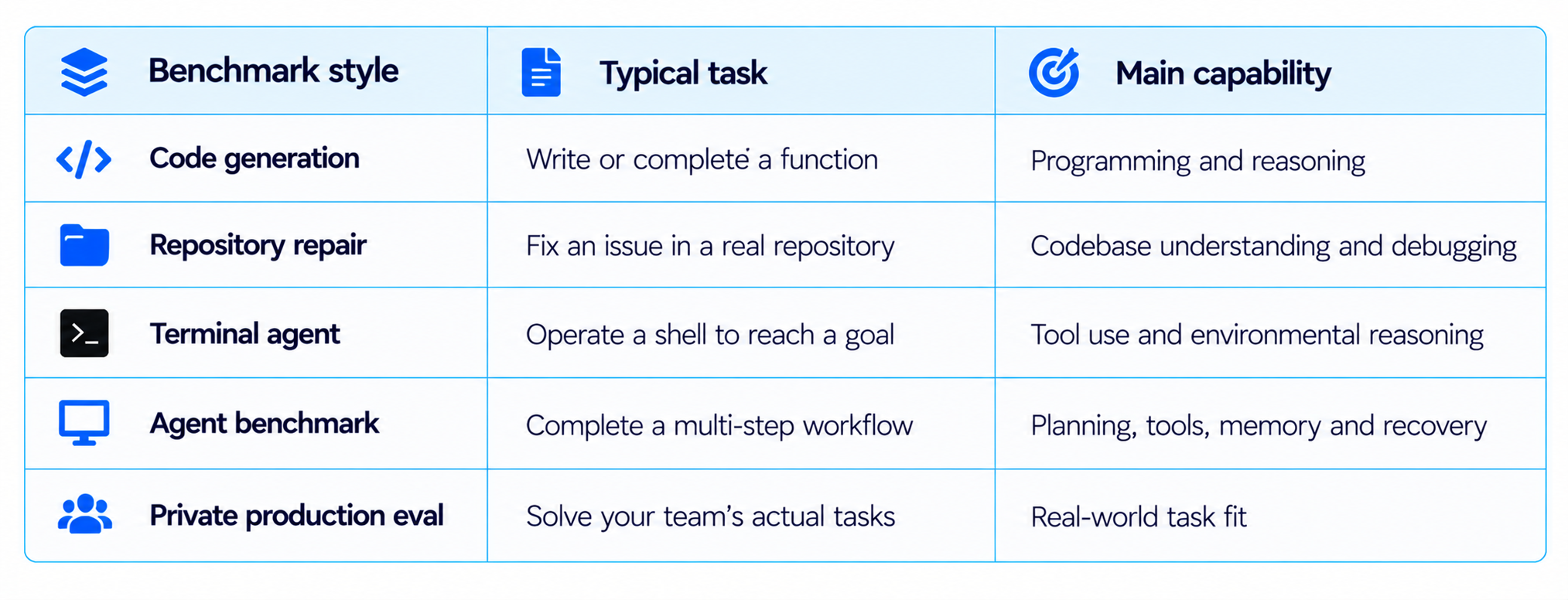
The phrase coding benchmark hides several different tasks. A benchmark can ask a model to complete a function, solve an algorithmic problem, explain code, generate tests, repair a real bug, answer questions about a repository or operate an entire software environment.
Those tasks exercise different capabilities. Short code-generation tasks reward syntax, algorithmic reasoning and instruction following. Repository tasks add codebase navigation and compatibility constraints. Terminal tasks add environment state, tool selection and recovery.
2. LiveCodeBench: Strong Coding Does Not Mean Strong Agency
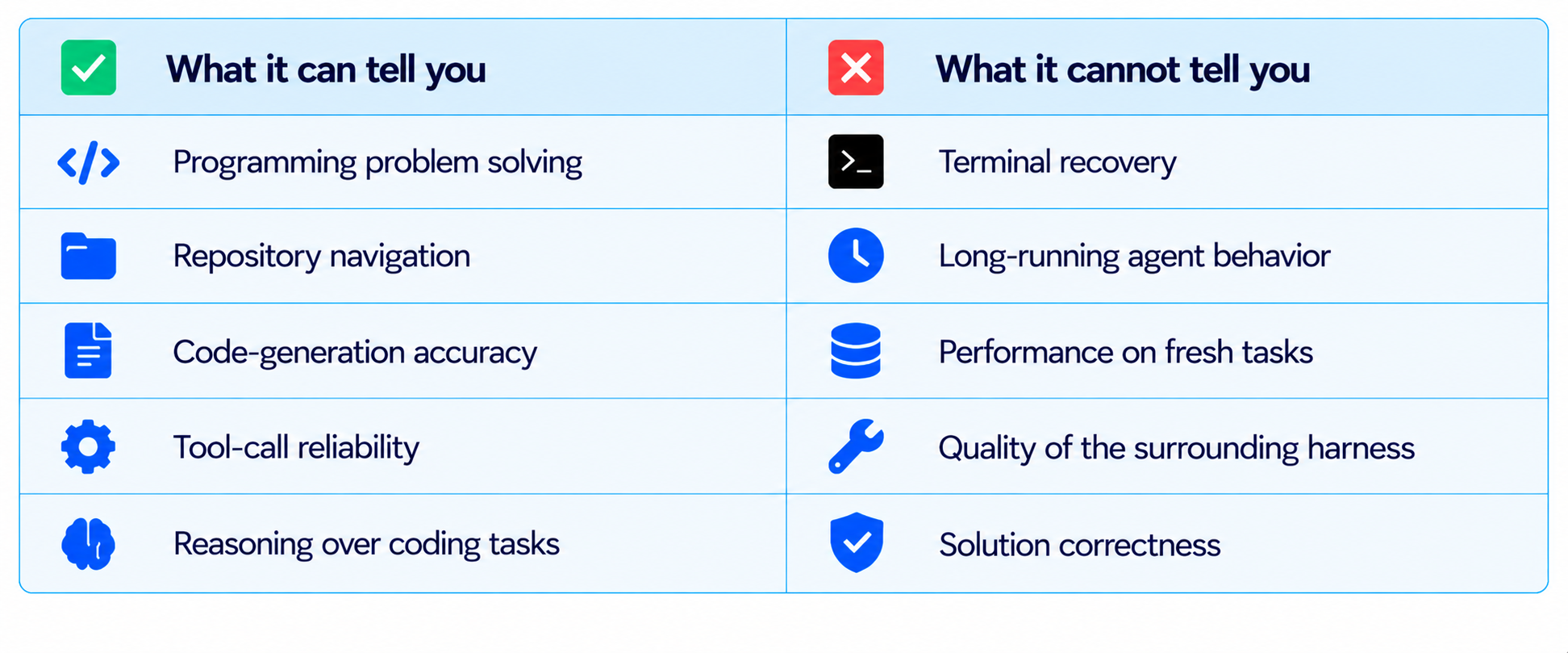
LiveCodeBench is built around competitive-programming-style tasks collected over time. It is useful for measuring programming problem solving and code generation under controlled conditions. It is deliberately much cleaner than a messy real-world development environment.
A strong LiveCodeBench result tells you that the model is good at solving the programming task presented to it. It does not tell you how well the same model will find the right file in a large repository, choose a terminal command, use a tool correctly or recover after a failed action.
3. SWE-bench: A Different Kind of Coding Test
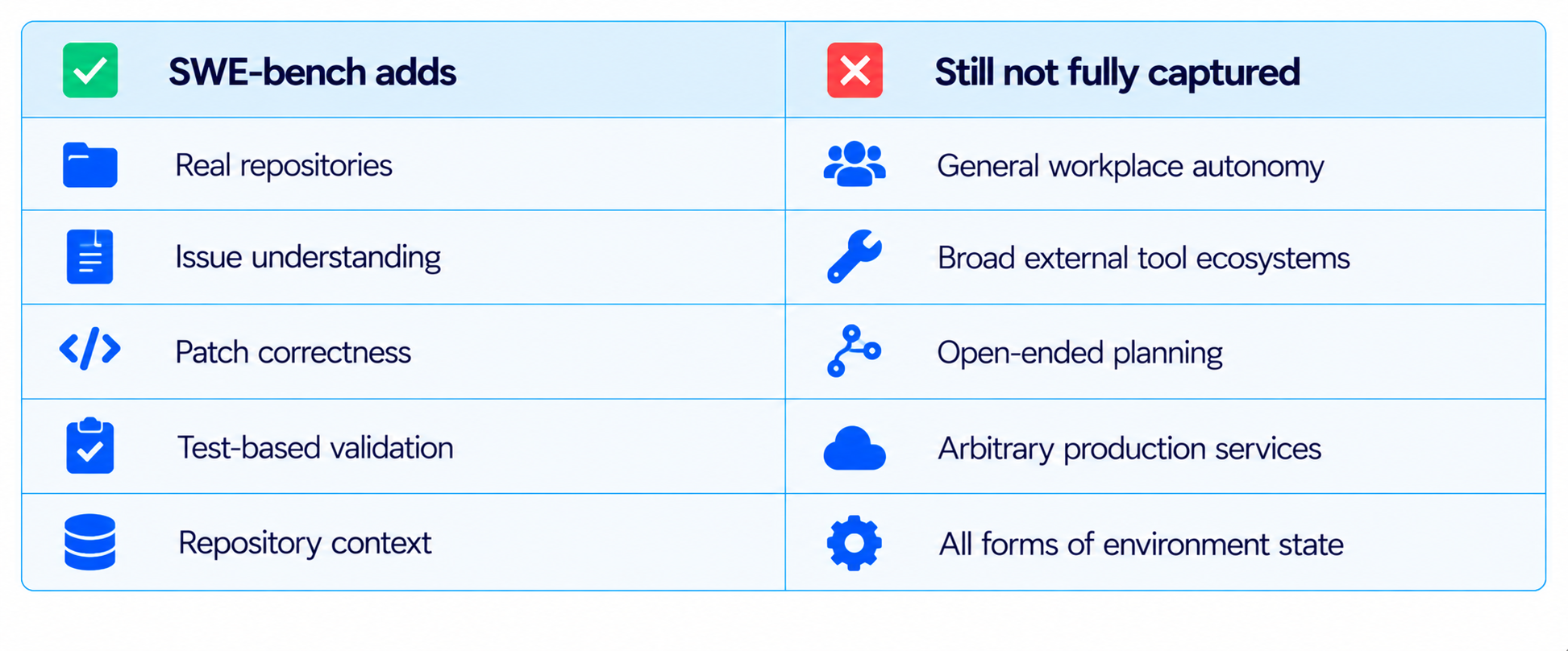
SWE-bench moves closer to software engineering by using real repositories and issue reports. Instead of starting from a blank editor, the system has to understand an existing project and make a change that satisfies the benchmark tests.
That introduces repository understanding, debugging and compatibility constraints. But SWE-bench still has a defined task boundary. It does not measure every kind of autonomous work a coding agent may perform, such as provisioning a new environment or coordinating arbitrary external services.
4. Terminal-Bench: Where Agents Start to Look Different
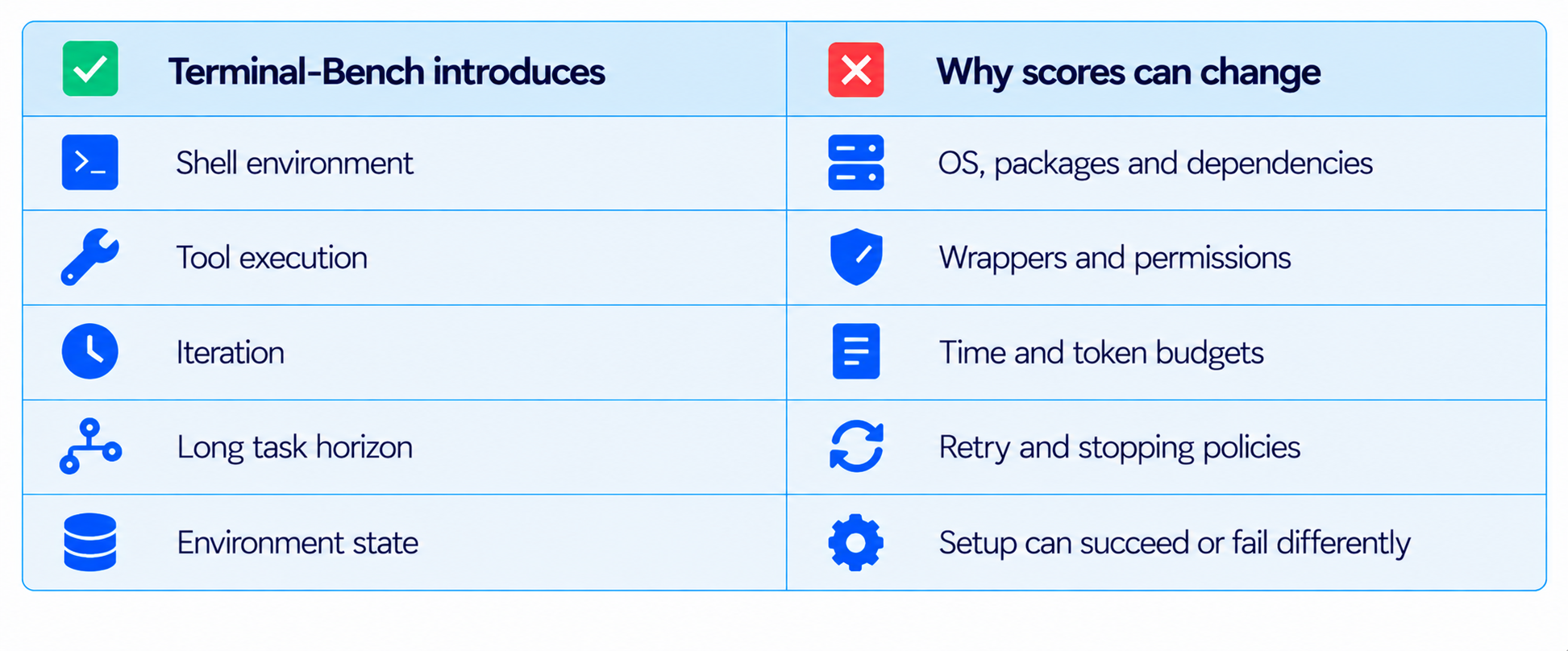
Terminal-Bench changes the problem from writing the right code to operating a working environment. The agent can inspect files, run commands, install dependencies, read outputs and iterate toward a goal.
That extra layer explains many ranking reversals. A model can be excellent at generating a correct patch but weaker when it has to decide which command to run next, interpret a shell error or recover from an unexpected environment state.
Infrastructure is part of the measurement too. Anthropic found a six-point spread caused by infrastructure configuration alone in its internal Terminal-Bench 2.0 experiments. That is large enough to matter when models are separated by only a few points.
5. Agent Benchmarks Measure a System
Once an evaluation gives an AI agent tools, context retrieval, a terminal and feedback, the final score becomes a property of the complete system.
A useful mental model is: Agent performance = model + harness + context + tools + environment + feedback loop + evaluation policy.
Change any of those components and the score can move. The same model can therefore perform differently inside two coding agents even when the underlying model weights are identical.
Artificial Analysis makes this distinction explicit in its Coding Agent Index by reporting model-and-harness combinations rather than pretending the model alone is the entire agent. The index combines DeepSWE, Terminal-Bench v2 and SWE-Atlas-QnA.
6. The Harness Can Change the Winner
Suppose Model A writes better code but Model B has a better coding-agent harness. Model A may win a static coding benchmark while Model B wins an agent evaluation.
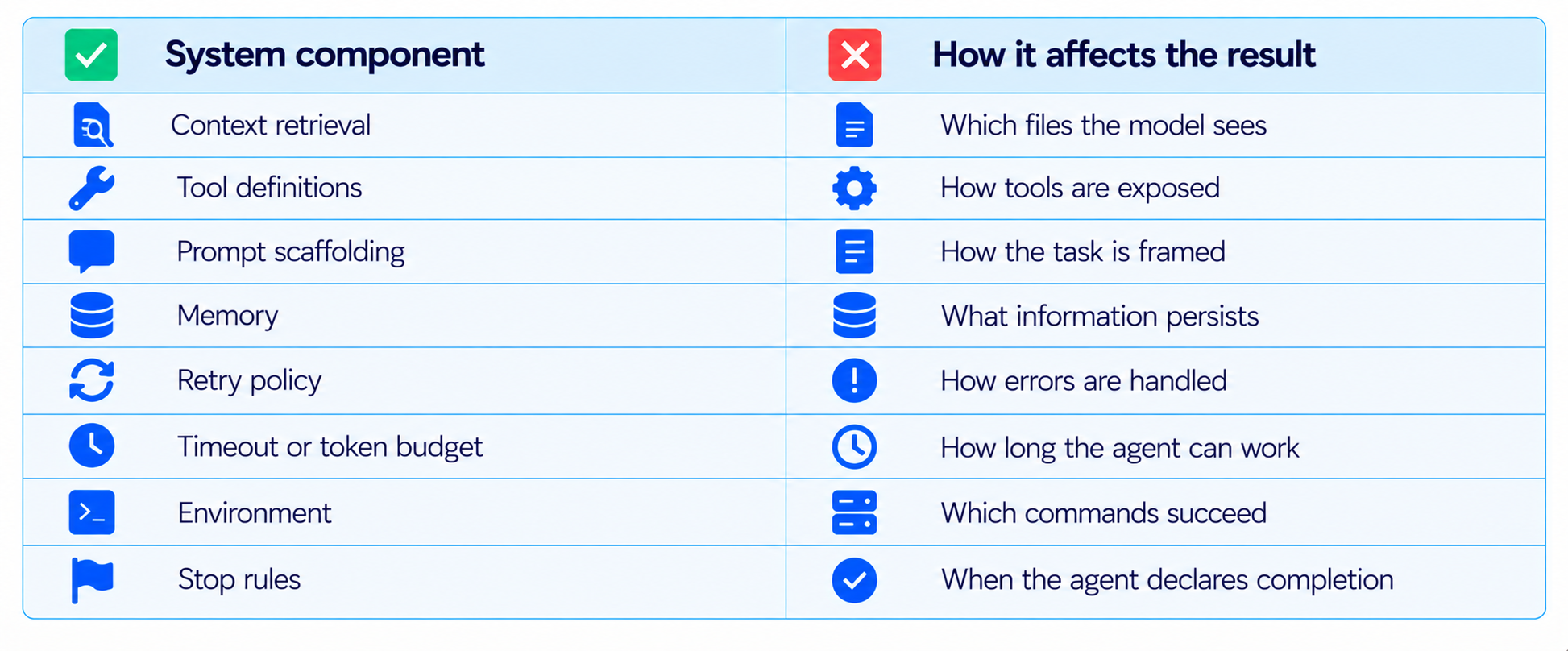
This is why a benchmark score should ideally name the exact evaluated setup. A number without its model, harness and environment is missing part of the experiment.
7. Infrastructure Is Part of the Experiment
An agent with every dependency installed is facing a different problem from an agent that has to discover and repair its own environment. An agent with generous time and tool budgets also has more opportunity to recover from mistakes.
Anthropic’s 2026 Terminal-Bench analysis is a useful reminder that infrastructure is not a minor footnote. Different setups produced a six-point spread in its internal experiments. For close leaderboard races, that can be the difference between first place and the middle of the pack.
This does not make agent benchmarks useless. It means the result needs a test contract: benchmark version, environment, harness, hardware, time budget, tool access and attempt policy.
8. The Single-Reference Problem
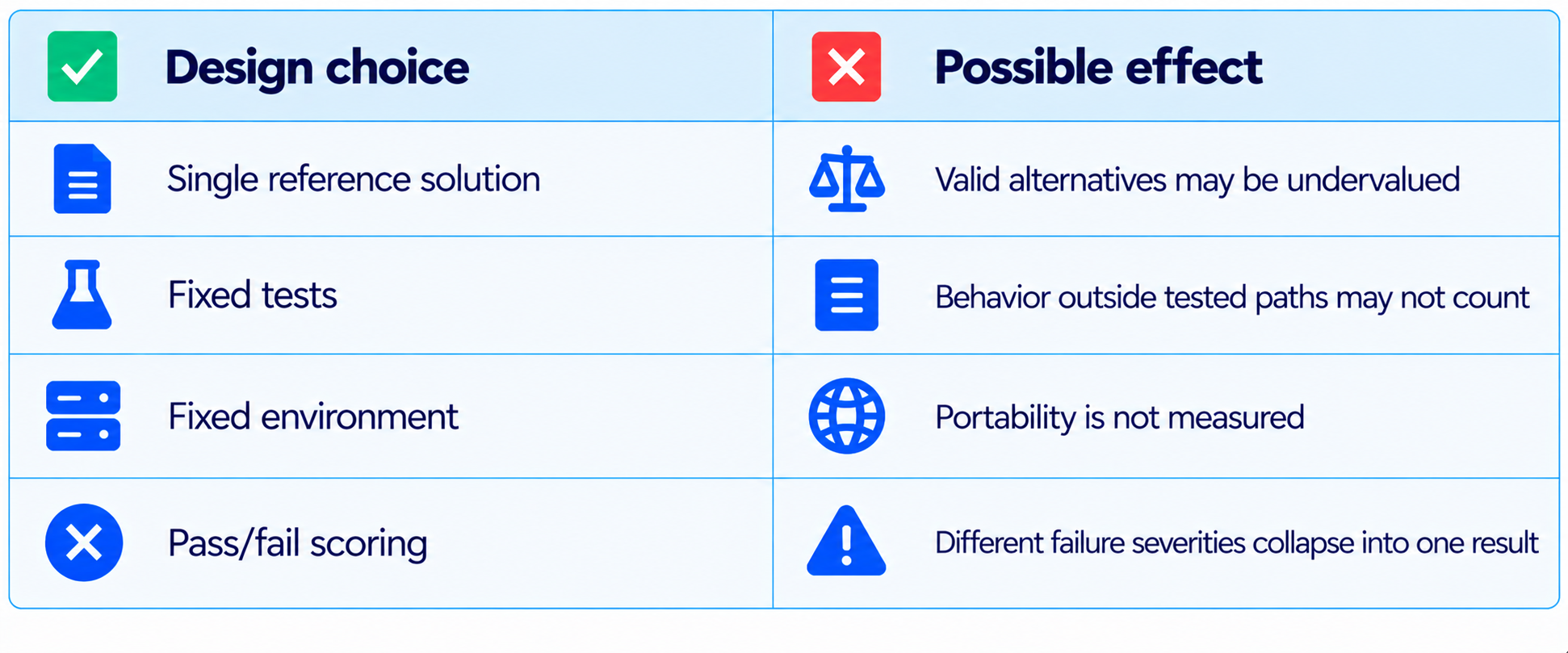
Benchmark grading can create another source of disagreement. Some evaluations compare a generated solution against a reference solution or fixed tests.
Real engineering often has many valid implementations. Two patches can have different code structure and both be correct, maintainable and compatible. A benchmark that is tightly coupled to one expected representation can under-credit alternative solutions.
A 2026 position paper on coding benchmarks argues that single-reference grading can penalize equally valid alternatives and that current end-to-end agent scores can hide which component actually caused the failure.
9. Why Coding Benchmarks Can Saturate
As models improve, older benchmarks can stop separating them effectively. When most current systems solve the easier tasks, the remaining hard tasks dominate the leaderboard.
A 2026 coding-agent benchmark review noted that leading agents were already reaching roughly the high-70 percent range on SWE-bench Verified by May and argued that the benchmark was approaching saturation.
This creates another ranking effect: several models can look nearly identical on one benchmark while a newer benchmark with harder terminal or long-horizon tasks spreads them much further apart.
10. Why One Model Can Be #1 on Coding and Weak on Agents
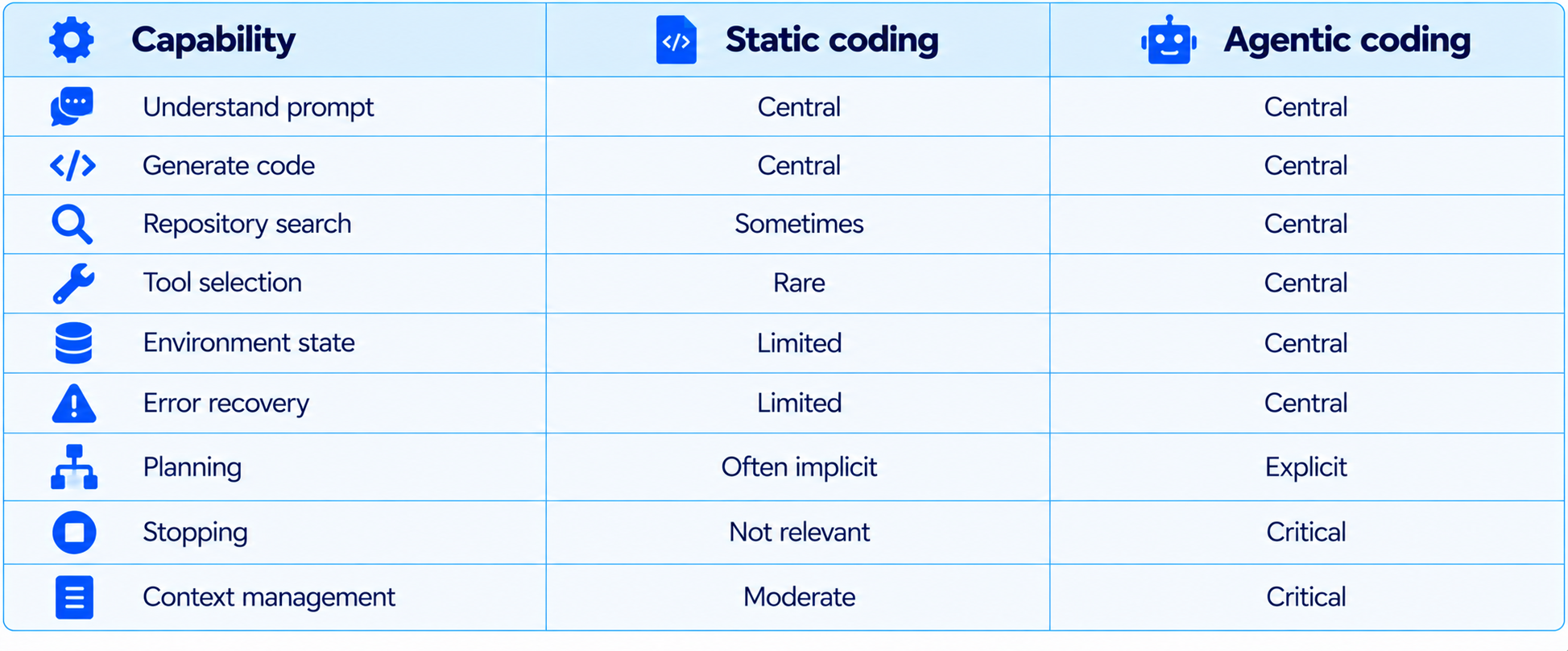
A model can be excellent at the first two rows and weaker at the rest. That is enough to create a large leaderboard reversal.
The agent does not receive the task as one clean question. It has to discover the path to the answer. Every additional decision is another place where the system can fail.
11. Why Agent Benchmarks Are More Volatile
Agent benchmarks contain more opportunities for failure. A static code task may have one major decision: generate the solution. An agent task can contain dozens of decisions about context, commands, edits, retries and verification.
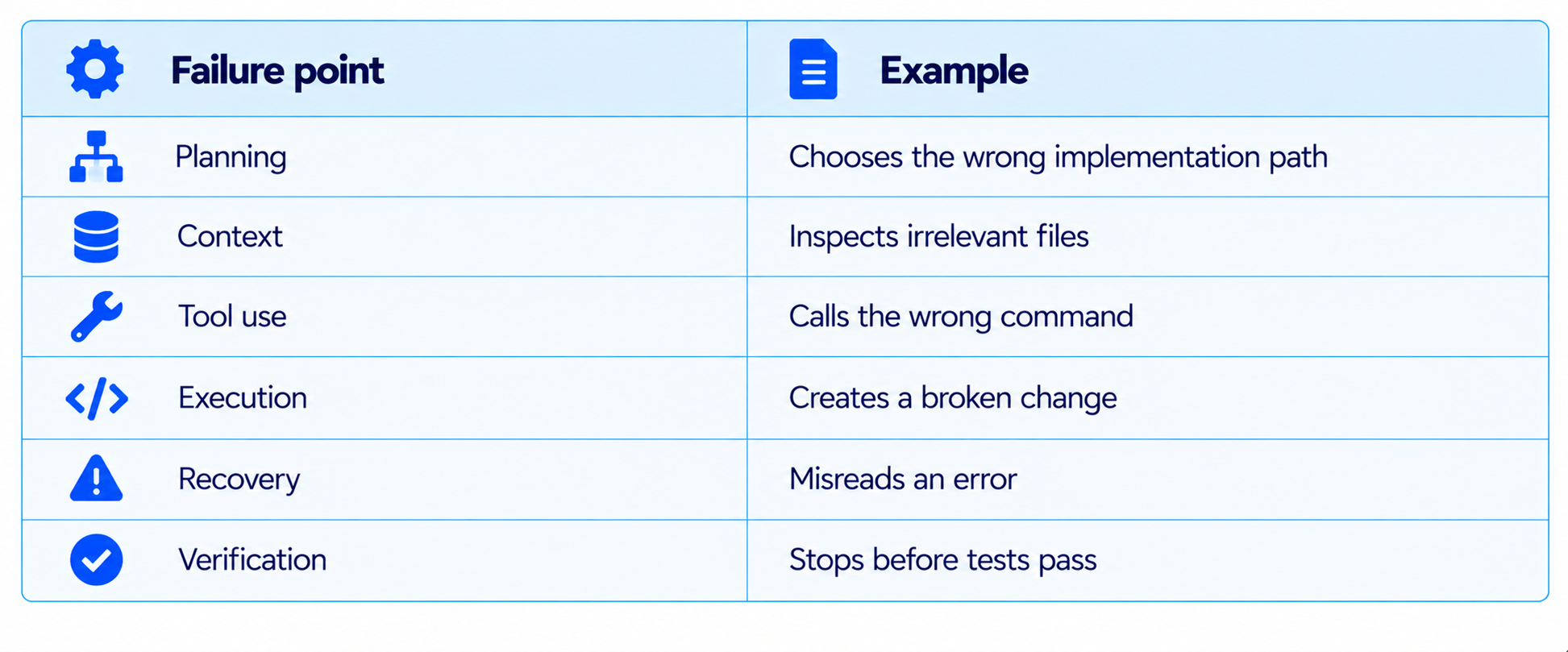
A small difference in per-step reliability can become a large difference in end-to-end completion because failures compound across the task.
12. Model Size Does Not Guarantee the Agent Win
A larger or more capable model can still lose an agent benchmark if the system around it is slower, less reliable or poorly configured.
Agent benchmarks evaluate completion under constraints. A smaller model with better context retrieval, stronger tool definitions and a better retry loop can outperform a larger model on a bounded workflow.
This is why production teams should track outcome metrics rather than only benchmark rank. A model that costs less, responds faster and completes your actual tasks with fewer retries can be the better engineering choice even if another model has a higher general intelligence score.
13. How to Read Benchmark Tables Correctly
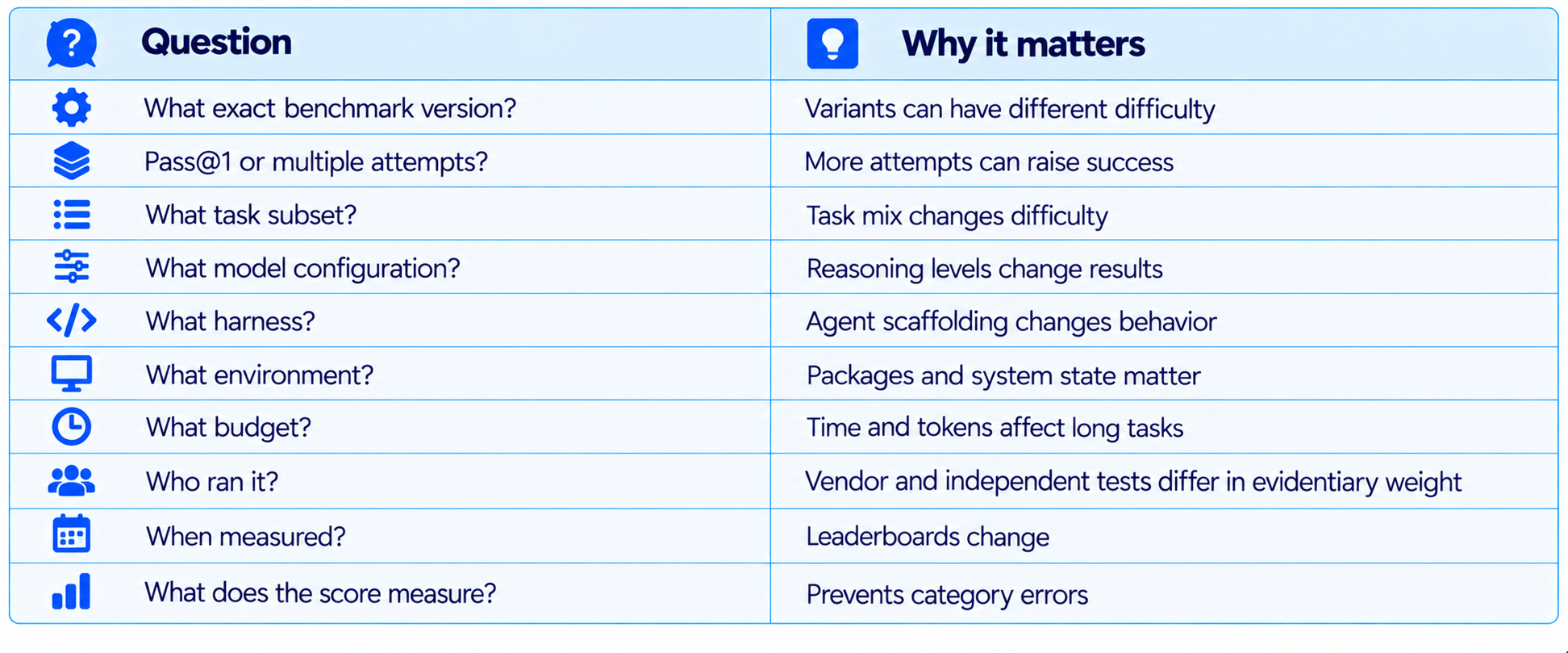
This checklist becomes especially important when two benchmarks disagree by only a few points. A small leaderboard gap may be smaller than the hidden difference in evaluation setup.
14. A Better Way to Compare Coding Models
Instead of searching for one universal benchmark, build a portfolio that maps to the work you care about.
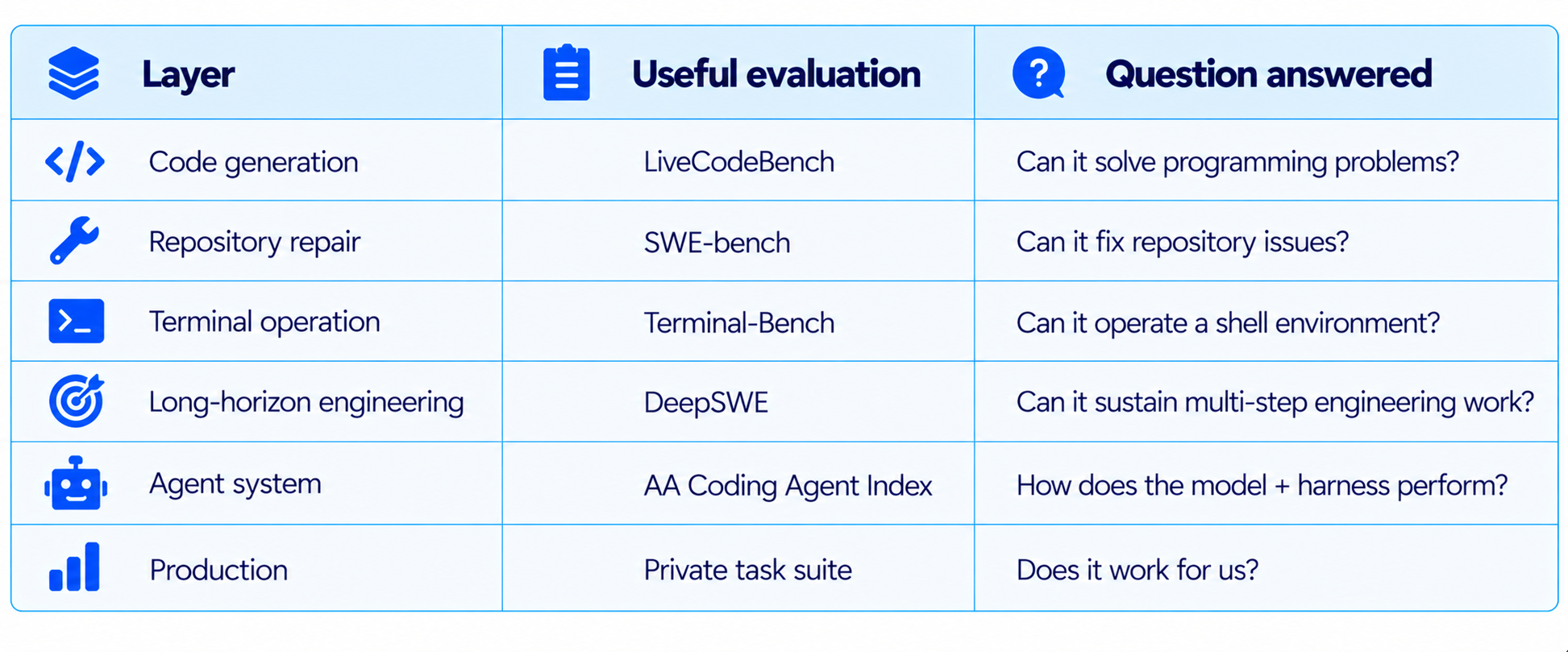
This is also why model routing works. You do not need one model to dominate every category. You can use the model that is strongest for each task class.
For a practical implementation, see Model Routing for AI Coding Agents.
15. Your Private Benchmark Is the Final Judge
Public leaderboards are useful for discovering candidates. They are not substitutes for your own evaluation.
A strong internal coding-agent benchmark should contain the tasks your team actually performs: bug fixes, feature requests, dependency upgrades, migrations, tests, refactors and infrastructure changes.
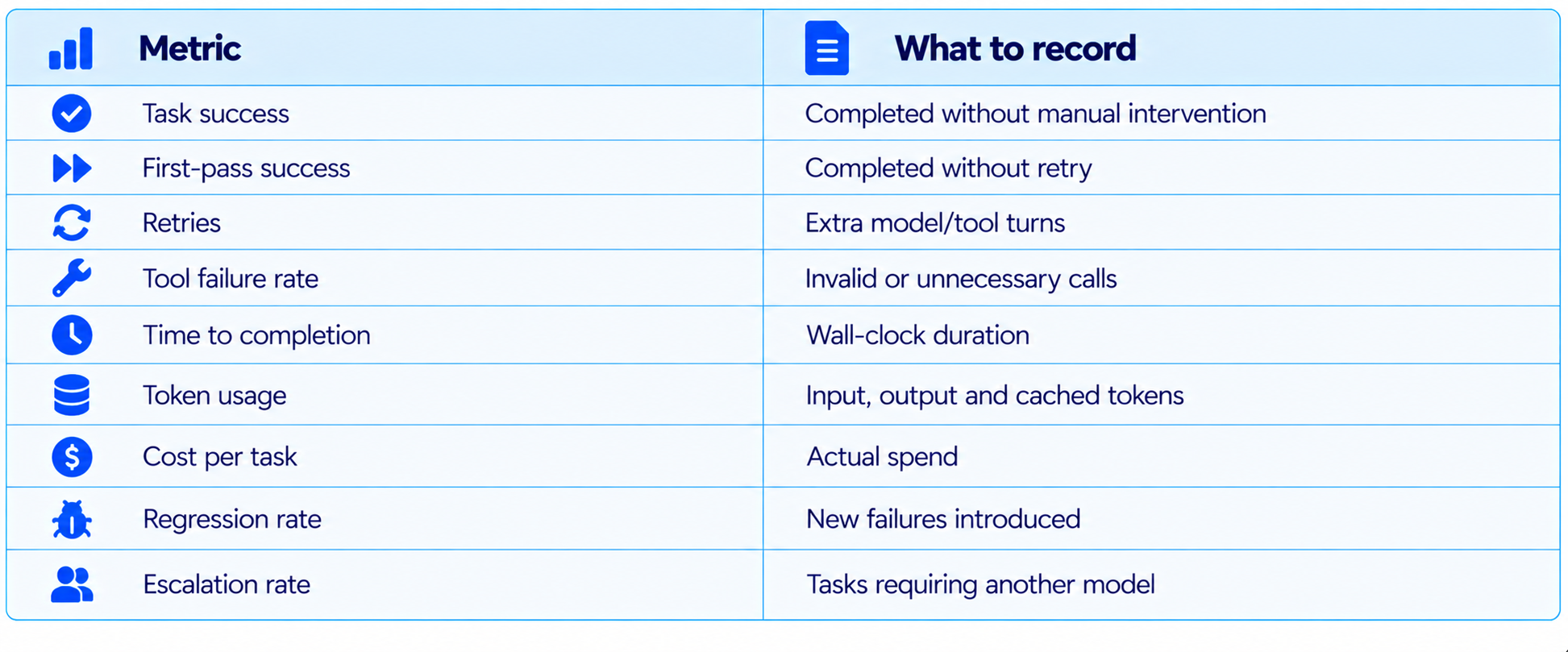
Run the same benchmark across models and agent configurations. Keep the harness fixed when comparing models. Keep the model fixed when testing different harnesses. That separation helps you identify where the improvement came from.
16. Benchmark Scores Are Not Product Reviews
A leaderboard measures a constrained evaluation. A product has a much broader surface area.
A production model has to work with your prompts, your context, your tools, your latency requirements, your privacy rules and your failure handling. A benchmark can provide useful evidence about one capability, but it cannot fully answer whether the model is easy to integrate or economically sensible for your application.
This matters especially for agents. An agent is a complete product system, while the underlying model is only one component.
17. What Benchmark Disagreement Actually Tells You
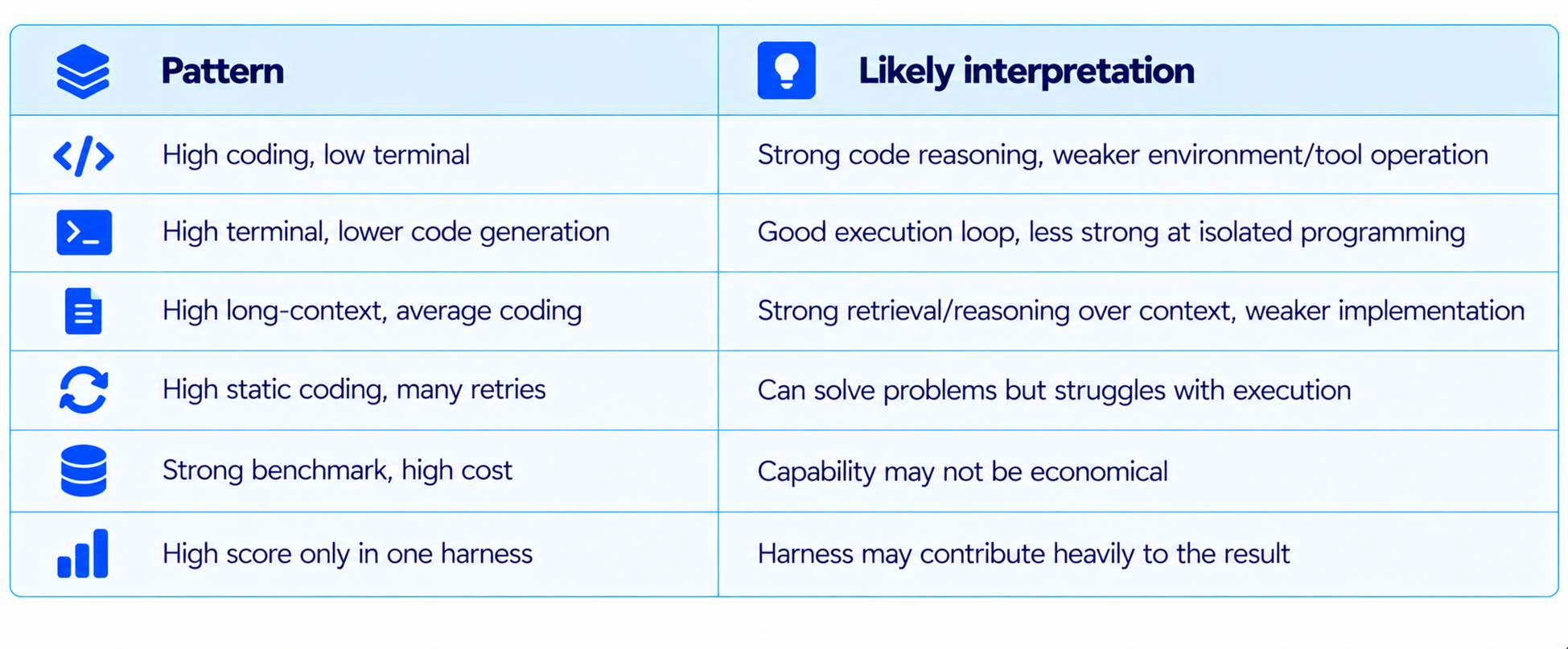
The disagreement becomes useful when you stop asking which leaderboard is right and start asking what capability each leaderboard is revealing.
18. The Benchmark Stack to Use in 2026
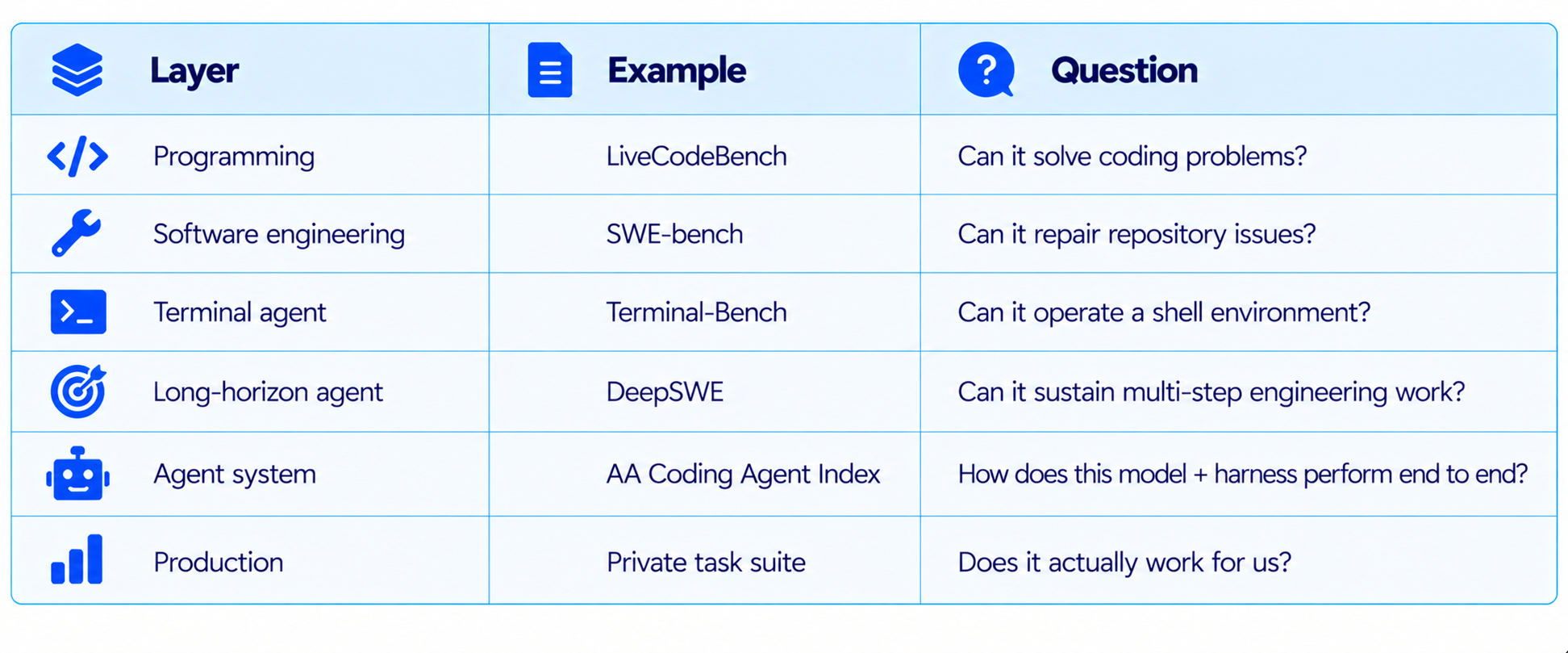
Artificial Analysis’s Coding Agent Index is particularly useful conceptually because it evaluates model-and-harness combinations and combines DeepSWE, Terminal-Bench v2 and SWE-Atlas-QnA into an agent-oriented measurement.
19. How to Build a Better Internal Benchmark
- Collect 30-100 tasks from real work, not synthetic prompts only.
- Separate code generation, debugging, repository work and tool-heavy tasks.
- Define success criteria before running the models.
- Keep model prompts and tool permissions identical for model comparisons.
- Record failures and retries, not only pass rates.
- Track cost and latency alongside quality.
- Re-run the suite whenever the model, harness or tool layer changes.
This creates a living evaluation rather than a one-time leaderboard. It also makes benchmark disagreements easier to explain because you can see which component changed.
20. Final Takeaway
AI benchmarks disagree because AI capability is multidimensional. Coding is not one task, and agentic software engineering is not simply more coding. It adds environment state, tool use, planning, recovery, context management and stopping decisions.
A model can therefore be #1 on a coding benchmark and weaker on an agent benchmark without any contradiction. The benchmarks are testing different slices of the system.
Recent research makes the distinction clear. Anthropic has shown that infrastructure configuration can materially change agentic coding scores. Researchers have argued that current coding benchmarks can conflate model and harness performance. Artificial Analysis now evaluates model-and-harness combinations in its Coding Agent Index.
The right way to read a leaderboard is not “who is #1?” but “what job was measured, under what conditions, and how close is that job to mine?” Once you ask that question, benchmark disagreements stop looking like contradictions and start looking like a map of different AI capabilities.
Frequently Asked Questions
Why do AI benchmarks disagree?
Because different benchmarks measure different tasks, datasets, environments, scoring rules and sometimes complete agent systems rather than the underlying model alone.
Why can a model be #1 on coding and weak on agents?
Static coding focuses heavily on solving the programming problem. Agent benchmarks add planning, tool use, environment state, recovery and stopping decisions.
What is the difference between LiveCodeBench and Terminal-Bench?
LiveCodeBench focuses on programming problem solving, while Terminal-Bench evaluates agents operating inside a terminal environment.
Does SWE-bench measure agents?
SWE-bench evaluates software issue resolution in repositories and is closer to real software engineering than isolated code generation, but it remains a defined repository task rather than a complete measure of autonomy.
Why does the agent harness matter?
The harness controls context gathering, tool definitions, retries, memory, stopping rules and other parts of the workflow.
Can infrastructure change benchmark scores?
Yes. Anthropic reported a six-point infrastructure-driven spread in its internal Terminal-Bench 2.0 experiments.
Should I trust AI leaderboards?
Use them as evidence about a specific evaluation, not as universal rankings. Check the benchmark version, configuration, harness, environment and scoring method.
What is the best benchmark for coding agents?
There is no single best benchmark. Use coding, repository, terminal and long-horizon evaluations together, then validate with your own task suite.
How should I choose an AI coding model?
Match the benchmark to the job, test the model in your real workflow and measure completion, retries, latency, cost and regressions.
Why is a private benchmark important?
It measures the model on your codebase, tools and workflow instead of a generic test set.
Recommended Blogs
Model Routing for AI Coding Agents: How to Cut Costs Without Losing Quality
How to Secure AI Coding Agents: Permissions, Sandboxing, MCP & Secrets
Gemini 3.8 Flash Review: Accuracy, Price & Is It Worth It? (2026)
Meta Muse Spark 1.3 Review: Coding, Price & Is It Worth It? (2026)
Qwen 3.8 Max 0902 Review: Benchmarks, Price & Is It Worth It? (2026)
Resources & Community
Join our community of 70,000+ AI enthusiasts and learn to build powerful AI applications. Whether you are a beginner or an experienced developer, Build Fast with AI helps you understand and implement AI in your projects.
Agentic AI Launchpad 2026
A structured 6-week cohort program that takes you from AI basics to building and deploying real-world agentic AI systems. Includes live sessions, expert mentorship, project reviews and a builder community network.
Ready to go from learning to building? Join the next cohort: Agentic AI Launchpad 2026
Free AI Resources
Access free tools, workshops and micro-learning to keep building.

