



Lyria 3.5 Review: Is Google's New AI Music Model Good Enough to Challenge Suno?
Lyria 3.5 is Google's latest music generation model, and the most important change is not simply that it can make longer songs. Google has pushed the model across the parts that matter most when a generated track is meant to sound like a finished musical idea: richer melodic structures, better lyrics, more expressive vocals and more control over tempo and duration.
Google first introduced Lyria 3.5 in Flow Music on July 29, 2026. On September 4, Google expanded the model to the Gemini app and the Gemini API, making Lyria 3.5 available globally in Gemini and accessible to developers through Google AI Studio and the API. Google also lists Lyria 3.5 in Google Vids, while Flow Music remains the dedicated creative surface.
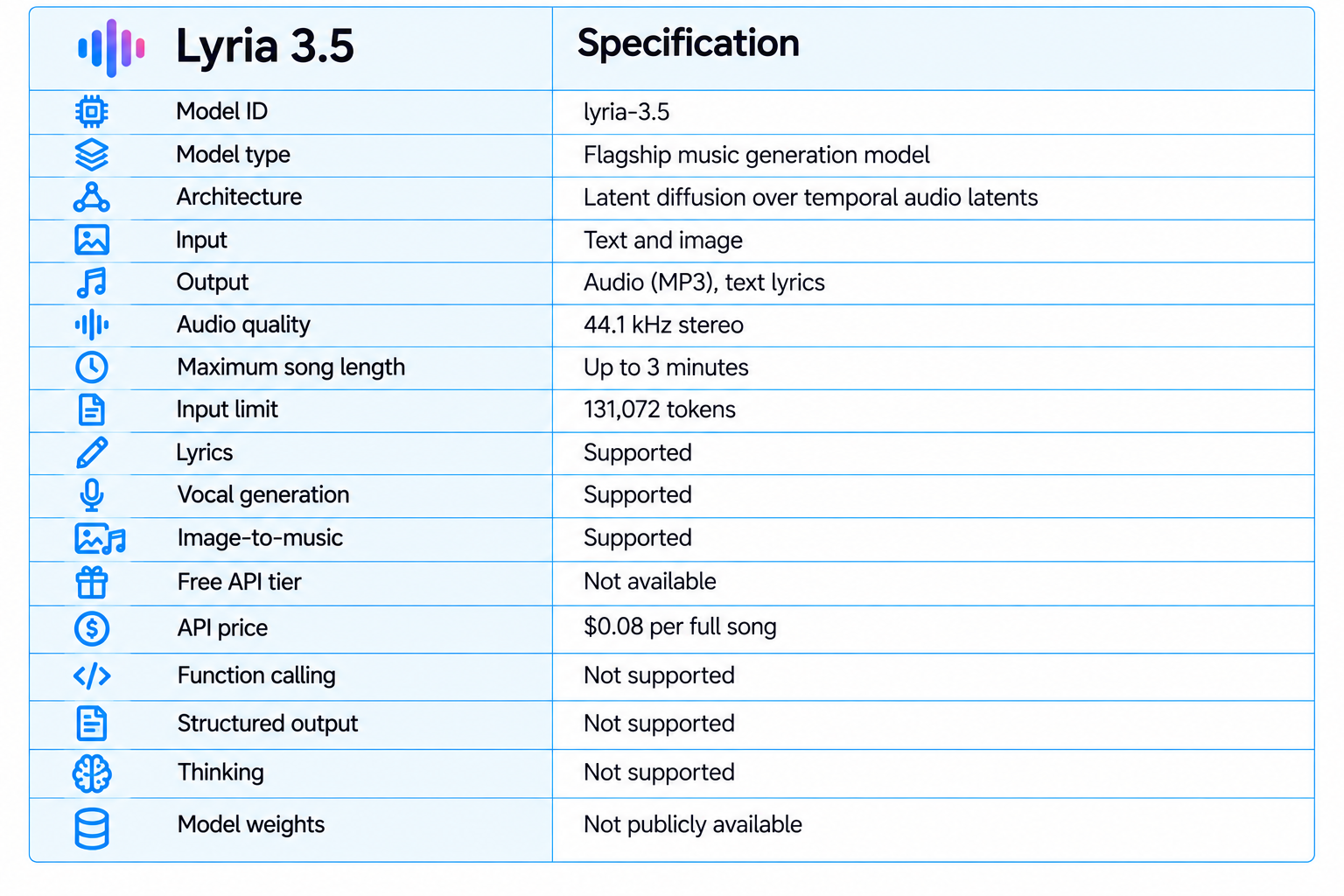
The model is now positioned as Google's most capable music-generation system. Its model card says Lyria 3.5 uses latent diffusion over temporal audio latents and generates audio from text, with text lyrics as a companion output. Google's evaluation with music experts found significant improvement over Lyria 2 in audio fidelity and better prompt adherence for lyrics, while the product release emphasizes more natural musicality, stronger vocal expression and improved pronunciation.
QUICK ANSWER
Lyria 3.5 is Google's current flagship music-generation model, designed for full-length songs with more coherent musical structure, expressive vocals and stronger lyric control. Google describes it as its best-sounding music model and supports songs of up to three minutes, with text or image prompts and 44.1 kHz stereo audio through the developer API.
The quality improvements are most visible in three areas: musicality, vocals and lyric adherence. Google says Lyria 3.5 creates richer melodic structures, more realistic and emotionally nuanced vocals, improved pronunciation and stronger compliance with simple and complex lyric instructions. Its model-card evaluation also found a significant audio-fidelity improvement over Lyria 2.
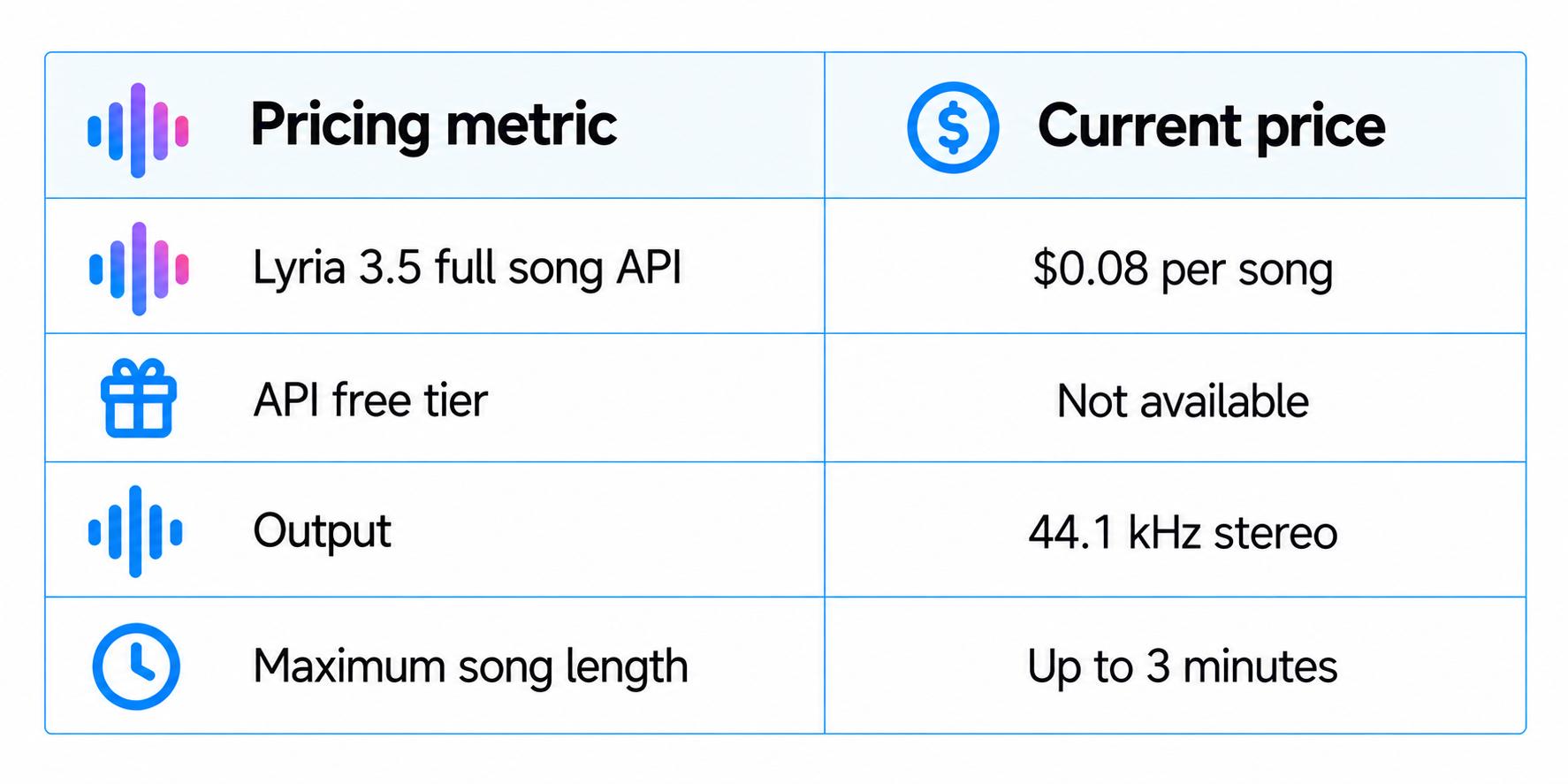
Pricing is straightforward on the Gemini API: Google currently charges $0.08 per generated full song for lyria-3.5. There is no free API tier for this model.
For everyday creators, Lyria 3.5 is available globally in the Gemini app, and the dedicated Flow Music experience provides additional music-focused controls. For developers, the API accepts text and image input and returns MP3 audio plus generated lyrics.
My verdict: 9.2/10 overall. Lyria 3.5 is one of the strongest music-generation systems to test in 2026 if you care about vocals, song structure, audio fidelity and integration with Google's creative ecosystem.
1. What Is Lyria 3.5?
Lyria 3.5 is the latest model in Google's Lyria family, which Google DeepMind has been developing specifically for AI music generation. The family now spans short-form clip generation, full-song generation and real-time music systems, with Lyria 3.5 occupying the current flagship position for full-length music.
Google's model card describes Lyria 3.5 as a music generation system that synthesizes high-quality audio from prompts. Its architecture uses latent diffusion applied to temporal audio latents, and training uses JAX and ML Pathways on Google's TPU infrastructure.
The model is not a general-purpose language model with music bolted on. Its output is music audio, accompanied by lyrics as text. That specialization is why Lyria 3.5 can expose musical controls that would be unusual for an ordinary chatbot.
2. Lyria 3.5 Specifications
3. How Much Better Is Lyria 3.5?
Google's model card gives a clear evaluation direction. Lyria 3.5 was tested with both human and automated evaluations designed with music experts, covering music quality and aesthetics, vocal quality, audio fidelity and prompt adherence across in-distribution and out-of-distribution prompts.
The result Google publishes is qualitative but meaningful: Lyria 3.5 improved significantly over Lyria 2 on audio fidelity, and when lyrics are involved it follows prompts more accurately, including more complex instructions.
That is important because music quality is not just about whether the output sounds clean. A track needs a convincing arrangement, sensible progression, coherent lyrics and a performance that fits the intended style.
4. Musicality and Song Structure
Lyria 3.5 is designed to make musical structure more convincing. Google specifically highlights richer melodic structures and the ability to maintain more complex musical ideas across a full track.
For a creator, that changes the usefulness of the model. A short generated clip can sound impressive with almost no structural continuity. A full song has to carry a motif, manage transitions and make verses, choruses or bridges feel related rather than randomly concatenated.
This is where Lyria 3.5's full-song focus matters. Google describes the model as optimized for longer music creation, while the current developer model page distinguishes it from the short-clip Lyria 3.5 Clip endpoint.
5. Vocals: One of the Biggest Improvements
Vocals are one of the clearest areas where Google says Lyria 3.5 improved. The release highlights more realistic and emotionally nuanced vocal performance, stronger expression and improved pronunciation.
That matters because vocals expose generation errors immediately. Pronunciation, timing, phrasing and emotional delivery have to work together with the melody. A synthetic vocal can have technically clean audio and still sound unconvincing if the performance does not fit the lyrics.
Lyria 3.5 is therefore especially interesting for creators who want songs with actual vocal identity rather than instrumental beds. For release-bound work, creators should still listen closely for pronunciation, lyrical interpretation and stylistic consistency before treating an output as final.
6. Lyrics and Prompt Adherence
Google says Lyria 3.5 demonstrates better prompt adherence when lyrics are involved, including the ability to follow more complex instructions. The model card specifically identifies lyrics as an area where the new model improves over Lyria 2.
That makes detailed prompting more useful. You can specify genre, instrumentation, mood, vocal character, tempo and lyric structure instead of giving the model only a broad style description.
7. Tempo and Duration Control
Google explicitly highlights improved control over tempo and duration in Lyria 3.5. That is useful for creators working to a fixed visual timeline because the music can be generated around the intended length instead of forcing the editor to cut a random-duration song.
The current Lyria product page says the latest family can create cohesive tracks up to three minutes long and that creators can prompt for the length they need, including shorter clips and full three-minute songs.
For advertising, social video and product content, this makes Lyria 3.5 more useful than a model that only generates a fixed short clip.
8. Image-to-Music: A Powerful Creative Feature
Lyria 3.5 accepts images as inputs in the Gemini API, and Google demonstrates an image-to-music workflow in its Lyria product experience. You can upload an image and ask Lyria to create a track inspired by the visual.
A visual reference can encode mood, palette, setting and narrative cues that are hard to describe in text. A cinematic landscape, fashion image or product photograph can become the starting point for a soundtrack without first writing a detailed musical brief.
The feature is especially well suited to video creators. Instead of searching through stock music libraries for a generic track, you can generate a custom score from the visual concept itself.
9. Lyria 3.5 in Gemini
Google expanded Lyria 3.5 to the Gemini app on September 4, 2026, making it available globally on web and mobile. Gemini users can describe or select a genre, choose vocal or instrumental styles, use templates for common music tasks and choose shorter or longer tracks.
This makes Lyria 3.5 significantly easier to use than an API-only model. A non-technical creator can experiment in Gemini without writing code, while developers can move to the API when the music-generation workflow needs to be integrated into a product.
10. Lyria 3.5 in Flow Music
Flow Music is the dedicated Google Labs experience for Lyria. Google launched Lyria 3.5 there on July 29 and built the experience around musical control rather than general chat. The product announcement emphasizes richer musicality, improved vocals and lyrics, and control over tempo and duration.
For musicians and producers, Flow Music is the natural first place to try the model. It removes the need to construct API requests and puts the creative process ahead of the infrastructure.
The larger picture is that Google now distributes Lyria 3.5 across several surfaces: Flow Music for dedicated creation, Gemini for general users, AI Studio and the API for developers, and Google Vids for video workflows.
11. Lyria 3.5 API and Developer Access
The current Gemini API model page lists lyria-3.5 as the full-song model. It accepts text or image input and returns MP3 audio and lyrics. The input token limit is 131,072. The model does not support function calling, code execution, file search, search grounding or structured outputs because it is a specialized music-generation endpoint.
Google's music-generation documentation provides REST and Python pathways for retrieving generated audio from the response.
12. Lyria 3.5 Pricing
13. Lyria 3.5 vs Lyria 3 Pro
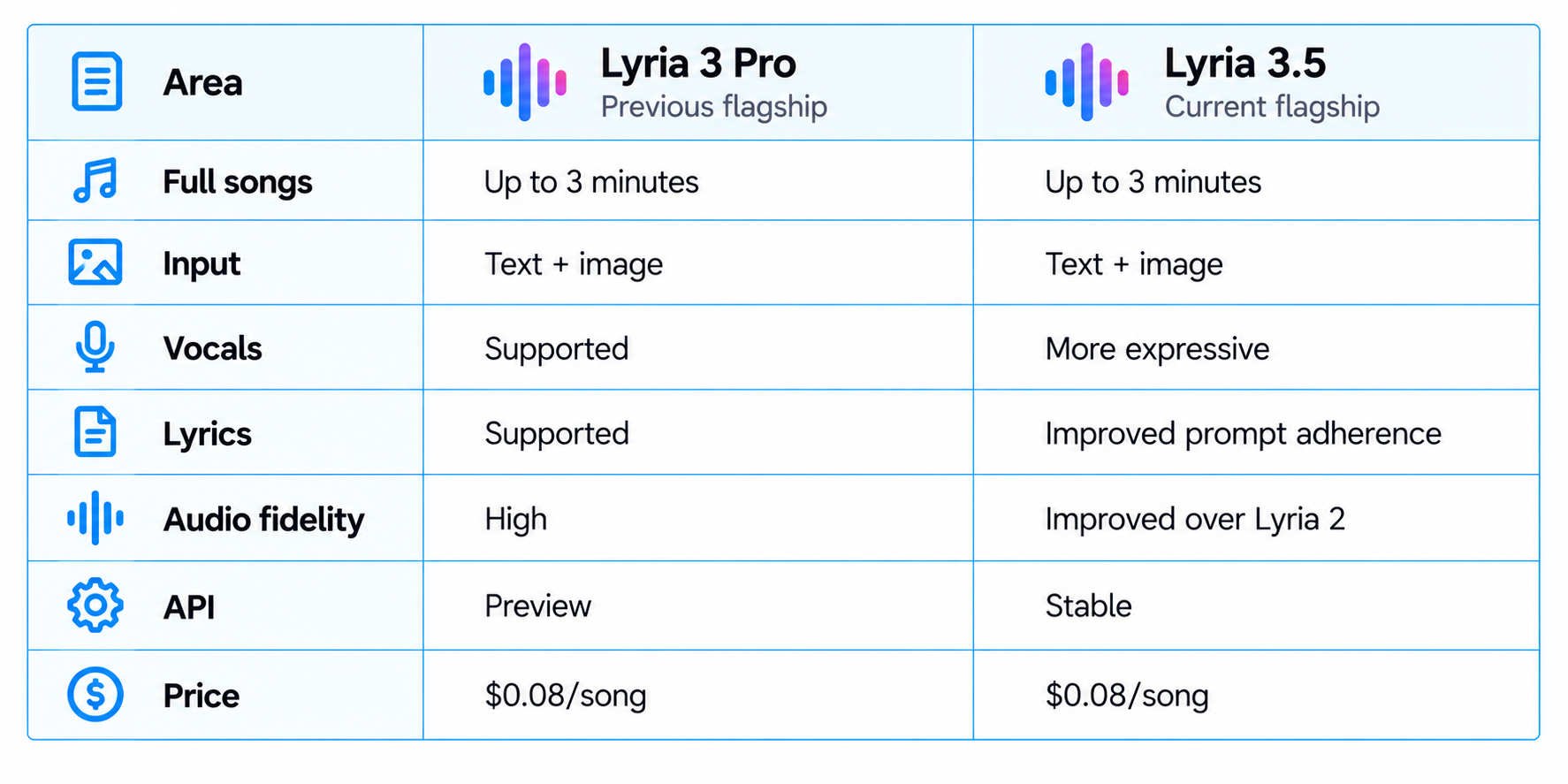
Lyria 3.5 replaces the previous Lyria 3 Pro generation as Google's flagship full-song music model. The earlier Lyria 3 Pro supported full-length compositions up to three minutes and structural elements such as intros, verses, choruses and bridges.
The major difference is quality rather than a dramatic change in the basic product shape. Lyria 3.5 takes the full-song architecture of Lyria 3 Pro and improves musicality, vocals, lyrics and fidelity.
14. Lyria 3.5 vs Suno
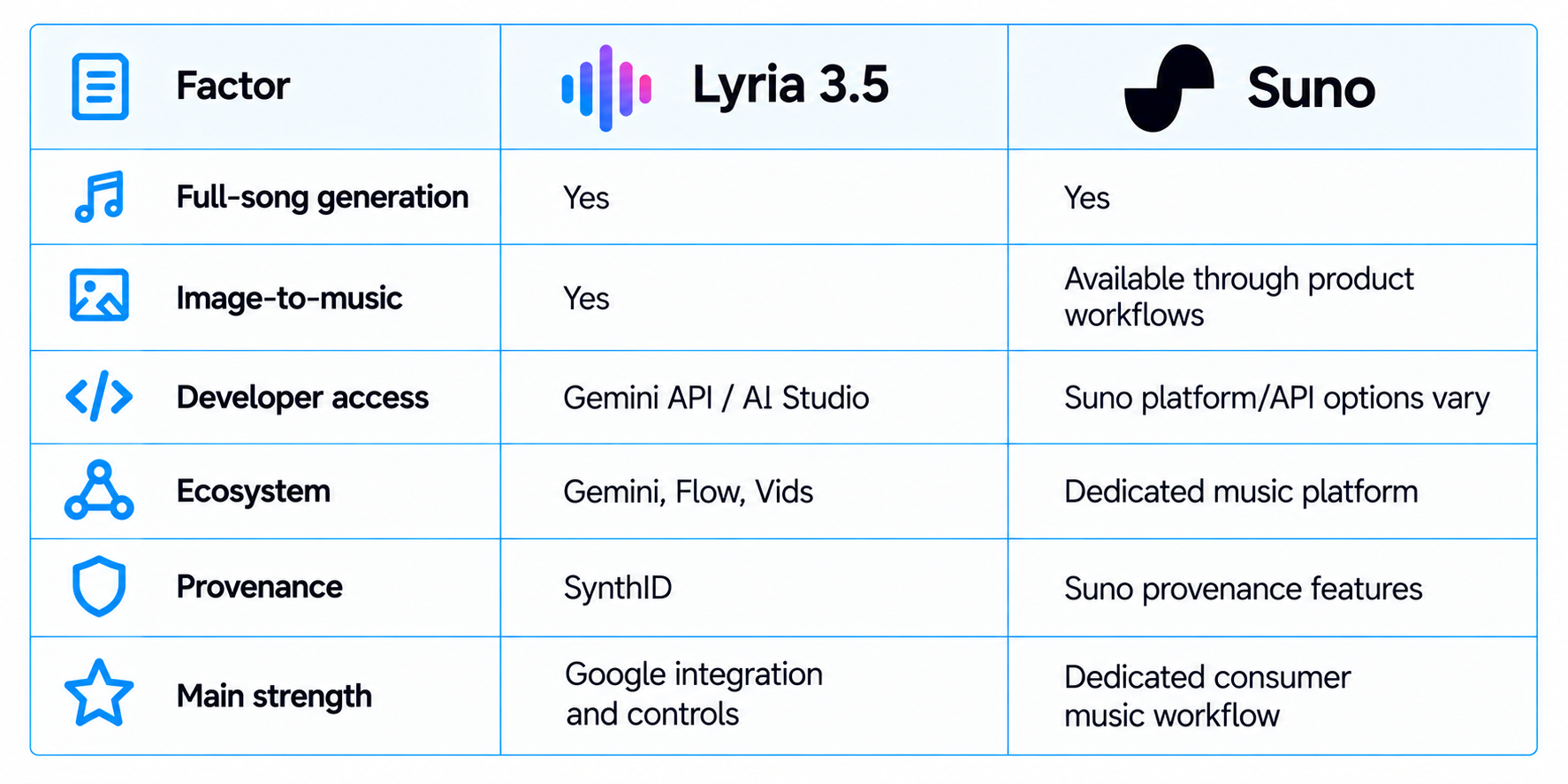
Suno remains the most obvious consumer competitor because it is built around fast song creation and a large creator community. Lyria 3.5 competes differently by integrating deeply into Google's AI products and by supporting image-to-music, developer API access and Google's SynthID provenance system.
There is no single universal winner because the products optimize for different workflows. Lyria 3.5 is particularly attractive when the music is part of a larger Google-based creative workflow, while Suno remains a strong option for users who primarily want a dedicated song-creation environment.
15. Audio Quality and Fidelity
Lyria 3.5 outputs 44.1 kHz stereo audio through the Gemini API, and Google's model card explicitly identifies audio fidelity as a major improvement over Lyria 2.
For practical use, fidelity matters in several layers: noise floor, high-frequency clarity, vocal intelligibility, stereo image and the way instruments occupy the mix. A technically clean track can still sound unnatural if the arrangement is crowded or the vocals sit incorrectly.
Lyria 3.5 is therefore strong for finished-sounding prototypes, background music, creative references and short-form production. Professional releases still need human listening and, where appropriate, additional mastering or editing.
16. SynthID and Content Provenance
Google says Lyria-generated tracks are imperceptibly watermarked with SynthID, its system for identifying AI-generated content. The Lyria product page also describes privacy and safety measures designed to address misuse and provenance.
For creators and platforms, this is a practical feature. If generated music is being distributed inside a larger content system, provenance information can help platforms and users understand how the audio was created or modified.
The watermark does not make a track automatically safe for every commercial use. Licensing, rights and platform terms still need to be reviewed for the specific use case.
17. Limitations You Should Know
Lyria 3.5 is specialized for music generation rather than general multimodal reasoning.
The API model does not support function calling, structured outputs, code execution or search tools.
Audio generation is not deterministic, so exact regeneration of a previously approved musical performance is not the same as editing a DAW project.
Professional tracks still require human review for vocals, pronunciation, arrangement and mix quality.
Image-to-music provides creative direction but does not guarantee a literal musical translation of every visual detail.
Model access, product tiers and consumer quotas can vary across Google surfaces.
Generated audio carries SynthID provenance, which may matter for downstream publishing workflows.
18. Best Use Cases
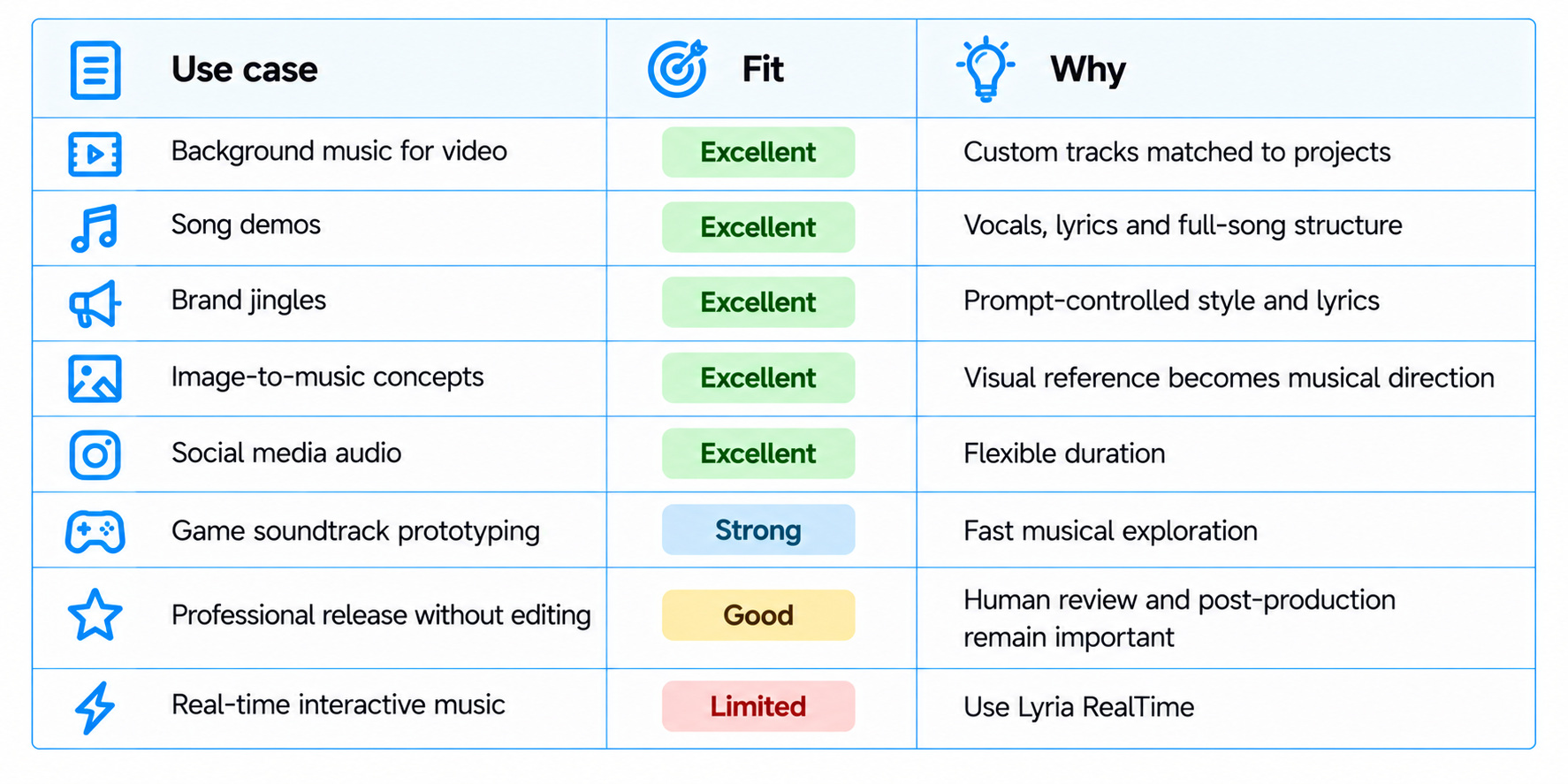
19. Recommended Lyria 3.5 Prompt Workflow
Lyria 3.5 responds well to prompts that specify musical intent instead of only naming a genre.
Start with the genre and emotional direction.
Describe the vocal type and performance character.
Specify tempo or rhythmic feel.
List key instruments or production textures.
Define the song structure when structure matters.
Describe the lyrical theme and tone of the words.
State the intended duration.
Generate several versions and keep the strongest musical idea rather than accepting the first output.
20. How to Evaluate Lyria 3.5 Yourself
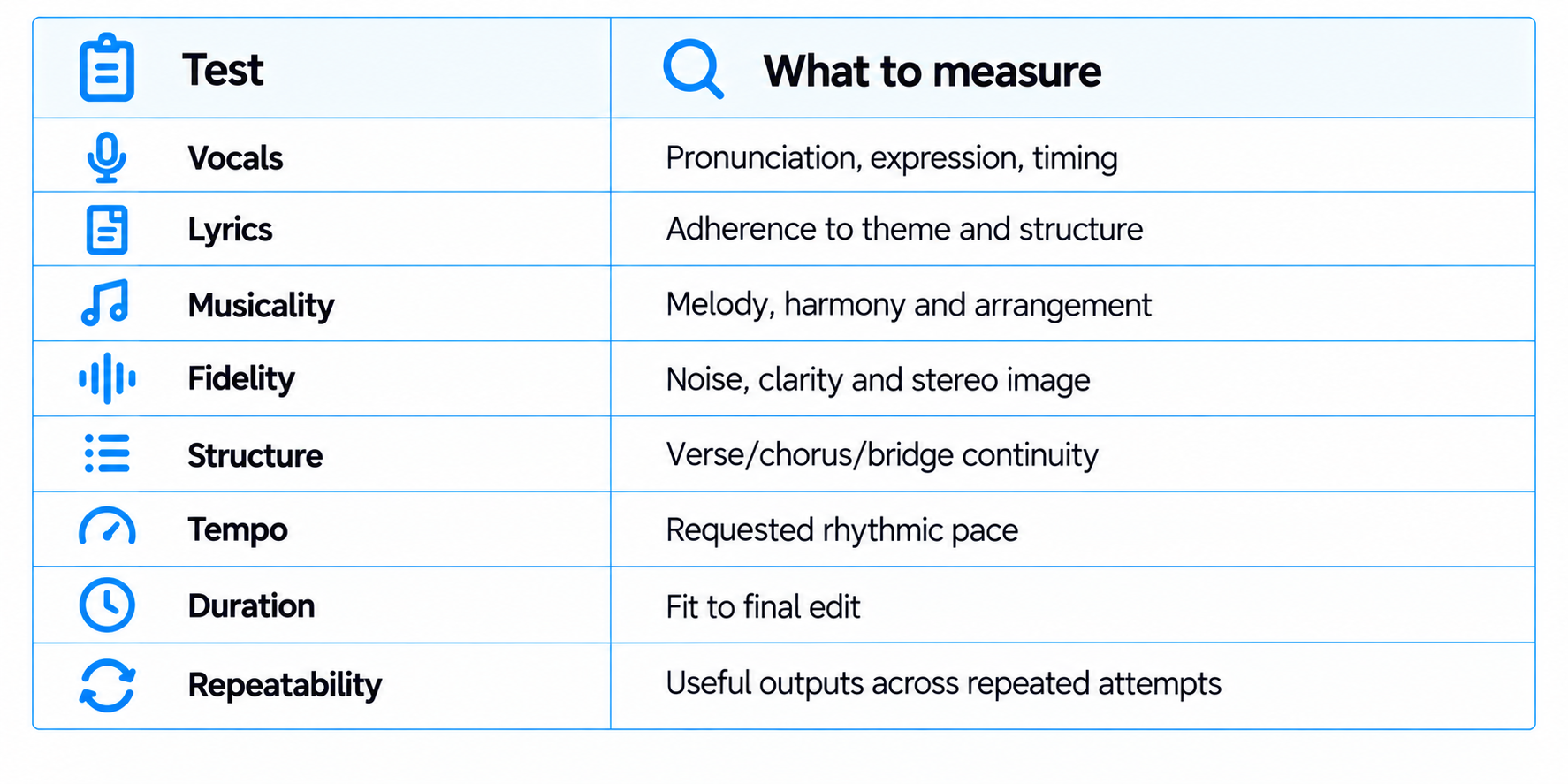
Music is easier to evaluate when you use a consistent prompt set rather than judging a few showcase generations.
Run repeated tests across vocals, lyrics, musicality, fidelity, structure, tempo, duration and repeatability. Judge the average quality across several attempts, not only the strongest generation.
21. Is Lyria 3.5 Worth It?
Yes. Lyria 3.5 is one of the strongest options to test when the goal is a polished, full-length AI-generated song with expressive vocals, better lyric control and strong audio fidelity.
The biggest improvement is that Google has made the model useful across several levels of the creative stack. A casual user can create music in Gemini, a musician can work in Flow Music, a developer can call the Gemini API, and a video creator can bring the generated music into Google Vids.
The $0.08 per-song API price is straightforward enough for experimentation. At ten generated tracks, the direct API generation cost is $0.80 before other application or infrastructure costs.
The main reason not to choose Lyria 3.5 is workflow specialization. It is not a DAW replacement, it does not expose normal function-calling or structured-output features, and exact musical editing remains a separate production problem.
22. Final Verdict
Lyria 3.5 is a strong update to Google's music-generation strategy. The model improves the parts of AI-generated music that listeners notice first: vocal realism, pronunciation, lyric adherence, musical richness and audio fidelity.
Google's model-card evaluation found significant audio-fidelity improvement over Lyria 2 and better lyric prompt adherence. The product release adds richer melodies, more expressive vocals and direct control over tempo and duration.
The model also has broad distribution. It is available globally in Gemini, in Flow Music, through Google AI Studio and the Gemini API, and inside Google Vids. That makes Lyria 3.5 more than a standalone music generator.
Pricing is competitive and simple: $0.08 per full song through the Gemini API. The current model produces 44.1 kHz stereo audio, supports text and image prompts, and can generate songs up to three minutes long.
My rating: 9.5/10 for vocals, 9.2/10 for musicality, 9.0/10 for creative control, 9.3/10 for value and 9.2/10 overall.
Bottom line: Lyria 3.5 is worth using for songs, vocals, brand music, video soundtracks and image-to-music creation. It is not a replacement for a human producer or a full music-editing workflow, but it is one of the most capable AI music systems available in 2026.
Frequently Asked Questions
What is Lyria 3.5?
Lyria 3.5 is Google's current flagship AI music-generation model for full-length songs, with text and image inputs and 44.1 kHz stereo audio output.
How long can Lyria 3.5 songs be?
Google's current Lyria product page says the latest model can create cohesive tracks up to three minutes long.
How much does Lyria 3.5 cost?
The Gemini API currently charges $0.08 per generated full song.
Does Lyria 3.5 generate vocals?
Yes. Google highlights more expressive and emotionally nuanced vocals with improved pronunciation.
Does Lyria 3.5 generate lyrics?
Yes. The API returns generated lyrics as text alongside the audio.
Can Lyria 3.5 use images?
Yes. The Gemini API accepts text and image inputs, and Google demonstrates image-to-music workflows.
What audio quality does Lyria 3.5 use?
The Gemini API model page lists 44.1 kHz stereo audio output in MP3 format.
Is Lyria 3.5 available in Gemini?
Yes. Google announced global availability in the Gemini app on September 4, 2026.
Does Lyria 3.5 have an API?
Yes. The stable lyria-3.5 model is available through the Gemini API and Google AI Studio.
Is Lyria 3.5 better than Lyria 3 Pro?
It is the newer flagship and improves vocals, musicality, lyrics and fidelity while retaining the full-song workflow.
Does Lyria 3.5 support function calling?
No. It is a specialized music-generation endpoint and does not support function calling, structured output or code execution.
Is Lyria 3.5 worth it?
Yes for songs, vocals, soundtracks and image-to-music creation, especially inside Google's ecosystem.
Recommended Blogs
Google Pics Review: Features, Price & Is It Worth It? (2026)
Gemini 3.8 Flash Review: Accuracy, Price & Is It Worth It? (2026)
Meta Muse Spark 1.3 Review: Coding, Price & Is It Worth It? (2026)
MiniMax H3 Max Review: Accuracy, Price & Is It Worth It? (2026)
MiniMax H3 Turbo Review: Speed, Quality, Price & Is It Worth It? (2026)
Best AI Video Models 2026: Ranked by Quality, Speed, Price & Use Case
Resources & Community
Join our community of 70,000+ AI enthusiasts and learn to build powerful AI applications. Whether you're a beginner or an experienced developer, Build Fast with AI helps you understand and implement AI in your projects.
Agentic AI Launchpad 2026
A structured 6-week cohort program that takes you from AI basics to building and deploying real-world agentic AI systems. Includes live sessions, expert mentorship, project reviews and a builder community network.
Ready to go from learning to building? Join the next cohort: Agentic AI Launchpad 2026
Free AI Resources
Access free tools, workshops and micro-learning to keep building.

