



MiniMax H3 Max Review: Is This the Fastest High-Quality AI Video Model in 2026?
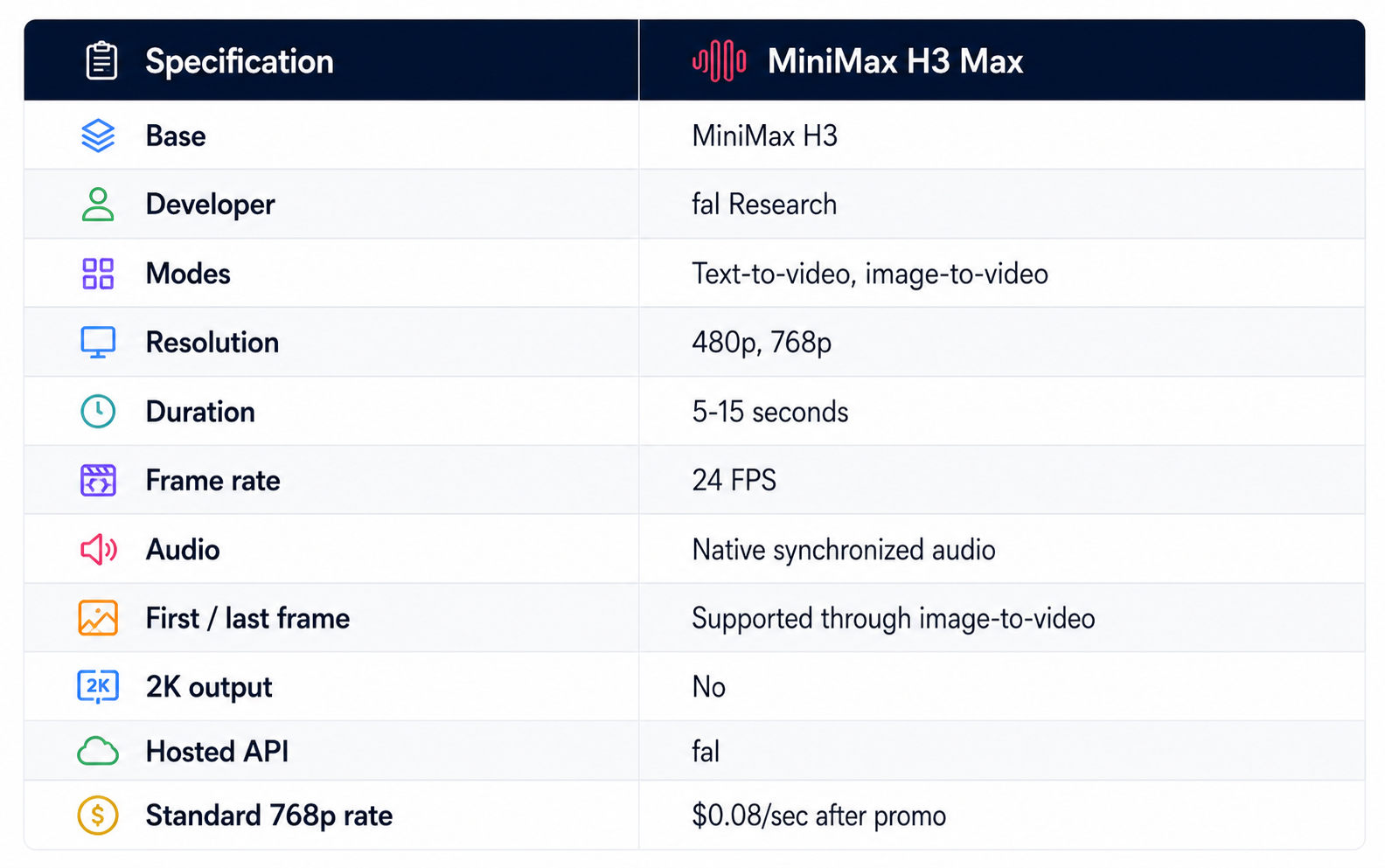
MiniMax H3 Max is a post-trained video model developed by fal Research on top of the open-weight MiniMax H3 base. The idea is straightforward: improve prompt adherence and aesthetics, then co-optimize the model with a custom inference stack so it can generate video much faster than the original H3. fal says a five-second 768p clip can be generated in under three seconds of backend inference, with synchronized audio included in the same generation.
This is more than a speed benchmark. Video generation is inherently iterative. A creator generates a shot, watches it, changes the prompt, tries another camera move, adjusts the character, and repeats. When each cycle is slow, creators are pushed toward guessing. When the cycle is a few seconds, they can actually explore. That makes throughput part of the model's practical quality rather than a separate infrastructure metric.
The quality evidence is promising, but the claims need to be separated. fal's own head-to-head evaluation puts H3 Max first for overall quality, prompt understanding and aesthetics across twelve leading video models. Independent Artificial Analysis and Design Arena snapshots also place it at the top of image-to-video or near the top of the broader video field. That still does not establish that H3 Max is the universal winner for every video task.

QUICK ANSWER
MiniMax H3 Max is one of the strongest AI video models to test right now if your priorities are prompt adherence, fast generation, image-to-video and native audio. It supports 480p and 768p output, with 5 to 15 second generations. fal currently lists launch pricing at $0.025 per second for 480p and $0.04 per second for 768p, with the promotion ending September 1 and the standard rates becoming $0.05 and $0.08 per second.
The headline feature is speed. fal reports a five-second 768p clip in under three seconds, with public endpoint timing showing roughly 2.5 seconds of backend inference for one five-second generation. The hosted tool also advertises five free five-second 768p generations per day without sign-in.
My verdict: 9/10 for speed and iteration, 8.5/10 for prompt adherence, 8.5/10 for price and 8.5/10 overall. H3 Max is worth using when you want fast, high-quality 768p video with synchronized audio. It is not the best choice when you specifically need 2K output or the broader reference and editing capabilities of standard MiniMax H3.
1. What Is MiniMax H3 Max?
H3 Max is a post-trained variant of MiniMax H3 rather than a completely separate model family. fal says it added substantial new training data with a focus on stronger prompt adherence and aesthetics, then optimized the inference path specifically for the resulting model. The goal was to avoid the usual speed-versus-quality tradeoff.
The distinction from standard MiniMax H3 is important. Base H3 is a broader multimodal video system supporting up to 2K output and additional reference and editing workflows. H3 Max narrows the output envelope to 480p and 768p, but emphasizes very fast generation for text-to-video and image-to-video.
2. Why H3 Max Is More Than a Faster Endpoint
The model and serving system were designed together. fal describes the inference stack as specifically optimized around H3 Max rather than simply placing the model on a generic serving platform. That approach matters because some inference shortcuts can reduce latency by damaging output quality. fal says H3 Max optimizations were kept only when quality held up in its evaluations.
This makes H3 Max interesting as a systems story. The model is not only trying to improve what gets generated. It is trying to improve how quickly the user can get back into the creative loop.
For creators, that means speed can increase quality indirectly. More iterations can lead to a better final shot because the creator has time to test alternatives rather than settling for the first acceptable generation.
3. Accuracy: How Good Is MiniMax H3 Max?
For generative video, accuracy is not one number. A useful evaluation includes prompt adherence, subject consistency, camera control, temporal stability, motion realism, audio synchronization and detail fidelity.
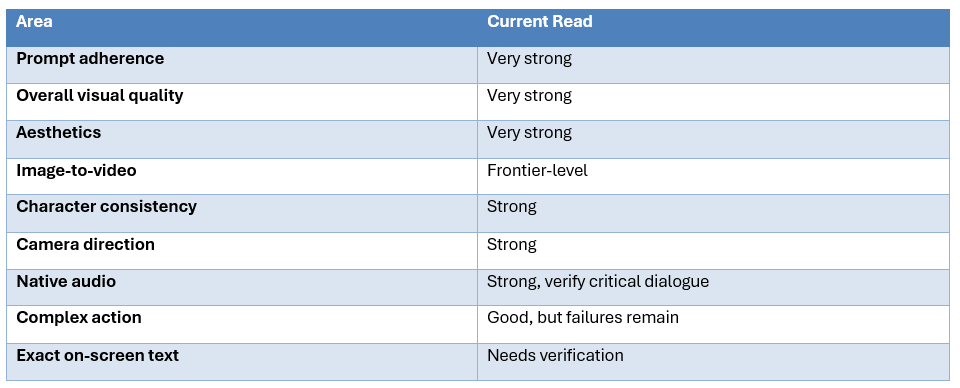
fal's internal human-preference evaluation compared H3 Max against twelve leading video models and ranked it first for overall preference, prompt understanding and aesthetics. The evaluation used head-to-head human judgments aggregated with Bayesian Elo and 95% confidence intervals. This is meaningful evidence, but it is still a vendor-run evaluation with vendor-selected competitors and prompts.
Independent evidence strengthens the case. Artificial Analysis currently puts the H3 Max variant first on its image-to-video with audio leaderboard in the available snapshot, while other independent reports place it in the top group for text-to-video with audio. The exact ranking moves as new votes arrive, so the defensible conclusion is that H3 Max is among the strongest current models, not that every workload has a guaranteed winner.
4. Prompt Adherence Is the Real Differentiator
The most useful claim about H3 Max is not that it creates pretty pictures. Many current video models do. The stronger value proposition is that it is tuned to execute a written brief with fewer surprises.
A production prompt may require a subject to enter the frame, turn toward camera, pick up a specific object, and finish under a defined lighting and camera setup. A visually attractive clip that skips two of those requirements is still a failed shot. H3 Max's post-training specifically targeted prompt understanding, which is why it deserves attention from creators producing to a brief rather than only exploring aesthetics.
The public endpoint examples also structure prompts around subject details, timed actions, camera motion and soundscape. That is a useful prompting pattern regardless of the model you use.
For a larger ready-to-use video prompt library, see our 100 Best Veo 3 Prompts 2026 (Copy-Paste).
5. Speed: The Feature That Actually Changes Production
fal reports a five-second 768p clip in under three seconds and roughly 35 times the throughput of the official H3 endpoint in its testing. The public H3 Max endpoint exposes inference timing, with examples around 2.5 seconds for a five-second clip.
That timing should be interpreted correctly. Backend inference is not the same as end-to-end user latency. Queueing, upload time, network transfer and preprocessing can add waiting time. The credible claim is that the core inference stage is exceptionally fast under the tested serving configuration.
The practical effect is still large. If a creator can run several alternatives during the time another model produces one, H3 Max changes the number of creative decisions that can be tested.
6. MiniMax H3 Max Pricing
As of August 31, 2026, fal lists the launch rates at $0.025 per second for 480p and $0.04 per second for 768p. The model page states that the 50% promotional pricing ends September 1, after which the listed rates become $0.05 and $0.08 per second.
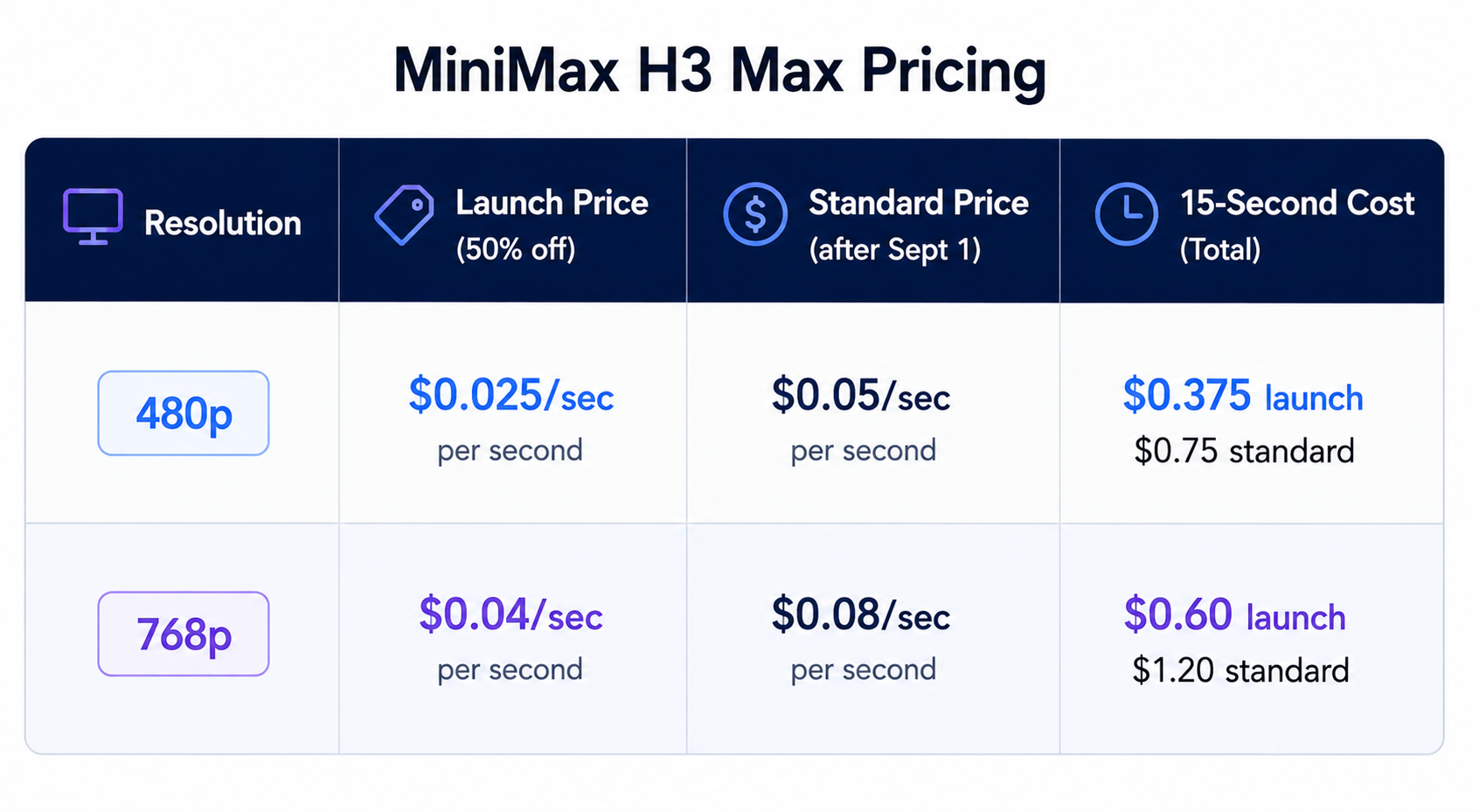
At the standard 768p rate, fifteen seconds costs $1.20. That is already competitive for a frontier-class video system. The launch discount makes it unusually inexpensive, but the discounted rate should not be used for long-term budget planning because it ends on September 1.
More important than price per second is cost per accepted shot. If faster iteration and better prompt adherence reduce the number of failed generations, the effective production cost can be lower than the headline per-second rate suggests.
7. Free Daily Generations
The public fal H3 Max tool currently advertises five free five-second 768p generations with synchronized audio every day without sign-in. Signing in adds another five daily generations in the fal sandbox, with durations up to 15 seconds.
That is enough for a serious first test. A creator can use the free runs to check prompt adherence, motion, audio, character consistency and speed before spending API credits.
8. Native Audio
H3 Max generates audio as part of the video output. The public examples describe room tone, foley, music and spoken dialogue inside the same prompt as the visual direction.
This reduces post-production work for many short-form use cases. A social clip can leave the model with synchronized ambience and effects instead of requiring a separate sound pass.
The caveat is obvious: a model-generated soundtrack is not equivalent to a finished professional mix. For dialogue-driven production, check speaker identity, timing, lip movement and intelligibility shot by shot.
9. Image-to-Video Is a Major Strength
H3 Max supports image-to-video with prompt control and optional end-image conditioning. Artificial Analysis currently ranks the model first on its image-to-video with audio board in the available snapshot, making this one of the strongest evidence-backed use cases.
This makes H3 Max useful when you already have the important visual. A product render, character image, concept frame or illustration can become the starting point for the shot. That reduces the number of creative variables the model has to invent.
10. First and Last Frame Control
The image-to-video endpoint can accept an opening image and an optional ending image. Instead of asking the model to invent the entire transition, you define the two visual states and let it synthesize the path between them.
This is useful for product reveals, visual transformations, camera moves and controlled transitions. It is not deterministic animation, though. The middle is still generated, so unusual motion or object drift can occur.
11. H3 Max vs Standard MiniMax H3
Standard H3 remains the broader model. MiniMax describes H3 as a general-purpose multimodal system that can generate native-audio video up to 15 seconds and 2K, while other current coverage notes broader reference-to-video and editing workflows. H3 Max trades some of that breadth for very low latency at 480p and 768p.
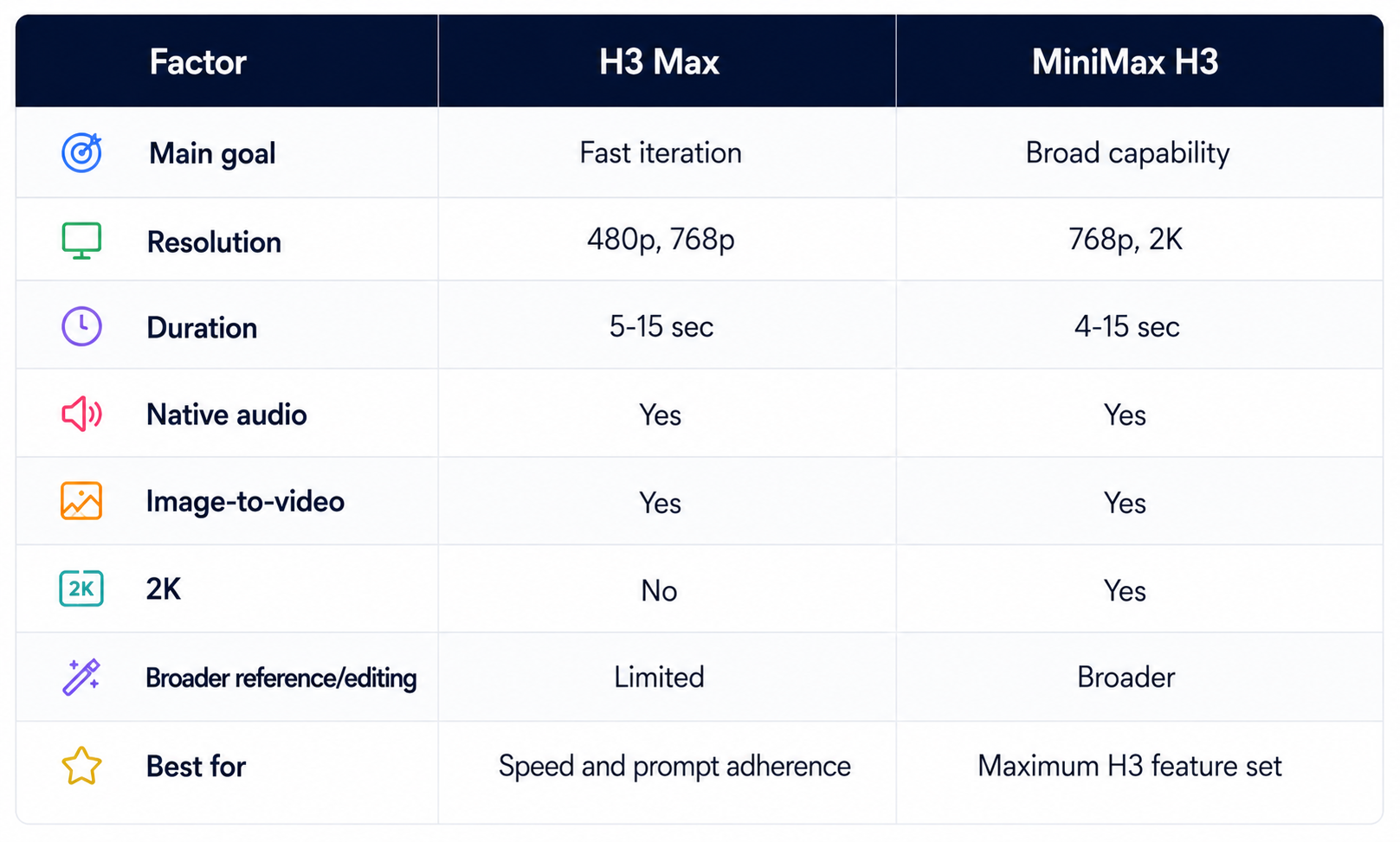
Choose H3 Max when waiting is the bottleneck. Choose standard H3 when resolution, open weights or the wider multimodal toolset matters more than raw serving speed.
12. H3 Max vs Wan 3.0
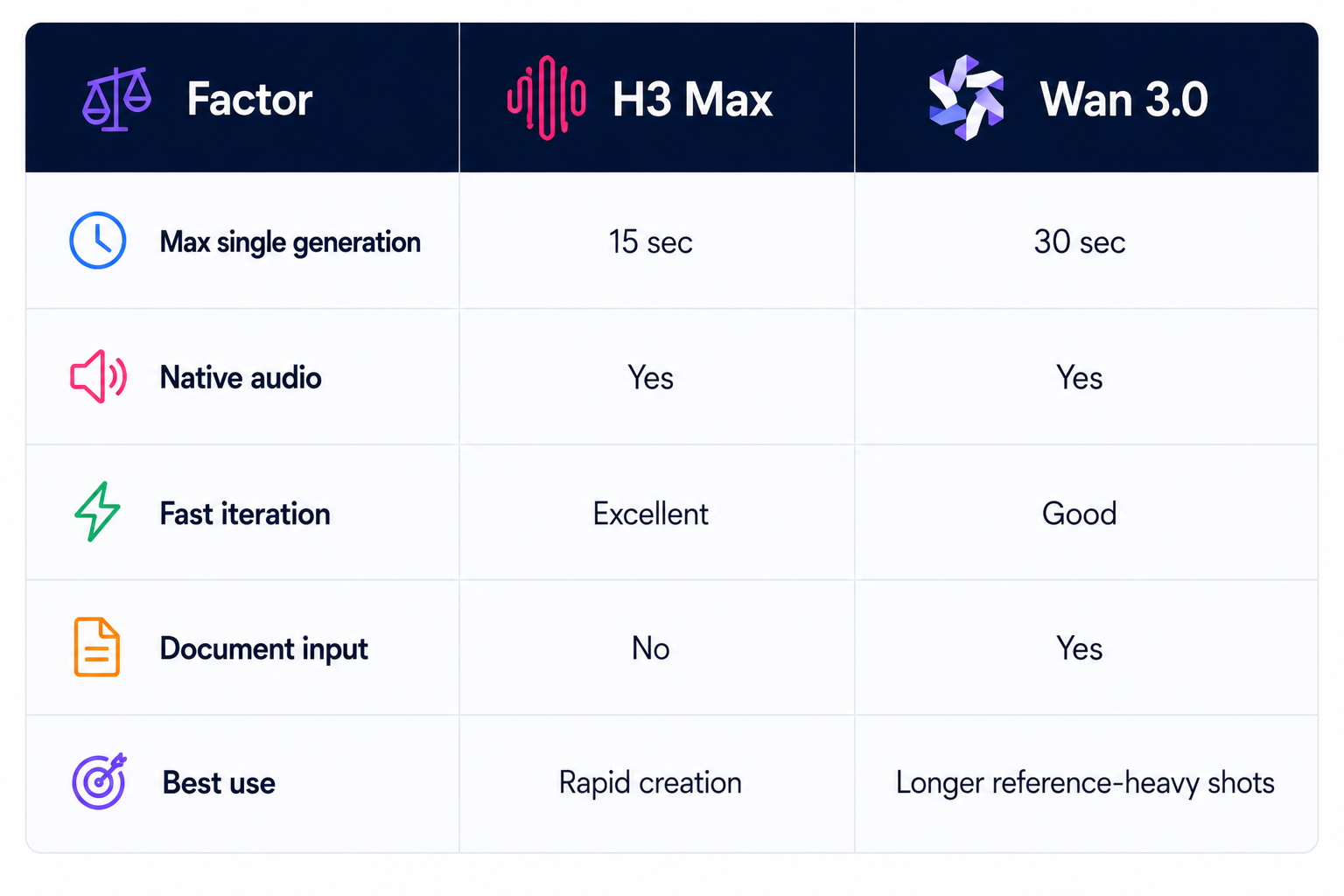
Wan 3.0 is stronger when the workflow demands longer native generations and broader document or multimodal reference inputs. H3 Max is stronger when the job is to generate many high-quality 768p candidates quickly.
Read our Wan 3.0 Review: Accuracy, Price & Is It Worth It? (2026) for the full Wan breakdown.
13. H3 Max vs Gemini Omni 1.1 Flash
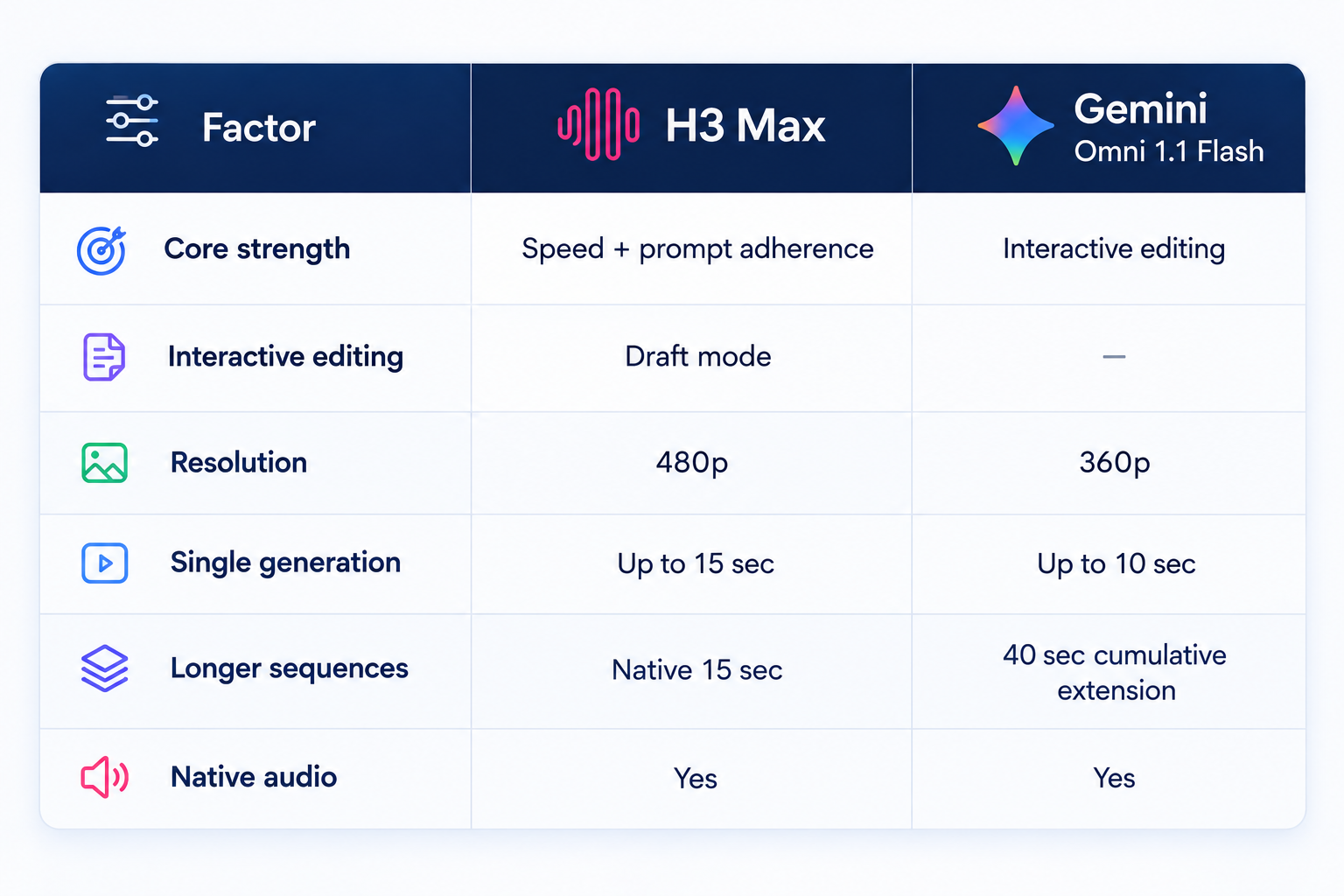
Gemini Omni 1.1 Flash is built around conversational generation and editing, including extension, first and last frame control and a 360p draft tier. H3 Max is more aggressively optimized around direct generation speed. If you want to keep talking to a scene and refining it, Omni is attractive. If you want to generate many strong candidates quickly, H3 Max has the clearer advantage.
See our Gemini Omni 1.1 Flash Review: Accuracy, Price & Is It Worth It? (2026) for the detailed review.
14. Limitations You Should Know
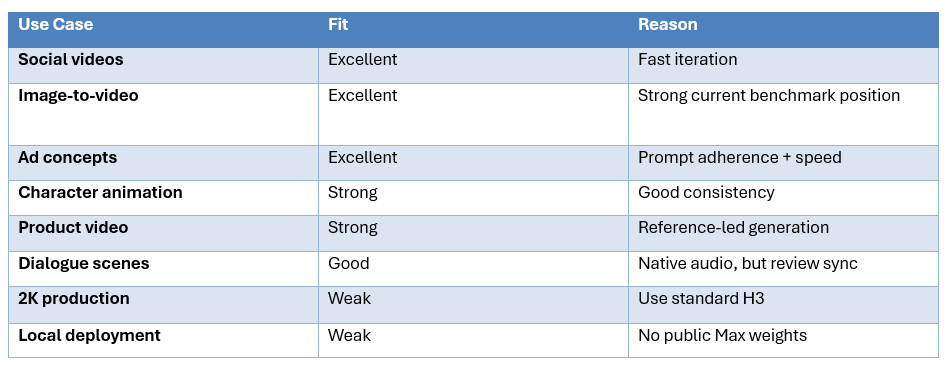
- 768p is the main H3 Max ceiling. Use standard H3 when 2K is required.
- Independent evidence is stronger for image-to-video than for universal text-to-video dominance.
- Complex physical interactions can still fail.
- Exact on-screen text should be verified before delivery.
- Dialogue and lip-sync need testing for important scenes.
- Long or conflicting instructions can still reduce adherence.
- The under-three-second result is backend inference time, not a guaranteed end-to-end wait.
- The launch discount ends September 1, so standard pricing matters for ongoing budgets.
- Public H3 Max weights are not currently offered for local deployment.
15. Best Use Cases
16. Recommended Production Workflow
The best way to use H3 Max is to treat it as a fast creative search tool. Do not pay premium resolution prices while the shot is still experimental.
- Start at 480p when exploring concepts.
- Move to 768p after the composition and action work.
- Write actions in temporal order.
- Describe the soundscape in the same prompt.
- Use image-to-video when identity or composition matters.
- Use first and last frame conditioning for controlled transitions.
- Generate multiple candidates before selecting a final take.
- Review the entire clip for consistency, audio and unwanted motion.
- Do a final text and dialogue check before publishing.
17. How to Evaluate H3 Max Yourself
Do not judge the model only from vendor showcase clips. Create a small test set that represents your own production.
- Five text-to-video prompts with different camera movements.
- Five image-to-video prompts that must preserve a subject.
- Two character-consistency tests.
- Two complex action or physics tests.
- Two dialogue and lip-sync tests.
- One exact-text scene.
- One first-to-last-frame transition.
Score each output for prompt adherence, visual quality, consistency, audio, artifacts, latency and cost. That gives you a better practical model review than a leaderboard alone.
18. Is MiniMax H3 Max Worth It?
Yes, especially for creators whose biggest bottleneck is iteration speed. A model that can produce a five-second 768p clip in roughly three seconds of backend inference lets you test more directions in the same amount of time. That can improve final creative quality because you are able to reject weak ideas rather than settling for them.
The pricing also makes sense. Even after the promotion ends, 768p is listed at $0.08 per second, or $1.20 for a 15-second clip. During the promotion it is half that.
The biggest reason not to choose H3 Max is not price. It is capability scope. If you need 2K, broader references, or the full base H3 feature set, the faster Max variant is the wrong tool.
19. Final Verdict
MiniMax H3 Max is one of the most interesting AI video releases of August 2026 because it focuses on a problem every creator actually has: iteration speed.
fal's own evaluation puts it first for overall preference, prompt understanding and aesthetics against twelve leading models, while independent benchmarks currently place it at the top of image-to-video with audio.
The price is competitive. Launch pricing is $0.025 per second at 480p and $0.04 per second at 768p, with standard rates of $0.05 and $0.08 after September 1.
The weaknesses are clear: 768p is the ceiling, some complex scenes still fail, exact text and dialogue need checking, and the model does not currently offer the same broad local or 2K path as base H3.
My rating: 9/10 for speed, 8.5/10 for prompt adherence, 8.5/10 for price and 8.5/10 overall.
Bottom line: H3 Max is worth using when you want fast, high-quality 768p text-to-video or image-to-video with native audio. It is less suited to workflows that require 2K masters or the wider multimodal feature set of standard MiniMax H3.
Frequently Asked Questions
What is MiniMax H3 Max?
MiniMax H3 Max is a post-trained variant of MiniMax H3 developed by fal Research and optimized for prompt adherence, aesthetics and very fast inference.
How accurate is MiniMax H3 Max?
There is no single universal accuracy score. Current evidence points to very strong prompt understanding and image-to-video quality, while complex motion, text and dialogue still need task-specific testing.
How fast is MiniMax H3 Max?
fal reports a five-second 768p clip in under three seconds of backend inference, with public examples showing about 2.5 seconds for one five-second generation.
How much does MiniMax H3 Max cost?
The launch rates are $0.025 per second at 480p and $0.04 per second at 768p. After September 1, the listed rates become $0.05 and $0.08 per second.
How much does a 15-second 768p clip cost?
About $0.60 during the launch promotion and $1.20 at the standard rate.
Does H3 Max generate audio?
Yes. Native synchronized audio is included with the video generation workflow.
Can H3 Max generate 15-second videos?
Yes. The public endpoints support 5 to 15 second generations.
Is H3 Max better than MiniMax H3?
Not universally. H3 Max is optimized for speed and prompt adherence, while standard H3 offers broader functionality and 2K output.
Does H3 Max support 2K?
No. H3 Max currently focuses on 480p and 768p.
Is H3 Max open source?
The base MiniMax H3 has open weights, but H3 Max is a fal post-trained hosted variant and its public Max weights are not currently available.
Is H3 Max worth it?
Yes for fast 768p generation and image-to-video. It is less compelling when 2K, broader reference workflows or local deployment are requirements.
Recommended Blogs
- Wan 3.0 Review: Accuracy, Price & Is It Worth It? (2026)
- Gemini Omni 1.1 Flash Review: Accuracy, Price & Is It Worth It? (2026)
- 100 Best Veo 3 Prompts 2026 (Copy-Paste)
- Best Open Source AI Models August 2026: Full Collection
- MiniMax Design Review: Software, M3, Pricing & Free Tier
Resources & Community
Join our community of 70,000+ AI enthusiasts and learn to build powerful AI applications. Whether you're a beginner or an experienced developer, Build Fast with AI helps you understand and implement AI in your projects.
- Website - buildfastwithai.com
- LinkedIn - Build Fast with AI
- Instagram - @buildfastwithai
- Founder Twitter - @satvikps
- Twitter - @BuildFastWithAI
Agentic AI Launchpad 2026
A structured 6-week cohort program that takes you from AI basics to building and deploying real-world agentic AI systems. Includes live sessions, expert mentorship, project reviews and a builder community network.
Ready to go from learning to building? Join the next cohort: Agentic AI Launchpad 2026
Free AI Resources
Access free tools, workshops and micro-learning to keep building.
- AI Workshops - Free resources, upcoming events and past recordings
- Unrot - Learn AI in 5 minutes a day

