



Two years ago it did not exist. This week it is worth 13.3 billion dollars. Lovable, the vibe coding platform that turns a plain-language description into a working app, just raised 400 million dollars and doubled its valuation in eight months, making it one of the fastest-rising companies in the history of software. The number is staggering, and it raises the obvious question this review answers: is the product actually that good, or is this a bubble with a login screen? Here is the honest breakdown of what Lovable builds, what it costs, and whether it earns the hype.
The short version: Lovable is a genuinely impressive tool that lets anyone describe an app in plain English and get a working full-stack result, complete with a database, login, and hosting, in minutes. Its growth is real, with roughly half a billion dollars in annualized revenue and enterprise customers like Adidas and NVIDIA. The catches are a credit-based pricing model that makes costs hard to predict and a rich valuation in a crowded field. For prototypes, internal tools, and non-coders shipping real software, it is excellent. For complex production systems, it is a strong start rather than a finish.
QUICK ANSWER
Lovable is a vibe coding app builder: you describe what you want in plain language and it generates a working full-stack web app with a React front end, a Supabase database, authentication, and hosting, no coding required. On August 12, 2026 it raised 400 million dollars at a 13.3 billion dollar valuation, double its December 2025 figure, on roughly 500 to 600 million dollars of annualized revenue, more than 60 million projects built, and enterprise customers including Adidas, NVIDIA, and Deutsche Telekom. Pricing runs from a Free tier to Pro at 25 dollars and Business at 50 dollars per month, billed by variable credits.
What Is Lovable?
Lovable is an AI app builder that lets you create software by describing it in plain language. You type what you want, and Lovable generates a working web application, handling the front end, the database, the login system, and the hosting for you, without you opening a code editor or a terminal. It was founded in 2023 by Anton Osika and Fabian Hedin, opened to the public in November 2024, and has grown to more than 8 million registered users.
The category Lovable leads is called vibe coding, a term for building software by conversation rather than by writing code line by line. Instead of learning a programming language, you learn to describe what you want clearly, and the AI does the implementation. Lovable is the most valuable company built around this idea, and its rise is the clearest signal yet that vibe coding has moved from a novelty to a real way people ship software.
It is important to be precise about what Lovable is and is not. It is not a chatbot that writes code snippets for you to paste elsewhere, and it is not a traditional no-code drag-and-drop builder with fixed templates. It is a full-stack generator that produces a real, running application you control through natural language, and then hosts it. That combination, real code plus real hosting plus a conversational interface, is what separates it from both the AI coding assistants and the older no-code tools.
For the broader shift this represents, see our what is agentic AI guide.
What Is Vibe Coding?
Vibe coding is the practice of building software by describing what you want in natural language and letting an AI generate the code, rather than writing it yourself. The name captures the shift in what the human does: you focus on the intent, the vibe of what you are building, and the AI handles the syntax, the structure, and the plumbing. It is the difference between being an architect who describes a building and a bricklayer who places each brick.
This matters because it changes who can build software. For decades, turning an idea into a working app required months of learning to code or hiring someone who had. Vibe coding collapses that barrier, letting a founder, a marketer, an operations lead, or a student go from idea to working prototype in an afternoon. Lovable is the standout example because it does not just generate code, it generates a complete, deployed, usable app, which is what most non-coders actually want. The honest caveat is that vibe coding is best at getting to a working version fast, and complex or highly custom software still benefits from real engineering, a tension this review returns to.
The $13.3B Raise: What the Money Says
On August 12, 2026, Lovable announced a 400 million dollar Series C at a 13.3 billion dollar valuation, roughly double the 6.6 billion it was valued at in its December 2025 round. Menlo Ventures led the round, with the Scaleup Europe Fund managed by EQT co-leading, and a striking global roster of new investors including Balderton and Carmignac in Europe, Kaszek and LTS Growth in Latin America, Tencent and World Innovation Lab in Asia, and Regent in the United States. That geographic spread signals investors positioning Lovable as a global platform, not a regional one.
The numbers behind the valuation are genuinely impressive. Lovable says more than 60 million projects have been built on the platform, and the apps created on it draw around 900 million visits a month. Its annualized revenue reached roughly 500 million dollars in June, up from 200 million in November 2025, and the company expected to approach 600 million by the end of August. That is one of the fastest revenue ramps software has ever seen, and it is the real reason the valuation doubled.
The honest read on the number: at roughly 500 to 600 million dollars of annualized revenue, a 13.3 billion dollar valuation is about 22 to 27 times revenue, a rich multiple even by AI standards. It is justified only if Lovable keeps growing at this pace and defends its lead in a crowded category. The growth is real and the enterprise traction is real, but the valuation prices in years of continued dominance, which is the bet investors are making. For you as a user, the valuation matters mainly as a signal of momentum and staying power, not as a reason to use or avoid the product.
Track the models and tools powering this wave in our best AI models of August 2026 ranking.
How Lovable Works
Using Lovable feels less like programming and more like briefing a very fast developer. You describe the app you want in plain language, for example a booking site for a barbershop with a calendar, customer logins, and email reminders, and Lovable generates a working version in minutes. Under the hood it produces a real React front end, a Supabase backend with a database and schema, an authentication and login flow, and the code that connects them, then deploys it so you have a live link you can click through immediately.
From there, you refine by conversation. You tell Lovable what to change, add, or fix, and it edits the app, showing you the result. You can click through a real front end, see the database behind it, test the login, and keep iterating until it does what you want. Because it generates actual code rather than a locked template, the app is more flexible than a traditional no-code builder, and because it handles hosting, you do not need to learn deployment, servers, or DevOps to get something live.
The experience is what makes the growth make sense. For someone who could never have built an app before, going from a sentence to a working, deployed product in one sitting is close to magic, and that is exactly the audience Lovable has captured. The realistic limit is that the more complex and specific your requirements get, the more the conversation turns into a back-and-forth that rewards some technical understanding, which is where lighter users can hit a wall and more technical ones pull ahead.
Key Features
Lovable has grown from a simple app generator into a broader platform, and several features explain why enterprises are adopting it, not just hobbyists.
Full-Stack App Generation
The core feature is generating a complete app: front end, database, authentication, and hosting from a plain-language description. This is the part that feels like magic and the reason most people come, because it removes every technical step between an idea and a live product.
Deep Integrations
Lovable connects to the tools businesses actually use, including Google Workspace, Microsoft 365, Salesforce, Stripe, and ElevenLabs. These integrations are what let an app built on Lovable do real work, from taking payments to syncing with a company's existing systems, rather than being an isolated demo.
Payments, SEO, and AI Search
Recent additions include built-in payments so apps can charge money out of the box, plus SEO and AI-search tools so the sites built on Lovable can actually be found. These features push Lovable from a prototyping toy toward a platform for shipping real, discoverable, revenue-generating products.
Enterprise Governance
For business use, Lovable added a governance stack: scheduled security scanning, publishing controls, and a public trust-center page for apps built on the platform. This is the unglamorous but essential work that lets large companies like Adidas, NVIDIA, and Deutsche Telekom let their teams build internal software on Lovable without security teams objecting, and it is a big reason the enterprise revenue is growing.
Lovable at a Glance
Table 1: Lovable at a glance
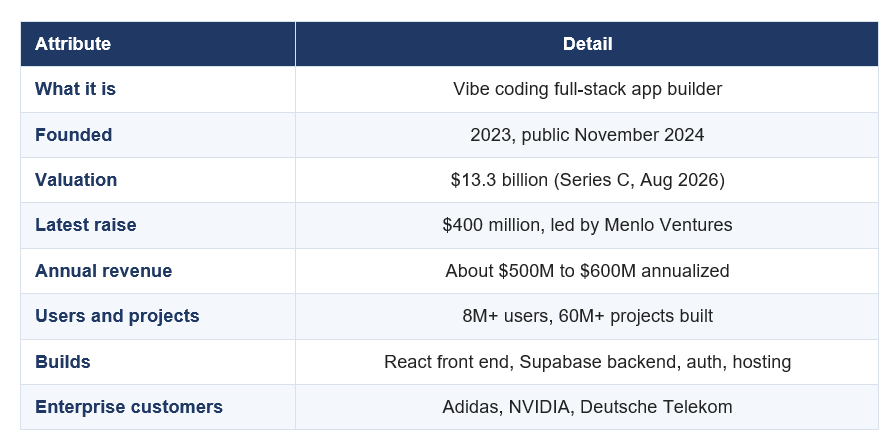
Figures as reported around the August 12, 2026 Series C announcement. Revenue is annualized run-rate, which can move quickly for a fast-growing company.
Lovable Pricing and the Credit Catch
Lovable has three published plans, and on the surface they look simple and affordable. The complication, and the thing to understand before you commit, is that Lovable bills by credits, and credits are a variable cost. Here are the plans first, then the catch.
Table 2: Lovable pricing plans (2026)
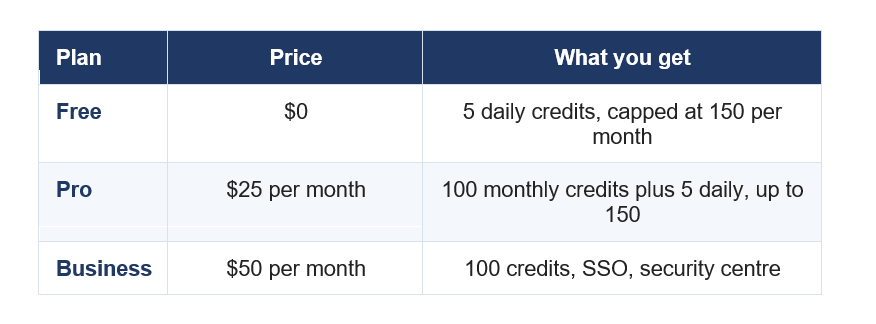
Pro and Business prices cover unlimited users. Credits are consumed per build or edit message, at a variable rate based on request complexity.
Here is the catch. Every message you send to build or edit your app burns credits, and the number of credits depends on how complex the request is. A small tweak might cost a little; a big feature or a complex change might cost a lot. That means your real monthly cost is not the headline 25 or 50 dollars, it is whatever your usage adds up to, and it is hard to predict in advance. Heavy building, lots of iteration, or complex apps can burn through a plan's credits quickly, which is the source of the hidden-cost complaints that show up in many Lovable reviews.
UNDERSTAND CREDITS BEFORE YOU COMMIT
Lovable's real price is credit consumption, not the plan sticker price. Because each build or edit costs a variable number of credits by complexity, an active project can run through a month's credits fast, and costs are hard to forecast. Before relying on Lovable for something big, run a small real project first to see how fast you burn credits, and treat the plan price as a floor, not a ceiling. For heavy or unpredictable building, budget above the headline number.
The value verdict on pricing: for light to moderate use, Lovable is genuinely affordable, and the Free tier is a real way to try it. For heavy building, the credit model can make it more expensive than it first appears, so the honest advice is to test your actual burn rate on a real project before committing to it as your main tool. The pricing is fair, but it is consumption-based, so treat it like a metered utility rather than a flat subscription.
What Lovable Is Great For and Where It Struggles
A useful review names both sides. Lovable is outstanding at some things and merely a starting point for others.
Where Lovable shines
- Prototypes and MVPs: going from idea to a working, clickable app in one sitting is where it is genuinely unmatched.
- Internal tools: exactly the dashboards, forms, and small apps that companies like Adidas and NVIDIA build for their teams.
- Non-coders shipping real software: founders, marketers, and operators who could never build before can now ship.
- Speed: what would take a developer days can appear in minutes, which is transformative for testing ideas.
- Full-stack completeness: database, auth, payments, and hosting included means a real product, not just a front end.
Where Lovable struggles
- Complex production systems: highly custom, large-scale, or performance-critical apps still benefit from real engineering.
- Predictable costs: the credit model makes heavy use hard to budget and can surprise you.
- Deep customization: the more specific and unusual your needs, the more you fight the conversational flow.
- Long-term ownership: relying on one platform for generation and hosting is a real dependency to weigh.
The pattern is that Lovable is a phenomenal accelerator and a strong finisher for a wide band of real apps, but the ceiling rises the moment your requirements become genuinely complex. For most people building most things, that ceiling is high enough. For a team building a large, bespoke production system, Lovable is a fast start that a real engineering effort may eventually take over.
Is Lovable Worth the Valuation?
The 13.3 billion dollar question is whether the valuation is deserved. The case for it is strong: real revenue near 500 to 600 million dollars annualized, one of the fastest growth curves in software history, genuine enterprise adoption, and a leadership position in a category that is clearly expanding. If vibe coding becomes a default way people build software, and Lovable stays in front, the valuation could look cheap in hindsight.
The case against it is equally clear. A 22-to-27-times-revenue multiple prices in years of continued dominance, and the category is crowded with well-funded rivals from AI coding assistants to other app builders, several backed by the biggest names in tech. Vibe coding also has a natural question mark over durability: the underlying AI models keep improving and are available to everyone, so Lovable's moat is its product experience, integrations, and enterprise trust rather than a unique technology. That is a defensible moat, but not an unassailable one.
My take: the valuation is aggressive but not crazy, and it reflects a genuine bet that Lovable becomes the default vibe coding platform the way a few tools became defaults in previous software waves. As a user, you do not need to resolve the valuation debate to benefit from the product. What the number really tells you is that Lovable has the momentum and the capital to keep improving fast, which is a good reason to take it seriously rather than dismiss it as hype.
Lovable vs the Vibe Coding Field
Lovable does not compete alone. The broader AI building space includes coding-focused tools like Cursor and other AI coding agents that target developers, and other app builders that, like Lovable, aim at non-coders. The rough split is that developer tools give more control and fit into existing engineering workflows, while Lovable optimizes for getting a complete, hosted app from a description with the least technical friction.
Lovable's edge in this field is the end-to-end experience for non-technical builders: it does not just help you write code, it delivers a running, hosted, full-stack product, with payments, integrations, and enterprise governance layered on. Its rivals may win with developers who want fine-grained control or with teams already committed to a code-first workflow. So the choice is less about which is best overall and more about who you are: for non-coders and fast full-app creation, Lovable leads; for hands-on developers who want to stay in code, a tool like Cursor may fit better.
Compare the developer-focused side in our Cursor Composer review, the Google Antigravity developer guide, and the Meta Muse Code review.
Is Lovable Worth Using?
Lovable is worth using, and for the right person it is close to essential. If you want to turn an idea into a working, hosted app without learning to code, or you need to ship internal tools and prototypes fast, Lovable is one of the best tools available and lives up to much of its reputation. The Free tier lets you prove that for yourself before spending anything, which is the smart way to start.
The verdict: Lovable earns its status as the leading vibe coding platform. It genuinely lets non-coders build and ship real full-stack apps, its integrations and governance make it viable for businesses, and its growth is not hype but revenue. The two things to go in clear-eyed about are the credit-based pricing, which you should test on a small real project before relying on it, and the ceiling on very complex production systems, where real engineering still matters. For prototypes, internal tools, MVPs, and anyone who could not build software before, Lovable is an easy recommendation and a genuine glimpse of how a lot of software will get made from here. The 13.3 billion dollar valuation is a bet on that future, and the product is real enough to make the bet reasonable.
Frequently Asked Questions
Q: What is Lovable?
Lovable is an AI app builder and the leading vibe coding platform. You describe an app in plain language and it generates a working full-stack web application, including a React front end, a Supabase database, authentication, and hosting, with no coding required. It was founded in 2023 and has more than 8 million registered users.
Q: What is vibe coding?
Vibe coding is building software by describing what you want in natural language and letting an AI generate the code, instead of writing it yourself. You focus on the intent while the AI handles the implementation. Lovable is the most valuable company built around vibe coding, taking it from a novelty to a real way people ship apps.
Q: How does Lovable work?
You describe the app you want, and Lovable generates a working version in minutes, producing a React front end, a Supabase backend with a database, a login flow, and hosting. You then refine it by conversation, telling Lovable what to change or add, and it edits the live app. No code editor or terminal is needed.
Q: How much does Lovable cost?
Lovable has a Free tier, a Pro plan at 25 dollars per month, and a Business plan at 50 dollars per month, with Pro and Business covering unlimited users. However, it bills by credits consumed per build or edit, so your real cost depends on usage and can exceed the headline plan price for heavy building.
Q: How do Lovable credits work?
Every message you send to build or edit your app burns credits, and the number depends on how complex the request is. Simple changes cost fewer credits, complex ones cost more. This makes cost variable and hard to predict, so an active project can run through a plan's credits quickly. Test your burn rate on a real project first.
Q: Why is Lovable worth $13.3 billion?
Lovable raised 400 million dollars at a 13.3 billion dollar valuation on August 12, 2026, driven by roughly 500 to 600 million dollars of annualized revenue, one of the fastest growth curves in software, more than 60 million projects built, and enterprise customers like Adidas and NVIDIA. It is a rich multiple that prices in continued dominance of vibe coding.
Q: What can you build with Lovable?
You can build full-stack web apps: prototypes, MVPs, internal tools, dashboards, booking sites, and small products with databases, logins, and payments. With integrations to tools like Stripe, Salesforce, and Google Workspace, apps can take payments and connect to real business systems, not just act as demos.
Q: Is Lovable good for production apps?
Lovable is excellent for prototypes, internal tools, MVPs, and many real production apps, especially with its payments, integrations, and enterprise governance. For highly complex, large-scale, or performance-critical systems, it is a fast start that real engineering may eventually extend. Test how it handles your specific complexity before committing.
Q: Is Lovable worth it?
Yes for non-coders and fast full-app creation, where it is one of the best tools available and lets you ship real software without learning to code. Start with the Free tier, test the credit burn rate on a real project, and be aware of the ceiling on very complex systems. For prototypes and internal tools, it is an easy recommendation.
Recommended Blogs
- Cursor Composer review
- Google Antigravity developer guide
- Meta Muse Code review
- What is agentic AI
- Best AI models of August 2026
Resources and Community
Join our community of 70,000+ AI enthusiasts and learn to build powerful AI applications. Whether you are a beginner or an experienced developer, Build Fast with AI helps you understand and implement AI in your projects.
- Website (buildfastwithai.com)
- LinkedIn (Build Fast with AI)
- Instagram (@buildfastwithai)
- Founder Twitter (@satvikps)
- Twitter (@BuildFastWithAI)
Agentic AI Launchpad 2026
A structured 6-week cohort program that takes you from AI basics to building and deploying real-world agentic AI systems. Includes live sessions, expert mentorship, project reviews, and a builder community network.
Ready to go from learning to building? Join the next cohort: Agentic AI Launchpad 2026
Free AI Resources
Access free tools, workshops, and micro-learning to keep building:
Follow Build Fast with AI for honest reviews of every major AI tool and the funding stories that shape them.

