


Best AI Models for Long Documents: 1M Context Tested - Which Model Actually Wins?
A million-token context window sounds like a simple specification, but it does not tell you whether an AI model is actually good at long documents. Two models can both accept roughly 1M tokens and behave very differently when the important fact is buried deep inside a report, when several documents contradict one another, or when the answer requires connecting evidence spread across hundreds of pages.
That is why the best way to compare long-context models is to separate capacity from reasoning quality. The current Artificial Analysis Long Context Reasoning benchmark, AA-LCR, gives us a useful common test. In the September 2026 leaderboard, Muse Spark 1.2 leads the field at 83.3%, followed by Kimi K3 at 82.7%, Gemini 3.8 Flash at 81.0%, MiniMax M3 at 80.3%, and Claude Fable 5.1 at 80.0%. Each of these models is listed with a context window around the 1M-token class.
The result is more interesting than a simple winner list. Muse Spark 1.2 and Kimi K3 lead the long-context leaderboard, but Gemini 3.8 Flash combines a high AA-LCR score with much stronger speed than Kimi K3, while MiniMax M3 offers an attractive open-weight and cost profile. Claude Fable 5.1 remains competitive on long-context reasoning, but its price is much higher. This article ranks the models by both the test result and what they are useful for in a real long-document workflow.
QUICK ANSWER
If you only care about the highest current AA-LCR score, Muse Spark 1.2 is the winner at 83.3%. Kimi K3 follows at 82.7%, Gemini 3.8 Flash at 81.0%, MiniMax M3 at 80.3%, and Claude Fable 5.1 at 80.0%. BenchLM's September 4, 2026 leaderboard identifies these as the top 1M-context models in the current long-context ranking.
For most users, though, the best choice is not simply the model at number one. Gemini 3.8 Flash is a particularly strong overall pick because it combines 1M context, an 81.0% AA-LCR score, very high output speed, multimodal input and a relatively low API price. Kimi K3 has the second-highest AA-LCR score and is open-weight, while MiniMax M3 is another strong open-weight option with a 1M context and a low cost profile.
The key lesson is that context length is only the starting point. A 1M context is useful for contracts, books, technical documentation, research collections, large repositories and multi-file projects, but a strong long-context model must also find the relevant evidence and connect it correctly.
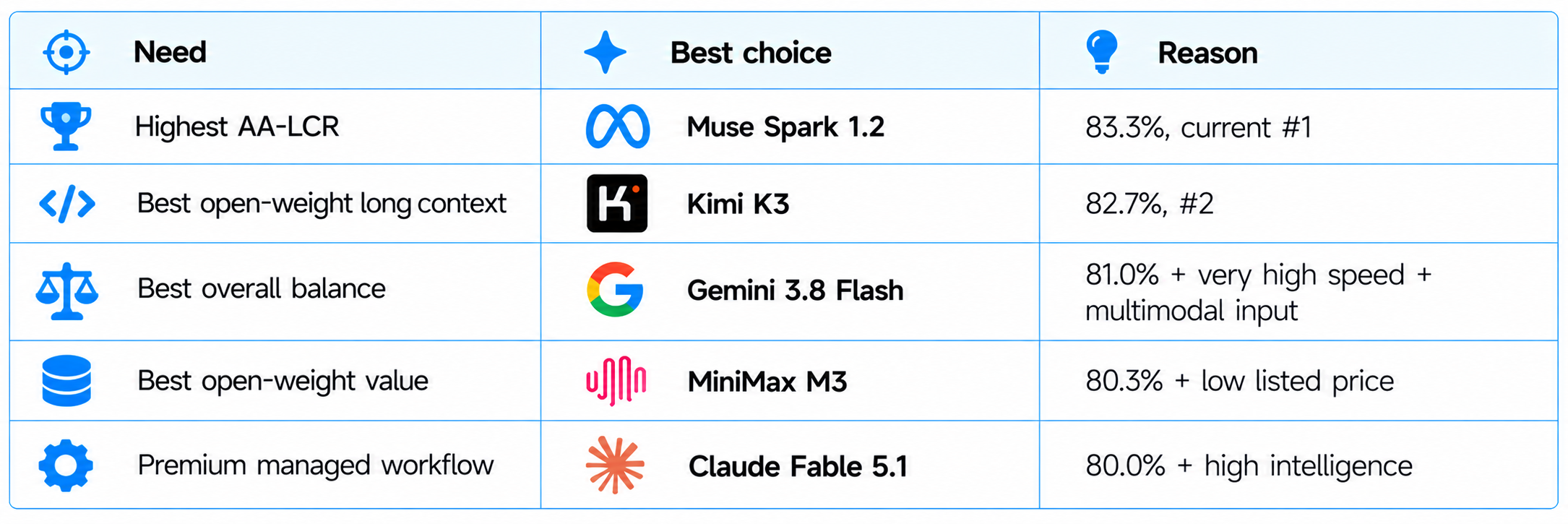
My overall pick for a balanced long-document workflow is Gemini 3.8 Flash. My pick for the highest AA-LCR score is Muse Spark 1.2. My open-weight pick is Kimi K3, and my value-oriented open-weight pick is MiniMax M3.
1. What Does a 1M-Token Context Actually Mean?
A 1M-token context window means the model can accept roughly one million tokens of combined input and conversation context, subject to the model's exact input and output limits. Artificial Analysis uses a rough conversion of about 1,500 A4 pages of 12-point Arial text for a 1M context.
That does not mean one million tokens equals one million useful facts. Long documents contain repetition, boilerplate, tables, references and irrelevant material. The real challenge is retrieval and reasoning: identifying what matters, resolving conflicts and building an answer from evidence that may be far apart in the input.
For that reason, AA-LCR is the main ranking signal in this comparison. It evaluates reasoning over long inputs rather than merely checking whether an API accepts a very large request.
2. The 1M-Context Models Ranked
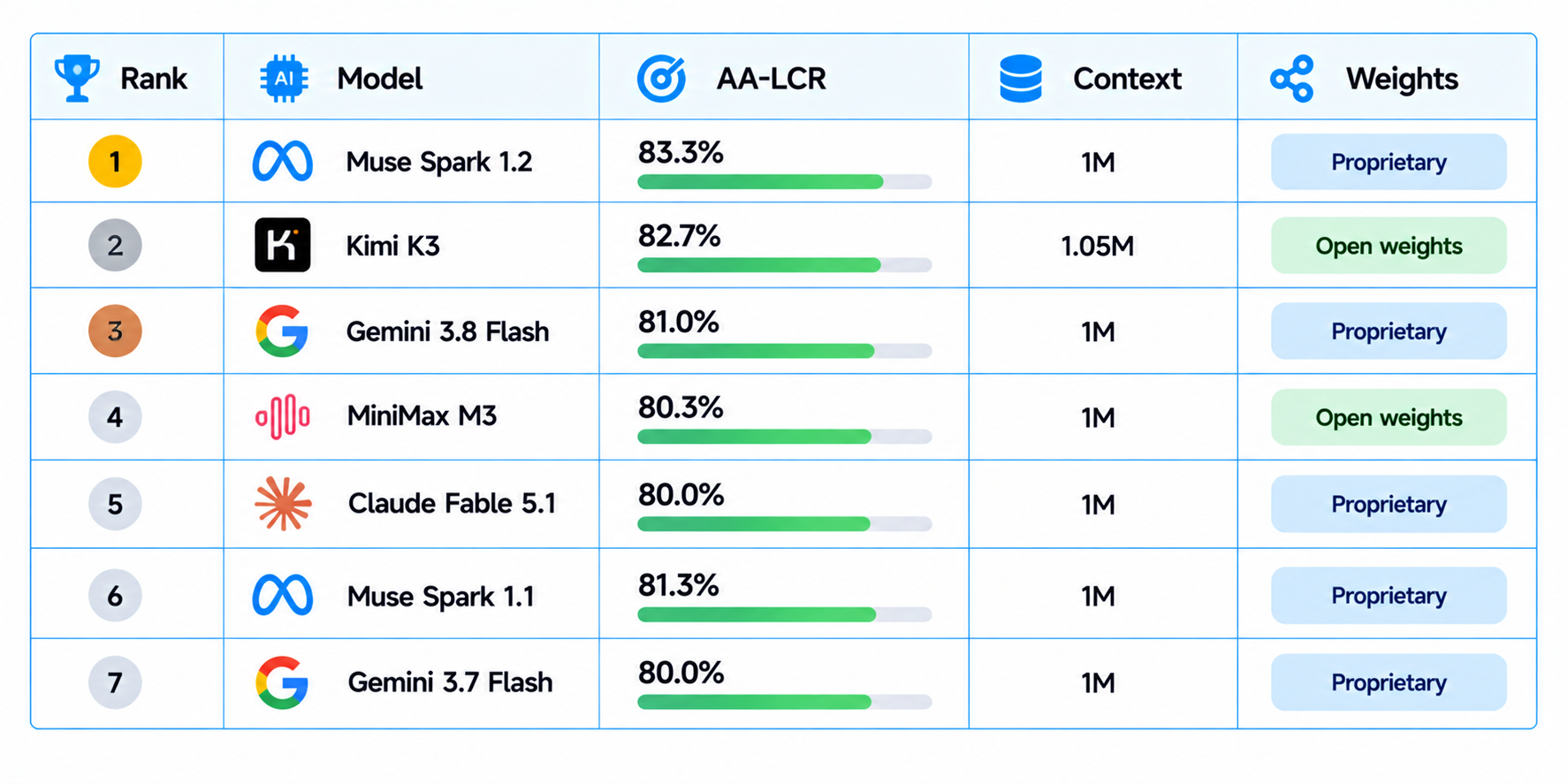
BenchLM's September 4 leaderboard places Muse Spark 1.2 at 83.3%, Kimi K3 at 82.7%, Muse Spark 1.1 at 81.3%, Gemini 3.8 Flash at 81.0%, MiniMax M3 at 80.3%, Claude Fable 5.1 at 80.0% and Gemini 3.7 Flash at 80.0%.
3. Muse Spark 1.2: The Current AA-LCR Leader
Muse Spark 1.2 currently leads the AA-LCR leaderboard at 83.3%. That makes it the strongest pure long-context choice in this comparison when the benchmark score is the primary criterion.
The result fits the model's broader positioning around coding, agents and knowledge work. Artificial Analysis previously recorded Muse Spark 1.2 at 56.8 on its Intelligence Index and 83.33% on AA-LCR, with a 72.2 Coding Index result.
4. Kimi K3: Strongest Open-Weight Long-Context Option
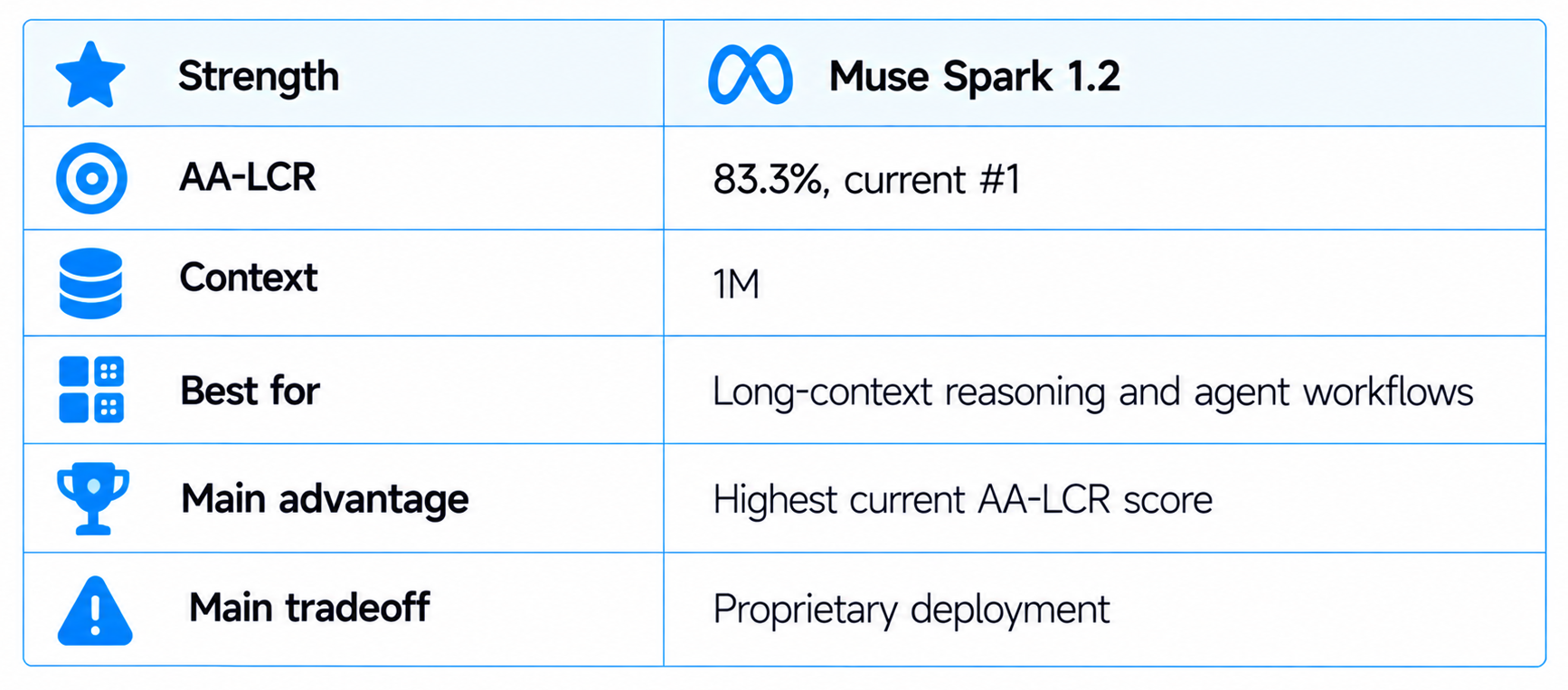
Kimi K3 sits just 0.6 percentage points behind Muse Spark 1.2 on AA-LCR at 82.7%. That makes it the strongest open-weight choice among the top models in the current ranking.
Artificial Analysis lists Kimi K3 with a 1M-token context, 2.8 trillion total parameters and 104 billion active parameters per token. Its max-reasoning configuration has an Intelligence Index score of 50 and output speed of roughly 42 tokens per second.
5. Gemini 3.8 Flash: Best Overall Balance
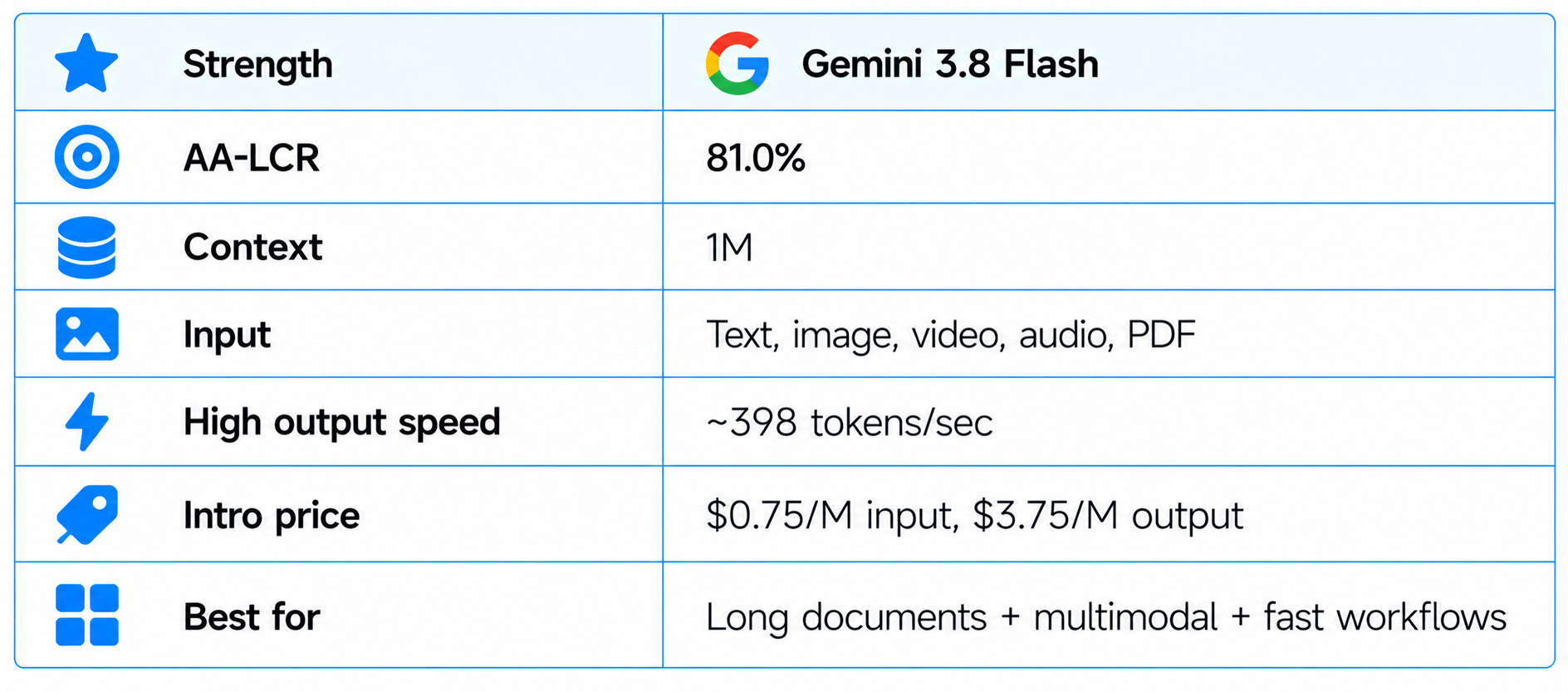
Gemini 3.8 Flash ranks third on AA-LCR at 81.0%, only 2.3 points behind Muse Spark 1.2. It is therefore not the pure benchmark winner, but it combines strong long-context reasoning with speed, multimodal document input and production tooling.
Google's official documentation lists a 1,048,576-token input limit and 65,536-token maximum output. The model accepts text, image, video, audio and PDF and supports code execution, file search, function calling, search grounding, structured outputs and multiple thinking levels.
Artificial Analysis currently measures the high-reasoning version at about 397.6 output tokens per second and lists $0.75 per million input tokens and $3.75 per million output tokens.
6. MiniMax M3: Best Value Open-Weight Choice
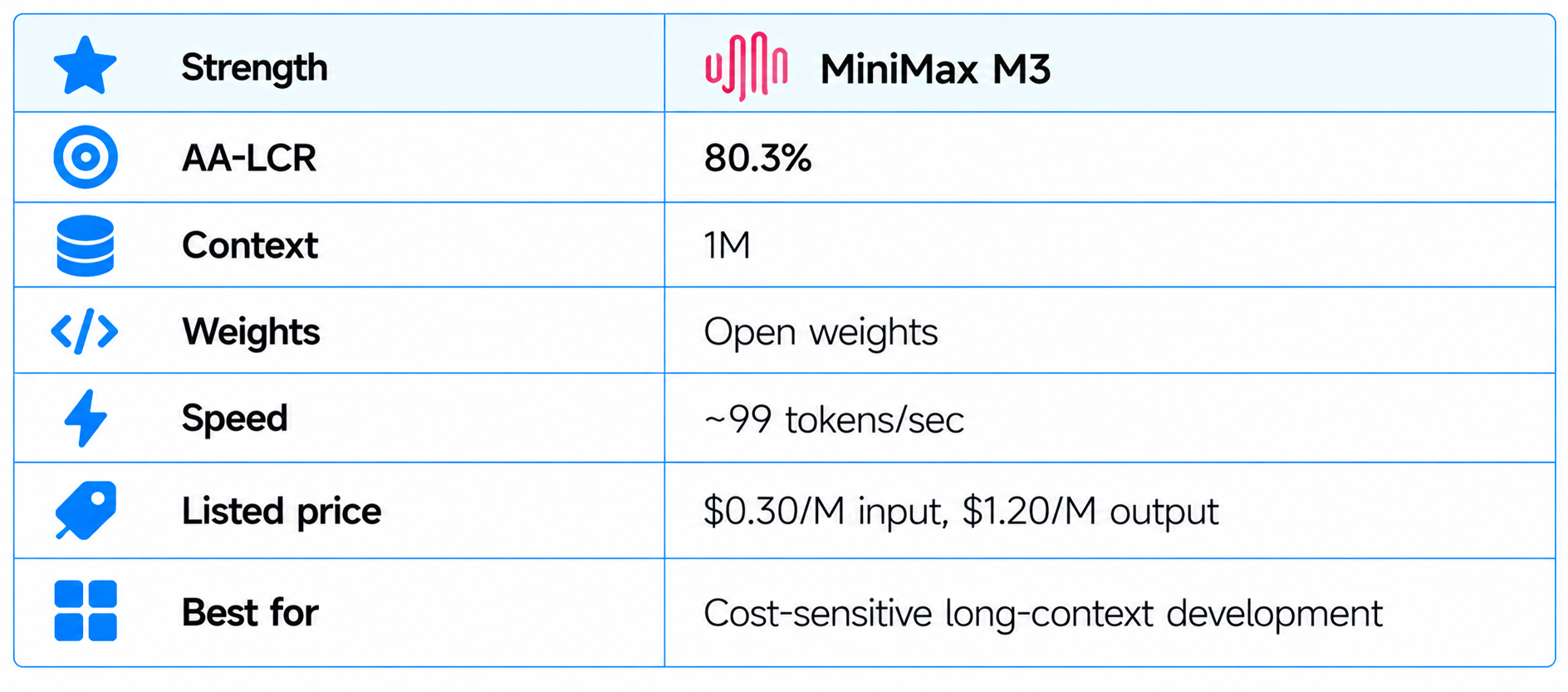
MiniMax M3 scores 80.3% on the current AA-LCR leaderboard and carries a 1M-token context. Artificial Analysis currently gives it a 45 Intelligence Index score and about 99 output tokens per second. It supports text, image and video input and is available as an open-weight model.
M3 is particularly attractive when ownership and cost matter. Artificial Analysis lists $0.30 per million input tokens and $1.20 per million output tokens.
7. Claude Fable 5.1: Strong Long Context at a Premium
Claude Fable 5.1 scores 80.0% on the current AA-LCR leaderboard and supports a 1M-token context with text and image input. It is competitive on long-context reasoning but is considerably more expensive than the Flash and open-weight alternatives.
Artificial Analysis lists the max-reasoning version at 57 on its Intelligence Index and about 67 tokens per second. Its tracked cost per Intelligence Index task is also substantially higher than the lower-cost choices in this comparison.
Fable 5.1 makes sense when you already want a premium Claude workflow and long-context reasoning is one part of that broader stack. It is not the obvious choice for simple long-document retrieval where cost and throughput dominate.
8. Gemini 3.8 Flash vs Kimi K3
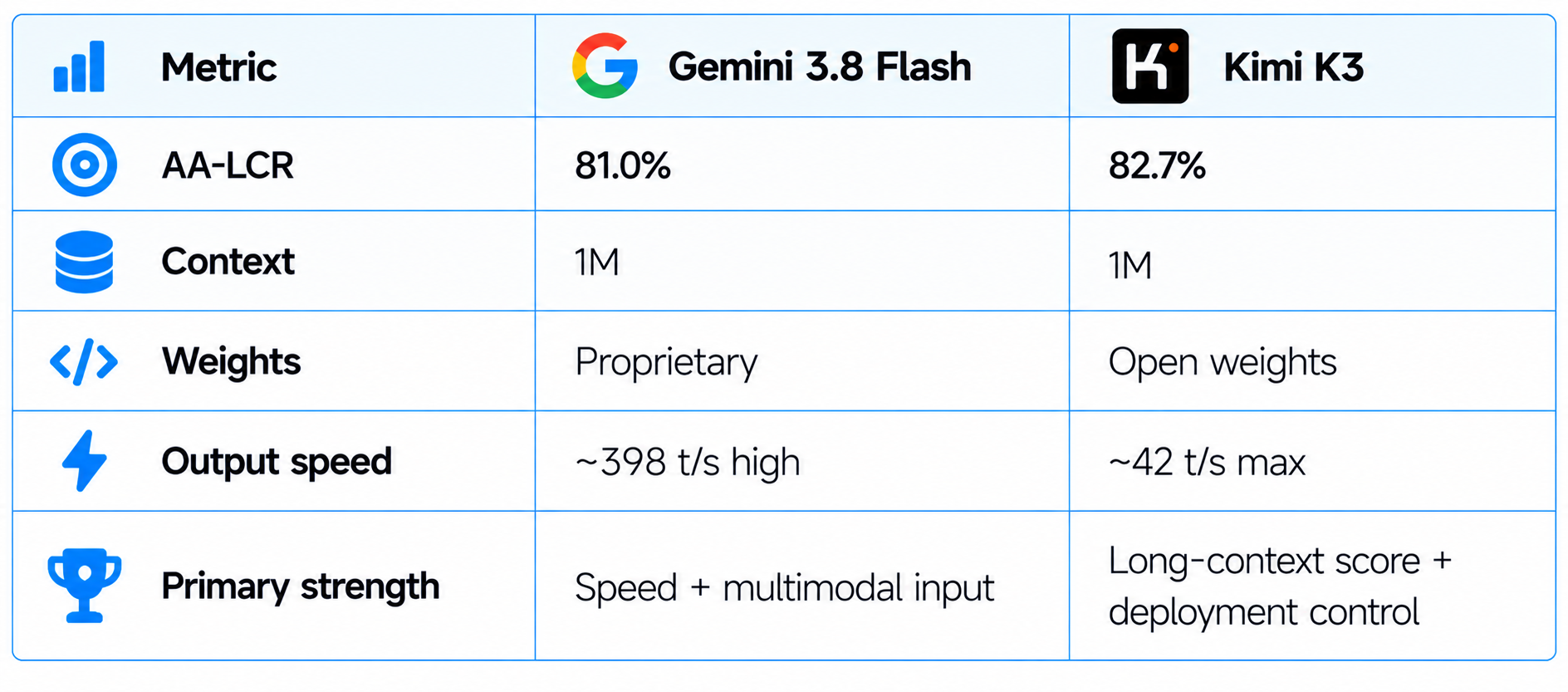
Kimi K3 wins on the long-context benchmark by 1.7 points, while Gemini 3.8 Flash has a major throughput advantage in current provider measurements. Kimi is the better choice when open weights matter. Gemini is the better fit for teams that value speed, multimodal files and a managed API.
9. Muse Spark 1.2 vs Gemini 3.8 Flash
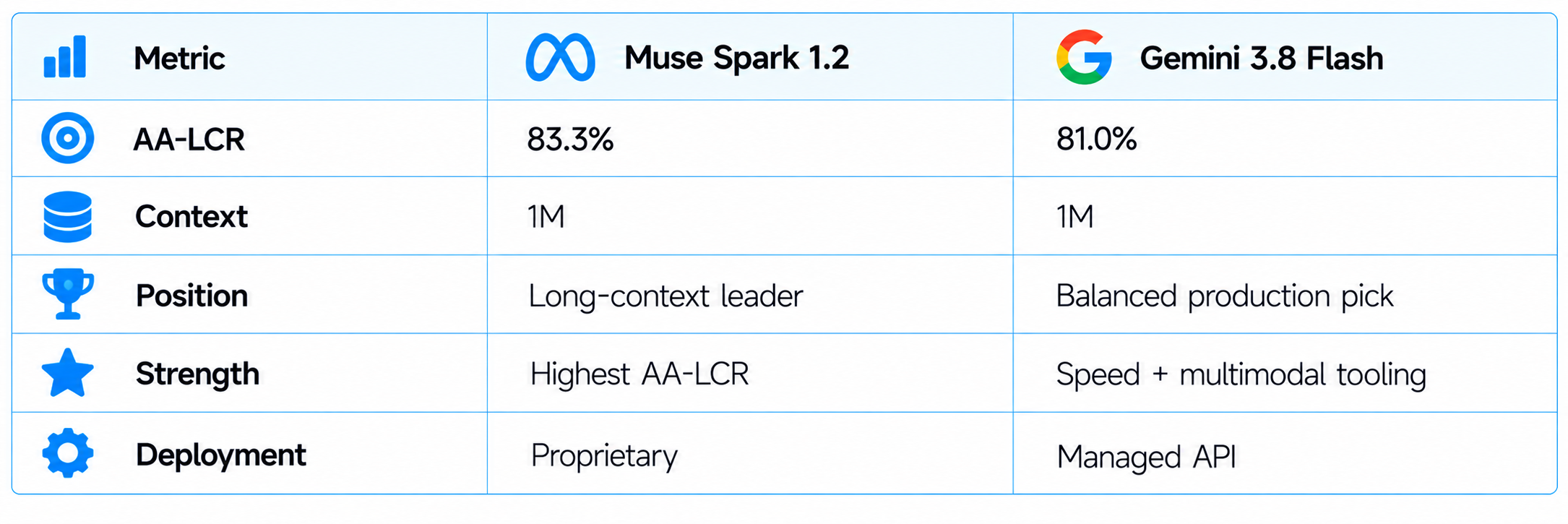
Muse Spark 1.2 has the better AA-LCR result. Gemini 3.8 Flash has the stronger all-round operational profile for many document workflows, especially when PDFs and other media are part of the input. Google also exposes file search, search grounding, code execution and structured output in the API.
10. MiniMax M3 vs Kimi K3
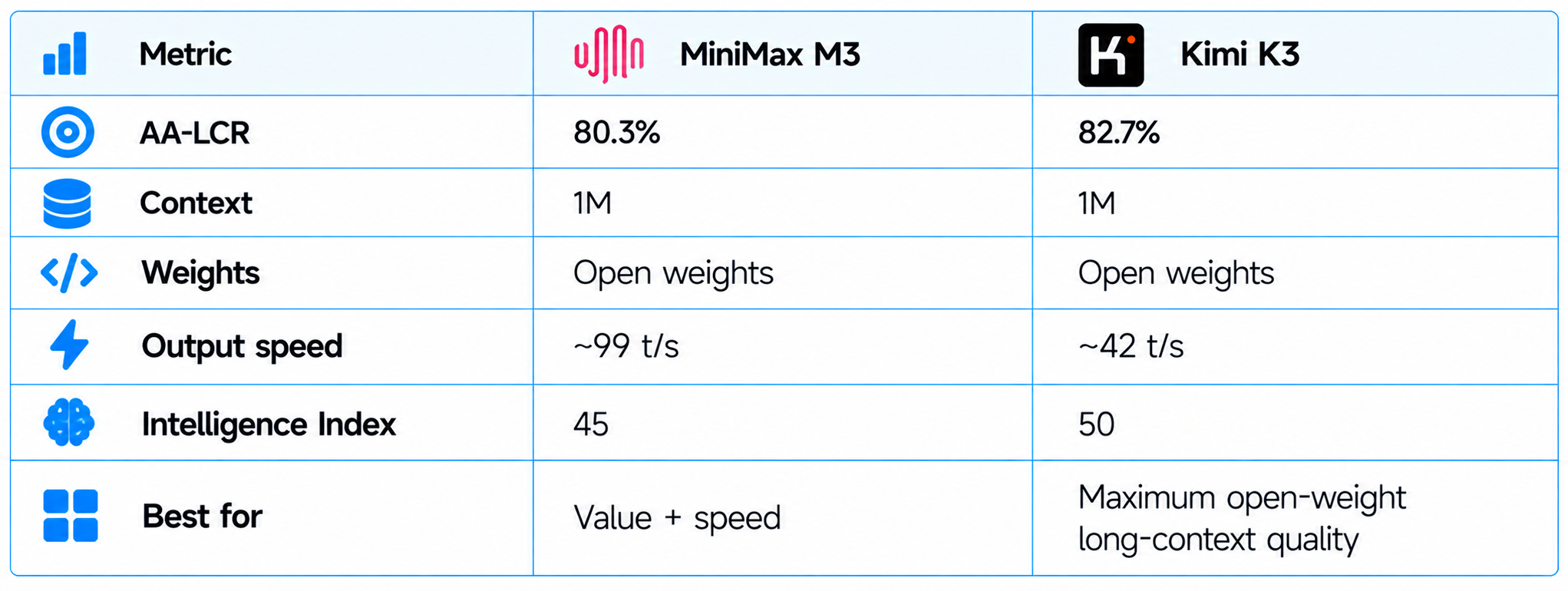
Kimi K3 is the stronger long-context model on the current benchmark, while MiniMax M3 is faster and has a lower listed API price. For self-hosted systems that need the best benchmark result, Kimi is the stronger pick. For high-throughput workflows, M3 is more attractive.
11. What Should You Use for PDFs?
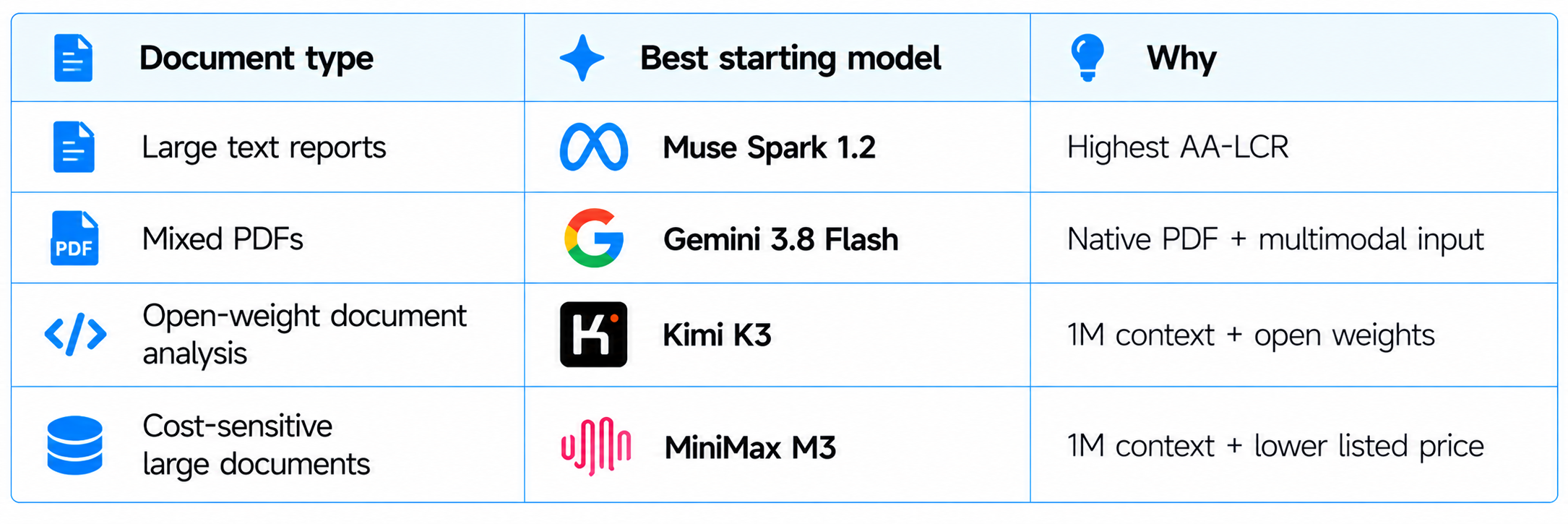
PDF workflows can include diagrams, tables, scanned pages and mixed layouts, so a large text context alone is not enough. Gemini 3.8 Flash is particularly strong for this use case because Google explicitly lists PDF, image, video and audio inputs alongside its 1M-token context.
For text-heavy PDFs, Muse Spark 1.2 and Kimi K3 remain excellent choices because of their higher AA-LCR scores. In a production system, the strongest pattern is to combine retrieval with a large context so the model receives the most relevant pages or sections together.
12. Long Context vs RAG: Do You Need Both?
A 1M context window does not eliminate retrieval-augmented generation. In many production systems, RAG and long context work together. Retrieval narrows a large knowledge base to relevant material, while the large context lets the model reason over a larger evidence set together.
For example, a legal assistant can retrieve a contract, its amendments and the relevant policy sections, then pass the combined evidence into a 1M-context model. This can preserve relationships between distant clauses that a heavily chunked pipeline may lose.
This is where context engineering becomes important. The goal is not to maximize tokens. It is to maximize useful evidence in the context.
13. The Best Model Depends on the Job
14. How to Test Long-Context Models Yourself
A benchmark is useful, but your own documents are the final judge. Build a small evaluation set from the material your system actually receives.
- One 500-1,000 page technical document.
- One contract or policy set with amendments and repeated clauses.
- One research packet with conflicting claims.
- One repository or documentation corpus with facts distributed across many files.
- Several needle-in-a-haystack questions with facts buried deep in the context.
- At least one task that requires combining evidence from distant sections.
15. Common Long-Context Mistakes
- Assuming a 1M context means the entire document is automatically understood.
- Stuffing the entire knowledge base into every request.
- Using a large-context model without source tracking or evidence requirements.
- Comparing models only by context length.
- Ignoring output limits for very large inputs.
- Measuring only summarization instead of retrieval and reasoning.
- Choosing the most intelligent model without considering latency and cost.
16. Best AI Models for Long Documents: Final Ranking
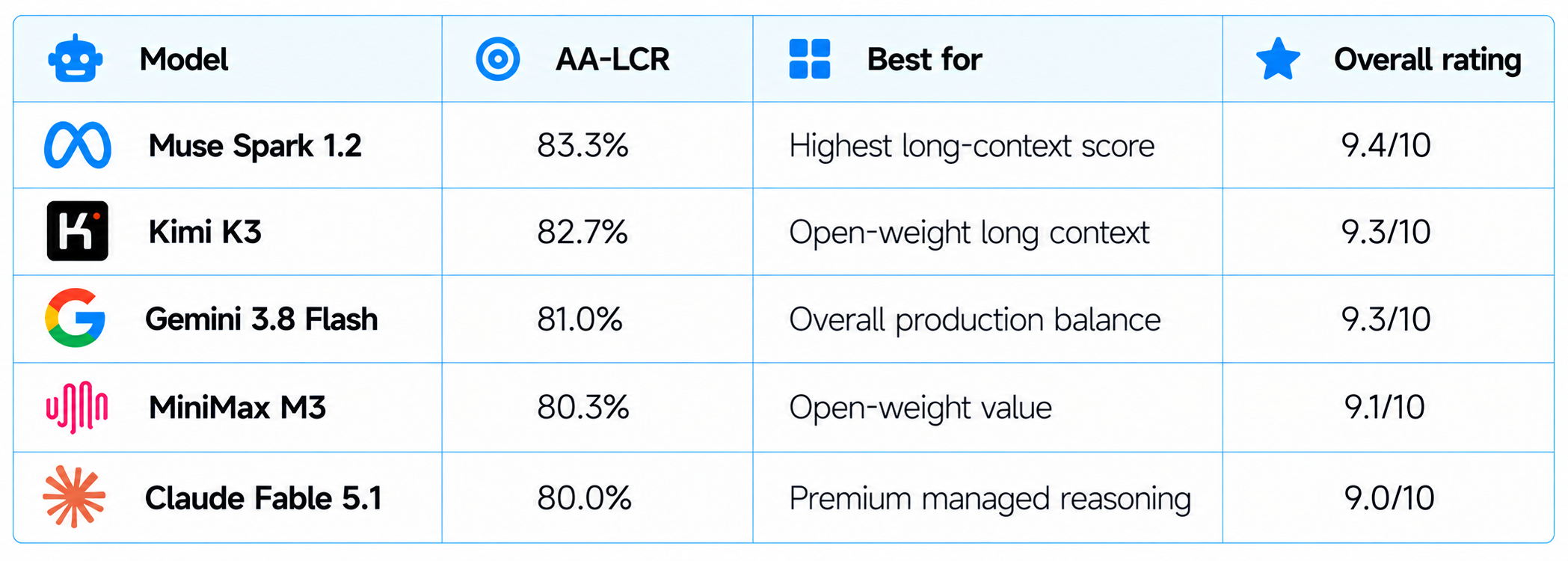
The ratings combine AA-LCR with practical considerations such as context size, speed, price, modalities and deployment. They are editorial ratings, not benchmark scores.
17. Is 1M Context Enough for a Book?
For many books, yes. Artificial Analysis gives a rough conversion of about 1,500 A4 pages of 12-point text for a 1M-token context. Actual capacity varies with formatting, language and token density.
The harder task is not fitting the book. It is reasoning over it. Cross-chapter analysis, finding a small detail hundreds of pages earlier, comparing arguments and resolving contradictions are much more demanding than a simple summary.
That is why AA-LCR is more informative than the context-window number by itself.
18. Recommended Production Workflow
For a real long-document assistant, use the model as part of an evidence pipeline.
- Normalize and identify the documents before inference.
- Retrieve the most relevant sources or sections.
- Use the large context for the evidence set that needs joint reasoning.
- Ask for explicit source locations for important claims.
- Require the model to flag contradictions instead of silently choosing one.
- Use structured output when the answer feeds another system.
- Store evaluation results so models can be compared over time.
19. Final Verdict
The current long-context leaderboard shows that 1M-token models are not just a context-window marketing exercise. Muse Spark 1.2, Kimi K3, Gemini 3.8 Flash, MiniMax M3 and Claude Fable 5.1 all sit around 80% or higher on the current AA-LCR ranking, with Muse Spark 1.2 leading at 83.3%.
If you want the highest measured long-context score, choose Muse Spark 1.2. If you want open weights, Kimi K3 is the strongest model in the top group. If you want the best balance of long-context reasoning, speed, multimodal document input and managed tooling, Gemini 3.8 Flash is the most practical overall pick.
MiniMax M3 is the value choice for developers who want open weights and a 1M context at a low listed price. Claude Fable 5.1 is the premium managed option for teams already invested in the Claude ecosystem.
The larger lesson is that a 1M context window should be treated as infrastructure, not as the final quality metric. The important question is how well a model can find, connect and verify information across that context.
Bottom line: for September 2026, Muse Spark 1.2 leads the pure long-context benchmark, Kimi K3 is the strongest open-weight option, and Gemini 3.8 Flash is the best all-rounder for most production long-document workflows.
Frequently Asked Questions
Which AI model is best for long documents?
Muse Spark 1.2 currently has the highest AA-LCR score at 83.3% in the September 2026 leaderboard.
Which AI models have a 1M context?
Current top examples include Muse Spark 1.2, Kimi K3, Gemini 3.8 Flash, MiniMax M3, Claude Fable 5.1 and Gemini 3.7 Flash.
What is the best open-weight long-context model?
Kimi K3 is the strongest open-weight model in the current top AA-LCR group at 82.7%.
What is the best value 1M-context model?
MiniMax M3 combines an 80.3% AA-LCR score, open weights and current listed pricing of $0.30/M input and $1.20/M output.
Is Gemini 3.8 Flash good for long documents?
Yes. It scores 81.0% on the current AA-LCR leaderboard and combines 1M context with PDF and other multimodal inputs.
Can a 1M-context model analyze a whole book?
Often yes. Artificial Analysis gives about 1,500 A4 pages as a rough 1M-token comparison, but actual capacity varies.
Is 1M context better than RAG?
They solve different problems. RAG retrieves relevant information, while a large context lets the model reason over a larger evidence set together. Production systems can use both.
Which model is best for large PDFs?
Gemini 3.8 Flash is an especially strong starting point because its official API supports PDF, image, video and audio input, while Muse Spark 1.2 and Kimi K3 are excellent for text-heavy long documents.
Does a larger context always mean better answers?
No. Long-context quality depends on retrieval, reasoning and evidence use, not simply the maximum token limit.
What is AA-LCR?
AA-LCR is Artificial Analysis Long Context Reasoning, an evaluation used to measure reasoning performance on long inputs.
Recommended Blogs
Ox Alpha Review: The Mystery AI Model With 1M Context (2026)
Gemini 3.8 Flash Review: Accuracy, Price & Is It Worth It? (2026)
Meta Muse Spark 1.3 Review: Coding, Price & Is It Worth It? (2026)
Qwen 3.8 Max 0902 Review: Benchmarks, Price & Is It Worth It? (2026)
Quasar 438B Review: Benchmarks, Speed, Price & Is It Worth It? (2026)
Resources & Community
Join our community of 70,000+ AI enthusiasts and learn to build powerful AI applications. Whether you're a beginner or an experienced developer, Build Fast with AI helps you understand and implement AI in your projects.
Agentic AI Launchpad 2026
A structured 6-week cohort program that takes you from AI basics to building and deploying real-world agentic AI systems. Includes live sessions, expert mentorship, project reviews and a builder community network.
Ready to go from learning to building? Join the next cohort: Agentic AI Launchpad 2026
Free AI Resources
Access free tools, workshops and micro-learning to keep building.

