



What Is Pomelli? Google AI Marketing Tool Explained: How It Works, What It Can Create & How to Use It (2026)
Google Pomelli is an AI marketing tool from Google Labs that helps businesses turn their existing brand information into usable marketing content. Instead of starting with a blank design canvas, Pomelli first learns about the business and creates a Business DNA profile. That profile can then be reused across campaigns, product imagery, brand books and websites.
This makes Pomelli different from a generic AI image generator. The system is designed around the idea that good marketing starts with context. Your website, products, images, colors, fonts and business values become inputs to the creative workflow. Pomelli can also use uploaded materials or eligible Google Business Profile information, so a business does not need to have a perfectly documented brand kit before it starts.
Pomelli has also expanded substantially since its original 2025 launch. In May 2026, Google added the Pomelli Agent, Brand Books and Websites. Current help documentation also covers campaign ingredients, product Photoshoots, animation, website editing and connected-app sharing. So the useful question in 2026 is not simply 'What is Pomelli?' but 'How much of a small business marketing workflow can Pomelli now handle?'
QUICK ANSWER
Pomelli is Google's AI marketing workspace for businesses that want to create on-brand content faster. Its central feature is Business DNA, a structured snapshot of a brand's fonts, colors, values, imagery and catalog information. Pomelli uses that context to generate campaign ideas and creatives instead of asking the user to rebuild the brand from scratch every time.
The product has grown beyond social posts. Pomelli can now help build Business DNA with the Pomelli Agent, generate Brand Books, create and edit websites, turn product photos into studio and lifestyle imagery, animate supported assets, and share creatives to connected apps such as Google Ads and professional Instagram accounts.
Google currently says Pomelli is available at no charge during its experimental phase. Its Help Center says users can create several hundred image and video generations, while also warning that AI-generated product images can change fine details such as colors, logos and textures. That means Pomelli is excellent for speed and marketing production, but important customer-facing assets still need human review.
This article is intentionally different from our earlier <What Is Google Pomelli AI? Full Review & Guide 2026>. That article covered the overall product and original feature set. This guide focuses on the 2026 workflow: Business DNA, the Pomelli Agent, Brand Books, Websites, Campaigns, Photoshoot, connected-app distribution and how these pieces fit together as one marketing system.
1. What Is Google Pomelli?
Pomelli is a Google Labs experiment developed with Google DeepMind to help businesses create tailored marketing content. Google originally introduced it in October 2025 as an AI marketing tool for small and medium-sized businesses, with a workflow built around website analysis, business identity and campaign generation.
The core idea has stayed consistent while the product surface has expanded. Pomelli tries to understand the business first, then use that understanding repeatedly. That is the reason Business DNA is more important than any single generation button.
In practical terms, Pomelli sits between a brand assistant, an AI creative tool and a lightweight marketing workspace. It does not replace every design, advertising or social platform, but it reduces the amount of manual setup needed to create a consistent first version of a campaign.
2. How Pomelli Works
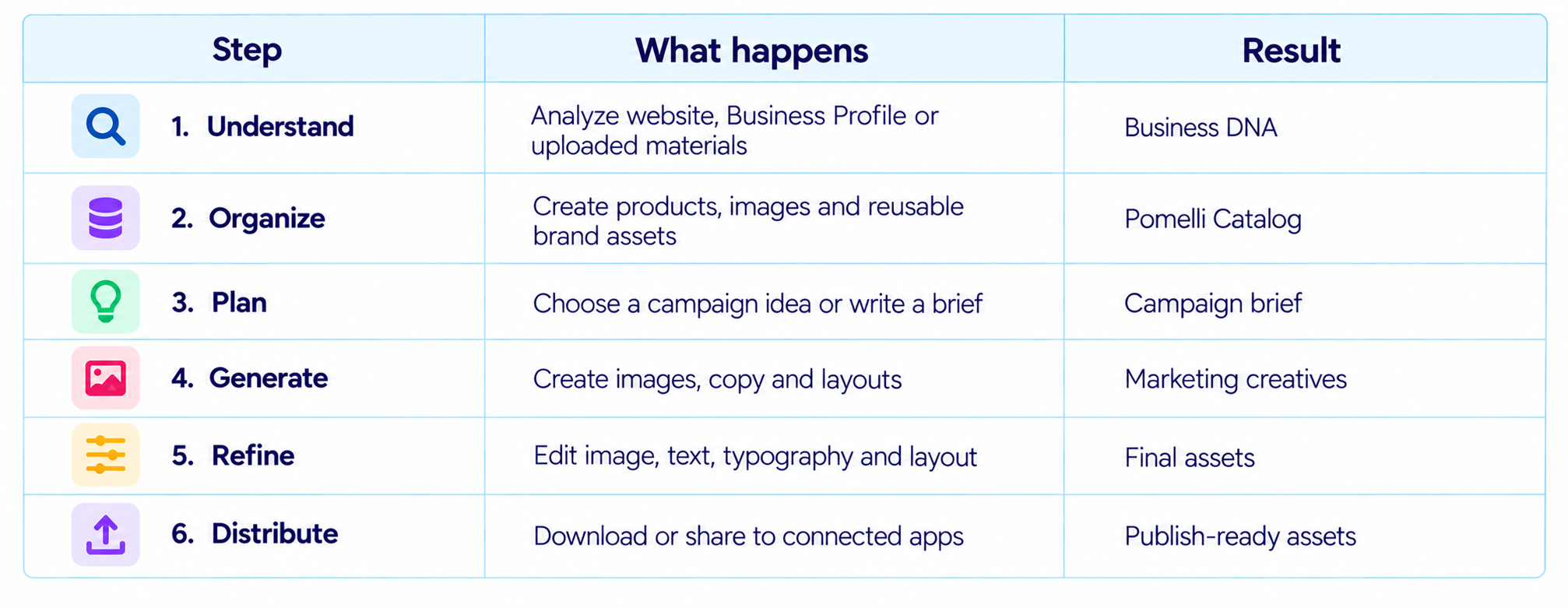
Google's current help pages make the stages explicit. Business DNA is created first, campaigns use products and campaign ingredients, and the resulting assets can then be edited and shared. This structure is what makes Pomelli different from opening an image model with no brand context.
3. What Is Business DNA?
Business DNA is Pomelli's reusable brand context. Google describes it as a snapshot of a business's identity that includes brand fonts, colors, values, images, the Pomelli Catalog and assets.
You can build it from a website, use information from an eligible Google Business Profile, or start from scratch with Pomelli Agent and upload supporting files. Google currently allows up to 20 uploaded files, with each file limited to 25 MB, and supports common formats including PDF, DOCX, images, audio and text.
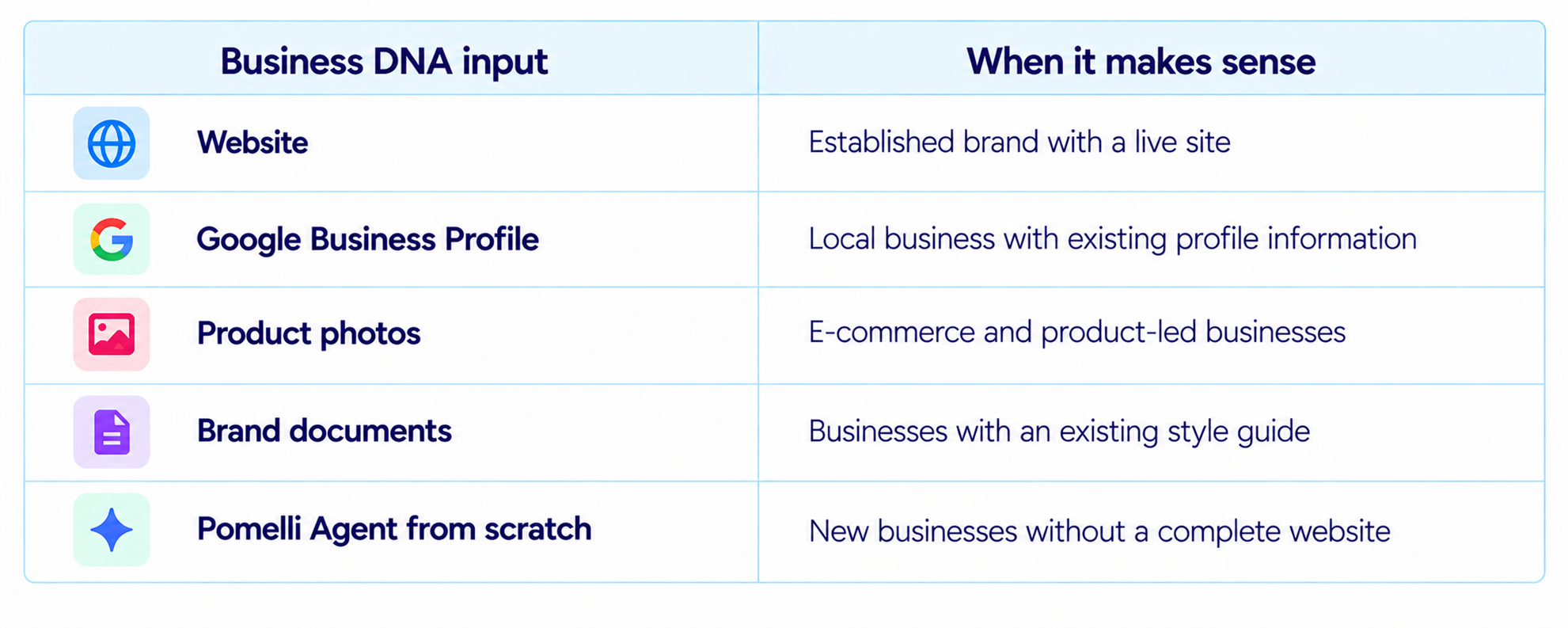
Google says website analysis can take up to eight minutes. That is a reasonable tradeoff because the goal is to create a reusable identity rather than a one-off image. The important step is reviewing the generated Business DNA before using it everywhere else.
4. Pomelli Agent
The Pomelli Agent is the biggest conceptual change in the product. Instead of requiring a fully formed website and brand identity, Pomelli can now help build the Business DNA itself.
Google says the agent can work from uploaded product documents and photos or from a conversation about the business. That makes Pomelli useful for a company that has the raw ingredients of a brand but has never formalized them into a structured system.
You can also use the agent to edit or add details to existing Business DNA. This matters because brand understanding is rarely perfect on the first pass. A company may want to change how it describes its audience, clarify its values or correct a visual preference before generating more content.
The practical workflow is therefore: build, review, correct, then generate. Skipping the review step can create the same wrong assumptions repeatedly across campaigns and websites.
5. Pomelli Campaigns
Campaigns are where Business DNA becomes actual marketing output. Google currently lets you select a product, generate a campaign brief, review that brief, then create a group of marketing creatives.
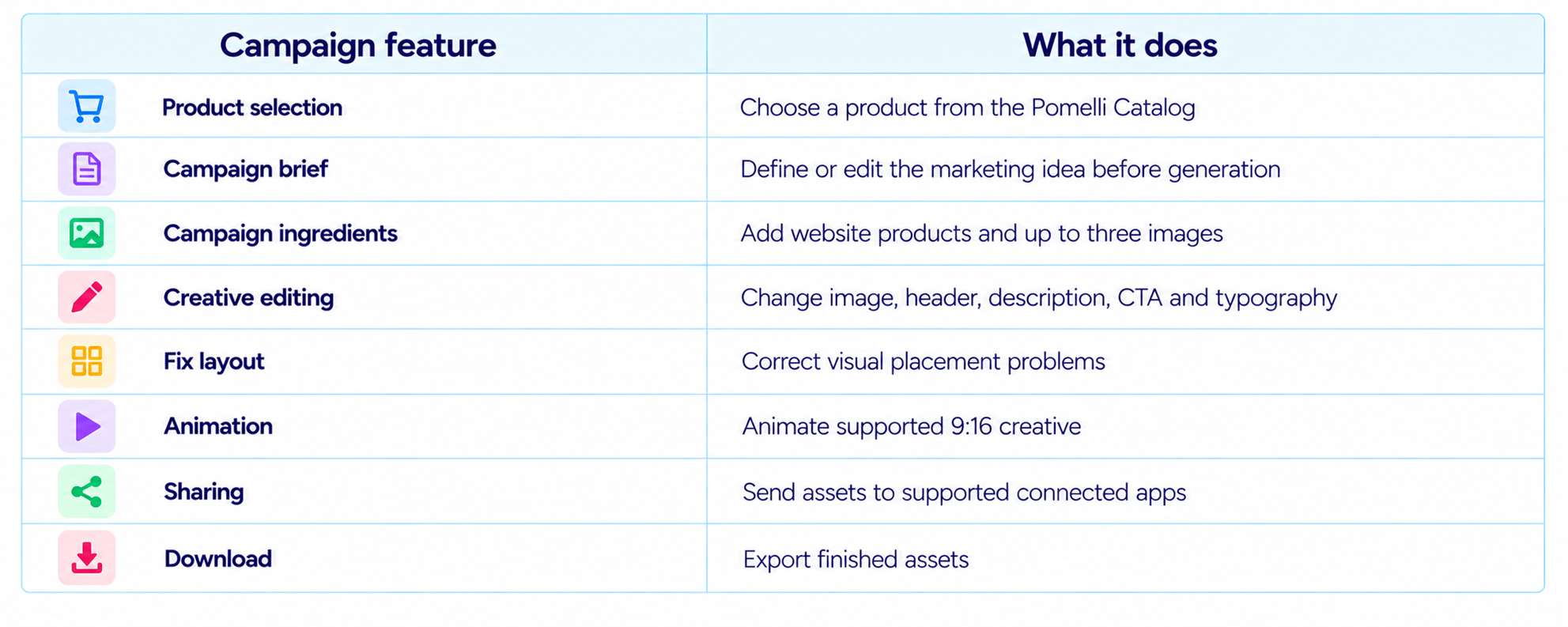
Campaign ingredients are particularly useful for e-commerce. Google says adding products and images from your website helps campaigns stay grounded in real product information and makes the creative more relevant to the item being promoted.
6. Pomelli Photoshoot
Photoshoot is Pomelli's product-imagery workflow. You start with a product image, select up to six preset or custom templates and generate studio or lifestyle variations that follow your Business DNA.
The current Photoshoot workflow also lets you generate or edit catalog images with prompts, save successful results as catalog items, resize outputs and animate selected images.
For small e-commerce brands, this is one of Pomelli's most useful features. The business can create several different product contexts without arranging a separate photoshoot for every campaign.
The important limitation is accuracy. Google explicitly warns that AI-generated product images can modify fine details. A generated image might change a logo shape, product color, texture or another physical characteristic. Use the tool to accelerate creative production, but compare final product visuals with the real item before publishing.
7. Pomelli Animate
Pomelli can add animation to supported creatives. Google's current campaign documentation says Animate is available for 9:16 campaign assets, and the Photoshoot workflow also lets users animate generated images and download the result in formats such as MP4 or GIF.
This matters because social marketing increasingly needs motion even when the original creative is static. Pomelli can take an already branded image and turn it into a short animated asset without asking the user to rebuild the visual identity elsewhere.
The feature is best understood as a creative extension, not a replacement for a dedicated video-editing suite. Its value is in reducing the work between a finished still asset and a short social-friendly motion version.
8. Pomelli Brand Books
Brand Books turn Business DNA into a shareable brand guide. Google says Pomelli can generate a Brand Book with custom images, fonts and colors, let you choose a cover, include up to seven images, and download the finished guide as a PDF.
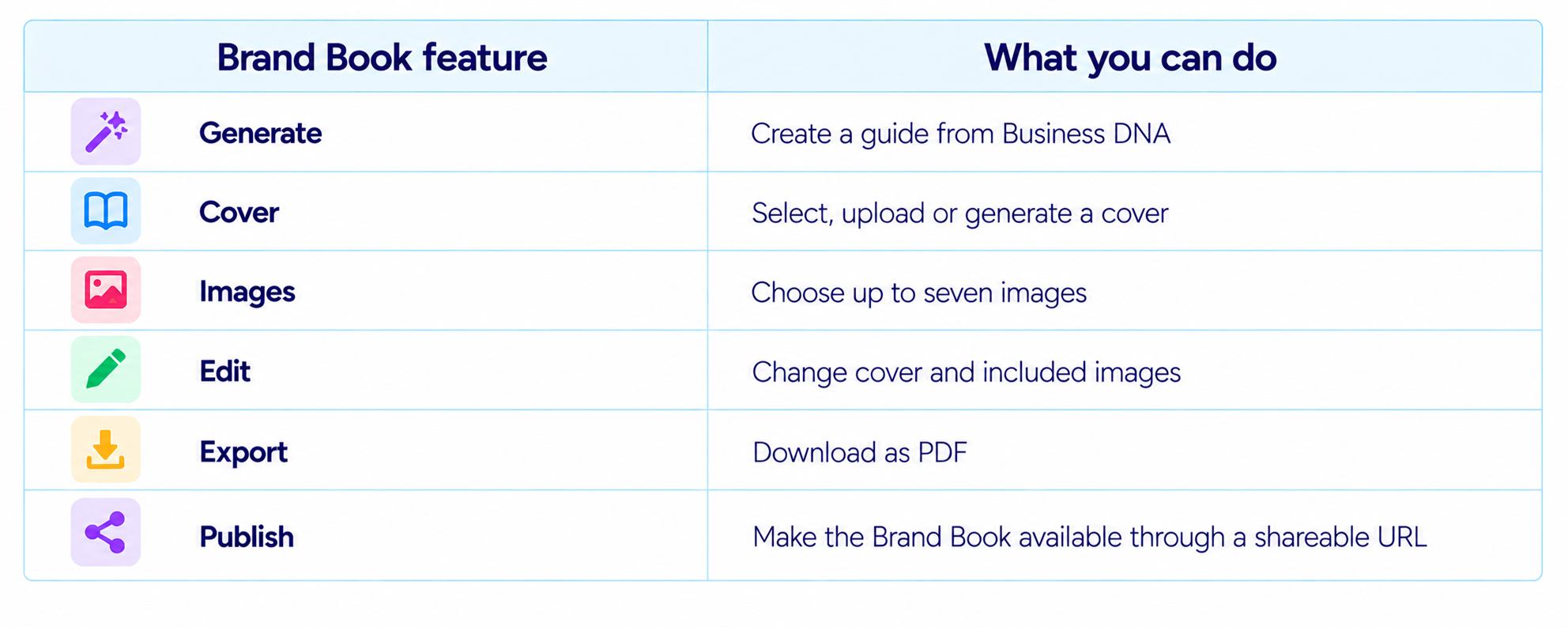
This is more useful than it first appears. A small team can use the Brand Book as a lightweight source of truth when working with freelancers, agencies or new employees. It also gives the business a tangible document produced from the same identity that powers campaigns.
9. Pomelli Website Builder
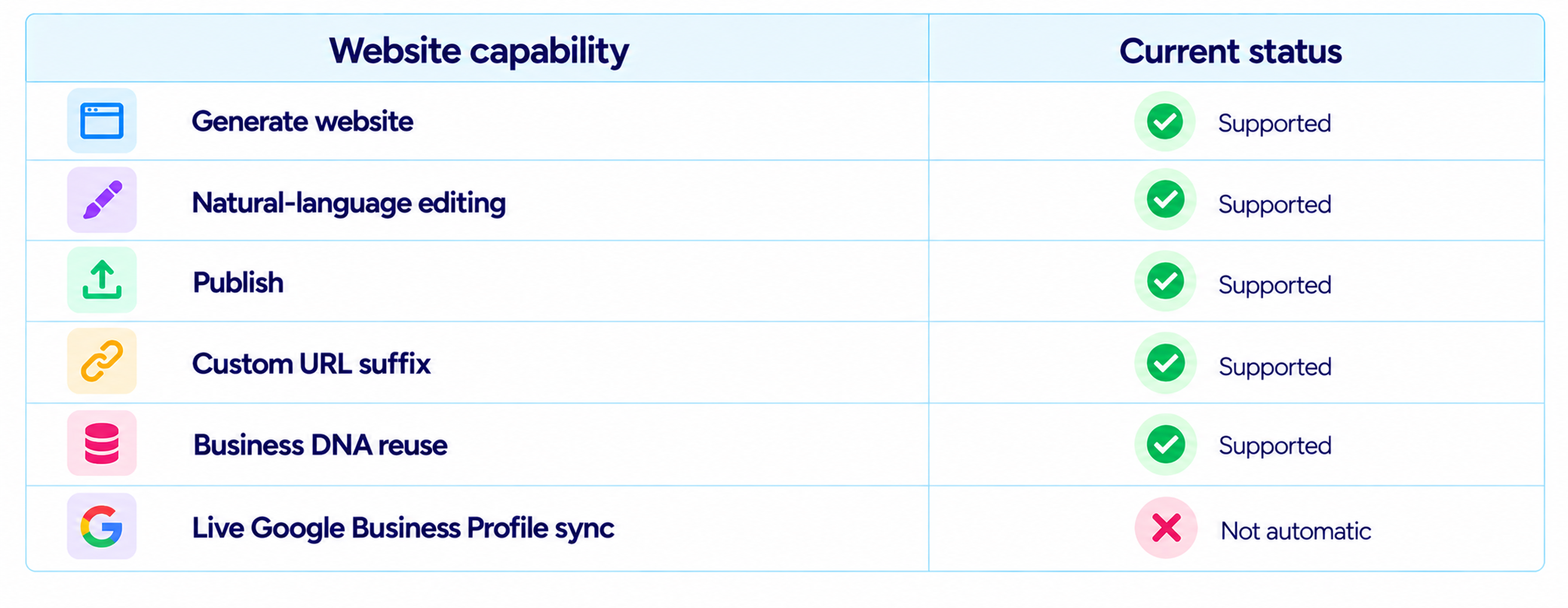
Pomelli can now create, edit and publish websites using the same Business DNA that powers its marketing assets. Google says a website can be generated once Business DNA exists, then changed through natural-language instructions.
That creates a much more complete launch workflow. A new business can define its brand, create a website, generate product imagery, build a campaign and create a Brand Book from a single starting identity.
There is one important synchronization detail. Google says information imported from a Google Business Profile is copied into the Pomelli website. Later changes to the Business Profile do not automatically update the website, and changes made on the site do not update the profile.
10. Pomelli and Connected Apps
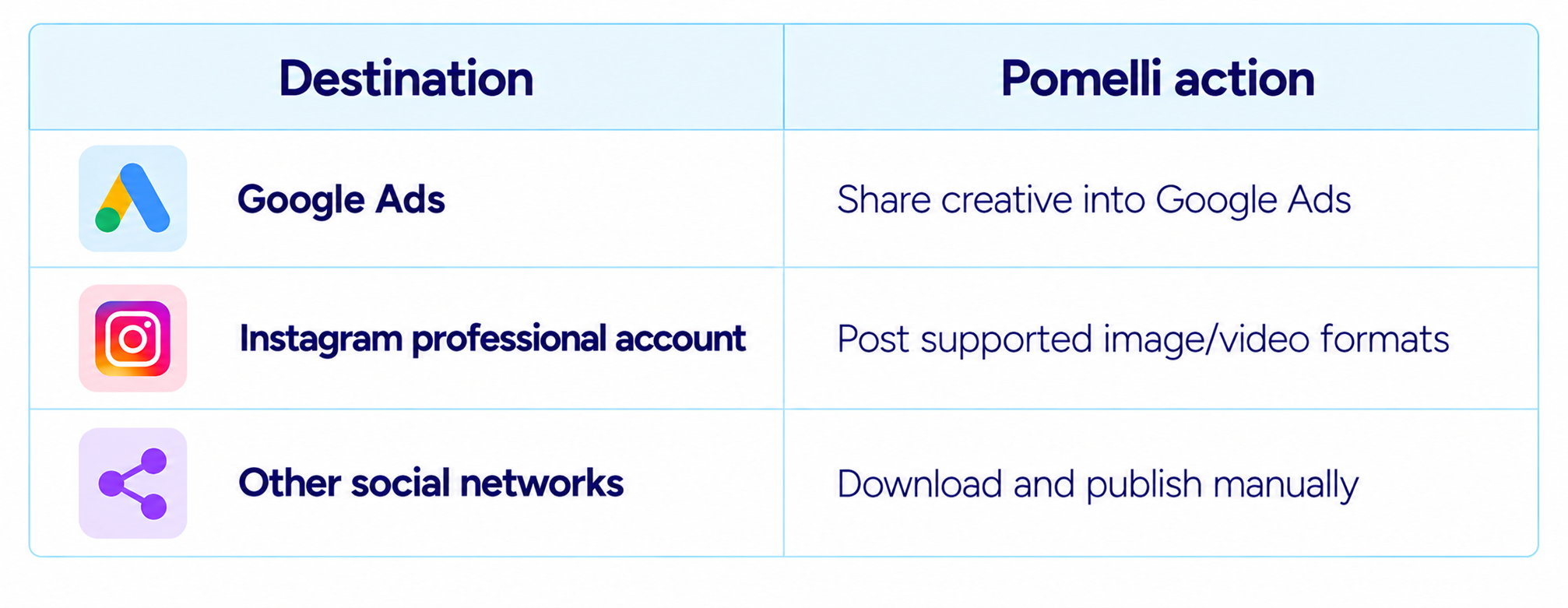
Pomelli has moved closer to the distribution stage with connected-app support. Google currently documents sharing images and videos to Google Ads and posting supported assets to connected professional Instagram accounts.
The Google Ads integration needs to be understood correctly. Sharing an asset with Google Ads does not launch the advertising campaign. The actual campaign is still created and launched in Google Ads.
For Instagram, Google documents support for connected professional accounts. The creative must use the correct aspect ratio: 9:16 for Stories and Reels, and 4:5 or 1:1 for Instagram Posts.
11. Is Pomelli Free?
Google currently says Pomelli is available at no charge during its experimental phase. The Help Center says users can create several hundred image and video generations and that future changes to usage caps will be reflected there.
That makes Pomelli unusually accessible for a small business testing AI marketing. There is no need to build a paid creative stack before seeing whether the workflow saves time.
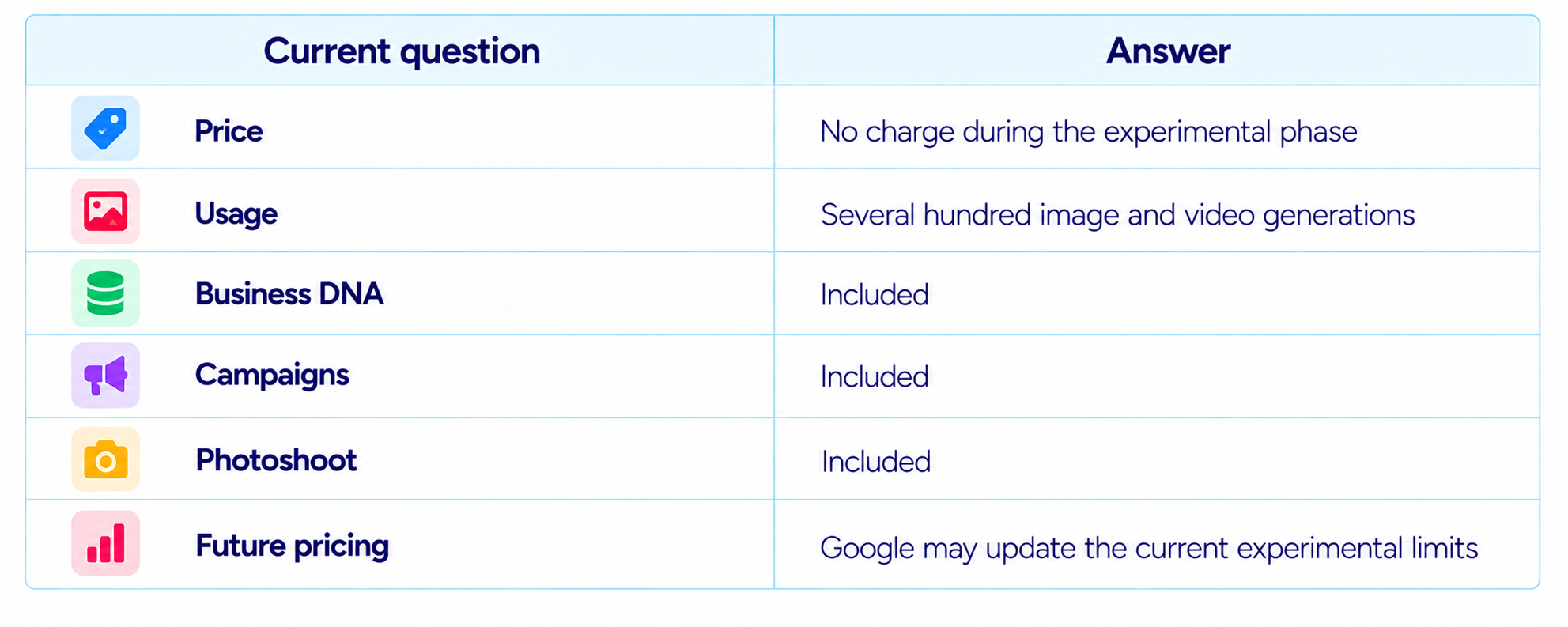
Because this is an experimental Google Labs product, treat current limits as changeable rather than as a permanent pricing guarantee.
12. Is Pomelli Available in India?
Pomelli availability depends on Google's supported countries and territories. Google expanded the product across the European Union, Iceland, Liechtenstein, Norway, Switzerland and the United Kingdom in April 2026, and the current Help Center directs users to the live supported-region list.
For India and other locations, the safest approach is to check the current Pomelli experience rather than rely on an older country list. Product availability can change as Google adjusts regional rollout and local requirements.
13. Pomelli vs Canva
Pomelli and Canva overlap, but they are optimized around different starting points. Canva begins with a design environment. Pomelli begins with business identity.
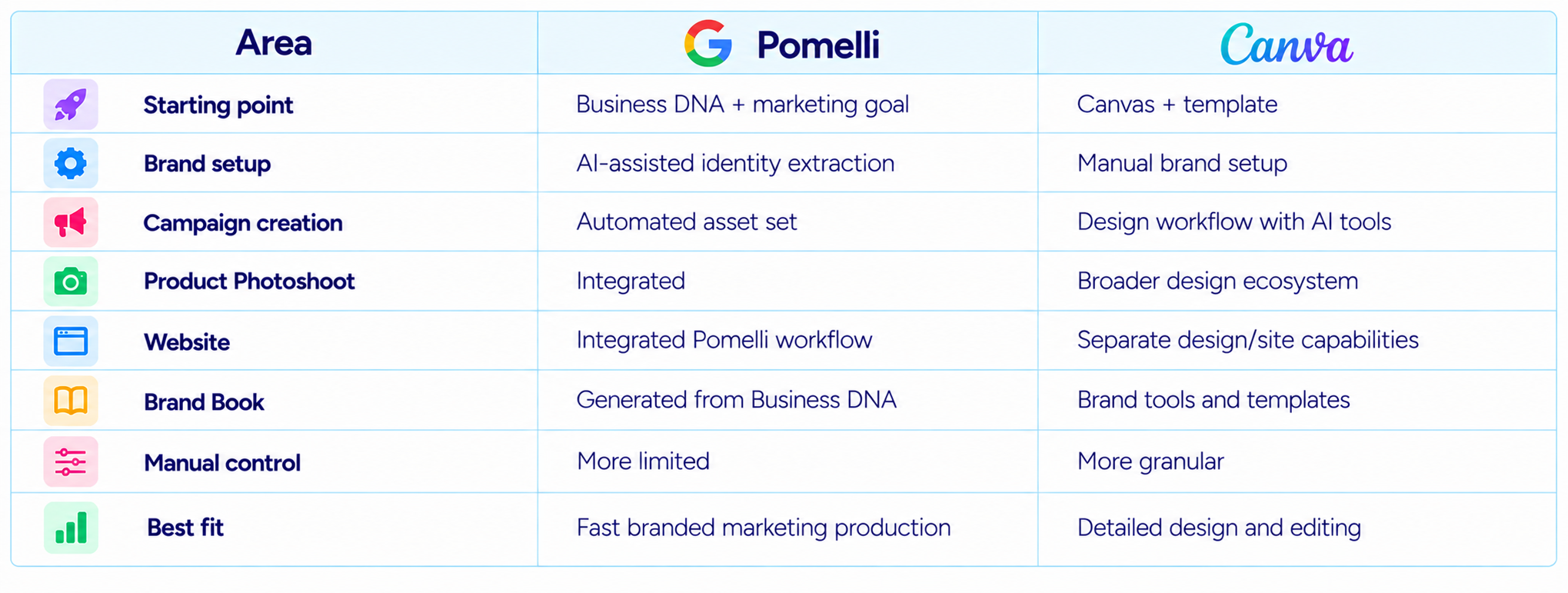
For many businesses, the best answer is not replacement. Pomelli can generate the first version quickly, while Canva can handle detailed manual refinements when a designer wants more control.
14. Pomelli vs a Generic AI Image Generator
A generic image generator usually starts with a prompt. Pomelli starts with the business. That changes the kind of work the user has to do.
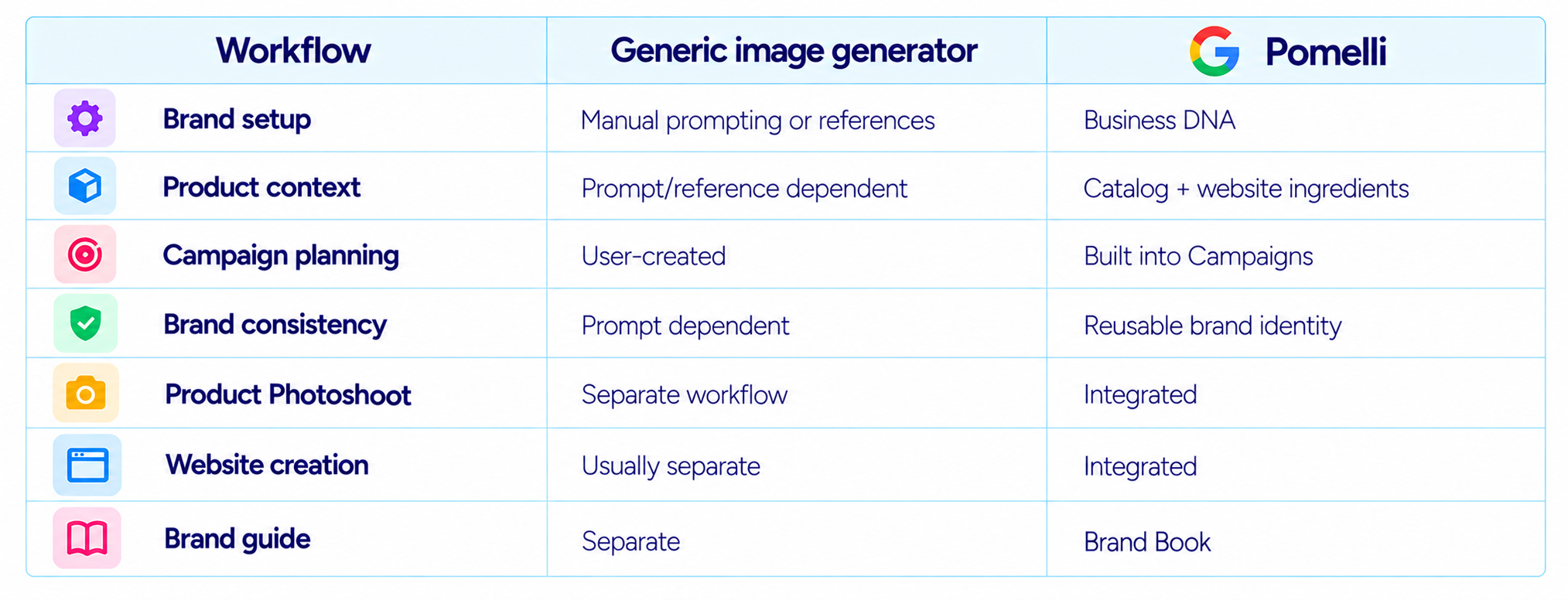
The advantage is workflow memory. Once Business DNA and the catalog are in place, the user does not need to restate the business identity in every prompt.
15. What Pomelli Is Best At
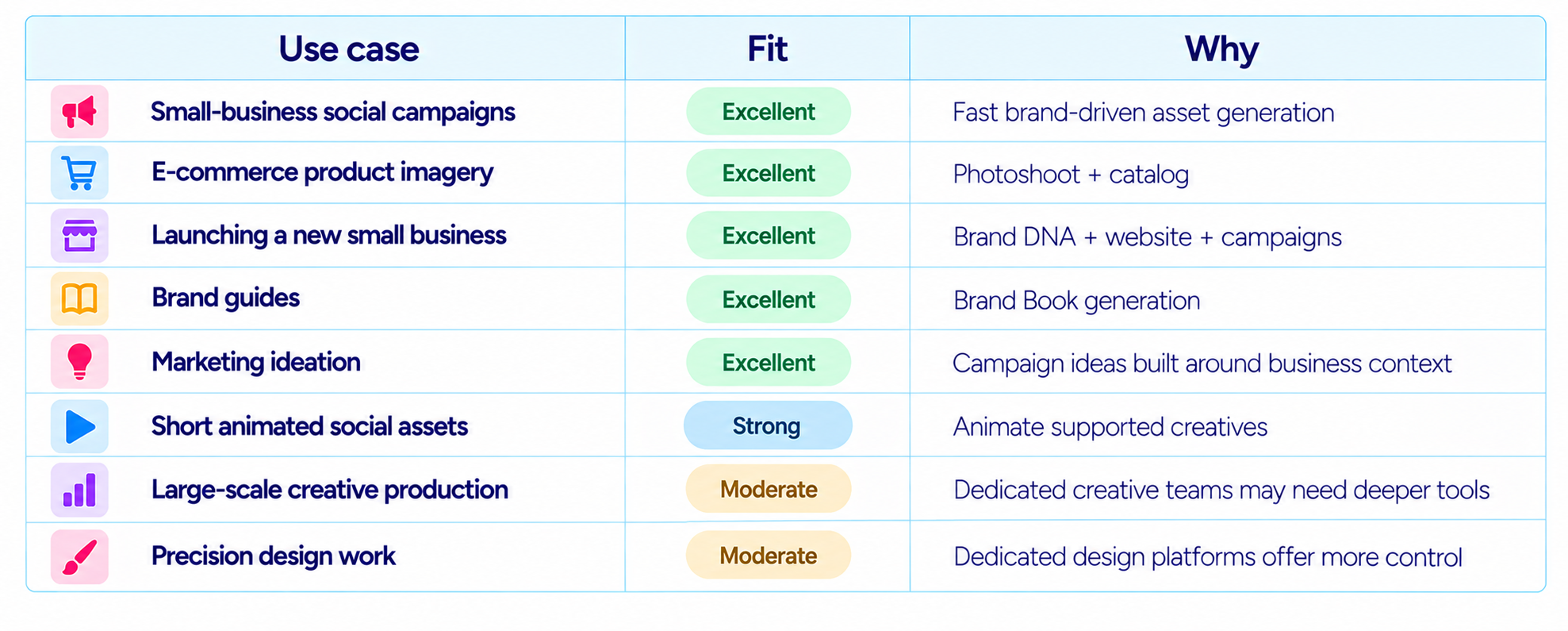
16. What Pomelli Is Not
Pomelli is not a full advertising platform, even though it can share assets with Google Ads. It is not a complete social scheduling suite, even though professional Instagram posting is supported. It is also not a guarantee that generated product images will preserve every physical detail.
Thinking about those boundaries keeps expectations realistic. Pomelli is strongest as a marketing creation and brand-context layer. External platforms still handle parts of distribution, media buying and broader campaign management.
17. How to Use Pomelli From Start to Finish
A practical workflow looks like this:
- Open Pomelli and create Business DNA from your website, Google Business Profile or uploaded materials.
- Review and correct the Business DNA before generating content.
- Organize products and images in the Pomelli Catalog.
- Create a Campaign and add product or image ingredients for important promotions.
- Generate several creatives and keep the strongest variations.
- Use the editor to revise the header, description, call to action, image and typography.
- Use Photoshoot when the campaign needs new product scenes.
- Animate selected 9:16 assets when motion would improve the social post.
- Generate a Brand Book once the identity is stable.
- Create a website when the business needs a branded web presence.
- Share supported assets to connected apps and finish publishing or advertising in those platforms.
- Check final product details before anything customer-facing goes live.
18. Pomelli Prompt Formula
Because Business DNA already contains much of the recurring brand context, Pomelli prompts work better when they focus on the campaign objective rather than repeating every brand rule.
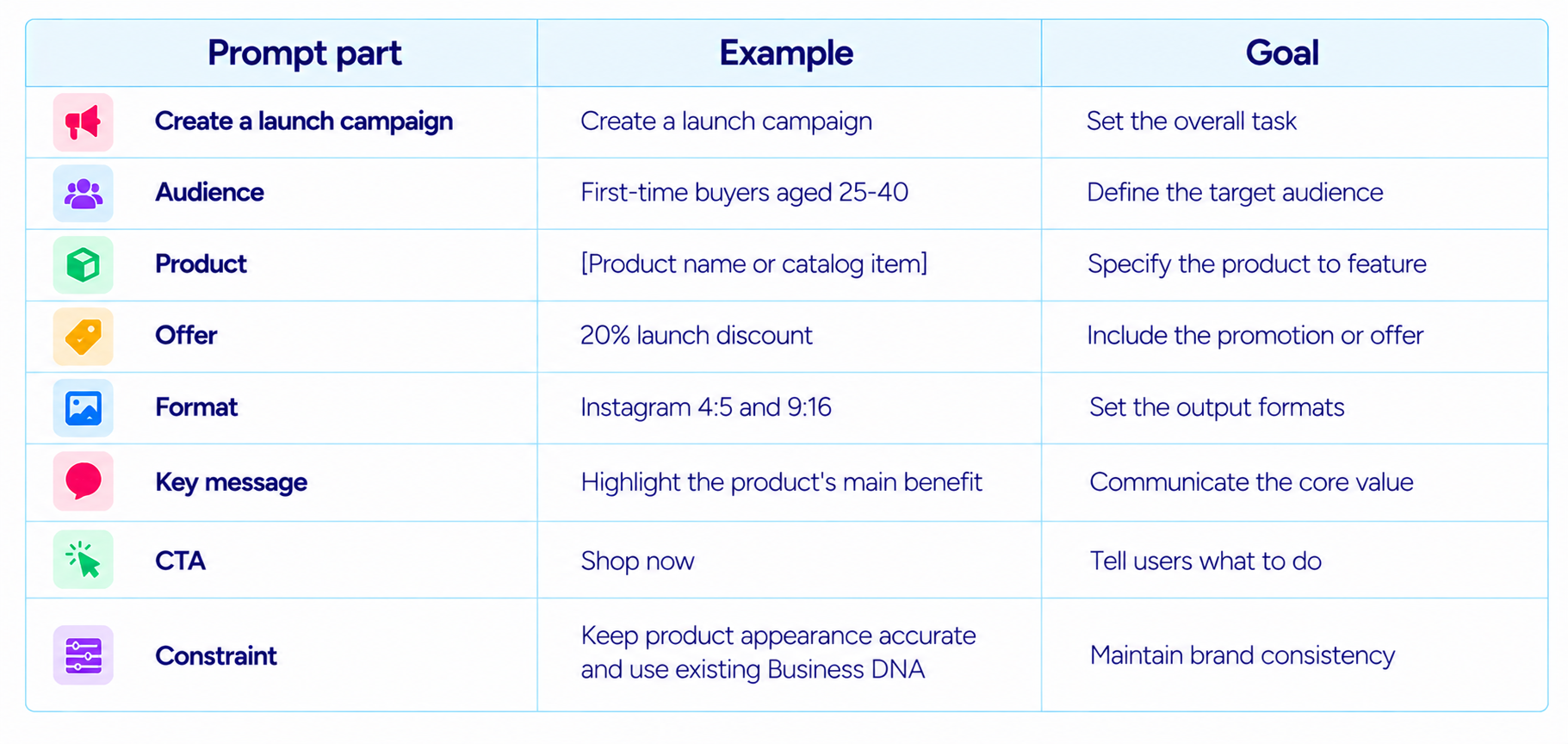
This turns a Pomelli prompt into a compact marketing brief. The model supplies the brand context, while the prompt supplies the campaign objective and constraints.
19. Limitations You Should Know
- Pomelli is still an experimental Google Labs product, so availability and usage limits can change.
- AI-generated product images can alter real product details and should be reviewed before publication.
- Connected-app support varies by destination.
- Sharing a creative with Google Ads does not launch the advertising campaign.
- Google Business Profile information copied into a Pomelli website does not automatically stay synchronized.
- Fine-grained design control is more limited than in a dedicated design application.
- Business DNA quality depends on the quality of the source information.
20. Final Verdict
Pomelli is no longer just a tool that turns a website into a few social graphics. In its current 2026 form, it is a connected AI marketing workflow built around one reusable piece of context: Business DNA.
That identity can now be created with the Pomelli Agent, used to produce campaigns and product Photoshoots, turned into a Brand Book, extended into a website and moved toward distribution through connected apps. Google's May 2026 update is what made this shift especially important.
The biggest advantage is consistency. A small business can move from scattered brand information to a repeatable system without manually recreating its colors, fonts, values and product context every time.
The biggest limitation is control. Pomelli is optimized for speed and accessibility, not for replacing every capability of a professional design studio, ad platform or social-media management system. Product accuracy also needs human review because generated imagery can change real-world details.
My rating: 9.2/10 for ease of marketing creation, 9.1/10 for brand consistency, 9.0/10 for small-business workflows, 8.4/10 for design control and 9.0/10 overall.
Bottom line: Pomelli is one of Google's most practical AI marketing tools for small businesses in 2026. Use it to create the brand context once, generate the bulk of your marketing assets from that context, then use the destination platforms and human review for the final publishing stage.
Frequently Asked Questions
What is Google Pomelli?
Pomelli is a Google Labs AI marketing tool that helps businesses build a reusable Business DNA and create campaigns, product imagery, Brand Books and websites.
What is Business DNA in Pomelli?
Business DNA is a snapshot of a business's identity including fonts, colors, values, images, catalog information and other brand assets.
How does Pomelli build Business DNA?
It can analyze a website, use eligible Google Business Profile information, or work from uploaded files with Pomelli Agent.
What is Pomelli Agent?
Pomelli Agent helps businesses create or edit Business DNA through conversation and uploaded source materials.
Can Pomelli create a website?
Yes. Google currently documents website generation, natural-language editing and publishing inside Pomelli.
Can Pomelli create product photos?
Yes. Photoshoot generates studio and lifestyle product imagery and applies Business DNA.
Can Pomelli make social media campaigns?
Yes. Campaigns generate sets of marketing creatives that can be edited and downloaded or shared to supported apps.
Can Pomelli post directly to Instagram?
Google currently documents posting to connected professional Instagram accounts for supported formats.
Can Pomelli launch Google Ads?
No. You can share assets to Google Ads, but the ad campaign itself is launched from Google Ads.
Is Google Pomelli free?
Google currently says Pomelli is available at no charge during its experimental phase, with several hundred image and video generations.
Is Pomelli available in India?
Availability depends on Google's current supported-country list. Check the live Pomelli product and Help Center for current regional access.
Is Pomelli better than Canva?
Pomelli is stronger for automated, brand-context-driven marketing production, while Canva offers more detailed manual design control. They can work well together.
Recommended Blogs
Google Pics Review: Features, Price & Is It Worth It? (2026)
Gemini 3.8 Flash Review: Accuracy, Price & Is It Worth It? (2026)
Meta Muse Spark 1.3 Review: Coding, Price & Is It Worth It? (2026)
Qwen 3.8 Max 0902 Review: Benchmarks, Price & Is It Worth It? (2026)
Mercury 2.5 AI Model Review: Speed, Price & Is It Worth It? (2026)
Resources & Community
Join our community of 70,000+ AI enthusiasts and learn to build powerful AI applications. Whether you're a beginner or an experienced developer, Build Fast with AI helps you understand and implement AI in your projects.
Agentic AI Launchpad 2026
A structured 6-week cohort program that takes you from AI basics to building and deploying real-world agentic AI systems. Includes live sessions, expert mentorship, project reviews and a builder community network.
Ready to go from learning to building? Join the next cohort: Agentic AI Launchpad 2026
Free AI Resources
Access free tools, workshops and micro-learning to keep building.

