



NVIDIA NeMo vs Hugging Face vs Ollama: Which to Choose?
One of these platforms costs $4,500 per GPU per year. One costs $9 a month. One is completely free and runs on your laptop. If that spread surprises you, it is because NVIDIA NeMo, Hugging Face, and Ollama are not really competitors, even though every comparison article treats them as if they are.
I have shipped production systems on all three, and the most useful thing I can tell you upfront is that the question is rarely which one. It is usually which one for this specific job. NeMo is an enterprise training and deployment stack. Hugging Face is the model registry and hosted inference layer that almost everything else plugs into. Ollama is the fastest way to run a model on hardware you already own. Below is the honest breakdown: real 2026 pricing, hardware requirements, where each one wins, and why most serious teams run all three at once.
Quick Verdict: Which One Should You Pick?
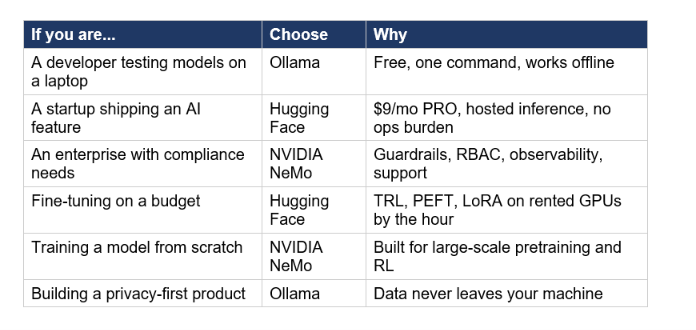
Pick Ollama if you want to run models locally on your own hardware for free. Pick Hugging Face if you need access to models, datasets, and hosted inference without managing infrastructure. Pick NVIDIA NeMo if you are an enterprise training, fine-tuning, or deploying models at scale on NVIDIA GPUs and you need governance, guardrails, and support.
What Each Platform Actually Does
The confusion in this comparison comes from the fact that all three touch models, but at different layers of the stack. Once you see where each one sits, the choice mostly makes itself.
NVIDIA NeMo: the enterprise training and agent stack
NVIDIA NeMo is an open-source generative AI framework built for researchers and developers who need fine-grained control over building models at scale, covering pretraining, post-training, and reinforcement learning of multimodal models. In 2026 it has grown into a modular suite of APIs and libraries that manage the full AI agent lifecycle, and the NeMo Platform layer adds synthetic data generation, fine-tuning, evaluation, security testing, real-time guardrails, and inference, with production features like role-based access control and observability.
Deployment happens through NVIDIA NIM microservices, which package models into containers optimized for NVIDIA GPUs. The Nemotron model family is NeMo's showcase, shipping open weights alongside training data and recipes, which is a level of openness most labs skip. Nemotron 3 uses a hybrid Mamba-Transformer MoE design with a 1M-token context aimed at high-throughput agentic work.
We covered the full Nemotron lineup and where it ranks in our NVIDIA AI models 2026 guide, which pairs well with this platform comparison.
Hugging Face: the registry everything plugs into
Hugging Face is the central hub where models and datasets live, plus a hosted inference and compute layer on top. Its real power is gravitational: nearly every open model on earth publishes there first, including NVIDIA's own Nemotron checkpoints, and the Transformers library is the default way most people load a model in Python. Free accounts get full access to models and datasets with no credit card required.
Beyond the registry, Hugging Face sells compute. Inference Endpoints let you deploy a model behind an API without touching Kubernetes, Spaces host demo apps, and the TRL and PEFT libraries make LoRA and QLoRA fine-tuning approachable. My view: Hugging Face is less a competitor to the other two and more the connective tissue between them.
Ollama: local models, one command
Ollama runs open models locally on your own hardware, free, with a single command. It wraps llama.cpp and the GGUF format into a clean CLI and API, handles model downloads and quantization automatically, and works offline, which makes it the strongest choice when privacy or latency matters. It runs on a MacBook, a consumer NVIDIA GPU, or a plain CPU if you are patient.
The catch is scale. Ollama is built for one machine, not a fleet. There is no built-in multi-tenancy, autoscaling, access control, or observability, so it is a development and edge tool rather than a production serving platform for a large user base. That is not a flaw, it is the design.
Ollama also gets day-one support for major open releases, as we saw with Google Gemma 4, which shipped simultaneously across Ollama, llama.cpp, vLLM, NIM, and NeMo.
Head-to-Head Comparison Table
Here is the full side-by-side. Read the deployment target row first, because it explains most of the other differences.
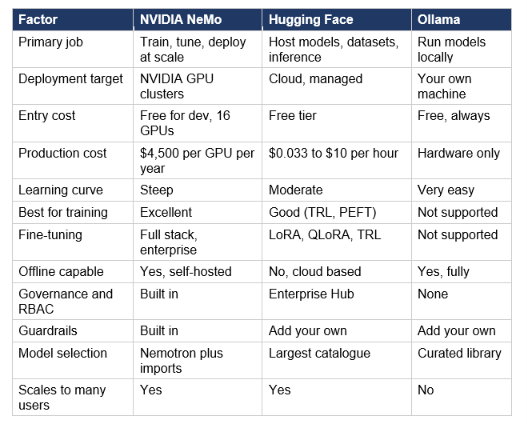
Quotable version: NeMo is a factory, Hugging Face is a warehouse and a delivery service, and Ollama is a workbench in your garage. Comparing them on raw capability misses that they are built for different stages of the same journey.
Pricing Compared: The Real Numbers
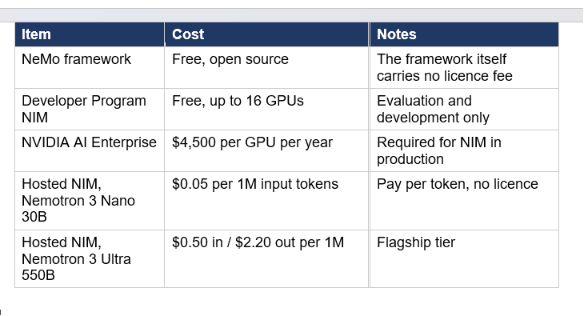
Ollama is free, Hugging Face starts free and scales by the hour, and NVIDIA NeMo is free for development but requires an NVIDIA AI Enterprise license at $4,500 per GPU per year for production. That last number is the single biggest decision point in this entire comparison, so plan around it before you build.
NVIDIA NeMo and NIM pricing
Hugging Face pricing
Ollama pricing
Ollama costs nothing. There is no subscription, no per-token billing, and no licence. Your only expense is the hardware you already own and the electricity to run it. For a solo developer or a privacy-sensitive team, that economic profile is impossible to beat, and it is the reason Ollama spread so fast.
THE HIDDEN COST NOBODY MENTIONS
Free is not free at scale. Running a model locally means you own the GPU purchase, the power bill, the model updates, and every reliability problem at 2am. Hosted inference at $0.05 per million tokens often works out cheaper than a depreciating GPU sitting idle most of the day. Calculate cost per completed task, not cost per platform.
My contrarian point: teams overestimate the savings of self-hosting. Unless your GPUs run above roughly 40% utilisation, hosted endpoints usually win on total cost, and they definitely win on engineering hours.
Hardware Requirements
Hardware is where the three platforms separate most sharply. NeMo targets data centre GPUs, Hugging Face rents you whatever you need by the hour, and Ollama is designed to work on the machine already on your desk.
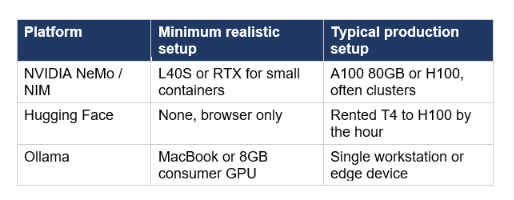
For NIM specifically, NVIDIA supports its data centre line including H100, H200, A100, and L40S. Most LLM NIM containers expect an A100 80GB or an H100, while smaller containers such as embedding models will run on an L40S or RTX-class card. After GTC 2026 the catalogue also added Rubin-optimized inference profiles, so the hardware floor keeps moving.
Ollama sits at the opposite extreme. A 7B or 8B model quantized to 4-bit runs comfortably in about 8GB of memory, which most modern laptops have. Quality-per-gigabyte has improved sharply too, which is the real story behind small models punching above their size.
The efficiency gains are real, and our review of Qwen3.6-27B beating a 397B model on coding is the clearest example of why you no longer need a datacentre to run something genuinely useful.
Best For: Matching Platform to Use Case
The fastest way to decide is to find your actual scenario below rather than comparing feature lists. I have grouped these by what people are really trying to do.
Learning, prototyping, and side projects
Ollama wins, decisively. Install it, run one command, and you have a working model in minutes with zero cost and zero account setup. Pair it with Hugging Face to browse what is available. I tell every developer learning this space to start here, because the feedback loop is fast and the mistakes are free.
Shipping an AI feature at a startup
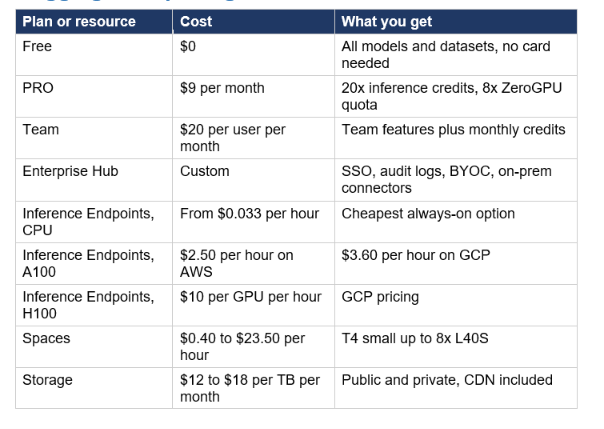
Hugging Face is the pragmatic pick. Inference Endpoints give you a production API without hiring an infrastructure engineer, PRO costs $9 a month, and you can move from a T4 at $0.50 an hour to an H100 when traffic justifies it. The scale-up path is smooth, which matters more than any benchmark when you are small.
Fine-tuning a model on your own data
Hugging Face for most teams, NeMo for the largest jobs. The TRL and PEFT libraries make LoRA and QLoRA fine-tuning straightforward on rented GPUs, and the ecosystem of tutorials is unmatched. Choose NeMo instead when you are doing full pretraining, large-scale reinforcement learning, or need the governance and evaluation tooling that comes with the NeMo Platform.
Enterprise deployment with compliance requirements
NVIDIA NeMo, and it is not close. Guardrails, role-based access control, observability, security testing, and vendor support are exactly what a regulated environment demands, and no free tool provides them. The $4,500 per GPU per year licence buys accountability, which is what enterprises are actually purchasing.
Privacy-critical or offline applications
Ollama, with self-hosted NIM as the enterprise alternative. If data cannot leave the building, local inference is the only honest answer. Ollama handles the single-machine case for free, and NIM containers cover the same requirement at organisational scale on your own GPUs.
Why They Are Not Mutually Exclusive
Most experienced teams use all three, because each covers a different phase of the same workflow. The platforms are deliberately interoperable, and the model release pattern in 2026 makes this obvious.
Take a typical NVIDIA release. Nemotron models publish open weights on Hugging Face, can be deployed through NIM on NVIDIA GPUs, and are simultaneously available as GGUF checkpoints you can run in Ollama or llama.cpp on a laptop. One model, three platforms, three different purposes. Gemma 4 followed the same pattern with day-one support across Hugging Face Transformers, Ollama, LM Studio, llama.cpp, MLX, vLLM, NIM, NeMo, and more.
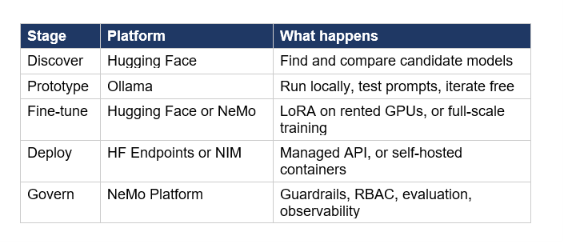
Hot take: the framing of this comparison as a three-way fight is mostly a content problem, not an engineering one. The real skill is knowing which tool to reach for at which stage, and that is a much more useful thing to learn than picking a winner.
For a sense of which models are worth putting through this pipeline right now, see our open-source LLM hub and the full 2026 model rankings.
How to Choose in Under Five Minutes
Answer these four questions in order and you will land on the right platform without reading another comparison article.
- Does your data need to stay on your own hardware? If yes, go to Ollama for single machines or self-hosted NIM for organisations. If no, continue.
- Are you training or heavily fine-tuning? If you are pretraining or running large-scale RL, choose NeMo. If you are doing LoRA or QLoRA, choose Hugging Face.
- Do you need compliance features such as RBAC, audit logs, and guardrails? If yes, budget for NeMo with an NVIDIA AI Enterprise licence or Hugging Face Enterprise Hub.
- Is this a prototype or a product with real users? Prototypes belong on Ollama. Products belong on Hugging Face Inference Endpoints or NIM.
If your answers pull you in two directions, that is the correct outcome and not a failure of the framework. It means you need more than one platform, which is normal. Start with the cheapest option that unblocks you today, and add the others as real constraints appear rather than imagined ones.
Frequently Asked Questions
Q: What is the difference between NVIDIA NeMo, Hugging Face, and Ollama?
NVIDIA NeMo is an enterprise framework for training, fine-tuning, and deploying models at scale on NVIDIA GPUs. Hugging Face is the central hub hosting models and datasets, plus paid hosted inference. Ollama runs open models locally on your own hardware for free. They operate at different layers of the stack rather than competing directly.
Q: Is Ollama better than Hugging Face?
For running models locally and privately, yes, Ollama is simpler and free. For model selection, hosted inference, fine-tuning tooling, and scaling to many users, Hugging Face is far stronger. Most developers use Ollama to prototype and Hugging Face to ship, since Ollama has no multi-tenancy, autoscaling, or access control.
Q: How much does NVIDIA NeMo cost?
The NeMo framework itself is free and open source. Production deployment with NIM microservices requires an NVIDIA AI Enterprise licence at $4,500 per GPU per year. NVIDIA Developer Program members can use NIM containers free on up to 16 GPUs for evaluation, and hosted NIM endpoints start around $0.05 per million input tokens.
Q: Is Hugging Face free to use?
Yes, the free tier gives full access to models and datasets with no credit card required. PRO costs $9 per month, Team is $20 per user per month, and Enterprise Hub is custom priced. Compute is separate: Inference Endpoints start at $0.033 per hour for CPU and reach $10 per GPU per hour for H100.
Q: Can I run Ollama without a GPU?
Yes. Ollama runs on CPU, though generation will be noticeably slower. A 7B or 8B model quantized to 4-bit needs roughly 8GB of memory and runs acceptably on a modern laptop, including Apple Silicon Macs where unified memory works particularly well.
Q: Which platform is best for fine-tuning LLMs?
Hugging Face for most teams, using TRL and PEFT for LoRA and QLoRA on rented GPUs. NVIDIA NeMo is better for full pretraining, large-scale reinforcement learning, and cases needing built-in evaluation and governance. Ollama does not support fine-tuning at all; it only runs existing models.
Q: Do I need NVIDIA AI Enterprise for NIM?
For production workloads, yes. NIM microservices require an NVIDIA AI Enterprise licence at $4,500 per GPU per year in production. Development and evaluation are covered free for NVIDIA Developer Program members on up to 16 GPUs, and hosted NIM endpoints are billed per token with no licence required.
Q: Can you use Hugging Face models in Ollama?
Yes. Ollama supports GGUF checkpoints, and many Hugging Face models are published in or converted to that format. NVIDIA's Nemotron models, for example, are available on Hugging Face and deployable through Ollama and llama.cpp on device, which is exactly how the three platforms interoperate in practice.
Recommended Reads
- NVIDIA AI models 2026 guide
- Best open source LLMs hub
- Google Gemma 4 open model review
- Gemma 4 MTP drafter, 3x faster inference
- Qwen3.6-27B beats 397B on coding
- GLM-5.2 review 2026
- Kimi K2.7 Code review
Start local, ship hosted, govern at scale. Pick the cheapest platform that unblocks you today and add the others only when a real constraint forces the upgrade.

