



How DeepSWE, Terminal-Bench and OSWorld Measure AI Coding Agents
AI coding benchmark scores look deceptively simple. A model gets 74% on one leaderboard, 88% on another, and a developer is expected to decide which model is better at coding. That conclusion is often wrong. DeepSWE, Terminal-Bench and OSWorld are not three versions of the same test. They expose different environments, ask agents to do different kinds of work, and therefore measure different slices of capability.
The useful question is not “Which benchmark has the highest score?” It is “What kind of agent behavior does this benchmark make necessary, and does that behavior match my workload?”
QUICK ANSWER
The main reason benchmark scores diverge is that an AI coding agent is a system, not just a language model. A result depends on the model, the agent harness, available tools, environment, timeout, step budget, verification method and task distribution.
This is why two models can reverse their ranking when you move from a repository task to a terminal task or from a terminal to a graphical desktop. Terminal-Bench explicitly evaluates agents on terminal-based tasks, while OSWorld evaluates computer-use agents in full operating-system environments. DeepSWE deliberately focuses on original long-horizon software engineering tasks and uses program-based verification of requested behavior.
That broader idea is exactly why our AI agent evaluation guide recommends separating outcome quality from trajectory, tools, recovery, cost, latency and safety instead of treating one final score as the whole system.
DeepSWE: What It Measures
DeepSWE is the closest of the three to a dedicated long-horizon software engineering benchmark. Its current benchmark contains 113 original tasks across 91 active open-source repositories and five languages. The tasks are written from scratch instead of being copied from public merged fixes, and each task uses a hand-written verifier that checks the requested functionality rather than demanding one specific implementation.
That design is important because DeepSWE is trying to test engineering judgment instead of repository-memory. The benchmark authors argue that conventional benchmarks built from public GitHub issues can be vulnerable to training-data exposure, while tests inherited from a merged fix can overfit to the reference implementation. DeepSWE is explicitly designed to reduce both problems.
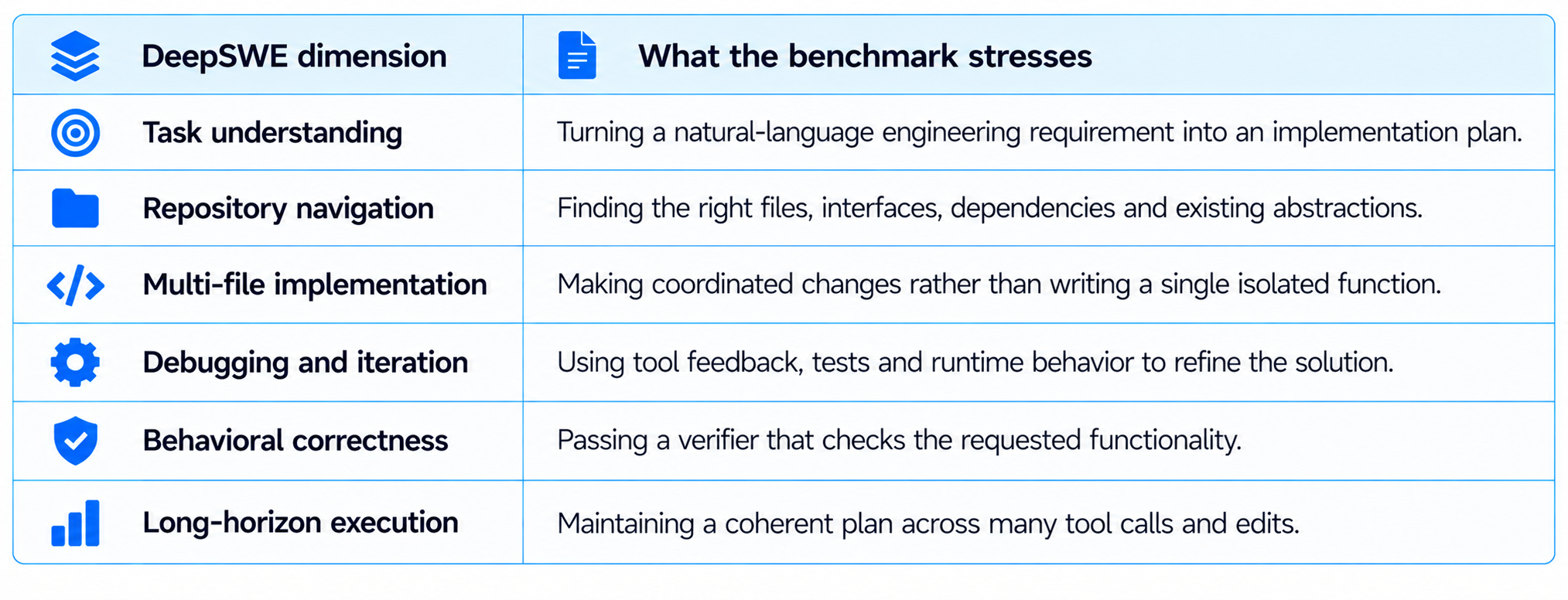
DeepSWE therefore answers a question close to: “Can this coding agent behave like an autonomous software engineer on a substantial repository task?” It is particularly useful for comparing repository-level coding agents, long-running implementation workflows and agents that must inspect, modify and verify a codebase.
For a broader developer-oriented view of where different coding agents fit, see Best AI Coding Agents 2026: Claude Code vs Codex vs Muse Code vs Cursor.
One useful current detail: the DeepSWE public leaderboard tracks not only pass rates but also average cost, output tokens and agent steps. A September 2026 snapshot shows frontier configurations clustered around the low-to-mid 70% range, which is another reminder that a 1 or 2 point leaderboard gap should not be read as a giant capability difference.
My take: DeepSWE is the strongest choice of these three when you want to ask a narrowly defined engineering question: can the agent understand and complete a meaningful software task? It is not the right benchmark for measuring how well that same agent uses a browser, manipulates a desktop application, or performs arbitrary system administration work.
Terminal-Bench 2.0: What It Measures
Terminal-Bench 2.0 measures terminal-native agent behavior: can an agent use the command line, inspect an environment, run programs, manipulate files, install or configure software, debug failures and eventually satisfy an end-to-end task? Harbor, the official harness for Terminal-Bench 2.0, describes it as a benchmark for evaluating agents on terminal-based tasks.
The important distinction is that “terminal coding” is broader than writing code. The current Terminal-Bench task set includes work such as building software, configuring servers, manipulating data, operating system tasks and other technical workflows. The repository visibly contains tasks ranging from compiler work and model inference to Git, databases, networking, security-oriented tasks and scientific workloads.
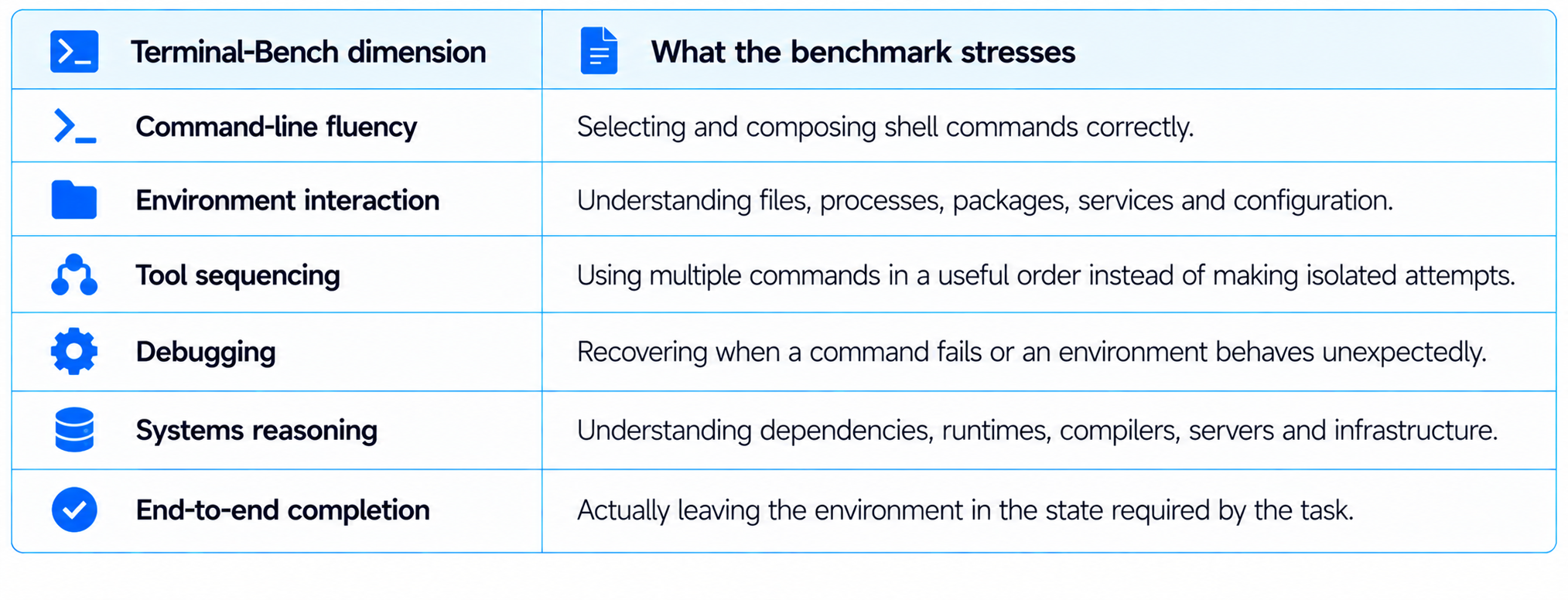
This makes Terminal-Bench a particularly interesting benchmark for CLI-first agents such as Claude Code, Codex-style terminal agents and other autonomous coding or DevOps systems. A model can be strong at repository patch generation but weak at environment setup or shell debugging, and Terminal-Bench will expose that difference.
Terminal-Bench 2.0 also illustrates another benchmark lesson: datasets evolve. The original 2026 paper describes an 89-task research release, while current Harbor documentation and benchmark tooling describe a larger 250-task suite. The version matters when reading scores, so “Terminal-Bench” without a version is not precise enough for a serious comparison.
Build Fast with AI tracks this type of agentic coding competition in its Best AI Models June 2026: Full Ranked Leaderboard and related model comparisons.
My hot take: Terminal-Bench is the benchmark that best exposes whether a coding agent has learned to operate a computer-like environment rather than merely generate plausible code. That is also why it is sensitive to infrastructure. Anthropic reported that configuration differences alone produced a six-point gap on Terminal-Bench 2.0 in its experiments, larger than many leaderboard gaps between top models.
OSWorld 2.0: What It Measures
OSWorld 2.0 is not primarily a coding benchmark at all. It is a computer-use benchmark for long-horizon workflows in realistic desktop and web environments. Its 108 tasks are designed around everyday and professional workflows where agents must navigate applications, interpret visual state, reason across sources and maintain progress over a long sequence of actions.
The scale is intentionally different from short GUI tests. The OSWorld 2.0 paper reports that a human takes a median of about 1.6 hours to complete a task, while a reference frontier agent can require hundreds of tool calls. The benchmark targets streaming interaction, dynamic environments, cross-source reasoning, implicit-state inference and visual-spatial precision.
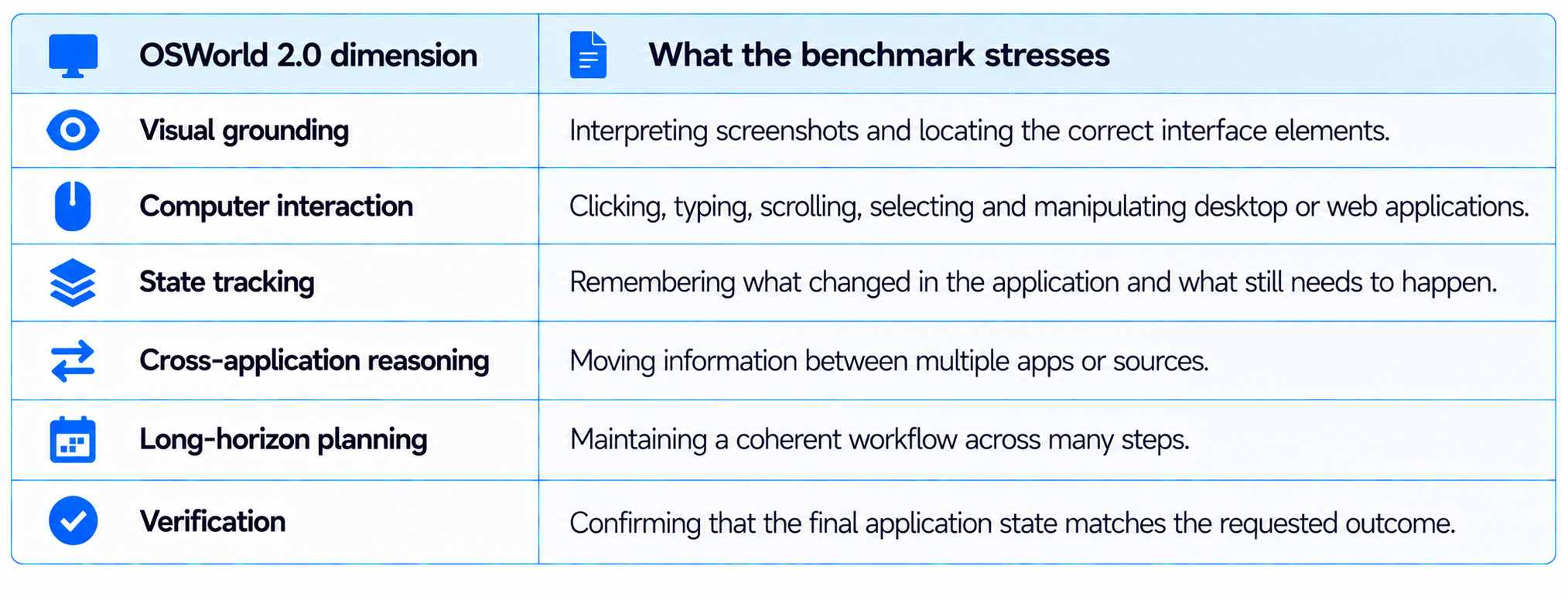
OSWorld matters to coding-agent evaluation because modern software agents increasingly leave the terminal. A developer tool may open a browser, interact with a dashboard, inspect a GUI-only admin console, upload an artifact, manipulate an office application or use a visual IDE. OSWorld can expose weaknesses that DeepSWE and Terminal-Bench never see.
That is also why our Cursor Cloud Agents & Dev Environments: Complete 2026 Guide is useful context for developers thinking about agents that work beyond a terminal.
The most important OSWorld lesson is that fluent computer interaction is not the same thing as software engineering. An agent can be excellent at navigating a desktop and still make poor architectural decisions. Conversely, a strong coding agent can fail because it loses track of a GUI state or clicks the wrong element.
DeepSWE vs Terminal-Bench vs OSWorld
The cleanest way to compare the three is to treat them as different lenses on agent capability rather than as a single ranking ladder.
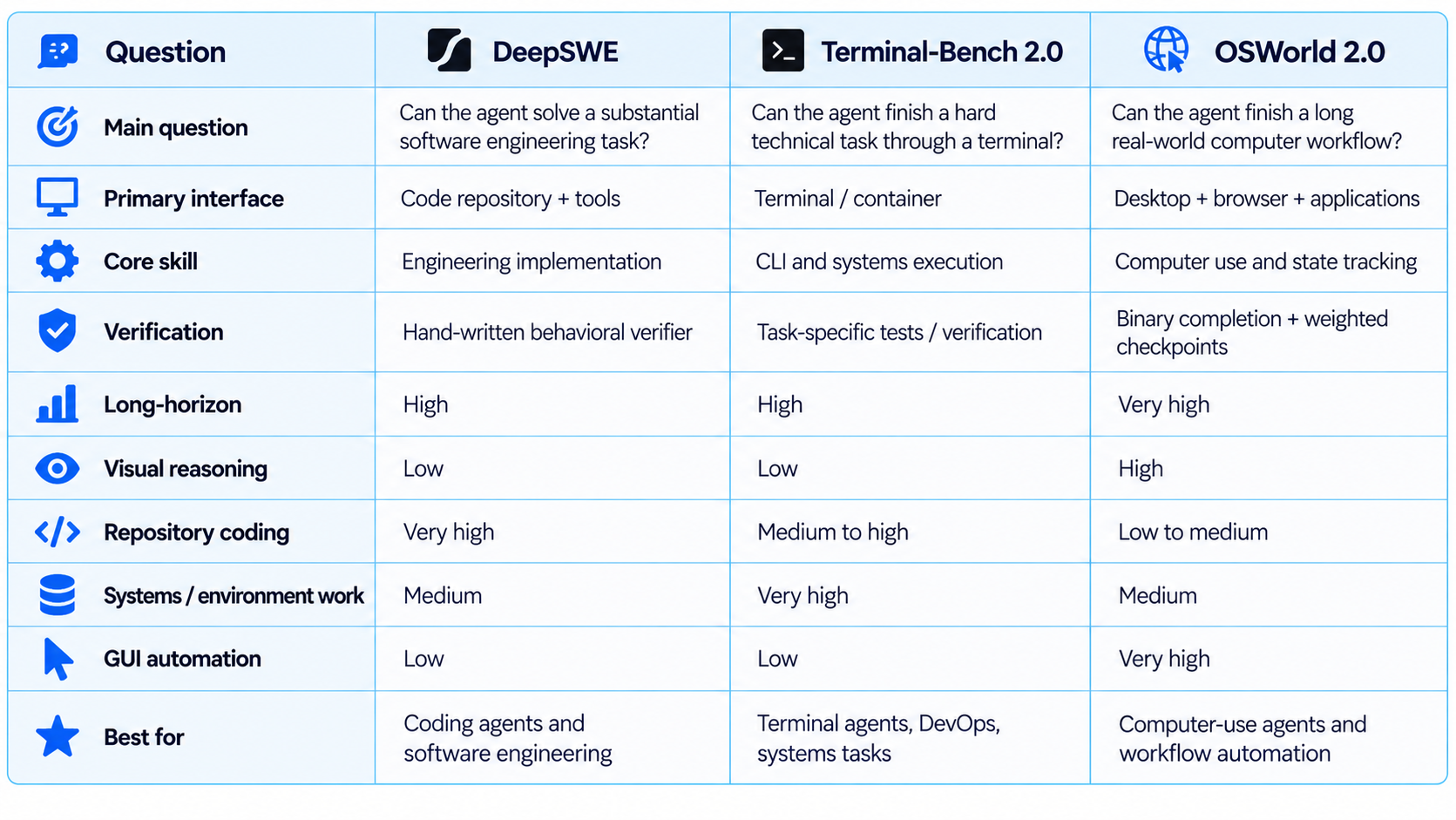
This is the key to answering “what do AI coding benchmarks actually measure?” They measure the intersection of a model, a harness and a task distribution. DeepSWE pushes the software-engineering axis. Terminal-Bench pushes the terminal-operation axis. OSWorld pushes the computer-use axis.
For a wider benchmark-selection mindset, the Best AI Models & Leaderboards collection is designed around task-specific comparisons rather than one permanent overall winner.
What Each Benchmark Misses
No benchmark is a complete proxy for production engineering, and this is where benchmark literacy becomes more valuable than memorizing leaderboards.
- DeepSWE does not tell you how well an agent handles graphical applications, browser workflows or arbitrary infrastructure outside the repository-centered task.
- Terminal-Bench does not fully represent software-product development because command-line competence can dominate some tasks. A model can be excellent at shell operations without being the best architect or code reviewer.
- OSWorld does not isolate coding skill. A large part of the challenge is visual grounding, interface state, navigation and application coordination.
- None of these benchmarks automatically measures collaboration quality, code review burden, maintainability, organizational policy compliance, security posture or the cost of repairing a wrong-but-plausible solution.
- A benchmark score can also be influenced by infrastructure configuration, task version, agent harness, tool budget and reasoning effort. Those details belong next to the number, not in a footnote.
Security is especially easy to miss. Our analysis on AI Coding Agent Security: The Risk of Too Much Access makes the broader point: a benchmark can show that an agent can act, but it does not automatically prove that you should give that agent unrestricted access.
There is a contrarian point worth making: a benchmark can become more useful precisely because it is narrow. Trying to build one universal “AI coding score” usually produces a number that is easy to quote and difficult to interpret. Three specialized benchmarks are often more informative than one synthetic aggregate because you can see which capability actually moved.
How to Read Coding Benchmark Scores in 2026
Read a benchmark score as a conditional statement: “This agent solved this kind of task, under this harness, with this budget, using this environment, at this rate.” Anything broader is inference.
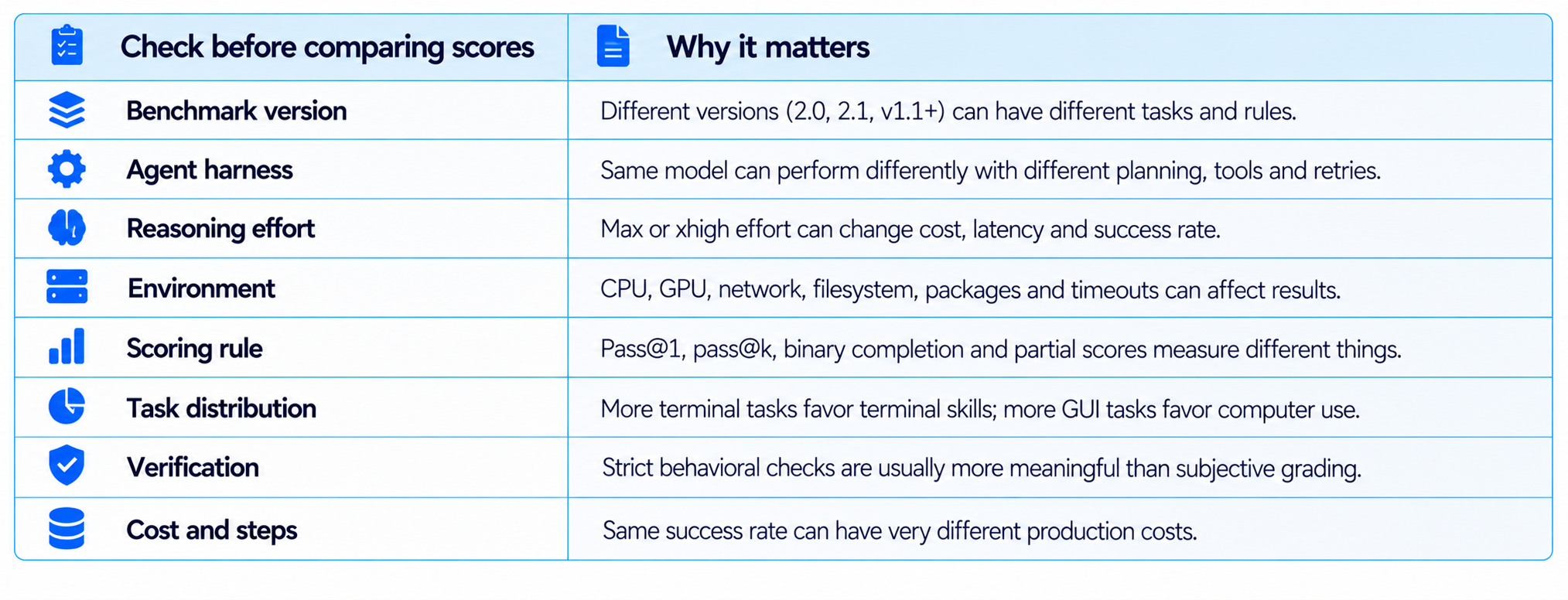
DeepSWE makes this especially visible by publishing cost and agent-step information alongside results. OSWorld 2.0 reports both binary completion and partial checkpoint performance. Terminal-Bench runs through a standardized harness, but its task environment and infrastructure still matter. These are not cosmetic details. They determine what the score means.
For the broader benchmark picture, our recent comparison Claude Fable 5.1 vs GPT-6 Astra vs Gemini 3.8 Flash vs Muse Spark 1.3: Which Wins in 2026? shows how the same frontier models can change ranking when the evaluation changes.
There is a simple rule I recommend: never write “Model X is better at coding because it scored higher” unless you can finish the sentence with “on benchmark Y, version Z, using harness H, under budget B.” That sentence is longer, but it is actually true.
Build Your Own AI Coding Evaluation
Public AI coding benchmarks are useful for narrowing the field. Your own evaluation is what should decide production adoption.
Start with 20 to 50 real tasks from your repository. Include feature work, bug fixes, refactors, dependency changes, tests, debugging and one or two ugly edge cases. Give every candidate the same repository snapshot, tools, time budget and approval policy.
- First, measure task success. Did the change actually work?
- Second, measure engineering quality. Was the solution maintainable, scoped and understandable?
- Third, measure trajectory quality. Did the agent search effectively, choose the right tools and avoid pointless loops?
- Fourth, measure operational cost. Record wall-clock time, output tokens, tool calls and failures.
- Fifth, measure recovery. Intentionally include broken tests, missing dependencies and ambiguous states.
- Sixth, measure safety. Test what happens when the agent encounters secrets, destructive commands or production-like systems.
- Seventh, rerun important tasks. A single lucky pass is weak evidence for a non-deterministic agent.
The practical methodology is consistent with our AI Agent Evaluation: 15 Metrics Beyond Accuracy, which recommends combining task success with trajectory, tool, recovery, cost, latency and safety metrics.
A useful extension is to run the same task through two or three benchmark-style environments. For example, ask a model to fix a repository issue, then solve a terminal setup problem, then complete a browser-based release workflow. You are effectively measuring the same agent across three different surfaces: engineering, terminal operation and computer use.
For hands-on experiments, the Build Fast with AI Gen-AI-Experiments Cookbooks repository provides runnable AI notebooks and experiments that can be adapted into your own evaluation harnesses.
My strongest recommendation is to track cost per successful task, not token price. A cheap model that retries six times and still needs human repair can be more expensive than a premium model that finishes the task once. That is the production metric public leaderboards rarely expose cleanly.
Final Verdict
DeepSWE, Terminal-Bench 2.0 and OSWorld 2.0 should not be treated as competing definitions of intelligence. They are complementary measurements of an increasingly broad agent stack.
DeepSWE is the strongest lens for repository-centered, long-horizon software engineering. Its 113 original tasks, broad repository coverage and behavior-based verification are specifically designed to test whether an agent can solve meaningful engineering problems rather than replaying public fixes.
Terminal-Bench 2.0 is the strongest lens for terminal-native technical work. It tells you whether an agent can operate in a complex command-line environment, compose tools, debug failures and finish the requested state instead of merely producing code that looks correct.
OSWorld 2.0 is the strongest lens for real computer use. Its long workflows, visual interaction, cross-source reasoning and stateful application tasks test capabilities that pure coding benchmarks cannot see.
So which benchmark is best? For coding agents, start with DeepSWE. For terminal-heavy engineering and DevOps, prioritize Terminal-Bench. For agents that must operate browsers and desktop software, use OSWorld. For serious production selection, use all three as complementary evidence and then run your own task set.
The biggest mistake in 2026 is still the simplest one: choosing the model with the biggest benchmark number. The better engineering habit is to choose the benchmark that resembles the work, inspect how the score was produced, and then validate it on your own environment.
Frequently Asked Questions
What is the best AI coding benchmark in 2026?
There is no single best benchmark for every coding workflow. DeepSWE is the strongest fit for long-horizon repository engineering, Terminal-Bench for terminal-native technical work, and OSWorld for long-horizon computer use.
What does DeepSWE measure?
DeepSWE measures long-horizon software engineering on original tasks across active open-source repositories. It emphasizes repository navigation, implementation, debugging and behavioral correctness with hand-written verifiers.
What does Terminal-Bench measure?
Terminal-Bench measures whether an AI agent can complete difficult end-to-end tasks through a terminal or containerized environment, including command-line execution, environment manipulation, debugging and systems work.
What does OSWorld measure?
OSWorld measures computer-use ability in realistic desktop and web environments. OSWorld 2.0 emphasizes long-horizon workflows, visual grounding, cross-source reasoning, implicit state and verification.
Is DeepSWE harder than SWE-bench?
It is not useful to reduce the difference to “harder” or “easier.” DeepSWE was designed to address contamination and verifier limitations seen in older benchmark styles, and its tasks require substantially more code touchpoints than SWE-bench Pro according to its authors.
What is the difference between Terminal-Bench and SWE-bench?
SWE-bench centers on resolving software issues in repositories. Terminal-Bench is broader and terminal-centric, so tasks can involve coding, debugging, system configuration, data processing and other command-line workflows.
Is OSWorld a coding benchmark?
Not primarily. OSWorld is a computer-use benchmark. Coding-related workflows can appear in computer-use evaluations, but the benchmark is designed to measure end-to-end interaction with software environments rather than pure repository engineering.
Why do AI models score differently across coding benchmarks?
Because the benchmarks expose different environments, tasks, verification methods, agent harnesses, reasoning budgets and resource constraints. A model that excels at repository engineering may not excel at GUI navigation or shell-heavy systems work.
Are AI coding benchmark scores reliable?
They can be useful and reproducible when the benchmark version, harness, environment and scoring rules are clear. They should still be treated as conditional evidence, not a universal ranking of coding ability.
How should I choose an AI coding model?
Match the benchmark to your workload, then run a representative private evaluation set that measures success, quality, recovery, cost, latency and safety. Public benchmarks should narrow your shortlist, not make the final decision.
Recommended Blogs
- AI Agent Evaluation: 15 Metrics Beyond Accuracy
- Model Routing for AI Coding Agents: How to Cut Costs Without Losing Quality
- What Is an AI Agent? Beginner Guide With Examples (2026)
- How to Secure AI Coding Agents: Permissions, Sandboxing, MCP & Secrets
- Claude Fable 5.1 vs GPT-6 Astra vs Gemini 3.8 Flash vs Muse Spark 1.3: Which AI Model Is Best? (2026)
- 24GB VRAM AI Models: What Can You Actually Run Locally in 2026?
Resources & Community
Join our community of 70,000+ AI enthusiasts and learn to build powerful AI applications. Whether you're a beginner or an experienced developer, Build Fast with AI helps you understand and implement AI in your projects.
- Website - buildfastwithai.com
- LinkedIn - Build Fast with AI
- Instagram - @buildfastwithai
- Founder X - @satvikps
- X - @BuildFastWithAI
Agentic AI Launchpad 2026
A structured 6-week cohort program that takes you from AI basics to building and deploying real-world agentic AI systems. Includes live sessions, expert mentorship, project reviews and a builder community network.
Ready to go from learning to building? Join the next cohort: Agentic AI Launchpad 2026
Free AI Resources
Access free tools, workshops and micro-learning to keep building.
- AI Workshops - Free resources, upcoming events and past recordings
- Unrot - Learn AI in 5 minutes a day
References
- DeepSWE: Measuring Frontier Coding Agents on Original, Long-Horizon Engineering Tasks
- DeepSWE benchmark and leaderboard
- Terminal-Bench - Official benchmark repository
- Terminal-Bench 2.0 documentation and examples
- OSWorld 2.0 - Official benchmark website
- OSWorld2.0: Benchmarking Computer Use Agents on Long-Horizon Real-World Tasks
- Epoch AI - OSWorld 2.0 methodology
- Anthropic - Quantifying infrastructure noise in agentic coding evals

