



How to Evaluate AI Agents Properly: 15 Metrics Beyond Accuracy
A fluent final answer is not proof that an AI agent worked correctly. An agent can return the right result after choosing the wrong tool, making unnecessary calls, ignoring a tool response, burning through a token budget, violating an authorization boundary, or succeeding only because an external system happened to behave in its favor. If you evaluate only the final response, you miss most of the system.
AI agent evaluation needs to measure the whole workflow: the outcome, the trajectory, the tools, the context, the failures, the recovery behavior, the cost, the latency, and the safety boundaries. Current guidance across agent evaluation research and engineering practice emphasizes this distinction between outcome evaluation and trajectory evaluation.
This guide gives you a practical AI agent evaluation framework built around 15 metrics. It is designed for coding agents, research agents, customer support agents, browser agents, data agents, and multi-agent systems. The goal is not to create one vanity score. The goal is to know whether an agent is useful, reliable, safe, efficient, and ready for production.
Quick Answer: How Do You Evaluate an AI Agent?
Evaluate an AI agent at three levels. First, measure whether it completed the task. Second, inspect how it completed the task by evaluating tool selection, arguments, trajectory quality, recovery, grounding, and policy compliance. Third, measure whether the workflow is practical through latency, cost, efficiency, human intervention, and consistency across repeated runs.
A strong AI agent evaluation framework therefore combines deterministic tests, trace-based evaluation, calibrated LLM-as-a-judge scoring, human review for difficult cases, and repeated regression testing. This is more useful than relying on a single benchmark score because an agent can pass a final-answer test while its underlying behavior is fragile.
Why Accuracy Alone Fails for AI Agents
Traditional LLM evaluation often starts with a simple question: was the answer correct? That works reasonably well when the model receives an input and returns one output. An AI agent is different. It may plan, call a tool, read the result, update its state, call another tool, ask for clarification, recover from an error, and finally complete an action.
That means two agents can have the same 90% task success rate while having radically different production quality. Agent A might solve tasks with four correct tool calls and recover cleanly from failures. Agent B might solve the same tasks by making ten calls, retrying blindly, and occasionally using an unauthorized tool. The final accuracy number hides the operational difference.
My strongest recommendation is simple: never make final-answer accuracy the only release metric for an agent that can take actions. Outcome quality matters, but process quality determines whether the result is repeatable and safe.
The current evaluation pattern is increasingly organized around outcome, trajectory, safety, operations, and consistency. Snowflake, for example, separates task outcomes from trajectory, safety, operational, and consistency metrics.
15 AI Agent Evaluation Metrics
1. Task Success Rate
Task success rate is the most important outcome metric: did the agent actually accomplish the requested goal? Define success before the run and verify the resulting state rather than trusting the agent's claim that it succeeded.
How to measure: Successful tasks / total tasks
Example: A calendar agent succeeds only if the correct event is actually created, not merely because it says the event was created.
2. Outcome Quality
Measure how good the completed result is, not only whether it exists. Use deterministic checks for code, structured data, database state, file output, and other verifiable results. Use a rubric when several outcomes can be valid.
How to measure: Task score against a predefined rubric
Example: A research agent may complete a report but still lose points for missing evidence, unsupported claims, or incomplete coverage.
3. Trajectory Quality
Trajectory evaluation measures the sequence of decisions, tool calls, observations, and state changes that produced the outcome. It catches inefficient, risky, circular, or unjustified paths.
How to measure: Trajectory score using rules, reference paths, or a calibrated judge
Example: A correct answer reached through unnecessary searches and repeated failed calls is not an equally good trajectory.
4. Tool-Call Accuracy
Measure whether tool calls use valid and appropriate arguments, required fields, types, and values. Separate argument errors from tool-selection errors so you know what needs fixing.
How to measure: Correct tool calls with valid arguments / evaluated tool calls
Example: A database tool may be selected correctly but receive the wrong account ID or date range.
5. Tool Selection Accuracy
Measure whether the agent chose the correct tool for each step and avoided tools that were unnecessary or outside the task scope.
How to measure: Correct selections / tool-selection opportunities
Example: A research agent should not call a write API when the task only requires reading information.
6. Tool-Call Success Rate
Measure whether tool calls execute successfully. Separate model-generated failures from external service failures such as timeouts, permissions, rate limits, and outages.
How to measure: Successful tool calls / total tool calls
Example: This tells you whether the problem is agent behavior or infrastructure reliability.
7. Tool-Output Utilization
Measure whether the agent correctly interprets and uses information returned by its tools. An agent that calls the right tool but ignores its result is still unreliable.
How to measure: Correctly used outputs / evaluated outputs
Example: Test cases where a tool result contradicts the agent's initial assumption are especially valuable.
8. Task Efficiency
Measure how much work the agent performs to complete a task. Track steps, tool calls, tokens, retries, duplicate actions, and unnecessary branches.
How to measure: Actual workflow cost or steps compared with a useful baseline
Example: An agent that needs 14 tool calls for a task that normally needs four has an efficiency problem even if it eventually succeeds.
9. End-to-End Latency
Measure the complete time from task start to verified completion. Include model generation, tool waits, retries, network latency, and orchestration overhead.
How to measure: p50, p95, and p99 end-to-end latency
Example: A fast model can still produce a slow agent if the workflow makes too many sequential tool calls.
10. Cost per Successful Task
Measure the total workflow cost required to produce a successful result. Include model tokens, retrieval, browser use, external APIs, compute, and retries.
How to measure: Total task cost / successful tasks
Example: This is more meaningful than cost per model call because failed runs and retries are part of the real operating cost.
11. Recovery Rate
Measure whether the agent can detect and recover from eligible intermediate failures without human intervention.
How to measure: Recovered failures / eligible failures
Example: Create deliberate test cases for malformed tool responses, timeouts, empty search results, syntax errors, and wrong assumptions.
12. Groundedness
Measure whether important claims and decisions are supported by retrieved information, approved context, tool outputs, or other evidence available to the agent.
How to measure: Supported important claims / evaluated claims
Example: For a research agent, citation correctness and evidence coverage should be tested rather than assumed.
13. Safety and Policy Compliance
Measure whether the agent respects authorization, permissions, approval requirements, data policies, prompt-injection defenses, and forbidden actions. Critical violations should be release gates, not averages.
How to measure: Compliant cases / evaluated cases, with critical failures as gates
Example: An agent that is 99% accurate but performs one unauthorized financial action is not production-ready.
14. Human Intervention Rate
Measure how often humans must approve, correct, clarify, or finish tasks. Track severity because a routine approval is not equivalent to repairing a failed workflow.
How to measure: Human-intervened tasks / total tasks
Example: Break intervention into clarification, approval, correction, escalation, and manual completion.
15. Consistency Under Reruns
Run the same evaluation tasks multiple times and measure variation in outcomes, trajectories, cost, latency, and tool use. Non-deterministic agents need repeated trials.
How to measure: Successful runs / total repeated runs, plus variance
Example: A task that passes once and fails four times is not reliable enough for production.
AI Agent Evaluation Metrics at a Glance
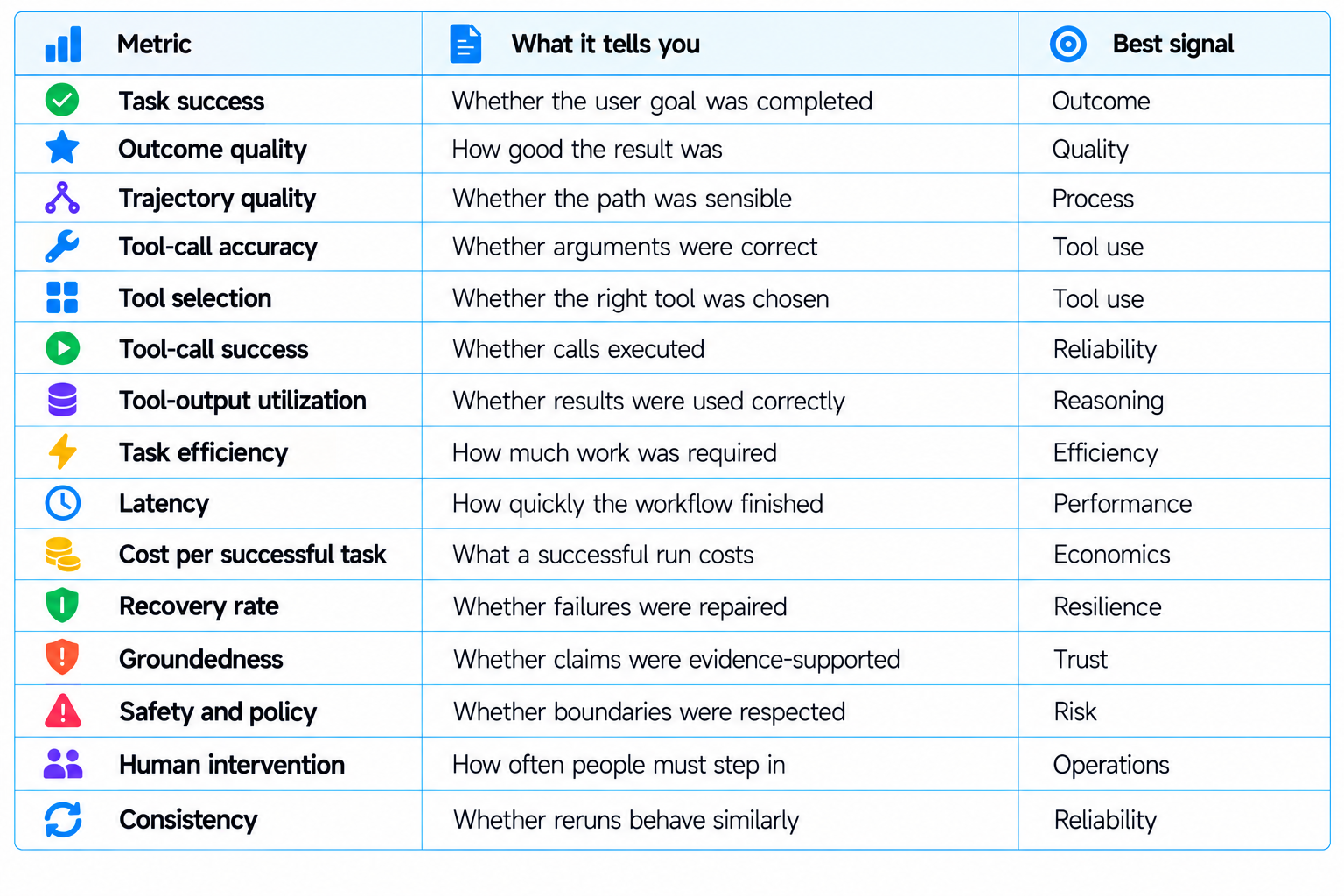
Use this table as a quick diagnostic map. The point is not to maximize every metric independently, but to identify which signal explains a success, failure, or regression.
Which Metrics Should You Prioritize?
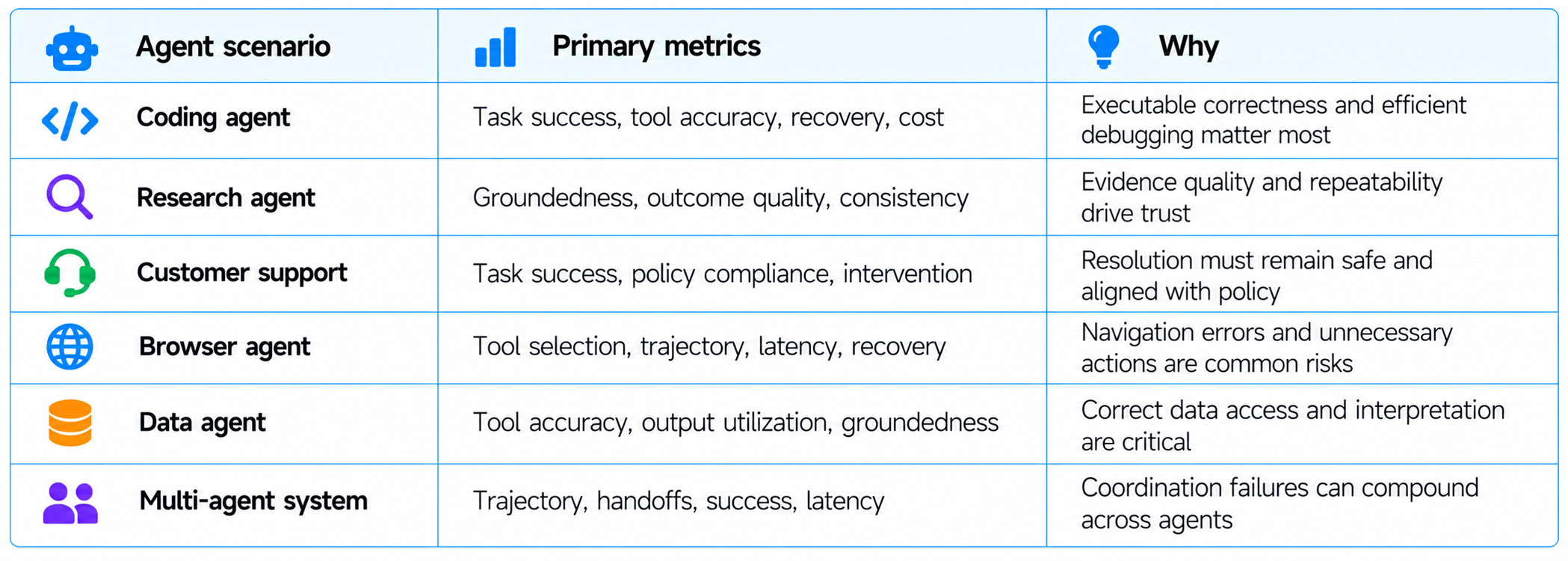
Not every agent needs the same scorecard. Prioritize the metrics that reflect the agent's real failure modes and risk level.
A Practical AI Agent Evaluation Scorecard
Do not average all 15 metrics into one number. That creates a false sense of precision and can hide catastrophic failures. Instead, organize metrics into gates, core performance, and optimization.
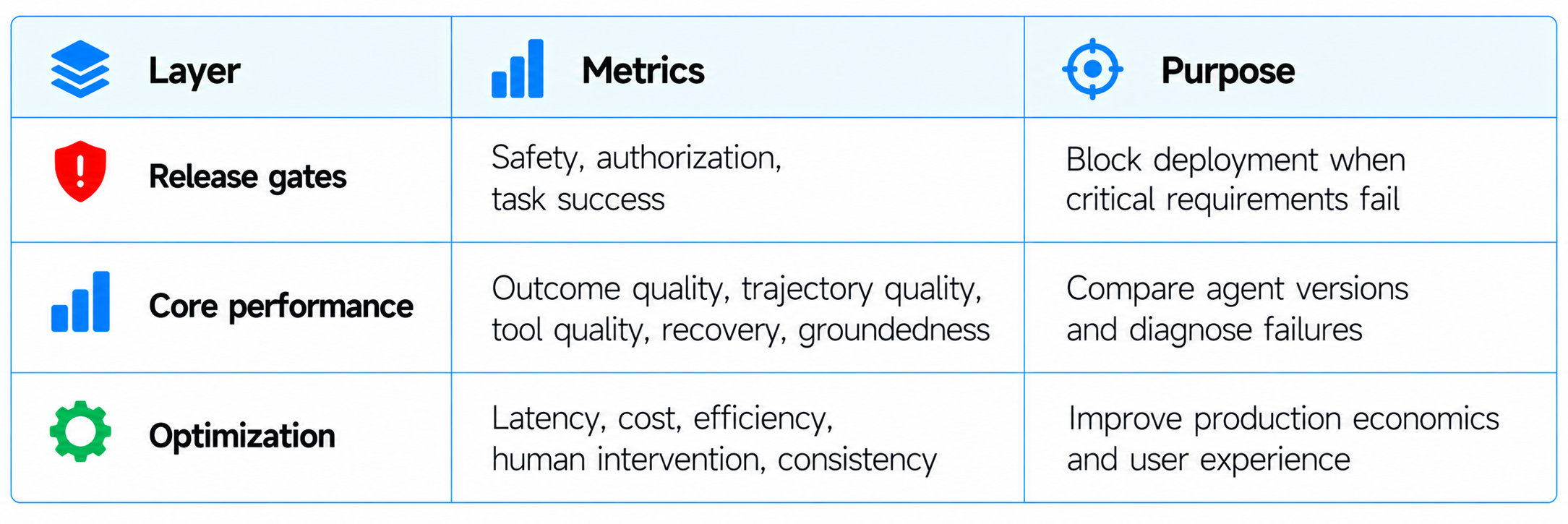
This structure gives engineering teams a useful diagnosis. If task success falls, you can ask whether tool selection worsened, recovery dropped, retrieval became less grounded, or the agent started taking longer paths.
How to Build an AI Agent Testing Framework
The evaluation dataset is more important than a complicated scoring formula. Build the dataset from real work instead of only clean benchmark prompts. A good AI agent testing framework should include normal tasks, historical failures, long-horizon workflows, ambiguous requests, safety cases, tool failures, and tasks with deterministic success criteria.
- Frequent production tasks that represent the normal workload.
- Historical failures, support tickets, and incidents.
- Long-horizon tasks involving several tools or state changes.
- Edge cases where asking for clarification or refusing is the correct behavior.
- Prompt-injection and adversarial safety cases.
- External failures such as timeouts, empty results, rate limits, and permission errors.
- Tasks with known outputs, database states, test results, or other deterministic checks.
Keep a held-out regression set that is not continuously optimized. If every prompt change is tuned against the same evaluation set, the set eventually measures how well you memorized your tests rather than how well the agent generalizes.
For serious agent evaluation, capture structured traces. Each run should record the request, model calls, tool selections, arguments, tool outputs, state changes, retries, approvals, latency, cost, and final outcome. This makes failures diagnosable rather than mysterious.
AI Agent Trajectory Evaluation and Trace Analysis
Trajectory evaluation is the clearest difference between testing an AI agent and testing a normal LLM response. The trajectory is the ordered record of what the agent did. It shows which tool it selected, what arguments it passed, what came back, what it did next, and whether it reached a valid final state.
A useful trajectory evaluator should not demand one exact path for every task. Many real workflows have several valid paths. Instead, define required actions, forbidden actions, acceptable orderings, maximum unnecessary steps, and state invariants. For open-ended workflows, use a calibrated rubric to judge whether each action was justified by the information available at that moment.
This is also where loop detection becomes important. Repeated tool calls, repeated searches, circular planning, and unnecessary retries can consume budget while leaving the final answer superficially correct. Track duplicate actions and maximum step budgets as explicit evaluation signals.
LLM-as-a-Judge for AI Agent Evaluation
LLM-as-a-judge is useful when deterministic grading cannot capture quality. It can score research completeness, trajectory quality, response relevance, policy adherence, and other open-ended dimensions. But an LLM judge should not replace deterministic checks when a deterministic check is available.
Use code for things such as test results, JSON schemas, database state, required fields, tool arguments, permission checks, and exact values. Use model-based grading for qualitative dimensions. Then calibrate the judge against a human-labeled sample so you know where its scores are trustworthy.
A good rubric should define what a 1, 3, and 5 mean, identify critical failure conditions, and tell the judge what evidence to inspect. Avoid prompts such as 'Was this a good agent run?' They produce vague scores that are difficult to reproduce.
OpenAI's grader documentation describes deterministic and model-based grading approaches, which fits this hybrid strategy well.
AI Agent Evaluation Before Production
Before deployment, run the same agent evaluation suite against realistic tools, realistic permissions, realistic data, and realistic failure conditions. A demo environment where every API works perfectly is not an adequate production test.
The release gate should answer six questions: Did the agent complete representative tasks? Did it use the correct tools? Did it stay inside authorization boundaries? Did it recover from expected failures? Is the latency acceptable? Is the cost acceptable?
For agents with write access or external side effects, safety should be treated as a hard gate. Human approval is appropriate for irreversible or high-impact actions until the agent has demonstrated reliable performance under adversarial and failure-heavy tests.
The strongest production approach is continuous evaluation. Run the regression suite after model changes, prompt changes, tool changes, retrieval changes, orchestration changes, and permission changes. Do not wait for a user to discover a regression.
AI Agent Evaluation by Agent Type
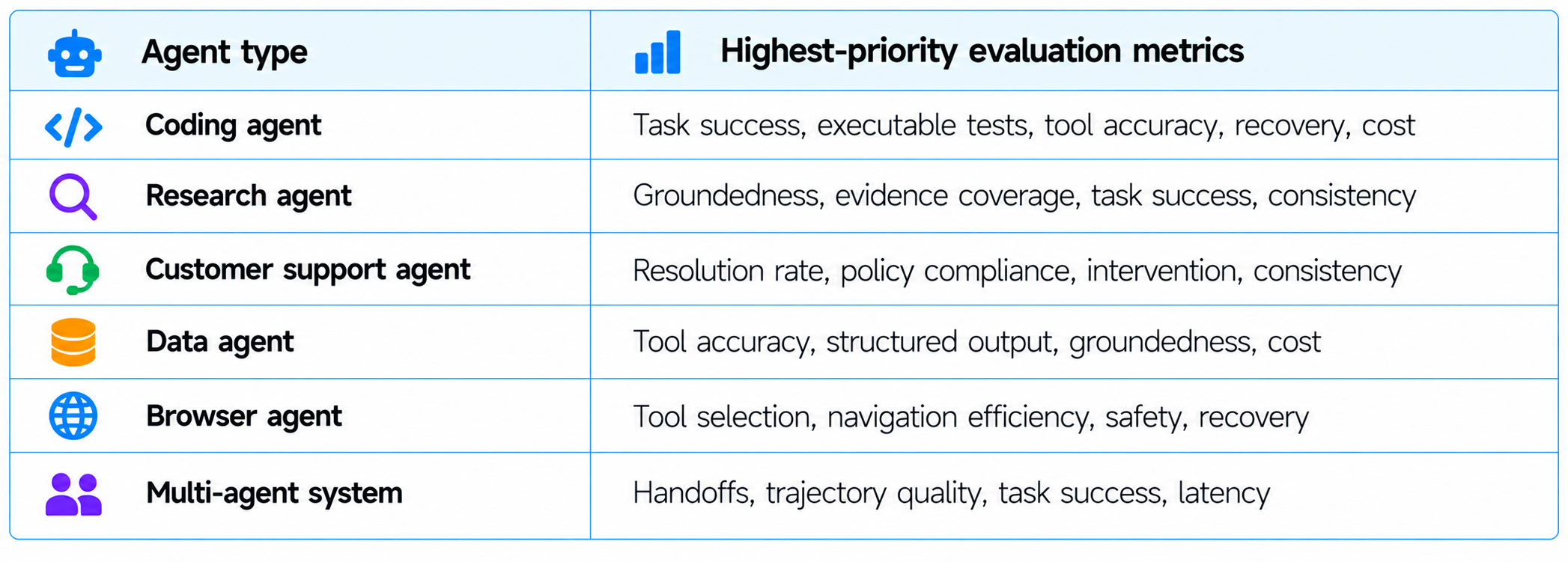
The framework stays the same, but the weighting changes. A coding agent needs executable verification. A research agent needs evidence and groundedness. A financial or enterprise action agent needs authorization and policy compliance to dominate the release decision.
Common AI Agent Evaluation Mistakes
- Measuring only final-answer accuracy.
- Testing only clean, easy tasks.
- Ignoring the trajectory when the final answer looks correct.
- Treating every retry as harmless.
- Using token price instead of cost per successful task.
- Trusting an LLM judge without calibration.
- Mixing agent failures with external-service outages.
- Averaging critical safety failures into a quality score.
- Changing the evaluation set whenever the agent changes.
- Optimizing prompts directly against the entire regression suite.
The contrarian point is that a higher aggregate score can sometimes mean a worse agent. If a new version reduces cost by skipping verification steps, the dashboard may look better while reliability falls. Evaluation should reward safe task completion, not superficial optimization.
A 30-Day AI Agent Evaluation Plan
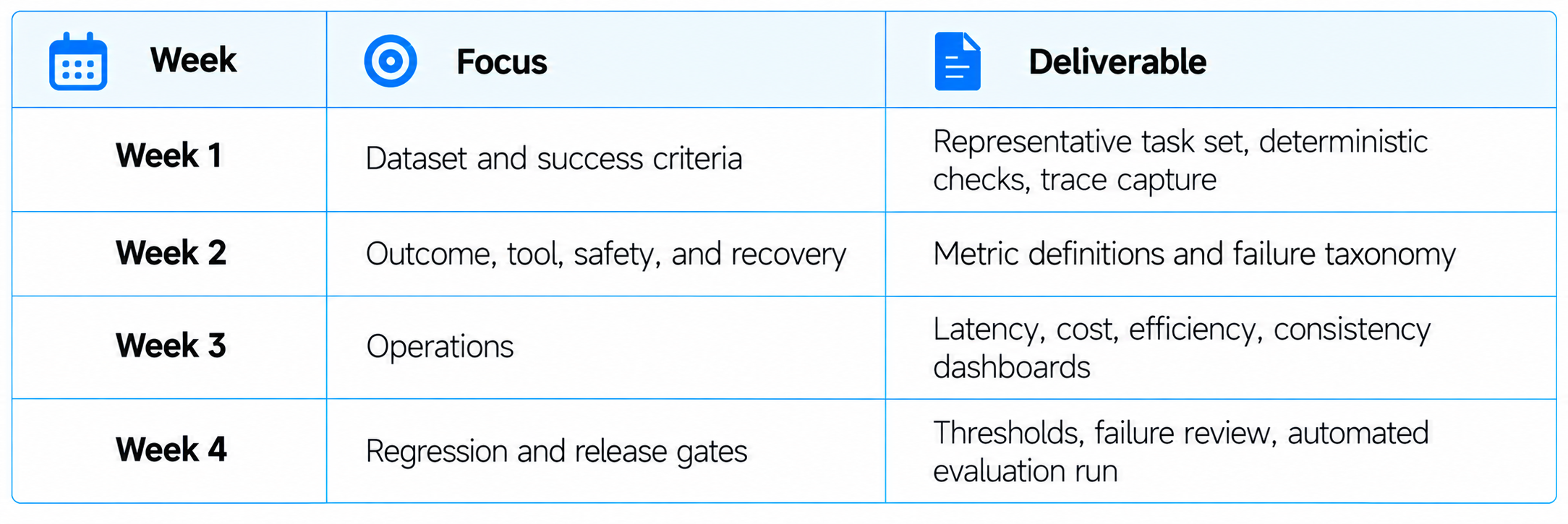
After the first month, evaluation should become part of normal AI agent development. The objective is not to produce a quarterly report. It is to make every meaningful change measurable.
AI Agent Evaluation Tools
The tool matters less than the capabilities behind it. You need trace capture, deterministic evaluation, qualitative grading, regression comparisons, and a way to inspect failures over time. Depending on your stack, this can be built with an evaluation framework, observability platform, custom test harness, or a combination.
Anthropic's evaluation guidance emphasizes multi-turn trajectories and realistic task environments. Microsoft Foundry provides separate agent evaluators for tool selection, tool inputs, tool outputs, tool-call success, and process-level behavior. These approaches reinforce the same principle: agent evaluation needs visibility into the workflow, not only the final response.
Final Checklist: Is Your AI Agent Ready for Production?
- Every important task has a measurable success criterion.
- Agent traces are captured and reviewable.
- Tool selection and tool-call correctness are measured separately.
- Tool-output utilization is tested.
- Safety and authorization have explicit release gates.
- Latency is measured end to end.
- Cost is measured per successful task.
- Recovery from common failures is tested.
- Human interventions are categorized.
- Important tasks are rerun to measure consistency.
- The evaluation set contains real failures and edge cases.
- Major model, prompt, tool, and retrieval changes trigger regression tests.
Final Takeaway
The right way to evaluate an AI agent is to treat it as a system that takes actions, not simply as a model that produces text. Task success tells you whether the user goal was achieved. Trajectory and tool metrics tell you how it was achieved. Recovery and consistency tell you whether the behavior is reliable. Latency and cost tell you whether it is practical. Safety and authorization tell you whether it is acceptable to operate.
If you are building an agent today, start with a small representative evaluation dataset, capture complete traces, use deterministic checks wherever possible, calibrate model judges with human review, and convert real failures into regression tests. That is the difference between an impressive AI agent demo and a production-ready AI agent.
Frequently Asked Questions
What is AI agent evaluation?
AI agent evaluation is the systematic process of measuring whether an AI agent completes tasks correctly, safely, efficiently, and consistently. It evaluates both the final outcome and the actions taken to reach that outcome.
What are the most important AI agent evaluation metrics?
Start with task success, safety, tool quality, recovery, latency, and cost per successful task. Add trajectory quality, groundedness, human intervention, and consistency to diagnose why performance changes.
How do you evaluate an AI agent before production?
Build a representative task dataset, define measurable success criteria, capture traces, test tool behavior and safety, measure latency and cost, repeat important tasks, and run the suite as a regression gate before deployment.
What is trajectory evaluation for AI agents?
Trajectory evaluation scores the sequence of decisions, tool calls, observations, and state changes during an agent run. It catches inefficient or unsafe behavior that final-answer evaluation can miss.
How do you evaluate AI agent tool calling?
Evaluate tool selection, argument validity, execution success, call ordering, and correct use of tool outputs separately. This makes it easier to identify whether the failure came from choosing the wrong tool, constructing bad arguments, or misunderstanding the result.
Should you use an LLM as a judge for AI agents?
Yes for qualitative dimensions where deterministic checks are not enough, but calibrate the judge against human-labeled examples. Use deterministic tests for code, schemas, database state, permissions, and other directly verifiable requirements.
How do you measure AI agent reliability?
Run representative tasks repeatedly and track success rate, failure rate, recovery rate, trajectory variance, intervention rate, and consistency. A single successful run is weak evidence for a non-deterministic agent.
What is the difference between AI agent evaluation and LLM evaluation?
LLM evaluation often focuses on an input and final output. AI agent evaluation also measures the multi-step process, including tool calls, state changes, recovery, safety boundaries, latency, and cost.
Recommended Blogs
- What Is Agentic AI? Complete Beginner's Guide (2026)
- Agentic AI vs Generative AI: Key Differences Explained (2026)
- Best AI Agent Frameworks 2026: LangGraph, CrewAI, AutoGen Compared
- How to Automate Your Work with AI Agents (No Code) - 2026
- 10 Best AI Agents of May 2026 That Actually Boost Productivity
- How to Secure AI Agents After the Four-Account Breach
Resources & Community
Join our community of 70,000+ AI enthusiasts and learn to build powerful AI applications! Whether you're a beginner or an experienced developer, Build Fast with AI helps you understand and implement AI in your projects.
- Website - buildfastwithai.com
- LinkedIn - Build Fast with AI
- Instagram - @buildfastwithai
- Founder X - @satvikps
- X - @BuildFastWithAI
Agentic AI Launchpad 2026
A structured 6-week cohort program that takes you from AI basics to building and deploying real-world agentic AI systems. Includes live sessions, expert mentorship, project reviews, and a builder community network.
Ready to go from learning to building? Join the next cohort: Agentic AI Launchpad 2026
Free AI Resources
Access free tools, workshops, and micro-learning to keep building.
- AI Workshops - Free resources, upcoming events and past recordings
- Unrot - Learn AI in 5 minutes a day
Want more practical AI guides? Follow Build Fast with AI for new tutorials, evaluations, and agentic AI workflows.

