


Andrew Wiles proved Fermat's Last Theorem in 1994 and mathematicians have been checking it ever since. Formal verification, the process of rewriting a proof so a computer can confirm every step, has been an open project for years because the argument is enormous and the translation is brutal. Anthropic finished it in 11 days. Claude, running on an internal research model, produced more than 13 million lines of Lean code, proved 30,300 individual theorems with 29,500 of them appearing in the final proof, and burned through roughly six billion output tokens doing it. It is the largest formal Lean proof ever written, and a separate proof kernel written in Rust independently confirmed all 1,052,234 declarations.
The first attempt failed. What changed was Prove2Me, an open-source framework that keeps a directed acyclic graph of theorem statements and points many Claude agents at it simultaneously, which turned an impossible single-agent task into a tractable parallel one. Elsewhere in the last 72 hours, GPT-6 Astra started driving Blender and Unreal Engine 5 by hand rather than explaining them, Google shipped weather forecasting at 5km hourly resolution, and Alibaba refreshed Qwen3.8-Max. Here are the 16 stories that matter for September 7, 2026. For running coverage, bookmark our AI industry news and trends hub.
1. Claude Formalized Fermat's Last Theorem in Lean in 11 Days
Anthropic announced that Claude completed the first formalization of Fermat's Last Theorem in Lean, finishing in 11 days using an internal research model. The output exceeds 13 million lines of Lean code, making it the largest formal Lean proof ever constructed. Claude proved 30,300 theorems along the way, of which 29,500 appear in the final proof, consuming roughly six billion output tokens.
Formalization is not the same as proving, and the distinction is the whole story. Andrew Wiles proved Fermat's Last Theorem in 1994. What nobody had done was translate that proof into a form a computer proof assistant like Lean can mechanically verify, which requires making every implicit step explicit and every dependency precise. That process normally takes teams of humans years, and it is the reason checking a major proof can take longer than writing one. Thirteen million lines gives a sense of the scale: the human-readable proof runs to a few hundred pages.
My take: I want to be careful here because the headlines are going to say Claude proved Fermat's Last Theorem and that is not what happened. What happened is arguably more useful. Verification, not discovery, is the bottleneck in modern mathematics, where proofs have grown too large for any individual to check. A system that can formalize a proof of this size in under two weeks changes the economics of mathematical certainty. That is a genuine contribution and it does not require anyone to claim the machine did the creative work.
2. Prove2Me: How Multiple Claude Agents Built a 13 Million Line Proof
Anthropic's first attempt to formalize Wiles's proof failed. The breakthrough came when the team gave Claude access to Prove2Me, an open-source collaborative framework built specifically for mathematical formalization. Prove2Me maintains a directed acyclic graph of theorem statements and coordinates multiple Claude agents working against it simultaneously, so each agent takes a node in the graph while the structure tracks what depends on what.
This is the most instructive detail in the whole story and it has nothing to do with model capability. The same model failed and then succeeded, and what changed was the orchestration around it. A dependency graph solves the specific problem that makes long formalization hard, which is that you cannot prove a theorem until its prerequisites exist, and a single agent working linearly stalls the moment it hits a gap. Splitting the graph across agents turns a sequential blocker into a parallel workload. It echoes what NVIDIA's NOOA framework demonstrated on SWE-bench Verified, hitting 82.2 percent at half the token cost of rival harnesses.
My take: if you take one lesson from today, make it this one. The harness is doing as much work as the model, and Anthropic just published a clean natural experiment proving it. Before you upgrade to a more expensive model, ask whether your task decomposition is the actual constraint. Prove2Me is open source, which means the pattern is available to anyone working on problems with a dependency structure. Our AI agent frameworks hub tracks this space.
3. How the Fermat Proof Was Independently Verified
Beyond Lean's own built-in proof checker, the completed proof was independently verified by nanoda, a separate proof kernel written in Rust, which confirmed that all 1,052,234 declarations are correct. That double verification is the reason this result can be trusted without anyone reading 13 million lines.
A proof kernel is a small, heavily scrutinised piece of software that checks logical steps, and the entire trustworthiness of formal verification rests on it being correct. Running the proof through a second kernel written in a different language by different people guards against the scenario where a bug in one checker silently accepts an invalid step. This is exactly the practice mathematicians asked for when formal verification was proposed as an answer to unverifiable proofs, and it is unusual to see an AI lab observe it properly rather than reporting the headline and moving on.
My take: the verification step is what separates this from an impressive-sounding claim, and I would treat any future AI mathematics result without independent kernel verification as unconfirmed. It also raises a question I have not seen answered. If Claude generated 13 million lines, no human has read them, and two kernels say they are correct, what exactly does the mathematical community now understand that it did not before? The certainty is real. The insight may not be.
4. GPT-6 Astra Computer Use: Driving Blender and Unreal Engine 5
GPT-6 Astra's headline capability is operating professional desktop software directly rather than explaining how to use it. It drives applications on the user's behalf, moving through menus and tools inside Blender or Unreal Engine 5 and producing editable scenes rather than instructions. On BenchCAD, a 3D reconstruction test from multiple views, OpenAI claims 95.9 percent. Early testers have used it to model a house in Blender and turn it into a walkable Unreal Engine 5 scene, and to build playable 3D games in Unity and Unreal, in some cases controlling Blender directly through computer use rather than writing code.
Producing an editable scene rather than a script is the meaningful difference. A model that writes Blender Python gives you something you have to run, debug, and then modify in the tool anyway. A model that operates the tool leaves you with a file in the state you asked for, in the format your pipeline already uses. That matters most in creative software where the artefact is the point and where scripting has always been the awkward workaround rather than the native workflow.
My take: this is the first computer-use capability I have seen that solves a problem people actually have rather than demonstrating that the technique works. 3D content creation is bottlenecked on skilled operator time in a way that writing text never was. The caveat is that 95.9 percent on BenchCAD is a vendor figure on a reconstruction benchmark, and reconstructing a known object from views is much easier than building something original to a brief. Watch what the community ships over the next month rather than the benchmark.
5. GPT-6 Astra OSWorld 2.0 Score Versus GPT-5.6 Sol
GPT-6 Astra scores 72.6 percent on OSWorld 2.0 at roughly 40 minutes per task, against GPT-5.6 Sol at 65.7 percent and roughly 75 minutes per task. That is nearly seven points more capability at a little over half the wall-clock time. For comparison, Claude Fable 5.1 posts 77.9 percent partial and 41.7 percent strict on the same benchmark.
OSWorld measures whether a model can complete real tasks in a real desktop environment, clicking through applications and file systems the way a person would, which makes it the closest benchmark to the computer-use claim. The time figure matters as much as the score, because a task that takes 75 minutes is one you start and walk away from, while 40 minutes is one you might wait for. Halving that changes how the capability feels to use. Note that Fable 5.1's 77.9 percent is the partial-credit score and the strict number is 41.7 percent, so cross-model comparison here needs care about which figure is being quoted.
My take: partial versus strict scoring is where most OSWorld comparisons quietly mislead, and I would not put Astra and Fable 5.1 side by side without knowing which basis each number uses. What is not ambiguous is the generational gain within OpenAI's own line, 65.7 to 72.6 percent with the clock nearly halved, measured consistently. That is the honest read on how much Astra improved at operating a computer. Detail on the launch sits in our September 4 roundup.
6. GPT-6 Astra on ARC-AGI-3: Fewer Moves Than the Median Human
GPT-6 Astra scored 63 percent on ARC-AGI-3 using the standard harness and, more notably, beat the human baseline on action efficiency, using fewer moves than the median human on 96 percent of levels. The separate provider adapter run reached 99.9 percent, but that configuration preserves opaque reasoning state between requests and is not directly comparable to how other models are measured.
Action efficiency is a different and arguably more interesting measurement than raw score. Solving a puzzle in fewer moves than a person means the model is not brute-forcing its way to an answer through trial and error, it is forming a hypothesis and testing it economically. Doing that on 96 percent of levels suggests the behaviour is systematic rather than lucky on a subset. The 63 percent completion rate says it still fails on a third of levels, so this is not saturation, it is efficiency without completeness.
My take: I flagged the harness distinction on Friday and it is worth repeating because most coverage is still quoting the 99.9 percent figure without the asterisk. The genuinely impressive result is the efficiency one, and it is getting almost no attention because it does not produce a round number. A model that reasons economically is more useful in production than a model that reasons exhaustively, because in production you pay for every move.
7. Qwen3.8-Max-0902: What Alibaba Updated
Alibaba released Qwen3.8-Max-0902, a dated refresh of its flagship open-weight model. The base Qwen3.8-Max carries 2.4 trillion total parameters with roughly 95 billion active per query, a 1 million token context window, and native multimodal input across text, images, and video, with open weights published on August 12.
Dated checkpoint releases are how Chinese labs ship incremental improvements without a version bump, and DeepSeek uses the same convention with releases like V4-Pro-0813. It signals a retrained or refined checkpoint rather than a new architecture, which matters for anyone running the model locally because the weights change while the serving setup does not. Qwen3.8-Max currently ranks as the strongest open-weight option in several September comparisons, sitting second among Chinese models at 78.6 behind Kimi K3 at 79.9.
My take: the dated-checkpoint habit is genuinely useful and Western labs should copy it. A version number tells you a model changed. A date tells you when, which is what you need when you are debugging why behaviour shifted last Tuesday. If you self-host Qwen3.8-Max, check whether you are on 0902 before you file a bug about output drift. Our Kimi K3 review covers the open-weight field.
8. Best AI Model September 2026: The Current Ranking
As of early September 2026, Claude Fable 5.1 leads on overall intelligence scoring, followed by Claude Opus 5 and Meta's Muse Spark 1.3. GPT-6 Astra and Gemini 3.8 Flash both launched within the last week and are still being independently benchmarked. BenchLM currently ranks 417 models overall, while Artificial Analysis places Claude Opus 5 at 63 on its Intelligence Index and Muse Spark 1.3 (max) at 62.
Rankings this close are more useful for elimination than selection. A one-point gap between Opus 5 and Muse Spark 1.3 on an aggregate index does not survive contact with a specific workload, and the leader changes depending on which index you consult and which week you check. What the composite rankings do establish is the band: five or six models now sit within a few points at the top, from three American labs and one Chinese, and nothing else is close to them.
My take: the honest answer to which model is best is that the question is now malformed. Fable 5.1 leads intelligence, Claude Opus 4.7 still leads SWE-bench Verified at 87.6 percent, GPT-5.4-Pro leads GPQA Diamond at 94.4 percent, Gemini 3.8 Flash Cyber leads CyberGym at 86.2 percent, and Muse Spark 1.3 leads cost per task at $0.55. Six leaders, six benchmarks. Pick the one that matches your work. Full comparison in our best AI models ranking.
9. Which AI Model Should You Use in September 2026
The right model depends on which constraint binds first, and for most teams that is cost rather than capability. If cost per completed task decides, Muse Spark 1.3 at $0.55 per Intelligence Index task against $0.95 for GPT-5.6 Sol. If you need cheap high volume, Gemini 3.8 Flash at $0.75 and $3.75 per million tokens, blended around $2.25. If your agentic workload is cache-heavy, Claude Fable 5.1 with cache reads at $0.25 against GPT-6 Astra's $1.00 at identical $10 and $50 base pricing. If you need desktop automation, GPT-6 Astra. If data cannot leave your infrastructure, Qwen3.8-Max or Tencent Hy4 preview.
Notice that capability barely enters that list. The models at the top are close enough that the deciding factors are price structure, licence, latency, and whether the thing can do the specific job you need. Cache pricing is the most overlooked of those, because a fourfold difference in cache read cost outweighs a three-point benchmark gap on any workload that re-reads context, which is every agent.
My take: the single highest-value thing you can do this month is benchmark tokens per completed task across two or three candidates on twenty real tasks from your own work. It takes a day, it captures retries and verbosity and harness efficiency together, and it routinely reverses the ranking that published leaderboards suggest. Every team I know that has done this changed their default model. Very few teams have done it.
10. Best Open Source AI Model in September 2026
Alibaba's Qwen3.8-Max is currently rated the strongest open-weight model overall at 2.4 trillion total parameters with roughly 95 billion active and a 1 million token context. Close behind sit Moonshot's Kimi K3 at 2.8 trillion parameters leading Chinese model rankings at 79.9, Tencent's Hy4 preview at 770 billion parameters under Apache 2.0 scoring 92.3 on GPQA Diamond, and MBZUAI's K2 Horizon, six Apache 2.0 models from 0.9 billion to 375 billion parameters that publish training data alongside weights.
Licence terms separate these more than capability does. Hy4 preview and K2 Horizon ship under Apache 2.0 with no conditions. Qwen3.8-27B is Apache 2.0 and runs on consumer hardware at 73.0 on Terminal-Bench. Kimi K3 and MiniMax M3 carry custom community licences requiring review before commercial deployment, and GLM-5.3 requires companies above $10 billion in revenue to pass a Z.ai security review. Only the Apache 2.0 and MIT releases meet the standard open-source definition.
My take: K2 Horizon is the release I would most like to see properly benchmarked, because publishing training data alongside weights is what open weights were supposed to mean and almost nobody does it. For practical deployment today, Hy4 preview at frontier scale under Apache 2.0 and Qwen3.8-27B for single-GPU work are the two I would shortlist. Every credible option in this category is now Chinese or Emirati, which remains the structural fact Western labs have not answered.
11. Google WeatherNext 3 Delivers 5km Hourly Forecasts
Google DeepMind and Google Research released WeatherNext 3, producing hourly forecasts at up to 5 kilometre resolution, five times sharper than its predecessor, with rain predictions up to 60 percent more accurate one day ahead. It is being integrated into Search, Maps, Gemini, and Earth Engine.
Resolution is what makes a forecast actionable rather than directional. At coarse resolution a model tells you it will rain in your region, while 5 kilometres tells you whether it will rain on your site, which is the difference between useful and interesting for agriculture, construction, logistics, and energy trading. The 60 percent improvement in one-day rain accuracy is the number with the most economic weight attached, since short-horizon precipitation drives the most operational decisions. Integration into Maps and Search means this reaches ordinary users rather than sitting behind an API.
My take: weather is the most commercially proven application of AI that nobody talks about, and it has been quietly outperforming traditional numerical models for two years. It is also the cleanest possible test of whether a model works, since reality arrives tomorrow and grades it. I would trust a weather model's published accuracy considerably more than any language benchmark, for exactly that reason.
12. Gemini Spark Arrives in Google Photos
Google is rolling out Gemini Spark inside Google Photos, letting users search, curate, edit, organise, share, and manage their photo library through conversation. It is available to Gemini AI Pro and Ultra subscribers in the United States in English, on a phased rollout.
Photo libraries are the ideal case for conversational AI because they are large, personal, and badly served by search. Most people have tens of thousands of images they cannot find anything in, and existing search relies on you remembering roughly when something happened. Curation is the harder capability in that list: picking the ten good photos out of two hundred from an event is a judgment task that nobody enjoys and everybody postpones. Restricting it to paid tiers makes it a subscription driver rather than a platform feature.
My take: this is the kind of application that decides consumer AI adoption far more than benchmark scores do, because it attaches to something people already have and already find annoying. The privacy calculus is worth thinking about before you enable it, since a model that can search and curate your photo library has, by definition, processed all of it. Google has the relationship to make that acceptable to most users, which is precisely why the question deserves asking.
13. OpenAI Defense Factory Automates Vulnerability Fixing
OpenAI unveiled Defense Factory, an automated system that continuously finds, validates, and fixes software vulnerabilities. The company framed it explicitly as a response to open-weight models closing the gap with attackers, meaning offensive capability is now widely available and defensive tooling needs to scale to match.
The validate step is what separates this from a scanner. Static analysis tools produce enormous volumes of findings, most of which are false positives, and the human triage cost is why security teams ignore most of their tooling output. A system that confirms a vulnerability is real before proposing a fix removes the bottleneck. It follows OpenAI declaring Astra the first model to cross its Critical cybersecurity threshold after finding two genuine zero-days on ExploitBench, and it arrives alongside Google's Gemini 3.8 Flash Cyber and CrowdStrike's Red Tempest and Blue Solano pairing.
My take: four defensive security products from four vendors inside two weeks tells you the labs believe the offensive capability is already out. That is a reasonable conclusion given GLM-5.3's weights are public and it led CyberGym at 84.5 percent until last week. The strategy is now to arm defenders faster than attackers can exploit, which is a race rather than a solution, and I have not seen anyone argue convincingly that defenders win it by default.
14. Google Play with Putty Builds Software in One Room
Google launched Play with Putty, a collaborative environment where an entire team works on software together in a shared room while an AI writes the code live. Separately, Proofpoint introduced its SOC Analyst Agent, an agentic capability built on OpenAI Daybreak models that turns natural language questions into structured, traceable security investigation findings.
Multiplayer AI coding is a genuinely different interaction model from the single-developer assistant everyone has built so far. When one person prompts an agent, the output is theirs to review. When a team is in the room, the review happens continuously and socially, which addresses the review bottleneck that Linear's data exposed when agent-using teams tripled weekly pull requests from 21 to 65 while non-agent teams moved from 8 to 10. Proofpoint's traceable findings requirement is the same idea applied to security, where an unexplainable conclusion is unusable.
My take: the review bottleneck is the unsolved problem in agentic coding and this is the first serious attempt at attacking it socially rather than technically. Whether developers actually want to work this way is a separate question, and pair programming has always had more advocates than practitioners. Our AI coding tools hub tracks what teams adopt versus what they try.
15. AI Model Prices in September 2026: Full Comparison
Here is where model pricing stands as of September 7, 2026, including cost per task where it is published.
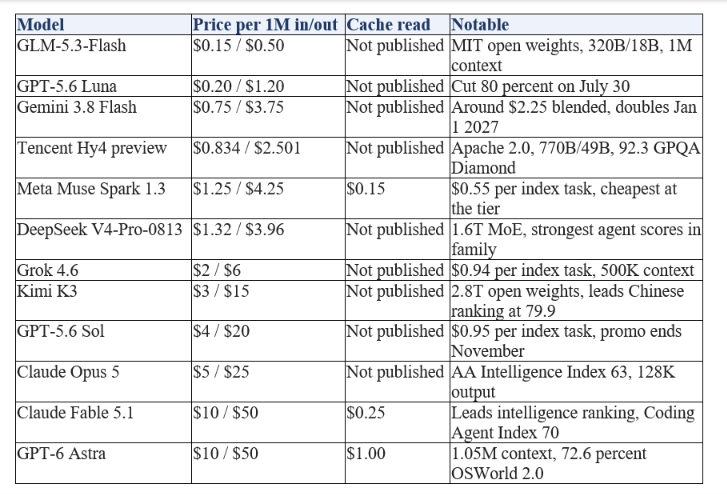
The two flagships are priced identically per token and differ fourfold on cache reads. For an agent that re-reads a system prompt and tool definitions on every turn, that gap decides the bill more than any benchmark does. Three promotional rates also expire between now and January: Claude Sonnet 5's ended August 31, GPT-5.6 Sol's ends in November, and Gemini Flash's ends December 31.
16. Where the Frontier Models Stand Today
Here is the practical state of the model landscape as of September 7, 2026.
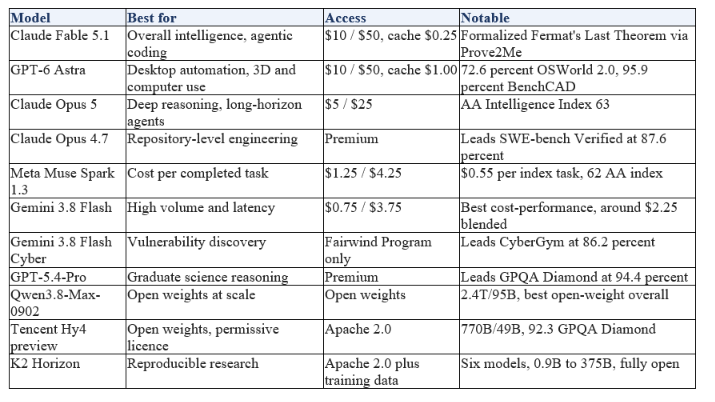
Six models lead six different benchmarks, which is the clearest sign yet that a single default model is the wrong architecture. Detail on each sits in our GPT-5.6 review and the Nemotron 3 Ultra review.
17. What to Watch Next in AI
Four things carry into this week.
● Independent benchmarking of GPT-6 Astra now that it has been out five days, particularly OSWorld 2.0 on a consistent partial or strict basis so it can be compared to Claude Fable 5.1's 77.9 and 41.7 percent.
● Whether other labs adopt the Prove2Me pattern, since Anthropic published a clean demonstration that dependency-graph orchestration turned a failed run into a completed one with the same model.
● Mathematical community reaction to the Fermat formalization, specifically whether anyone argues the result produces understanding rather than only certainty.
● Regulatory review of the Nvidia and Hugging Face acquisition, confirmed last week at $12.93 billion and expected to close in the first half of 2027.
The through-line for September 7 is that orchestration beat capability twice in one week. Claude failed to formalize Fermat's Last Theorem, then succeeded with the same model once Prove2Me split the problem into a dependency graph across many agents. GPT-6 Astra's biggest gain over GPT-5.6 Sol was halving the time per desktop task rather than raising the ceiling. If you are choosing where to spend engineering effort this quarter, the evidence keeps pointing at the scaffolding rather than the model.
Frequently Asked Questions
Did AI prove Fermat's Last Theorem?
No. Andrew Wiles proved it in 1994. What Claude did was formalize that proof in Lean, translating it into a form a computer proof assistant can mechanically verify, which had never been completed before. The run took 11 days, produced more than 13 million lines of Lean code, proved 30,300 theorems, and used roughly six billion output tokens.
What is Prove2Me and how did Claude use it?
Prove2Me is an open-source collaborative framework for mathematical formalization that maintains a directed acyclic graph of theorem statements and coordinates multiple Claude agents against it. Anthropic's first formalization attempt failed, and the breakthrough came after switching to Prove2Me, which allowed many agents to work in parallel on different nodes of the dependency graph.
Can GPT-6 Astra use Blender and Unreal Engine?
Yes. GPT-6 Astra operates professional desktop software directly, navigating menus and tools inside Blender and Unreal Engine 5 to produce editable scenes rather than instructions or scripts. It scores 95.9 percent on BenchCAD, a 3D reconstruction test from multiple views, and early testers have built walkable Unreal Engine 5 scenes and playable games with it.
What did GPT-6 Astra score on OSWorld 2.0?
GPT-6 Astra scored 72.6 percent on OSWorld 2.0 at roughly 40 minutes per task, against GPT-5.6 Sol at 65.7 percent and roughly 75 minutes per task. Claude Fable 5.1 posts 77.9 percent partial credit and 41.7 percent strict on the same benchmark, so comparisons need care about which scoring basis is quoted.
Which is the best AI model in September 2026?
It depends on the benchmark. Claude Fable 5.1 leads overall intelligence rankings, Claude Opus 4.7 leads SWE-bench Verified at 87.6 percent, GPT-5.4-Pro leads GPQA Diamond at 94.4 percent, Gemini 3.8 Flash Cyber leads CyberGym at 86.2 percent, and Muse Spark 1.3 leads cost per task at $0.55. No single model leads everything.
Which AI model should I use for my work?
Match the model to your binding constraint. Muse Spark 1.3 if cost per completed task decides, Gemini 3.8 Flash if volume and latency decide, Claude Fable 5.1 if your agentic workload is cache-heavy given its $0.25 cache reads, GPT-6 Astra if you need desktop automation, and Qwen3.8-Max or Tencent Hy4 preview if data cannot leave your infrastructure.
What is the best open source AI model right now?
Qwen3.8-Max is currently rated strongest overall among open-weight models at 2.4 trillion parameters with roughly 95 billion active. Tencent Hy4 preview at 770 billion parameters offers frontier-adjacent capability under Apache 2.0 with no licence conditions, and Qwen3.8-27B under Apache 2.0 is the strongest option that runs on a single consumer GPU.
What is Google WeatherNext 3?
WeatherNext 3 is a weather forecasting model from Google DeepMind and Google Research producing hourly forecasts at up to 5 kilometre resolution, five times sharper than its predecessor, with rain predictions up to 60 percent more accurate one day ahead. It is being integrated into Google Search, Maps, Gemini, and Earth Engine.
What is Gemini Spark in Google Photos?
Gemini Spark is a conversational assistant inside Google Photos that can search, curate, edit, organise, share, and manage a photo library through natural language. It is rolling out in phases to Gemini AI Pro and Ultra subscribers in the United States in English.
What is OpenAI Defense Factory?
Defense Factory is an automated OpenAI system that continuously finds, validates, and fixes software vulnerabilities. OpenAI framed it as a response to open-weight models closing the capability gap with attackers. The validation step distinguishes it from conventional scanners by confirming a vulnerability is real before proposing a fix.
Recommended Blogs
● GPT-6 Astra Lands as Nvidia Buys Hugging Face: AI News September 4 2026
● Muse Spark 1.3 Undercuts GPT-5.6 by 70%: AI News September 3 2026
● OpenAI Astra Hits Critical Cyber Risk: AI News September 2 2026
● NVIDIA Nemotron 3 Ultra Review: Benchmarks and Architecture
● Best AI Models July 2026: Ranked by Use Case and Price
● GPT-5.6 Review: Sol, Terra, Luna Benchmarks and Pricing
● Kimi K3 Review: Benchmarks, Pricing, and K2 Comparison
Resources & Community
Join our community of 70,000+ AI enthusiasts and learn to build powerful AI applications! Whether you're a beginner or an experienced developer, Build Fast with AI helps you understand and implement AI in your projects.
● Website: buildfastwithai.com
● LinkedIn: Build Fast with AI
Agentic AI Launchpad 2026
A structured 6-week cohort program that takes you from AI basics to building and deploying real-world agentic AI systems. Includes live sessions, expert mentorship, project reviews, and a builder community network.
Ready to go from learning to building? Join the next cohort: Agentic AI Launchpad 2026
Free AI Resources
Access free tools, workshops, and micro-learning to keep building:
● AI Workshops: Free resources, upcoming events, and past recordings
● Unrot: Learn AI in 5 minutes a day (free micro-learning app)
● Gen AI Experiments: free cookbooks and notebooks on GitHub
Independent Astra benchmarks and mathematical community reaction to the Fermat proof both develop this week. Follow Build Fast with AI so each recap reaches you before your standup.
References
● Formalizing Fermat's Last Theorem (Anthropic)
● Claude formalizes Fermat's Last Theorem (SiliconANGLE)
● Astra drives Blender and Unreal Engine (Crypto Briefing)
● GPT-6 Astra on ARC-AGI-3 (ARC Prize)
● OpenAI unveils GPT-6 Astra amid scrutiny (Al Jazeera)
● Best AI models September 2026 (BenchLM)
● September 2026 model updates (Local AI Zone)
● Model release timeline (LLM Gateway)

