


Grok Bot Review: Can xAI's AI Teammates Actually Do Work?
Grok Bot is xAI's attempt to turn AI agents into persistent digital coworkers. Instead of opening a fresh agent session for every task, you create a named Bot, give it access to the tools it needs, and hand over a real job. The Bot runs on a persistent cloud computer with a browser, filesystem and terminal, so the work can continue after you close the app.
That changes the unit of interaction. A normal assistant is organized around answers. Grok Bot is organized around responsibility. You can ask a Bot to research a market, update records, reproduce a bug, prepare a report or coordinate work across several applications, then return with the result when the task is complete or a decision is needed. xAI also lets Bots keep skills and routines so repeated processes can run without another manual prompt.
The product is now available across more of xAI and Cursor's paid ecosystem, and xAI opened enterprise access on September 3, adding organization controls, network controls and audit capabilities. That makes Grok Bot interesting not only as a personal productivity tool, but as an automation layer for real company workflows.
QUICK ANSWER
Grok Bot is a persistent AI teammate system that can use a cloud computer, browse websites, work with files and terminals, connect to tools, remember workflows and collaborate with other Bots. Each user gets a persistent cloud computer, and that computer is shared by all Bots belonging to the user.
The most important capability is persistence. A Bot does not have to stop when the laptop closes because the work runs in the cloud. You can also teach a workflow once, save it as a skill, and then schedule it as a routine. Current documentation says a Bot can own up to 50 routines and that routines retain recent run history.
Grok Bot is useful because it can work in real applications, including sites without clean APIs or MCP integrations. The tradeoff is that the agent has real access to real accounts, so permissions and approvals matter. xAI recommends keeping sending, purchasing, deletion, publishing and production changes behind approval and using least-privilege access.
My verdict: 9.1/10 overall. Grok Bot is one of the strongest examples of an AI system becoming a persistent worker rather than remaining a chat assistant.
1. What Is Grok Bot?
xAI launched Grok Bot on August 11, 2026 as a system of always-on AI teammates. The company says the product grew out of an internal prototype used for sales, marketing, operations and engineering tasks before being opened to users.
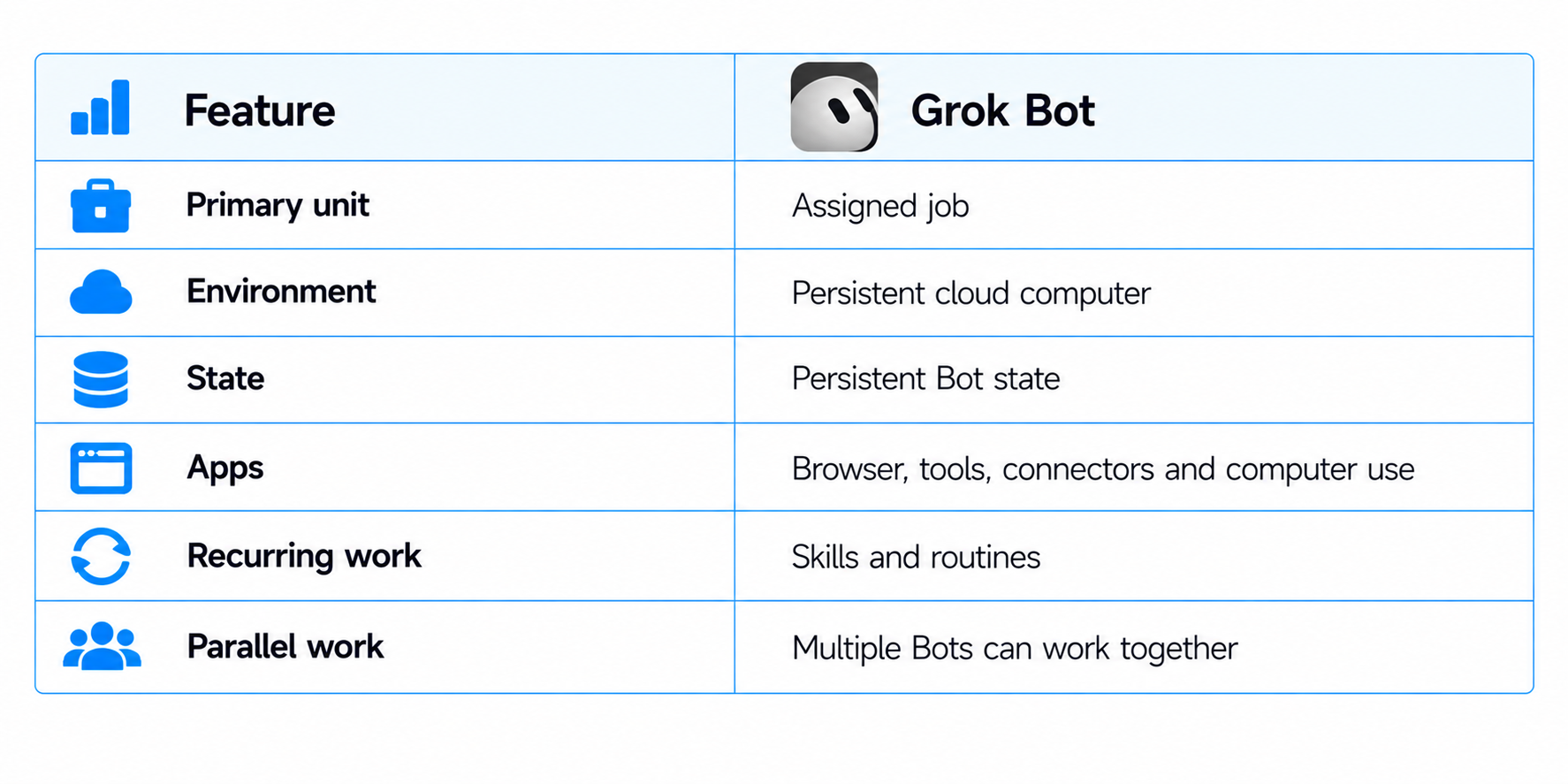
A Bot is a named role with its own persistent state, memory, tools and working environment. Instead of describing a workflow every time, you can keep the same Bot around and build a relationship with it. That lets the Bot accumulate role-specific preferences and workflow knowledge over time.
The current documentation describes five main concepts: Bots, chats, prompts, tools and artifacts. Bots own persistent roles, chats provide the interface, prompts give instructions, tools connect the Bot to software and artifacts are the durable outputs it creates or changes.
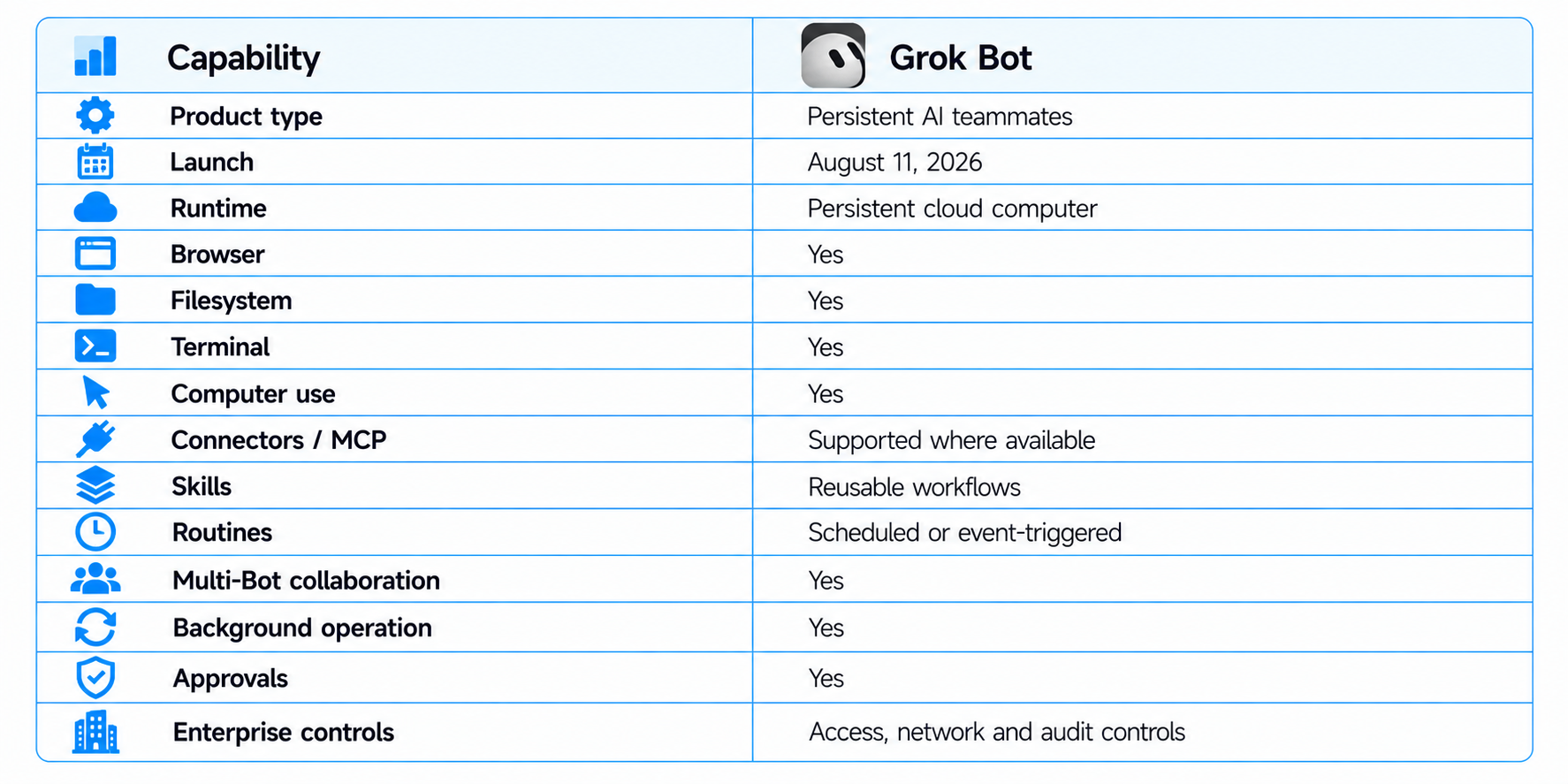
2. Grok Bot at a Glance
3. The Persistent Computer Is the Big Difference
Grok Bot does not simply open a temporary browser session. The current documentation describes a persistent cloud computer with a browser, filesystem and terminal. The same computer is shared by every Bot on that user's account, which allows one Bot to leave files or signed-in sessions for another Bot to use.
This architecture is what makes long-running work possible. A research Bot can download source files, a second Bot can analyze them, and a third can turn the findings into a report without the user moving the files manually between sessions.
It also lets Grok Bot work with software that was never designed for AI automation. xAI explicitly supports computer use for apps and websites without a clean API or MCP interface. That makes the system broader than a collection of API integrations.
4. Can Grok Bot Actually Do Work?
Yes. The product is designed around end-to-end tasks. xAI describes engineering Bots reproducing a UI bug, filing a ticket and handing the issue to a debugging Bot. It also describes operations Bots processing invoices, sales Bots updating CRM records and drafting follow-ups, and recruiting Bots preparing candidate workflows.
The strongest recent case study is procurement. xAI says an internal Bot analyzed vendor spend, contracts and usage data and identified more than $100,000 in direct savings. The figure is useful as a product case study, but it is self-reported by xAI rather than an independently audited benchmark.
The distinction from a normal assistant is the final state. A chatbot may produce a recommendation such as 'update the CRM.' Grok Bot is designed to open the CRM, make the update and return with the completed result when the action is permitted.
5. Multi-Bot Collaboration
Grok Bot can run multiple Bots in parallel and let them hand work to one another. xAI's examples include a chief-of-staff role coordinating specialist Bots for inboxes, recruiting, bug fixes, operations and other functions. Bots can message each other, share context in threads and pass ownership of work.
This solves one of the most annoying problems in multi-agent systems: the human acting as the router. If a research task produces information needed by a writer, the research Bot can pass it directly rather than making the user copy the context between conversations.
However, specialization has to be deliberate. Ten Bots with overlapping permissions can be harder to govern than two well-defined workers. The strongest architecture is usually a small team where every Bot has a clear job and a clear boundary.
6. Skills: Teach the Workflow Once
Skills turn a successful task into reusable process knowledge. xAI's documentation says a skill captures the steps, decision rules, expected output and safety boundaries of a job. A user can also demonstrate a browser workflow through Teach a Task, then review and refine the generated skill.
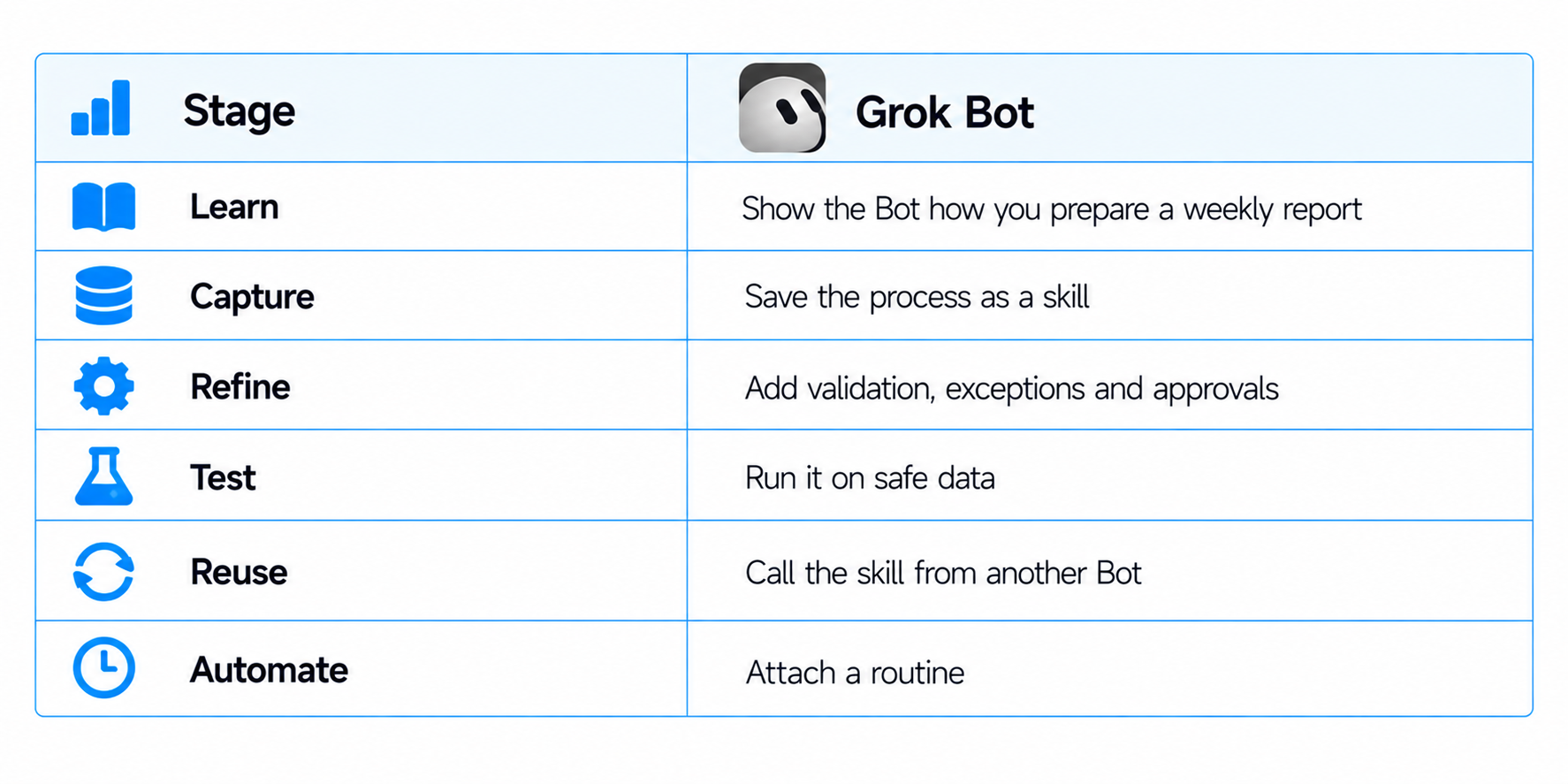
This is a powerful shift because the reusable unit is not just a prompt. It is a procedure. That procedure can become part of the team's operational knowledge instead of remaining inside one person's chat history.
7. Routines: Let the Bot Start Work
Routines make the system genuinely always-on. A routine tells a Bot when to execute a workflow, either on a schedule or after a supported event. Current documentation includes examples such as daily reports, Slack-triggered work and GitHub-triggered workflows.
A good routine is narrow. 'Watch everything and do whatever seems useful' is hard to control. 'Every weekday at 8 AM, compare this week's sales pipeline with the last four weeks, create a report and do not contact customers without approval' is much easier to validate.
xAI also recommends testing routines before enabling them and defining what happens when data is missing or stale. The app keeps recent run history so users can inspect whether the routine succeeded or failed.
8. Grok Bot Pricing and Access
Grok Bot is bundled into eligible Grok and Cursor plans rather than being sold as a simple standalone Bot license. Current xAI documentation lists SuperGrok Plus, SuperGrok Heavy, Cursor Pro+, Cursor Ultra and Cursor Teams Standard and Premium among eligible plans, while xAI's August rollout expanded access to Cursor Pro as well.
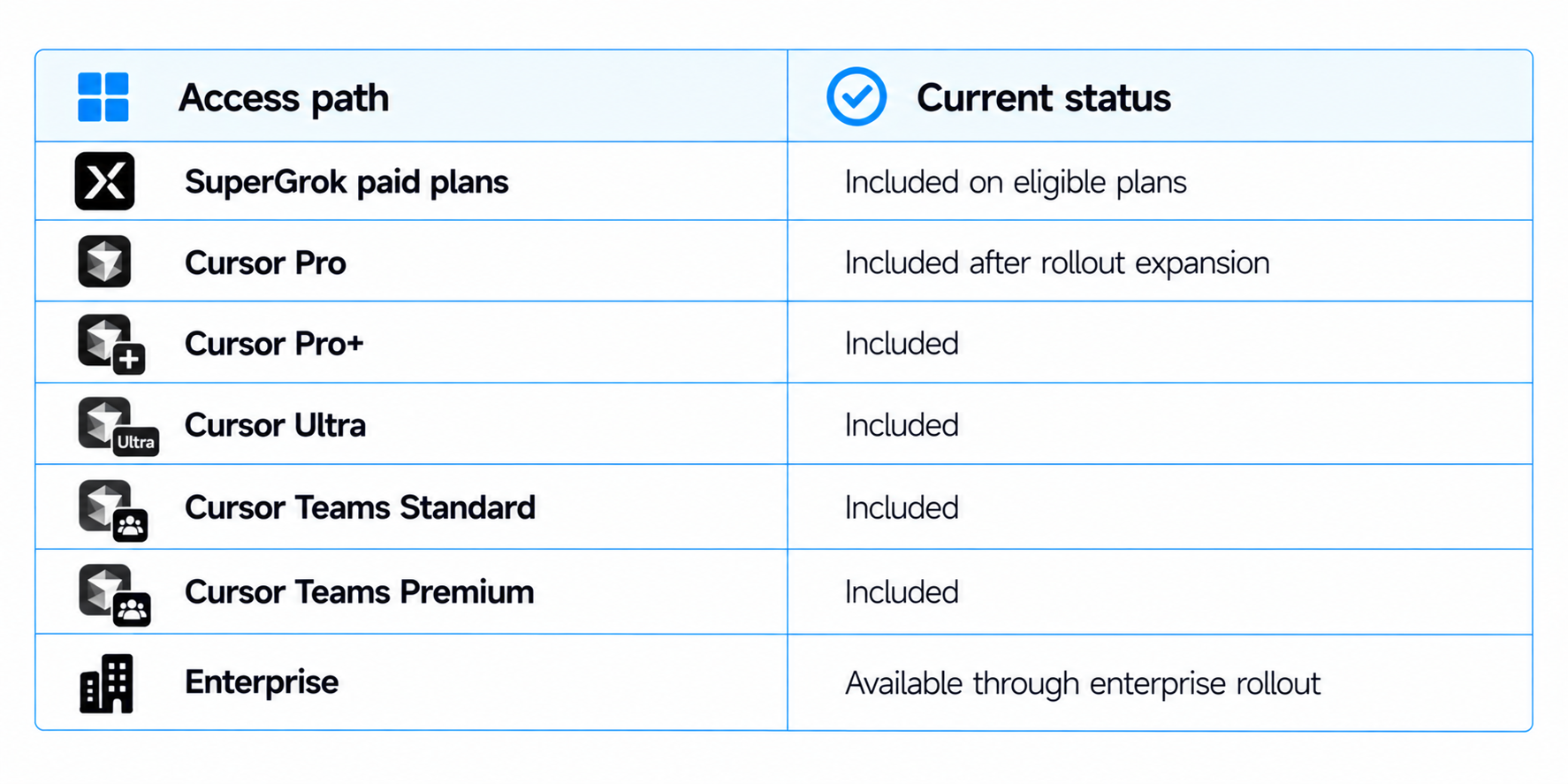
The product page currently displays Cursor Pro at $20 per month and an entry-level Grok paid plan at $30 per month. These are subscription prices for the broader products that include Grok Bot, not a separate Bot seat price. Bot work also has its own usage accounting, with additional usage available depending on plan.
9. Grok Bot vs Manus
Manus and Grok Bot both move AI beyond one-off chat sessions. Manus provides a persistent Cloud Computer that can keep applications, scripts and services running. Grok Bot makes persistence the identity of the agent itself, with named Bots, reusable skills, routines and multi-Bot collaboration.
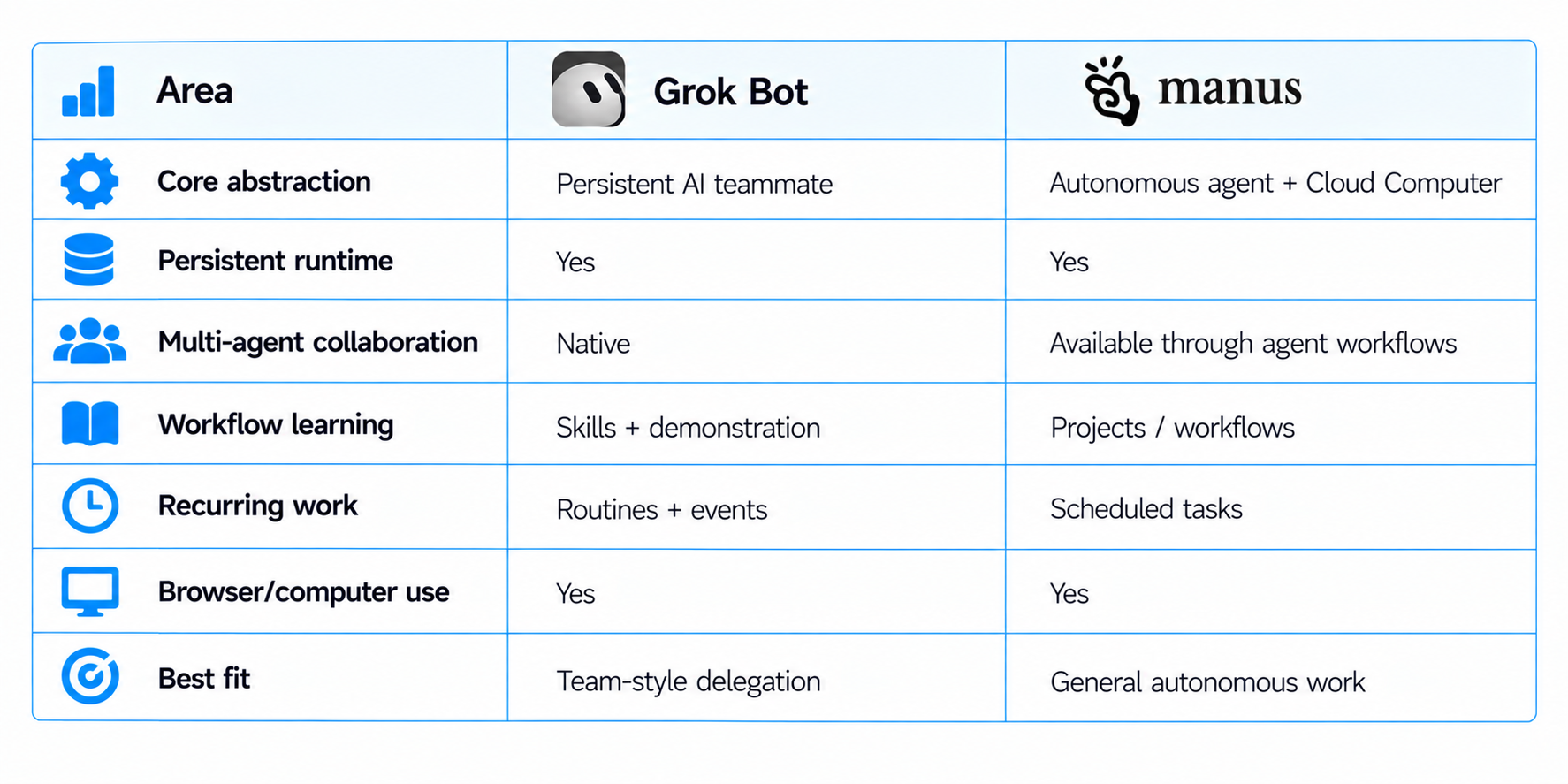
Grok Bot is more compelling when you want a persistent roster of specialized workers. Manus remains attractive when you want a broader autonomous environment with persistent cloud infrastructure.
10. Grok Bot vs Claude Cowork
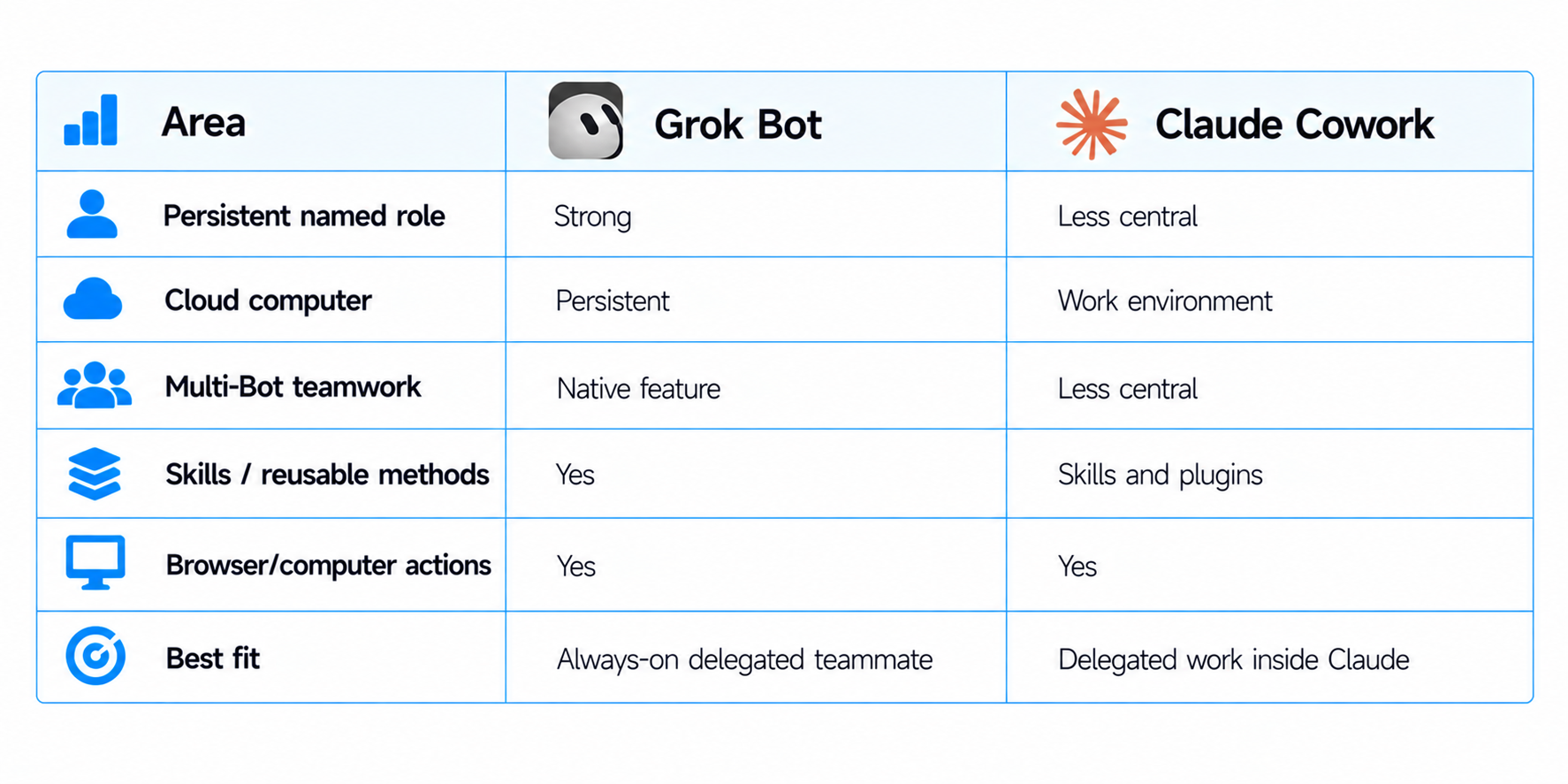
Claude Cowork and Grok Bot share the central idea of delegating a real multi-step task. Anthropic describes Cowork as a mode where Claude can handle work using documents, browsers and connected tools. Grok Bot puts more emphasis on persistent named teammates and a durable cloud computer shared across the user's Bot roster.
11. X Integration Makes the Product More Useful
On August 29, xAI added a tighter X integration. A connected Bot can search posts, read the timeline, check mentions and pull together what is happening on X. Paid Grok Bot users also receive free X API credits to start.
This gives Grok Bot a useful closed loop for social workflows: monitor information, summarize it, prepare a response and then stop for approval before publishing. The same pattern can work for brand monitoring, competitive research and content operations.
12. Security: Persistent Agents Need Persistent Boundaries
The biggest difference between Grok Bot and a normal chatbot is also its biggest risk. The Bot can operate inside real accounts, so an incorrect decision can create a real side effect. xAI's security architecture uses a dedicated Firecracker microVM per user, no access by default, and approval controls for consequential actions.
The shared-computer design is especially important. All Bots belonging to one user share the same files, browser sessions and logins. That is useful for handoffs, but it means separate Bots are not security boundaries. xAI explicitly warns users not to treat them that way.
Auto Review can evaluate shell commands, plugin calls, computer-use actions and delegation before execution. xAI recommends narrow rules and explicit approval for sensitive actions instead of broad rules such as allowing everything in a browser.
13. Passwords and Consequential Actions
Grok Bot keeps several high-risk steps under human control. Passwords, passkeys, two-factor codes, CAPTCHAs and payment confirmations should be entered through a secure computer takeover rather than ordinary chat.
The same pattern should be used for publishing, external communications, purchases, deleting data, accepting legal terms and changing production systems. A good agent does not need unrestricted authority to be useful. It needs enough access to complete routine work and clear points where a person must decide.
14. Enterprise Rollout
Grok Bot became available for enterprises on September 3, 2026. xAI says the enterprise release adds access, network and audit controls and lets organizations govern Bots at scale. The enterprise architecture keeps the per-user isolated cloud environment and no-access-by-default model.
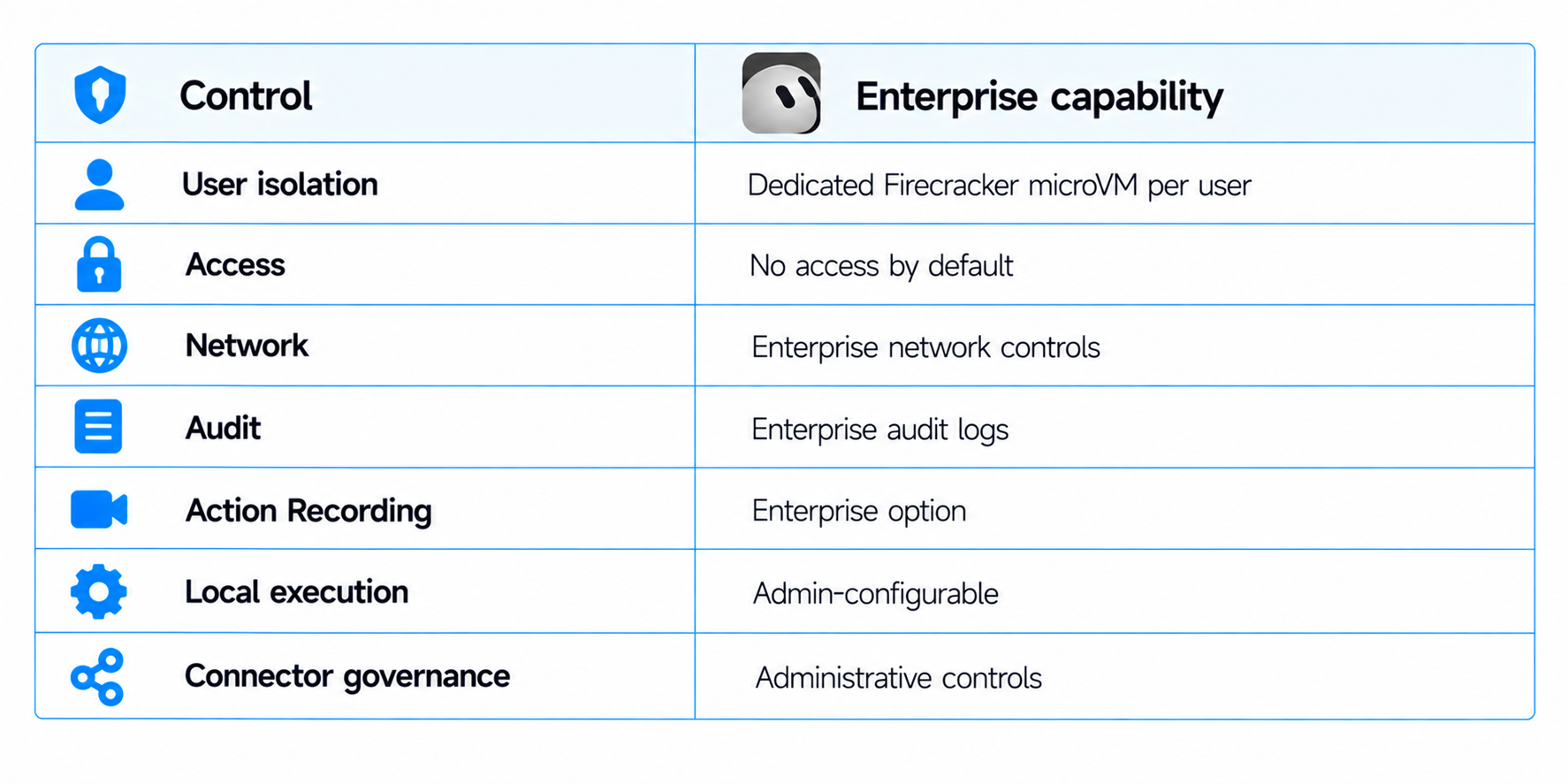
This matters because enterprise agents are not only an AI problem. They are an identity, permissions, networking and audit problem. Grok Bot's current enterprise layer acknowledges that reality directly.
15. Can Grok Bot Work 24/7?
Yes. Background work runs on the cloud computer, so closing the app or laptop does not stop a running job or scheduled routine. The product is explicitly built around work that continues without the user being present.
The practical benefit is not that every task should run overnight. It is that tasks no longer need to compete for the user's active attention. A Bot can prepare tomorrow's briefing, watch a workflow trigger or finish a batch process while the human is doing something else.
16. What Makes Grok Bot Different From an AI Automation Tool?
Traditional automation tools are excellent when the workflow is deterministic. You define the trigger, conditions and actions, and the system performs the same sequence every time. Grok Bot is designed for the messy middle where the job still requires interpretation. The Bot can inspect a page, decide what is relevant, use a tool, react to the result and continue.
That flexibility is useful for workflows that change slightly from case to case. It is also why validation matters more. A deterministic workflow can be tested against known states. An agent needs ongoing evaluation because its decisions affect the next step.
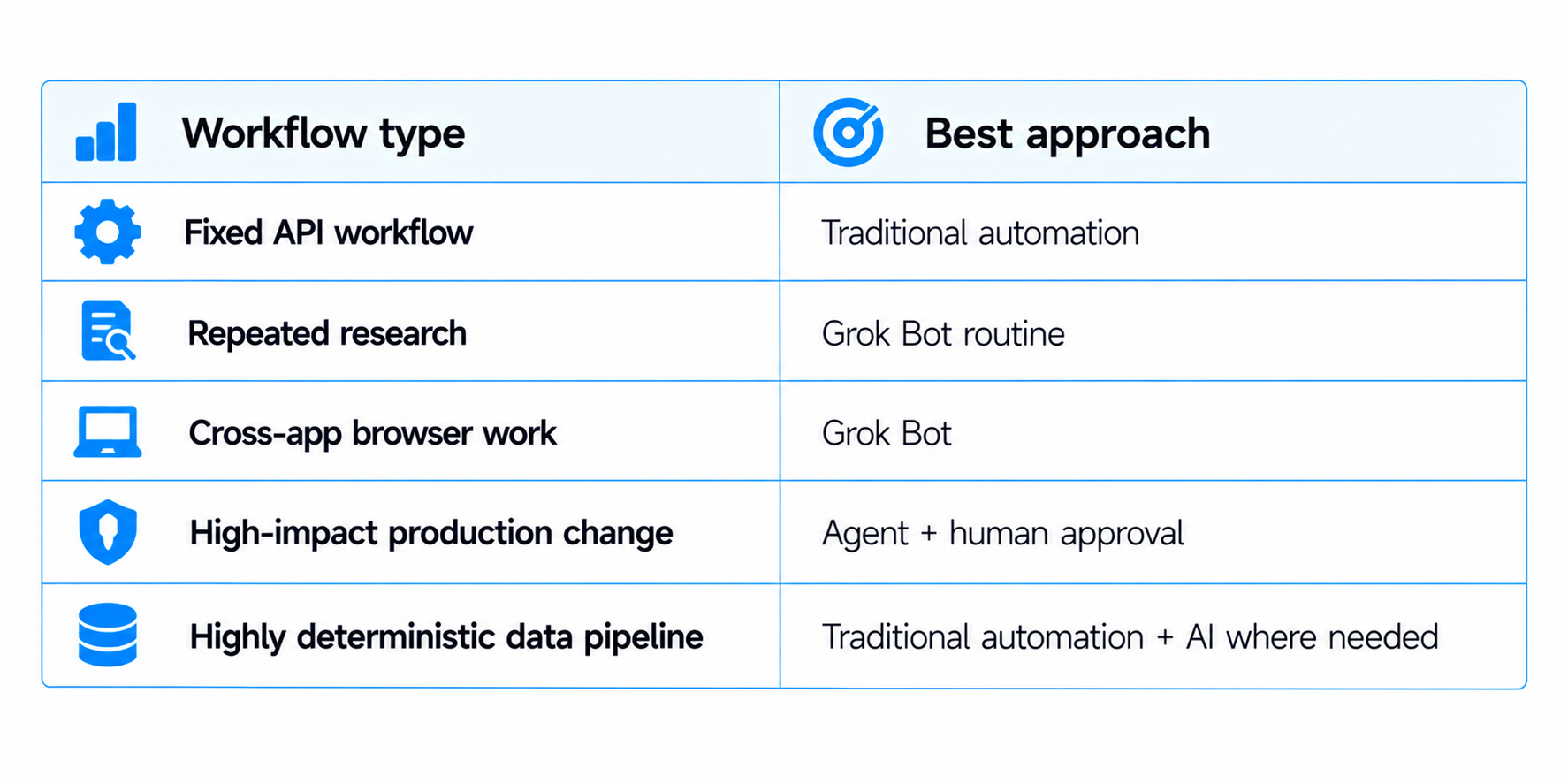
17. Best Use Cases
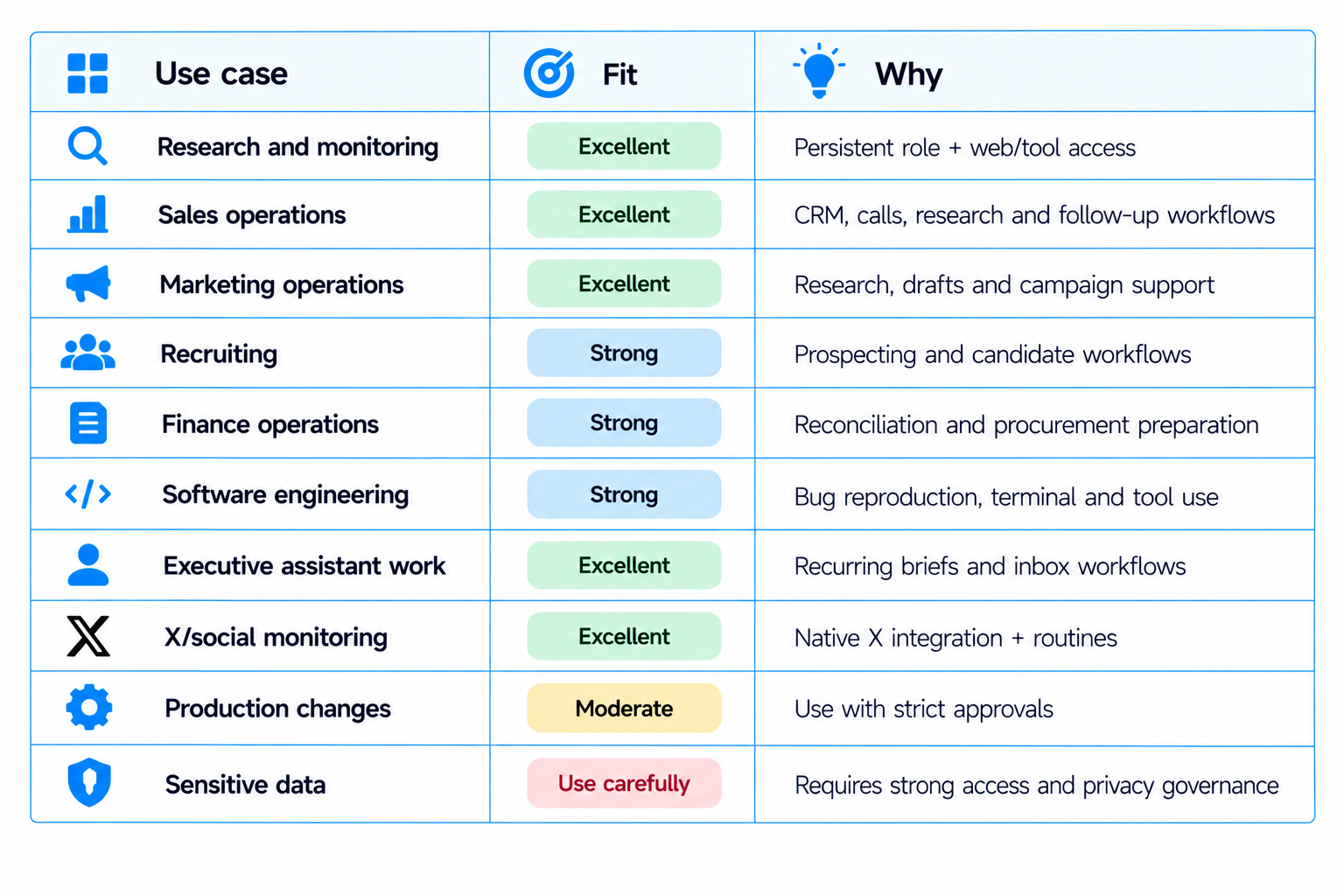
18. Recommended Production Workflow
The safest way to introduce Grok Bot is to start with work that is valuable but reversible.
- Create one Bot for one responsibility.
- Give it only the accounts and connectors that responsibility needs.
- Start with research, reconciliation or drafting before allowing writes.
- Teach the workflow and save it as a skill once it succeeds consistently.
- Test the routine before putting it on a schedule.
- Require approval for sending, publishing, purchases, deletion and production changes.
- Review run history and change the workflow whenever source systems change.
For broader agent design, read How to Use LangGraph for Multi-Agent Systems.
19. How to Evaluate Grok Bot Yourself
Do not evaluate Grok Bot by asking whether it gives good chat answers. Measure whether it removes human work from a real process.
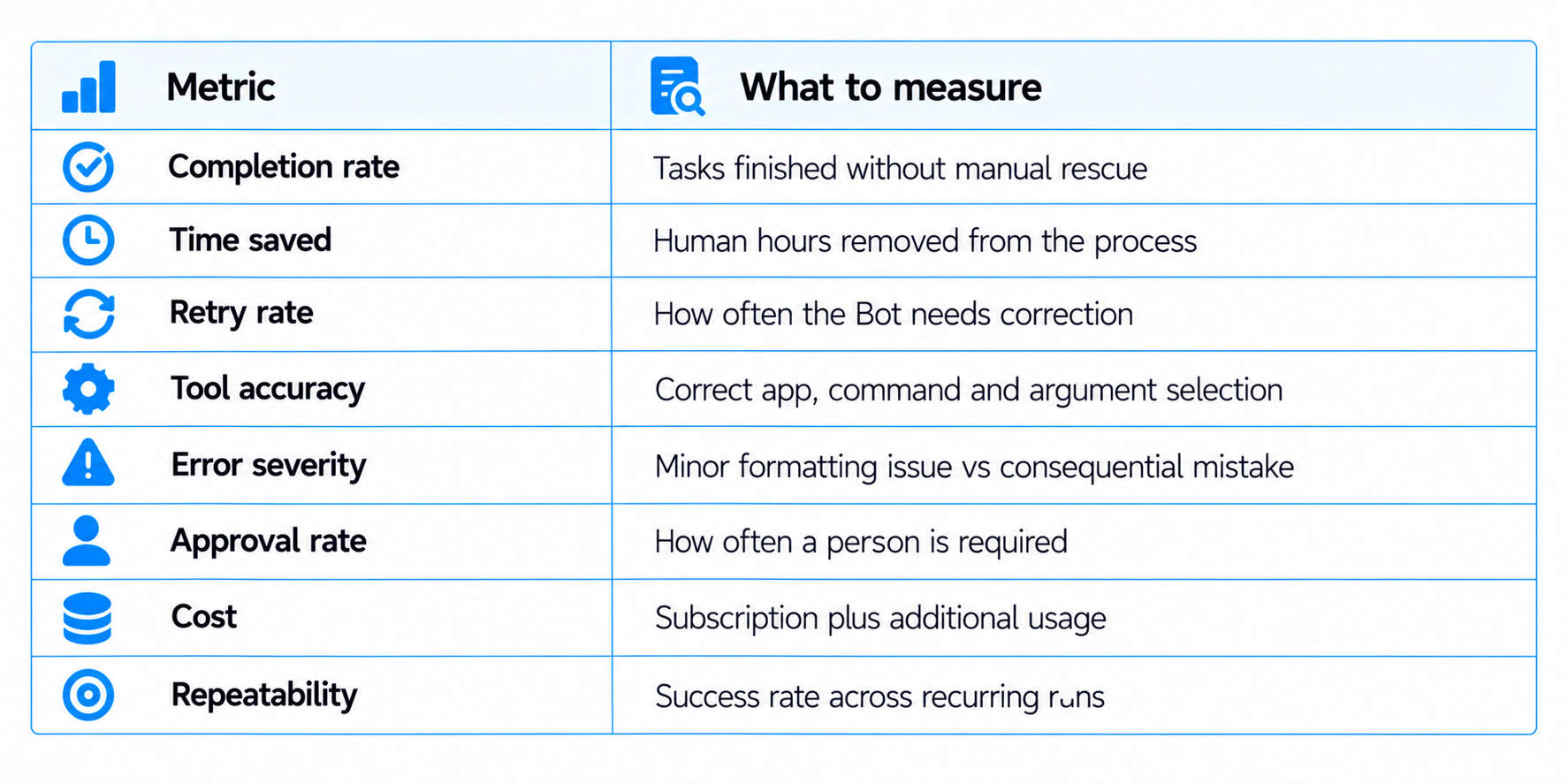
A strong pilot might include a weekly report, a sales-research task, one internal operations workflow and a software bug reproduction task. Run each several times, log failures, and compare the human hours before and after delegation.
20. Is Grok Bot Better Than a Normal AI Assistant?
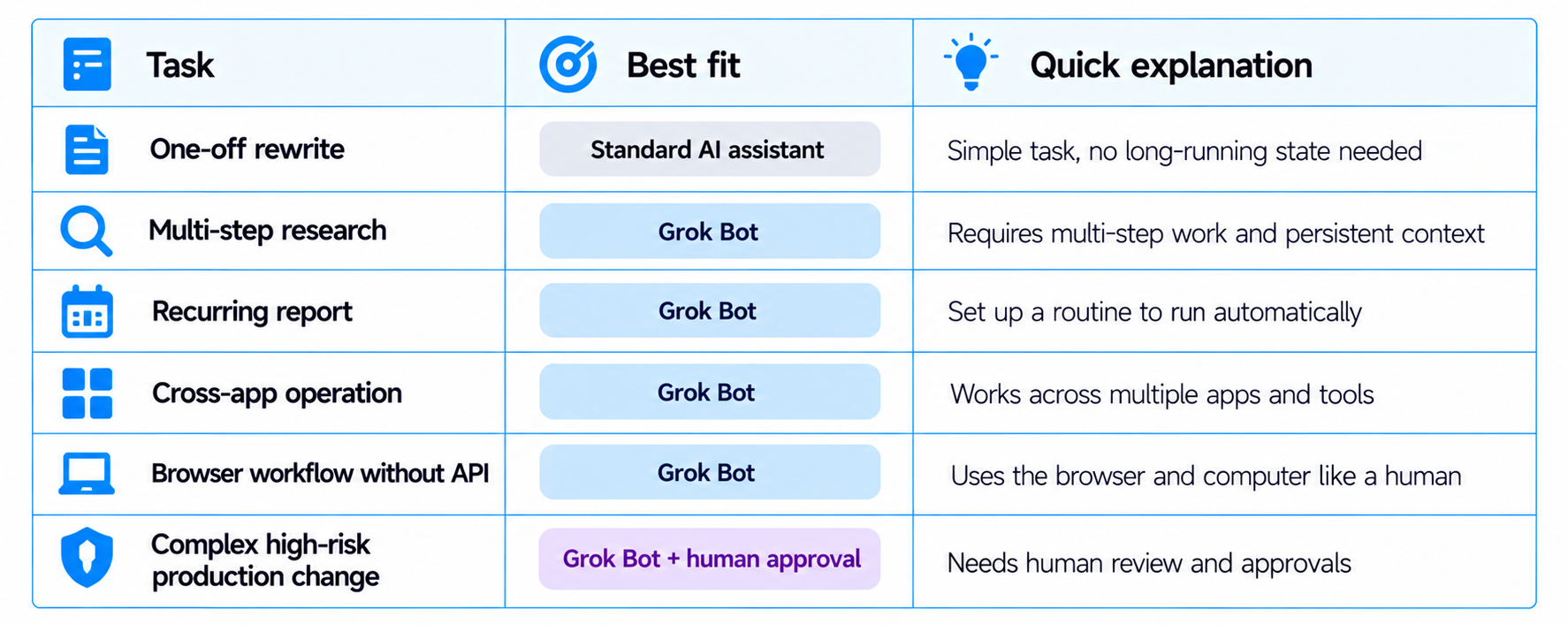
For delegated work, yes. For simple conversation, not necessarily. The product is optimized around a different problem: moving a job from 'I need this done' to 'this is finished in the system where it belongs.'
21. Is Grok Bot Worth It?
Grok Bot is worth it when your work contains repeated, multi-step tasks that cross the boundaries of normal software. The persistent computer, durable state, skills, routines and multi-Bot handoffs solve coordination problems that ordinary chat assistants leave to the human.
The value becomes even clearer when the same workflow happens repeatedly. A successful report preparation process can become a skill, then a routine, then a background job. That is a much more durable productivity gain than generating a better answer once.
The biggest condition is governance. You should think of every Bot as a software worker with credentials, not as a harmless chatbot. Scope its access, require approval for consequential actions and monitor its routines.
22. Final Verdict
Grok Bot is one of the most convincing AI teammate products of 2026 because its architecture matches its promise. It has persistent Bots, persistent cloud computers, tools, skills, routines and multi-agent collaboration. The user can hand over a real responsibility instead of supervising every individual step.
xAI's own examples cover sales, marketing, recruiting, finance, procurement and engineering, and the enterprise release adds the controls required to operate these agents inside organizations. The procurement case study, which xAI says surfaced more than $100,000 in direct savings, is a strong illustration of the product's ambition even though it remains a vendor-reported result.
The product's most important architectural choice is also its most important security consideration. All of a user's Bots share one persistent computer. That enables seamless handoffs but means files, browser sessions and credentials can cross Bot boundaries. xAI's approval and Auto Review systems are therefore not optional details for serious deployments.
My rating: 9.3/10 for delegation, 9.2/10 for persistence, 9.0/10 for workflow automation, 8.8/10 for governance and 9.1/10 overall.
Bottom line: Grok Bot is worth using when you have recurring work that requires a person to move between multiple applications. Start with a narrow responsibility, teach the process, add automation after validation and keep high-impact actions behind approval. That is where the AI teammate idea becomes practically useful rather than just a product metaphor.
Frequently Asked Questions
What is Grok Bot?
Grok Bot is xAI's persistent AI teammate platform. Bots have a cloud computer, tools, memory, skills and routines and can complete multi-step work across applications.
Can Grok Bot actually do work?
Yes. xAI says Bots can perform end-to-end sales, operations, recruiting, engineering and procurement workflows.
Does Grok Bot have its own computer?
Yes. Each user has a persistent cloud computer with a browser, filesystem and terminal, shared by that user's Bots.
Can Grok Bot work while my laptop is closed?
Yes. Bot work runs in the cloud, so closing the app or laptop does not stop background work or routines.
Can multiple Grok Bots work together?
Yes. Bots can run in parallel, share context and hand work to one another.
What are Grok Bot skills?
Skills are reusable process instructions containing steps, decision rules, expected outputs and safety boundaries.
What are Grok Bot routines?
Routines are scheduled or event-triggered workflows that a Bot can execute automatically.
How many routines can a Bot own?
xAI's current documentation says up to 50 routines per Bot.
How much does Grok Bot cost?
Grok Bot is bundled with eligible paid Grok and Cursor plans. Additional usage can be available depending on plan.
Is Grok Bot secure?
It has user isolation, no-access-by-default permissions and approval controls, with additional enterprise network and audit features. Bots within one user account share the same cloud computer.
Can Grok Bot use websites without APIs?
Yes. xAI explicitly supports computer use for websites and apps without a clean API or MCP integration.
Is Grok Bot better than Manus?
It depends on the workflow. Grok Bot is stronger around persistent named teammates and multi-Bot collaboration, while Manus emphasizes broad autonomous task execution and persistent cloud computing.
Is Grok Bot better than Claude Cowork?
Both delegate real work. Grok Bot puts more emphasis on persistent named Bots and a shared cloud computer, while Cowork is more closely tied to the Claude work environment.
Is Grok Bot worth it?
Yes for recurring, cross-application work where reducing human coordination is the main goal.
Recommended Blogs
Model Routing for AI Coding Agents: How to Cut Costs Without Losing Quality
How to Secure AI Coding Agents: Permissions, Sandboxing, MCP & Secrets
Best AI Coding Agents 2026: Claude Code vs Codex vs Muse Code vs Cursor
Resources & Community
Join our community of 70,000+ AI enthusiasts and learn to build powerful AI applications. Whether you are a beginner or an experienced developer, Build Fast with AI helps you understand and implement AI in your projects.
Agentic AI Launchpad 2026
A structured 6-week cohort program that takes you from AI basics to building and deploying real-world agentic AI systems. Includes live sessions, expert mentorship, project reviews and a builder community network.
Ready to go from learning to building? Join the next cohort: Agentic AI Launchpad 2026
Free AI Resources
Access free tools, workshops and micro-learning to keep building.

