



Gemini 3.8 Flash Cyber vs GPT-6 Astra: Which AI Is Better for Defensive Cybersecurity?
Gemini 3.8 Flash Cyber and GPT-6 Astra represent two very different approaches to AI-powered cybersecurity. Google built Gemini 3.8 Flash Cyber specifically for defensive security work, with vulnerability discovery and automated patching as its central jobs. OpenAI built GPT-6 Astra as a broader frontier model, but its cybersecurity capabilities are strong enough to reach the Critical level in OpenAI's Preparedness Framework.
Google released Gemini 3.8 Flash Cyber on September 2, 2026 through its Fairwind Program for trusted defenders. Google reports 86.2% Pass@1 on CyberGym, 47.2% on CWE-Bench, and says its Chrome Security team found 2.6 times more correct vulnerability patches than much larger commercial models in an internal evaluation. Wiz also reported 7.5 to 9.7 percentage points higher recall on its internal penetration-testing benchmark at 2.3 to 5.2 times lower cost than other leading frontier models.
OpenAI released GPT-6 Astra on September 3, 2026. OpenAI reports 100% on ExploitBench, 42.4% on ExploitGym, 39.0% on its June-August 2026 contamination-controlled ExploitBench, 88.0% on SRE-Bench and 85.4% on SEC-Bench Pro. OpenAI also says Astra can find previously unknown vulnerabilities and develop exploit techniques with the right tools and access, which is why the model receives its Critical cyber classification and additional safeguards.
QUICK ANSWER
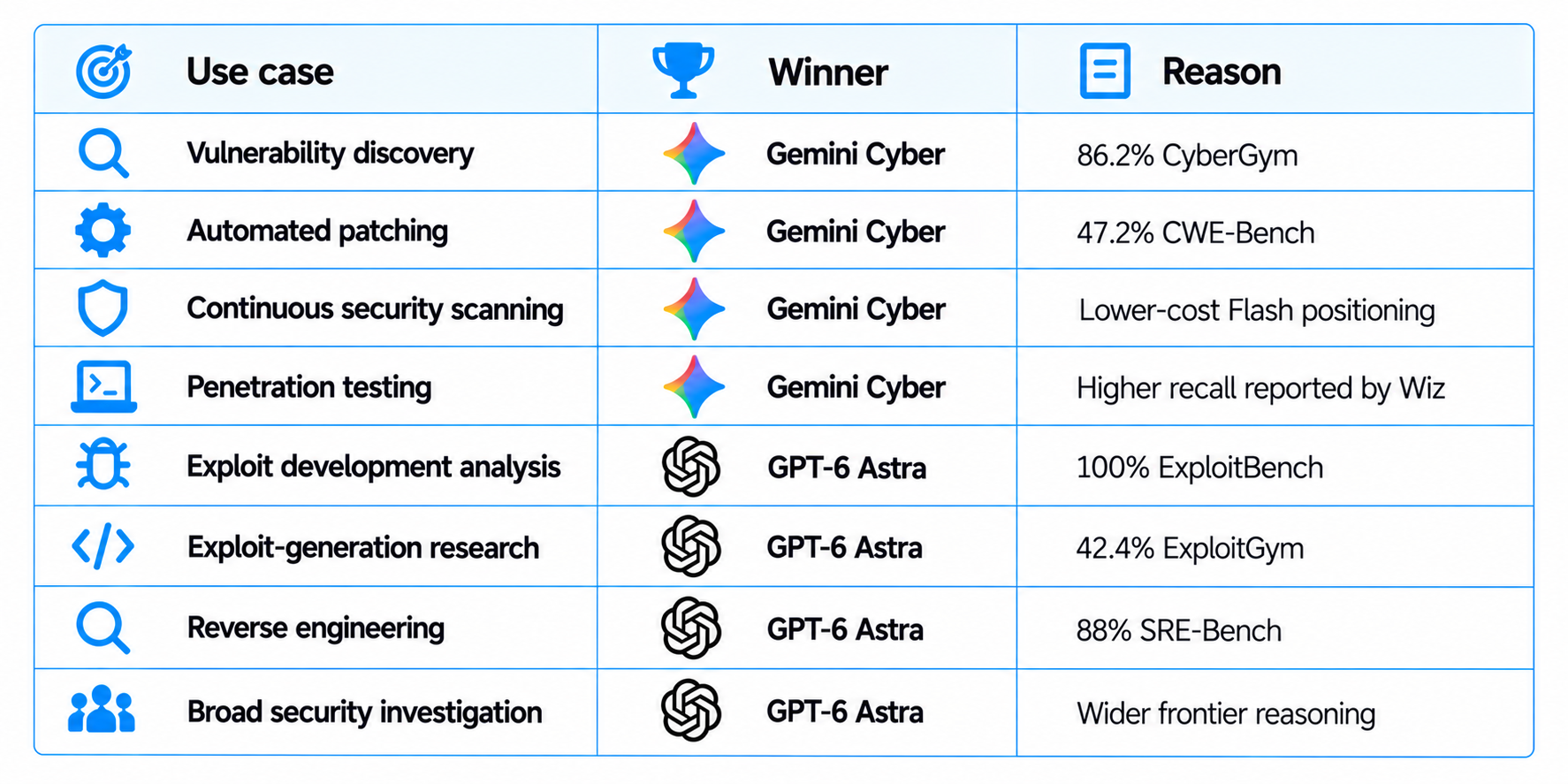
For defensive vulnerability discovery and automated patching, Gemini 3.8 Flash Cyber is the better fit. Its public cybersecurity results are centered on exactly those tasks: 86.2% on CyberGym and 47.2% Pass@1 on CWE-Bench. Google also reports strong real-world results from Chrome and Wiz, including more correct patches and higher penetration-testing recall at lower cost.
GPT-6 Astra is the stronger maximum-capability security model. Its 100% ExploitBench, 42.4% ExploitGym, 88.0% SRE-Bench and 85.4% SEC-Bench Pro results cover exploitation, reverse engineering and security-agent tasks that go beyond the narrower defensive focus of Gemini Cyber.
The access and safety models are different as well. Gemini 3.8 Flash Cyber is available to trusted defenders through Fairwind, while Astra's cyber capabilities are controlled because OpenAI has classified the model as Critical for cybersecurity. The safest production architecture is therefore not to give either model unrestricted access, but to use least privilege, isolation, logging and human approval around security-sensitive actions.
My verdict: Gemini 3.8 Flash Cyber wins for cost-efficient defensive operations and patching. GPT-6 Astra wins for the deepest security investigation, exploit analysis and reverse engineering. For a mature security program, the two are better viewed as complementary than interchangeable.
1. What Is Gemini 3.8 Flash Cyber?
Gemini 3.8 Flash Cyber is Google's specialized cybersecurity model in the Gemini 3.8 family. Google says it is designed to help defenders find vulnerabilities, validate security issues and automatically produce patches, with access provided through the Fairwind Program to trusted defenders.
The model is intentionally different from the normal Gemini 3.8 Flash. The general Flash model is a broad workhorse for coding and agentic tasks, while the Cyber variant is trained and evaluated specifically around security workflows.
That specialization matters in production. A security team does not always need a general-purpose model that can write a clever answer. It needs a system that can find the vulnerability, explain why it matters and produce a patch that can survive tests and review.
2. What Is GPT-6 Astra?
GPT-6 Astra is OpenAI's latest frontier model for difficult end-to-end work, including cybersecurity, coding, computer use, research and professional tasks. OpenAI describes Astra as its most intelligent model and reports state-of-the-art performance across several areas.
Cybersecurity is one of Astra's defining capabilities. OpenAI says Astra reaches the Critical threshold under its Preparedness Framework because the model can find previously unknown vulnerabilities and develop new exploitation techniques with the right tools and access. That level of capability led OpenAI to deploy stronger isolation, checkpoint encryption, trajectory monitoring and blocking alignment evaluations.
Astra therefore occupies a wider security role than Gemini Cyber. It can operate across vulnerability analysis, exploitation research, reverse engineering and broader security investigations, with stronger safeguards around the highest-risk actions.
3. Cybersecurity Benchmark Comparison
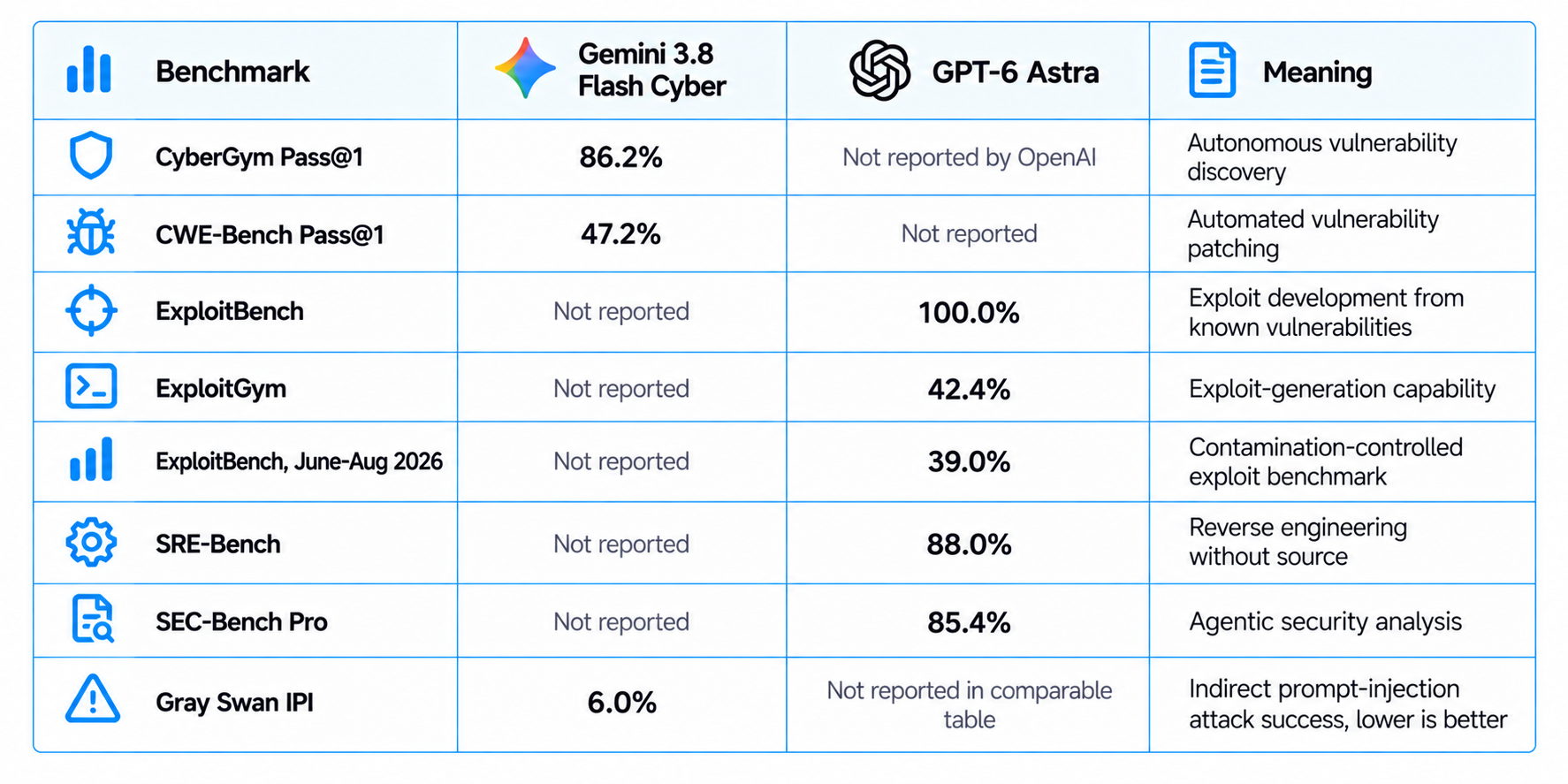
These benchmarks test different parts of cybersecurity. Gemini Cyber's strongest published numbers are about discovering vulnerabilities and patching them, while Astra's strongest numbers emphasize exploitation, reverse engineering and broader security-agent behavior. A single combined score would hide that difference.
4. Vulnerability Discovery: Gemini Cyber's Strength
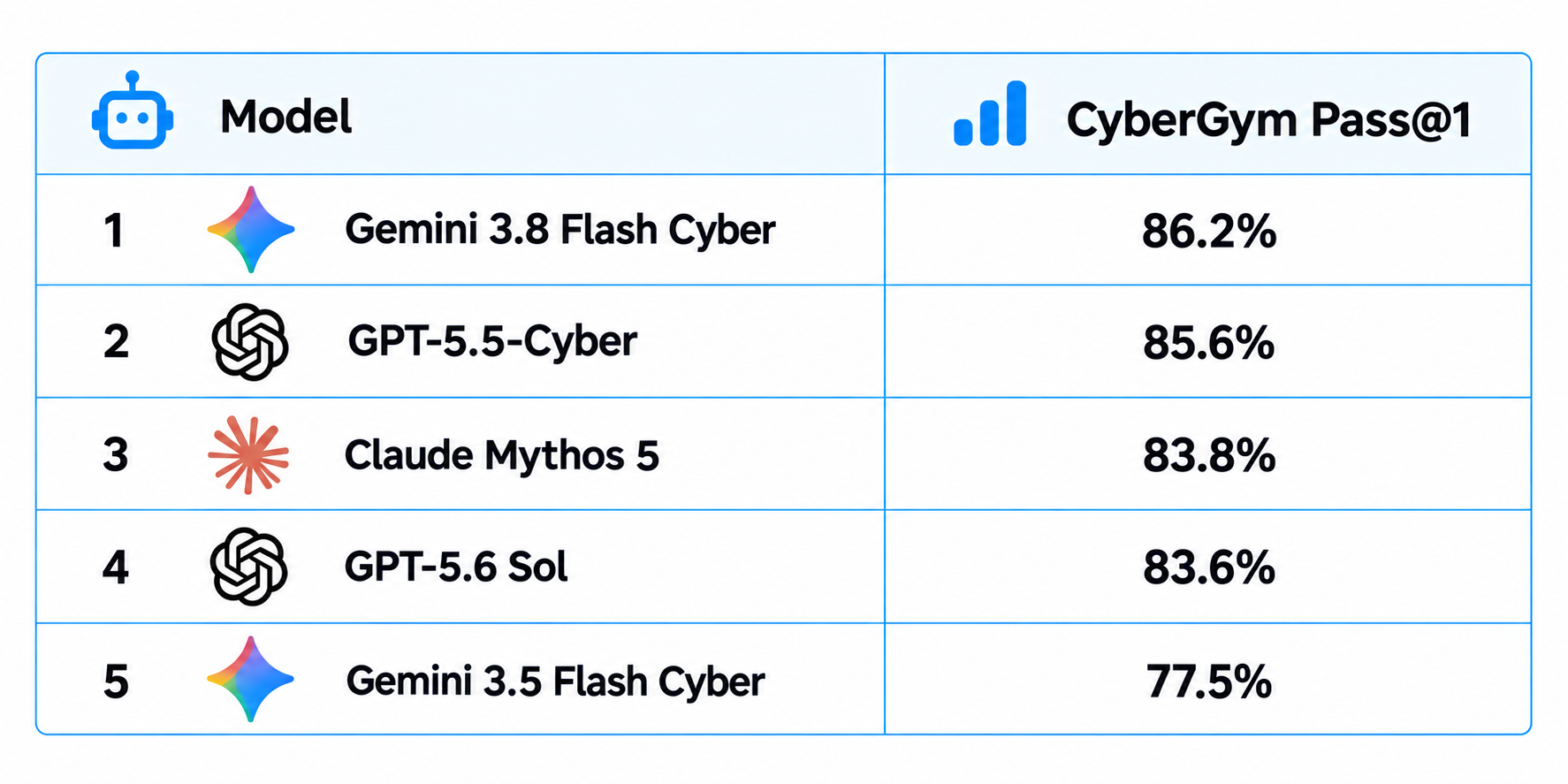
On CyberGym, Gemini 3.8 Flash Cyber achieves 86.2% Pass@1. Google reports that this is ahead of Gemini 3.5 Flash Cyber at 77.5%, GPT-5.5-Cyber at 85.6%, Mythos 5 at 83.8% and GPT-5.6 Sol at 83.6%.
That makes Gemini Cyber especially strong for software-security pipelines where the first job is identifying a real weakness inside a codebase. A high Pass@1 score means the model can find a vulnerability without requiring repeated attempts.
Google also reports a separate internal benchmark spanning 20 programming languages, where Gemini 3.8 Flash Cyber achieved a success rate above 70%. Because that benchmark is internal, its value is as supporting evidence rather than an independently reproducible leaderboard.
5. Automated Patching: The Practical Advantage
A vulnerability scanner is only useful if a security team can fix what it finds. Gemini 3.8 Flash Cyber is explicitly optimized for that second step.
On CWE-Bench, an external benchmark run by Collinear, Google reports 47.2% Pass@1 for Gemini 3.8 Flash Cyber, versus 47.8% for a leading frontier model, while emphasizing a significantly lower cost per rollout.
Google also says Chrome Security found that Gemini 3.8 Flash Cyber produced 2.6 times more correct vulnerability patches than the best commercial models that were much larger. That is an internal Google result, but it is especially relevant because the measurement reflects production security work rather than only synthetic prompts.
For large organizations, this creates a strong automation loop: scan, propose a patch, run tests, send the patch for review and repeat. Lower inference cost becomes valuable because the workflow can run continuously across a large codebase.
6. Exploit and Security-Research Capability: Astra's Lead
GPT-6 Astra has the stronger published exploit-oriented profile. OpenAI reports 100% on ExploitBench, 42.4% on ExploitGym and 39.0% on a June-August 2026 contamination-controlled ExploitBench.
These numbers show a model that can reason beyond finding a weakness. It can analyze how vulnerabilities can be turned into practical attack paths, which is valuable for defensive validation and controlled red-team work.
It also explains Astra's security classification. OpenAI classifies GPT-6 Astra at the Critical level for cybersecurity because, with the right tools and access, it can discover unknown vulnerabilities and develop exploitation techniques. That capability is useful to defenders, but requires stronger safeguards.
7. Reverse Engineering: Astra Is the Better Choice
Astra's 88.0% SRE-Bench result is a major differentiator because SRE-Bench evaluates reverse-engineering tasks without source code. This is closer to incident-response cases where defenders receive a binary or artifact and have to reconstruct its behavior.
Gemini Flash Cyber's public positioning is more focused on source-code vulnerability discovery and automated patching. For binary analysis, exploit-chain reconstruction and deep reverse engineering, Astra has the stronger documented case.
8. Penetration Testing and Security Operations
Google reports that Wiz found Gemini 3.8 Flash Cyber achieved 7.5 to 9.7 percentage points higher recall on its internal penetration-testing benchmark while costing 2.3 to 5.2 times less than other leading frontier models.
That matters for security operations because recall is directly tied to the ability to find real issues. A model that can scan more systems without a proportional increase in cost can support more continuous testing.
Astra's 85.4% SEC-Bench Pro result provides a complementary signal. BenchLM's September 4 snapshot places GPT-6 Astra first among the currently published SEC-Bench Pro results, ahead of GPT-5.6 Sol at 71.2%.
9. Prompt Injection and Agent Safety
Cybersecurity agents routinely consume untrusted inputs, so prompt injection is a direct operational risk. Source files, issue trackers, documentation, web pages and logs can all contain attacker-controlled instructions.
Google reports a 6.0% attack-success rate for Gemini 3.8 Flash Cyber on the Gray Swan indirect prompt-injection benchmark, where lower is better.
OpenAI reports multiple internal safety results for Astra, including 1.8% on its internal computer-use safety benchmark with AutoReview, 0.00% on its circumvention benchmark and 0.0% on its ExploitGym honeypot measure, using lower-is-better conventions where applicable.
These evaluations are not directly comparable because the test designs differ. The practical lesson is that security agents should assume adversarial input and operate with isolated tools, least privilege and explicit approval gates.
10. Access: Fairwind vs Controlled Astra Rollout
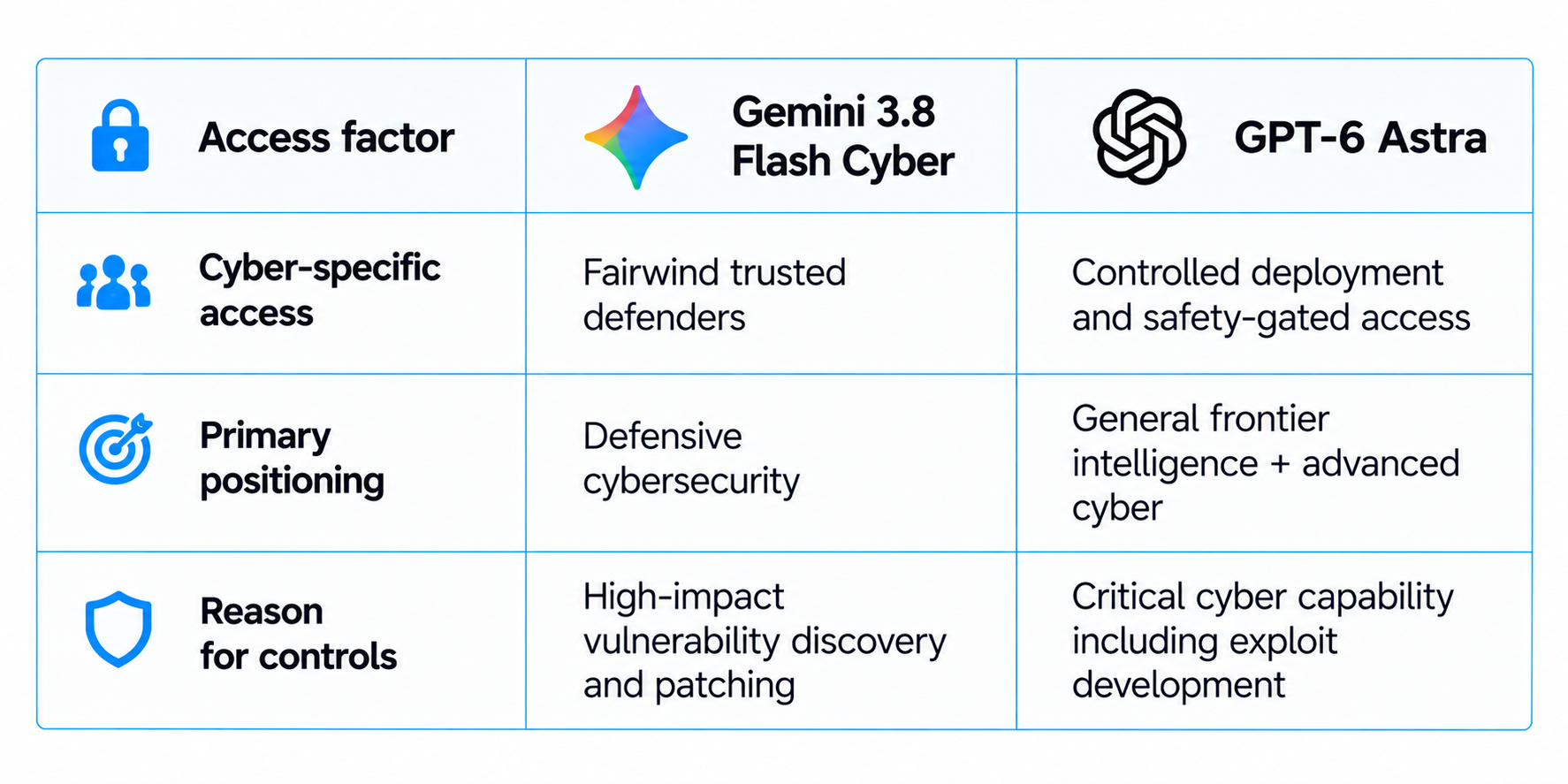
Gemini 3.8 Flash Cyber is offered through Google's Fairwind Program, which gives trusted defenders access to the specialized cyber model under a controlled deployment model.
GPT-6 Astra is rolling out to a limited set of organizations, with broader access planned through ChatGPT, the OpenAI API, Azure and AWS Bedrock. Cybersecurity capabilities receive additional protections because Astra is classified as Critical.
11. Cost Efficiency
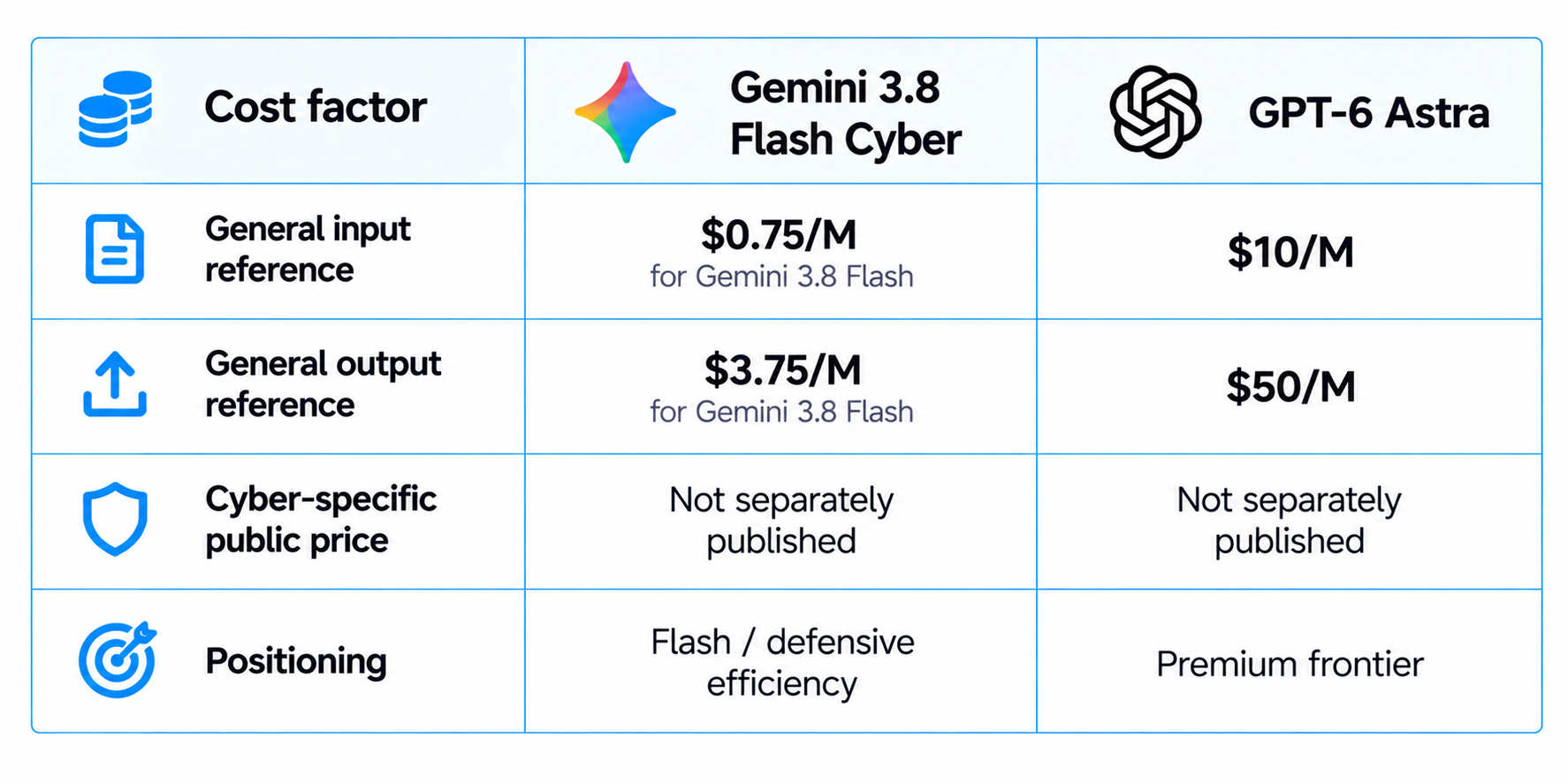
Google's general Gemini 3.8 Flash price is $0.75 per million input tokens and $3.75 per million output tokens during the introductory period. Google positions Flash Cyber around the same speed-and-cost philosophy, but does not publish a separate public token price for the Fairwind cyber model.
OpenAI's current GPT-6 Astra API listing shows $10 per million input tokens, $1 per million cached input tokens, $12.50 per million cache writes and $50 per million output tokens. Requests above 272K input tokens are charged at higher rates.
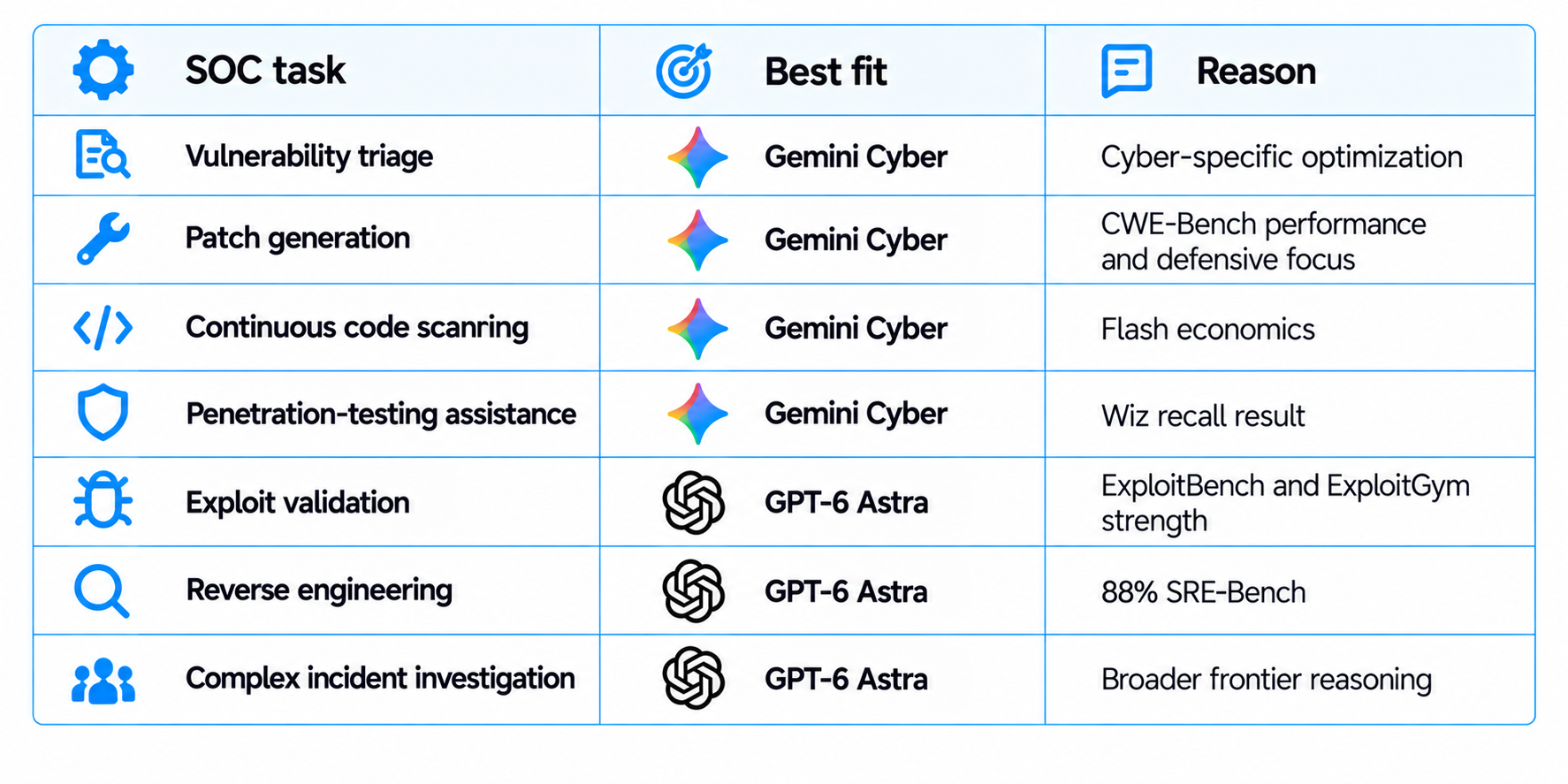
12. Which Model Is Better for a SOC?
13. Which Model Is Better for Secure Software Development?
Gemini 3.8 Flash Cyber has the cleaner fit for secure software development because its public story connects vulnerability discovery directly to patching. A security pipeline can use one system to identify a weakness, propose a fix and feed the result into automated testing.
GPT-6 Astra becomes more attractive when the secure-development task requires a deeper investigation into how a vulnerability can be exploited or how a complex failure propagates through an environment.
For most engineering teams, the practical architecture is to use the cyber-focused model for high-volume discovery and patching, then escalate difficult or ambiguous cases to Astra.
14. Best Use Cases
15. Limitations You Should Know
- Gemini Cyber access is controlled through Fairwind.
- GPT-6 Astra has stronger safeguards because of its Critical cyber classification.
- The benchmark sets cover different tasks and should not be collapsed into one score.
- Google's Chrome and Wiz results are internal evaluations and should be labeled that way.
- OpenAI's exploit benchmarks measure a broader and higher-risk capability surface than Google's patching benchmarks.
- Neither model should receive unrestricted production credentials or autonomous merge authority.
16. Recommended Defensive Architecture
A secure AI cybersecurity system should treat both models as components inside a controlled workflow, not as autonomous administrators.
- Start with read-only repository and security-data access.
- Use Gemini Cyber for high-volume discovery and patch proposals.
- Run generated patches in an isolated environment.
- Require automated tests and security checks before merge.
- Use Astra for difficult validation or reverse-engineering tasks in a sandbox.
- Keep credentials scoped to the minimum required for each tool.
- Require human approval before production changes.
- Log model outputs and tool actions for audit and regression testing.
17. How to Evaluate Them on Your Own Security Stack
Public benchmarks give you a starting point, but security teams should build an internal evaluation set based on their own repositories, infrastructure and threat model.
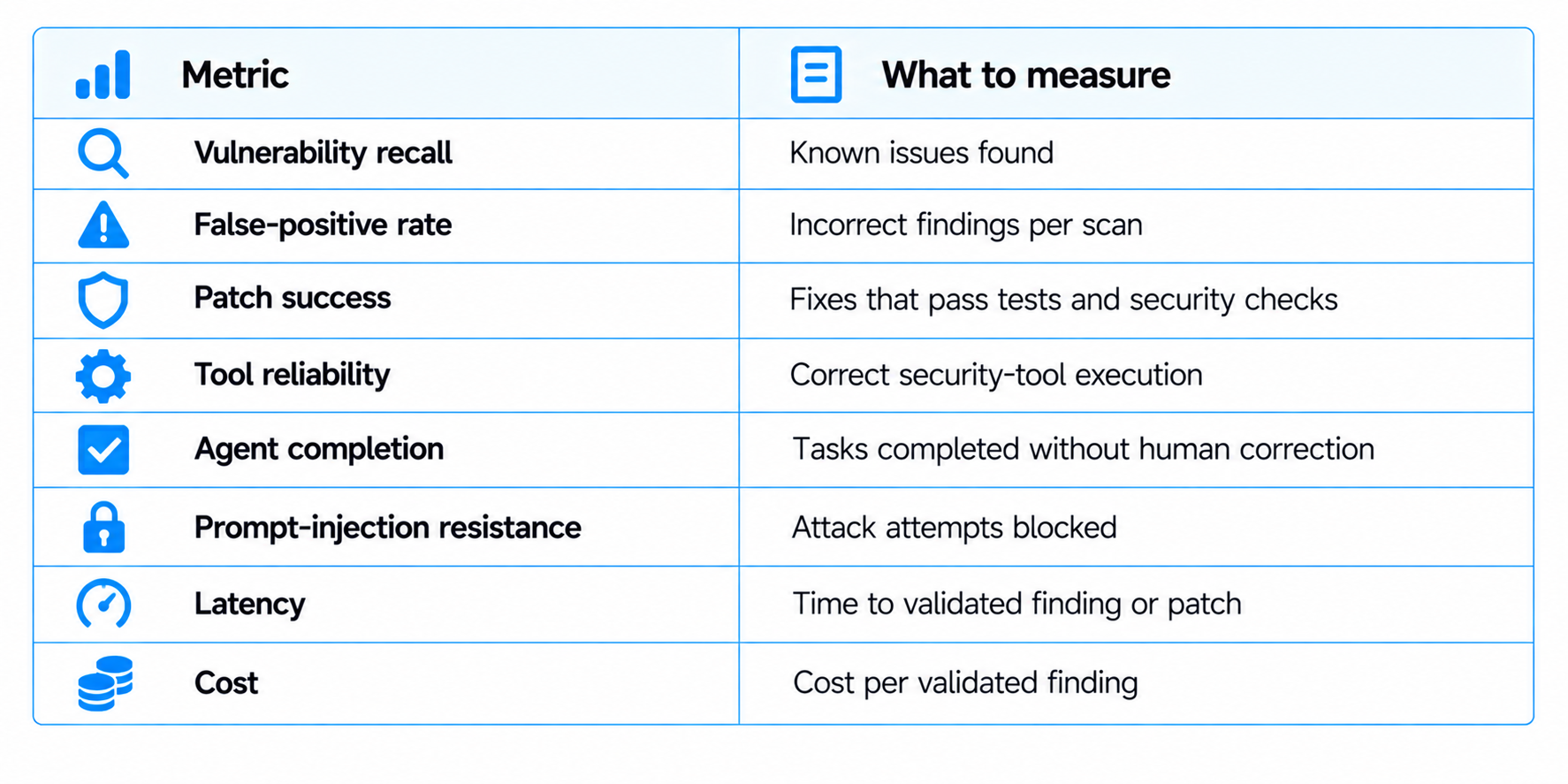
Run the same task set through both models, keep tool permissions consistent and score the complete workflow. That tells you whether benchmark advantages translate into better security outcomes.
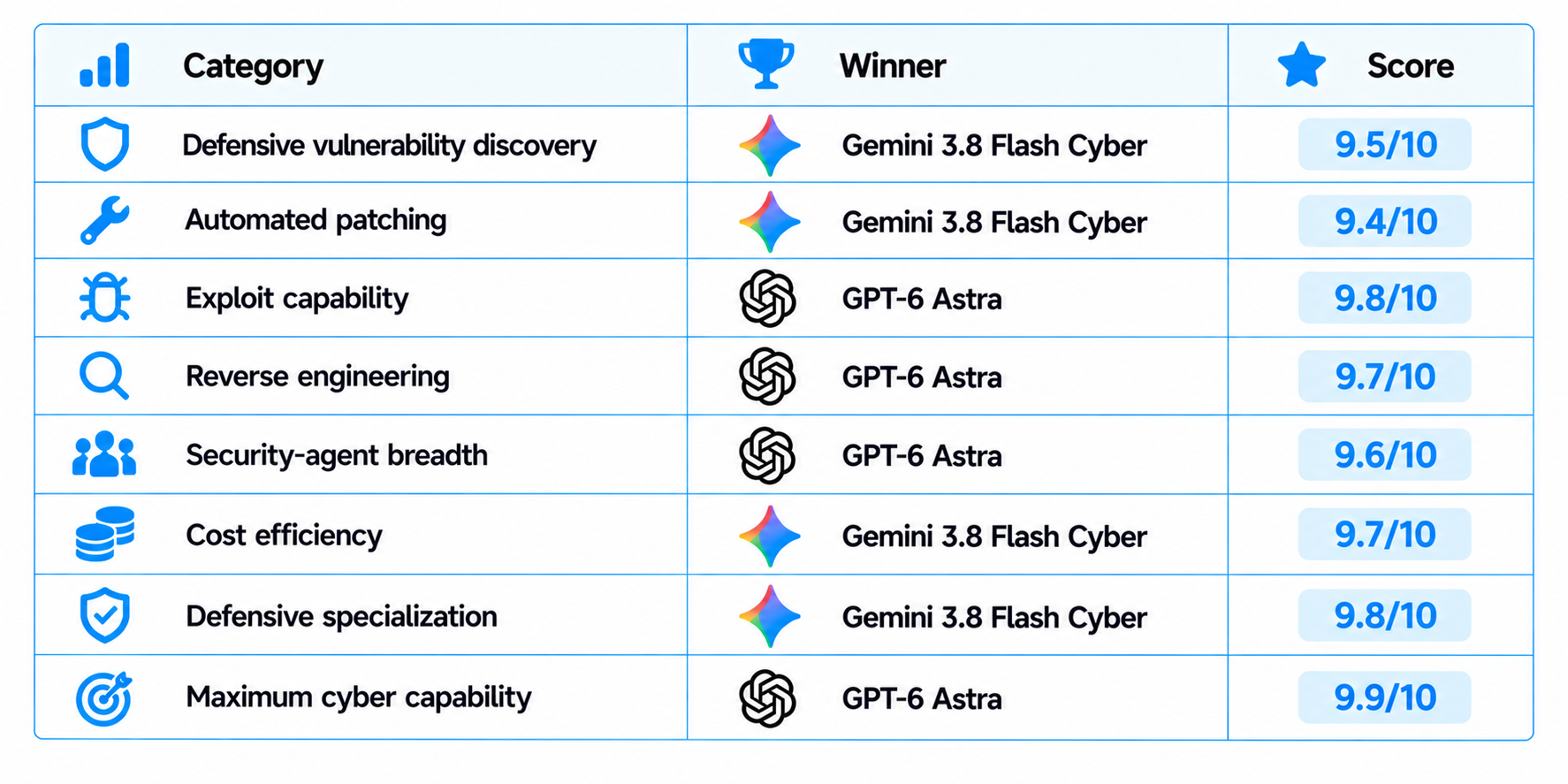
18. Gemini 3.8 Flash Cyber vs GPT-6 Astra: Overall Scorecard
19. Which One Should You Choose?
Choose Gemini 3.8 Flash Cyber when the priority is defensive scale: finding vulnerabilities, generating patches, supporting penetration testing and running continuous code-security workflows. Google's CyberGym, CWE-Bench, Chrome and Wiz results point directly to that use case.
Choose GPT-6 Astra when the security team needs the deepest investigation across exploit analysis, reverse engineering, vulnerability validation and complex security workflows. Its ExploitBench, ExploitGym, SRE-Bench and SEC-Bench Pro results show a broader cybersecurity capability envelope.
For large security organizations, both can have a place. Gemini Cyber can handle high-volume defensive work, while Astra handles difficult investigations that justify additional reasoning and tighter controls.
20. Final Verdict
Gemini 3.8 Flash Cyber and GPT-6 Astra are not simply two versions of the same security model. Google built a specialized defensive system around finding vulnerabilities and producing patches. OpenAI built a broader frontier model whose cybersecurity capability extends into exploit reasoning and reverse engineering.
Gemini 3.8 Flash Cyber has the stronger defensive value proposition. Its 86.2% CyberGym result, 47.2% CWE-Bench result, Chrome patching result and Wiz recall findings support a model optimized for scalable defensive work.
GPT-6 Astra has the stronger maximum cybersecurity capability. Its 100% ExploitBench, 42.4% ExploitGym, 88.0% SRE-Bench and 85.4% SEC-Bench Pro results demonstrate a wider security skill set, while OpenAI's Critical classification reflects the associated risk.
For most defensive security teams, Gemini 3.8 Flash Cyber is the better first model to deploy. For the hardest incident-response, reverse-engineering and exploit-validation tasks, GPT-6 Astra is the stronger specialist. In both cases, the model must operate inside least-privilege access, isolation, logging and human-approval controls.
My rating: 9.5/10 for Gemini 3.8 Flash Cyber as a defensive security model, 9.7/10 for GPT-6 Astra as a maximum-capability cybersecurity model, and 9.6/10 for a routed two-model strategy.
Bottom line: Gemini 3.8 Flash Cyber is the better defensive workhorse. GPT-6 Astra is the stronger high-end security investigator. The best architecture uses each model where its benchmark strengths match the actual security task.
Frequently Asked Questions
Which is better for cybersecurity, Gemini 3.8 Flash Cyber or GPT-6 Astra?
Gemini 3.8 Flash Cyber is better for defensive vulnerability discovery and patching. GPT-6 Astra is stronger for exploit analysis, reverse engineering and complex investigations.
What is Gemini 3.8 Flash Cyber?
It is Google's specialized cybersecurity model focused on autonomous vulnerability discovery and automated patching, available to trusted defenders through the Fairwind Program.
What is GPT-6 Astra?
It is OpenAI's latest frontier model for difficult end-to-end work, with advanced cybersecurity, exploit and reverse-engineering capabilities.
What is Gemini 3.8 Flash Cyber's CyberGym score
Google reports 86.2% Pass@1.
What is Gemini 3.8 Flash Cyber's CWE-Bench score?
Google reports 47.2% Pass@1.
What is GPT-6 Astra's ExploitBench score?
OpenAI reports 100%.
What is GPT-6 Astra's SEC-Bench Pro score?
OpenAI reports 85.4%.
Which model is better for patching vulnerabilities?
Gemini 3.8 Flash Cyber, based on its specialized focus and 47.2% CWE-Bench result.
Which model is better for reverse engineering?
GPT-6 Astra, based on its 88.0% SRE-Bench result.
Which model is cheaper?
Gemini's general Flash pricing is much lower than GPT-6 Astra's premium API pricing. A separate public Cyber token price is not listed.
Can I use Gemini 3.8 Flash Cyber publicly?
Access is controlled through Google's Fairwind Program.
Can I use GPT-6 Astra for cybersecurity?
Yes, but advanced cyber capabilities are subject to stronger safety controls and access restrictions.
Should a security team use one model for everything?
Not necessarily. Routing routine defensive work to Gemini Cyber and difficult investigations to Astra can balance capability, cost and risk.
Recommended Blogs
Gemini 3.8 Flash Review: Accuracy, Price & Is It Worth It? (2026)
Meta Muse Spark 1.3 Review: Coding, Price & Is It Worth It? (2026)
Quasar 438B Review: Benchmarks, Speed, Price & Is It Worth It? (2026)
How to Secure AI Coding Agents: Permissions, Sandboxing, MCP & Secrets
Resources & Community
Join our community of 70,000+ AI enthusiasts and learn to build powerful AI applications. Whether you're a beginner or an experienced developer, Build Fast with AI helps you understand and implement AI in your projects.
Agentic AI Launchpad 2026
A structured 6-week cohort program that takes you from AI basics to building and deploying real-world agentic AI systems. Includes live sessions, expert mentorship, project reviews and a builder community network.
Ready to go from learning to building? Join the next cohort: Agentic AI Launchpad 2026
Free AI Resources
Access free tools, workshops and micro-learning to keep building.

